AI Citation Strategy - Tygart Media

Category: AI Citation Strategy

Thought leadership on AI citation data, platform-specific optimization, and the emerging citation economy.

  • Writing for Google vs Writing for Copilot vs Writing for ChatGPT: They’re Not the Same Audience

    Writing for Google vs Writing for Copilot vs Writing for ChatGPT: They’re Not the Same Audience

    The Assumption That’s Costing You Citations

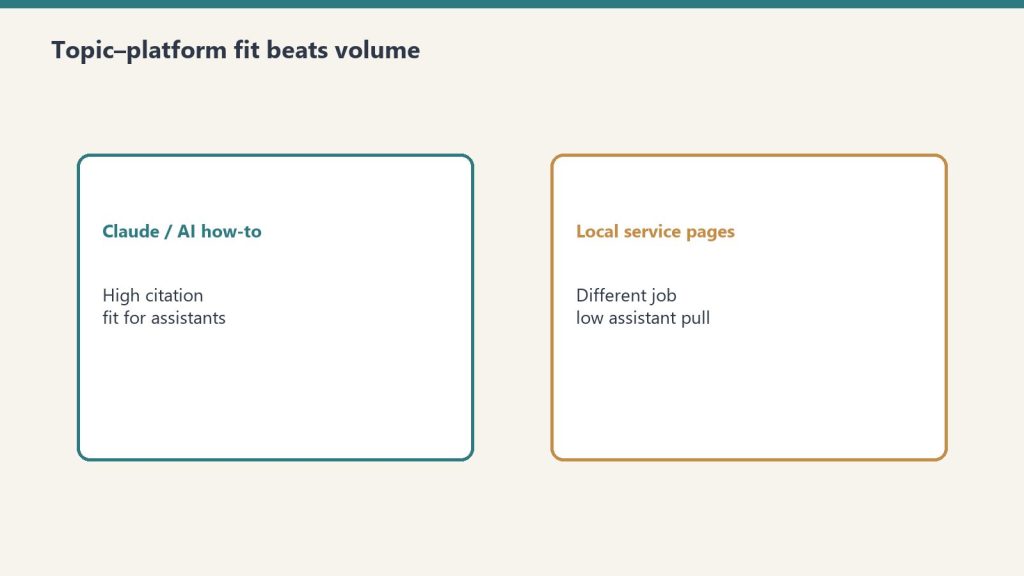
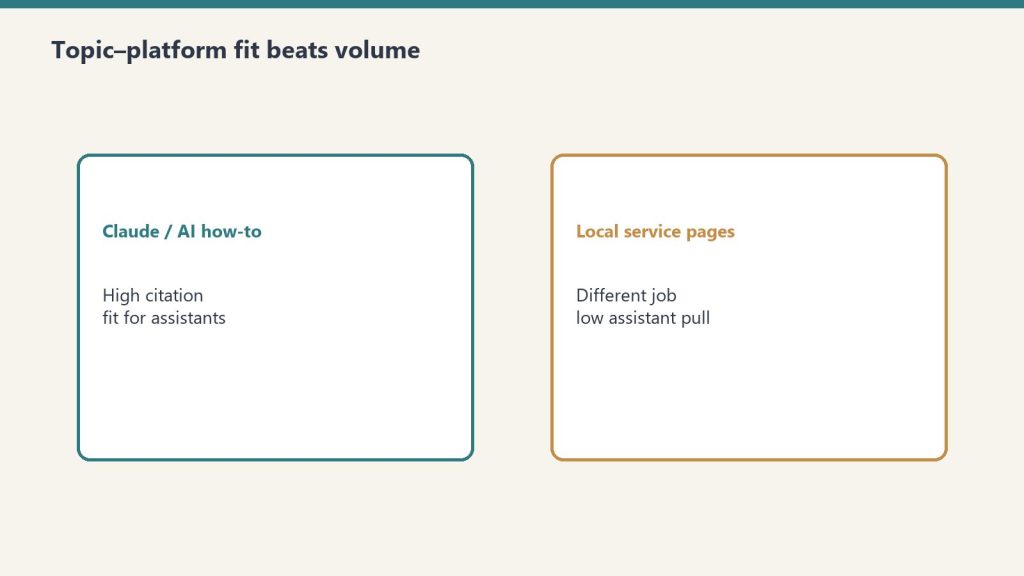
    Comparison of Claude how-to fit versus local service page fit for assistants
    The assumption costing you citations.

    The entire content marketing industry operates on a single assumption: write great content, optimize it for search, and the right people will find it. For two decades, “the right people” meant Google users. That assumption worked because there was only one discovery engine that mattered.

    There are now at least five. And they don’t behave the same way.

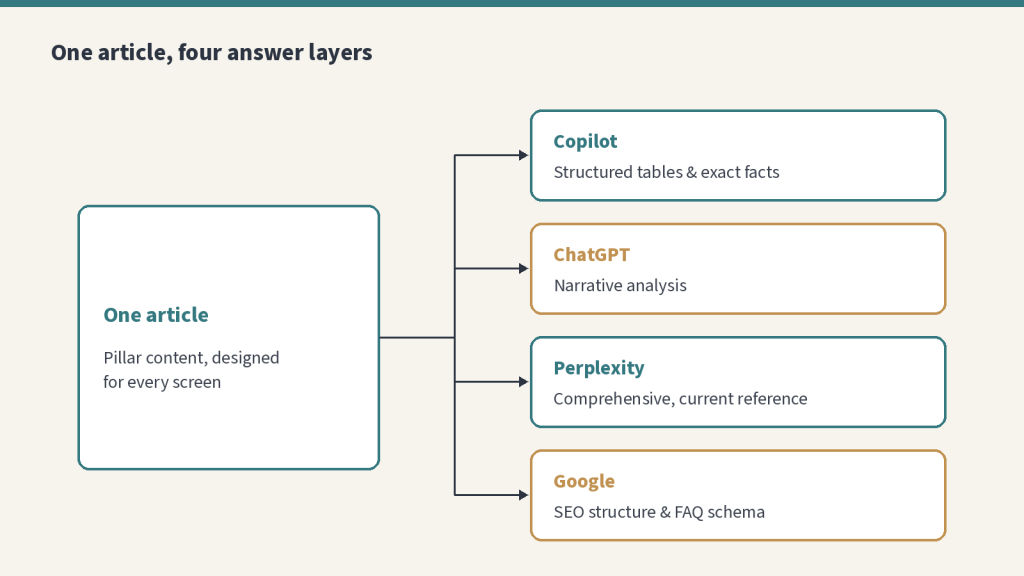
    Google users type keywords. Microsoft Copilot users ask questions mid-task inside Word, Excel, or Outlook. ChatGPT users explore topics conversationally. Perplexity users want curated, multi-source answers. Claude users tend to ask deep, technical questions about implementation.

    I know this because I can see it. My site generates 98,800 AI citations from Copilot alone, and the grounding queries — the actual questions that triggered those citations — reveal an audience that looks nothing like my Google Analytics traffic. These are different people, in different contexts, with different needs, finding the same content through completely different pathways.

    The content that serves one platform well often serves another poorly. And if you’re optimizing for “AI search” as a single category, you’re making the same mistake as someone who runs the same TV commercial on ESPN, HGTV, and the Discovery Channel.

    Google Users: The Keyword Searchers

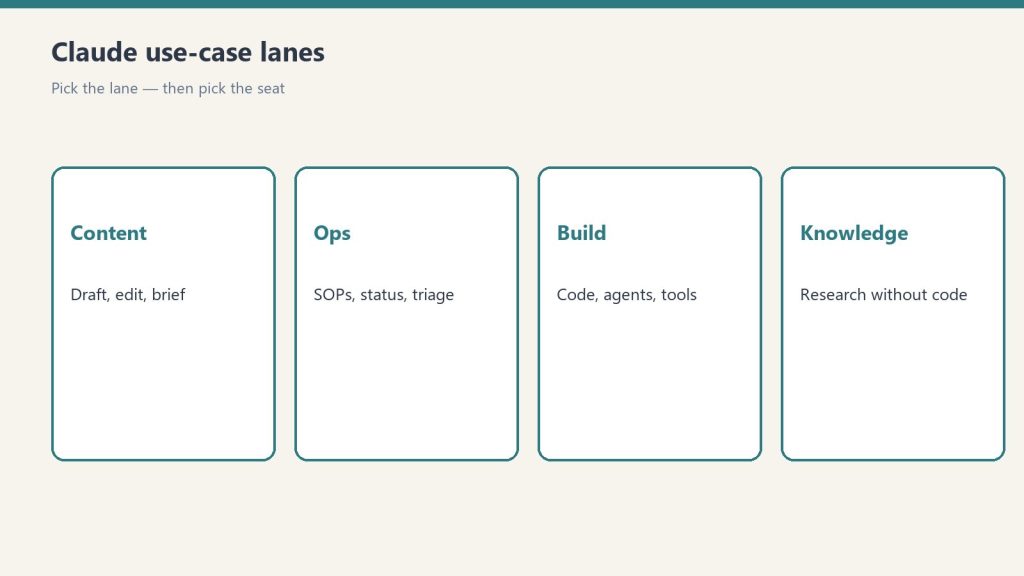
    Four cards for content, ops, build, and knowledge work with Claude
    Google users: keyword searchers.

    Google’s audience is the one everyone understands. They type keywords — sometimes fragments, sometimes questions, often just a few words. “Best CRM software.” “Water damage restoration Houston.” “Claude AI pricing 2026.”

    The behavior is transactional or informational. They want a list, a comparison, a local service, or a quick answer. Google’s algorithm rewards content that satisfies this intent quickly: clear headings, structured data, fast load times, and content that matches the keyword pattern.

    Google users click through to your site. They see your ads. They enter your funnel. The entire monetization model of the internet is built on this interaction: search, click, land, convert.

    Content that wins on Google: keyword-optimized pages, local landing pages, listicles, product comparisons, and how-to content with clear structure. The audience skims. They want answers in the first 100 words or they bounce.

    Copilot Users: The Mid-Task Workers

    Copilot users are a fundamentally different audience. They’re not searching — they’re working. They invoke Copilot inside Microsoft 365 applications while writing a report, analyzing a spreadsheet, composing an email, or researching a decision they need to make in the next 30 minutes.

    The queries I see in Bing’s grounding data confirm this: “what is claude ai pricing in 2026,” “how to connect notion to claude code,” “difference between claude code and cursor for teams.” These are operational questions from people in the middle of a task. They need accurate, specific, reference-grade information — not a 2,000-word SEO article with a table of contents and 47 H2 headings.

    The content that earns 16,500 Copilot citations for a single query isn’t my best-written piece. It’s my most accurate, specific, and structured piece. It has clear pricing tables. It has version-specific details. It answers the exact question without making you read three paragraphs of context first.

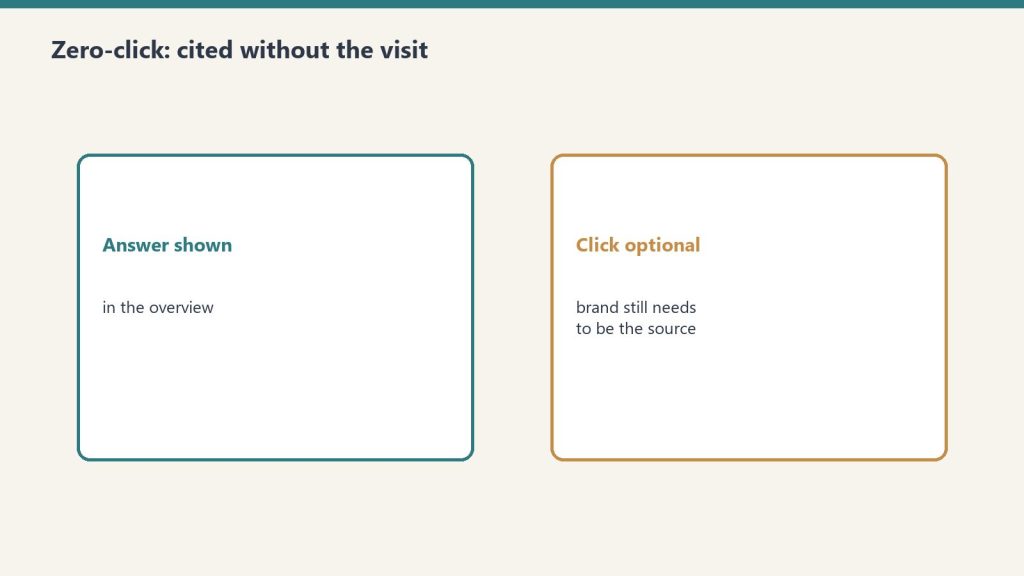
    Copilot users never visit your site. They consume your content inside their Office application, surfaced as a grounded AI response. Your content becomes the source material for Copilot’s answer. The citation is your visibility — not the click.

    Content that wins on Copilot: detailed pricing breakdowns, tool comparison matrices, integration guides with specific steps, and reference documentation that’s structured for extraction rather than engagement.

    ChatGPT Users: The Explorers

    ChatGPT’s audience is different again. These are people in exploration mode — they’re thinking through a problem, evaluating options, or trying to understand something complex. They write long, conversational queries. They ask follow-up questions. They treat the AI as a thinking partner rather than an answer machine.

    ChatGPT’s citation behavior (visible through ChatGPT Search) favors content that demonstrates expertise, provides unique insights, and covers topics comprehensively. Where Copilot wants structured reference data, ChatGPT wants depth and nuance. Where Copilot users need an answer in 10 seconds, ChatGPT users are willing to engage for 10 minutes.

    Content that wins on ChatGPT: long-form thought leadership, original research, case studies with real data, and contrarian perspectives backed by evidence. ChatGPT’s grounding algorithm appears to reward content that says something other sources don’t.

    Perplexity Users: The Curators

    Perplexity positions itself as an answer engine — it synthesizes multiple sources into a single response with inline citations. Its users want the definitive answer, pulled from the best available sources and presented with transparency about where each claim comes from.

    Perplexity’s citation behavior rewards pages that are recognized as authoritative on a specific topic. It tends to pull from a smaller number of high-trust sources rather than aggregating broadly. If your page is the best single source on a topic, Perplexity will cite it repeatedly.

    Content that wins on Perplexity: comprehensive pillar pages, original data, and content that’s clearly the primary source rather than a summary of other sources. Perplexity penalizes derivative content more visibly than any other platform.

    Claude Users: The Implementers

    Three cards for fast volume, daily workhorse, and deep flagship Claude seats
    Claude users: the implementers.

    Claude’s user base skews toward developers, technical professionals, and power users who ask implementation-level questions. They want to know how to build something, how to configure something, or how to debug something. The queries tend to be specific and technical.

    Content that wins Claude citations: technical documentation, code examples, step-by-step implementation guides, and troubleshooting content. Claude’s training data and retrieval mechanisms favor content that’s precise and actionable over content that’s broadly informative.

    The Same Article, Five Different Treatments

    Let me make this concrete. Say I’m writing about connecting Claude to a Notion database using MCP (Model Context Protocol). Here’s how the same topic needs to be treated differently for each platform:

    For Google: “How to Connect Notion to Claude AI (2026 Guide)” — Keyword-optimized title, H2 structure, step-by-step with screenshots, FAQ schema, 1,200 words. Goal: rank for “notion claude integration.”

    For Copilot: A reference page with the exact configuration JSON, version requirements, common error codes and fixes, and a clean table of parameters. No fluff. Copilot will extract the technical specs and present them to a user who’s currently trying to set this up.

    For ChatGPT: A 2,500-word deep dive on why MCP matters, what it enables, the architecture decisions behind it, and how it compares to other integration approaches. ChatGPT users are evaluating whether to adopt MCP, not just how to configure it.

    For Perplexity: The definitive reference that other sources can’t match — original benchmarks, real performance data, edge cases nobody else documents. Perplexity will choose this as its primary source if it’s clearly the most authoritative.

    For Claude: Working code examples, actual configuration files, error handling patterns, and the kind of implementation detail that lets someone copy-paste and go.

    That’s five different content approaches for one topic. And most content operations are producing one version and hoping it works everywhere.

    Why This Matters Now

    The advertising industry figured this out decades ago. You don’t run the same creative on a billboard, a podcast ad, a YouTube pre-roll, and a smart TV placement. Each format has a different audience in a different context with different attention patterns. The creative has to match.

    AI platforms are the new formats. Copilot is the workplace billboard — your content appears where people are already working. ChatGPT is the podcast — people are engaged and exploring. Perplexity is the curated newsletter — only the best sources make the cut. Google is still the highway — highest volume, broadest audience, most competitive.

    The content operations that figure out platform-specific optimization first will dominate the AI citation economy the way early SEO adopters dominated organic search. The data is already available. The tools exist. The only missing piece is the strategic framework — and the willingness to treat AI platforms as distinct audiences rather than a single monolithic “AI search” category.

    I’m building that framework in real time, publishing the data as I go. This article is part of it.

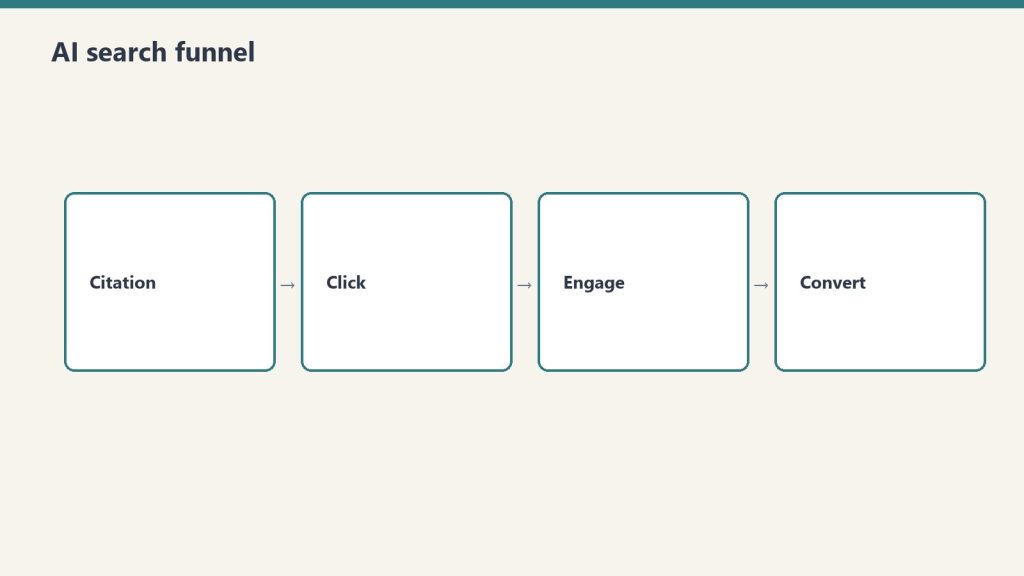
    Related on Tygart Media: SEO vs GEO vs AEO · Copilot day / Google night · AI search funnel.

    Frequently Asked Questions

    Do I need to create separate articles for each AI platform?

    Not necessarily separate articles, but you need to think about which platform each piece is optimized for. Some articles naturally serve multiple platforms. But your highest-value topics should have platform-specific treatments — a reference version for Copilot, a deep-dive version for ChatGPT, a definitive version for Perplexity.

    How do I know which AI platform is citing my content?

    Currently, Bing Webmaster Tools shows Copilot citation data in the AI Performance beta tab. ChatGPT citations can be partially tracked through referral traffic from chat.openai.com. Perplexity and Claude citation data is harder to access — you’ll need to manually query these platforms with topics you rank for and observe whether your content appears in their responses.

    What content format works best for Copilot citations?

    Structured, reference-grade content with clear data points, pricing tables, comparison matrices, and specific technical details. Copilot users are mid-task and need precise answers. Content that’s structured for extraction — where Copilot can pull a specific fact or figure — earns the most citations.

    Is this the same as GEO (Generative Engine Optimization)?

    GEO is a component, but it treats all AI engines as one audience. Platform-Specific AI Optimization (PSAO) goes further by recognizing that each AI platform serves a different user base with different intent patterns. GEO gives you the foundation. PSAO gives you the targeting.

    Should I stop optimizing for Google to focus on AI platforms?

    No. Google still drives the majority of direct traffic for most sites. The strategy is to run parallel content operations — Google-optimized content for organic traffic and platform-specific content for AI citations. On my own sites, I serve local Google searchers with community content and enterprise Copilot users with AI tool content. Same domain, two funnels.

  • 98,800 AI Citations from One Laptop: What Microsoft Copilot Is Actually Sourcing

    98,800 AI Citations from One Laptop: What Microsoft Copilot Is Actually Sourcing

    The Number Nobody Expected

    Comparison of Claude how-to fit versus local service page fit for assistants
    The number nobody expected.

    I run a portfolio of WordPress sites. One of them — a media property publishing articles about AI tools, local business intelligence, and content strategy — started showing up in a place I didn’t expect: inside Microsoft Copilot’s answers.

    Not as a search result. Not as a backlink. As a citation — the source that Copilot grounded its response on when enterprise users asked questions inside Word, Edge, Outlook, and the Copilot sidebar.

    The Bing Webmaster Tools AI Performance tab — still in beta, still barely documented — told me exactly how much: 98,800 AI citations across 576 unique grounding queries in under 90 days.

    That’s not a typo. Ninety-eight thousand, eight hundred times an AI engine pulled content from my site and embedded it in a response to a real user. And here’s the part that flipped my understanding of content economics: during that same period, the site received roughly 1,900 human clicks from Bing search.

    The AI was reading my content 52 times more often than humans were clicking on it.

    What the Bing AI Performance Tab Actually Shows

    Topic platform fit visual for first-party AI citation measurement
    What the Bing AI Performance tab actually shows.

    Most marketers don’t know this tab exists. It appeared in Bing Webmaster Tools sometime in late 2025, buried under the Performance section. Microsoft labeled it “AI Performance (beta)” and didn’t announce it with any fanfare. No blog post. No keynote mention. It just showed up.

    Here’s what it tracks:

    Citations: The number of times your content was used as a grounding source in a Copilot-generated response. This isn’t an impression — it’s a direct attribution. Copilot pulled from your page, used your information, and (in many cases) linked back to you as the source.

    Grounding Queries: The actual questions users asked that triggered your content to be cited. These aren’t keywords — they’re natural language questions. Full sentences. “What is claude ai pricing in 2026.” “How do I connect Claude to Notion.” “What’s the difference between Claude Code and Cursor.”

    Daily Trend Data: The day-by-day citation count. This is where the story gets interesting.

    The Growth Curve That Changed My Strategy

    When I first noticed the AI Performance tab, my daily citation count was sitting at around 672 per day. Modest. Interesting, but not transformative.

    Ninety days later, it was 5,500 citations per day. That’s an 8x increase with no corresponding change in my publishing cadence, no new backlink campaigns, no paid distribution. The content was the same. What changed was Copilot’s appetite for it.

    The growth wasn’t linear. It came in steps:

    Days 1-30: Steady at 600-800 citations/day. Copilot was discovering the site.
    Days 30-50: Jump to 1,500-2,200/day. A handful of articles got locked in as preferred sources.
    Days 50-70: Acceleration to 3,000-4,000/day. The site was now a default grounding source for an expanding set of queries.
    Days 70-90: Peak at 5,500/day. Citation velocity was compounding — the more Copilot cited the site, the more queries it became eligible for.

    This looks like a flywheel, and I believe that’s exactly what it is. Copilot’s grounding algorithm appears to develop trust in sources over time. Once a domain proves reliable for a topic cluster, it gets promoted for adjacent queries in that cluster.

    The 576 Queries: What Enterprise Users Actually Ask

    The grounding queries are the most valuable dataset I’ve ever had access to. They reveal what Copilot users — overwhelmingly enterprise workers inside Microsoft 365 — are actually asking when they invoke the AI.

    The top query by citation volume: “claude ai pricing” — generating 16,500 citations on its own. One query. One article. Sixteen thousand five hundred times Copilot used my page as the source for its answer.

    The next tier includes queries like “claude code vs cursor,” “how to use claude code,” “anthropic console guide,” and “notion mcp setup.” These are highly specific, tool-comparison, how-do-I-use-this queries from people who are actively working. They’re not browsing. They’re not exploring. They’re in the middle of a task and they need an answer right now.

    This tells me something fundamental about who Copilot serves: knowledge workers making decisions inside productivity software. They’re writing a memo and need a pricing comparison. They’re evaluating a developer tool and need a feature breakdown. They’re setting up an integration and need configuration steps.

    The content that wins Copilot citations isn’t SEO content. It isn’t listicles. It isn’t keyword-stuffed landing pages. It’s reference-grade material that answers specific operational questions.

    What Roofing Articles Got: Zero

    Four cards for content, ops, build, and knowledge work with Claude
    What roofing articles got: zero — topic-platform fit.

    I also publish content in trade verticals — restoration, construction, and local services. Those articles have solid traditional SEO performance. Google sends traffic. The content ranks.

    Copilot citations for those articles: zero.

    Not low. Not “a few.” Zero. Because the people using Copilot in their daily workflow aren’t asking about emergency water damage repair or roofing contractors in Houston. They’re asking about the tools they use to do their jobs — AI platforms, development environments, productivity software, and business strategy.

    This is the first data point that made me realize: AI citation optimization is platform-specific. The topics that win on Copilot are not the topics that win on Google, and they’re not the same topics that win on ChatGPT or Perplexity. Each platform has a different user base with different intent patterns.

    The Raw Numbers, Laid Out

    Here’s the data from one domain over approximately 90 days, pulled directly from Bing Webmaster Tools AI Performance (beta):

    Total AI Citations: 98,800
    Total Grounding Queries: 576
    Average Daily Citations (start): 672
    Average Daily Citations (end): 5,500
    Top Single Query Citations: 16,500 (“claude ai pricing”)
    Human Clicks from Bing (same period): ~1,900
    AI-to-Human Ratio: 52:1
    Top Content Type Cited: Detailed comparison/pricing guides
    Content Types with Zero Citations: Local service pages, trade industry content

    What This Means for Content Strategy

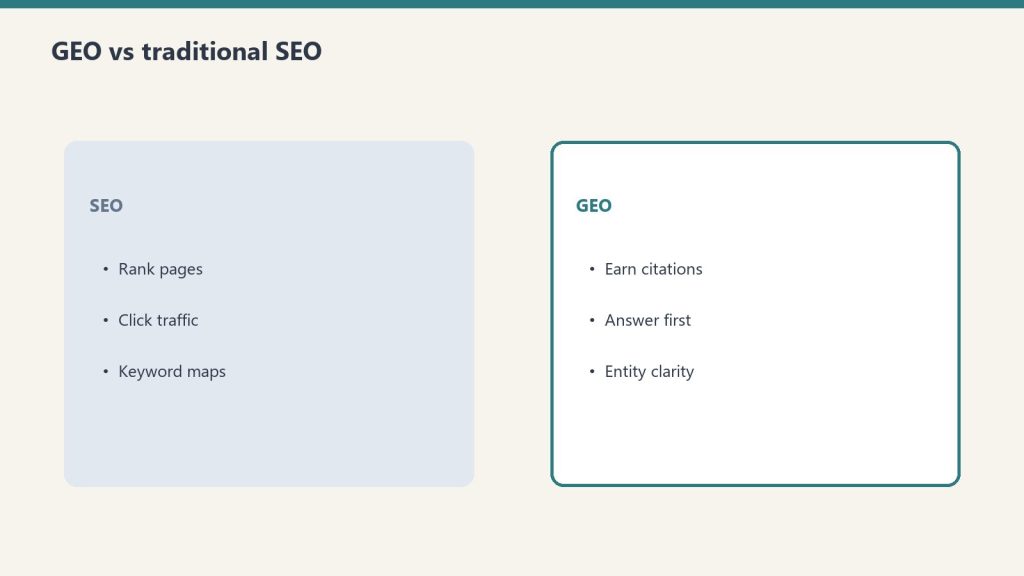
    The industry is currently arguing about SEO vs GEO vs AEO. That argument is already outdated. What the data shows is something more granular: different AI platforms are different audiences, and they require different content strategies, the same way that smart TV advertising requires different creative than mobile advertising.

    I’m calling this Platform-Specific AI Optimization (PSAO) because nobody else has named it yet. Nobody else has named it because nobody else is measuring it. The tools are there — Bing Webmaster Tools shows Copilot citation data right now — but the marketing industry hasn’t caught up to the idea that AI engines are audiences, not just algorithms.

    Here’s what I’m doing with this data:

    I’m writing content specifically engineered for Copilot’s enterprise user base during business hours — detailed tool comparisons, pricing breakdowns, integration guides, and operational how-tos. I’m writing different content for Google’s organic audience — local business directories, event guides, and community resources. Same domain. Two completely different content strategies running simultaneously.

    The Copilot content doesn’t need to rank on Google. The Google content doesn’t need Copilot citations. Each serves its platform’s audience where they actually are.

    Why I’m Publishing This

    I’m publishing this data because the industry needs a baseline. Right now, there is no public benchmark for AI citation volume. No one is talking about citation-per-query rates, daily citation growth curves, or topic-platform fit analysis. There’s no equivalent of “Domain Authority” or “organic traffic” for the AI citation economy.

    Someone needs to be first. I have the data. So here it is.

    If you run a content operation and you haven’t checked your Bing Webmaster Tools AI Performance tab, do it today. You might be sitting on citation data you didn’t know existed. And if you’re building content strategy without accounting for which AI platforms are actually consuming your content, you’re optimizing for one audience while ignoring the one that’s reading you 50 times more often.

    The AI citation economy is already here. The question is whether you’re measuring it.

    Related on Tygart Media: $0.35 article · 16,500 citations · citation economy.

    Frequently Asked Questions

    What are AI citations in Bing Webmaster Tools?

    AI citations are instances where Microsoft Copilot uses your website content as a grounding source in its responses to user queries. They appear in the AI Performance (beta) tab within Bing Webmaster Tools and represent direct attribution — Copilot pulled information from your page and used it to construct an answer for a real user.

    How do I check my AI citation data?

    Log into Bing Webmaster Tools, navigate to the Performance section, and look for the “AI Performance” tab. It’s currently in beta. You’ll see total citations, grounding queries (the actual questions users asked), and daily trend data showing how your citation volume changes over time.

    Why does Copilot cite some content but not others?

    Copilot’s user base is predominantly enterprise workers inside Microsoft 365 applications. They ask operational questions — tool comparisons, pricing details, integration guides, and how-to content related to their daily work. Content that answers specific, task-oriented questions earns citations. Generic listicles, local service pages, and broadly targeted SEO content typically receives zero citations because it doesn’t match what Copilot users are asking.

    What is Platform-Specific AI Optimization (PSAO)?

    PSAO is a content strategy framework that recognizes different AI platforms serve different audiences with different intent patterns. Copilot users are enterprise workers mid-task. ChatGPT users are explorers and researchers. Perplexity users want curated multi-source answers. PSAO means creating content tailored to each platform’s user behavior rather than treating all AI engines as interchangeable.

    Is AI citation data more valuable than traditional search clicks?

    The data suggests AI citations represent a fundamentally different type of content consumption. With a 52:1 ratio of AI citations to human clicks, AI engines are consuming content at dramatically higher volumes. Whether this translates to direct revenue depends on your monetization model, but from a reach and authority perspective, AI citations may represent the larger audience for many content categories.