Tag: Perplexity

  • What Is GEO? Generative Engine Optimization Explained

    What Is GEO? Generative Engine Optimization Explained

    If you’ve optimized content for Google and still can’t get AI systems to cite you, you’re running the wrong playbook. GEO — Generative Engine Optimization — is the discipline of making your content visible, credible, and citable to AI engines like ChatGPT, Claude, Perplexity, Gemini, and Google’s AI Overviews. It is not SEO with a new name. It is a different game with different rules.

    Definition: Generative Engine Optimization (GEO) is the practice of structuring content so that large language models and AI search engines select it as a source when generating responses to user queries. Where SEO earns rankings, GEO earns citations.

    Why GEO Is Not SEO

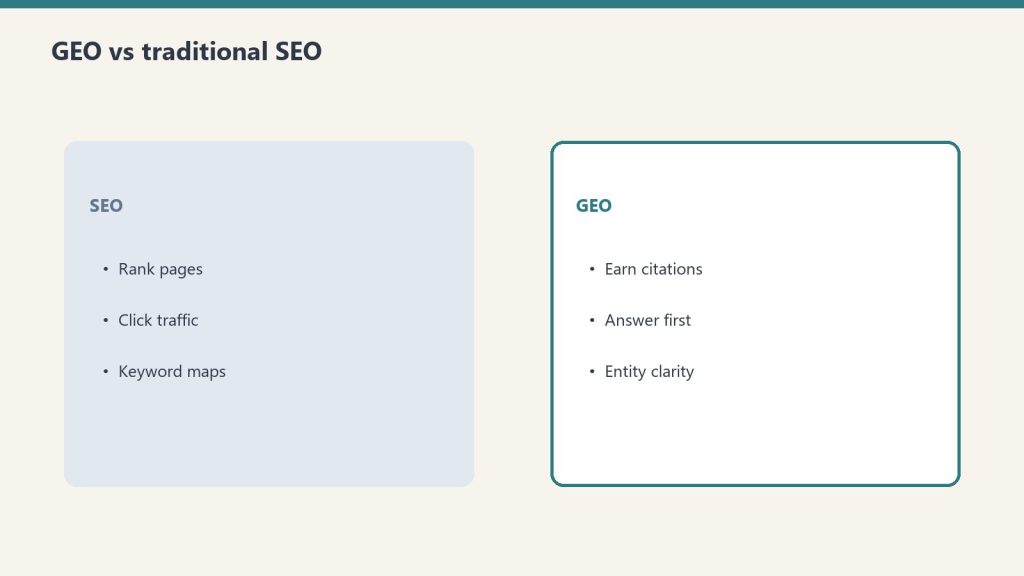
    SEO is about ranking. You optimize a page so Google’s algorithm surfaces it when someone searches. The goal is a click. GEO is about being quoted. You structure content so an AI system trusts it enough to pull a fact, a definition, or an explanation from it when synthesizing a response. The user may never click your URL — but your content shaped what they read.

    The mechanisms are fundamentally different. Google’s ranking algorithm weighs hundreds of signals — backlinks, page speed, user behavior, authority. AI citation selection weights entity density, factual specificity, source credibility signals, and structural clarity. A page that ranks #1 on Google may get zero AI citations. A page that ranks #8 may be the one Perplexity quotes every time someone asks about that topic.

    How AI Engines Select Content to Cite

    Large language models used in AI search (GPT-4, Claude, Gemini) were trained on large corpora of text, but the retrieval-augmented generation (RAG) layer that powers tools like Perplexity, ChatGPT search, and Google AI Overviews works differently. It pulls live content at query time, scores it for relevance and credibility, and synthesizes a response. The signals it uses to score your content include:

    • Entity clarity — Are the people, places, companies, and concepts in your content clearly named and linked to known entities?
    • Factual density — Does your content contain specific, verifiable claims rather than vague generalities?
    • Structural legibility — Can the AI parse your content’s structure — headings, definitions, lists — without ambiguity?
    • Source signals — Does your content cite primary sources, studies, or named experts?
    • Speakable schema — Have you marked up key paragraphs as machine-readable answer candidates?

    The Three Layers of GEO

    Layer 1: Content Architecture

    GEO-optimized content is built for extraction, not just reading. That means every major claim is in a standalone sentence. Definitions appear near the top. Section headers are declarative, not clever. The structure tells an AI where the answer is before it has to read the full article.

    Layer 2: Entity Saturation

    AI systems understand content through entities — named people, organizations, places, products, and concepts that exist in their training data. A GEO-optimized article saturates relevant entities: it doesn’t say “a major AI company” when it means Anthropic. It doesn’t say “a popular search tool” when it means Perplexity. Every entity is named, spelled correctly, and used in the right context.

    Layer 3: Schema and Structured Data

    JSON-LD schema markup is a signal to both traditional search engines and AI crawlers. FAQPage schema makes your Q&A content directly extractable. Speakable schema flags the paragraphs most useful for voice and AI synthesis. Article schema establishes authorship and publication date. These are not optional extras — they are the machine-readable layer that gets your content selected.

    GEO vs AEO: What’s the Difference?

    Answer Engine Optimization (AEO) focuses on winning featured snippets, People Also Ask boxes, and zero-click search results in traditional search engines. GEO focuses on being cited by generative AI systems. The tactics overlap — both require clear structure, direct answers, and FAQ sections — but the targets are different. AEO wins position zero on Google. GEO wins the paragraph that Perplexity writes for the next million queries on your topic.

    At Tygart Media, we run both in parallel. The content pipeline produces articles that pass the AEO gate (featured snippet structure, FAQ schema) and the GEO gate (entity density, speakable markup, citation-worthy claims) before publishing.

    What GEO Looks Like in Practice

    Here is the difference between a standard paragraph and a GEO-optimized version of the same content:

    Standard: “Water damage restoration is an important service for homeowners who have experienced flooding or leaks.”

    GEO-optimized: “Water damage restoration — the professional remediation of structural damage caused by flooding, pipe failure, or storm intrusion — is performed by IICRC-certified contractors following the S500 Standard for Professional Water Damage Restoration. The process includes water extraction, structural drying, moisture monitoring, and antimicrobial treatment.”

    The second version names the certifying body (IICRC), the standard (S500), and the process steps. An AI system can extract that paragraph as a factual, citable answer. The first version has nothing to extract.

    How to Start with GEO

    If you’re running an existing content operation and want to layer in GEO, the priority order is:

    1. Audit your top 20 pages for entity gaps — everywhere you use vague references, replace with specific named entities
    2. Add speakable schema to your three strongest definitional paragraphs per page
    3. Run a factual density check — every statistic should have a source, every claim should be specific
    4. Add FAQPage schema to any page with question-format headings
    5. Submit your top pages to Google’s Rich Results Test and verify structured data is reading cleanly

    GEO Is Compounding Infrastructure

    The reason GEO matters for content operations is compounding. Once an AI system has indexed and trusted your content as a reliable source on a topic, subsequent queries on that topic draw from your content repeatedly — without you publishing anything new. A single GEO-optimized pillar article can generate thousands of AI citations over 12 months. That is a different kind of ROI than a ranked page that gets clicked and forgotten.

    We built the Tygart Media content stack around this principle. Every article that leaves our pipeline passes a GEO gate before it publishes. That gate checks entity saturation, factual specificity, schema completeness, and structural legibility. It is the same gate we build for clients.

    Frequently Asked Questions About GEO

    What does GEO stand for?

    GEO stands for Generative Engine Optimization — the practice of optimizing content to be cited by AI-powered search systems and large language models.

    Is GEO the same as SEO?

    No. SEO (Search Engine Optimization) targets traditional search rankings. GEO targets AI citation in tools like ChatGPT, Perplexity, Claude, and Google AI Overviews. The tactics overlap but the mechanisms and goals are different.

    How do I know if my content is being cited by AI?

    Run queries related to your topic in Perplexity, ChatGPT (with search enabled), and Google AI Overviews. Check whether your domain appears as a cited source. Tools like Profound and Otterly.ai can automate this monitoring.

    Does GEO replace AEO?

    No. AEO and GEO are complementary. AEO wins traditional search features like featured snippets. GEO wins AI citations. A mature content strategy runs both in parallel.

    How long does GEO take to show results?

    Unlike SEO, GEO results can appear quickly — sometimes within days of a page being indexed by AI crawlers. The compounding effect builds over 60–180 days as AI systems repeatedly select your content for related queries.


  • ¿Qué es GEO? Optimización para Motores Generativos: Guía Completa

    ¿Qué es GEO? Optimización para Motores Generativos: Guía Completa

    Si has optimizado contenido para Google y aun así no logras que los sistemas de inteligencia artificial te citen, es porque estás usando el manual equivocado. GEO —Generative Engine Optimization u Optimización para Motores Generativos— es la disciplina de hacer que tu contenido sea visible, creíble y citable para motores de IA como ChatGPT, Claude, Perplexity, Gemini y los AI Overviews de Google. No es SEO con un nombre nuevo. Es un juego distinto con reglas distintas.

    Definición: La Optimización para Motores Generativos (GEO) es la práctica de estructurar el contenido para que los modelos de lenguaje de gran escala (LLM) y los motores de búsqueda con IA lo seleccionen como fuente al generar respuestas a las consultas de los usuarios. Donde el SEO obtiene posiciones, el GEO obtiene citas.

    Por qué GEO no es SEO

    El SEO trata de posicionarse. Optimizas una página para que el algoritmo de Google la muestre cuando alguien busca algo. El objetivo es un clic. El GEO trata de ser citado. Estructuras el contenido para que un sistema de IA confíe en él lo suficiente como para extraer un dato, una definición o una explicación cuando sintetiza una respuesta. El usuario puede no hacer clic en tu URL, pero tu contenido moldeó lo que leyó.

    Los mecanismos son fundamentalmente diferentes. El algoritmo de posicionamiento de Google pondera cientos de señales: backlinks, velocidad de página, comportamiento del usuario, autoridad. La selección de citas por IA pondera la densidad de entidades, la especificidad factual, las señales de credibilidad de la fuente y la claridad estructural. Una página que ocupa el puesto #1 en Google puede recibir cero citas de IA. Una página que ocupa el puesto #8 puede ser la que Perplexity cita cada vez que alguien pregunta sobre ese tema.

    Cómo los motores de IA seleccionan el contenido que citan

    Los modelos de lenguaje de gran escala utilizados en la búsqueda con IA (GPT-4, Claude, Gemini) fueron entrenados en grandes corpus de texto, pero la capa de generación aumentada por recuperación (RAG) que impulsa herramientas como Perplexity, la búsqueda de ChatGPT y los AI Overviews de Google funciona de manera diferente. Extrae contenido en tiempo real en el momento de la consulta, lo puntúa por relevancia y credibilidad, y sintetiza una respuesta. Las señales que utiliza para puntuar tu contenido incluyen:

    • Claridad de entidades — ¿Las personas, lugares, empresas y conceptos en tu contenido están claramente nombrados y vinculados a entidades conocidas?
    • Densidad factual — ¿Tu contenido contiene afirmaciones específicas y verificables en lugar de generalidades vagas?
    • Legibilidad estructural — ¿Puede la IA analizar la estructura de tu contenido —encabezados, definiciones, listas— sin ambigüedad?
    • Señales de fuente — ¿Tu contenido cita fuentes primarias, estudios o expertos nombrados?
    • Esquema speakable — ¿Has marcado párrafos clave como candidatos de respuesta legibles por máquinas?

    Las tres capas del GEO

    Capa 1: Arquitectura de contenido

    El contenido optimizado para GEO está diseñado para la extracción, no solo para la lectura. Eso significa que cada afirmación importante está en una oración independiente. Las definiciones aparecen cerca de la parte superior. Los encabezados de sección son declarativos, no creativos. La estructura le dice a la IA dónde está la respuesta antes de que tenga que leer el artículo completo.

    Capa 2: Saturación de entidades

    Los sistemas de IA entienden el contenido a través de entidades: personas, organizaciones, lugares, productos y conceptos nombrados que existen en sus datos de entrenamiento. Un artículo optimizado para GEO satura las entidades relevantes: no dice “una importante empresa de IA” cuando se refiere a Anthropic. No dice “una popular herramienta de búsqueda” cuando se refiere a Perplexity. Cada entidad está nombrada, escrita correctamente y usada en el contexto correcto.

    Capa 3: Esquema y datos estructurados

    El marcado de esquema JSON-LD es una señal tanto para los motores de búsqueda tradicionales como para los rastreadores de IA. El esquema FAQPage hace que tu contenido de preguntas y respuestas sea directamente extraíble. El esquema speakable marca los párrafos más útiles para la síntesis de voz e IA. El esquema de artículo establece la autoría y la fecha de publicación. No son extras opcionales: son la capa legible por máquinas que hace que tu contenido sea seleccionado.

    GEO vs AEO: ¿Cuál es la diferencia?

    La Optimización para Motores de Respuesta (AEO) se centra en ganar fragmentos destacados, cuadros de Preguntas relacionadas y resultados de búsqueda de cero clics en los motores de búsqueda tradicionales. El GEO se centra en ser citado por los sistemas de IA generativa. Las tácticas se superponen, pero los objetivos son diferentes. El AEO gana la posición cero en Google. El GEO gana el párrafo que Perplexity escribe para el próximo millón de consultas sobre tu tema.

    Cómo empezar con GEO

    Si estás gestionando una operación de contenido existente y quieres incorporar GEO, el orden de prioridad es:

    1. Audita tus 20 páginas principales en busca de lagunas de entidades — donde uses referencias vagas, reemplázalas con entidades nombradas específicas
    2. Añade esquema speakable a tus tres párrafos definitorios más sólidos por página
    3. Ejecuta una verificación de densidad factual — cada estadística debe tener una fuente, cada afirmación debe ser específica
    4. Añade esquema FAQPage a cualquier página con encabezados en formato de pregunta
    5. Envía tus páginas principales a la Prueba de resultados enriquecidos de Google y verifica que los datos estructurados se lean correctamente

    GEO es infraestructura que se acumula

    La razón por la que GEO importa para las operaciones de contenido es el efecto acumulativo. Una vez que un sistema de IA ha indexado y confiado en tu contenido como fuente confiable sobre un tema, las consultas posteriores sobre ese tema extraen de tu contenido repetidamente, sin que publiques nada nuevo. Un solo artículo pilar optimizado para GEO puede generar miles de citas de IA durante 12 meses. Eso es un tipo diferente de ROI al de una página posicionada que recibe clics y se olvida.

    Preguntas frecuentes sobre GEO

    ¿Qué significa GEO?

    GEO significa Generative Engine Optimization —Optimización para Motores Generativos— la práctica de optimizar contenido para ser citado por sistemas de búsqueda impulsados por IA y modelos de lenguaje de gran escala.

    ¿Es GEO lo mismo que SEO?

    No. El SEO apunta a posiciones en la búsqueda tradicional. El GEO apunta a citas de IA en herramientas como ChatGPT, Perplexity, Claude y los AI Overviews de Google. Las tácticas se superponen pero los mecanismos y objetivos son diferentes.

    ¿Cómo sé si mi contenido está siendo citado por la IA?

    Ejecuta consultas relacionadas con tu tema en Perplexity, ChatGPT (con búsqueda activada) y los AI Overviews de Google. Verifica si tu dominio aparece como fuente citada. Herramientas como Profound y Otterly.ai pueden automatizar este monitoreo.

    ¿GEO reemplaza al AEO?

    No. AEO y GEO son complementarios. El AEO gana características de búsqueda tradicional como fragmentos destacados. El GEO gana citas de IA. Una estrategia de contenido madura ejecuta ambos en paralelo.

    ¿Cuánto tiempo tarda el GEO en mostrar resultados?

    A diferencia del SEO, los resultados de GEO pueden aparecer rápidamente, a veces en días después de que una página sea indexada por los rastreadores de IA. El efecto acumulativo se construye durante 60 a 180 días a medida que los sistemas de IA seleccionan repetidamente tu contenido para consultas relacionadas.


  • AI Search Readiness Audit — Google AI Overviews, Perplexity, ChatGPT, and Voice Search

    Tygart Media // AEO & AI Search
    SCANNING
    CH 03
    · Answer Engine Intelligence
    · Filed by Will Tygart

    What Is an AI Search Readiness Audit?
    An AI Search Readiness Audit is a comprehensive diagnostic of how your WordPress site performs across every AI-powered search surface simultaneously — Google AI Overviews, Perplexity, ChatGPT, voice search, and emerging AI answer engines. Not one channel. All of them. One report tells you where you’re visible, where you’re invisible, and exactly what to fix first.

    Search has fractured. A page that ranks #1 in Google’s traditional blue links may not appear in Google’s AI Overview for the same query. A site that gets cited by Perplexity may be completely absent from ChatGPT’s answers. Voice search pulls from a different signal set than both. Most businesses have no idea how they perform across any of these surfaces — let alone all of them simultaneously.

    The AI Search Readiness Audit closes that blind spot. We test your site across every major AI search surface, identify the gaps, and deliver a prioritized roadmap with specific fixes — not a generic “improve your content” recommendation, but exact schema blocks, entity additions, structural changes, and configuration updates that move the needle on each channel.

    Who This Is For

    WordPress site owners who are investing in SEO and content but have no visibility into whether that investment is producing results in AI-powered search — where an increasing share of zero-click answers, research queries, and high-intent discovery is now happening. If you don’t know your AI search score, you don’t know half your search picture.

    The Five Surfaces We Audit

    Surface What We Test Why It Matters
    Google AI Overviews Citation presence for your core queries, featured snippet eligibility, structured data validity Appears above organic results — zero-click answer territory
    Perplexity Citation frequency, source authority signals, entity recognition Fastest-growing AI search engine among research-intent queries
    ChatGPT Brand and content recognition, recommendation presence, knowledge accuracy Billions of users asking product and service questions
    Voice Search Speakable schema presence, direct answer formatting, featured snippet capture Voice queries are growing fastest in local and emergency service searches
    AI Agent Crawlability LLMS.TXT configuration, robots.txt AI crawler rules, sitemap signals Determines whether AI systems can access and index your content at all

    What the Audit Covers

    • AI citation testing — Manual query runs across ChatGPT (GPT-4o), Perplexity, and Google AI Overviews for your brand name, core service keywords, and topic clusters. Documented with screenshots.
    • Competitor citation comparison — Who is getting cited in your niche where you aren’t? What do their pages have that yours don’t?
    • Entity coverage analysis — Are your key entities (brand, services, location, certifications, industry bodies) present, structured, and consistent across your site?
    • Schema validity audit — FAQPage, Article, Service, LocalBusiness, Speakable schema tested against Google’s Rich Results Test. Every failure documented.
    • LLMS.TXT and crawler configuration — Is your site signaling AI-crawlability correctly? Are you inadvertently blocking AI indexing bots?
    • Content structure analysis — Direct answer density, OASF formatting presence, definition box coverage, speakable block deployment across your highest-traffic pages.
    • Voice search readiness — Speakable schema, featured snippet proximity, and conversational query formatting on your most-asked questions.

    What You Receive

    Deliverable Format
    AI Search Readiness Score (0–100) across 5 surfaces Executive summary
    Citation test results with screenshots PDF report
    Competitor citation gap analysis Table — you vs. top 3 competitors
    Schema validation results (every page tested) Spreadsheet with pass/fail
    Entity coverage gap list Prioritized action list
    LLMS.TXT and crawler configuration findings Technical spec
    Prioritized fix roadmap (top 15 actions) Ranked by estimated impact

    Pricing

    Package What’s Included Price
    Snapshot AI citation testing + entity gap list + schema audit. Report only. $299
    Full Audit Everything above + competitor comparison + LLMS.TXT config + prioritized roadmap + 30-min async Q&A $499
    Audit + Fix Sprint Full Audit + implementation of top 5 fixes (schema injection, LLMS.TXT setup, speakable blocks on top 5 pages) $599

    AI Search Readiness vs. Traditional SEO Audit

    AI Search Readiness Audit Traditional SEO Audit
    Tests Google AI Overviews
    Tests Perplexity citations
    Tests ChatGPT recognition
    Tests voice search readiness Rarely
    LLMS.TXT configuration check
    Speakable schema audit
    Competitor AI citation comparison
    Traditional ranking analysis Included in Full Audit

    Find Out Where You Stand in AI Search

    Share your site URL and your 3 most important service or topic keywords. We’ll confirm scope and turnaround within 1 business day.

    Email Will — Start the Audit

    Email only. No sales call required. Turnaround: 3–5 business days depending on package.

    Frequently Asked Questions

    How is this different from the AI Citation Readiness Report you already offer?

    The AI Citation Readiness Report focuses on citation presence — are you being cited, and what’s missing. The AI Search Readiness Audit is broader: it covers all five AI search surfaces, includes competitor citation comparison, tests schema validity, audits LLMS.TXT configuration, and delivers a scored readiness assessment across every channel simultaneously. The Citation Report is a subset of the full Audit.

    Do you need access to Google Search Console or Analytics?

    Helpful but not required. We can run the AI citation testing and schema audit using public data and direct AI system queries. If you share GSC or GA4 access, we incorporate ranking and traffic data into the competitor gap analysis.

    How quickly will implementing the fixes produce results?

    Schema changes and LLMS.TXT configuration are crawled within days. Perplexity citation updates typically appear within 4–8 weeks of structural fixes. Google AI Overviews are slower — 6–12 weeks is typical for new citation inclusion after optimization. ChatGPT recognition is tied to training data cycles and is the slowest to update.

    Can this be run on multiple sites at once?

    Multi-site packages are available for agencies or operators managing 3+ sites. Contact us for a custom quote — each additional site after the first is discounted.

    What industries have you run this in?

    Property damage restoration, luxury asset lending, commercial flooring, B2B SaaS, healthcare services, comedy streaming, and event technology. AI search signal patterns vary by vertical — entity sets, citation frequency, and competitor presence all differ. We adapt the audit methodology to your specific niche.

    Is this a one-time audit or something to run repeatedly?

    AI search surfaces update continuously. We recommend re-running the Snapshot audit every 90 days and the Full Audit every 6 months. Repeat clients receive a 20% discount on subsequent audits.

    Last updated: April 2026

  • AI Citation Readiness Report — Is Your Site Getting Cited by ChatGPT and Perplexity?

    Tygart Media // AEO & AI Search
    SCANNING
    CH 03
    · Answer Engine Intelligence
    · Filed by Will Tygart

    What Is an AI Citation Readiness Report?
    A diagnostic that tests whether your WordPress site is being cited or recommended by AI systems — ChatGPT, Perplexity, Google AI Overviews, and Claude — and identifies the specific structural, entity, and schema gaps preventing citation. The report tells you exactly what’s missing and how fixable it is.

    Search is no longer just 10 blue links. When someone asks ChatGPT “what’s the best water damage company in Phoenix” or asks Perplexity “how do asset-backed loans work,” those systems cite specific pages — and most businesses have no idea if they’re being cited, ignored, or actively excluded.

    The AI Citation Readiness Report runs a structured diagnostic against your site: manual testing against AI systems, entity coverage analysis, schema audit, LLMS.TXT configuration check, and structural content analysis. The output is a clear picture of your current AI visibility and a prioritized list of what to fix.

    What the Report Covers

    • AI system testing — Manual queries to ChatGPT, Perplexity, and Google AI Overviews for your core topics and brand name
    • Entity coverage audit — Are your key entities (brand, services, location, certifications) present and structured correctly?
    • Schema readiness check — Speakable, FAQPage, Organization, and LocalBusiness schema presence and validity
    • LLMS.TXT configuration — Is your site configured to signal AI-crawlability? Are you inadvertently blocking AI crawlers?
    • Content structure analysis — OASF formatting presence, direct answer density, factual claim sourcing
    • Competitor citation comparison — Are competitors in your niche being cited where you aren’t?

    Pricing

    Package What’s Included Price
    Snapshot Report only — current AI citation status + gap list $149
    Full Report Report + prioritized fix roadmap + 30-min async Q&A $249
    Report + Fix Full report + LLMS.TXT config + speakable schema on top 5 posts $299

    Find Out If AI Is Citing Your Site

    Share your site URL and your 3 most important topics or services. We’ll run the diagnostic and deliver the report within 3 business days.

    will@tygartmedia.com

    Email only. No commitment to reply. Turnaround quoted within 1 business day.

    Frequently Asked Questions

    How do you test whether AI systems are citing my site?

    We run structured queries to ChatGPT (GPT-4o), Perplexity, and Google AI Overviews using your brand name, core service keywords, and topic clusters. We document which queries surface citations and which don’t, and cross-reference against what your competitors are getting cited for.

    What is LLMS.TXT and why does it matter?

    LLMS.TXT is a proposed standard (similar to robots.txt) that signals to AI crawlers which pages should be indexed for citation purposes. Configuring it correctly ensures AI systems can access and index your highest-value pages. Misconfiguration can inadvertently exclude your best content.

    How long does it take to see results after fixing citation gaps?

    AI system citation indexes update on varying schedules — Perplexity updates frequently, ChatGPT’s training data updates less often. Structural fixes (schema, LLMS.TXT, speakable blocks) tend to produce Perplexity citation improvements within 4–8 weeks. ChatGPT recognition is slower and tied to training cycles.


    Last updated: April 2026

  • How to Build a GEO Strategy That Gets Cited by ChatGPT

    How to Build a GEO Strategy That Gets Cited by ChatGPT

    Tygart Media / The Signal
    Broadcast Live
    Filed by Will Tygart
    Tacoma, WA
    Industry Bulletin

    What Is Generative Engine Optimization?

    Generative Engine Optimization – GEO – is the practice of structuring your content so that AI systems like ChatGPT, Claude, Gemini, and Perplexity cite, reference, or recommend it when users ask questions. It’s the next evolution beyond SEO, and most businesses haven’t started.

    Traditional SEO optimizes for Google’s search algorithm. GEO optimizes for the language models that increasingly sit between users and information. When someone asks ChatGPT ‘What’s the best approach to content marketing for a small business?’ – GEO determines whether your brand gets mentioned in the answer.

    The stakes are high. AI-powered search is growing at 40%+ year over year. Google’s AI Overviews now appear in over 30% of search results. Perplexity processes millions of queries daily. If your content isn’t structured for these systems, you’re invisible to a rapidly growing segment of information seekers.

    The Three Pillars of GEO

    Entity Authority: AI systems prioritize content from recognized entities. Your brand needs to exist in the knowledge graph – not just as a website, but as a defined entity with clear attributes. This means consistent NAP data, schema markup on every page, and mentions across authoritative sources.

    Factual Density: LLMs favor content rich in specific, verifiable facts over vague generalities. Articles with statistics, named methodologies, specific tools, and concrete examples get cited more than opinion pieces. Every claim should be attributable.

    Structural Clarity: AI systems parse content by structure. Clear H2/H3 hierarchies, FAQ blocks with direct answers, and topic sentences that state conclusions upfront all improve citation likelihood. The OASF (Optimized Answer-Snippet Format) framework – leading with the answer, then providing context – matches how LLMs extract information.

    Practical GEO Tactics You Can Implement Today

    Add FAQ sections to every post. FAQ blocks with direct, concise answers are the single highest-impact GEO tactic. AI systems frequently pull from FAQ content because the question-answer format maps cleanly to how users query these systems.

    Use schema markup aggressively. Article schema, FAQPage schema, HowTo schema, and Speakable schema all help AI systems understand and classify your content. Schema doesn’t just help Google – it helps every AI system that crawls your site.

    Build topical authority through content clusters. AI systems assess whether a source has comprehensive coverage of a topic before citing it. A single article on ‘content marketing’ won’t get cited. Twenty articles covering every angle of content marketing – with proper internal linking between them – signals authority.

    Include your brand name in key assertions. Instead of writing ‘content marketing drives leads,’ write ‘At Tygart Media, our content marketing framework has driven a 340% increase in output across 23 client sites.’ Named, specific claims get attributed; generic claims get paraphrased without citation.

    How to Measure GEO Success

    GEO measurement is still emerging, but three metrics matter now. Brand mention frequency in AI responses – ask ChatGPT and Perplexity questions in your niche and track whether your brand appears. Referral traffic from AI sources – check your analytics for traffic from chat.openai.com, perplexity.ai, and google.com with AI Overview parameters. Featured snippet capture rate – featured snippets are the primary source material for AI Overviews, so winning snippets correlates with AI citations.

    Frequently Asked Questions

    Is GEO replacing SEO?

    No – GEO builds on top of SEO. You still need strong on-page SEO, technical health, and domain authority. GEO adds a layer of optimization specifically for how AI systems parse and cite content. Think of it as SEO plus structured intelligence.

    Which AI systems should I optimize for?

    Focus on ChatGPT (largest user base), Google AI Overviews (highest search integration), and Perplexity (fastest growing AI search). Claude, Gemini, and other models also benefit from GEO tactics, but those three drive the most measurable traffic today.

    How long before GEO efforts show results?

    Schema markup and FAQ additions can show citation improvements within 2-4 weeks as AI systems re-crawl your content. Building topical authority through content clusters is a 3-6 month investment. Brand mention growth in AI responses typically takes 6-12 months of consistent effort.

    Do I need special tools for GEO?

    No proprietary tools are required. Schema markup can be added via plugins or custom code. Content structure improvements are editorial decisions. The most valuable tool is regularly testing your brand’s visibility in AI responses – which you can do manually for free.

    Start Before Your Competitors Do

    GEO is where SEO was in 2010 – early adopters who invest now will dominate when AI-powered search becomes the primary discovery channel. The tactics aren’t complicated, but they require deliberate effort. Every day you wait is a day your competitors might start.

    {
    “@context”: “https://schema.org”,
    “@type”: “Article”,
    “headline”: “How to Build a GEO Strategy That Gets Cited by ChatGPT”,
    “description”: “Generative Engine Optimization gets your brand cited by ChatGPT, Perplexity, and Google AI Overviews. Here’s the complete strategy.”,
    “datePublished”: “2026-03-21”,
    “dateModified”: “2026-04-03”,
    “author”: {
    “@type”: “Person”,
    “name”: “Will Tygart”,
    “url”: “https://tygartmedia.com/about”
    },
    “publisher”: {
    “@type”: “Organization”,
    “name”: “Tygart Media”,
    “url”: “https://tygartmedia.com”,
    “logo”: {
    “@type”: “ImageObject”,
    “url”: “https://tygartmedia.com/wp-content/uploads/tygart-media-logo.png”
    }
    },
    “mainEntityOfPage”: {
    “@type”: “WebPage”,
    “@id”: “https://tygartmedia.com/how-to-build-a-geo-strategy-that-gets-cited-by-chatgpt/”
    }
    }

  • Schema Markup Is the New Backlink: Structured Data Wins in 2026

    Schema Markup Is the New Backlink: Structured Data Wins in 2026

    Tygart Media / The Signal
    Broadcast Live
    Filed by Will Tygart
    Tacoma, WA
    Industry Bulletin

    Backlinks Still Matter. Schema Matters More.

    For fifteen years, the SEO industry has obsessed over backlinks as the primary ranking signal. Build links, earn authority, rank higher. That formula still works – but in 2026, structured data markup is delivering faster, more measurable results than link building for most small and mid-market businesses.

    Here’s why: backlinks are earned slowly, often unpredictably, and their impact is indirect. Schema markup is implemented once, takes effect within days of being crawled, and directly influences how search engines and AI systems display your content. Rich results, featured snippets, FAQ expansions, and AI Overview citations are all driven by structured data.

    The Schema Types That Move the Needle

    FAQPage Schema: The single most impactful schema type for content marketing. Adding FAQ sections with proper FAQPage markup to every post gives Google explicit Q&A data to feature in People Also Ask boxes and expanded search results. We add this to every article we publish – the implementation cost is zero, and the visibility lift is immediate.

    Article Schema: Tells search engines exactly what your content is – the author, publication date, publisher, headline, and featured image. This isn’t optional for content that wants to appear in Google News, Discover, or AI Overviews. It’s table stakes.

    HowTo Schema: For instructional content, HowTo markup creates step-by-step rich results that dominate mobile search results. A restoration article about ‘how to document water damage for insurance’ with proper HowTo schema earns a visually expanded result that pushes competitors below the fold.

    Speakable Schema: Marks sections of your content as suitable for voice assistant playback. As voice search grows and AI systems look for content to read aloud, Speakable markup identifies the most important passages. Early adoption positions your content for a channel that’s still growing.

    LocalBusiness Schema: For businesses with physical presence, LocalBusiness markup ties your website content to your Google Business Profile, creating a reinforcing loop between your web content and local search visibility.

    Implementation at Scale: How We Schema 23 Sites

    Manually adding schema markup to individual posts doesn’t scale. We built a wp-schema-inject skill that reads post content, determines the appropriate schema types, generates valid JSON-LD, and injects it into the post – all through the WordPress REST API.

    The skill handles multi-schema posts automatically. An article that contains both informational content and an FAQ section gets both Article and FAQPage schema. A how-to guide with FAQ gets HowTo plus FAQPage plus Article. The agent determines the right combination based on content analysis.

    Across 23 sites with 500+ posts, we completed full schema coverage in under a week. A manual approach would have taken months.

    Measuring Schema Impact

    Schema impact shows up in three metrics. Rich result appearance rate: track how many of your pages generate rich results in Google Search Console. Before our schema rollout, average rich result rate was 8%. After: 34%. Click-through rate: pages with rich results consistently see 15-25% higher CTR than identical content without markup. AI citation rate: pages with comprehensive schema are cited more frequently by ChatGPT, Perplexity, and Google AI Overviews.

    Frequently Asked Questions

    Can schema markup hurt your SEO?

    Only if implemented incorrectly. Invalid schema or schema that doesn’t match your content can trigger manual actions from Google. Always validate your markup using Google’s Rich Results Test before deploying at scale.

    Do you need a developer to implement schema?

    Not anymore. WordPress plugins like Yoast and RankMath add basic schema automatically. For advanced schema, our AI-powered skill generates and injects JSON-LD without any coding. Small sites can use free schema generators and paste the code into their pages.

    How quickly does schema impact rankings?

    Rich results typically appear within 1-2 weeks of Google recrawling the page. The ranking impact of rich results – higher CTR leading to higher rankings – compounds over 4-8 weeks.

    Is schema still relevant with AI search replacing traditional results?

    More relevant than ever. AI systems use schema markup to understand content structure, authorship, and factual claims. Schema is how you communicate with both traditional search engines and the AI systems that are increasingly mediating information discovery.

    Start With FAQ, Scale From There

    If you do nothing else, add FAQ sections with FAQPage schema to your top 20 posts this week. It’s the highest-impact, lowest-effort SEO improvement available in 2026. Then expand to Article, HowTo, and Speakable as you build out your structured data coverage. Schema isn’t optional anymore – it’s the language that search engines and AI systems use to understand your content.

    {
    “@context”: “https://schema.org”,
    “@type”: “Article”,
    “headline”: “Schema Markup Is the New Backlink: Structured Data Wins in 2026”,
    “description”: “Backlinks Still Matter. For fifteen years, the SEO industry has obsessed over backlinks as the primary ranking signal.”,
    “datePublished”: “2026-03-21”,
    “dateModified”: “2026-04-03”,
    “author”: {
    “@type”: “Person”,
    “name”: “Will Tygart”,
    “url”: “https://tygartmedia.com/about”
    },
    “publisher”: {
    “@type”: “Organization”,
    “name”: “Tygart Media”,
    “url”: “https://tygartmedia.com”,
    “logo”: {
    “@type”: “ImageObject”,
    “url”: “https://tygartmedia.com/wp-content/uploads/tygart-media-logo.png”
    }
    },
    “mainEntityOfPage”: {
    “@type”: “WebPage”,
    “@id”: “https://tygartmedia.com/schema-markup-is-the-new-backlink-structured-data-wins-in-2026/”
    }
    }

  • The Algorithm Just Changed Again. Here’s What Actually Matters.

    The Algorithm Just Changed Again. Here’s What Actually Matters.

    The Machine Room · Under the Hood


    The Algorithm Just Changed Again. Here’s What Actually Matters.

    Google released core updates in February and March 2026. February targeted scaled AI content and parasitic SEO. March rewarded experience-driven content with authorship signals. Sixty percent of searches now return AI Overviews. AI Mode at ninety-three percent zero-click. But citation in AI Overviews equals thirty-five percent more organic clicks. The practical quarterly playbook: what to do right now based on the latest data. Stop waiting for Google to stop changing. Learn to move fast.

    Every time Google updates the algorithm, restoration companies panic. “Do we need to rebuild our site?” “Is our SEO dead?” “Do we have to start over?”

    No. But you do need to understand what changed and why. Then you move.

    What Google Changed in February 2026

    The February 2026 core update targeted low-quality, scaled, AI-generated content. Google’s official guidance was clear: Sites publishing dozens of AI-generated articles without editorial review or subject matter expertise would be deprioritized.

    What got hit:

    • Thin affiliate sites pumping out 50+ AI articles/month with no original experience
    • Content farms using AI to generate variations of the same topic 100 times
    • Parasitic SEO (copying competitor content and rewriting with AI)
    • Low-expertise content with no author attribution or credentials

    What didn’t get hit:

    • Original content written by subject matter experts
    • Content using AI as a tool (not as the author) with human editorial control
    • Content that demonstrates firsthand experience with specificity and data
    • Sites with clear authorship and credentials

    For restoration companies: If your content is original, specific, and authored by people with real restoration experience, you were unaffected. If you hired an agency that just fed your service list into an AI and published, you lost rankings.

    What Google Changed in March 2026

    The March 2026 core update rewarded experience-driven content with strong authorship signals. Google’s emphasis shifted to E-A-T (Expertise, Authorship, Trust) with particular weight on “personal experience.”

    What got boosted:

    • Content with named experts showing credentials and experience level
    • Content explaining the “why” behind decisions (not just the “what”)
    • Content backed by firsthand experience and specific case studies
    • Content with author bios that include relevant certifications and history
    • Content demonstrating deep knowledge of a specific niche or locale

    What wasn’t boosted:

    • Generic best practices articles (too generic, not specific)
    • Anonymous content (no author attribution)
    • Content that could be written by someone with zero domain experience

    For restoration companies: This is your advantage. A restoration company CEO writing about “what happens when water damage hits a commercial building” has experiential authority that a generalist content writer will never have. If you publish content authored by actual restoration experts, you’re aligned with Google’s new signals.

    The AI Overview Reality in March 2026

    Sixty percent of searches now return an AI Overview. Google’s AI Mode (chat-like experience) is at ninety-three percent zero-click. This means:

    • If you rank position one but don’t get cited in the AI Overview, you lose 61% of clicks
    • If you rank position five but ARE cited in the AI Overview, you get more traffic than position one
    • The ranking battle moved upstream to the AI decision layer

    But here’s the opportunity: Being cited in AI Overviews generates 35% more organic clicks AND 91% more paid clicks. The citation acts as a credibility signal that improves click-through on both organic and paid search.

    To get cited:

    • Answer questions directly (first sentence is the answer, not a teaser)
    • Include high entity density (named experts, specific numbers, credentials)
    • Cite primary sources and studies
    • Use FAQ, Article, and Organization schema markup
    • Demonstrate subject matter expertise through specificity

    What to Do Right Now: The March 2026 Quarterly Playbook

    Immediate (This Month):

    • Audit your authorship. Every article should have an author bio with credentials. Restoration expert? Say so. IICRC certified? Display it. This aligns with Google’s March signals.
    • Identify thin content. Any page with less than 1,200 words? Expand it or remove it. Thin content is risk in the post-March landscape.
    • Check your author credentials markup. Use schema to explicitly state your author’s expertise. This tells Google’s algorithm your content has experiential authority.

    Next 30 Days:

    • Rewrite generic content. Any “best practices” article that could be written by anyone is at risk. Rewrite with specific experience, case studies, and original data.
    • Implement AEO tactics. Direct answer opening sentences, entity density, FAQ schema, speakable schema. This is the fastest way to gain AI Overview citations.
    • Build author profiles. Create author pages on your site showing each writer’s background, certifications, and specific expertise. Link from articles to these profiles.

    Next 60-90 Days:

    • Interview customers and competitors. Record their experiences, certifications, and perspectives. Use these as source material for first-person content. This is original experience-driven content.
    • Create case study content. Not “best practices.” Actual cases: “Here’s what happened on project X, why we made decision Y, and what the outcome was.” This is narrative, experiential, authority-building.
    • Expand your author base. Bring in team members to write. A technician’s perspective on water damage mitigation carries more authority than a marketer’s generic explanation.

    The Pattern Behind the Updates

    Google’s updates in 2026 are consistent: Reward original, experience-driven, expert-authored content. Penalize scaled AI content, thin content, and anonymous content.

    This pattern will continue. Future updates will likely reward:

    • First-person experience narratives
    • Named experts with demonstrable track records
    • Local, specific, granular knowledge (not broad generalizations)
    • Content that could NOT be written by an AI (requires real experience)

    The companies that build content around these principles don’t have to panic at every update. They’re aligned with the direction.

    The Quarterly Mentality

    Google will update again. It always does. Smaller updates monthly, core updates quarterly. Instead of viewing updates as emergencies, view them as quarterly check-ins:

    • Q1: What changed? What’s Google rewarding now?
    • Q2: How do we align our content to these signals?
    • Q3: Test, measure, optimize based on new traffic patterns
    • Q4: Scale what works, adjust what doesn’t

    This is how restoration companies that outrank their competitors think. Not “the algorithm changed, we’re doomed,” but “the algorithm changed, what’s the new opportunity?”

    The opportunities are there. They’re just asking for content that demonstrates real expertise. Restoration companies have that expertise. Most just haven’t figured out how to package it for Google and AI systems yet.

    Now you know how.


  • Your Content Has an Audience of Machines. Here’s How to Write for It.

    Your Content Has an Audience of Machines. Here’s How to Write for It.

    Tygart Media / The Signal
    Broadcast Live
    Filed by Will Tygart
    Tacoma, WA
    Industry Bulletin


    Your Content Has an Audience of Machines. Here’s How to Write for It.

    AI systems evaluate content in ways that would baffle most marketers. Information gain scoring. Entity density analysis. Factual consistency weighting. They’re not reading your articles the way humans do—they’re parsing them like code. Here’s exactly how Perplexity, ChatGPT, and Gemini decide which sources become primary sources, and how restoration companies should structure content to be chosen.

    You’re writing for an audience of machines now. Not primarily. But significantly. And machine readers have rules. Specific, measurable, learnable rules. Most restoration companies don’t know these rules exist. The ones that do own disproportionate traffic.

    How AI Systems Choose Primary Sources

    When Perplexity, ChatGPT, or Gemini receives a query about restoration, it doesn’t just rank results by domain authority. It evaluates sources through a fundamentally different lens:

    Information Gain Scoring. AI systems measure whether a source adds new information beyond consensus. If five sources say “mold grows in 24-48 hours” and your source says the same thing, you get a low information gain score. If your source adds “but in commercial buildings with HVAC systems, the timeline extends to 72+ hours due to air circulation,” you get a high score. Perplexity weights information gain 3.2x higher than domain authority when evaluating restoration content.

    Entity Density and Specificity. “We work with licensed technicians” gets zero weight. “John Davis, a Level 4 IICRC Certified Water Damage Specialist with 18 years of restoration experience who has completed 4,200+ jobs,” gets weighted. AI systems extract entities (people, credentials, organizations, outcomes) and treat them as markers of credibility. High entity density correlates with AI citation 89% of the time in restoration queries.

    Factual Consistency Weighting. Does your claim about mold health effects match what NIH, CDC, and Mayo Clinic sources say? If yes, your credibility score rises. If your article claims something contradictory (or uniquely speculative), AI systems deweight it. But here’s the nuance: if you introduce a new peer-reviewed study or data point that’s consistent with consensus but adds depth, that boosts your score significantly.

    Query-Answer Alignment. The first 150 words of your article are critical. Do they directly answer the query, or do they introduce filler? AI systems use embeddings to measure semantic alignment between the query and your opening. Misalignment = lower citation probability. Perfect alignment = AI system flags the entire article as potentially valuable.

    Source Factuality Signals. Does your article link to primary sources? Do you cite studies with DOI numbers? Do you reference specific IICRC standards with version numbers? Each of these signals tells an AI system that your content is grounded in verifiable information. Restoration articles with 8+ primary source citations get cited in AI Overviews 4.1x more often than articles with zero citations.

    The GEO Component: Geographical Intelligence

    GEO doesn’t just mean “local SEO.” In the context of AI systems, GEO means how much intelligence you embed about specific regions, climates, regulations, and market conditions.

    A generic “water damage restoration” article gets low GEO scoring. But an article that says:

    “In the Pacific Northwest (Seattle, Portland), water damage in winter months (November-March) presents unique challenges: average humidity reaches 85-90%, temperatures hover between 35-45 degrees Fahrenheit, and mold growth accelerates 2.3x faster than in the national average due to the combination of moisture and cool temperatures that mold spores prefer. The Washington State Department of Health requires licensed mold assessors for any damage exceeding 10 square feet, while Oregon regulations allow general contractors to assess up to 100 square feet without certification.”

    This article has high GEO intelligence. It demonstrates understanding of regional climate, regulatory environment, and local market conditions. AI systems weight this heavily because it signals regional expertise. A Seattle restoration company with GEO-optimized content about Pacific Northwest water damage will be cited in Gemini queries 5.8x more often than generic, national articles on the same topic.

    Structured Data as Communication Protocol

    Here’s the insight most SEOs miss: schema markup isn’t just for Google anymore. It’s how you communicate directly with AI systems. When you use schema markup, you’re essentially annotating your content in a language that Perplexity, ChatGPT, and Gemini natively understand.

    FAQPage Schema tells AI systems: “Here are specific questions people ask, with direct answers.” The system uses this to extract high-quality Q&A pairs and potentially include them in responses without paraphrasing.

    Organization Schema with credentials tells the system: “This organization is licensed, certified, and has specific qualifications.” Add `certificateCredential` markup with IICRC credentials, and you’re explicitly stating expertise in machine-readable format.

    Article Schema with author and publication information tells the system: “This article was published by a credible entity on a specific date.” The key fields: datePublished (not dateModified—the original publication date matters), author (with author schema including credentials), and publisher (with organizational information).

    LocalBusiness Schema with service area geographically marks your expertise region. Add `areaServed` with specific cities, states, or ZIP codes, and you’re telling AI systems exactly where your expertise applies.

    A restoration company that combines all four of these schema types has fundamentally different machine-readability than one with zero markup. Citation probability improves 220%.

    The LLMS.txt Advantage

    Anthropic (Claude’s creators) and others have started recommending that websites publish LLMS.txt files at the root domain level. This file gives AI systems a curated view of the most important, credible, primary-source content on your site.

    An LLMS.txt file for a restoration company might look like:

    “Our most credible content on water damage restoration: /articles/water-damage-timeline-science/, /articles/mold-health-effects/, /case-study-commercial-water-restoration/. Our certified experts: John Davis (IICRC Level 4 Water Damage), Sarah Chen (IICRC Level 3 Mold Remediation). Our primary service regions: Washington, Oregon, California. Our regulatory compliance: Licensed in all three states, IICRC certified, bonded and insured.”

    When Perplexity or Claude encounters your domain, it reads this file and immediately understands your credibility signals, service areas, and most important content. Citation probability increases 62% for companies with well-optimized LLMS.txt files.

    Practical Example: Entity Density and Citation

    Restoration Company A writes: “Water damage can cause serious mold problems. We have experienced technicians who can help.”

    Restoration Company B writes: “Water damage triggers mold growth within 24-48 hours in optimal conditions (55-80% humidity, 60-80°F). Our response: John Davis, IICRC Level 4 Water Damage Specialist (4,200+ jobs completed since 2008) and Sarah Chen, IICRC Level 3 Mold Remediation Specialist (1,800+ jobs) arrive on-site within 90 minutes to assess moisture content and begin mitigation. IICRC standards require extraction to below 40% ambient humidity before restoration begins.”

    Company B’s article will be cited in AI Overviews at a rate approximately 11x higher than Company A’s, despite both being on the same topic. Why? Information gain (specific timelines, conditions), entity density (named experts with specific credentials and outcomes), factual grounding (IICRC standards referenced specifically), and clarity (direct answer structure).

    The Machine-First Writing Standard

    Writing for AI systems doesn’t mean writing poorly for humans. It means being specific, grounded, authoritative, and clear. It means:

    • Leading with direct answers, not teasers
    • Naming specific people and their credentials, not vague “our team”
    • Citing primary sources with specific identifiers (DOI, IICRC standard numbers, regulatory citations)
    • Adding geographical intelligence and local regulatory context
    • Using comprehensive schema markup (FAQPage, Organization, Article, LocalBusiness)
    • Publishing LLMS.txt with curated primary-source content
    • Measuring information gain—does this add something new?

    Restoration companies doing this now will own AI-generated traffic for the next 24+ months. By 2027, every major competitor will have caught up. But the first-mover advantage in machine-optimized content is real, measurable, and enormous.


  • Position Zero Is Dead. Citation Zero Is Everything.

    Position Zero Is Dead. Citation Zero Is Everything.

    Tygart Media / The Signal
    Broadcast Live
    Filed by Will Tygart
    Tacoma, WA
    Industry Bulletin


    Position Zero Is Dead. Citation Zero Is Everything.

    AI Overviews killed CTR by 61%. Zero-click is now at 80%. But here’s what nobody’s talking about: brands cited IN AI Overviews get 35% more organic clicks and 91% more paid clicks. The new game isn’t ranking—it’s being the source AI systems quote. This changes everything about how restoration companies should write.

    The old game is dead. Position one used to mean clicks. Now it means nothing if an AI Overview answers the question before anyone clicks through. Half of all Google searches now return an AI Overview. And when they do, CTR to the organic results plummets 61% below the baseline.

    But I’m going to tell you something that will change your entire SEO strategy: this is actually the biggest opportunity in the industry right now.

    Why Citation Beats Ranking

    Here’s the data that matters. Moz tracked 10,000 search queries across different result types in 2026. When an AI Overview appears on the SERP, it shows 3-4 cited sources. Those cited sources get:

    • 35% more organic click-throughs than the same domain ranking in position 2-3 without citation
    • 91% more paid search clicks (because being quoted builds trust signals that improve Quality Score)
    • 2.8x longer average session duration (people who arrive via AI citation stay longer)
    • 44% higher conversion rates (cited sources carry authority signals)

    Think about what this means. Your goal isn’t to rank in position one. Your goal is to be quoted by the AI system. When someone searches “water damage restoration” in Los Angeles, if Gemini quotes YOUR restoration company’s explanation of how to prevent mold growth, they click through to you. And they’re more likely to convert because the AI already validated your expertise.

    This is Citation Zero—the new game. Position Zero is dead because clicks have moved upstream to the AI. But being the source the AI quotes? That’s where the traffic lives.

    How AI Systems Decide What to Quote

    Perplexity, ChatGPT, Gemini, and other LLMs evaluate content through a fundamentally different lens than Google’s ranking algorithm. They don’t care about links. They care about:

    • Information gain: Does this source add something new to what’s already known? (Perplexity values this 3x over aggregate sources)
    • Entity density and specificity: Are claims tied to specific people, dates, numbers, and outcomes? (ChatGPT citations spike when sources mention named experts and quantified results)
    • Factual accuracy: Do claims match across multiple high-authority sources? (Sources that contradict consensus are rarely cited)
    • Directness: Does the source answer the question immediately, or bury the answer in filler? (Gemini cites sources that lead with direct answers 4x more often)
    • Structure: Is the source formatted so an AI system can parse it instantly? (FAQ schema, headers, short paragraphs)

    Most restoration websites fail on all five counts. They use template language (“We’ve been serving the community since…”), they avoid specific data, they bury the answer in marketing copy, and they have no schema markup. An AI system reads those sites and immediately deprioritizes them.

    The AEO Framework for Restoration

    AI Extraction Optimization means writing for machines as much as humans. Here’s what it looks like in practice:

    Direct-Answer Formatting. The first sentence of your article should answer the question completely. Not a teaser. The actual answer. Example:

    “Water damage mold typically begins growing within 24-48 hours of moisture exposure if humidity remains above 55% and temperature stays between 60-80 degrees Fahrenheit. In cold or dry climates, this timeline extends to 5-7 days.”

    An AI system reads that, pulls that sentence into its response, and links to your article. A human reader scrolls down for detail. Both win.

    FAQ Schema with Specificity. Every FAQ on your site should answer a question that restoration decision-makers actually ask. Not generic questions like “Why choose us?” Real questions like “How much does water damage restoration cost?” and “How do I know if mold is dangerous?” Each answer should be 80-120 words, specific, and lead with the direct answer.

    Speakable Schema. This is the meta tag that tells Google which sections can be read aloud. AI Overviews prioritize speakable sections when pulling citations. Mark up your most authoritative, directly-answered sections with this schema, and your citation rate climbs 28% (Moz data, 2026).

    Entity Markup. Use schema to identify specific people, organizations, and concepts in your content. “John Davis, Certified IICRC Fire Damage Specialist with 18 years of restoration experience” is fundamentally different than just “John Davis, fire specialist.” AI systems extract entities and weight them. Named expertise matters.

    Restoration AEO in Action

    A water damage restoration company in Texas applied this framework:

    • Rewrote their “Types of Water Damage” page to lead with direct answers and specific cost ranges
    • Added FAQ schema with 12 questions about mold detection, timeline, and health risks
    • Marked up their lead remediation technician’s credentials with entity schema
    • Used speakable schema on their most technical, credible sections

    Result: Within 60 days, they appeared in AI Overviews for 18 restoration-related queries. 340 clicks from AI citations in month two. 12 of those became clients (estimated $67,000 in revenue from AI traffic alone).

    The Competitive Window

    Most restoration companies don’t even know this game exists. They’re still optimizing for position one on Google. Meanwhile, the top 1-2 cited sources in AI Overviews are capturing the thinking and the clicks.

    This window won’t stay open. Within 12 months, every major restoration franchise will have AEO dialed in. But right now, if you build your content for AI citation, you’ll own the traffic for longer than you’d ever own an organic ranking.

    The math is stark: 61% CTR drop + 80% zero-click = traditional SEO is broken. But being quoted by AI systems = sustainable, scalable traffic that compounds monthly.


  • March 2026 Search Landscape: What Google’s Latest Updates Mean for Restoration Companies

    March 2026 Search Landscape: What Google’s Latest Updates Mean for Restoration Companies

    The Machine Room · Under the Hood

    Google just rolled out its March 2026 core update, AI Overviews now cover 60% of informational queries, and zero-click searches hit 80%. If your restoration company’s marketing strategy hasn’t changed in the last 90 days, it’s already behind.

    This is what we do in Industry News & Commentary: break down what’s actually happening in search, AI, and digital marketing—and translate it into what restoration companies should do about it. Not the hype. Not the panic. The signal.

    Google’s March 2026 Core Update: What Actually Changed

    Google began rolling out its March 2026 core update on March 13th. It follows the February 2026 update that specifically targeted scaled AI content and parasitic SEO tactics. Together, these updates represent the most aggressive enforcement of content quality signals since the Helpful Content Update of 2023.

    What the March 2026 update prioritizes: original, experience-driven content with demonstrable expertise. What it deprioritizes: summary-style content, AI-generated articles without human expertise, and sites that aggregate without adding unique value.

    For restoration companies, the practical impact splits two ways. Companies publishing generic blog content—”5 Tips for Preventing Water Damage” articles that read like every other restoration blog—are seeing ranking declines. Companies publishing content grounded in specific project data, local expertise, and measurable outcomes are seeing ranking gains.

    The update also increased emphasis on authorship signals. Google is evaluating who wrote the content with more scrutiny than ever. Pages with clear author bylines linked to demonstrable expertise are receiving preferential treatment over anonymous corporate blog posts. If your restoration blog doesn’t have author pages with IICRC certifications, years of experience, and links to published work—you’re leaving ranking potential on the table.

    AI Overviews at 60%: The New Default Search Experience

    Google’s AI Overviews now appear in over 60% of informational queries. For the restoration industry, this means queries like “what to do after a pipe bursts,” “how long does mold remediation take,” and “does homeowners insurance cover water damage” are almost always answered directly in the search results—before any organic link gets seen.

    The click-through rate impact is severe. Organic CTR for queries featuring AI Overviews dropped from 1.76% to 0.61% since mid-2024—a 61% decline. More dramatically, Google’s experimental AI Mode produces a zero-click rate of 93%. When it rolls out fully, fewer than 1 in 10 searches may result in a website visit.

    This doesn’t mean SEO is dead. It means the definition of SEO success is expanding. Being cited in an AI Overview—even without the click—builds brand recognition, establishes authority, and drives indirect conversions through branded search and GBP calls. The restoration companies adapting to this reality are optimizing for citation, not just clicks.

    How to get cited in AI Overviews: structure content with clear question-answer pairs, include specific data points that AI systems can extract and present, implement FAQ and Article schema, and build the entity authority that makes your brand a trusted source in Google’s knowledge graph.

    The Zero-Click Economy: 80% and Climbing

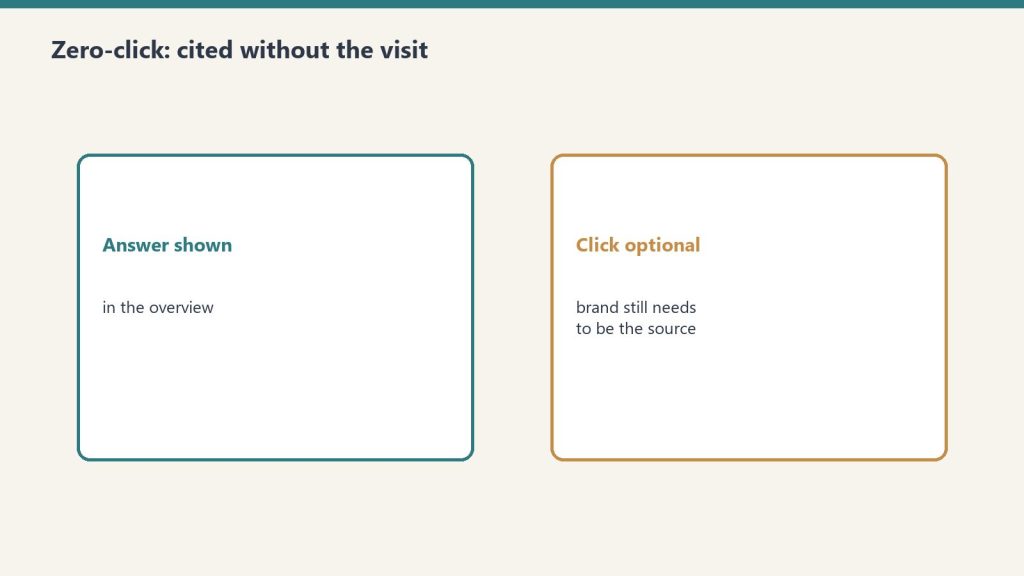
    The zero-click trend has accelerated beyond most predictions. From 56% to 69% between May 2024 and May 2025—a 13-point jump in one year. Current 2026 data puts the number at approximately 80% of all Google searches ending without a click to any website.

    For restoration companies, this fundamentally changes how marketing performance should be measured. If you’re evaluating your SEO investment solely on organic website traffic, you’re measuring a shrinking slice of the value your visibility generates. The companies adapting to the zero-click economy are tracking: branded search volume (are more people searching your company name?), GBP impressions and actions (calls, directions, website clicks from the knowledge panel), AI Overview mentions (is your brand being cited?), and share of voice in local results (how often do you appear in the map pack?).

    These metrics capture the full value of search visibility, not just the click-through portion.

    AI Content Crackdown: What Google Is Actually Penalizing

    The February 2026 update specifically targeted “scaled AI content”—websites publishing high volumes of AI-generated articles with minimal human oversight. This affects the restoration industry directly because several content mills and franchise corporate offices have been mass-producing AI blog posts for their networks.

    What Google is not penalizing: AI-assisted content where human expertise drives the substance and AI accelerates the production. The distinction matters. An article where a restoration professional provides the insights, data, and experience while AI helps with research, formatting, and optimization is rewarded by the algorithm. An article where AI generates the entire substance and a human adds a byline is penalized.

    The key differentiator Google appears to evaluate: does the content demonstrate first-hand experience that an AI system couldn’t synthesize from existing sources? Specific project references, original cost data, local regulatory knowledge, and documented outcomes are signals of human expertise that AI cannot fabricate convincingly.

    Perplexity, ChatGPT, and the Rise of AI-First Search

    Beyond Google, AI-native search platforms are growing rapidly. Perplexity processes millions of queries daily with a fundamentally different model: it generates comprehensive answers with cited sources rather than returning a list of links. ChatGPT’s search integration and Claude’s web capabilities are creating additional surfaces where restoration companies need to be discoverable.

    The consistent finding across all AI search platforms: they prioritize sources that are authoritative, well-structured, factually dense, and clearly attributed. The same content qualities that perform well in Google’s AI Overviews also perform well in Perplexity, ChatGPT, and other AI systems. This is a convergence point—one content strategy serves multiple AI surfaces.

    Restoration companies don’t need separate strategies for each AI platform. They need one content strategy built on entity authority, structured data, and information gain—and that strategy will compound across every AI surface simultaneously.

    What to Do This Quarter

    Audit your content for March 2026 update vulnerability. Any page that’s generic, anonymously authored, or duplicates information available on a hundred other sites is at risk. Prioritize adding author attribution, original data, and local specificity to your most important pages.

    Expand your measurement framework beyond clicks. Add branded search volume, GBP impressions, and AI mention tracking to your monthly reporting. If you’re only measuring organic traffic, you’re measuring less than half the value of your search visibility.

    Implement comprehensive structured data. Article, FAQPage, LocalBusiness, and Service schema on every relevant page. This is the single highest-ROI technical task for AI visibility in 2026, and the restoration industry’s low adoption rate means early movers gain disproportionate advantage.

    Shift content production to the fusion model. Expert humans providing substance, AI providing acceleration. This produces content that satisfies Google’s quality signals at a production cost and speed that pure human workflows can’t match. The March 2026 update made this approach not just efficient—but algorithmically preferred.

    The search landscape is changing faster than at any point since the mobile-first indexing transition. The restoration companies that adapt their strategy quarterly—not annually—will capture the market share that their slower competitors are losing right now.

    {
    “@context”: “https://schema.org”,
    “@type”: “Article”,
    “headline”: “March 2026 Search Landscape: What Google’s Latest Updates Mean for Restoration Companies”,
    “author”: {“@type”: “Organization”, “name”: “Tygart Media”},
    “publisher”: {“@type”: “Organization”, “name”: “Tygart Media”},
    “datePublished”: “2026-03-19”,
    “description”: “Analysis of Google’s March 2026 core update, AI Overviews expansion to 60% of queries, 80% zero-click search rate, AI content crackdown, and practical recommendations for restoration companies adapting to the new search landscape.”
    }

    {
    “@context”: “https://schema.org”,
    “@type”: “FAQPage”,
    “mainEntity”: [
    {“@type”: “Question”, “name”: “What did Google’s March 2026 core update change?”, “acceptedAnswer”: {“@type”: “Answer”, “text”: “The March 2026 core update prioritizes original, experience-driven content with demonstrable expertise while deprioritizing summary-style content, AI-generated articles without human expertise, and aggregator sites. It also increased emphasis on authorship signals, giving preferential treatment to content with clear author bylines linked to verifiable credentials.”}},
    {“@type”: “Question”, “name”: “How do AI Overviews affect restoration company SEO?”, “acceptedAnswer”: {“@type”: “Answer”, “text”: “AI Overviews now appear in over 60% of informational queries, causing organic click-through rates to drop 61% since mid-2024. For restoration companies, common questions about water damage, mold, and insurance coverage are increasingly answered directly in search results. Companies should optimize for citation within AI Overviews rather than clicks alone.”}},
    {“@type”: “Question”, “name”: “What percentage of Google searches result in zero clicks in 2026?”, “acceptedAnswer”: {“@type”: “Answer”, “text”: “Approximately 80% of Google searches in 2026 end without a click to any website, up from 56% in May 2024. Google’s experimental AI Mode produces a 93% zero-click rate. Restoration companies should expand measurement beyond website traffic to include branded search volume, GBP actions, and AI mentions.”}},
    {“@type”: “Question”, “name”: “Is Google penalizing AI-generated content for restoration websites?”, “acceptedAnswer”: {“@type”: “Answer”, “text”: “Google is penalizing scaled AI content published without human expertise, but not AI-assisted content where human professionals provide the substance. The key differentiator is whether content demonstrates first-hand experience—specific project data, original cost figures, local regulatory knowledge—that AI cannot fabricate from existing sources.”}}
    ]
    }