This is part of Tygart Media’s AI Search Intelligence series — a 10-part investigation into how AI systems discover, evaluate, cite, and refer traffic to web content, built on proprietary server log data and real-world publishing experiments.
Every CMO can tell you what a Google click is worth. Years of attribution modeling, CTR curves, and keyword-level conversion tracking have made the organic search click one of the most well-understood units of value in digital marketing. But ask that same CMO what a Microsoft Copilot citation is worth — a referral from copilot.microsoft.com where an AI system explicitly names their brand as a source — and you will get silence.
That silence is a strategic vulnerability. AI search is not a future state. It is a current one. And the organizations that build valuation frameworks for AI citations now will have a decisive advantage over those still trying to retrofit Google Analytics models onto an entirely different referral mechanism.
At Tygart Media, we have been tracking this problem with real data. After publishing 40 articles targeting Microsoft Copilot citation patterns, we recorded 3 confirmed Copilot citation referrals within 48 hours — and simultaneously observed that AI crawlers were hitting our server 6,805 times compared to 4,897 traditional visits (Tygart Media server log analysis, June 2026). AI is already reading more than humans are browsing. The question is no longer whether AI citations matter. The question is: how much are they worth?
This article introduces our AI Citation Value Framework — a 5-component model for measuring what a Copilot referral is actually worth to a publisher, a brand, or a business.
Why Traditional SEO ROI Models Break for AI Search

Before we build the new framework, we need to understand why the old one fails. Traditional SEO ROI modeling depends on a chain of measurable inputs that simply do not exist in AI search.
Get The Signal
What we actually ran, what it measured, and what it means for a restoration shop — every week, including the flops.
The Four Structural Breaks
1. No keyword position to track. In traditional search, value begins with a ranking position. Position 1 for “enterprise software comparison” has a known CTR, a known traffic volume, and a known conversion probability. In AI search, there is no position. Your content is either cited or it is not. There is no “position 3 in Copilot” — the AI either references your brand or it does not mention you at all.
2. No CTR curve to model. Google’s organic CTR curve — where position 1 captures roughly 27-30% of clicks and position 10 captures roughly 2-3% — is one of the foundational inputs to every SEO ROI projection. AI citations have no equivalent curve. When Copilot cites a source within an enterprise workflow answer, the user either clicks through to the cited source or they do not. There is no graduated decay based on citation order.
3. Citations are binary, not graduated. This is the most fundamental structural difference. Traditional SEO operates on a spectrum — position 1 is better than position 5, which is better than position 20, which is better than position 50. Each position has a calculable value. AI citations are binary. You are cited, or you are not. You are the named source, or you are invisible. This binary nature makes traditional regression-based ROI modeling inapplicable.
4. Value accrues through authority reinforcement, not traffic volume alone. In traditional SEO, the primary value mechanism is traffic. More traffic means more conversions means more revenue. In AI search, value accrues through a different mechanism: being cited is worth more than being clicked. The citation itself — the act of an AI system naming your brand as an authoritative source — carries independent value beyond the referral click it may or may not generate.
The AI Citation Value Framework: Five Components
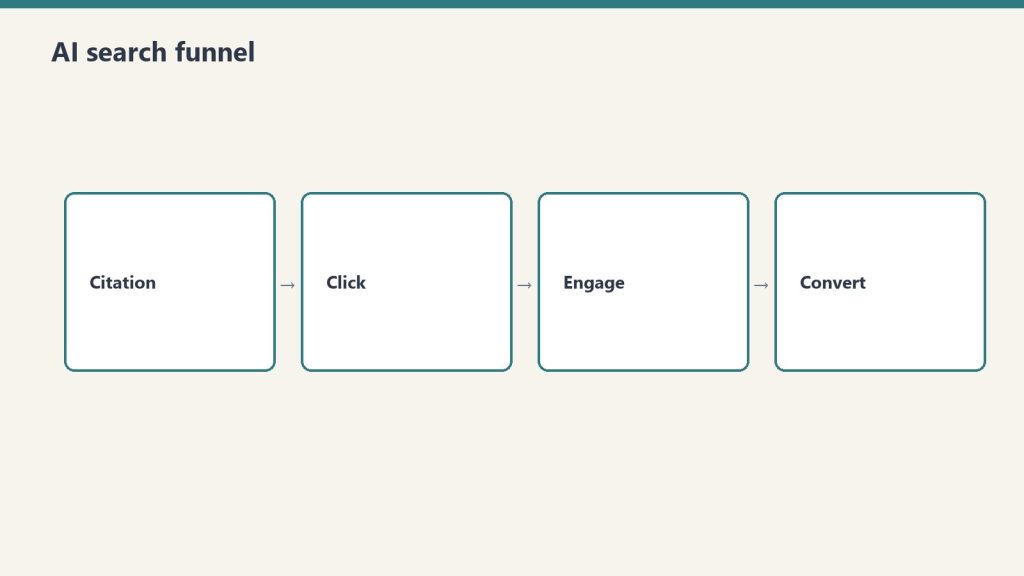
Our framework decomposes the value of a single AI citation into five measurable components. Each captures a different dimension of value that traditional models ignore. Together, they provide a comprehensive picture of what a Copilot referral — or any AI citation — is actually worth to an organization.
Component 1: Direct Referral Value
This is the component closest to traditional SEO measurement: the value of the actual click that occurs when a user follows a citation link from an AI response to your website. But even here, the mechanics differ substantially from a Google organic click.
A traditional organic click arrives with context shaped by a search results page. The user has seen your title tag, your meta description, and your competitors’ listings. They have made a comparative choice. A copilot.microsoft.com referral arrives with context shaped by an AI endorsement. The user has received an answer, and the AI has specifically named your content as the source supporting that answer. The intent signal is different. The trust transfer is different.
Publishers should calculate their direct referral value by examining the downstream behavior of AI-referred visitors compared to organic-referred visitors. Key metrics include:
- Pages per session for AI referral traffic vs. organic traffic
- Session duration for AI referral traffic vs. organic traffic
- Conversion rate for AI referral traffic vs. organic traffic
- Bounce rate differential between the two traffic sources
Our early observations suggest that AI referral traffic exhibits distinct engagement patterns that require their own attribution models. The framework recommends treating AI referral traffic as its own channel in GA4 rather than lumping it into organic search.
Component 2: Brand Authority Multiplier
This is the component that has no analog in traditional SEO. When Google ranks your page at position 1, Google is not telling the user “this source is authoritative.” Google is presenting a list and letting the user decide. When Microsoft Copilot cites your brand in a conversational answer, the AI is making an explicit endorsement: “According to [Your Brand]…” or “As [Your Brand] explains…”
That is a fundamentally different value proposition. The AI is functioning as a third-party endorser at scale — recommending your brand to potentially millions of enterprise users within their daily workflow. This endorsement carries brand equity value that exists independently of whether the user clicks through to your site.
Consider the parallel: if a respected industry analyst cited your research in a keynote presentation to 10,000 executives, you would calculate the brand value of that mention even if none of those executives visited your website afterward. An AI citation operates on the same principle, but at dramatically larger scale and with higher frequency.
The brand authority multiplier should be calculated based on:
- Estimated reach of the AI platform (Microsoft Copilot’s enterprise user base)
- The context of the citation (workflow integration vs. casual query)
- Brand lift measurement through pre/post surveys or branded search volume changes
- Equivalent media value of a third-party endorsement at comparable scale
The enterprise workflow context of Copilot citations makes this multiplier particularly significant. These citations reach decision-makers during active work sessions, not during casual browsing — a context that our temporal analysis shows differs markedly from traditional search usage patterns.
Component 3: Compounding Citation Effect
In traditional SEO, rankings are volatile. A page that ranks position 1 today may rank position 5 tomorrow and position 15 next month. Every algorithm update reshuffles the deck. This volatility is baked into traditional ROI models through discount rates and probability adjustments.
AI citations behave differently. Our observation — and one of the most strategically important findings in this series — is that once an AI system cites a source, it tends to continue citing that source. There is no position ranking decay in the traditional sense. The AI’s retrieval patterns create a reinforcement loop: content that gets cited builds authority signals that make it more likely to be cited again.
This compounding effect means that the value of a single AI citation extends far beyond the moment of that citation. Each citation is not just a discrete event — it is a contribution to a compounding authority position. Our server log data shows this pattern clearly: after our 40-article Copilot content strategy began generating citations, the AI crawler activity on our site increased substantially, suggesting that citation activity triggers additional crawling and indexing attention from AI systems.
The compounding citation effect should be modeled as:
- Citation persistence rate (what percentage of citations continue over 30, 60, 90 days)
- Citation expansion rate (does being cited for Topic A lead to citations for Topics B and C)
- Authority reinforcement velocity (how quickly does compounding accelerate)
- Decay comparison with traditional rankings over equivalent time periods
Component 4: Retargeting Amplifier Value
This component captures a tactical opportunity that most organizations are overlooking entirely. When a user clicks through from a Copilot citation to your website, that user enters your retargeting ecosystem. They can be reached through Bing Ads, display advertising, social media retargeting, and email capture — the same downstream activation paths that exist for any website visitor.
But the retargeting amplifier for AI-referred visitors carries a specific advantage: the visitor arrived with AI-endorsed trust. They did not find you through a search results page where you were one option among ten. They found you because an AI system specifically recommended your content. That trust context should, in principle, improve downstream conversion rates for retargeted campaigns.
The retargeting amplifier value should be calculated by:
- Building dedicated retargeting audiences for AI referral traffic in Bing Ads and other platforms
- Measuring conversion rates of AI-referred retargeting audiences vs. organic-referred retargeting audiences
- Calculating the incremental revenue attributable to the AI referral entry point
- Factoring in the lifetime value differential of AI-acquired vs. organic-acquired customers
This component connects directly to the broader Platform-Specific AI Optimization (PSAO) framework — where understanding the unique user journey of each AI platform enables targeted activation strategies that generic SEO approaches cannot deliver.
Component 5: Content Shelf Life Extension
The final component addresses a problem that every content marketer knows intimately: content decay. In traditional SEO, content has a half-life. A blog post ranks well for weeks or months, then gradually declines as fresher content, algorithm updates, and competitive publishing erode its position. Content teams operate on a treadmill — constantly producing new content to replace the decaying traffic from older content.
AI-cited content exhibits a different decay pattern. Because AI citations are driven by authority signals and retrieval patterns rather than freshness signals and ranking algorithms, content that earns AI citations tends to maintain those citations for longer periods than equivalent content maintains Google rankings.
This means that the effective shelf life of AI-cited content is longer than the effective shelf life of Google-ranked content, all else being equal. The investment in creating citation-worthy content generates returns over a longer horizon.
Content shelf life extension should be measured by:
- Comparing the traffic decay curve of AI-cited content vs. non-cited content of similar quality and topic
- Tracking citation persistence over 6-month and 12-month windows
- Calculating the reduced content production burden from extended shelf life
- Modeling the NPV difference between a content asset with traditional decay vs. AI-extended shelf life
Understanding how AI engines select and persist citations is foundational to maximizing this component.
Putting the Framework Together: A Practical Valuation Approach
Each of the five components can be measured independently, but the framework’s power comes from combining them into a unified valuation. Here is the practical approach we recommend for organizations beginning to measure AI citation value.
Step 1: Establish Baseline Measurement Infrastructure
Before calculating any values, organizations need to ensure they can actually detect and track AI citations. This requires:
- Server log analysis capability — to identify AI crawler activity and referral sources at the server level, not just through JavaScript-based analytics
- GA4 custom channel groupings — to separate AI referral traffic (from
copilot.microsoft.com,chatgpt.com,claude.ai, and similar sources) from traditional organic traffic - Citation monitoring — systematic testing of AI systems to identify when and where your content is being cited
- Temporal analysis — tracking when AI referrals occur relative to content publication to understand citation latency
Our own infrastructure revealed the 6,805 AI crawler hits vs. 4,897 traditional visits split that informed much of this series (Tygart Media server log analysis, June 2026). Without server-level analysis, this data — and the strategic insights it enables — would be invisible.
Step 2: Calculate Each Component Independently
For each component, establish a measurement methodology appropriate to your data maturity:
Direct Referral Value: Start with per-session revenue for AI referral traffic. If you do not yet have enough AI referral volume for statistical significance, use your overall per-session revenue as a proxy and adjust as data accumulates.
Brand Authority Multiplier: Begin with equivalent media value estimation. What would you pay for a third-party endorsement at the scale and context that an AI citation delivers? Refine with branded search lift measurement over time.
Compounding Citation Effect: Track citation persistence monthly. Calculate the projected value of maintaining a citation over 12 months vs. the projected value of maintaining a Google ranking for the same keyword over 12 months. The differential is the compounding premium.
Retargeting Amplifier: Build the audience segments, run the campaigns, and measure the incremental lift. This component is the most directly measurable using existing ad platform infrastructure.
Content Shelf Life Extension: Compare traffic decay curves for cited vs. non-cited content. Calculate the content production cost savings from extended shelf life.
Step 3: Apply the Unified Formula
The total AI Citation Value for a given piece of content is the sum of all five components over the measurement period. Organizations should calculate this quarterly and compare it against the traditional SEO value of equivalent content to build a clear picture of relative ROI.
The formula structure is straightforward:
AI Citation Value = Direct Referral Value + (Brand Authority Multiplier × Estimated Reach) + (Compounding Citation Effect × Time Horizon) + Retargeting Amplifier Value + Content Shelf Life Extension Value
Each variable requires organization-specific inputs. The framework provides the structure; your data provides the numbers.
What Our Data Shows So Far
We are transparent about the maturity of our own dataset. After publishing 40 articles specifically designed to test AI citation acquisition strategies, our results within the first 48 hours included:
- 3 confirmed Copilot citation referrals — verified through server logs as traffic from
copilot.microsoft.com - 6,805 AI crawler hits vs. 4,897 traditional visits (Tygart Media server log analysis, June 2026)
- Confirmed citations from articles covering Microsoft 365 Copilot governance frameworks, enterprise adoption playbooks, and pricing comparison guides
This is early-stage data. Three referrals in 48 hours from a cold start is a signal, not a conclusion. But the signal is directionally significant: content engineered for AI citation can earn citations rapidly, and the mechanisms for earning those citations are learnable and repeatable.
The more revealing data point is the crawler ratio. When AI systems are reading your content at a higher rate than traditional systems and humans combined, it confirms that the audience for your content is no longer exclusively human. Your content is being evaluated, indexed, and potentially cited by AI systems with every crawl. The question of why some content gets cited and other content does not becomes the central strategic question.
The Dollar Value Comparison: AI Citation vs. Traditional Organic Click
Let us be direct about what this comparison looks like structurally, even without asserting specific dollar amounts that would vary wildly by industry, niche, and business model.
Traditional Organic Click Value
A traditional organic click’s value is calculated through a well-established chain:
- Keyword search volume → estimated monthly searches
- Ranking position → expected CTR (position 1 ≈ 27-30%, position 5 ≈ 5-7%, position 10 ≈ 2-3%)
- Expected traffic → volume × CTR
- Conversion rate → percentage of visitors who take desired action
- Revenue per conversion → average deal value or transaction size
- Applied discount → ranking volatility, seasonal fluctuation, algorithm risk
The critical weakness: every variable in this chain is subject to decay. Rankings decay. CTR decays as competitors improve their listings. Traffic decays as search volume shifts. Traditional organic click value is a depreciating asset.
AI Citation Referral Value
An AI citation referral’s value chain looks fundamentally different:
- Citation status → binary (cited or not cited)
- AI platform reach → estimated user base of the citing AI system
- Query relevance → how frequently the cited topic is queried in AI systems
- Click-through behavior → percentage of users who follow citation links
- Trust premium → conversion rate adjustment for AI-endorsed visitors
- Applied appreciation → compounding citation effect over time
The critical strength: the appreciation rate replaces the discount rate. Instead of modeling value decay, the framework suggests modeling value accumulation. The longer you hold an AI citation, the more valuable it becomes as compounding reinforces your position.
Implications for Content Investment Strategy

If this framework holds — and our early data suggests the structural logic is sound — it has significant implications for how organizations should allocate content budgets.
Implication 1: Citation-Optimized Content Deserves Premium Investment
Content designed to earn AI citations should receive higher per-piece investment than content designed solely for Google rankings. The logic is straightforward: if AI-cited content is an appreciating asset while Google-ranked content is a depreciating asset, the net present value of the citation-optimized content is higher over any multi-year horizon.
This does not mean abandoning traditional SEO content. It means recognizing that the distinction between SEO, GEO, and AEO is strategically material and allocating investment accordingly.
Implication 2: Measurement Infrastructure Is No Longer Optional
Organizations that cannot detect AI citations, track AI referral traffic, or analyze AI crawler behavior are flying blind in a channel that already generates more server activity than traditional search on some properties. Server log analysis, custom GA4 configurations, and systematic citation monitoring must be treated as essential infrastructure, not nice-to-have analytics projects.
Implication 3: The Valuation Gap Creates Arbitrage Opportunity
Right now, most organizations are not measuring AI citation value at all. This means the “market” for AI-optimized content is dramatically underpriced relative to its actual value. Organizations that adopt a rigorous valuation framework now — and invest in citation acquisition strategies based on that valuation — are buying an appreciating asset at a discount.
The arbitrage window will close as more organizations adopt AI citation measurement. Early movers who build the infrastructure, develop the content, and establish citation authority now will compound those advantages over time.
Implication 4: Attribution Models Need a Full Rebuild
Most marketing attribution models treat all organic search as one channel. AI referral traffic needs its own attribution path — with its own conversion metrics, its own LTV calculations, and its own ROI benchmarks. Blending AI referral data into “organic search” obscures the true performance of both channels and prevents accurate investment allocation.
Frequently Asked Questions
How do you calculate the value of an AI citation from Microsoft Copilot?
The AI Citation Value Framework uses five components: direct referral value, brand authority multiplier, compounding citation effect, retargeting amplifier value, and content shelf life extension. Each component captures a different dimension of value that a single AI citation delivers. Organizations should measure each component independently using their own data, then combine them into a unified valuation that can be compared against traditional organic search ROI.
Is a Copilot referral worth more than a traditional Google organic click?
The framework suggests that Copilot referrals carry structurally different value characteristics than Google organic clicks. Traditional organic clicks are depreciating assets — subject to CTR decay, position fluctuation, and algorithm updates. AI citations function as appreciating assets — they compound over time, experience no position ranking decay, and benefit from implicit third-party endorsement by the AI system. Publishers should calculate their own comparative values using the five-component framework and their organization-specific data.
Why do traditional SEO ROI models fail for AI search?
Traditional SEO ROI models depend on four inputs that do not exist in AI search: keyword positions, CTR curves, graduated ranking values, and traffic-volume-based value accrual. AI citations are binary (cited or not), carry no position ranking, have no CTR decay curve, and deliver value through authority reinforcement rather than traffic volume alone. Applying traditional models to AI citations will systematically produce incorrect valuations.
What is the compounding citation effect in AI search?
The compounding citation effect describes the observed pattern where once an AI system cites a source, it tends to continue citing that source for related queries. Unlike traditional search rankings that fluctuate with every algorithm update, AI citations build on themselves — each citation reinforces the source’s authority within the AI model’s retrieval patterns. This creates an appreciating dynamic rather than the depreciating dynamic of traditional rankings.
How many AI crawler visits does a typical website receive compared to human visits?
This varies significantly by site, but Tygart Media’s server log analysis from June 2026 recorded 6,805 AI crawler hits compared to 4,897 traditional visits. On this property, AI systems were reading content at a higher rate than traditional crawlers and human visitors. Organizations should conduct their own server log analysis to understand their specific AI-to-human traffic ratio, as this metric is invisible in standard JavaScript-based analytics platforms like Google Analytics.
What Comes Next in This Series
This framework is a starting point, not a final answer. The data underpinning AI citation valuation is still maturing, and the frameworks will evolve as more organizations contribute measurement data and as AI platforms’ citation behaviors become better understood.
In our final installment of the AI Search Intelligence series, we will synthesize the findings from all ten articles into a unified strategic playbook — connecting platform-specific optimization, citation mechanics, and this valuation framework into a comprehensive action plan for organizations ready to treat AI search as a first-class channel.
The organizations that measure what matters — and invest based on those measurements rather than outdated proxies — will own the AI citation economy. The framework is here. The data is building. The question is whether you will wait for the market to price AI citations accurately, or whether you will capture the arbitrage while it lasts.
All server log data, crawler statistics, and citation referral counts cited in this article are sourced from Tygart Media server log analysis, June 2026. For methodology details, see our complete data analysis.
Get The Signal
What we actually ran, what it measured, and what it means for a restoration shop — every week, including the flops.
Leave a Reply