The Unit of Value Is Changing
For twenty-five years, the internet’s content economy ran on one unit of value: the click. A user searches, sees your result, clicks, lands on your page. That click triggers a pageview, which triggers an ad impression, which generates revenue. Or the click starts a funnel: landing page to email capture to nurture sequence to purchase. Every business model, every analytics platform, every marketing strategy was built around the click as the atomic unit of value.
The click is losing its monopoly.
When Microsoft Copilot cites my content 98,800 times, those aren’t clicks. No user loads my page. No ad renders. No pixel fires. But 98,800 times, a real person — an enterprise worker making a real decision — receives information sourced from my domain, attributed to my domain, and shaped by my domain’s content. My information enters their document, their email, their analysis. My brand name appears as the citation source.
That’s a different kind of value than a click. And it might be worth more.
The Click Economy Was Always a Proxy
Here’s what we’ve always known but rarely said aloud: clicks were never the actual goal. Clicks were the proxy for something deeper — attention, trust, influence, and eventually, a commercial relationship.
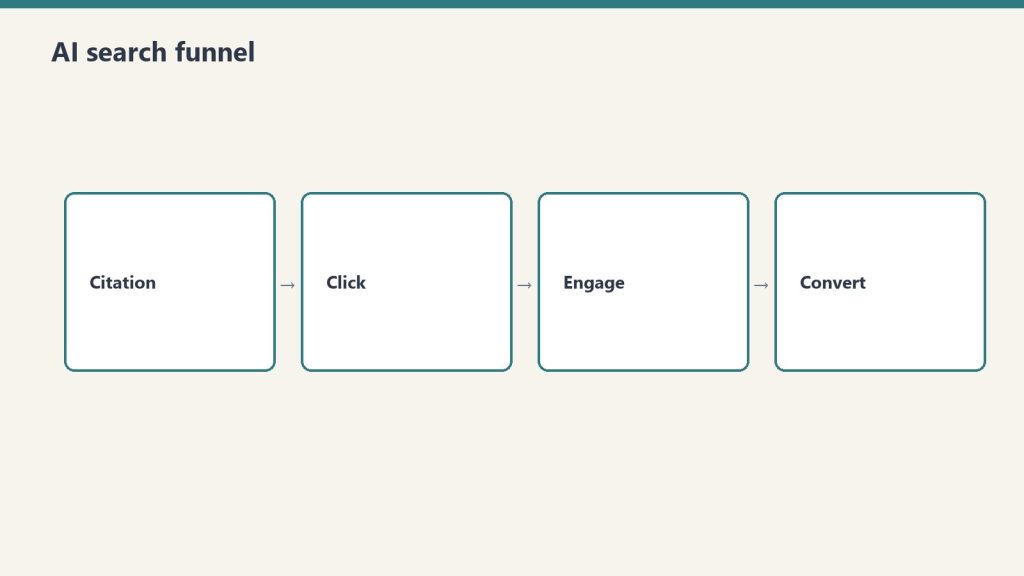
A click meant someone gave you a moment of attention. But the attention wasn’t guaranteed — bounce rates of 60-80% were normal. A click meant someone might trust you. But trust wasn’t guaranteed — most first-time visitors never return. A click was the entry to a funnel. But the funnel’s conversion rate was typically 1-3%.
Get The Signal
What we actually ran, what it measured, and what it means for a restoration shop — every week, including the flops.
We built an enormous infrastructure around maximizing clicks — SEO, SEM, social media marketing, content marketing — not because clicks were intrinsically valuable, but because they were the best available proxy for the things that actually mattered: reaching the right person, at the right time, with the right information.
A citation is a better proxy.
Why Citations Are a Better Signal
When Copilot cites my Claude pricing guide to an enterprise worker who asked “what is claude ai pricing in 2026,” several things are true about that interaction that are not true about a typical click:
The user has high intent. They didn’t stumble onto my page from a vague search. They asked a specific question while working on a specific task, and Copilot selected my content as the authoritative answer. The intent signal is stronger than a keyword match.
The content was consumed. Not skimmed, not bounced from, not opened in a tab and forgotten. Copilot extracted the relevant information and presented it to the user inline. The user received my content’s value whether or not they clicked through to my site.
The attribution is explicit. Copilot cites the source. My domain name appears alongside the information. This isn’t an anonymous impression — it’s a credited contribution. The user knows where the information came from.
The context is professional. Copilot users are working. They’re writing reports, making decisions, evaluating tools. My content enters a professional workflow — not a casual browsing session. The context in which my brand appears is inherently higher-value than a typical web pageview.
Each citation is a moment where my domain provided trusted, authoritative information to a professional decision-maker in a high-intent context. That’s the moment every content marketing strategy is designed to create. The click was just the old way of getting there.
The Scale Shift
Here’s the number that reframes everything: 52:1.
For every human who clicks on my content from Bing search, Copilot cites it 52 times. My content reaches 52x more users through AI citation than through traditional search clicks. And that’s just Copilot — it doesn’t include ChatGPT, Perplexity, Google AI Overviews, or Claude.
The total AI readership of my content is likely 100x or more the human click volume. And every one of those AI-mediated interactions involves a user who received my information, saw my attribution, and incorporated my content into their work.
In the click economy, the most successful content might reach tens of thousands of users per month through organic search. In the citation economy, the same content can reach hundreds of thousands through AI platforms — users who are higher-intent, more engaged with the content (because it was extracted and presented directly to them), and consuming it in a professional context.
The scale of the opportunity is an order of magnitude larger than clicks. The remaining question is how to capture the value.
The Monetization Frontier
This is where honesty matters. The citation economy’s monetization model is not fully developed. I can tell you what works, what’s emerging, and what doesn’t work yet.
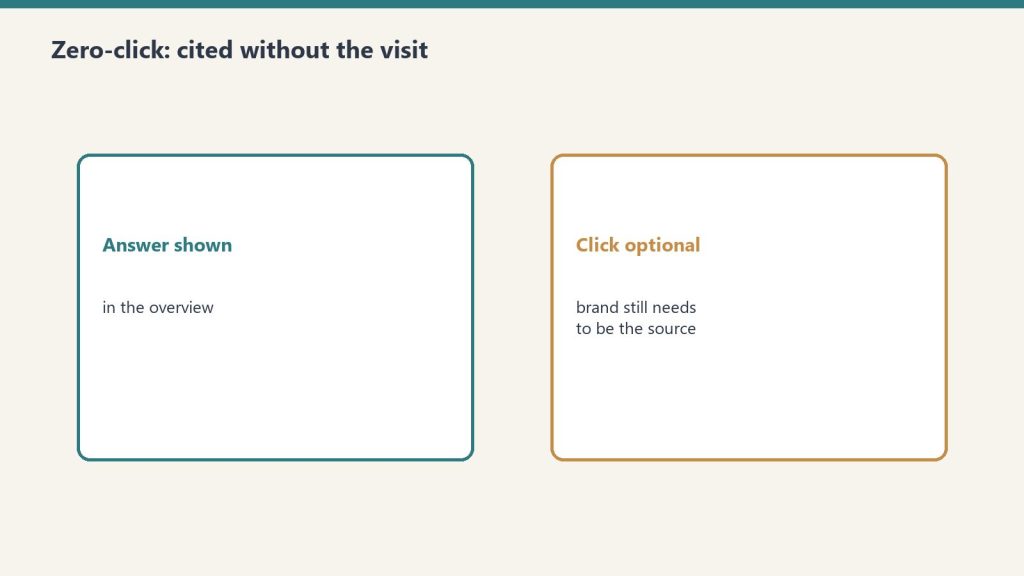
What works now: brand authority compounding. When Copilot cites your domain thousands of times, you become the recognized source for that topic among enterprise professionals. This translates to consulting inquiries, partnership opportunities, speaking invitations, and inbound business development. The citation builds the brand, and the brand generates revenue through traditional channels. This is measurable but indirect.
What works now: citation flywheel to search authority. The signals that earn AI citations — content quality, structural clarity, topical authority — also improve traditional search performance. My domain’s growing Copilot authority appears to correlate with improved Google organic performance. The citation strategy feeds the click strategy, creating a compound effect.
What’s emerging: AI-mediated traffic. Some Copilot and ChatGPT citations include clickable source links. A percentage of users do click through. This traffic is small compared to citation volume but high-quality — the user has already seen a preview of your content through the AI response and is choosing to visit for more. The conversion potential of this traffic is likely higher than typical organic traffic, though the data is still too early for definitive benchmarks.
What doesn’t work yet: direct citation monetization. There is no ad network for AI citations. There is no affiliate revenue from AI-mediated content consumption. There is no way to place a conversion pixel inside a Copilot response. The infrastructure for monetizing citations the way we monetize clicks does not exist.
This is the frontier. The value is clear — massive reach to high-intent professional audiences — but the capture mechanism is still developing. The businesses that figure out how to convert citation authority into revenue will define the next era of content economics.
The Attention Redistribution
What’s happening with AI citations is part of a larger pattern: attention is being redistributed from concentrated channels (Google, social media feeds) to distributed AI interfaces (Copilot in Office, ChatGPT conversations, Perplexity answers, AI Overviews in search).
In the old model, Google was the gatekeeper. All attention flowed through one discovery interface. Publishers optimized for one algorithm, one set of ranking factors, one measurement system. The entire content economy was organized around Google’s distribution infrastructure.
In the new model, attention is fragmented across multiple AI interfaces. A professional might encounter your content through Copilot while writing, ChatGPT while researching, Perplexity while fact-checking, and Google while searching — all in the same day, for different purposes, through different content presentations.
This fragmentation is uncomfortable for publishers who built their operations around a single distribution channel. But it’s also an opportunity. In a fragmented attention landscape, the publisher who shows up across multiple AI platforms has an outsized advantage over the publisher who only shows up on Google.
My 98,800 Copilot citations represent a position in one AI platform’s distribution. If I can build comparable positions in ChatGPT, Perplexity, and Google AI Overviews, the total citation footprint would represent content distribution at a scale that was previously only achievable through paid advertising at significant cost.
What the Citation Economy Demands
The transition from click economy to citation economy changes what content operations need to prioritize:
Accuracy over engagement. In the click economy, content needed to be engaging enough to prevent bounces and drive conversions. In the citation economy, content needs to be accurate enough that AI engines trust it as a grounding source. Engagement still matters for human readers, but accuracy is the threshold for AI citation eligibility.
Structure over narrative. AI engines extract structured information more effectively than narrative prose. The citation economy rewards clean data tables, explicit definitions, numbered procedures, and organized comparison frameworks. This doesn’t mean narrative disappears — it means structure shares equal billing.
Currency over permanence. In the click economy, evergreen content could generate traffic for years without updates. In the citation economy, stale content loses citations as AI engines detect outdated information. Maintaining existing content becomes as important as producing new content.
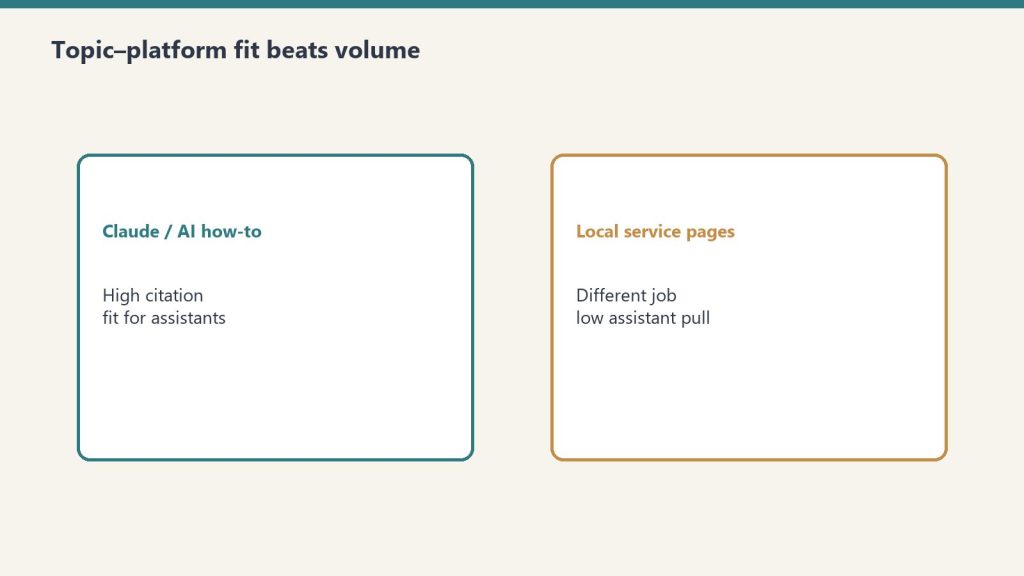
Platform-specific optimization over universal optimization. The click economy had one optimization target: Google. The citation economy has multiple: Copilot, ChatGPT, Perplexity, AI Overviews, and whatever comes next. Each platform has different preferences, different user bases, and different citation behaviors.
Authority over volume. In the click economy, more content meant more keyword targets, more landing pages, more chances to rank. In the citation economy, authority on a topic matters more than volume of content about it. One comprehensive, authoritative, regularly-updated pricing guide earns more citations than ten thin pricing articles.
The First Mover Advantage Is Real
My citation flywheel — from 672 daily citations to 5,500 in 90 days — demonstrates that AI citation authority compounds. The domain that establishes itself as the trusted source for a topic early builds a moat that later entrants have to overcome.
This is different from SEO, where a new article can outrank an established one by being better optimized. In AI citations, the trust relationship appears to be stickier. Copilot doesn’t just evaluate individual pages — it appears to develop domain-level trust for topic clusters. Once your domain is the trusted source for “AI tool pricing,” new articles on related topics benefit from that established trust.
The businesses building citation authority now are building a compounding asset. The businesses waiting for the measurement tools to mature are falling behind a curve they won’t be able to see until it’s too late.
Where This Goes
The AI citation economy is in its first inning. The measurement tools are primitive. The monetization models are nascent. The strategic frameworks are just being articulated. But the underlying behavior — AI engines consuming, citing, and distributing web content at massive scale — is already established and accelerating.
I believe that within two to three years, AI citations will be as standard a metric as organic traffic. Webmaster tools across all major platforms will expose citation data. Content operations will track citation volume by platform alongside traditional SEO metrics. And the strategic approach of Platform-Specific AI Optimization will be as mainstream as SEO is today.
The question for content operators right now isn’t whether this shift is happening — the data already confirms it is. The question is whether you’re going to measure it, optimize for it, and build citation authority while the category is still open — or wait until everyone else has already established their positions.
I’m publishing my data, naming the category, and building the playbook in real time. The AI citation economy is here. It rewards different content, different strategies, and different metrics than the click economy it’s supplementing. And the first people to take it seriously will define how everyone else thinks about it.
Related on Tygart Media: AI search funnel · $0.35 article citations · how AI engines cite.
Frequently Asked Questions
Will AI citations replace clicks entirely?
No. Clicks will remain important for direct conversion, ad revenue, and controlled user experiences. AI citations supplement clicks by providing massive reach and brand authority through a different channel. The most effective content strategies will optimize for both.
How do I monetize AI citations?
Currently through indirect channels: brand authority that drives consulting and partnerships, the citation flywheel that improves traditional search performance, and AI-mediated referral traffic from users who click through from citation links. Direct citation monetization infrastructure doesn’t exist yet.
What is the AI citation flywheel?
A compounding effect where earning citations builds domain trust, which makes new content eligible for more citations, which builds more trust. On one domain, this grew daily Copilot citations from 672 to 5,500 in 90 days without changes to content volume or strategy.
Is there a first-mover advantage in AI citations?
Yes. AI citation authority appears to compound over time. Domains that establish trust as citation sources for specific topic clusters benefit from preferential selection for new and adjacent queries. Building this authority early creates a moat that later entrants must overcome.
When will AI citation data become widely available?
Bing Webmaster Tools AI Performance is already available in beta. Google and other platforms are expected to follow as publisher demand for citation transparency grows. The most likely timeline for broad availability of citation analytics across major platforms is 12-24 months.
Get The Signal
What we actually ran, what it measured, and what it means for a restoration shop — every week, including the flops.
Leave a Reply