You submit the form. You get a receipt with a work-order number. You get a written verdict within one business day. The price is agreed before anyone pays — the checkout link rides inside the verdict, after triage, not before it.
No calls. No retainer pitch. No “let’s hop on a quick Zoom” standing between you and a finished piece of work.
Before we told anybody about it, we ran a test work order through it ourselves — form, receipt, logging in two places so a submission can’t silently vanish. That last part is the whole design. A front door that loses orders quietly is worse than no front door.
Built it this week. It works. Doors open as soon as the address is on it.
An honest AEO report shows four things: the exact questions that were asked, the answers the assistants actually gave, which businesses and pages those answers cited, and how all of it changed since the last run. AEO reporting is the scheduled record of those four things, kept the same way every time. Anything that cannot show you the four is showing you a mood, not a measurement.
What questions were asked?
A real AEO report prints its question set in full, word for word. The questions are the foundation of the whole report: they should be your customers’ real questions, fixed in advance, and identical from run to run. A citation count means nothing until you can see the questions it was counted on.
This is where reports quietly cheat. Swap the questions between runs and every comparison is fiction — you improved because the test got easier. Add a question you already win and the average climbs without a single answer changing. Ask for the set in writing before the first run, and treat any later change to it as a new baseline, announced as one. A short set of real questions, held steady, beats a long set that wanders.
What did the AI actually say?
A real AEO report keeps the raw answers, not summaries of them. The answer text is what your customer actually reads — the names in it, the order they appear, the words around them. A summary written by the provider can only tell you what the provider noticed. The raw answer lets you check.
Summaries hide the losses. A run where you were cited on nine questions and dropped on the tenth, hard, reads as “visibility strong” in a summary and as a work order in the raw text. Keep the full answers, dated, for every run. They take almost no space, they cannot be reconstructed later, and they are the difference between having evidence and having a recollection.
Who got cited?
A real AEO report names the citations for every question: which businesses the answers credited, which pages of theirs did the work, and what share of the citations on each question went to whom. The citation list is the most useful page in the report. It converts “we are not visible” into a named list of exactly who the machines trusted instead, question by question.
Read it as a work list, not a wound. When one restoration client of ours kept losing a question to the same competitor, the citation list showed the competitor’s page the assistant kept crediting — a page that answered the question in the customer’s own words, in the first paragraph. That is a specific, fixable problem, and it was invisible in every summary number we had. Your citation share — your slice of the citations on your questions — is the one summary figure worth tracking, because it is arithmetic on the list, not an opinion about it.
What changed since last time?
A real AEO report is built to compare: this run against the last, same questions, with the differences stated plainly and the work done in between written next to them. Answers churn — the same question, asked next month, can name different businesses with nothing changed on either side. An honest report says so, and reads movement over several runs instead of celebrating or mourning a single one.
The work log belongs inside the report for one reason: without it, you cannot tell your work from the weather. “We rebuilt the profile and published two answer pages in March; citations on those questions rose across the April and May runs” is knowledge. The same rise with no log behind it is luck you will try to repeat blind. If your provider’s report never mentions what they did between runs, ask why their work and their results live in separate documents.
What does a horoscope report look like?
A horoscope report shows a single score with no questions behind it, percentages with no counts under them, and screenshots of the one good answer from a good day. It changes its questions when the results are inconvenient, reports only the wins, and always finds that things are improving and that more budget would improve them faster. It feels good, commits to nothing, and cannot be checked.
The test is simple. Pick any number in the report and ask: on which questions, from which answers, counted how? A real report answers in one step, because the number came from a list it can show you. A horoscope report answers with another number. We call them horoscopes because, like the ones in the paper, they are written to be agreeable about the future and impossible to grade about the past.
How often should you read an AEO report?
Read AEO reporting on a rolling cadence — monthly is a sane default — and never daily. AI answers move day to day with nothing changed, so daily reading is noise-chasing: it manufactures urgency, spends your attention, and teaches you to react to weather. What is worth reading is the run-over-run trend, and the first run after real work has had time to settle.
Reading it should end in a decision, or the reading is decoration. The standing decision a good report sets up is small: which questions is a competitor cited on that we are not, and what is the missing answer we should write next? Our AI Citation Quick-Scan is this artifact in its smallest honest form — 10 prompts about your service line, the answers recorded, the citations named, a scored report within 7 days, $97, one time.
Which lines the platforms lift is their call. We build the material they lift from — and then we measure what they did.
A friend stays over. Morning comes, they open your cabinets and look around for tea bags. No tea bags. So they drink your coffee instead and say nothing.
If you ever saw them looking, you'd buy tea. Not because coffee failed. Because someone told you what they wanted with their behavior, and listening is cheap.
Your website gets houseguests every day. And most of them are looking for tea bags.
The query is the want
Every search query is a small confession. Not "what words did they type" but "what were they trying to accomplish." A homeowner typing a city plus "water damage restoration" is standing in a wet hallway. A facilities director reading about IFRC sustainability guidelines at 10 AM on a Tuesday is doing homework for a budget meeting. Same internet, completely different mindsets.
Bing's AI performance reports now label this outright. Every query that triggers an AI answer citing your pages comes with an intent tag: informational, commercial, local, research. The mindset column is just sitting there in the export. Most people never read it as what it is, which is a list of what your visitors wanted.
Here's the part that changed my thinking: the industry standard for measuring AI-search visibility is synthetic prompts. Tools invent questions, run them across engines, and record what comes back. Probabilistic reporting, built on guesses, because as a 2026 Luminary analysis put it, "Since AI platforms don't share real prompt data (as at April 2026), organizations must build measurement baselines using synthetic prompts." Except Bing does share the real thing with site owners: the actual grounding query, the engine's own intent label, and your citation share. First-party want, straight from the source. Stop guessing with synthetic prompts when the engine will just tell you.
Three places the tea bags show up
1. Citation gaps. When an AI answer cites your page for 15 percent of its response, the want is proven and your voice is small. Someone asked, the machine answered mostly with other people's words. That's a stock-the-shelf list hiding in plain sight: every query where you're present but weak is a page you haven't written yet, or a page that doesn't serve the intent behind the query.
There's now a named framework for this. Search Engine Land covered a method from Robin Tully, co-founder at Forecast.ing, that scores the distance between what a page claims to deliver and the queries it actually surfaces for, sorting everything into four quadrants. The one that matters is labelled "Create": demand you're visible for but not capturing. As Tully put it: "Your audience is already telling you what they need. That signal is always shifting." And: "observations create interesting conversations, but numbers create urgency and action."
2. No-result site searches. I'll be honest about my own wrong mechanism here: I assumed failed on-site searches produced 404s. They don't. WordPress renders an empty results page instead. The signal lives in no-result search logs, and there are plugins that exist solely to capture it. One of them positions itself in pure tea-bag language: "Turn Lost Searches into Content Opportunities. Instead of guessing what to create next, build content based on real demand." Every empty search is a houseguest who opened the cabinet, found nothing, and left quietly. Log them.
3. The 404s. True 404s are a separate signal and just as valuable. Raven Tools documented an agency client who, after a relaunch, started getting emails from visitors hitting dead pages telling them exactly which old resources to recreate. Those conversations turned into sales: "After the client closed a second sale from a '404 lead,' the client jokingly asked if we could just serve up a 404 page all the time." Put a contact path on your 404, watch what comes in, and treat it as demand data. And keep true 404s as 404s. Google's John Mueller has said it plainly: don't blindly redirect dead pages to your homepage or a category page; 404s are a normal part of a healthy website. Blanket redirects confuse the crawlers and bury the signal.
When matters as much as what
Across most of the properties I track, AI citations drop hard on Saturdays. The main site fell from 8,863 citations on Friday to 4,197 on Saturday. The B2B-leaning properties all show the same shape, down 26 to 72 percent. That's not lost rankings. That's a weekday-professional audience going home. The exception proves the rule: the race-event property nearly quadrupled on Saturday, because race day is its weekday.
A DesignRush study of 950,000 U.S. B2B search queries found the mirror image worth noting: weekend visitors showed higher intent, more form fills, deeper reads into content. Different crowds, different mindsets, different hours.
This is where it stops being analytics and starts being strategy. A research-intent query at 10 AM on a workday wants depth. The same person scrolling at 9 PM wants the short version that respects their evening. Meet the morning persona with the white paper and the evening persona with the two-minute read, and you're not retargeting. You're recognizing someone.
The philosophy underneath
None of this is about grabbing people. The grabby version is funnels and popups and "we noticed you almost bought." The tea-bag version is quieter: I see you, I see where you're at, I see what's important to you, and I'll meet you as best I can where you are. Sometimes you won't have the tea. Knowing they wanted it is what lets you stock it next time.
Run the report monthly. Queries with intent labels, citation shares, no-result searches, 404 hits, daypart patterns. Rank every gap by frequency. What comes out the other end isn't a dashboard. It's a publishing roadmap written by your visitors, a restocking list for shelves you didn't know were empty.
They already told you what they want. You just have to look where they looked.
The product
This is now a standing offer: the Tea-Bag Report. Send us your search data and we'll tell you what your visitors were looking for that you didn't have, ranked by frequency. Then go stock the shelves.
“The highest-ROI marketing work is also the most boring. That’s not a coincidence.”
Name. Address. Phone. Identical everywhere. That’s the whole piece, and it’s worth more than the last three marketing tactics you tried combined — because nobody does it, because it’s boring, and boring is exactly where the edge lives.
The witnesses
Your business doesn’t exist in one place. It exists in dozens, and each one is a witness testifying about who you are and where to find you.
The Google profile. The website footer. Yelp, Facebook, Angi, the BBB. The directories you claimed in 2017 and forgot. The truck door. The invoice template. The email signature. Every one of them says your name, your address, your phone number — or it says something close, which is worse.
Nobody audits the witnesses. That’s the problem, and the opportunity.
The leaks
Here’s what the witnesses are saying right now, on profiles all over town:
“123 Main St” on Google, “123 Main Street” on Yelp, “123 Main St Suite B” on Facebook — three addresses for one door. The old cell number still on the Angi listing from before the voice line. The suite number on the website, missing everywhere else. The Facebook page from 2016 with the previous address, still ranking, still confusing people.
Each mismatch is small. Together they’re a credibility leak. The homeowner comparing two contractors doesn’t think “NAP inconsistency” — they think “something feels off about this one,” and they can’t say why. The search engine doesn’t think in words at all — it just has less confidence that all these listings are the same business, and confidence is the currency.
Small leaks, everywhere, all the time. That’s what boring neglect looks like.
The dividend
Now flip it. Every place that agrees is a vote.
Same name, same address, same phone — on the profile, the site, the directories, the truck, the invoice. Each matching witness raises confidence: the human’s (“these people have their act together”) and the machine’s (every corroborating listing makes the entity clearer). Trust isn’t built in one place. It’s the sum of a hundred small agreements.
That’s the dividend: not a spike, a yield. It pays a little every day, in every search, in every comparison — the quiet background hum of a business that agrees with itself. You don’t notice it working. You notice when it’s missing.
The audit
The work is unglamorous, which is why I’m spelling it out:
Write down the canonical version — one name, one address format, one phone number. Not the pretty version, the exact version: St or Street, suite or no suite, which number. Then list every witness: every profile, every directory, the site, the truck, the invoices, the signatures. Then fix every mismatch, one by one, until they all testify the same.
Then maintain it. New directory? Canonical version goes in. New truck? Canonical version on the door. New phone system? Every witness gets updated the same week, not “when we get around to it.”
It’s an afternoon of tedium, twice a year. That’s the whole price.
The boring moat
Here’s why this is a moat and not just hygiene: your competitors won’t do it.
Not because they’re lazy — because it’s boring, and boring doesn’t feel like marketing. Marketing feels like a new website, a new ad campaign, a new something. Nobody gets excited about making the suite number match in fourteen places. So nobody does it. The field stays sloppy, and the one business that agrees with itself everywhere stands out without spending a dollar.
Every real edge I’ve ever seen looked boring from the outside. This one just happens to look boring from the inside too.
The close
Name. Address. Phone. Identical everywhere.
Boring is the moat. Consistency is the dividend. And the businesses collecting it are the ones whose witnesses all tell the same story — the story of a business that has its act together, down to the suite number.
“Nobody visits your website first. They meet your front door.”
Search the trade plus the town and look at what comes up before anything with your URL on it: the business profile. The hours, the photos, the stars, the questions, the call button. That’s the first impression, and for most customers it’s the only one — they never walk past the door into the house.
Your website is the house. The profile is the front door. Nobody’s impressed by the house if the door is boarded up.
The door inventory
Walk up to your own front door like a stranger and read what’s on it:
The hours — including the holiday hours, the ones that are wrong on half the profiles in America right now. The photos — the truck, the crew, the work, or a gray empty storefront from 2019. The reviews — stars, words, and whether anyone from the business ever answered back. The questions — asked by strangers, answered by strangers, when nobody from the business is home. The posts — the weekly update slot, empty since the profile was claimed. And the two big brass buttons: call, and directions.
That’s the door. Every customer reads it before they knock.
The untended door
Here’s what most front doors look like: hours that lie on holidays. Photos older than the crew in them. A Q&A section where a stranger asked “do you do water damage?” eight months ago and another stranger answered “idk.” No posts — the business has done a hundred jobs since the profile went up and the door shows none of them. Reviews sitting unanswered, the digital equivalent of mail piling up in the slot.
And the doorbell — the call button — still works. It rings. Right into the voice line, right into the tuition piece. The door and the phone are the same system: the profile is where they decide to knock, the line is what answers.
An untended door doesn’t just lose the knock. It sends the customer to the next door on the street — the competitor whose hours are right and whose photos are from this year.
Tending the door
The good news: tending a front door is a fifteen-minute weekly ritual, not a project.
Fresh photos — the actual truck, the actual crew, the actual work from this month. A door with fresh photos says “we’re alive in here.” Check the hours — especially before holidays, the highest-traffic lying season. Work the Q&A — seed the questions customers actually ask, answer them in your own voice, so strangers don’t do it for you. One post a week — the job you finished, the storm you worked, the crew milestone. It’s the shop window; put something in it. Answer the reviews — every one, but especially the good ones, because the response is the business talking back through the door.
Fifteen minutes. The highest-traffic page in the business, tended.
The compound
Here’s what makes the door different from every other marketing chore: it compounds and it doesn’t decay.
A post you write stays up. A question you answer stays answered — every future stranger with the same question reads your answer instead of a stranger’s guess. A photo you add joins the set. Reviews you respond to stack into a record of a business that talks back. Nothing you do to the door un-does itself. It’s all permanent, all cumulative, all working while you sleep.
Most marketing is rent — stop paying, it stops working. The front door is owned. Every fifteen minutes you spend on it is still there next year.
The close
Your website is the house. Beautiful, expensive, and visited second — if ever.
The profile is the front door. It’s what they see from the street, it’s where they decide, and the doorbell on it rings straight into your line. Tend the door. Sweep the step. Put something alive in the window. Answer when they knock.
Nobody ever hired the house. They hired the door that looked like somebody was home.
“Most of the calls are garbage. Listing bots, spam, junk — and I’m paying for every one of them. But all it takes is one. One real person, one real conversation, and it pays for all of them.”
That’s the whole piece. But it took me a year of phone bills to learn it, and about five minutes of forgetting it, so I’m writing it down.
The tuition frame
Every system has tuition. Ad spend has click fraud. Email has spam filters and the good leads that land in them. The voice line has junk calls.
Tuition isn’t a scam — it’s the price of the classroom. The question was never whether I’d pay it. The question was whether I’d remember what the classroom was for.
What the junk actually costs
Here’s the part that stings, and it’s straight from the arms column: the bill doesn’t care whether the call mattered.
The listing bot that calls to sell me a listing. The robocall about my car’s warranty. The silence. Every one of them spins up the model, opens the carrier leg, records the nothing, transcribes the nothing. The arms fire either way. I pay for the whole stack to handle a call that never existed.
Multiply that by a month and the tuition line on the invoice is real. I’m not going to pretend it isn’t.
The math of the one
But here’s the other column, the one the invoice doesn’t print.
One call. A real person, a real problem, water where it shouldn’t be. They talked to the line instead of bouncing to the next listing. Somebody answered — well, something answered — and it sounded like a human who gave a damn, and by the end there was a name, an address, and a job on the calendar.
One of those pays for months of junk. Not close — completely. The asymmetry is so lopsided it looks like a rounding error until you run the year.
The junk calls cost arms. The one call buys the whole armory.
Why the why fades
The bill arrives every month. The connection was a Tuesday.
That’s the whole problem. The tuition is invoiced on schedule; the reason is a memory. And memories fade faster than bills do. So every few months I catch myself staring at the junk-call line and thinking “why am I paying for this” — and the answer is always the same Tuesday I forgot.
Systems don’t run on memory. They run on what’s written down. So this is me writing it down: the junk is the tuition, the one call is the classroom, and the day I forget that is the day I start optimizing the wrong thing.
The filter question
Notice what the answer isn’t. It isn’t “block the junk.”
A filter aggressive enough to stop every bot is aggressive enough to stop a human — the tired homeowner who mumbles, the bad connection, the caller who sounds like a robocall for the first four seconds because they’re reading the address off a piece of paper. The door has to stay open. That’s the entire point of the door.
The right question isn’t how to stop the junk. It’s how cheap the junk can get while the door stays wide open: faster hangup detection, quicker routing, less model time burned on the obviously-empty calls. That’s harness work — making the tuition cheaper, not pretending school is free.
The close
The junk calls are the tuition. Pay it gladly.
Just don’t forget what the classroom is for. It’s for the one. It’s always been for the one.
It’s the question every agency dreads. It shouldn’t be. It’s the best question a client can ask — because the honest answer is the whole business.
Here’s the honest answer: you’re not buying pages.
Pages are free now
An AI can produce a thousand service pages before lunch. Decent ones, even — clean structure, correct grammar, plausible advice. Page production, the thing agencies sold by the unit for twenty years, now costs approximately nothing.
So if your agency’s $995 buys you pages, you’re buying manufacturing in the age of the factory. That’s not a retainer. That’s a nostalgia subscription.
The agencies that survive already know this. The ones that don’t are still sending you a monthly report that says “we published 8 pages” like it’s 2019.
What the money actually buys
Strip out the manufacturing and what’s left is the part that was always the real product — it was just hiding inside the page count. The $995 buys five things:
1. The judgment of which questions to win. Anybody can publish fifty pages. Somebody has to decide which ten questions are yours — the ones your best customers ask right before they hire you, in the towns you actually serve. That’s a decision, not a deliverable. It requires knowing your business, your market, and your proof. AI can’t make it for you; it doesn’t know which jobs you want more of.
2. The proof operation. Cited pages win on verifiable detail — real job photos, real street names, real outcomes. Somebody has to collect that proof: get the photos off the techs’ phones, attach them to the right jobs, write down what happened in plain words. Nobody enjoys this work. That’s why it’s valuable.
3. The citation watch. Every month, somebody checks: which of your pages is the answer actually citing? Which ones held their position, which ones slipped, which questions got taken by a competitor? This is the ledger. Without it you’re publishing into the dark.
4. The consistency discipline. Same business name, same service area, same number — everywhere. Reviews answered, photos current, hours correct. Boring, relentless, and directly downstream of whether the answer trusts you at 2 AM.
5. A monthly report that means something. Not traffic. Not rankings. Cited questions, cited pages, persistence, losses, and the next question to win. One page, five numbers, and a decision about where the next month’s effort goes.
That’s the retainer. Not manufacturing — maintenance of a position.
What it doesn’t buy
It doesn’t buy vanity traffic reports. It doesn’t buy a blog schedule. It doesn’t buy a redesign every eighteen months. It doesn’t buy keyword rankings, which measured a game that ended.
If your agency’s monthly report leads with how much they made instead of what position you hold, you’re paying for the factory.
The reframe
Think of it like a lobbyist, not a factory. You don’t pay a lobbyist per meeting or per phone call — you pay for a maintained position. Access held, relationships warm, your name in the room when the decision gets made.
The $995 holds your position in the answer. The answer changes daily — competitors publish, engines update, questions shift. A position unattended decays. Somebody tends it, or nobody does.
The pages are just the visible part, the way a lobbyist’s suit is the visible part. Nobody’s paying for the suit.
The close
Ask any agency the $995 question. “What exactly am I paying for?”
If the answer is deliverables — pages, posts, reports — walk. Deliverables are free now.
If the answer is a position — which questions you’re winning, how long you’ve held them, what’s next — stay. That’s the thing that can’t be manufactured.
A vendor just published the obituary for my industry. “90% of SEO agencies will be irrelevant by 2026.” It’s a sales pitch dressed as a prophecy — they’re selling their own “hyper-intelligent SEO,” so of course the old model has to die first.
Here’s the uncomfortable part: they’re half right.
The steelman
Their argument, at full strength: AI has already absorbed keyword research, content outlines, and technical audits. The page-minting labor — the thing agencies billed hours for — is now a commodity any contractor can run from their own AI stack. And niching down doesn’t save you, because AI flattens execution across every niche equally. A restoration-only agency mints pages the same way a dental-only agency does: same models, same prompts, same output.
Then the sharpest line, aimed straight at a $995/month retainer like ours: monthly payments masked declining perceived value while clients stayed only because switching felt risky. Inertia as a business model. And inertia collapses the moment the contractor’s own AI handles the page work in-house.
Read that twice. It’s the most dangerous true thing anyone’s said about my business this year.
Where they’re wrong
Execution was never the product. It was the packaging.
Nobody ever paid an agency for pages. They paid for the judgment about which pages, in which order, aimed at which questions — and for someone to notice when the game changed and change with it. The page was the receipt, not the purchase.
What actually died is the retainer that sold counts: X city pages, Y blog posts, Z “optimizations” per month. Count-based selling trained clients to audit deliverables instead of outcomes, and it trained agencies to manufacture deliverables instead of outcomes. AI didn’t kill that model. It just made the manufacturing free — which exposed that the model was already hollow.
What survives is the part AI can’t commoditize: being present inside the answer. When a homeowner asks their AI assistant who to call for a flooded kitchen, somebody’s name comes out of its mouth. That presence isn’t won by page counts. It’s won by being the source the answer engines trust and cite — clear answers, real proof, a consistent identity across the web. That’s judgment work. It has a human gate. It doesn’t scale into a commodity, because trust doesn’t scale into a commodity.
The re-anchor
So we’re re-anchoring the sprint to the only number that matters: cited pages. Not pages published — pages the answer engines actually cite, tracked by identity over time. Five cited today plus five different tomorrow is churn, not growth. The metric is persistence: which of our pages keep showing up inside answers, month after month.
The $995 doesn’t buy GBP tweaks and city-page counts anymore. It buys a standing position inside the answers your customers are already asking for — and the judgment to keep it there as the engines change the rules. That’s a strategy partner, not a page vendor.
What changes Monday
If you run an agency, or you buy from one, here’s the Monday-morning version:
Kill count-based reporting. If your monthly report leads with pages published, posts written, or “optimizations completed,” you’re reporting manufacturing output. Nobody buys that anymore — they can manufacture it themselves.
Report cited presence instead. Which questions do your clients show up inside? Which pages got cited, by which engines, and are the same pages still cited next month? That’s the report worth paying for.
Price the judgment, not the labor. The labor is free now. What’s scarce is knowing which questions are worth winning, what proof earns a citation, and when to change course. Put that on the invoice or someone else will.
The 10%
The vendor’s prophecy ends with 90% irrelevant. Fine. Let them have the 90% — they were selling page counts, and page counts are free now.
The 10% that survive won’t be the ones with the best AI stack. Every agency will have the same models. They’ll be the ones who stopped selling execution before the market forced them to — and started selling the one thing the models can’t mint: being the answer.
Starting October 1, Google will charge you for the calls you don’t answer. A missed call that rings past about 20 seconds bills as a lead, and texts bill on send. Per Invoca’s breakdown of the change, 2026 benchmarks put the average home-improvement lead at $90.92.
That’s the first bill. It’s itemized, and it stings.
The second bill never shows up on an invoice.
The first bill: $90 for the ring you missed
The math is simple and brutal. Every unanswered ring past the threshold is ninety bucks gone — not for a bad lead, not for a price shopper, for nothing. Nobody called back. Nobody got helped. You paid for the privilege of missing it.
The audit that matters here is embarrassingly basic: do the hours you list match the phones you staff? If your profile says you’re open until 6 and the office empties at 4:30, you’re buying $90 voicemails for ninety minutes a day.
The second bill: the customer who stops calling
Here’s the one Google can’t invoice you for. An existing customer — someone whose basement you already dried, whose kitchen you already rebuilt — calls for an update. “Where’s my tech?” “Did the adjuster call you back?” They get voicemail. They leave a message. Nobody triages it until tomorrow.
They don’t complain. They just don’t become a repeat customer. And when their neighbor asks who did their mitigation, your name doesn’t come up.
Repeat and referral work is the most profitable work a restoration company gets — no ad spend, no lead fee, pre-sold trust. Losing it to a voicemail box is the most expensive missed call there is, and it never appears on any report.
The fix is triage, not more staff
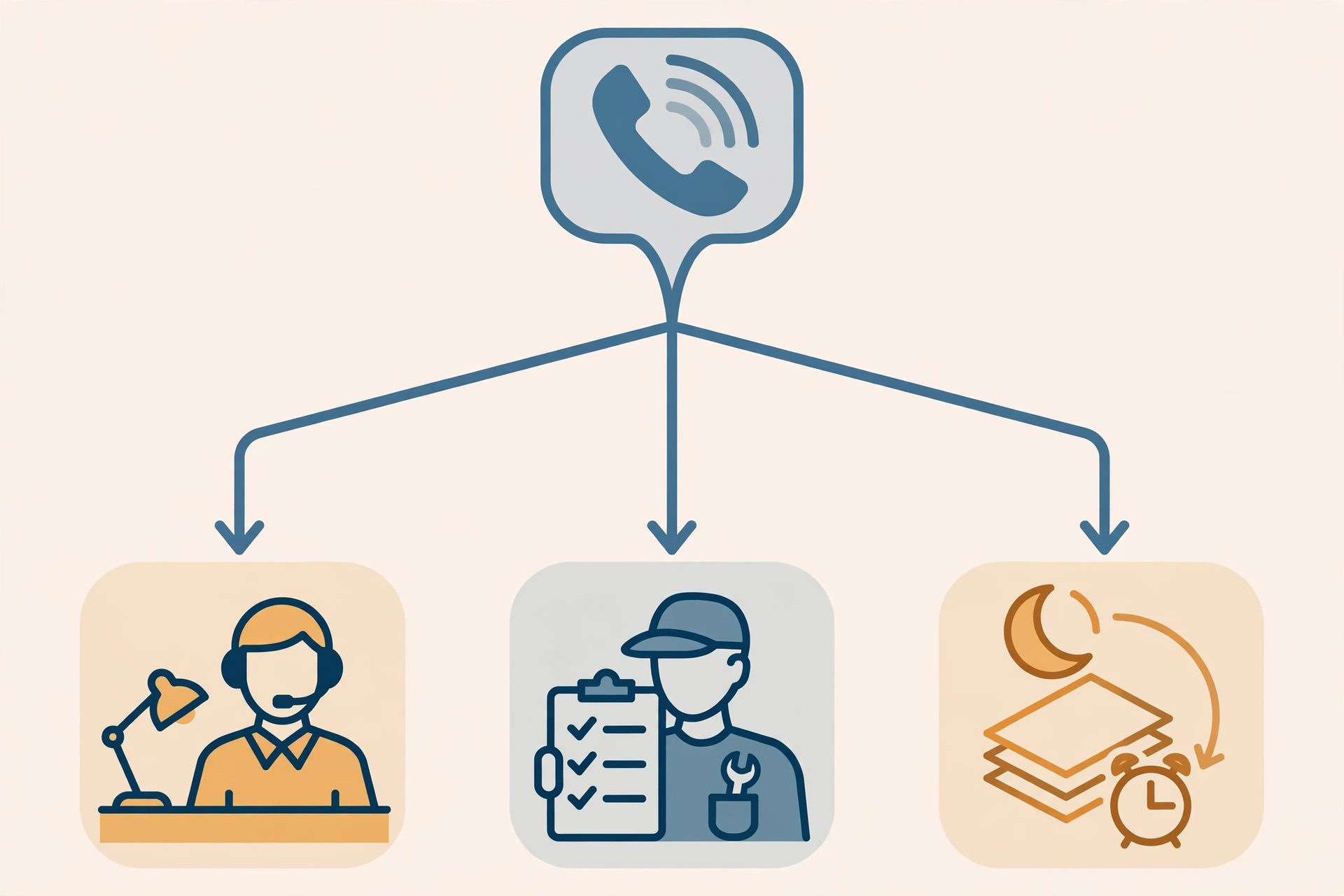
Most of these calls don’t need a human being — they need routing. A new lead needs a dispatcher, now. A status update needs whoever holds the job file, with the actual answer. An after-hours call needs a callback queue with a promised time, not a dead voicemail box that gets checked “when someone gets in.”
Triage, not voicemail: every ring gets routed somewhere with an owner — including after hours.
This is the whole phone-first argument in one story. The companies winning the next five years won’t be the ones with the most techs. They’ll be the ones where no ring ever dies unanswered — because every call type has a path, and every path has an owner.
The four-question audit
Do your listed hours match staffed phones? Every gap is a $90 donation to Google.
What happens to a call at 6:15 PM? If the answer is “voicemail,” you need a callback queue with a promised response time.
Who owns status-update calls? If it’s “whoever picks up,” nobody owns it. Route them to the job file.
When did you last mystery-call yourself? Call your own number after hours tonight. Whatever you hear is what your customers hear.
October 1 just put a price tag on the first kind of missed call. The second kind was always expensive — now you have a reason to fix both.
Secure checkout via Square — all major cards accepted
You can copy this method and do it yourself. Split campaigns by service. Load negatives before you spend another week. Match every landing page to its ad group. Compute fully-loaded cost per acquired job, not just CPC. Buy Now is the packaged analysis delivered by email after checkout, so you are not assembling the read from a blank spreadsheet.
Restoration PPC is an engineering problem, not a set-it-and-forget-it expense. Emergency water-damage keywords have been reported as high as $250 per click in competitive metros. Average emergency restoration keywords more commonly land in the $40-$150 range depending on geography. At those CPCs, structure and landing pages decide whether the phone pays you or you subsidize the auction.
How to run the analysis
Open the account. List every campaign, ad group, and the landing URL each ad actually hits.
Mark the single-campaign trap if you see it: one campaign, one ad group, water / mold / fire / flood keywords fighting each other, every ad pointing at the homepage.
Pull Search Terms for the last 30-60 days. Tag wasted queries (jobs, DIY, training, equipment rental).
Check bidding against conversion volume. Under 30 conversions a month in a campaign is a different tool than 30+.
Open each landing page on a phone. Does the H1 match the ad? Is click-to-call above the fold?
Write fully-loaded cost per acquired job by channel: spend ÷ booked jobs from that channel, then layer close rate. CPC from the dashboard is not that number.
1. Kill the single-campaign trap
Kill the single-campaign trap first.
The most common setup: one campaign, one ad group, a mix of water damage, mold removal, fire restoration, and flood cleanup keywords all fighting each other. Every click gets the same generic ad. Every ad points to the homepage.
Quality Score is built on expected click-through rate, ad relevance, and landing page experience. When you stuff water damage and fire restoration into the same ad group, ad relevance tanks for both. A Quality Score of 9 can outrank a competitor bidding twice as much at a 5. Poor structure can inflate CPC by 30% or more while delivering fewer qualified leads.
Split by service. Each ad group 10-20 tightly related keywords. Every keyword in the group has to fit the same ad and the same landing page. If they do not, split them.
Campaign 1. Emergency water damage. Ad groups for emergency water extraction, burst pipe, basement flooding, sewage backup. Separate ad copy. Landing page that opens with emergency water damage, not the homepage.
Campaign 2. Fire and smoke restoration. Fire damage, smoke damage, soot removal. Different call to action. Fire jobs are longer projects, a different sales conversation.
Campaign 3. Mold remediation. Mold testing, black mold removal, mold inspection. Often a separate buyer with a different timeline.
Give Performance Max its own campaign and its own budget if you run it. PMax black-box reporting will otherwise hide whether Search is working.
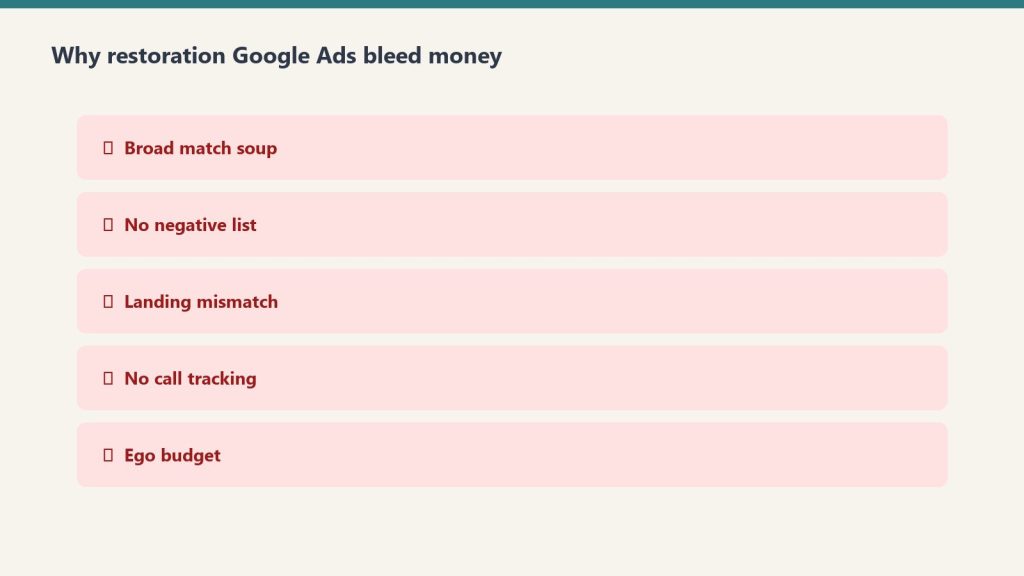
2. Negative keywords: the bill you are not seeing
Negatives are the bill you are not seeing.
Most restoration PPC campaigns have a weak or nonexistent negative list. Every day without one, you pay for job seekers (“water damage restoration jobs near me”), DIY researchers (“how to do water damage restoration yourself”), students looking for training, and equipment renters who are not calling you for service.
Campaigns that actively manage negatives see a reported 10-20% lower wasted spend and a 5-15% conversion-rate lift. On a $10,000/month budget, that is $1,000-$2,000 a month currently going to irrelevant clicks.
Build a seed negative list before the campaign launches. Pull Search Terms weekly for the first 60 days. Add exact-match negatives first. Only go broader if the data supports it. Over-blocking with broad-match negatives will starve volume you actually want.
3. Bidding: stop fighting the machine
A large share of Google Ads spend now runs through Smart Bidding (Target CPA, Target ROAS, Maximize Conversions). Advertisers using AI bidding have been reported at roughly 22% lower cost per conversion versus manual CPC on average. For restoration, the right tool depends on data:
Under 30 conversions per month in a campaign. Maximize Clicks with a CPC cap while you accumulate signal. Smart Bidding starved of conversions produces garbage.
30+ conversions per month. Move to Target CPA. Set the target from actual job margins, not aspirational ones. If a water job averages $12,000 and you close 25% of qualified leads, a $300 CPL target can still profit. If you close under 15%, fix sales before you fix bidding.
Large campaigns with consistent job data. Target ROAS becomes viable only if revenue tracking is actually wired into Google Ads. Most restoration accounts do not have that configured.
The problem is rarely the channel. It is losing track of where the leads went after the phone call.
4. The landing page has to match the ad
Landing page must match the ad — or you paid for confusion.
If the ad says “Emergency Basement Flooding, 24/7 Response” and the landing page is the homepage with a hero of a happy family and a form below the fold, you are burning the click you just paid for.
A restoration PPC landing page needs: the emergency service name in the H1 above the fold; a click-to-call number prominent on mobile; a response-time claim only if you can back it up; one short form (name, phone, zip, issue); proof (reviews, IICRC, insurance logos).
Do not send PPC traffic to the homepage. Do not build one landing page for all services. Match the ad to the page, the page to the ad group, the ad group to the keyword cluster. That chain is where Quality Score lives.
5. Channel mix and the number that actually matters
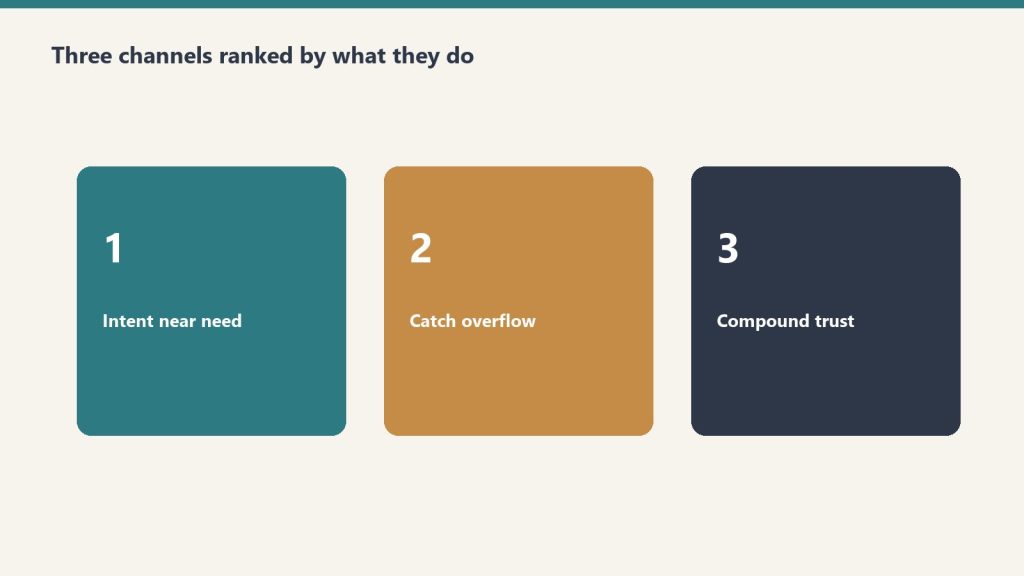
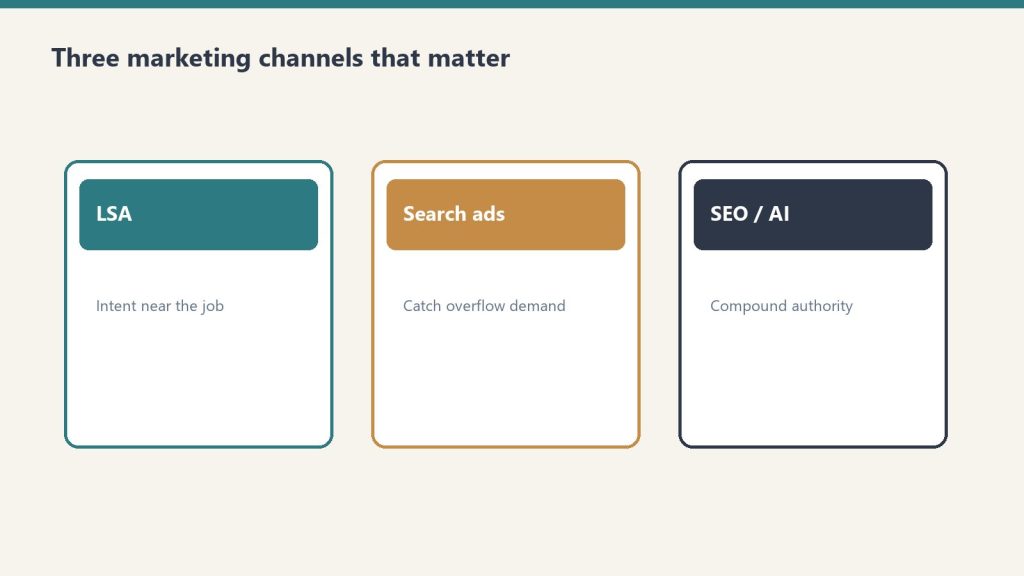
Three channels do the heavy lifting. LSA (pay per qualified call; reported restoration CPL roughly $80-$200 depending on the write-up) is the highest-ROI paid lever for most residential operators, with a catch: Google ended credits for “job type not serviced” and “geo not serviced” in 2025, so junk leads come out of your pocket. Search Ads (reported CPL $150-$400+ structured, $400-$700+ not) buy control LSA does not have: commercial work, specific service lines, overflow when LSA hits a daily cap, brand defense. If you are spending more than $5,000 a month on Search and you do not have LSAs set up, that is the first fix. SEO is the compounding asset. Restoration SEO in competitive metros typically takes 12-18 months. Treat reported ranges as ranges, not promises.
Cost-per-lead is the number every vendor reports. The number that matters is fully-loaded cost per acquired job: CPL divided by channel-specific close rate, plus CSR labor on the call, plus processing, minus franchise or TPA fee if it applies. Most shops have CPL from the platform and revenue from the job software, and the two systems have never talked. Fix that before you change a single bid.
Budget ballparks (Search only, reported)
Mid-size market (pop. 200K-500K): $3,000-$6,000/month to generate 15-30 leads
Major metro (pop. 1M+): $8,000-$15,000/month to maintain consistent visibility
Specific suburb or tight service area: $1,500-$3,000/month if geo is tight and Quality Score is managed
These are Search figures. They are ballparks from the published method, not a quote for your market.
Done when
You can show separate service campaigns, a negative list with at least 50 entries, a dedicated landing page for each major service, and a fully-loaded acquired-job cost by channel. If your current agency cannot show those four, the account is not being run as an engineering problem.
If you want the packaged analysis
You can run the six steps from the outline above on your own login. Buy Now is the analysis delivered by email after checkout. Same Square button at the top of this page.
Marketing and operational read only. Not a media-buy, legal, or insurance engagement. Reported CPC and CPL ranges move by metro and by month. Use your own numbers.