
What is the right content strategy for a restoration company? Every story starts with a job. The four categories worth consistently celebrating are the clients you served, the jobs themselves (especially the ones that went well), the staff who did the work, and the town you operate in. Real job, real photos, real client, real staff, real town, published within a week. That is the content engine. Everything else — the stock photo, the generic blog post, the AI-slop article — is noise that distracts from the signal.
The content problem most restoration companies have is not producing enough content. It is producing the wrong kind. The home page uses stock photos. The blog runs generic posts — “Five Signs of Water Damage” — that could have been written for any restoration company in any market. The Instagram account is a mix of memes and vendor-provided graphics. None of it says anything specific about this company, these people, this town.
The content that actually builds a restoration company’s presence is specific, real, and sourced from the work the company is already doing. Every story starts with a job. If you did not do a job that informs the content, do not publish the content.
The Four Celebrations
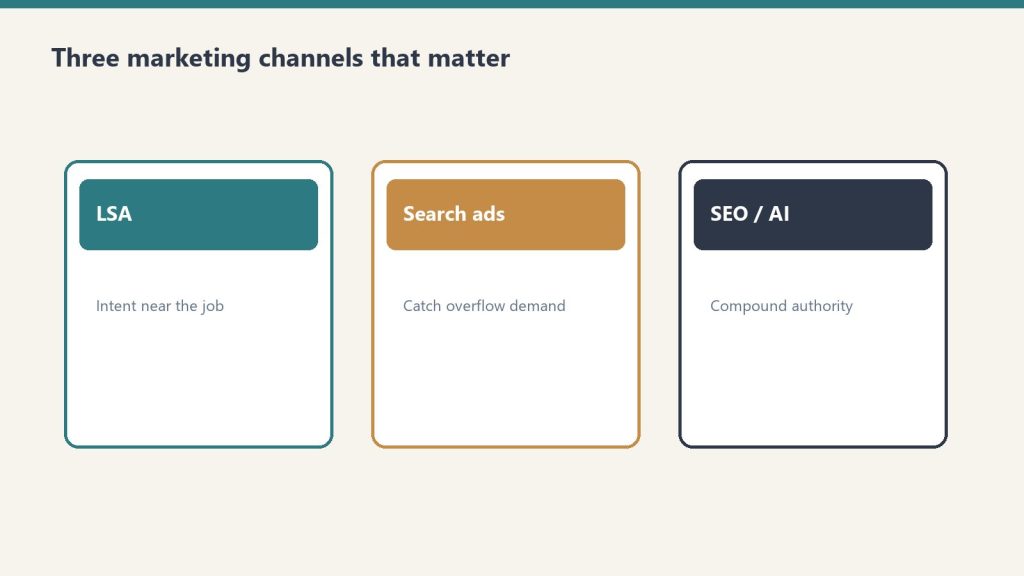
Once you accept that every story starts with a job, the categories worth celebrating are simple. There are four.
The clients. The homeowner whose basement you saved. The small business owner whose storefront reopened on time. The property manager who did not have to explain a bad outcome to ownership. Their story, their name, their appreciation, their permission-granted photo — that is content. It is also the highest-quality signal you can send about who this company is and who it serves.
The jobs. The actual work. The before and after. The scope. The technique. The problem solved. The thing that went unusually well — the water loss finished two days ahead of schedule, the mold remediation that revealed a hidden structural issue, the fire restoration that preserved a family heirloom. That is content. Every completed job has a story in it if someone bothers to extract it.
Get The Signal
What we actually ran, what it measured, and what it means for a restoration shop — every week, including the flops.
The staff. The tech who has been here nine years. The PM who led the three-hundred-thousand-square-foot commercial mitigation. The estimator who caught the insurance issue that saved the client forty thousand dollars. The new hire who just certified on a specialty. The staff is the company. Celebrate them in public and the people inside the company feel it. So do the people outside.
The town. The neighborhoods you work in. The local landmarks near the jobs you completed. The town events the company sponsors. The community moments the company shows up for. Restoration is local. The content should be obviously, specifically local. Use the street names. Name the neighborhoods. Mention the coffee shop on the corner. Show the community as it actually is.
Those four — clients, jobs, staff, town — are the entire content universe that matters for a local restoration company. Everything else is filler.
Why Every Story Starts With a Job
The doctrine that every story starts with a job is not a stylistic preference. It is a filter against the content slop that fills most restoration marketing.
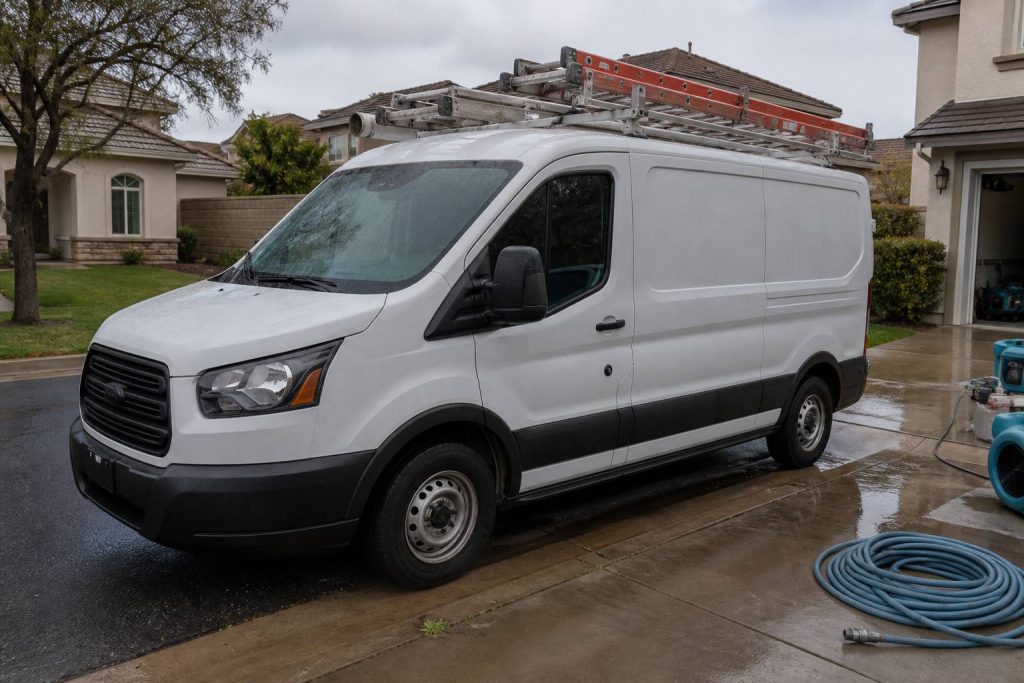
If you start with a job, you have photos. Real photos. The work in progress, the finished result, the truck at the curb, the tech in the PPE, the street sign, the neighborhood. That is the raw material that makes content specific.
If you start with a job, you have a client. A real person or a real business with a real name and a real story. You can ask permission to mention them. You can ask for a review. You can ask for a quote. You can ask for a photo of the finished space. They become content partners, not content subjects.
If you start with a job, you have staff. The tech who ran the point. The PM who quarterbacked the scope. The estimator who put the bid together. The office coordinator who handled the insurance paperwork. Real people doing real work.
If you start with a job, you have a location. A specific street. A specific neighborhood. A specific town. The story is automatically local in a way no generic blog post can be.
If you do not start with a job, you have none of that. You have a stock photo, a generic headline, and a caption that could apply to any restoration company anywhere. The algorithm can tell. The homeowner can tell. The insurance partner can tell. The content does not register because there is nothing specific to register.
The Tech as Content Source
The practical mechanics of the content engine start in the field. The tech on the truck is the primary content source, not the marketing department.
Every job, the tech takes photos. Not for social. For the file. Before photos. During photos. After photos. Equipment in place. Hazards identified. Scope visible. The client looking relieved in the finished space if they agree to it. The street sign. The coffee shop across from the driveway. The neighborhood detail.
Those photos are job documentation and content inventory simultaneously. The content team pulls from the inventory each week. The best jobs become articles. The next tier become social posts. The routine jobs become map pack photos on Google Business Profile or neighborhood page updates on the site.
A company that is not training its techs to photograph jobs is a company with no content pipeline. A company that is training its techs well has a content pipeline that outpaces what the marketing team can even publish.
Real Clients, Real Permission
The content doctrine only works when the clients are treated as partners, not as subjects.
Every job ends with a specific ask about content. Would you be comfortable if we mention the work we did here as an example of our restoration work? Would we be able to use a photo? Would you be willing to leave a review? Would we be able to use a short quote about how the project went?
The ask is stated. The client gives a yes, a partial yes (“you can mention it but please no address”), or a no. All three are fine. The log captures the answer. The content team respects the answer.
Most clients say yes. A meaningful number say partial yes. A small number say no, often for reasons related to the loss (insurance, privacy, embarrassment about the cause). All of those are legitimate. The discipline is to ask every time, respect every answer, and use the yeses as content raw material without having to guess.
This is the opposite of the current content norm in most of marketing, which treats real-client content as something that has to be manufactured or simulated. The restoration company that asks respectfully and uses what it is given produces content that feels real because it is real, and competes on a different plane from companies running generic stock-photo campaigns.
Real Staff, Recognized in Public
The staff celebration is the most underused of the four. Most restoration owners undershare their people. They list them on an about page, maybe, with a headshot. They are uncomfortable putting their techs in front of a camera. They worry about other companies poaching good staff who get public profiles.
The calculation is backwards. The staff who get public recognition become more loyal, not less. The techs who see their work celebrated by the company build identity around the company. The clients who see the company as a set of specific named humans, not an anonymous brand, trust the company more. And the hiring advantage of being known as the company that visibly values its people is bigger than the risk of a poach.
A concrete example of staff celebration: the tenth-anniversary post. The company publishes a short story about a tech on their ten-year anniversary. Photo of the tech, a quote from them about the work, a note about a specific job they handled well, a note from the owner. That post does four things simultaneously — it celebrates a specific human, it tells the team something about what the company values, it tells the community about a specific expert they can trust, and it signals the company’s tenure and continuity to every prospect who finds it.
That kind of post takes thirty minutes to produce. Most restoration companies have never published one.
Real Town, Real Presence
The town celebration is the fourth category, and it is the connective tissue that makes the whole thing feel local.
The content about the town does not have to be about restoration. It can be. It can also be a sponsor of the youth football team. A tent at the town festival. A note about the high school’s graduation. A photo of the new mural downtown. A shout-out to a client business — the local coffee shop where your techs grab coffee on the way to jobs.
The town celebration is how the company becomes visibly embedded in the place, not just transacting in it. It reinforces the community standing that owner-as-rainmaker is building at the trade association level. It gives the content engine a rotation of non-job content that does not feel forced.
The test for whether town content is working: would someone who lives in this town feel like this company belongs to this town? If yes, the content is landing. If no, it is performative.
Publishing Cadence
The content engine runs on a weekly cadence, not a campaign cadence. No January content push. No content “season.” Weekly. Forever.
A minimum working cadence for a local restoration company:
- One job-driven article or blog post per week, pulled from a real completed job
- One neighborhood page update or new page per month, built from a job in that specific neighborhood
- One to three social posts per week, mixing the four celebration categories
- One Google Business Profile post per week
- One email or newsletter per month, built from the same raw material the social and blog used
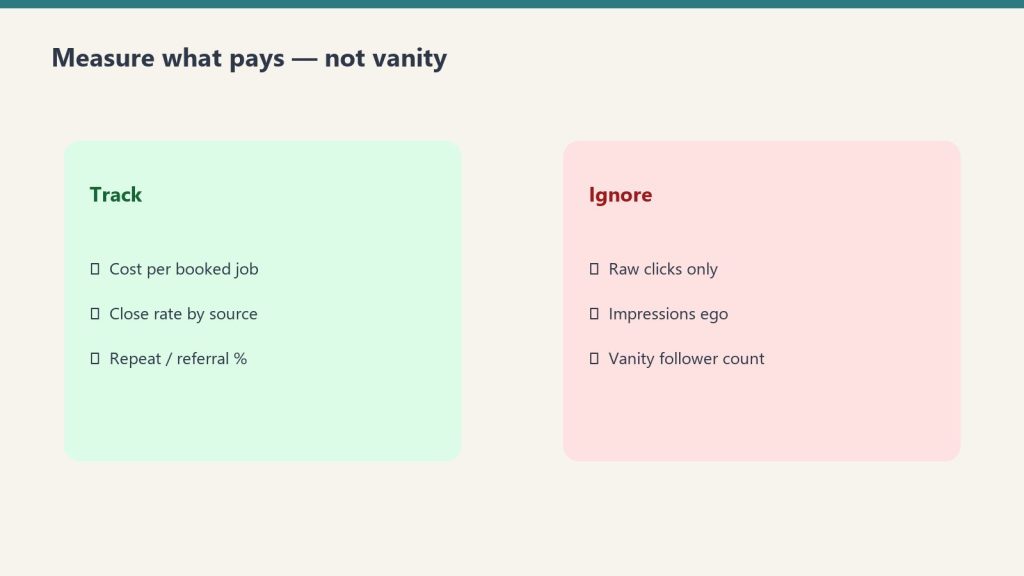
- Client-review request on every completed job, photo capture on every job
That is not a heavy content calendar. It is a weekly habit. Most restoration companies fail to run even this modest cadence not because it is hard but because they are trying to produce content outside of the work. The content engine that runs on the work itself is almost self-sustaining once installed.
Why AI-Generated Generic Content Fails
A quick note on the current wave of AI-generated content. The temptation is real — tools can produce a thousand-word “Signs of Water Damage” article in thirty seconds. Many restoration companies are filling their blogs with this kind of content right now.
It does not work. The content does not rank because it is indistinguishable from a thousand identical articles published by every competitor. It does not convert because it reads like it was written by nobody in particular for nobody in particular. It does not build any durable asset because there is nothing specific in it that belongs to this company.
AI is a useful tool for producing variations of real content, cleaning up tech-written job notes into publishable copy, drafting FAQ answers, and accelerating the editorial process. It is not a substitute for the job itself being the source. The doctrine — every story starts with a job — is the filter against the content slop problem.
How This Pairs With the Rest of the Stack
The content engine produces the raw material every other layer needs. The digital three-legged stool — GBP, website matrix, reviews — is fed by job content. The observational B2B network is reinforced by celebrating joint jobs with partners. The paid layer has specific creative to amplify. The owner’s community standing is reinforced by the town celebrations that make the company visibly present.
Without the content engine, every other layer is starved for material. With it, every other layer has something real to multiply.
Where to Start
This week: pick the best job you completed in the last thirty days. Write one article about it. Real photos, real client quote (with permission), real tech credit, real neighborhood reference, real scope detail. Publish it on the website. Cross-post to social. Link from the neighborhood page.
Next week: install the photo discipline. Every tech, every job, a short list of required photos. Document it. Train to it.
Next week also: install the content ask at job close-out. Script the conversation. Train the PMs and techs to run it. Log the answer in the job file.
Ninety days in: the engine is producing more content than you can publish. The problem flips from “we need content” to “we need to choose.” That is a better problem.
Frequently Asked Questions
What is the right content strategy for a restoration company? Every story starts with a job. Celebrate four things consistently: the clients you served (with permission), the jobs themselves, the staff who did the work, and the town you operate in. Real job, real photos, real client, real staff, real town, published within a week. That is the content engine.
Why does every story need to start with a job? Because the job gives the content everything generic content lacks — real photos, a real client, real staff, a real location. Content that starts with a job is automatically specific, local, and credible. Content that does not is indistinguishable from every other restoration company’s stock-photo blog post.
How do restoration companies get photos for content? Train every tech to photograph every job. Before, during, after, equipment, hazards, scope, street sign, neighborhood detail. The photos are job documentation and content inventory at the same time. The content team pulls from the inventory each week.
How do you get permission to use client names and photos in content? Ask at job close-out as part of the wrap conversation. Can we mention the work we did here? Can we use a photo? Would you leave a review? Most clients say yes. Some say partial yes. A few say no. Respect every answer, log the answer in the job file, and only publish what you are given permission to publish.
Why should restoration companies publicly celebrate their staff? Because staff who are publicly celebrated become more loyal, not less. The fear of staff being poached is outweighed by the identity, retention, hiring, and client-trust gains from having a visibly human, named company. The tech anniversary post is one of the highest-leverage thirty minutes a marketing team can spend.
Is AI-generated content useful for restoration marketing? Useful as a tool to polish tech-written job notes, draft FAQ answers, and accelerate editorial. Not useful as a substitute for the job being the source. Pure AI-generated generic articles (“Five Signs of Water Damage”) do not rank, do not convert, and do not build durable assets because nothing in them is specific to this company.
Tygart Media on restoration — an analyst-operator body of work on the systems that separate compounding restoration companies from busy ones. No client names. No brand placements. Just the operating standard.
Get The Signal
What we actually ran, what it measured, and what it means for a restoration shop — every week, including the flops.
Leave a Reply