The Invisible Majority of Your Readership
For every human who clicks on one of my articles from Bing search results, Microsoft Copilot cites that same content 52 times. Not reads. Not impressions. Citations — instances where an AI engine uses my content as the grounding source for a response delivered to a real user.
The numbers: 98,800 AI citations from Copilot. Roughly 1,900 human clicks from Bing. Same time period. Same domain. Same content.
And here’s what makes this disorienting: I can see the AI citations in Bing Webmaster Tools. But my Google Analytics, my heatmaps, my session recordings, my conversion tracking — none of it registers the 98,800 AI interactions. As far as my analytics stack is concerned, those readers don’t exist.
The largest audience consuming my content is invisible to every measurement tool I’ve used for the past decade.
How We Got Here Without Noticing
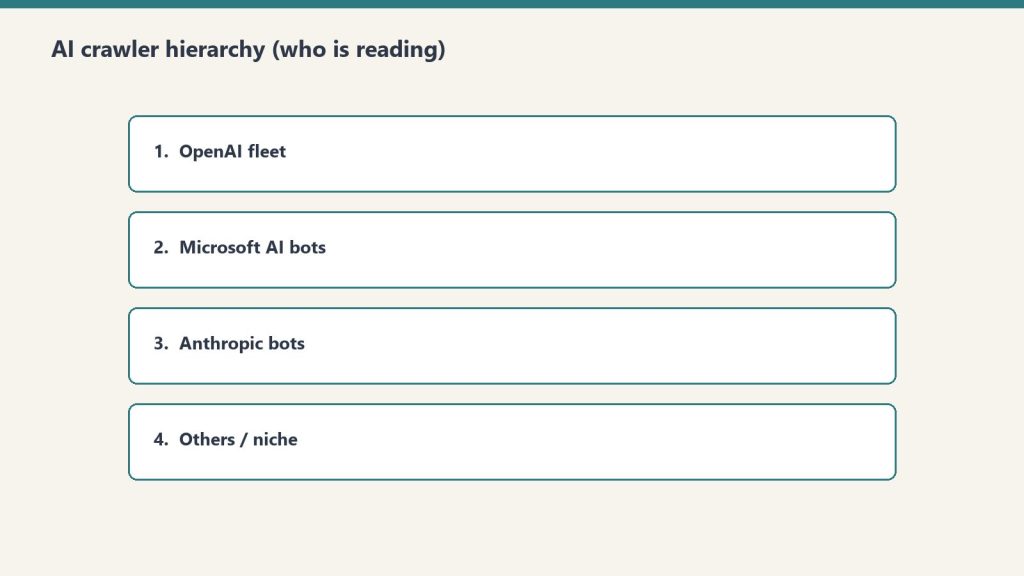
The shift happened gradually, then all at once. Microsoft shipped Copilot in Microsoft 365 to hundreds of millions of enterprise seats. Google rolled out AI Overviews to every search user. ChatGPT launched its search feature. Perplexity grew to millions of daily users. Claude’s user base expanded.
Each of these platforms consumes web content to generate responses. They crawl, index, and cite websites — not to send traffic, but to build the source material for AI-generated answers. Your content becomes the foundation of an AI response that gets delivered to a user who may never know your site exists and will certainly never show up in your analytics.
Get The Signal
What we actually ran, what it measured, and what it means for a restoration shop — every week, including the flops.
The scale is enormous. Microsoft alone has over 400 million Copilot users across its products. If even a fraction of their queries trigger content citations, the total volume of AI-mediated content consumption dwarfs traditional search clicks for many content categories.
My 52:1 ratio might be extreme because my content is heavily skewed toward AI tools — a topic that Copilot users ask about frequently. But even for more general content categories, the AI consumption layer is growing faster than any other traffic channel. And most content operations are completely blind to it.
The Measurement Crisis
Here’s what your current analytics stack tells you about AI consumption of your content: almost nothing.
Google Analytics tracks human visits. An AI engine that cites your content doesn’t load your page in a browser, doesn’t execute JavaScript, doesn’t trigger a session. It reads your content through APIs or cached indexes and incorporates it into a response. No pageview. No session. No data.
Google Search Console tracks clicks and impressions from Google search. It doesn’t track AI Overview citations — when Google’s own AI uses your content to build an AI-generated summary, that interaction doesn’t appear as a click or an impression in Search Console.
The only tool currently offering AI citation data is Bing Webmaster Tools, through its AI Performance beta tab. This shows Copilot-specific citations — the number of times Copilot used your content as a grounding source. But it only covers Microsoft’s AI. Google, ChatGPT, Perplexity, and Claude citation data remains largely invisible.
This creates a measurement crisis. Content operations make decisions based on analytics data. If the majority of your content’s audience is invisible to your analytics, you’re making decisions based on the minority of your readership. You’re optimizing for the 1,900 clicks while ignoring the 98,800 citations.
What “Being Read by AI” Actually Means
When I say AI is reading your content, I want to be precise about what’s happening technically.
Grounding: When a user asks Copilot a question, Copilot searches for relevant web content, retrieves it, and uses it to “ground” its response in factual sources. Your page becomes the cited source for specific claims in the AI’s answer. The user sees your content’s information, often with a link back to your page — but they may never click that link because the AI already gave them what they needed.
Scale: One article on my site answering “claude ai pricing” was grounded 16,500 times. That means 16,500 Copilot users received information sourced from my page. In a traditional web model, that would be 16,500 pageviews. In the AI model, it’s 16,500 invisible reads.
Reach: Each citation represents content delivery to a user who is actively working, actively needing that information, and actively incorporating it into a task. This isn’t a bounce-rate impression — it’s a high-intent content consumption event. The quality of these “reads” may be higher than most human pageviews, even though they’re invisible.
The Writing Implications

If AI is your primary reader, you need to write differently. Not worse. Not shorter. Differently.
Write for extraction, not engagement. AI engines don’t scroll, don’t skim, and don’t get bored. They extract specific information from your content. A pricing table that’s easy for AI to parse serves the citation audience better than a narrative pricing discussion that’s more “engaging” for human readers. Both can coexist, but the extraction-friendly content needs to be there.
Accuracy is non-negotiable. AI engines are grounding their responses on your content. If your pricing page is wrong, Copilot gives 16,500 users the wrong answer — with your name attached as the source. In a traditional web model, a wrong number on a page hurts your credibility with the humans who visit. In the AI model, it hurts your credibility with the AI engine itself, which may stop citing you if users flag the information as incorrect.
Structure beats storytelling for citation content. This doesn’t mean storytelling is dead — it means you need both. The narrative draws human readers. The structured data draws AI citations. A good article about Claude pricing has both: a narrative explanation of the pricing structure and a clean, parseable table of actual numbers.
Currency matters more than ever. AI engines can detect stale content. A pricing article from January 2025 won’t earn citations in June 2026 because the prices have changed. The content that maintains citation velocity is content that’s demonstrably current — date-stamped, version-specific, and regularly updated.
The Monetization Question
The obvious question: if AI is reading your content 52 times more than humans, but those AI reads don’t generate pageviews, how do you monetize them?
Right now, the honest answer is: the direct monetization model is still emerging. Ad revenue depends on pageviews. Affiliate revenue depends on clicks. Lead generation depends on form fills. None of these happen when AI reads your content.
But here’s what does happen:
Brand authority compounds. When Copilot cites your pricing guide 16,500 times, you become the de facto source for that topic. Enterprise workers learn your name through AI responses. When they eventually need to visit your site — for a demo, for a purchase, for a deeper evaluation — they already know you.
Citation begets citation. My data shows a flywheel effect: the more Copilot cites a source, the more it trusts that source for adjacent queries. 672 daily citations grew to 5,500 daily citations over 90 days. Authority compounds in AI engines just as it does in traditional search.
The traffic still comes — indirectly. AI citations include source links. Some users do click through. And as your citation authority grows, your traditional search visibility often grows with it, because AI citation authority and search authority draw from overlapping signals.
The long-term monetization model for AI citations probably looks more like brand advertising than direct response. You’re building awareness and authority at massive scale. The conversion happens downstream, through channels that your analytics can track.
What to Do About It Today
Check your Bing Webmaster Tools AI Performance tab. If you haven’t verified your site with Bing, do that first. The citation data might change how you think about your entire content operation.
Look at your analytics with fresh eyes. That high-quality article with “disappointing” traffic might be generating thousands of AI citations you can’t see. The low-traffic technical guide might be one of your most-consumed pieces of content through AI channels.
Start tracking the AI-to-human ratio for your content categories. Which topics are being consumed primarily by AI? Which are still human-traffic driven? This tells you where to invest in structured, extraction-friendly content (for AI) and where to invest in engagement-optimized content (for humans).
Your biggest audience might be the one you can’t see yet. But the data to find it is already there — if you know where to look.
Related on Tygart Media: AI crawler experiment · citation economy.
Frequently Asked Questions
Does Google Analytics track AI citations?
No. Google Analytics tracks human browser visits. AI engines consume content through APIs and indexes without loading pages in browsers, so they don’t trigger JavaScript analytics. The only current tool showing AI citation data is Bing Webmaster Tools AI Performance beta tab.
What is the AI-to-human read ratio?
For one domain focused on AI tools, the ratio was 52:1 — 98,800 Copilot citations vs 1,900 Bing clicks in the same period. This ratio varies dramatically by topic. Enterprise technology content tends to have very high AI-to-human ratios. Local consumer content tends to have very low ratios.
Should I stop writing for humans and focus on AI?
No. Humans still drive direct revenue through clicks, conversions, and engagement. The strategy is to write content that serves both — narrative elements for human readers and structured, extractable data for AI engines. Both audiences can be served by the same article with intentional formatting.
How do I make my content more citable by AI?
Structure information for extraction: clean tables, specific numbers, version-stamped details, clear definitions. Ensure accuracy — AI engines may reduce citations for sources that users flag as incorrect. Keep content current with date stamps and regular updates.
Will Google eventually show AI citation data?
Google has not announced plans to expose AI Overview citation data in Search Console. However, as the AI citation economy grows and marketers demand transparency, competitive pressure from Bing’s AI Performance tab may push Google to provide similar analytics.
Get The Signal
What we actually ran, what it measured, and what it means for a restoration shop — every week, including the flops.
Leave a Reply