A Lesson Advertisers Learned (That Marketers Forgot)
In the early 2000s, smart TV advertising was a mess. Media buyers would take a 30-second TV spot — optimized for lean-back, passive viewing — and run it on every screen: broadcast TV, connected TV, desktop pre-roll, mobile interstitials, and later, smart TV apps. Same creative. Different screens. Predictably terrible results.
It took the advertising industry about a decade to figure out what seems obvious in retrospect: different screens serve different audiences in different contexts, and the creative has to match.
A smart TV viewer is on the couch, relaxed, 10 feet from the screen. A mobile user is commuting, distracted, holding the phone 12 inches from their face. A desktop user is at work, focused, multitasking. The same 30-second spot that stops a TV viewer cold gets skipped on mobile because the hook takes too long. The same mobile-first vertical video looks absurd on a 55-inch smart TV.
Once advertisers internalized this, the industry restructured. Creative teams started building platform-specific versions from the ground up. Media strategies segmented by screen. Measurement tracked performance by device, by platform, by context. The unified “TV commercial” became an artifact. In its place: a matrix of screen-specific creative, each optimized for its audience.
Content strategy for AI is exactly where TV advertising was in 2005. And most people don’t see it yet.
AI Platforms Are the New Screens
The analogy maps precisely:
Get The Signal
What we actually ran, what it measured, and what it means for a restoration shop — every week, including the flops.
| Platform | Screen | How people use it | What content wins |
|---|---|---|---|
| Microsoft Copilot | Smart TV (built into a device people already own) | Embedded in Microsoft 365, the platform people already use for work. Users aren’t seeking it out; it’s there when they need it. | Lean-back reference material: structured, specific, ready to surface without the user leaving their workflow. |
| ChatGPT | Laptop/desktop | Users go there deliberately, open a session, and engage actively: leaning forward, exploring, asking follow-up questions. | Detailed, nuanced, conversation-worthy content, the equivalent of long-form desktop video that rewards active attention. |
| Perplexity | Curated feed | Synthesizes the best sources into a clean answer with citations, like a personalized news feed or a curated newsletter. | Authoritative, primary content: the source a discerning editor would choose as the definitive reference. |
| Google AI Overviews | Pre-roll | Appear before the organic results, like a pre-roll ad before a YouTube video, capturing attention at the top of the funnel. | Content formatted for instant extraction: concise definitions, direct answers, structured lists that can be repurposed into a summary. |
| Google organic search | Broadcast TV | Still the largest audience, the broadest reach, and the most competitive, but no longer the only screen that matters. | SEO structure built to rank for keyword searches. |
My data shows the Copilot fit: 98,800 citations from enterprise users who never left Word or Edge.
The audiences, by the numbers (as of October 2026)
Copilot: Microsoft said Microsoft 365 Copilot reached over 30 million paid seats in its fiscal fourth-quarter results (July 29, 2026).
ChatGPT: OpenAI said at DevDay that ChatGPT now has 1.2 billion weekly users, up from 1 billion in July (The Verge, September 29, 2026).
Perplexity: CEO Aravind Srinivas said Perplexity received 780 million queries in May 2025, with more than 20% month-over-month growth (TechCrunch, June 5, 2025).
Google AI Overviews: Alphabet said AI Overviews now have over 2.5 billion users each month (investor presentation, June 3, 2026).
These are different measures (paid seats, weekly users, monthly queries, monthly users), so they don’t compare head to head. That’s the same reason to measure each platform separately.
The Creative Matrix for AI Content

Just as an ad agency now produces a creative matrix — smart TV version, mobile version, desktop version, social version — a content operation needs to produce a content matrix for AI platforms.
Let me show how this works with a real example. I publish content about Claude AI pricing. Here’s how that single topic gets treated differently for each platform:
Copilot version: Clean pricing table. Plan names, model names with version numbers, input/output token costs, monthly subscription prices. Minimal narrative. Maximum structure. This is the version that earns 16,500 citations because Copilot users need a number, not a story.
ChatGPT version: 2,000-word analysis of Claude’s pricing strategy. How the tiers compare to OpenAI’s pricing. What the model costs mean for different use cases. Total cost of ownership calculations. Strategic framing for business decision-makers.
Perplexity version: The definitive, comprehensive, most-current pricing reference on the internet. Updated within days of any price change. Formatted so Perplexity can cite specific numbers with confidence. The page that makes other sources unnecessary.
Google version: SEO-optimized comparison page. “Claude AI Pricing 2026” in the title. FAQ schema. Clean headings. First paragraph answers the query directly. Designed to rank for keyword searches.
In practice, some of these treatments can coexist in a single article. My highest-performing pages layer narrative depth (for ChatGPT and human readers) on top of structured data tables (for Copilot extraction) with FAQ sections (for Google snippets and AEO). But the intentionality matters — you have to design for each screen, not just hope one version works everywhere.
What the Ad Industry Learned That Content Strategy Hasn’t
The advertising industry’s transition to screen-specific creative taught several lessons that apply directly to AI content strategy:
The generalist loses. The brand that ran the same spot everywhere got outperformed by the brand that optimized for each screen. In content, the operation that writes one article and publishes it hoping all AI platforms cite it will be outperformed by the operation that tailors content for each platform’s audience.
Measurement has to segment by platform. Ad performance makes no sense when aggregated across all screens. A campaign that crushed on mobile but bombed on CTV looks mediocre in aggregate. The same is true for AI content: if you’re measuring “AI visibility” as a single metric, you’re missing the fact that your Copilot performance might be exceptional while your ChatGPT performance is zero.
The production model has to change. When TV went from one-spot-fits-all to screen-specific creative, production workflows had to adapt. Agencies started shooting with multiple formats in mind. Content operations need the same evolution: write with multiple AI platforms in mind from the start, not as an afterthought.
The early movers win disproportionately. The brands that figured out smart TV creative early locked in audience relationships and platform partnerships that late movers couldn’t replicate. In AI content, the publishers that build platform-specific citation authority now are building a moat. My Copilot citation flywheel — 672 daily citations growing to 5,500 — is the content equivalent of early smart TV audience lock-in.
Why Content Operations Are Behind

The advertising industry had a structural advantage: media buyers were already thinking in terms of channels, audiences, and platforms. When new screens emerged, the mental model of “different creative for different channels” was already established. They just had to apply it to a new channel.
Content marketing has operated under a different mental model: “publish great content and let search engines distribute it.” For twenty years, this meant one distribution channel (Google) with one optimization framework (SEO). The idea that you might need platform-specific content strategies for AI engines is foreign to most content operations because they’ve never had to think about distribution as a multi-platform problem.
That’s changing. The data is forcing it. When you can see in Bing Webmaster Tools that your enterprise tool content earns 5,500 daily Copilot citations while your local content earns zero, the multi-platform nature of AI distribution becomes undeniable. And once you accept that AI platforms are different audiences, the advertising industry’s decades of screen-specific creative become your playbook.
Building the Platform-Specific Content Operation
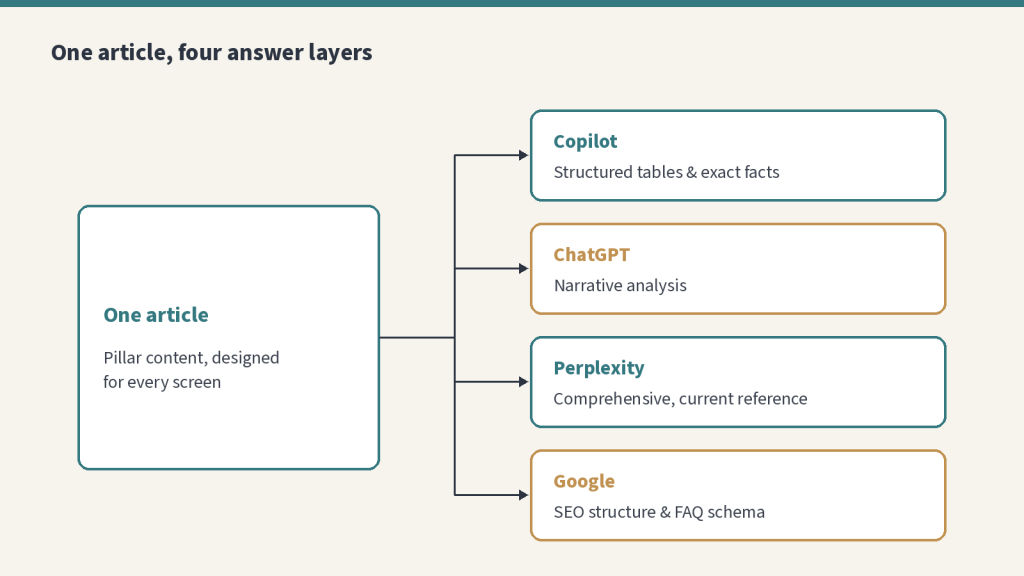
Here’s what the transition looks like, based on what I’m building right now:
Audit by platform. Check your Bing AI Performance data. Manually test your key topics in ChatGPT, Perplexity, and Claude. Build a map of which content earns citations where.
Segment your content calendar. Assign platform targets to each piece of content. “This pricing guide is optimized for Copilot extraction.” “This thought leadership piece is optimized for ChatGPT depth.” “This reference page is optimized for Perplexity authority.”
Structure for multiple audiences in one article. Your best content should layer: structured data for Copilot, narrative depth for ChatGPT, definitive authority for Perplexity, and keyword optimization for Google. Not every piece needs all four, but your pillar content should.
Measure separately. Track Copilot citations in Bing Webmaster Tools. Track ChatGPT referral traffic in analytics. Test Perplexity visibility manually. Don’t aggregate these into one “AI performance” number — they’re different audiences and need different metrics.
The ad industry spent a decade learning that one creative doesn’t fit all screens. The content industry can learn the same lesson faster — because the data is available today, and the playbook has already been written by someone else.
For Agency Media Buyers: What Happens After the Spot Airs
If you buy TV for a living, here’s the part of the funnel that changed under your feet. A viewer sees your client’s spot, picks up a phone or opens a laptop, and asks a question. Increasingly that question goes to ChatGPT, Copilot, Perplexity, or a Google AI Overview instead of a plain search box. “Is this brand any good?” “What’s the best option in this category?” “Who else does this?”
The assistant answers in a sentence or two, and it names whoever it can actually read and trust. Sometimes that’s your client. Sometimes it’s a competitor that never bought a single spot. Your reach and frequency can be perfect, and the demand the campaign created can still leak to whoever the AI cites at the moment of follow-up.
It’s the same screen-specific lesson from earlier in this piece, one step later in the funnel. The TV creative does its job. Then the answer layer decides who gets the credit. Three things matter there:
Whether the brand gets cited. Run the questions a viewer would ask after the spot and see which names come back, platform by platform.
Whether answer-ready content exists. Pages that answer the brand and category questions directly — clear definitions, specific facts, FAQ structure — are what assistants extract and cite.
Whether it’s measured separately. Citation visibility is its own metric, tracked per platform, not a line folded into search or brand lift. Here’s how I think about what a citation is worth.
That’s where Tygart Media fits. We don’t buy your airtime, and we don’t make the spot. We make sure that when the spot sends people to an AI assistant, your client is the answer it gives. That starts with a citation scan — where AI cites the brand today, where it doesn’t, and who it cites instead — and moves into rebuilding the pages AI pulls its answers from, using the same methodology behind this site’s own citation numbers.
Running a TV campaign and want to know what AI says when viewers go looking? Tell us about it, and we’ll tell you honestly whether we can help.
Related on Tygart Media: different AI audiences · SEO vs GEO vs AEO · citation economy.
Sources:
- Microsoft, “Microsoft Cloud and AI strength fuels fourth quarter results,” July 29, 2026. news.microsoft.com
- The Verge, “ChatGPT now has 1.2 billion weekly users, OpenAI says,” September 29, 2026. theverge.com
- TechCrunch, “Perplexity received 780 million queries last month, CEO says,” June 5, 2025. techcrunch.com
- Google (The Keyword), “Alphabet investor presentation: June 2026,” June 3, 2026. blog.google
Frequently Asked Questions
How is AI content like advertising?
Just as advertisers create different creative for smart TV, mobile, desktop, and social media, content operations need platform-specific approaches for Copilot, ChatGPT, Perplexity, and Google. Each platform serves a different audience in a different context with different needs.
Can one article serve all AI platforms?
Yes, with intentional layering. A single article can include structured data tables for Copilot extraction, narrative depth for ChatGPT engagement, authoritative sourcing for Perplexity citation, and keyword optimization for Google rankings. The key is designing for all audiences from the start.
What does platform-specific content measurement look like?
Track Copilot citations in Bing Webmaster Tools AI Performance tab. Monitor ChatGPT referral traffic in Google Analytics. Test Perplexity visibility by manually searching your topics. Measure each platform separately rather than aggregating into one AI performance number.
Which AI platform should I prioritize?
It depends on your audience. Enterprise and technology content should prioritize Copilot because its user base is knowledge workers mid-task. Consumer and research content may perform better on ChatGPT. Use the topic-platform fit matrix to determine where your content has the highest citation potential.
How did smart TV advertising change production workflows?
Agencies shifted from one-spot-fits-all to shooting with multiple formats in mind from the start. Content operations need the same evolution: plan content with multiple AI platform audiences in mind during the writing process, not as a post-publish optimization.
Get The Signal
What we actually ran, what it measured, and what it means for a restoration shop — every week, including the flops.
Leave a Reply