A New Kind of Unit Economics
I wrote an article about Claude AI pricing. The entire production cost — from research to publication — was roughly $0.35 in AI API costs and about 20 minutes of my time for editing and fact-checking. I published it through my existing WordPress infrastructure with zero additional distribution cost.
That article has generated over 4,000 Copilot citations for the query “claude ai pricing” alone, with the total across related queries pushing well past 16,500. It earns new citations every day. It’s been cited more times than most marketing campaigns reach people.
The cost-per-citation: less than $0.00009. Nine thousandths of a penny per citation.
Compare that to any traditional content marketing metric. Cost per click in paid search for AI tool keywords runs $5-15. Cost per impression in display advertising is $5-10 per thousand. Cost per lead in B2B SaaS is $50-200. The cost per AI citation for well-optimized content is effectively zero.
This isn’t a gimmick or an edge case. It’s the fundamental unit economics of the AI citation economy — and they’re so different from traditional content economics that most marketers haven’t processed what they mean.
How the $0.35 Article Gets Made
Let me break down the actual production pipeline for an article that earns thousands of AI citations.
Get The Signal
What we actually ran, what it measured, and what it means for a restoration shop — every week, including the flops.
Research and outline: I use AI tools to research current pricing data, feature comparisons, and user questions for the topic. This involves API calls to Claude for synthesis and cross-referencing against official documentation. API cost for a thorough research session: roughly $0.10-0.15.
Draft generation: Using my content pipeline — which combines AI-assisted drafting with manual editing and fact-checking — I produce a structured article with pricing tables, feature comparisons, and FAQ sections. API cost for drafting and revision: roughly $0.10-0.20.
Optimization and formatting: I apply SEO, AEO, and GEO optimization passes. Schema markup gets injected. Internal links are added. Taxonomy is assigned. This is partially automated through my publishing pipeline. API cost: roughly $0.05-0.10.
Publication: The article is published via WordPress REST API. Zero distribution cost. No paid promotion. No social media budget. The content sits on its own domain and waits for AI engines to discover it.
Total API cost: approximately $0.25-0.45. Call it $0.35 as a round number. My time investment is 15-30 minutes for quality control, fact-checking, and editorial decisions that I don’t delegate to AI.
That’s the entire investment. There’s no ad spend to drive traffic. No outreach campaign to earn backlinks. No social distribution budget. The content earns citations because it’s the best available answer to a question that enterprise workers ask Copilot regularly.
The Compounding Returns
What makes AI citation economics fundamentally different from traditional content economics is the compounding behavior.
In traditional SEO, a blog post might earn organic traffic for 6-12 months before it starts declining. You have to continually produce new content to maintain traffic levels. The depreciation curve is steep.
In AI citations, I’m observing the opposite pattern. My Copilot citation data shows a flywheel: daily citations grew from 672 to 5,500 over 90 days. The more Copilot cited my content, the more queries it became eligible for, which generated more citations, which built more authority for adjacent queries.
A $0.35 article doesn’t just generate citations once. It generates citations daily, at increasing volume, for as long as it remains accurate and current. The total lifetime citations for a well-maintained article in a high-demand topic could reach tens of thousands.
The math is simple but staggering: invest $0.35 to create the article, spend another $0.10 every month or two updating it for accuracy, and collect thousands of citations continuously. The return on that investment doesn’t have a meaningful comparison in traditional marketing economics.
Why This Doesn’t Work for Every Article
Before this sounds like alchemy, here’s the reality check: the $0.35-to-4,000-citations ratio only works when three conditions are met.
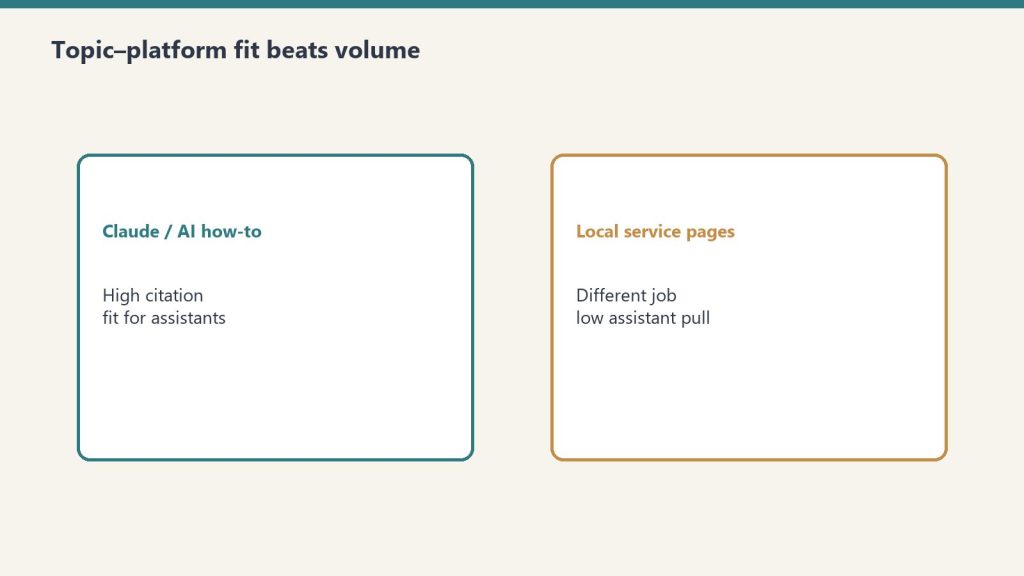
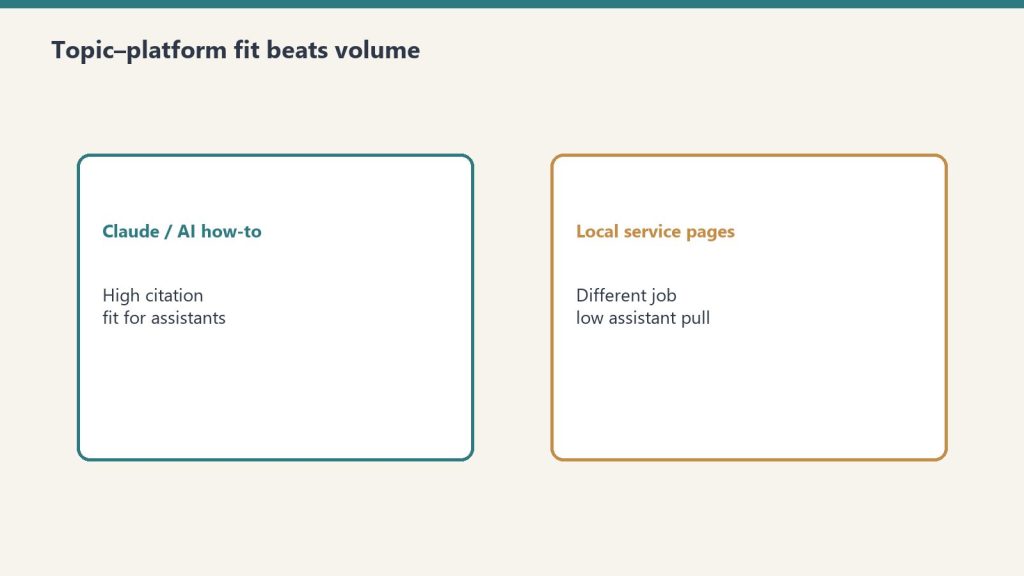
Condition 1: Topic-platform fit. The article has to answer questions that Copilot users actually ask. “Claude AI pricing” is a perfect fit because enterprise workers evaluating AI tools ask this question inside Microsoft 365 regularly. An article about local restaurant hours would cost the same $0.35 to produce and earn zero Copilot citations — because nobody asks Copilot that question.
Condition 2: Structural quality. Copilot’s grounding algorithm prefers content it can extract cleanly. A pricing table that’s formatted as a real HTML table gets cited more than the same information buried in paragraphs. Structured content with clear headings, defined terms, and extractable data points earns more citations per article than narrative content with the same information presented conversationally.
Condition 3: Accuracy and currency. AI engines can detect when content is outdated. My pricing articles are version-stamped and updated regularly. An article that says Claude Haiku costs one price when it actually costs another will eventually lose citations as the AI engine gets corrective signals from other sources or user feedback.
When all three conditions are met, the unit economics are extraordinary. When any one is missing, the economics collapse to zero — literally zero citations regardless of how much you spend on production.
Comparing the Numbers
Here’s how AI citation unit economics compare to traditional content marketing channels, using rough industry benchmarks:
Paid search (Google Ads): Cost per click for AI tool keywords: $5-15. To reach 4,000 users, you’d spend $20,000-60,000. And those users might bounce without engaging.
Display advertising: Cost per thousand impressions: $5-10. To reach 4,000 users, you’d spend $20-40 — but impressions are passive. The user might not even notice your ad, let alone engage with your content.
Content marketing (traditional): A well-produced blog post might cost $200-500 between writer, editor, and designer. It might earn 500-2,000 organic visits over its lifetime. Cost per engaged reader: $0.10-1.00.
AI citation content: Production cost: $0.35. Citations earned: 4,000+ (and growing). Cost per citation: $0.00009. And each citation represents a high-intent user who received your information as part of their active workflow — not a passive impression, not a possible bounce.
The comparison isn’t even in the same order of magnitude. AI citation content is 10,000x more cost-efficient than paid search for reaching users at scale. The caveat is that citations aren’t clicks — you don’t control the downstream conversion. But for brand authority, content distribution, and audience reach, the economics are unprecedented.
What This Means for Content Operations
If the unit economics of AI citation content are this different from traditional content, the operational implications are significant.
Volume becomes feasible. When an article costs $0.35 to produce, you can produce a lot of them. The constraint isn’t budget — it’s editorial quality and topic selection. A content operation can test hundreds of topics to find the ones with the best citation economics and then invest in keeping those articles current.
Maintenance becomes the job. In traditional content marketing, the work is producing new content. In AI citation marketing, the work shifts to maintaining existing content. An article that’s earning 1,000 daily citations needs to stay accurate, current, and structured. A $0.10 update that keeps a $0.35 article earning citations for another quarter is the highest-ROI work in content marketing.
Topic selection becomes everything. The difference between a $0.35 article that earns 4,000 citations and a $0.35 article that earns zero is topic-platform fit. Content operations need to get very good at identifying which topics will earn citations on which platforms before investing production resources.
The moat is compounding authority. The early articles that establish citation authority create a flywheel that later articles benefit from. My domain’s Copilot authority — built through 98,800 citations over 90 days — means new articles I publish earn citations faster than they would on a domain starting from scratch. The economics improve over time for the first mover.
The Uncomfortable Conclusion
The unit economics of AI citation content are so favorable that they make most traditional content distribution strategies look wasteful by comparison. You could spend $50,000 on a content marketing program — writers, editors, designers, SEO tools, paid distribution — or you could spend $35 on 100 precisely targeted, AI-optimized articles and potentially generate more total reach through AI citations alone.
The catch is that AI citations don’t (yet) convert the same way clicks do. You can’t track a citation to a sale the way you can track a PPC click to a purchase. The monetization model is still emerging.
But the reach is real, the authority-building is real, and the compounding is real. And the cost to participate is $0.35 per article. The barrier to entry has never been lower. The question is whether your content operation is measuring what matters.
Related on Tygart Media: 98,800 Copilot citations · 16,500 Copilot citations · citation economy.
Frequently Asked Questions
How can an article cost only $0.35?
The $0.35 represents AI API costs for research, drafting, and optimization. It assumes a content operator using AI-assisted workflows who handles editorial judgment, fact-checking, and quality control themselves. Infrastructure costs like hosting and WordPress are sunk costs spread across the entire content operation.
Are AI citations as valuable as clicks?
They serve different functions. A click delivers a user to your site where you control the experience. A citation delivers your information to a user through an AI interface. Citations build brand authority at massive scale but lack direct conversion tracking. The long-term value likely accrues through brand recognition and downstream conversions.
What is the ROI of AI citation content?
Direct ROI measurement is still developing because citation-to-revenue attribution doesn’t exist yet. However, at $0.35 per article and thousands of citations per article for well-targeted topics, the cost per unit of reach is orders of magnitude lower than any traditional content channel.
Does every article earn thousands of citations?
No. Citation volume depends on topic-platform fit, content structure, and accuracy. Articles on topics that Copilot users ask about regularly can earn thousands of citations. Articles on topics that don’t match the platform’s user base earn zero. Topic selection is the primary variable.
How often should AI citation content be updated?
Content should be updated whenever the underlying facts change — especially pricing, version numbers, and feature availability. For fast-moving topics like AI tool pricing, monthly reviews are appropriate. Each update costs roughly $0.10 in API costs and preserves the citation authority the article has built.
Get The Signal
What we actually ran, what it measured, and what it means for a restoration shop — every week, including the flops.
Leave a Reply