“The highest-ROI marketing work is also the most boring. That’s not a coincidence.”
Name. Address. Phone. Identical everywhere. That’s the whole piece, and it’s worth more than the last three marketing tactics you tried combined — because nobody does it, because it’s boring, and boring is exactly where the edge lives.
The witnesses
Your business doesn’t exist in one place. It exists in dozens, and each one is a witness testifying about who you are and where to find you.
The Google profile. The website footer. Yelp, Facebook, Angi, the BBB. The directories you claimed in 2017 and forgot. The truck door. The invoice template. The email signature. Every one of them says your name, your address, your phone number — or it says something close, which is worse.
Nobody audits the witnesses. That’s the problem, and the opportunity.
The leaks
Here’s what the witnesses are saying right now, on profiles all over town:
“123 Main St” on Google, “123 Main Street” on Yelp, “123 Main St Suite B” on Facebook — three addresses for one door. The old cell number still on the Angi listing from before the voice line. The suite number on the website, missing everywhere else. The Facebook page from 2016 with the previous address, still ranking, still confusing people.
Each mismatch is small. Together they’re a credibility leak. The homeowner comparing two contractors doesn’t think “NAP inconsistency” — they think “something feels off about this one,” and they can’t say why. The search engine doesn’t think in words at all — it just has less confidence that all these listings are the same business, and confidence is the currency.
Small leaks, everywhere, all the time. That’s what boring neglect looks like.
The dividend
Now flip it. Every place that agrees is a vote.
Same name, same address, same phone — on the profile, the site, the directories, the truck, the invoice. Each matching witness raises confidence: the human’s (“these people have their act together”) and the machine’s (every corroborating listing makes the entity clearer). Trust isn’t built in one place. It’s the sum of a hundred small agreements.
That’s the dividend: not a spike, a yield. It pays a little every day, in every search, in every comparison — the quiet background hum of a business that agrees with itself. You don’t notice it working. You notice when it’s missing.
The audit
The work is unglamorous, which is why I’m spelling it out:
Write down the canonical version — one name, one address format, one phone number. Not the pretty version, the exact version: St or Street, suite or no suite, which number. Then list every witness: every profile, every directory, the site, the truck, the invoices, the signatures. Then fix every mismatch, one by one, until they all testify the same.
Then maintain it. New directory? Canonical version goes in. New truck? Canonical version on the door. New phone system? Every witness gets updated the same week, not “when we get around to it.”
It’s an afternoon of tedium, twice a year. That’s the whole price.
The boring moat
Here’s why this is a moat and not just hygiene: your competitors won’t do it.
Not because they’re lazy — because it’s boring, and boring doesn’t feel like marketing. Marketing feels like a new website, a new ad campaign, a new something. Nobody gets excited about making the suite number match in fourteen places. So nobody does it. The field stays sloppy, and the one business that agrees with itself everywhere stands out without spending a dollar.
Every real edge I’ve ever seen looked boring from the outside. This one just happens to look boring from the inside too.
The close
Name. Address. Phone. Identical everywhere.
Boring is the moat. Consistency is the dividend. And the businesses collecting it are the ones whose witnesses all tell the same story — the story of a business that has its act together, down to the suite number.
For twenty years, SEO was link-building. Other sites vouching for you, one hyperlink at a time. That game is over — and the replacement is sitting in your Google Business Profile, mostly ignored.
Your reviews are your new backlinks.
Why trust moved
An answer engine recommending a contractor at 2 AM is making a trust decision. It can’t inspect your trucks or interview your techs. It reads signals — and the richest trust signal a local business produces is the public record of its customers, in their own words.
Links said “this site is authoritative.” Reviews say “this company showed up, did the work, and a real human vouches for it.” In the answer era, the second statement is worth more than the first.
The three layers
Not all reviews are fuel. Three layers separate the profiles that get cited from the ones that don’t:
1. Volume and recency. A profile with 200 reviews and nothing in three months reads abandoned. The engine notices recency the way a homeowner notices dust. Trust is a flow, not a stock — it needs refilling.
2. Content. “Great service, highly recommend” is noise. It says nothing the engine can verify. Compare: “They dried out our kitchen after the dishwasher supply line burst, here in Puyallup, and had fans running the same day.” That’s a service, a place, a timeline, an outcome — verifiable detail from a third party. That’s citation fuel.
Most contractors get the first kind because they ask for “a review.” The second kind comes from asking a better question — more on that below.
3. Responses. The owner answering every review — good and bad — is the consistency discipline made visible. It proves there’s a human tending the business. The engine reads a thoughtful response as operational evidence: this company pays attention.
How to ask
Don’t ask for “a review.” Ask at the moment of relief — the equipment’s out, the house is dry, the stress is gone — and make it specific:
Send the direct link. Every extra tap loses half your ask rate.
Prompt for the details: what happened, where, how fast. “Mention what we fixed and how quickly” is a fair ask, and it turns noise into fuel.
Ask the happy ones. The tech knows who they are. Build the ask into the job-close routine, not into a quarterly campaign.
One detailed review a week beats fifty generic ones a year.
The bad review is content too
Answer it like the answer engine is reading — because it is. A calm, specific, human response to a one-star review is some of the strongest trust content a profile can carry. It shows how the company behaves when things go wrong, which is exactly what a 2 AM homeowner is trying to figure out.
Never argue. Never go silent. Own what’s ownable, state what happened in plain words, invite the conversation offline. The response isn’t for the reviewer — it’s for the hundred strangers reading it after.
What reviews don’t replace
The pages still matter. The GBP still matters. Name, address, phone — consistent everywhere — still matters. Reviews are the fuel, not the engine. A hundred five-star reviews on a profile with the wrong phone number is a fast car with no wheels.
But given the foundation, reviews are the highest-leverage work in local trust. Nothing else you do produces third-party verifiable detail at zero marginal cost.
The close
Backlinks were other websites vouching for you. Reviews are your customers vouching for you, in public, in their own words, attached to real jobs in real towns.
The currency changed. The game didn’t. Get vouched for.
This is part of Tygart Media’s AI Search Intelligence series — a 10-part investigation into how AI systems discover, evaluate, cite, and refer traffic to web content, built on proprietary server log data and real-world publishing experiments.
Every CMO can tell you what a Google click is worth. Years of attribution modeling, CTR curves, and keyword-level conversion tracking have made the organic search click one of the most well-understood units of value in digital marketing. But ask that same CMO what a Microsoft Copilot citation is worth — a referral from copilot.microsoft.com where an AI system explicitly names their brand as a source — and you will get silence.
That silence is a strategic vulnerability. AI search is not a future state. It is a current one. And the organizations that build valuation frameworks for AI citations now will have a decisive advantage over those still trying to retrofit Google Analytics models onto an entirely different referral mechanism.
At Tygart Media, we have been tracking this problem with real data. After publishing 40 articles targeting Microsoft Copilot citation patterns, we recorded 3 confirmed Copilot citation referrals within 48 hours — and simultaneously observed that AI crawlers were hitting our server 6,805 times compared to 4,897 traditional visits (Tygart Media server log analysis, June 2026). AI is already reading more than humans are browsing. The question is no longer whether AI citations matter. The question is: how much are they worth?
This article introduces our AI Citation Value Framework — a 5-component model for measuring what a Copilot referral is actually worth to a publisher, a brand, or a business.
Why Traditional SEO ROI Models Break for AI Search
Why traditional SEO ROI models break for AI search.
Before we build the new framework, we need to understand why the old one fails. Traditional SEO ROI modeling depends on a chain of measurable inputs that simply do not exist in AI search.
The Four Structural Breaks
1. No keyword position to track. In traditional search, value begins with a ranking position. Position 1 for “enterprise software comparison” has a known CTR, a known traffic volume, and a known conversion probability. In AI search, there is no position. Your content is either cited or it is not. There is no “position 3 in Copilot” — the AI either references your brand or it does not mention you at all.
2. No CTR curve to model. Google’s organic CTR curve — where position 1 captures roughly 27-30% of clicks and position 10 captures roughly 2-3% — is one of the foundational inputs to every SEO ROI projection. AI citations have no equivalent curve. When Copilot cites a source within an enterprise workflow answer, the user either clicks through to the cited source or they do not. There is no graduated decay based on citation order.
3. Citations are binary, not graduated. This is the most fundamental structural difference. Traditional SEO operates on a spectrum — position 1 is better than position 5, which is better than position 20, which is better than position 50. Each position has a calculable value. AI citations are binary. You are cited, or you are not. You are the named source, or you are invisible. This binary nature makes traditional regression-based ROI modeling inapplicable.
4. Value accrues through authority reinforcement, not traffic volume alone. In traditional SEO, the primary value mechanism is traffic. More traffic means more conversions means more revenue. In AI search, value accrues through a different mechanism: being cited is worth more than being clicked. The citation itself — the act of an AI system naming your brand as an authoritative source — carries independent value beyond the referral click it may or may not generate.
Definition — AI Citation Value: The total economic impact of being named as a source by an AI system, encompassing direct referral traffic, brand authority reinforcement, compounding citation patterns, retargeting opportunities, and extended content shelf life. Unlike traditional organic search value, AI citation value is not derived from keyword position or CTR curves but from the binary act of being cited by a trusted AI intermediary.
The AI Citation Value Framework: Five Components
The AI citation value framework — five components.
Our framework decomposes the value of a single AI citation into five measurable components. Each captures a different dimension of value that traditional models ignore. Together, they provide a comprehensive picture of what a Copilot referral — or any AI citation — is actually worth to an organization.
Component 1: Direct Referral Value
This is the component closest to traditional SEO measurement: the value of the actual click that occurs when a user follows a citation link from an AI response to your website. But even here, the mechanics differ substantially from a Google organic click.
A traditional organic click arrives with context shaped by a search results page. The user has seen your title tag, your meta description, and your competitors’ listings. They have made a comparative choice. A copilot.microsoft.com referral arrives with context shaped by an AI endorsement. The user has received an answer, and the AI has specifically named your content as the source supporting that answer. The intent signal is different. The trust transfer is different.
Publishers should calculate their direct referral value by examining the downstream behavior of AI-referred visitors compared to organic-referred visitors. Key metrics include:
Pages per session for AI referral traffic vs. organic traffic
Session duration for AI referral traffic vs. organic traffic
Conversion rate for AI referral traffic vs. organic traffic
Bounce rate differential between the two traffic sources
Our early observations suggest that AI referral traffic exhibits distinct engagement patterns that require their own attribution models. The framework recommends treating AI referral traffic as its own channel in GA4 rather than lumping it into organic search.
Component 2: Brand Authority Multiplier
This is the component that has no analog in traditional SEO. When Google ranks your page at position 1, Google is not telling the user “this source is authoritative.” Google is presenting a list and letting the user decide. When Microsoft Copilot cites your brand in a conversational answer, the AI is making an explicit endorsement: “According to [Your Brand]…” or “As [Your Brand] explains…”
That is a fundamentally different value proposition. The AI is functioning as a third-party endorser at scale — recommending your brand to potentially millions of enterprise users within their daily workflow. This endorsement carries brand equity value that exists independently of whether the user clicks through to your site.
Consider the parallel: if a respected industry analyst cited your research in a keynote presentation to 10,000 executives, you would calculate the brand value of that mention even if none of those executives visited your website afterward. An AI citation operates on the same principle, but at dramatically larger scale and with higher frequency.
The brand authority multiplier should be calculated based on:
Estimated reach of the AI platform (Microsoft Copilot’s enterprise user base)
The context of the citation (workflow integration vs. casual query)
Brand lift measurement through pre/post surveys or branded search volume changes
Equivalent media value of a third-party endorsement at comparable scale
In traditional SEO, rankings are volatile. A page that ranks position 1 today may rank position 5 tomorrow and position 15 next month. Every algorithm update reshuffles the deck. This volatility is baked into traditional ROI models through discount rates and probability adjustments.
AI citations behave differently. Our observation — and one of the most strategically important findings in this series — is that once an AI system cites a source, it tends to continue citing that source. There is no position ranking decay in the traditional sense. The AI’s retrieval patterns create a reinforcement loop: content that gets cited builds authority signals that make it more likely to be cited again.
This compounding effect means that the value of a single AI citation extends far beyond the moment of that citation. Each citation is not just a discrete event — it is a contribution to a compounding authority position. Our server log data shows this pattern clearly: after our 40-article Copilot content strategy began generating citations, the AI crawler activity on our site increased substantially, suggesting that citation activity triggers additional crawling and indexing attention from AI systems.
The compounding citation effect should be modeled as:
Citation persistence rate (what percentage of citations continue over 30, 60, 90 days)
Citation expansion rate (does being cited for Topic A lead to citations for Topics B and C)
Authority reinforcement velocity (how quickly does compounding accelerate)
Decay comparison with traditional rankings over equivalent time periods
Key Insight: Traditional SEO ROI models apply a depreciation rate to rankings because positions decay. The AI Citation Value Framework suggests applying an appreciation rate to citations because citations compound. This single inversion — from depreciation to appreciation — fundamentally changes how content investment should be valued.
Component 4: Retargeting Amplifier Value
This component captures a tactical opportunity that most organizations are overlooking entirely. When a user clicks through from a Copilot citation to your website, that user enters your retargeting ecosystem. They can be reached through Bing Ads, display advertising, social media retargeting, and email capture — the same downstream activation paths that exist for any website visitor.
But the retargeting amplifier for AI-referred visitors carries a specific advantage: the visitor arrived with AI-endorsed trust. They did not find you through a search results page where you were one option among ten. They found you because an AI system specifically recommended your content. That trust context should, in principle, improve downstream conversion rates for retargeted campaigns.
The retargeting amplifier value should be calculated by:
Building dedicated retargeting audiences for AI referral traffic in Bing Ads and other platforms
Measuring conversion rates of AI-referred retargeting audiences vs. organic-referred retargeting audiences
Calculating the incremental revenue attributable to the AI referral entry point
Factoring in the lifetime value differential of AI-acquired vs. organic-acquired customers
This component connects directly to the broader Platform-Specific AI Optimization (PSAO) framework — where understanding the unique user journey of each AI platform enables targeted activation strategies that generic SEO approaches cannot deliver.
Component 5: Content Shelf Life Extension
The final component addresses a problem that every content marketer knows intimately: content decay. In traditional SEO, content has a half-life. A blog post ranks well for weeks or months, then gradually declines as fresher content, algorithm updates, and competitive publishing erode its position. Content teams operate on a treadmill — constantly producing new content to replace the decaying traffic from older content.
AI-cited content exhibits a different decay pattern. Because AI citations are driven by authority signals and retrieval patterns rather than freshness signals and ranking algorithms, content that earns AI citations tends to maintain those citations for longer periods than equivalent content maintains Google rankings.
This means that the effective shelf life of AI-cited content is longer than the effective shelf life of Google-ranked content, all else being equal. The investment in creating citation-worthy content generates returns over a longer horizon.
Content shelf life extension should be measured by:
Comparing the traffic decay curve of AI-cited content vs. non-cited content of similar quality and topic
Tracking citation persistence over 6-month and 12-month windows
Calculating the reduced content production burden from extended shelf life
Modeling the NPV difference between a content asset with traditional decay vs. AI-extended shelf life
Putting the Framework Together: A Practical Valuation Approach
Each of the five components can be measured independently, but the framework’s power comes from combining them into a unified valuation. Here is the practical approach we recommend for organizations beginning to measure AI citation value.
Before calculating any values, organizations need to ensure they can actually detect and track AI citations. This requires:
Server log analysis capability — to identify AI crawler activity and referral sources at the server level, not just through JavaScript-based analytics
GA4 custom channel groupings — to separate AI referral traffic (from copilot.microsoft.com, chatgpt.com, claude.ai, and similar sources) from traditional organic traffic
Citation monitoring — systematic testing of AI systems to identify when and where your content is being cited
Temporal analysis — tracking when AI referrals occur relative to content publication to understand citation latency
Our own infrastructure revealed the 6,805 AI crawler hits vs. 4,897 traditional visits split that informed much of this series (Tygart Media server log analysis, June 2026). Without server-level analysis, this data — and the strategic insights it enables — would be invisible.
Step 2: Calculate Each Component Independently
For each component, establish a measurement methodology appropriate to your data maturity:
Direct Referral Value: Start with per-session revenue for AI referral traffic. If you do not yet have enough AI referral volume for statistical significance, use your overall per-session revenue as a proxy and adjust as data accumulates.
Brand Authority Multiplier: Begin with equivalent media value estimation. What would you pay for a third-party endorsement at the scale and context that an AI citation delivers? Refine with branded search lift measurement over time.
Compounding Citation Effect: Track citation persistence monthly. Calculate the projected value of maintaining a citation over 12 months vs. the projected value of maintaining a Google ranking for the same keyword over 12 months. The differential is the compounding premium.
Retargeting Amplifier: Build the audience segments, run the campaigns, and measure the incremental lift. This component is the most directly measurable using existing ad platform infrastructure.
Content Shelf Life Extension: Compare traffic decay curves for cited vs. non-cited content. Calculate the content production cost savings from extended shelf life.
Step 3: Apply the Unified Formula
The total AI Citation Value for a given piece of content is the sum of all five components over the measurement period. Organizations should calculate this quarterly and compare it against the traditional SEO value of equivalent content to build a clear picture of relative ROI.
The formula structure is straightforward:
AI Citation Value = Direct Referral Value + (Brand Authority Multiplier × Estimated Reach) + (Compounding Citation Effect × Time Horizon) + Retargeting Amplifier Value + Content Shelf Life Extension Value
Each variable requires organization-specific inputs. The framework provides the structure; your data provides the numbers.
What Our Data Shows So Far
We are transparent about the maturity of our own dataset. After publishing 40 articles specifically designed to test AI citation acquisition strategies, our results within the first 48 hours included:
3 confirmed Copilot citation referrals — verified through server logs as traffic from copilot.microsoft.com
6,805 AI crawler hits vs. 4,897 traditional visits (Tygart Media server log analysis, June 2026)
This is early-stage data. Three referrals in 48 hours from a cold start is a signal, not a conclusion. But the signal is directionally significant: content engineered for AI citation can earn citations rapidly, and the mechanisms for earning those citations are learnable and repeatable.
The more revealing data point is the crawler ratio. When AI systems are reading your content at a higher rate than traditional systems and humans combined, it confirms that the audience for your content is no longer exclusively human. Your content is being evaluated, indexed, and potentially cited by AI systems with every crawl. The question of why some content gets cited and other content does not becomes the central strategic question.
The Dollar Value Comparison: AI Citation vs. Traditional Organic Click
Let us be direct about what this comparison looks like structurally, even without asserting specific dollar amounts that would vary wildly by industry, niche, and business model.
Traditional Organic Click Value
A traditional organic click’s value is calculated through a well-established chain:
The critical weakness: every variable in this chain is subject to decay. Rankings decay. CTR decays as competitors improve their listings. Traffic decays as search volume shifts. Traditional organic click value is a depreciating asset.
AI Citation Referral Value
An AI citation referral’s value chain looks fundamentally different:
Citation status → binary (cited or not cited)
AI platform reach → estimated user base of the citing AI system
Query relevance → how frequently the cited topic is queried in AI systems
Click-through behavior → percentage of users who follow citation links
Trust premium → conversion rate adjustment for AI-endorsed visitors
Applied appreciation → compounding citation effect over time
The critical strength: the appreciation rate replaces the discount rate. Instead of modeling value decay, the framework suggests modeling value accumulation. The longer you hold an AI citation, the more valuable it becomes as compounding reinforces your position.
Framework Comparison: Traditional organic click value = depreciating asset (rankings decay, algorithms shift, competitors erode position). AI citation value = appreciating asset (citations compound, authority reinforces, shelf life extends). The valuation methodology must match the asset type. Applying depreciation models to appreciating assets systematically undervalues AI citations.
Implications for Content Investment Strategy
Implications for content investment strategy.
If this framework holds — and our early data suggests the structural logic is sound — it has significant implications for how organizations should allocate content budgets.
Content designed to earn AI citations should receive higher per-piece investment than content designed solely for Google rankings. The logic is straightforward: if AI-cited content is an appreciating asset while Google-ranked content is a depreciating asset, the net present value of the citation-optimized content is higher over any multi-year horizon.
Implication 2: Measurement Infrastructure Is No Longer Optional
Organizations that cannot detect AI citations, track AI referral traffic, or analyze AI crawler behavior are flying blind in a channel that already generates more server activity than traditional search on some properties. Server log analysis, custom GA4 configurations, and systematic citation monitoring must be treated as essential infrastructure, not nice-to-have analytics projects.
Implication 3: The Valuation Gap Creates Arbitrage Opportunity
Right now, most organizations are not measuring AI citation value at all. This means the “market” for AI-optimized content is dramatically underpriced relative to its actual value. Organizations that adopt a rigorous valuation framework now — and invest in citation acquisition strategies based on that valuation — are buying an appreciating asset at a discount.
The arbitrage window will close as more organizations adopt AI citation measurement. Early movers who build the infrastructure, develop the content, and establish citation authority now will compound those advantages over time.
Implication 4: Attribution Models Need a Full Rebuild
Most marketing attribution models treat all organic search as one channel. AI referral traffic needs its own attribution path — with its own conversion metrics, its own LTV calculations, and its own ROI benchmarks. Blending AI referral data into “organic search” obscures the true performance of both channels and prevents accurate investment allocation.
Frequently Asked Questions
How do you calculate the value of an AI citation from Microsoft Copilot?
The AI Citation Value Framework uses five components: direct referral value, brand authority multiplier, compounding citation effect, retargeting amplifier value, and content shelf life extension. Each component captures a different dimension of value that a single AI citation delivers. Organizations should measure each component independently using their own data, then combine them into a unified valuation that can be compared against traditional organic search ROI.
Is a Copilot referral worth more than a traditional Google organic click?
The framework suggests that Copilot referrals carry structurally different value characteristics than Google organic clicks. Traditional organic clicks are depreciating assets — subject to CTR decay, position fluctuation, and algorithm updates. AI citations function as appreciating assets — they compound over time, experience no position ranking decay, and benefit from implicit third-party endorsement by the AI system. Publishers should calculate their own comparative values using the five-component framework and their organization-specific data.
Why do traditional SEO ROI models fail for AI search?
Traditional SEO ROI models depend on four inputs that do not exist in AI search: keyword positions, CTR curves, graduated ranking values, and traffic-volume-based value accrual. AI citations are binary (cited or not), carry no position ranking, have no CTR decay curve, and deliver value through authority reinforcement rather than traffic volume alone. Applying traditional models to AI citations will systematically produce incorrect valuations.
What is the compounding citation effect in AI search?
The compounding citation effect describes the observed pattern where once an AI system cites a source, it tends to continue citing that source for related queries. Unlike traditional search rankings that fluctuate with every algorithm update, AI citations build on themselves — each citation reinforces the source’s authority within the AI model’s retrieval patterns. This creates an appreciating dynamic rather than the depreciating dynamic of traditional rankings.
How many AI crawler visits does a typical website receive compared to human visits?
This varies significantly by site, but Tygart Media’s server log analysis from June 2026 recorded 6,805 AI crawler hits compared to 4,897 traditional visits. On this property, AI systems were reading content at a higher rate than traditional crawlers and human visitors. Organizations should conduct their own server log analysis to understand their specific AI-to-human traffic ratio, as this metric is invisible in standard JavaScript-based analytics platforms like Google Analytics.
What Comes Next in This Series
This framework is a starting point, not a final answer. The data underpinning AI citation valuation is still maturing, and the frameworks will evolve as more organizations contribute measurement data and as AI platforms’ citation behaviors become better understood.
In our final installment of the AI Search Intelligence series, we will synthesize the findings from all ten articles into a unified strategic playbook — connecting platform-specific optimization, citation mechanics, and this valuation framework into a comprehensive action plan for organizations ready to treat AI search as a first-class channel.
The organizations that measure what matters — and invest based on those measurements rather than outdated proxies — will own the AI citation economy. The framework is here. The data is building. The question is whether you will wait for the market to price AI citations accurately, or whether you will capture the arbitrage while it lasts.
All server log data, crawler statistics, and citation referral counts cited in this article are sourced from Tygart Media server log analysis, June 2026. For methodology details, see our complete data analysis.
Last week we covered the four-element spec and the robots.txt pairing. This week is the harder problem: assuming you already know how to ship the file, what goes inside it? Curation is where almost every llms.txt implementation falls apart, and it is the only decision in the file that actually affects how AI systems represent you.
This is the URL-selection playbook. No spec recap. No “why llms.txt matters” framing. If you already have a file in production and you suspect it is doing nothing for you, the problem is almost certainly the link list — and this guide is the diagnostic.
The Failure Mode Almost Everyone Hits
The failure mode almost everyone hits.
The default impulse when building an llms.txt file is to dump the sitemap, or to mirror your top nav, or to copy the breadcrumb hierarchy. All three produce a file that is technically valid and functionally useless. Independent audits documented in the State of llms.txt 2026 report and the Codersera 2026 analysis both flag the same root cause: AI systems weight density, not breadth. A file with 200 URLs of mixed quality signals nothing distinctive; a file with 30 URLs that each defines a piece of your entity signals exactly what you are the authority on.
The principle from the official spec is curated context, not full coverage. Treat the file as a one-page editorial brief on what your site is for. Anything that does not contribute to that brief is noise.
The Five Buckets
The five buckets for URL curation.
A working llms.txt link list breaks into five buckets. Aim for 25 to 40 total entries across all five.
Bucket 1: Entity-defining pages (5–8 URLs). The pages where your business defines what it is. Service pages for what you sell. Methodology pages explaining your approach. The “what we do” hub. These are the highest-priority entries and should appear in your first ## Core Resources section.
Bucket 2: Answer-dense reference content (8–12 URLs). Long-form guides that answer a specific question end-to-end. Glossaries. Comparison pages. Technical documentation. The content AI systems are most likely to cite when answering a query.
Bucket 3: Proof and case studies (4–8 URLs). Documented outcomes. Customer stories with specifics. Before-and-after evidence. AI systems weight verifiable claims more heavily; give them something to verify.
Bucket 4: Active editorial (4–8 URLs). Recent articles representing current expertise. Rotate these quarterly. Stale editorial drags entity coherence.
Bucket 5: Optional supporting context (3–5 URLs). About, contact, terms, accessibility. Goes in the final ## Optional section, which the spec explicitly marks as lower priority.
If you cannot place a URL in one of those five buckets, it does not belong in the file.
The Curation Worksheet
Here is the decision sheet that turns five buckets into 30 URLs. Run it once, then version-control the output.
Step
Action
Output
1
Pull your 50 highest-traffic pages from GA4.
Raw candidate list.
2
Cross-reference with your sitemap to surface evergreen pages not in the top 50.
Expanded candidate pool.
3
Score each URL: does it define a piece of the entity? (Y/N)
Bucket 1 candidates.
4
Score each URL: does it answer a discrete question end-to-end? (Y/N)
Bucket 2 candidates.
5
Tag every page with the topical cluster it serves.
Cluster map.
6
Within each cluster, keep the single strongest representative.
Deduplicated list.
7
Write a one-sentence description for each URL that describes what it contains, not what it is optimized for.
Final list.
The single most common error in step 7 is reverting to meta-description voice — keyword-stuffed promises instead of literal descriptions. AI systems parse these literally. “This explains our pricing tiers and what each includes” is read as a factual claim about what the page contains. “Affordable enterprise SaaS pricing solutions” is read as marketing copy and discounted.
A Worked Example Across Buckets
Here is a real-shape llms.txt for a hypothetical content-marketing agency, showing how the bucket structure looks in production:
# Anchor Studio

> Anchor Studio is a content strategy agency for B2B SaaS companies between
> $5M and $50M in ARR. We build topical authority programs combining
> traditional SEO, GEO, and answer engine optimization across the full
> funnel.

## Core Resources

- [Our Methodology](https://anchor.studio/methodology): The full eight-stage
  process from topic discovery through measurement.
- [Topical Authority Framework](https://anchor.studio/topical-authority): How
  we map content clusters to entity definitions.
- [Service Tiers](https://anchor.studio/services): What we sell at each
  engagement level and what is included.

## Reference Guides

- [B2B SaaS Content Audit Checklist](https://anchor.studio/audit): The
  72-point audit we run before every engagement.
- [GEO Implementation Guide](https://anchor.studio/geo): How to optimize
  content for AI citation across ChatGPT, Claude, and Perplexity.
- [AEO Featured Snippet Playbook](https://anchor.studio/aeo): Structural
  patterns that win the answer box.

## Case Studies

- [SaaS Company A: Citation Lift Case Study](https://anchor.studio/case-a):
  Documented 90-day citation tracking across four AI platforms.
- [SaaS Company B: Editorial Rebuild](https://anchor.studio/case-b): Full
  content architecture rebuild and the traffic outcome.

## Recent Editorial

- [The 2026 GEO Landscape](https://anchor.studio/2026-landscape): Current
  state of AI search optimization and what is changing.
- [Why Most Content Audits Fail](https://anchor.studio/audit-failures):
  The three structural mistakes that invalidate audit findings.

## Optional

- [About Anchor Studio](https://anchor.studio/about): Team, mission, contact.
- [Privacy and Terms](https://anchor.studio/legal): Site policies.
Note what is missing: there is no “Blog” link dumping the full archive. No category landing pages. No tag pages. Every entry is a destination, not a directory.
The Quarterly Audit
The quarterly audit.
llms.txt is not a deploy-and-forget asset. Set a quarterly review on the calendar with three checks:
Editorial freshness. Replace Bucket 4 entries older than six months with current articles. Stale editorial signals an inactive site.
URL validity. A 404 or 301 in your llms.txt is a credibility hit. Audit links against a crawler quarterly.
Strategic alignment. Has your business changed? New service line, new vertical, new positioning? The H1 and blockquote should still describe what you actually do today.
The AI Rank Lab 2026 best-practices brief puts the quarterly cadence at the center of effective implementation, and matches what mature publishers like the developer-tools cohort are doing in practice.
What This Earns You
To be honest about expected outcomes: major AI providers do not all fetch /llms.txt on every request today, and the file is not a ranking signal in the Google sense. What it does is give you a deterministic answer to the question “what would I want a language model to know about my site if it asked one question?” That answer becomes useful in three forward-leaning scenarios — when AI providers begin weighting it explicitly, when your own AI agents and IDE tools consume it (this is happening now in developer tooling), and when third-party AI-citation tracking services begin scoring it as an authority signal.
The cost is half a day of curation and a quarterly review. The optionality is significant. Ship the file with a real link list, not a dumped sitemap, and move on.
Most GEO advice in 2026 stops at “add statistics and citations.” That’s true — Princeton’s GEO research paper (Aggarwal et al., 2023) found those two tactics boosted visibility in generative engine responses by up to 40%. But the gap between sites that get cited by ChatGPT, Claude, and Perplexity and sites that don’t isn’t really about more numbers in your paragraphs. It’s about whether the AI system can resolve your brand as a stable entity across the open web before it ever reaches your page.
This is entity binding. It’s the layer underneath every GEO tactic. If you skip it, statistics and FAQs won’t save you. If you do it right, your citation rate compounds.
What “Entity Binding” Actually Means for GEO
What entity binding means for GEO.
When an LLM decides whether to cite a source, it isn’t reading your page in isolation. It’s running a fast resolution step: is this brand a real thing? Does it have consistent attributes across sources? Can I categorize it confidently? The model’s confidence in citing you scales with how unambiguous that resolution is.
Entity binding means making yourself a knowable, consistent entity — not just a domain — across the surfaces AI systems consult: Wikipedia, Wikidata, Crunchbase, LinkedIn, your schema.org markup, industry directories, and the structured data inside Google’s Knowledge Graph. Research synthesized in 2026 by GEO firm Brandlight found the overlap between top Google links and AI-cited sources has dropped from roughly 70% to under 20% — meaning rank no longer guarantees citation. Entity authority does heavier lifting now.
The Four-Surface Entity Binding Stack
The four-surface entity binding stack.
Practitioners working on GEO in 2026 should treat entity binding as a stack with four surfaces, in priority order:
On-page Organization schema — the source of truth for your own claims about yourself.
Wikidata / Wikipedia presence — the most heavily weighted external source for knowledge graph construction.
Third-party directories — Crunchbase, LinkedIn company page, industry-specific databases.
Consistent cross-source language — same category, same one-line description, same founding date, same founder names, everywhere.
If even one surface contradicts the others — say, your LinkedIn calls you a “marketing agency” but your schema says “SaaS company” — the LLM’s confidence in citing you drops. Inconsistency is the silent GEO killer.
Step 1: Ship a Clean Organization Schema Block
Ship a clean Organization schema block.
The foundation is a JSON-LD Organization block on your homepage (and a Person block on your About page if you have a named founder). Here’s a working example you can adapt — drop it inside <script type="application/ld+json"> tags in your <head>:
Two parts do the heavy lifting here for GEO: sameAs (which binds you to external authoritative profiles) and knowsAbout (which gives the LLM topical anchors for when it should consider you a relevant citation).
Step 2: Audit Your Wikidata Footprint
Most independent publishers and B2B brands have no Wikidata entry. That’s a problem because Wikidata is consumed directly by Google’s Knowledge Graph and is one of the most reliable structured sources LLMs pull from during training and retrieval.
The minimum viable Wikidata footprint:
A Wikidata item with at least: instance of, industry, founded by, official website, and headquarters location.
References for every claim — Wikidata rejects unsourced statements, and an unreferenced claim is worse than no claim.
Cross-links to your LinkedIn company ID, Crunchbase ID, and (if applicable) Twitter/X handle.
If you don’t qualify for a full Wikipedia article (most B2B brands don’t), a Wikidata item alone still significantly increases your entity resolution rate inside LLM responses.
Step 3: Normalize Your One-Line Description Across All Surfaces
This is the cheapest, highest-leverage entity binding move and almost nobody does it. Pick exactly one sentence — under 20 words, category-first, no marketing fluff — and use it identically on:
Your homepage meta description
Your Organization schema description field
Your LinkedIn company page About section’s opening line
When five external surfaces and your own schema all say the same category in the same words, the LLM’s resolution confidence is high. When they all say something slightly different, the model hedges — and a hedging model doesn’t cite you.
Step 4: Build Topical Authority Around Bound Entities, Not Just Keywords
Traditional SEO builds topical authority around a keyword cluster. GEO requires you to build it around entities the LLM already recognizes. Practical translation: every pillar article you publish should explicitly name and (ideally) link to:
The canonical entities in your topic (e.g., specific platforms, specific researchers, specific published papers)
The accepted definitions and frameworks from the foundational sources
Your own brand entity, in a way that lets the LLM connect “this topic” to “this publisher”
For a GEO publisher, that means citing the Princeton GEO paper by name, naming Google AI Overviews and Perplexity and ChatGPT search as the specific generative engines, and consistently positioning your own brand as the entity that produces practitioner GEO content. Every article reinforces the entity binding.
How to Measure Entity Binding Is Working
Entity binding is a leading indicator, not a direct ranking signal — so you measure it sideways. The three practical signals to watch:
Brand mentions in AI responses. Manually query ChatGPT, Claude, Perplexity, and Google AI Overviews monthly with 10–20 of your target topical questions. Track whether your brand appears in any cited or recommended source.
Knowledge Graph presence. Search your brand name in Google. A Knowledge Panel appearing on the right side of the SERP is direct evidence that Google has resolved you as a stable entity. No panel after 90 days of entity binding work signals a gap in your Wikidata or sameAs links.
Referral traffic from AI sources in GA4. Filter for sessions where source contains chatgpt, perplexity, claude, or gemini. Sustained growth in this segment is the downstream result of entity binding combined with on-page GEO tactics.
The Common Mistakes
Three failure modes show up repeatedly in 2026:
Shipping schema with placeholder content. A schema block that says “description: Your description here” is worse than no schema. LLMs see it and downgrade trust.
Inconsistent founder names. “William Tygart” on the site, “Will Tygart” on LinkedIn, “W. Tygart” on Crunchbase. Pick one form and use it everywhere — including author bylines.
Treating sameAs as optional. The sameAs array is the single highest-leverage entity binding field in your schema. Empty or partial sameAs is the most common reason small publishers fail to get cited.
What is the difference between GEO and traditional SEO?
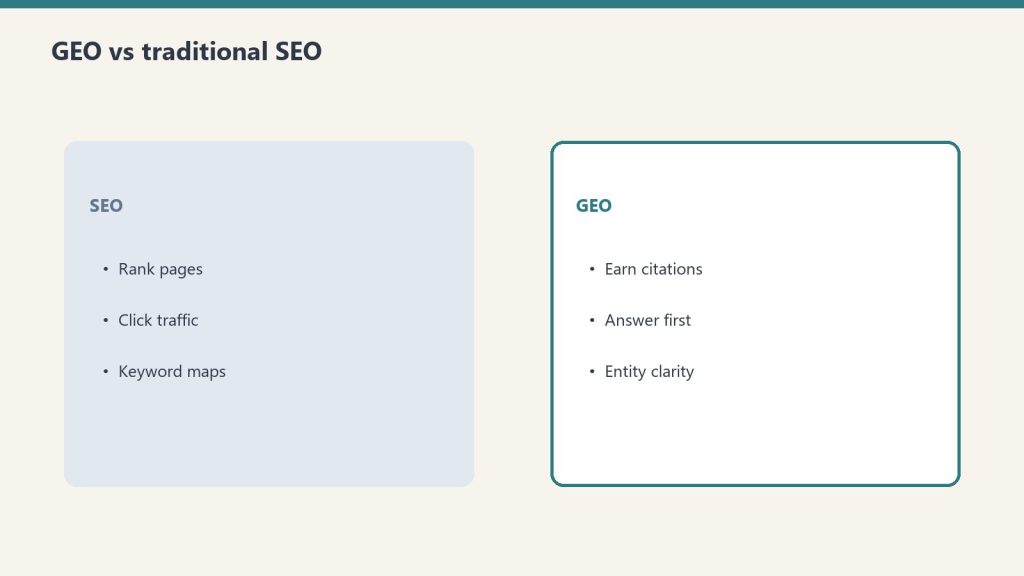
Traditional SEO optimizes for ranking and clicks on search engine results pages. Generative Engine Optimization (GEO) optimizes for citation, mention, and recommendation inside AI-generated answers from systems like ChatGPT, Claude, Perplexity, and Google AI Overviews. The overlap between top Google links and AI-cited sources has fallen from roughly 70% to under 20% as of 2026, meaning GEO is now a distinct discipline.
What is entity binding in the context of GEO?
Entity binding is the practice of making your brand resolvable as a stable, consistent entity across schema markup, Wikidata, third-party directories, and external profiles so that LLMs can confidently identify and cite you. It is the foundation underneath GEO tactics like statistics addition and source citation.
Do I need a Wikipedia article to be cited by AI systems?
No. A Wikidata item alone is sufficient for most B2B brands and independent publishers. Wikidata is consumed directly by Google’s Knowledge Graph and is one of the most reliable structured sources LLMs use during entity resolution. Wikipedia helps but is not required.
How long does entity binding take to show results in AI citations?
Most practitioners see Knowledge Panel appearance within 30–90 days of completing the four-surface stack. AI citation rate increases lag by an additional 30–60 days because LLM training and retrieval cycles update on slower cadences than search engine indexes.
What schema type should small publishers use?
Use Organization schema on your homepage and Person schema on your About page. If you publish frequently, add Article schema to individual posts and link the author Person back to the Organization. This three-way linkage gives LLMs the cleanest entity graph to resolve.
The Bottom Line
Entity binding is not a one-time setup task. It’s the underlying condition that makes every other GEO tactic work. Before you spend another month adding statistics and FAQ sections, audit your four surfaces, normalize your one-line description, and ship a clean Organization schema with a complete sameAs array. The publishers winning the citation game in 2026 are the ones whose entity resolution is so unambiguous that the LLM never has to hedge.
If you want to know whether generative engine optimization actually moves the needle, stop reading think pieces and look at what shipped. The case-study record from 2025 and early 2026 is now thick enough to draw practitioner conclusions: which interventions correlate with citation lift, how fast the curve bends, and what the conversion side of the funnel does once AI traffic shows up. This is a working teardown of the published case studies — what was done, what changed, and what the implementation pattern looks like underneath.
Case 1: B2B SaaS — 575 to 3,500 AI-referred trials in roughly seven weeks
GEO case teardown — B2B SaaS AI-referred trials.
A $30M+ ARR B2B SaaS company documented in Digital Agency Network’s GEO case study roundup moved from 575 AI-referred free trials per period to over 3,500 in about seven weeks. The intervention sequence was content restructuring for citability — clear one-sentence definitions at the top of each section, statistics and comparisons rendered as tables rather than buried in prose, and step-by-step frameworks that LLMs can extract verbatim. The first 40–60 words under every H2 carried the answer to that H2’s implicit question.
The implementation pattern under this win is what matters: the company did not write new articles. It rebuilt existing articles to surface the answer first. That is the cheapest possible GEO intervention — restructure, do not republish.
Case 2: B2B SaaS — citation rate from 8% to 12% in four weeks
Citation-rate lift case — four weeks.
Discovered Labs documented a B2B SaaS case where ChatGPT citation rate on tracked queries moved from 8% to 12% by week four of an engagement, with the company’s VP of Marketing noting they had been “invisible for 18 months despite solid SEO work.” The 50% relative lift came from the same restructuring pattern plus aggressive entity-binding — explicit company name, product name, and category definition repeated in citation-friendly positions throughout each asset.
The data point worth carrying: traditional SEO authority does not automatically translate to LLM citation. The two systems read pages differently, and the page-level rewrite is what closes the gap.
Case 3: CloudEagle — 33 pages optimized, 33% increase in AI citations
CloudEagle’s published GEO result, cited across multiple 2026 case study summaries including AlphaP’s real-world GEO examples, is one of the cleanest dose-response curves in the public record. Optimize 33 pages → 33% increase in AI citations. The ratio is suspicious as a coincidence but tells the practitioner the right thing: GEO is a per-page intervention, and aggregate lift scales roughly with how many pages you treat. There is no site-wide tag you can flip. Each asset gets its own restructure.
Case 4: HubSpot — template rebuild, not content rebuild
HubSpot — template rebuild, not content rebuild.
HubSpot’s internal AEO case study, summarized in HubSpot’s own AEO case study writeup, is the cleanest illustration of the structural fix. HubSpot already ranked for thousands of marketing queries — the volume was there. The barrier was that answers were buried multiple paragraphs deep, written in traditional long-form. The fix was a template rebuild: every article restructured so the first 40–60 words under each H2 or H3 directly answered the implicit question of that heading.
This is the playbook to copy. If your site has any existing traffic, restructuring beats writing new content. The audit question is: under every H2 on every page, do the first three sentences answer the question that H2 raises?
Case 5: Netpeak USA — 120% revenue lift, 693% AI traffic growth
Stackmatix’s AEO case study compilation documents Netpeak USA’s conversational ecommerce GEO campaign producing +120% revenue and +693% AI traffic growth. The mechanism: product and category pages restructured around buyer questions (“what is the best X for Y?”, “X vs Y comparison”, “how do I choose X?”) with direct, hedged answers up top and detailed reasoning below. The pattern works because AI search engines synthesize buying decisions from extractable answer fragments, and ecommerce pages historically bury the answer under marketing copy.
The structural pattern under every win
Read the five cases together and one implementation discipline emerges. Every published GEO win in the public record traces back to the same physical change to the page:
Answer first. The first 40–60 words under every H2 directly answer the question that heading raises. No setup, no transition paragraph, no scene-setting.
Tables over prose for comparison data. Articles with 15+ data points receive measurably more AI citations than those with fewer than five, per the research synthesized in Marketing LTB’s 2026 GEO statistics roundup. Tables make those data points extractable.
Entity binding. Company name, product name, and category definition explicitly stated in citation-friendly positions, not just implied through context.
Stepwise frameworks. Procedural content rendered as numbered steps that LLMs can extract verbatim into responses.
Citable sources inline. Authoritative external citations placed adjacent to claims, not banished to a references section at the bottom.
What the cases do not prove
The published record has selection bias the size of a building. Every case study you can read is a published win. The agencies and SaaS companies that ran a GEO campaign and got nothing are not writing blog posts about it. Read the cases for the structural patterns, not the percentage lifts — the lifts are a function of starting baseline, vertical, and how invisible the brand was before the intervention.
Two other limits worth naming. First, conversion-rate claims about AI-referred traffic (“converts at a higher rate than organic” appears in over half of marketer surveys per the 2026 HubSpot State of Marketing report) come from self-reporting, not third-party measurement. The directional point is probably right — qualified intent behind an LLM query — but the magnitude is unverifiable. Second, AI citation rates are measured against the agencies’ own tracked query sets. Those sets are chosen for relevance to the client, which means baseline visibility is artificially low. The 8% → 12% case is real; whether it generalizes to a random query set is unknown.
What to do tomorrow if you are starting from zero
Pick ten pages on your site that already rank in positions 4–15 for queries with commercial intent. Open each one. Under every H2, rewrite the first 40–60 words so they directly answer the question that heading raises. Convert any prose comparison into a table. State your company name, product category, and the specific problem you solve in the opening paragraph. Add a sources list with authoritative citations.
That is the intervention every published GEO case study reduces to. Ten pages, one week of writing work. The case study record suggests you will see citation movement in three to six weeks if the queries you care about already have AI Overview or LLM citation surface area at all. If they do not, the intervention is still right — you are positioning for when they do.
FAQ
How long until GEO interventions show measurable lift?
Published cases show citation movement at the four-week mark (the 8% → 12% B2B SaaS case) and traffic movement at six to eight weeks (the 575 → 3,500 trials case at roughly seven weeks). Three months is the standard window quoted in agency case studies for material citation rate change.
Does traditional SEO authority help GEO?
Partially. Pages that already hold featured snippets are disproportionately pulled into Google AI Overviews, per multiple 2026 AEO summaries. But the B2B SaaS case where the company was “invisible for 18 months despite solid SEO work” shows that authority alone does not produce citations — page-level structural changes are the missing ingredient.
How many pages do I need to optimize before I see results?
CloudEagle’s case (33 pages → 33% citation lift) suggests the dose-response is roughly linear at small scale. Most published case studies show meaningful aggregate movement starting around 10–30 pages restructured. Below that, you are testing the methodology rather than expecting measurable lift.
Is the citation rate lift actually translating to revenue?
The published evidence says yes for ecommerce (Netpeak USA’s +120% revenue) and trial-driven SaaS (the 575 → 3,500 trials case). For brand and consideration-stage content the answer is murkier — AI citations probably influence brand recall and assisted conversion, but the attribution chain to revenue is harder to draw cleanly and the case study record is thin on this slice.
What is the cheapest GEO intervention with the highest published return?
Restructuring existing pages that already rank. The HubSpot template rebuild and the 575 → 3,500 trials case both used this approach. No new content, no new authority work, no link building — just rewriting the first 40–60 words under every H2 and converting prose comparisons into tables.
The short version: If you want a job in a flooded market, stop trying to be employable in general. Pick one specific corner of your industry. Spend 30 minutes in the morning learning it. Spend the day forgetting most of what you read. Spend 30 minutes at night posting about whatever survived. The forgetting is the filter. The publishing is the proof. Six months in, you are not looking for a job. The job is looking for you.
Last refreshed: October 8, 2026 (Pacific)
Most career advice is built around a quiet lie: that the way to stand out is to be a little better at everything everyone else is also a little better at. Sharpen your resume. Add a certification. Take another course. Write another cover letter. Put it all on LinkedIn and hope the algorithm notices.
It does not work. It cannot work. The market is not short on generalists. It is starving for specialists, especially specialists who have visibly done the thing in public.
What follows is a job-seeking strategy that takes about an hour a day, requires no extra money, and exploits two pieces of cognitive science most career coaches do not mention: spaced repetition and spaced retrieval. The whole point is to use forgetting as a feature, not a bug — and to publish the part that survives.
The four-step protocol
Pick three things from your industry that are the most valuable. Not the most popular. Not the most discussed. The three problems that, when someone solves them, money moves.
Pick one of the three you actually want to become an expert on. The one you would willingly read about on a Sunday with no one watching.
Spend 30 minutes in the morning researching it. Read primary sources. Take rough notes. Do not try to remember everything. You will not.
Spend 30 minutes in the evening posting about it. Whatever you can still articulate without notes is the thing worth publishing. The rest was noise.
That is the entire system. It is shorter than most morning routines. It will outperform almost any other career-building activity you can do in the same time.
Why morning study and evening publishing actually works
The forgetting is doing the editing
When you study something in the morning and then go live a normal day, your brain runs a quiet triage process. Most of what you read decays. The handful of things that connect to something you already understand — or that genuinely surprised you, or that you can imagine using — survive.
By evening, what is left in your head is not a complete summary of what you read. It is the signal of what you read. The compression happened automatically.
This is why the evening publishing step matters. You are not trying to teach the morning’s full reading. You are publishing what survived eight hours of normal life. That is, by definition, the part most likely to be useful, memorable, and original.
Spaced repetition is one of the most-validated learning techniques in cognitive science
The morning-then-evening rhythm is a lightweight version of spaced repetition, the practice of revisiting information at intervals rather than cramming it in one session. A 2024 prospective cohort study published through the American Board of Family Medicine tracked thousands of practicing physicians and found spaced repetition produced significantly better long-term knowledge retention than repeated study sessions.
A separate quasi-experimental study at Jawaharlal Nehru Medical College found students using spaced repetition scored 16.24 versus 11.89 on post-test assessments compared to traditional study — a statistically significant difference (p < 0.0001) that held across multiple disciplines.
The mechanism is not mysterious. Each time you successfully retrieve information after a delay, the neural pathway gets reinforced. Each time you fail to retrieve it, you learn something more important: that piece was not load-bearing. You can let it go.
When you publish in the evening what you can still remember from the morning, you are running this loop in public. You are letting your brain tell you what mattered, then giving the world the part that mattered.
The publishing layer is what changes your career
Studying alone makes you smarter. Publishing what you study makes you findable.
The career-changing leverage is in the second half. A junior marketer who quietly reads about LinkedIn ads for construction companies in rural areas for six months becomes a slightly better junior marketer. A junior marketer who publishes one short post per evening for six months about the same thing becomes the person every rural construction company finds when they search “how to run LinkedIn ads for a contractor.”
That is not the same outcome. That is a different career.
Specificity is the multiplier
“LinkedIn ads” is a saturated topic. Hundreds of generalists post about it daily. Each new post fights for the same shrinking attention slice.
“LinkedIn ads for construction companies in rural markets” is almost empty. The total competing supply of content might be a dozen serious posts a year. The total demand from rural construction company owners trying to figure this out is significant. The ratio is what makes the niche valuable.
The specific corner you pick is the entire game. The narrower it is, the faster you become the visible expert in it. The narrower it is, the easier it is for the right buyer or hiring manager to find you. The narrower it is, the less you have to compete on resume and the more you compete on demonstrated thinking.
What gets cited by AI is not what gets the most engagement
There is a quiet shift happening in how hiring managers and buyers find people. They no longer search Google and scroll through ten blue links. They ask ChatGPT, Gemini, Perplexity, or Google’s AI Overview “who’s good at X?” and read what the AI says.
The thing is — AI systems do not cite content based on follower count or engagement. They cite based on relevance, specificity, and structure. A short, well-structured LinkedIn article from someone with 200 followers is regularly cited above a viral post from someone with 200,000 followers, because the smaller account wrote something specific and useful.
This is the most underpriced opportunity in personal branding right now. You do not need an audience. You need a corner you own and a publishing rhythm you can sustain. The AI does the distribution.
What the evening 30 minutes should actually look like
Do not overthink the format. The post is not the product. The practice is the product. Here is a workable template:
One observation from the morning’s reading. Not the main point. The thing that surprised you.
One concrete example of how it shows up in your specific niche.
One short opinion on what most people get wrong about it.
That is roughly 150 to 250 words. It takes ten minutes to write if you let yourself write badly. The other twenty minutes are for the next day’s reading list and any replies to the previous day’s post.
You do not need to post on LinkedIn. You can post anywhere your industry actually reads. But LinkedIn rewards consistent professional output more than almost any other platform, especially for B2B niches, and AI systems are increasingly citing LinkedIn articles in answer to professional queries. So the platform pays its own freight.
Six months from now
If you do this for six months — and almost no one does — three things are true at once.
First, you actually know your niche better than 95% of the people who claim to. You have read primary sources every morning for 180 mornings. You have wrestled with the material publicly. You have gotten things wrong, gotten corrected by other practitioners, and updated your understanding in front of an audience.
Second, you have a public record of that learning. Your LinkedIn — or whatever surface you chose — is now a longitudinal proof of competence in a specific area. Anyone vetting you can see exactly how you think about the problem they need solved.
Third, the math has flipped. You are no longer trying to find a job. You are getting messages from people who need exactly what you have spent six months publishing about. Some of those messages are job offers. Some are consulting opportunities. Some are partnerships you would not have known existed.
The whole strategy rests on a quiet observation: most people will not do this. Not because it is hard. Because it is slow at the start, requires saying things in public before you feel qualified, and pays nothing for the first few months. Most career advice optimizes around making people feel like they are doing something. This optimizes around making the market notice you have done something.
The compounding loop
The longer this runs, the better it gets. Six months of daily 30-minute morning study is roughly 90 hours of focused reading in a single domain — more than most working professionals invest in any specific topic outside of formal education. Six months of daily evening posting is roughly 180 short-form pieces of public-facing thinking in your niche.
Compare that to the alternative: another resume rewrite, another certification, another generic course. None of those produce a public footprint. None of those compound. None of them make you findable to the people who are actually trying to solve the problem you have spent six months understanding.
An hour a day. One narrow niche. Spaced repetition doing the editing. Evening publishing doing the marketing. The forgetting is the filter. The publishing is the proof. The compounding is what changes your career.
Frequently asked questions
How do I pick the right niche if I have not started a career yet?
Pick the intersection of: a problem real businesses pay money to solve, an industry you find genuinely interesting, and an angle that is not already saturated. Specific is always better than general. “B2B SaaS marketing” is too broad. “Onboarding email sequences for vertical SaaS in healthcare” is the size of niche that wins.
What if I already have a job and want to use this to switch fields?
The protocol is identical. Do the morning study and evening publishing in the niche you want to move into, not the one you currently work in. Six months of public output in the new field is more credible to a hiring manager in that field than ten years of unrelated experience.
What if I do not know enough to write anything yet?
Write what you are learning, with that framing. “I have been studying X for two weeks. Here is the most surprising thing I have found so far.” Beginner-as-narrator is one of the most engaging voices on LinkedIn. People follow learning journeys. They scroll past finished experts.
Does this work for technical fields too?
Especially well. Engineers, scientists, and analysts who can publish clearly about their narrow domain are vanishingly rare and disproportionately valuable. The 30-minute evening post can be a code walkthrough, a paper summary, a debugging story, or a single counterintuitive finding. The format does not matter. The consistency does.
What if I post for a month and nothing happens?
Expected. The first 30 to 60 days are unread. The compounding starts somewhere between day 90 and day 180 for most people. The point of the practice is the practice. The audience is a side effect of the discipline, not the goal of it.
How is this different from a traditional content marketing strategy?
Traditional content marketing optimizes for traffic and conversions. This optimizes for being findable in the moment a buyer or hiring manager is searching for someone who understands their specific problem. It is closer to a slow-cooking authority strategy than a fast-twitch growth strategy. The output is the same — published material — but the goal is positioning, not pageviews.
How long before this protocol produces results?
Most practitioners see the first inbound interest — a recruiter message, a LinkedIn DM, or a referral — within 30 to 60 days of consistent publishing. Meaningful job offers from the protocol typically appear between 60 and 120 days. The compound effect is real but it requires showing up every single day, not every few days.
Does this work if I don’t have a large following?
Yes — that is the point. The protocol is designed for zero followers. Niche specificity means your content surfaces in search and in algorithmic feeds for people who actually hire in that domain. A post about a specific IICRC standard seen by 40 restoration adjusters is worth more than a generic “open to work” post seen by 4,000 random connections.
What platform should I publish on?
LinkedIn is the primary platform for most B2B and professional roles. If your target niche is technical (engineering, development, data), adding a personal site or GitHub significantly accelerates the signal. Pick one platform and go deep — cross-posting thin content to multiple networks dilutes the authority signal you are trying to build.
What if my niche is too broad?
Narrow it by one layer. “Marketing” is too broad. “B2B SaaS content marketing” is still broad. “Content operations for vertical SaaS companies under $10M ARR” is specific enough to own. The discomfort of narrowing is the signal you are on the right track — niches that feel too small almost always have more hiring demand than the broad lane you came from.
Is this only useful for people currently unemployed?
No — the protocol is most powerful when you start it before you need a job. Building niche authority takes time; running it while employed means you enter your next search with an established signal rather than starting from zero. Many practitioners use it permanently as a career infrastructure habit, not a job-search tactic.
The bottom line
The short post that became this article said: pick three things from your industry, choose one, study it 30 minutes in the morning, post about it 30 minutes at night. That is the whole strategy.
What that short post did not say is why it works. The morning input gives your brain something to process. The day in between lets the trivial stuff fall away. The evening output forces you to publish what survived — which is, by the cleanest possible test, the part worth publishing. Repeat for six months. Pick the right niche. Watch what happens to your inbox.
The career advice industry sells motion. This is the opposite. This is a small, slow, compounding bet on becoming visibly excellent at one specific thing. Almost no one will do it. That is what makes it work.
search and in algorithmic feeds for people who actually hire in that domain. A post about a specific IICRC standard seen by 40 restoration adjusters is worth more than a generic “open to work” post seen by 4,000 random connections.
What platform should I publish on?
LinkedIn is the primary platform for most B2B and professional roles. If your target niche is technical (engineering, development, data), adding a personal site or GitHub significantly accelerates the signal. Pick one platform and go deep — cross-posting thin content to multiple networks dilutes the authority signal you are trying to build.
What if my niche is too broad?
Narrow it by one layer. “Marketing” is too broad. “B2B SaaS content marketing” is still broad. “Content operations for vertical SaaS companies under $10M ARR” is specific enough to own. The discomfort of narrowing is the signal you are on the right track — niches that feel too small almost always have more hiring demand than the broad lane you came from.
Is this only useful for people currently unemployed?
No — the protocol is most powerful when you start it before you need a job. Building niche authority takes time; running it while employed means you enter your next search with an established signal rather than starting from zero. Many practitioners use it permanently as a career infrastructure habit, not a job-search tactic.
What SiteBoost for Classic Car Dealers Is: A structured SEO and content program built for dealers, brokers, and marque specialists who sell collector vehicles to knowledgeable buyers. We build content that speaks to someone who knows what a matching-numbers car means, who understands the difference between a restored and an unrestored example, and who will immediately dismiss a website that talks about “vintage cars” in generic terms.
The Content Gap in Collector Automotive
The collector car market runs on specificity. A buyer looking for a numbers-matching example of a particular model year does not search “classic cars for sale.” They search the marque, the production year, the body style, and sometimes the production number range. The dealers who rank for those searches have a structural advantage that no amount of advertising spend can fully replicate.
Most collector car dealer websites are not built to capture that search behavior. They are digital brochures — handsome, occasionally well-photographed, and almost impossible to find for anything other than the dealership name. The SEO is either absent or handled by a general agency that writes about “timeless classics” without a single reference to Concours condition, AACA judging standards, or what a correct date-coded component means for value.
> What Hagerty and Barrett-Jackson have that most dealers do not: Massive content archives that have been indexed for years. Every article about a specific model builds domain authority for that model. Every buyer who researches that model passes through their content ecosystem first. SiteBoost builds that same architecture — at dealership scale.
What We Build for Collector Car Dealers
Marque and model entity optimization — Content with the technical depth that earns authority: production history, option codes, matching-numbers standards, known variants, correct restoration references
Buyer intent content — Guides that answer what serious buyers are actually researching: how to evaluate a car before purchase, what correct looks like for a given year, what restoration costs realistically are, how to transport and insure
GEO visibility for AI search — Structured so that when a buyer asks an AI assistant which dealers specialize in a specific marque, era, or condition tier, your name surfaces as a credible option
Inventory schema — Structured data that communicates year, make, model, condition, and provenance signals to search engines beyond a basic product listing
Category architecture by marque and era — Organized the way collectors search: by manufacturer, by decade, by body style, by condition tier
Year + make + model + condition queries that buyers actually use
AI search visibility
Not considered
GEO optimization for ChatGPT, Perplexity, Google AI Overviews
Provenance content
Not addressed
Documentation standards, AACA criteria, authenticity content built in
Trust signals for buyers
Generic testimonials
Expert content depth that demonstrates knowledge before first contact
Who This Is For
Independent dealers with real inventory and real expertise who have never had an SEO program that matched their knowledge level. Marque specialists who own a category of buyer but do not own the search results for it. Broker-dealers who work primarily by referral but want inbound inquiries from qualified buyers. Restoration shops with a sales arm who need content that communicates both capability and inventory.
Not for dealerships looking for volume at the expense of quality. The buyer this program attracts is researching seriously before they contact anyone. If your inventory and your process cannot support that buyer, this program will not help you.
Ready to talk about your dealership?
Tell us what you specialize in, where your inventory lives online right now, and what kind of buyer you most want to reach. We will give you an honest read on the opportunity.
will@tygartmedia.com
Frequently Asked Questions
Can you write about specific marques accurately?
Yes. We do not write generic automotive content. We research the specific marque, model, and production history before we write a word. The goal is content that a knowledgeable buyer finds credible, not content that a knowledgeable buyer immediately skips.
How does this work for dealers who move inventory quickly?
The most valuable content is not inventory-specific — it is category and expertise content that builds authority over time regardless of what is currently in stock. Buyers researching a specific marque find your expertise pages, develop confidence in your knowledge, and contact you when the right car comes available. That is a better outcome than ranking for a car you already sold.
What is the difference between traditional SEO and GEO for this market?
Traditional SEO gets you into Google search results. GEO — Generative Engine Optimization — gets your dealership named by AI assistants when buyers ask questions like “which dealers specialize in unrestored American muscle” or “who are the best Ferrari specialists in the US.” Both matter. We build for both.
How long does it take to see results?
Marque and model content typically shows movement in search rankings within two to four months. The long-tail queries — specific production years, option combinations, condition standards — often rank faster because existing content competition is thin. We start with the highest-value searches for your specific inventory profile.
What SiteBoost for Fine Art Galleries Is: A structured SEO and content program built specifically for galleries, private dealers, and secondary market specialists. We write content that speaks the language of collectors and institutions — provenance, attribution, medium, period, and market — and structure it so search engines and AI systems surface your inventory and expertise when serious buyers are looking.
The Problem With Art Dealer Websites
Most gallery and dealer websites are beautiful and findable by no one. They were designed for the opening night crowd, not for the collector in London who searches “American Impressionist landscapes for sale” at 11pm on a Tuesday. The SEO is an afterthought. The content is vague. The structured data is nonexistent. And the gap between what your inventory deserves and what Google shows for it is enormous.
Generic SEO agencies make this worse. They write blog posts about “the art market” without understanding the difference between a primary and secondary market transaction. They do not know what TEFAF is. They cannot write about attribution chains or condition reports without making you wince. And they certainly do not know how to structure content so that AI systems like ChatGPT and Perplexity recommend your gallery when someone asks where to buy a specific artist’s work.
> The search reality for fine art dealers in 2026: Collectors increasingly begin acquisition searches on AI-powered platforms. If your site is not structured for machine readability — entities named, schema marked, provenance language present — you are invisible to the buyer who never opens Instagram.
What We Actually Do
We build what galleries rarely have: a content infrastructure that works while the gallery is closed. Artist profile pages written with the depth of a serious catalog essay but optimized for how collectors search. Category pages built around medium, period, and price point — not just your current show. FAQ content structured so Google surfaces your gallery when someone asks which galleries represent living painters working in a given tradition.
The stack we deploy on gallery and dealer sites:
Artist and artwork entity optimization — Named artist entities with biography depth, auction record context, and market positioning language that search engines treat as authoritative
AEO content for collector queries — Direct answers to the questions serious buyers ask: how to authenticate, how to transport, how to insure, what to expect in the acquisition process
GEO visibility for AI search — Structured so that when a collector asks an AI assistant to recommend a dealer specializing in a given artist or period, your gallery is a named result
Schema markup for arts entities — VisualArtwork, LocalBusiness, and ItemList schema that communicates inventory structure to search engines
Category architecture — Organized by medium, period, geography, and price — because that is how collectors think, not how most dealer sites are organized
Built-in GEO optimization for ChatGPT, Perplexity, Gemini
Artist entity depth
Name only
Biography, market context, comparable sales language
Collector search alignment
Brand keywords only
Medium + period + price + acquisition intent queries
Who This Is For
Galleries with an established inventory who have never had a serious SEO program. Private dealers who operate without a storefront but need digital authority. Secondary market specialists whose inventory moves through relationships but who want inbound acquisition leads. Auction specialists who need content depth around specific categories and periods.
This is not for galleries that want to publish a monthly blog post and call it content marketing. This is structural work — the kind that takes three to six months to show in rankings but compounds for years.
Ready to talk about your gallery?
Send a brief note. Tell us what you sell, what you feel is missing, and whether you have ever had a real SEO program. We will tell you honestly what we think the opportunity is.
will@tygartmedia.com
Frequently Asked Questions
Do you need to understand the art market to do this work?
Yes, and we do. The difference between useful SEO content for a gallery and embarrassing SEO content is entirely in the vocabulary and the accuracy. We write about art in a way that does not make your curatorial team roll their eyes.
How long before we see results?
Organic SEO for competitive niches typically shows meaningful movement in three to six months. For less competitive long-tail queries — specific artists, specific periods, specific media — movement can happen within weeks. We prioritize the realistic wins first.
Will this work for a gallery that does not sell online?
Yes. Most serious gallery transactions happen off-site regardless. The goal is to be the gallery that serious collectors find when they are researching. The website earns the inquiry. The relationship closes the sale.
What does the process look like?
We start with a site audit, entity mapping, and category architecture review. Then we build the content calendar based on your inventory priorities and collector search behavior. Content goes to you for review before it publishes. Nothing goes live without your sign-off.
Is this just SEO or does it include AI search optimization?
Both. In 2026, separating SEO and AI search optimization is a false distinction. We optimize for traditional search rankings and for the AI-powered answer engines — ChatGPT, Perplexity, Google AI Overviews — that affluent collectors increasingly use to research acquisitions.
What makes you different from an agency that claims arts specialization?
Most agencies that claim arts specialization mean they have worked with a theater company or a music school. We mean vocabulary, schema, and entity architecture that is native to the art market. That distinction matters when the person reading the content is a serious collector.
The Named Addiction Treatment Entities That Make Google and AI Trust Your Center’s Content
By Tygart Media Updated: October 5, 2026
Why named entities matter more in treatment than any other vertical: Addiction treatment is simultaneously the most regulated, the most stigmatized, and the most crisis-driven content category in digital health. Families searching for treatment information are skeptical — they have encountered predatory facilities and misleading marketing. Google’s YMYL quality evaluators and AI systems are similarly skeptical. Named, verifiable regulatory and accreditation entity references are the proof that separates genuine clinical authority from marketing copy.
The Treatment Center Entity Hierarchy
The treatment center entity hierarchy that carries authority signal.
Tier 1: Federal Regulatory Bodies
SAMHSA — Substance Abuse and Mental Health Services Administration: The primary federal authority for substance use disorder treatment standards. Referenced in content: SAMHSA National Survey data, SAMHSA Treatment Locator, SAMHSA Treatment Improvement Protocols (TIPs), SAMHSA Behavioral Health Treatment Services Locator
NIDA — National Institute on Drug Abuse: Federal research body for addiction science. Referenced for: evidence base for treatment modalities, overdose statistics, clinical efficacy data for MAT (Medication-Assisted Treatment)
DEA — Drug Enforcement Administration: Referenced for: buprenorphine prescribing authority requirements, controlled substance regulations relevant to MAT content
CMS — Centers for Medicare & Medicaid Services: Referenced for: Medicare and Medicaid coverage of behavioral health treatment, MHPAEA enforcement, SUD treatment benefit requirements
Tier 2: Accreditation and Standards Bodies
ASAM — American Society of Addiction Medicine: Publisher of the ASAM Criteria (patient placement standards), ASAM clinical practice guidelines for opioid use disorder, MAT prescribing standards
CARF International — Commission on Accreditation of Rehabilitation Facilities: Accreditor for behavioral health and addiction treatment programs. One of two primary accreditation bodies families and referral sources use to verify facility quality
The Joint Commission (JCAHO): The second primary accreditation body for healthcare organizations including behavioral health facilities. Referenced as accrediting authority
NAADAC — National Association for Alcoholism and Drug Abuse Counselors: Credentialing body for addiction counselors. Referenced for staff credential verification
What named entities should addiction treatment WordPress content include for Google E-E-A-T and AI citation?
Addiction treatment content optimized for E-E-A-T and AI citation should reference: SAMHSA (Substance Abuse and Mental Health Services Administration) for treatment standards and prevalence data, ASAM Criteria for level-of-care placement standards with specific level numbers (2.1 IOP, 2.5 PHP, 3.5 residential, 4.0 medically managed inpatient), CARF International or The Joint Commission as named accreditation authorities, NIDA for evidence-base references on treatment modality efficacy, MHPAEA (Mental Health Parity and Addiction Equity Act) for insurance coverage content, and DSM-5 (Diagnostic and Statistical Manual of Mental Disorders, 5th edition) for Substance Use Disorder diagnostic criteria references. These named entities are machine-verifiable — AI systems cross-reference them against known behavioral health regulatory data before citing treatment content.
How to Inject Treatment Entities Naturally Into Existing Content
How to inject treatment entities naturally into existing content.
The Definition Box Approach
Open each treatment article with a definition box that names the relevant standard. “Medication-Assisted Treatment (MAT): A SAMHSA-endorsed approach to opioid and alcohol use disorder that combines FDA-approved medications — buprenorphine, methadone, or naltrexone — with counseling and behavioral therapies, per ASAM clinical practice guidelines.” This opening entity reference establishes regulatory grounding before the article body and is the section most likely to be cited by AI systems in responses to treatment modality questions.
The Statistics Sourcing Approach
Every statistic in treatment content should be attributed to a named federal source. “According to SAMHSA’s 2024 National Survey on Drug Use and Health (released July 2025), 48.4 million people aged 12 or older (16.8%) had a substance use disorder in the past year, and only 19.3% of those who needed substance use treatment received it.” “NIDA research confirms that MAT with buprenorphine reduces opioid use and mortality risk.” Named source attribution is required for YMYL compliance and is the entity signal that AI systems use to evaluate whether addiction statistics represent verified federal data rather than facility marketing claims.
The Accreditation Context Approach
Accreditation references should appear in clinical authority sections with specific named body and scope. “CARF International accreditation for behavioral health programs requires facilities to meet standards for clinical documentation, staff credentials, outcome measurement, and patient rights — standards that independent CARF surveyors verify through on-site review every three years.” This is more authoritative than “we are CARF accredited” — it explains what CARF accreditation means clinically, which is the information families actually want when evaluating facilities.
SAMHSA, ASAM, CARF, NIDA, and MHPAEA entity injection across your existing treatment articles is part of the GEO layer in WordPress content optimization for addiction treatment centers through SiteBoost. Applied to educational blog content only; clinical content unchanged.
Does citing SAMHSA and NIDA statistics create any compliance concerns for treatment centers?
No. Citing federal agency statistics (SAMHSA prevalence data, NIDA research findings) with proper attribution is standard educational practice in behavioral health content — and is specifically what Google’s quality evaluators look for in YMYL addiction treatment content. The compliance concern in treatment marketing relates to specific outcome claims, guarantee language, and misleading facility descriptions — not to educational citations of federal research data. Including a disclaimer that individual treatment outcomes vary is standard practice for any content that discusses treatment efficacy.
What is the difference between CARF and Joint Commission accreditation for content purposes?
Both CARF International and The Joint Commission are nationally recognized accreditation bodies for behavioral health facilities — and both are meaningful authority signals in treatment content. CARF is more specialized in rehabilitation and behavioral health services. The Joint Commission accredits a broader range of healthcare organizations including hospitals. For content purposes, naming either (or both, if the facility holds both) with specific program scope (e.g., “CARF accreditation for outpatient substance abuse treatment” or “Joint Commission Gold Seal of Approval for behavioral health”) provides more specific entity depth than simply stating accreditation status.
How do LegitScript verification and content entity references work together?
LegitScript certification is an advertising compliance credential that governs access to Google Ads and other paid platforms for addiction treatment marketing. Named entity references in organic content (SAMHSA, ASAM, CARF) are organic SEO and GEO optimization signals — they are completely separate mechanisms. LegitScript-certified treatment centers can and should use SAMHSA, ASAM, and CARF entity references in their educational blog content for organic authority signals. The LegitScript certification adds an additional entity reference that can itself appear in content (“LegitScript-verified addiction treatment provider”) as a trust signal for families evaluating facility credibility.
Sources: SAMHSA — samhsa.gov, including the 2024 National Survey on Drug Use and Health (released July 2025); ASAM Criteria (3rd ed.); CARF International — carf.org; NIDA — nida.nih.gov; CMS MHPAEA guidance — cms.gov; SEO Agency USA, “SEO for Addiction Treatment Centers: Complete Guide” (January 2026)