
ChatGPT Search cites 15% of the pages it retrieves. The other 85% get pulled into the model’s context window, evaluated, and silently discarded — no visibility, no referral, no trace. If you are doing GEO work and your pages keep getting retrieved but never quoted, you are losing at the second filter, not the first.
This is the 2026 implementation guide for surviving both filters: getting retrieved by ChatGPT Search, then getting cited once you are there.
How ChatGPT Search Actually Builds an Answer
ChatGPT Search runs a three-stage pipeline. Each stage kills most candidates.
- Retrieval — ChatGPT Search is powered by Bing’s index for real-time web retrieval. Seer Interactive’s analysis found 87% of SearchGPT citations match Bing’s top results, with the bulk in positions one through ten and a long tail in positions eleven through twenty. AirOps research separately put ChatGPT-to-Bing overlap at 73%. If you are not in Bing’s top 20 for a query, you almost certainly are not in ChatGPT’s candidate set.
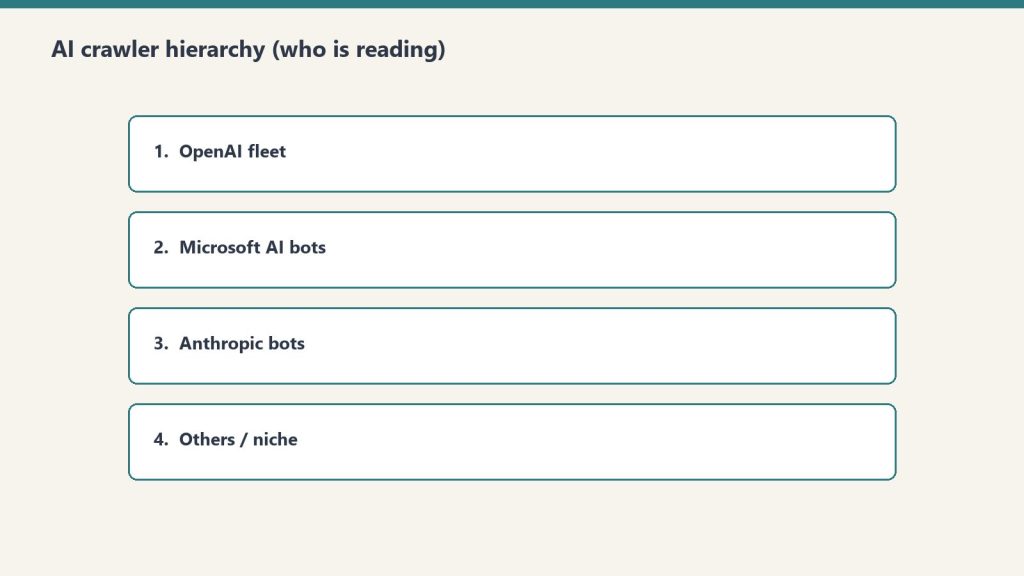
- Crawlability check — OpenAI’s OAI-SearchBot is the user agent that builds the index used for ChatGPT’s search features. It is separate from GPTBot (training) and ChatGPT-User (browsing). Block OAI-SearchBot in robots.txt and you remove yourself from ChatGPT Search entirely, even if Bing has you ranked.
- Citation selection — Of the pages retrieved, AirOps found ChatGPT cites only 15%. The model picks what to quote based on structure, freshness, authority signals, and whether the page directly answers the query.
Step 1: Verify You Are Indexed by Bing
Most sites optimized for Google have never logged into Bing Webmaster Tools. Fix that first. Three checks before anything else:
- site:yourdomain.com in Bing — confirms basic indexing.
- Bing Webmaster Tools → URL Inspection — confirms the specific pages you want cited are indexed and have no crawl errors.
- Bing rankings for your target queries — if you are not in the top 20 in Bing, ChatGPT will not see you.
If pages are missing, submit a sitemap via Bing Webmaster Tools and request URL inspection on any priority page. Bing typically reflects changes within 24–72 hours, faster than Google.
Step 2: Allow OAI-SearchBot in robots.txt
The single most-skipped step in GEO work. Add this block to your robots.txt:
# Allow ChatGPT Search to retrieve and cite this site
User-agent: OAI-SearchBot
Allow: /

# Optional: allow on-demand browsing for ChatGPT users
User-agent: ChatGPT-User
Allow: /

# Optional: block training crawler if you want retrieval without training
User-agent: GPTBot
Disallow: /
OpenAI publishes these three user agents and treats each independently. You can allow OAI-SearchBot for ChatGPT Search visibility and still disallow GPTBot from using your content for model training. The settings do not conflict. OpenAI’s systems typically recognize robots.txt changes within 24 hours.
Step 3: Structure Pages for the Citation Filter
Retrieval is necessary but not sufficient. Once your page is in the candidate set, the model decides whether to quote it. Pages that get quoted share a structural pattern.
Direct answers in the first 100 words
ChatGPT cites sources that answer the question fully. Partial answers lose to complete ones. Lead each page with a clean direct-answer paragraph: question implied or stated, answer in the next sentence, supporting detail after. This is the same pattern that wins featured snippets, which is not a coincidence — answer engines and snippet engines reward the same structure.
JSON-LD schema
An AirOps study of 548,534 pages found pages with JSON-LD markup posted a 38.5% citation rate versus 32.0% without it. Article, FAQPage, and HowTo schema are the highest-leverage types. Add them.
Word count: 500–2,000
Pages between 500 and 2,000 words performed best in the same AirOps study. Pages longer than 5,000 words were cited less often than pages under 500. The mechanism is mechanical: long pages overflow the retrieval context window, and the model defaults to shorter, denser sources it can quote in full.
Freshness
Content updated within 30 days received 3.2x more citations than older material. The fix is not faked freshness — it is genuine updates: a new stat, a new case, a corrected claim. Update the date when you update the content, not before.
Step 4: Build the Authority Layer
Structure gets you cited once. Authority gets you cited repeatedly. AirOps found sites with over 32,000 referring domains are 3.5x more likely to be cited by ChatGPT than sites with fewer than 200. You do not need 32,000 — you need to be in the upper band of your topical neighborhood.
ChatGPT’s citation pattern leans heavily on Wikipedia (roughly 48% of top citations in multiple studies) and large news/media properties. The practitioner read on that: ChatGPT favors sources with multi-source third-party validation. Build the kind of citations on the open web that Wikipedia editors accept — peer-reviewed studies, primary sources, named author attribution, transparent methodology.
Step 5: Track Your Citation Footprint
You cannot manage what you do not measure. The minimum tracking stack for 2026:
- Server log monitoring for OAI-SearchBot user agent — confirms OpenAI is actually crawling. If you allowed the bot in robots.txt three weeks ago and there are zero OAI-SearchBot hits in your logs, something is wrong (CDN block, IP firewall, misconfigured allow rule).
- Manual citation audits — pick 10 priority queries, run them in ChatGPT with the Search toggle on, log which domains get cited. Repeat weekly. A spreadsheet beats no tracking.
- Bing position tracking — because ChatGPT pulls from the Bing index, Bing rankings are a leading indicator. If your Bing position drops, ChatGPT visibility drops behind it.
The Practitioner Summary
Ranking in ChatGPT in 2026 is not mysterious. It is a four-gate funnel: Bing index → OAI-SearchBot crawl access → retrieval into the candidate set → citation selection. Most sites fail at gate one (not indexed in Bing) or gate two (OAI-SearchBot blocked or not addressed). Sites that clear those two gates and write pages that answer the question fully, with schema and a 500–2,000-word range, will land in the 15% that get quoted.
Treat ChatGPT Search like a separate search engine that happens to share an index with Bing. Optimize for the index. Allow the crawler. Write the page. The rest follows.
Related on Tygart Media: AI citation monitoring · AI search funnel · how AI engines cite.
Leave a Reply