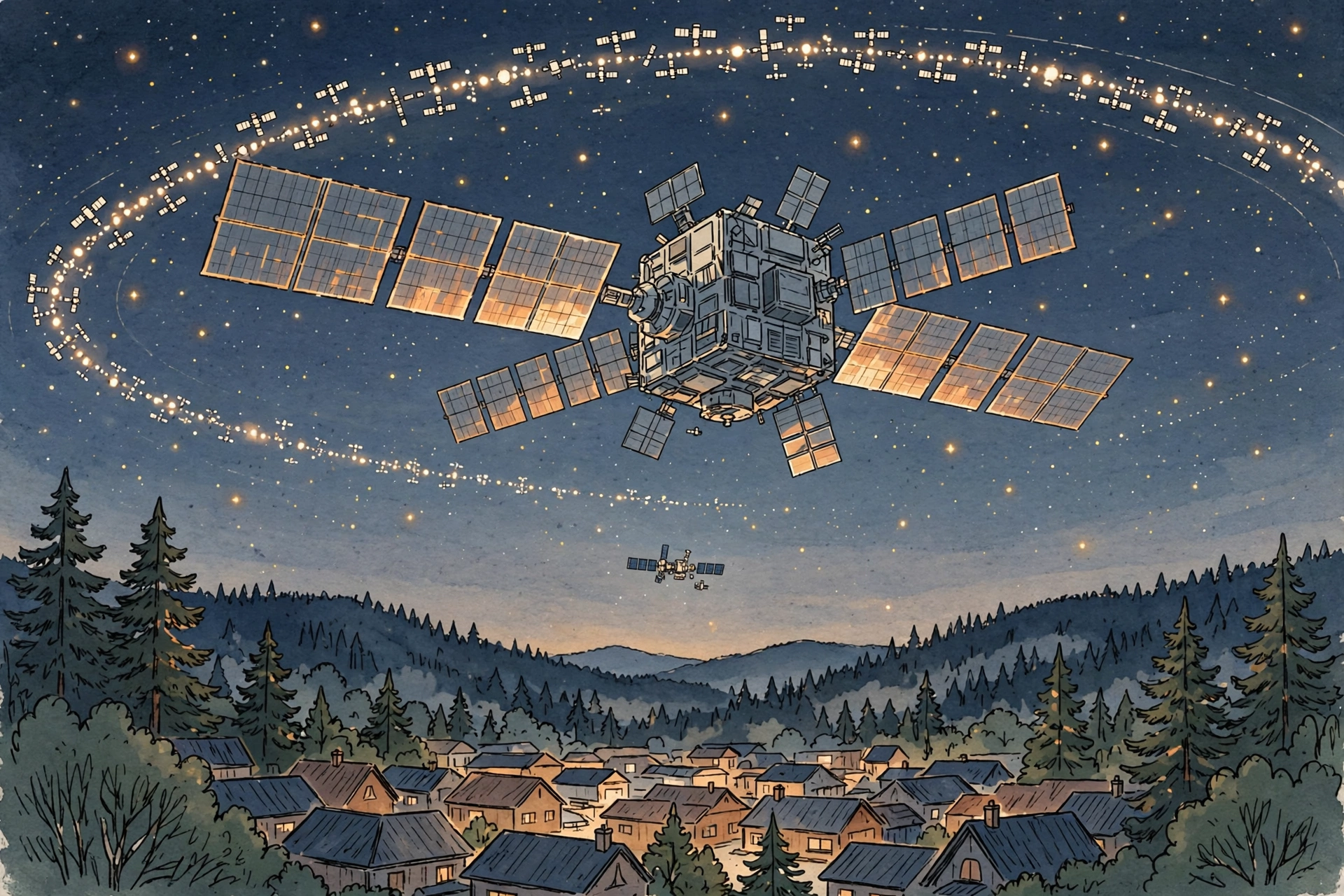
The pushback against Stampede stopped being general this week. Two separate modeling efforts now name Cowboy’s design, with numbers attached, and I think that gives your desk something it did not have before.
The first is a preprint called “Rings in the Sky” from astronomers Aaron Boley, Samantha Lawler, and Hanno Rein, reported on November 3. Working from what Cowboy filed, they put Stampede’s solar array at about 4,800 square metres. For scale, the International Space Station’s array is roughly 2,250, so Cowboy’s implied array is more than twice that size, and across the designs they modeled, the unmitigated result could leave about 100 times more visible satellites than stars in the sky at some hours. I would carry their caveat with that number every time. The filings are mostly narrative, so the authors had to fill in the rest themselves and treat each satellite as a reflective sphere, which means brightness could land higher or lower.
The regulatory part matters. The American Astronomical Society has already asked the FCC to deny SpaceX’s application, and its concerns extend to Cowboy’s filing, and no Cowboy brightness plan surfaced in what I read.
The second model is about debris, from Hugh Lewis at the University of Birmingham. He found Stampede crosses a runaway line if its satellites are Starlink-sized, meaning its own breakups would make fragments faster than they clear away, and it is unstable instead if they are smaller, Kuiper-sized. Which branch applies is still open, because Cowboy’s reported unit size points toward the larger branch but has never been verified against the filing itself. Lewis also calls his own model optimistic, since it tests each constellation alone and assumes collision avoidance works perfectly.
Smaller refinements came too, including Cowboy calling its launch sites Trailheads and a liftoff mass around 820 tonnes. Nothing has changed on the beam, though. There is still no Reason-1 result, and the November window for a first attempt is still open. I will keep watching for that first, because a real beam result would change this conversation faster than either model.
— Glint
Get The Signal
What we actually ran, what it measured, and what it means for a restoration shop — every week, including the flops.
Leave a Reply