Category: Insurance Claims Guides

Plain-English property insurance claim checklists, valuation disputes, adjuster timelines, and escalation playbooks. Original hub: claims.tygartmedia.com.

  • Why is my insurance claim taking so long?

    Why is my insurance claim taking so long?

    Tygart Media · Insurance Claims Guides · Delays & timelines

    QUICK ANSWEROriginally published at claims.tygartmedia.com · Reviewed October 5, 2026
    The short answer: it’s probably not you, and it’s not necessarily your adjuster dragging their feet. The whole system is overloaded — disasters are striking every 10 days, there aren’t enough workers, and parts take twice as long to arrive. Here’s what’s behind the wait, in plain numbers.

    Disasters are happening every 10 days

    In 2025, the U.S. averaged a billion-dollar weather disaster roughly every 10 days, according to Sedgwick’s 2026 Loss Adjusting Insights Report. Forty years ago, the average gap was 82 days.

    Every one of those disasters generates thousands of insurance claims. Your adjuster isn’t handling your claim — they’re handling hundreds of them, in order. You’re in a line that’s getting longer faster than it’s getting shorter.

    There aren’t enough workers

    The construction industry needs 349,000 additional workers in 2026 just to meet demand. Fewer available crews means longer waits for repairs — even after your claim is approved and everyone agrees on what needs doing.

    Parts and equipment take twice as long

    Lead times for specialized equipment have more than doubled in the past five years. A repair can stall for weeks or months waiting on a single part, while the costs around it keep running.

    October 2026 update: fewer claims filed, but the system is still strained

    New numbers from Verisk show U.S. claim assignments fell to 1.24 million in the second quarter of 2026 — down 12.2% from a year earlier and 13.1% below the five-year average. So why are claims still slow? Because 43% of those assignments were catastrophe claims, up from 34% five years ago. Fewer total claims, but a bigger share of the hard, complex kind.

    The people problem is getting worse, not better: a quarter of claim adjusters are expected to retire by the end of 2027 — what Sedgwick’s Andrew McCallum calls a “silver tsunami” of experience walking out the door. In an industry survey, 73% of respondents said the retirement wave’s biggest impact would be the loss of industry knowledge.

    On the repair side, higher deductibles are pushing some homeowners to handle smaller losses themselves, so restoration companies are competing for fewer jobs — while the big, complex losses that remain pull in more parties, more approvals, and more waiting. (Sources: Verisk Q2 2026 claims volume report; Sedgwick 2026 Loss Adjusting Insights, via Insurance Journal, October 5, 2026.)

    What you can actually do

    1. Document everything. Photos, dates, receipts — and every conversation with your insurer in writing. Email beats phone calls because it leaves a trail.
    2. Follow up on a schedule. A polite written check-in every week keeps your file from settling to the bottom of the pile.
    3. Ask for timelines in writing. “When will I hear back?” should always get a date attached, not a vague “soon.”
    4. Calibrate your expectations. The delay isn’t proof your claim is weak — it’s proof the system is full. The homeowners who get through fastest are the organized ones, not the loudest ones.
    Editor's Note
    Keep a delay log Dates of every contact, who you spoke with, what was promised, and what actually happened. If the dispute ever reaches a regulator, a mediator, or a lawyer, this log is gold.
    Disclaimer
    Informational only — not legal or insurance advice.
    Insurance rules vary by state and by policy. Check your own policy documents and your state’s insurance department, or talk to a licensed professional, before acting on a claim. Data: Sedgwick 2026 Loss Adjusting Insights Report; Verisk Q2 2026 claims volume report.

    Where the time goes

    Common delay points in a claim
    Delay pointWhat’s actually happeningYour move
    Adjuster assignmentBacklog, especially after stormsCall weekly; log every call with date and name
    Estimate reviewInternal review queues at the carrierAsk for the reviewer’s name and a decision date in writing
    “Need more info”Sometimes legitimate, sometimes stallingSend it same-day, certified; note the date the clock restarts
    Supplement reviewSecond trip through the queueSame as above — everything in writing, everything dated
    Next Step & Source Attribution
    Continue navigating Insurance Claims Guides
    Source: Originally published at https://claims.tygartmedia.com/why-claims-take-so-long/ · Author: William Tygart, Tygart Media · Last reviewed October 5, 2026.
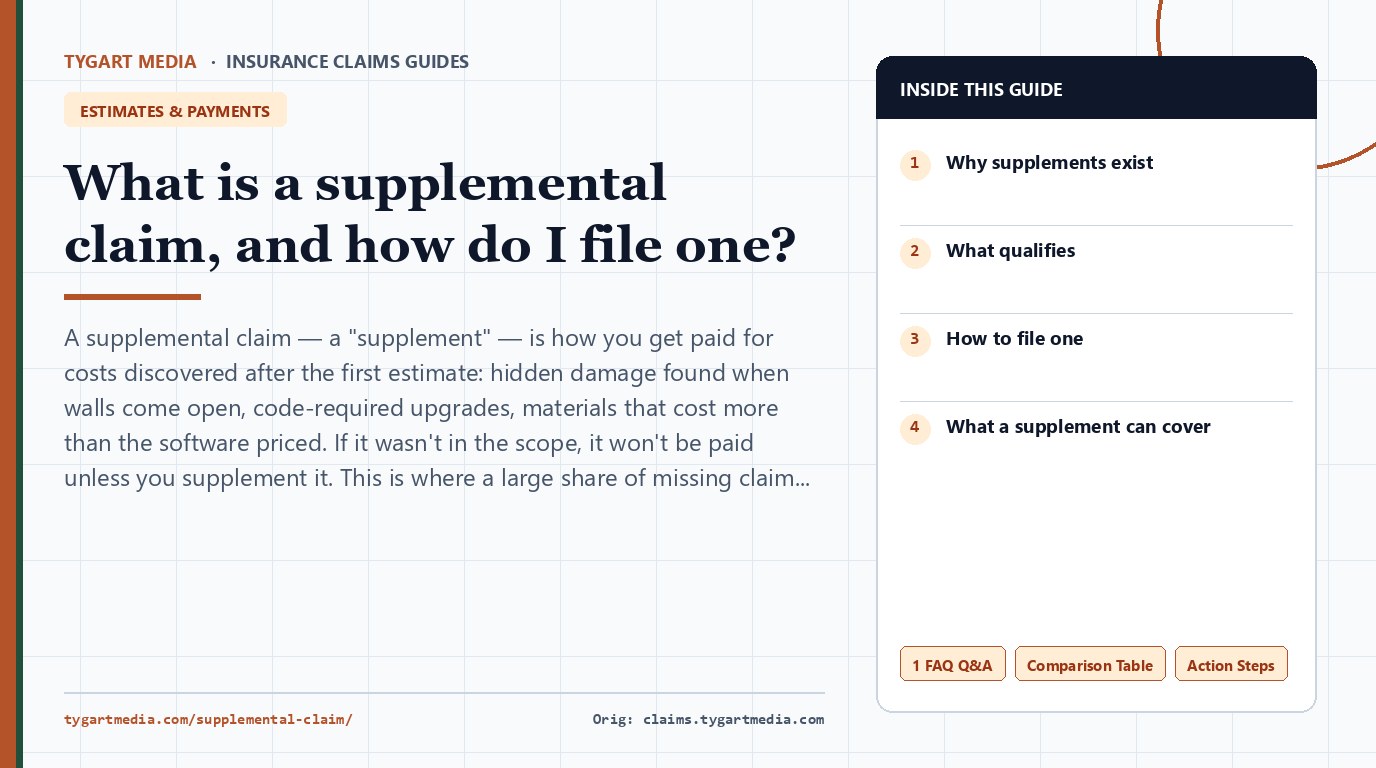
  • What is a supplemental claim, and how do I file one?

    What is a supplemental claim, and how do I file one?

    Tygart Media · Insurance Claims Guides · Estimates & payments

    QUICK ANSWEROriginally published at claims.tygartmedia.com · Reviewed October 4, 2026
    The short answer: a supplemental claim — a “supplement” — is how you get paid for costs discovered after the first estimate: hidden damage found when walls come open, code-required upgrades, materials that cost more than the software priced. If it wasn’t in the scope, it won’t be paid unless you supplement it. This is where a large share of missing claim money lives, and most homeowners have never heard of it.

    Why supplements exist

    The adjuster’s first estimate is written from a single visit, before any demolition. But real repairs reveal real surprises: rotted framing behind the drywall, wiring that no longer meets code, flooring that can’t be matched and must be replaced as a continuous run. None of that was visible on day one — so none of it is in the first check. The supplement is the mechanism for getting it covered. It’s a normal part of the process, not a confrontation.

    What qualifies

    • Hidden damage discovered during repairs — what the walls were hiding.
    • Code upgrades required by your local building department to complete the repair legally (permits, electrical, plumbing).
    • Price differences — materials or labor that genuinely cost more than the estimating software allowed.
    • Scope corrections — line items the first estimate missed entirely.

    What doesn’t qualify: upgrades you simply want (nicer tile, a better fixture than what was damaged) — the policy owes you restoration to pre-loss condition, not a remodel.

    How to file one

    1. Stop and document when additional damage is found. Photos, measurements, and a written description before anything gets covered back up.
    2. Have your contractor write the supplement as a line-item document: each additional item, its cost, and why it’s necessary (code section, photo reference, manufacturer spec). A supplement that explains itself gets approved faster than one that just lists numbers.
    3. Submit it in writing to the adjuster — email with the supplement and photos attached. Ask for written approval.
    4. Get approval before the work is done whenever possible. It’s far easier to get a supplement approved for work the adjuster can still inspect than for work that’s already behind new drywall.
    5. Follow up on a schedule. Supplements sit in queues. A polite weekly check-in keeps yours moving.
    Editor's Note
    This is where good contractors earn their keep Contractors who document supplements thoroughly — photos, code citations, clear line items — get them approved. If your contractor shrugs at the idea of writing a supplement, that’s useful information about your contractor.
    Important Notice
    Don’t pay out of pocket for covered extras without asking If your contractor discovers additional damage mid-job, pause and supplement first. Paying for it yourself and asking for reimbursement later is a much harder fight than getting approval up front.
    Disclaimer
    Informational only — not legal or insurance advice.
    Insurance rules vary by state and by policy. Check your own policy documents and your state’s insurance department, or talk to a licensed professional, before acting on a claim.

    What a supplement can cover

    Common supplemental claim items
    Found after the first estimateWhy it was missed
    Hidden water damage behind wallsNot visible until demolition
    Code upgrades required by permitAdjuster priced to old code
    Price increases since the estimateMaterial/labor costs moved
    Additional rooms affectedDamage spread or was overlooked
    Next Step & Source Attribution
    Continue navigating Insurance Claims Guides
    Source: Originally published at https://claims.tygartmedia.com/supplemental-claim/ · Author: William Tygart, Tygart Media · Last reviewed October 4, 2026.
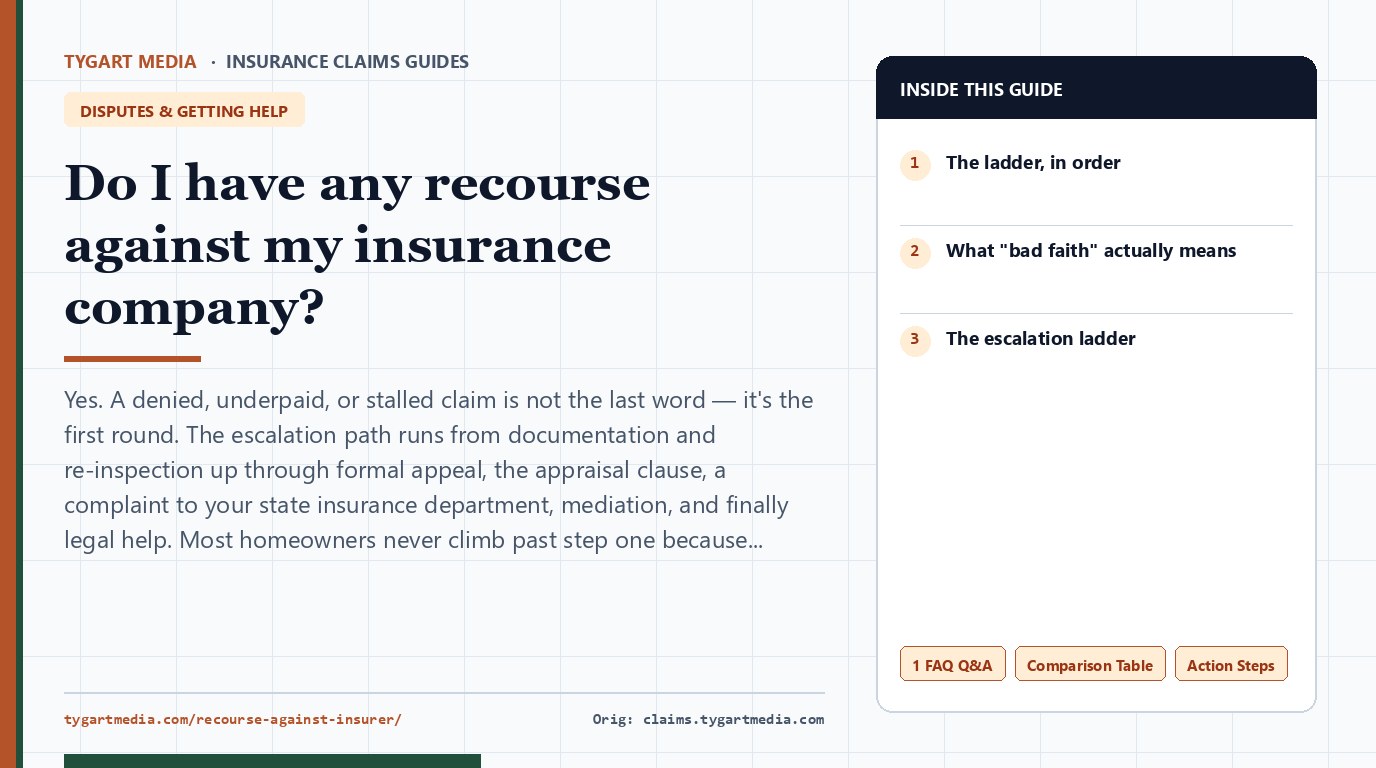
  • Do I have any recourse against my insurance company?

    Do I have any recourse against my insurance company?

    Tygart Media · Insurance Claims Guides · Disputes & getting help

    QUICK ANSWEROriginally published at claims.tygartmedia.com · Reviewed October 4, 2026
    The short answer: yes. A denied, underpaid, or stalled claim is not the last word — it’s the first round. The escalation path runs from documentation and re-inspection up through formal appeal, the appraisal clause, a complaint to your state insurance department, mediation, and finally legal help. Most homeowners never climb past step one because nobody tells them the ladder exists.

    The ladder, in order

    1. Document everything. Photos with timestamps, every letter and email, a log of every phone call (date, name, what was said), receipts for emergency mitigation. This file is the foundation of every step below. Start it the day damage happens, not the day you’re denied.
    2. Request a re-inspection. Ask — in writing — for another look, with your contractor present. New evidence, a second adjuster, or simply a more thorough walkthrough changes outcomes regularly.
    3. File a formal written appeal. Address the denial reason directly, cite your policy language, and attach your documentation and independent estimate. Keep the tone factual. You’re building a record, not venting.
    4. Invoke the appraisal clause. Most homeowners policies include one: each side hires an independent appraiser, the two appraisers select an umpire, and they determine the amount of loss. It settles how much, not whether it’s covered — but most disputes are about how much.
    5. File a complaint with your state insurance department. Free, and it works better than people expect. Regulators track complaint patterns against carriers, and insurers take regulator inquiries seriously. Find yours through the National Association of Insurance Commissioners (naic.org).
    6. Try mediation. Some states run free or low-cost mediation programs for claim disputes — Florida’s is the best known, but check your state. A neutral mediator in a conference room resolves an enormous number of stuck claims.
    7. Talk to an attorney. For bad-faith handling, complex coverage denials, or large losses, a lawyer who handles insurance disputes is the final lever. Many offer free consultations. Public adjuster vs. attorney →

    What “bad faith” actually means

    Bad faith is the legal term for an insurer unreasonably refusing to pay what it owes — denying without investigation, misrepresenting policy language, or dragging a claim out to wear you down. The remedies vary enormously by state: some allow you to recover attorney fees, some allow multiples of the benefit owed, some do neither. This is squarely “talk to a lawyer in your state” territory, not DIY territory.

    Important Notice
    Two things that weaken your position
    First, letting the claim go quiet — delay helps the insurer, not you; keep every step in writing and on a timeline. Second, signing anything marked as a full and final settlement while you still dispute the amount. If you’re still fighting, don’t sign a release.
    Disclaimer
    Informational only — not legal or insurance advice.
    Insurance rules vary by state and by policy. Check your own policy documents and your state’s insurance department, or talk to a licensed professional, before acting on a claim.

    The escalation ladder

    Recourse against your insurer, cheapest first
    StepCostWhen to use it
    Re-inspection requestFreeEstimate missed damage or was clearly low
    DOI complaintFreeDelay, poor communication, unfair handling
    Appraisal clauseYour appraiser’s feeFight is about the amount, not coverage
    MediationSplit or state-run (often free)Both sides want resolution without lawyers
    AttorneyContingency or hourlyDenial cites policy language; bad faith suspected
    Next Step & Source Attribution
    Continue navigating Insurance Claims Guides
    Source: Originally published at https://claims.tygartmedia.com/recourse-against-insurer/ · Author: William Tygart, Tygart Media · Last reviewed October 4, 2026.
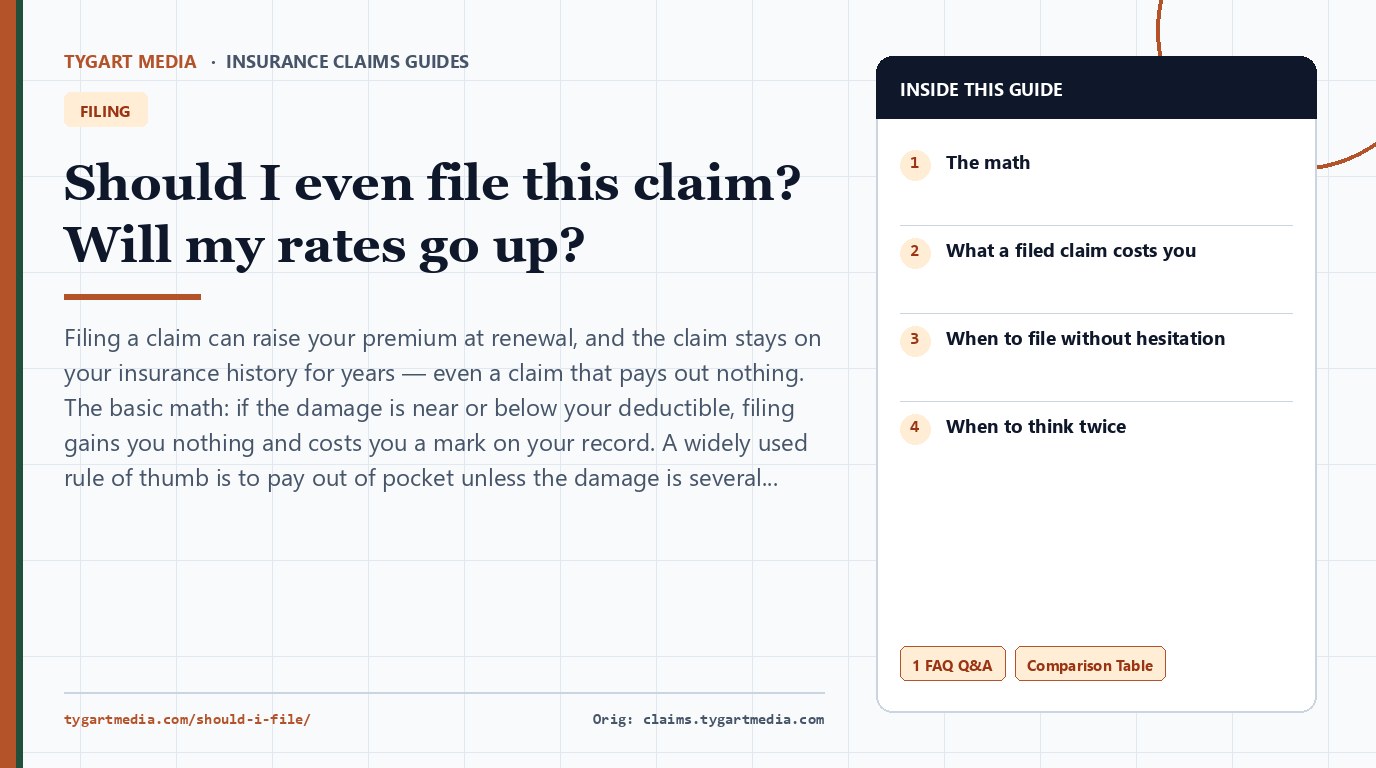
  • Should I even file this claim? Will my rates go up?

    Should I even file this claim? Will my rates go up?

    Tygart Media · Insurance Claims Guides · Filing

    QUICK ANSWEROriginally published at claims.tygartmedia.com · Reviewed October 4, 2026
    The short answer: filing a claim can raise your premium at renewal, and the claim stays on your insurance history for years — even a claim that pays out nothing. The basic math: if the damage is near or below your deductible, filing gains you nothing and costs you a mark on your record. A widely used rule of thumb is to pay out of pocket unless the damage is several times your deductible, and to reserve claims for sudden, significant losses.

    The math

    Start with two numbers: your deductible and a realistic repair cost. If the repair costs less than your deductible, the insurer pays zero — but the filed claim still goes on your record. If the repair is only slightly above your deductible, the small payout may not be worth the premium increase and the history mark. The claims worth filing are the ones where the payout is clearly, substantially larger than the deductible.

    What a filed claim costs you

    • Premium increases. A single claim can raise your premium at renewal — water damage and liability claims tend to move rates more than, say, a hail claim. The increase compounds over the years the claim stays on your record.
    • Your claims history. Filed claims are reported to industry databases and stay visible to insurers for years. Multiple claims in a short window can make you look high-risk — and in the worst case, lead to non-renewal.
    • Your deductible, obviously. You pay it first, every time, before the insurer pays a dollar.

    When to file without hesitation

    • Major sudden damage — burst pipe flooding multiple rooms, fire, storm tearing off the roof.
    • Liability situations — someone injured on your property. Report these promptly; delay can jeopardize coverage.
    • Damage you can’t afford to fix yourself, where the payout meaningfully exceeds the deductible.

    When to think twice

    • Damage near or below your deductible.
    • Small, isolated issues you’d pay a handyman to fix.
    • Maintenance-related problems — these are typically excluded anyway, so you’d take the history mark for a denial.
    • You’ve filed recently — stacking claims multiplies the premium and non-renewal risk.
    Editor's Note
    Asking questions is not filing Calling your agent to ask a hypothetical question is not the same as filing a claim — but be careful how you phrase it. Ask about your policy’s coverage in general terms before describing your specific situation, and understand that some carriers log inquiries. When in doubt, read your policy first.
    Important Notice
    Don’t wait too long deciding Policies require prompt notice of a loss. If you’re going to file, file promptly — and if you’re going to pay out of pocket, still mitigate further damage immediately. Indecision plus delay is the worst combination.
    Disclaimer
    Informational only — not legal or insurance advice.
    Insurance rules vary by state and by policy. Check your own policy documents and your state’s insurance department, or talk to a licensed professional, before acting on a claim.

    The breakeven math, worked out

    With a $1,000 deductible, here’s how the decision looks at different repair costs. The “net payout” is what the insurer actually sends you — the rest is the mark on your record.

    Should you file? Deductible $1,000, repair cost varies
    Repair costNet payoutVerdict
    $800$0 — below deductiblePay out of pocket. Filing gains nothing and still marks your record.
    $1,500$500Probably pay out of pocket. $500 isn’t worth the premium risk.
    $3,000$2,000Judgment call. Weigh the payout against 3–5 years of higher premiums.
    $10,000$9,000File. This is what insurance is for.
    Next Step & Source Attribution
    Continue navigating Insurance Claims Guides
    Source: Originally published at https://claims.tygartmedia.com/should-i-file/ · Author: William Tygart, Tygart Media · Last reviewed October 4, 2026.
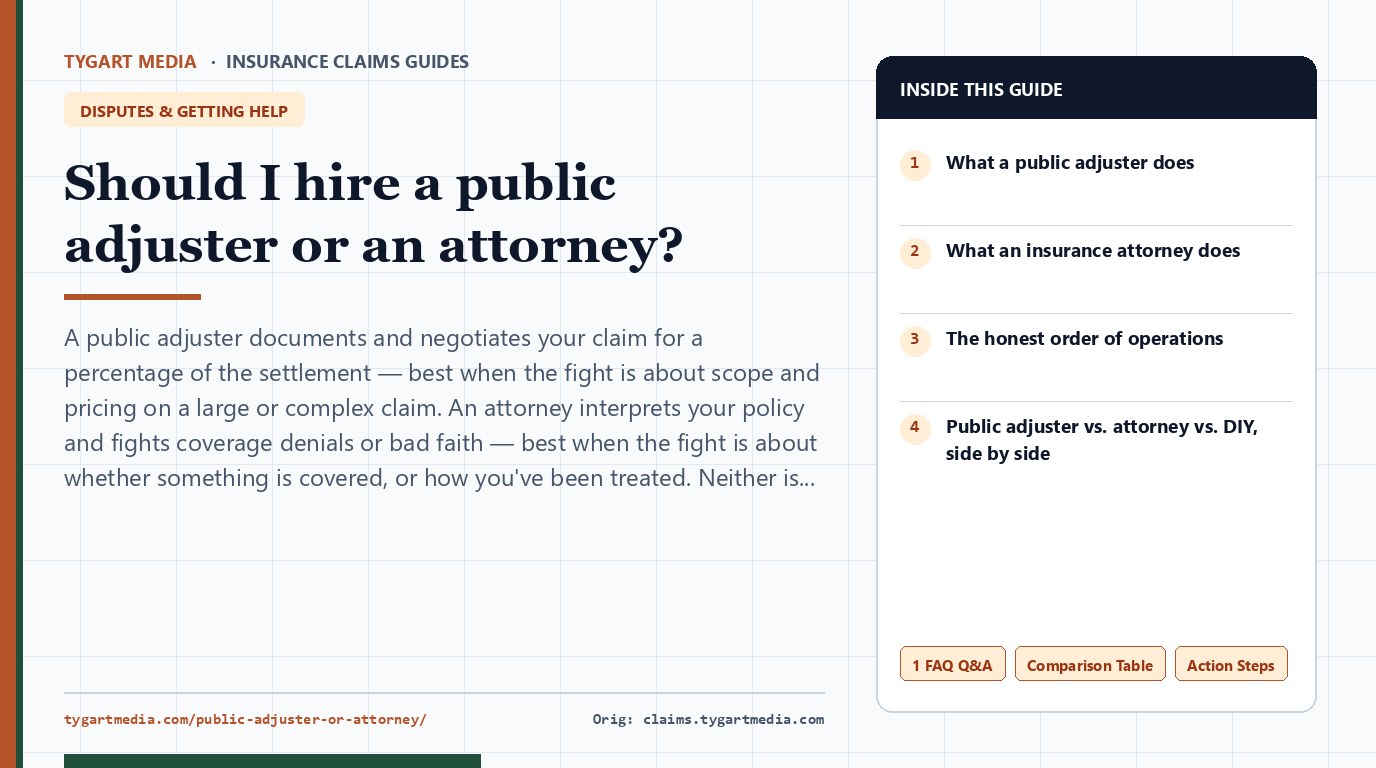
  • Should I hire a public adjuster or an attorney?

    Should I hire a public adjuster or an attorney?

    Tygart Media · Insurance Claims Guides · Disputes & getting help

    QUICK ANSWEROriginally published at claims.tygartmedia.com · Reviewed October 4, 2026
    The short answer: a public adjuster documents and negotiates your claim for a percentage of the settlement — best when the fight is about scope and pricing on a large or complex claim. An attorney interprets your policy and fights coverage denials or bad faith — best when the fight is about whether something is covered, or how you’ve been treated. Neither is step one: document, dispute in writing, and work the insurer’s process first.

    What a public adjuster does

    A public adjuster is licensed by the state (unlike the insurance company’s adjuster, who works for the carrier, the public adjuster works for you). They inspect the damage, build the full scope of the claim, prepare the documentation, and negotiate directly with the insurer. Think of them as a professional version of what this site teaches you to do yourself.

    • Cost: typically a percentage of the final settlement — commonly around 10%, though it varies by state and some states cap the fee. On a large claim, that percentage is real money, so do the math.
    • Best for: large or complex claims where the dispute is about the amount — scope disagreements, underpriced estimates, mountains of documentation.
    • Not for: small claims (the fee eats the benefit), or pure coverage questions — a public adjuster can’t practice law.
    • Watch for: anyone who knocks on your door after a storm pressuring you to sign. Reputable adjusters don’t need to chase. Check the license with your state insurance department before signing anything.

    What an insurance attorney does

    An attorney handles the legal side: interpreting policy language, challenging wrongful denials, pursuing bad-faith claims, and filing suit if it comes to that.

    • Cost: varies — some work on contingency (a percentage of recovery), some hourly, some offer free initial consultations. In some states, policyholders who win can recover attorney fees from the insurer.
    • Best for: denied claims where the insurer’s reading of the policy looks wrong, bad-faith handling (unreasonable delays, misrepresentation), and large losses where the stakes justify legal fees.
    • Not for: straightforward scope disputes that a re-inspection or the appraisal clause could resolve for free.

    The honest order of operations

    1. Document and dispute yourself first. Photos, a contractor’s estimate, a written dispute — free, and it resolves a surprising number of claims. Challenging a low estimate →
    2. Use the free levers: re-inspection, formal appeal, your state insurance department complaint, mediation where available. The full ladder →
    3. Hire a public adjuster when the claim is large, the documentation burden is heavy, and the dispute is about dollars and scope.
    4. Hire an attorney when it’s about coverage, bad faith, or the insurer won’t engage with the process at all.
    Important Notice
    Read before you sign Both public adjuster contracts and attorney fee agreements deserve a careful read. Know the percentage, know what happens if you cancel, and never sign a contract with blank spaces. A legitimate professional will let you take the paperwork home.
    Disclaimer
    Informational only — not legal or insurance advice.
    Insurance rules vary by state and by policy. Check your own policy documents and your state’s insurance department, or talk to a licensed professional, before acting on a claim.

    Public adjuster vs. attorney vs. DIY, side by side

    Who to hire for an insurance dispute
    Public adjusterAttorneyDIY (you)
    Best forScope & pricing fights on large claimsCoverage denials, bad faith, policy interpretationSmall gaps, straightforward documentation
    Typical cost5–15% of the settlementContingency (often ~33%) or hourlyYour time
    Can’t doGive legal advice or sue—Force the insurer’s hand
    Hire whenEstimate is far below reality on a big lossDenial cites policy language; delay looks intentionalAlways start here — document and dispute in writing first
    Next Step & Source Attribution
    Continue navigating Insurance Claims Guides
    Source: Originally published at https://claims.tygartmedia.com/public-adjuster-or-attorney/ · Author: William Tygart, Tygart Media · Last reviewed October 4, 2026.
  • How long does the insurance company have to respond to my claim?

    How long does the insurance company have to respond to my claim?

    Tygart Media · Insurance Claims Guides · Disputes & getting help

    QUICK ANSWEROriginally published at claims.tygartmedia.com · Reviewed October 4, 2026
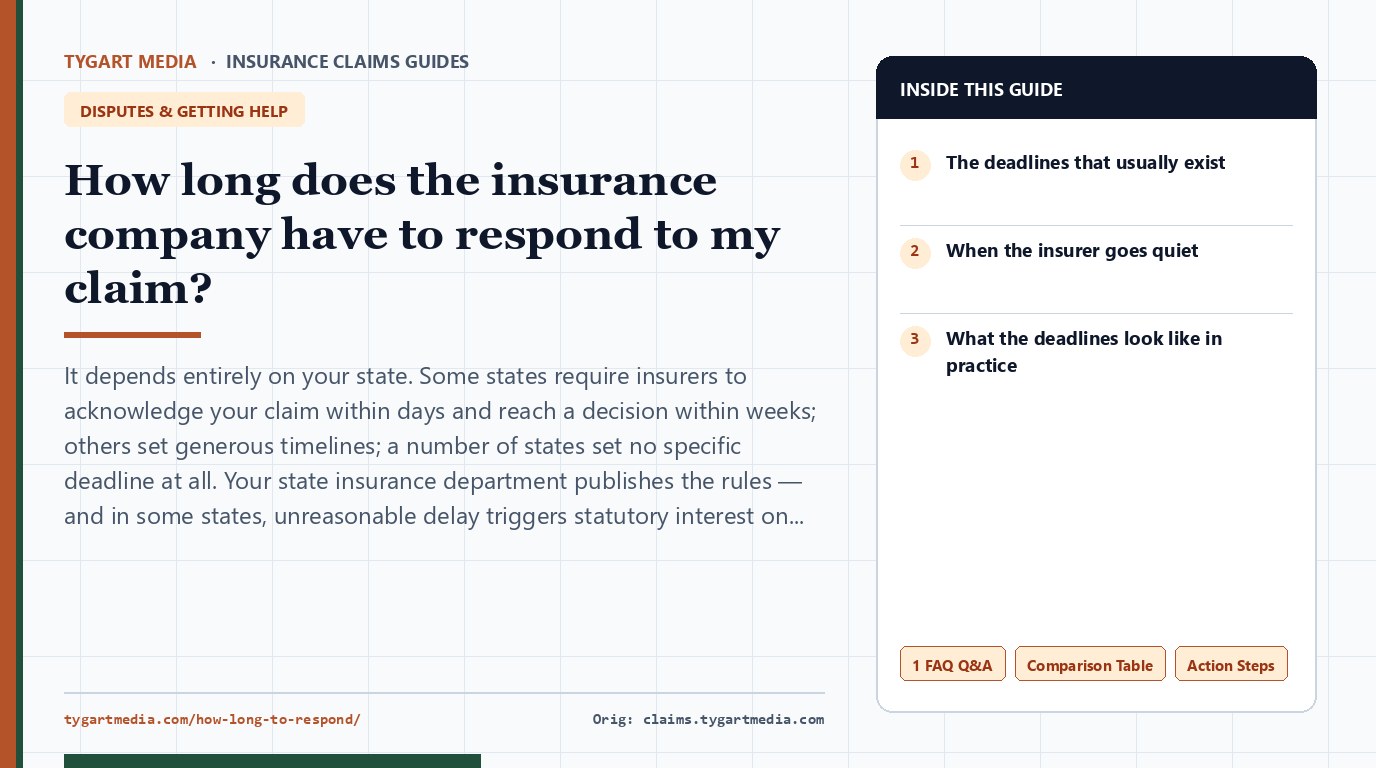
    The short answer: it depends entirely on your state. Some states require insurers to acknowledge your claim within days and reach a decision within weeks; others set generous timelines; a number of states set no specific deadline at all. Your state insurance department publishes the rules — and in some states, unreasonable delay triggers statutory interest on what you’re owed, or even bad-faith liability.

    The deadlines that usually exist

    Where states regulate timelines, they typically break into three stages:

    • Acknowledgment — confirming they received your claim (often within days).
    • Investigation/decision — accepting or denying the claim, often within 30 to 90 days depending on the state.
    • Payment — issuing payment promptly after a claim is accepted or a settlement is reached.

    The variation is enormous, which is exactly why “how long” has no national answer. Look up your state’s specific rules on your state insurance department’s website — search “[your state] insurance claim response time requirements.”

    When the insurer goes quiet

    The silence game is one of the most common claim frustrations: the adjuster stops returning calls, the file sits, months pass. Here’s the playbook:

    1. Move everything to writing. If you’ve been calling, switch to email. Every request gets a date stamp, and “per my email of…” is a sentence adjusters respond to.
    2. Set your own deadlines in writing. “Please provide a status update by [date, ~10 business days out].” Reasonable, documented, and it creates a record of the delay.
    3. Escalate inside the company. Ask for the adjuster’s supervisor or the claims manager, in writing. Front-line adjusters juggle heavy caseloads; supervisors can unstick files.
    4. File a complaint with your state insurance department. This is the lever that moves silent files. Regulators ask the carrier why, and carriers answer regulators. It’s free.
    5. Know that delay can cost them. In several states, late payment triggers statutory interest on the amount owed. In others, a pattern of unreasonable delay supports a bad-faith claim — which is attorney territory. The recourse ladder →
    Editor's Note
    Keep a delay log Dates of every contact, who you spoke with, what was promised, and what actually happened. If the dispute ever reaches a regulator, a mediator, or a lawyer, this log is gold.
    Important Notice
    Don’t let the clock run on you either While you’re waiting on the insurer, watch your own deadlines: policy time limits for filing suit, deadlines to submit documentation, and windows to recover depreciation holdbacks. The insurer’s delay doesn’t pause your obligations.
    Disclaimer
    Informational only — not legal or insurance advice.
    Insurance rules vary by state and by policy. Check your own policy documents and your state’s insurance department, or talk to a licensed professional, before acting on a claim.

    What the deadlines look like in practice

    These are examples — your state’s rules may differ, and statutes change. Confirm with your state insurance department before relying on any deadline.

    Example state claim-handling deadlines
    StateAcknowledge claimAccept or deny
    CaliforniaWithin 15 daysWithin 40 days of receiving proof of loss
    TexasWithin 15 daysWithin 15 business days after receiving all requested information
    FloridaWithin 14 daysWithin 90 days (with interest owed on late payments)
    New YorkWithin 15 business daysPromptly; delay triggers regulatory scrutiny

    In several states, missing the deadline doesn’t just annoy you — it can trigger statutory interest on the amount owed, or support a bad-faith claim. That’s why documenting every date matters.

    Next Step & Source Attribution
    Continue navigating Insurance Claims Guides
    Source: Originally published at https://claims.tygartmedia.com/how-long-to-respond/ · Author: William Tygart, Tygart Media · Last reviewed October 4, 2026.
  • My mold claim was denied. Is that the end?

    My mold claim was denied. Is that the end?

    Tygart Media · Insurance Claims Guides · Denials

    QUICK ANSWEROriginally published at claims.tygartmedia.com · Reviewed October 4, 2026
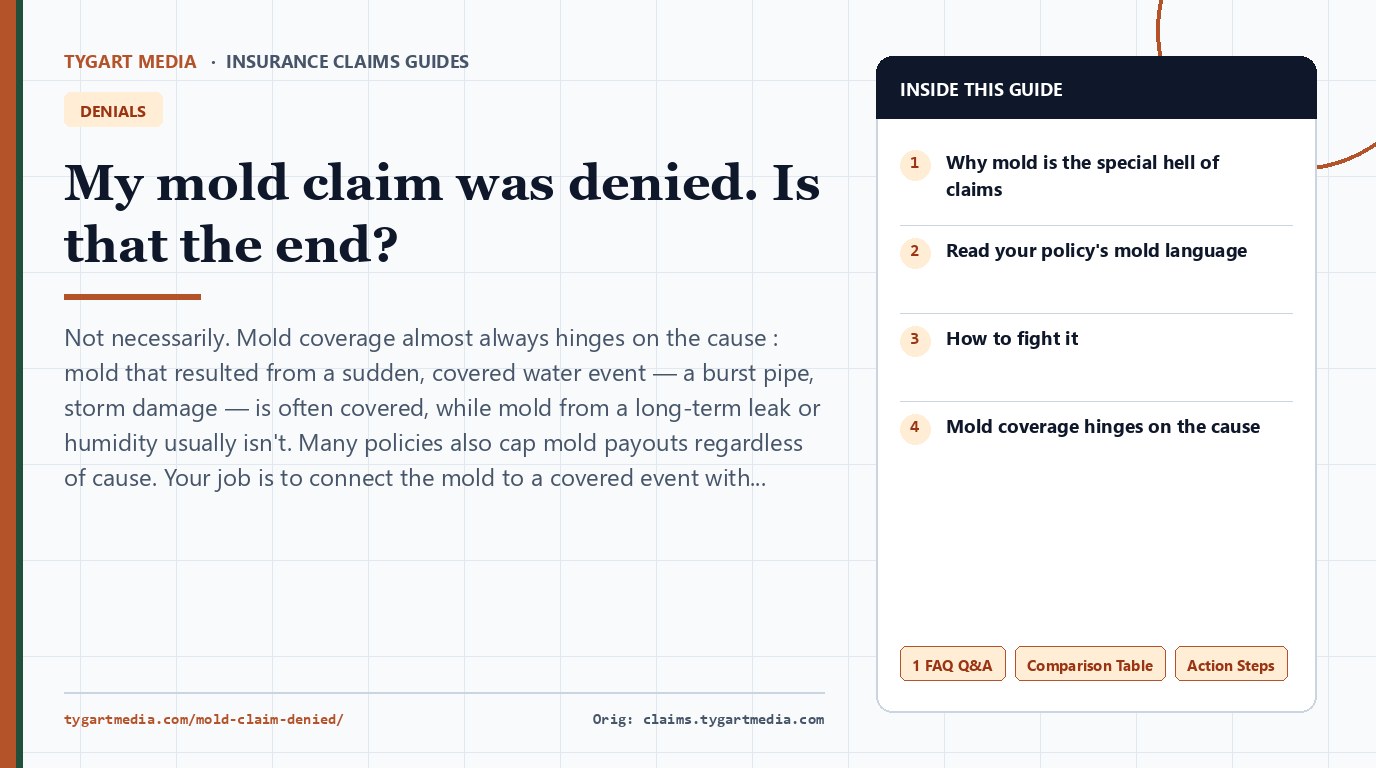
    The short answer: not necessarily. Mold coverage almost always hinges on the cause: mold that resulted from a sudden, covered water event — a burst pipe, storm damage — is often covered, while mold from a long-term leak or humidity usually isn’t. Many policies also cap mold payouts regardless of cause. Your job is to connect the mold to a covered event with evidence, and to read exactly what your policy’s mold language says.

    Why mold is the special hell of claims

    Insurers treat mold as a symptom, not a peril. The question is never really “is there mold” — it’s “what caused the moisture that caused the mold, and was that covered?” A pipe bursts on Tuesday and mold blooms by Friday: that’s a covered water event with a mold consequence. A slow drip under a sink feeds mold for a year: that’s a maintenance issue, and the denial will say so. Same mold, opposite outcomes — the cause is everything.

    Read your policy’s mold language

    Find the mold exclusion or limitation in your policy. Common patterns:

    • A sublimit — mold covered, but capped at a fixed dollar amount that’s often far below the remediation cost.
    • Cause-based coverage — mold covered only when it results from a covered water loss.
    • Full exclusion with limited buy-back — some policies exclude mold entirely unless you purchased a mold endorsement.

    Then compare it against the denial letter’s cited language, exactly as with any denial. The denial playbook →

    How to fight it

    1. Establish the water source. This is the whole case. A plumber’s or contractor’s written statement identifying a sudden failure point — the burst fitting, the failed supply line, the storm breach — is the evidence that converts “mold” into “covered water damage with mold.”
    2. Get professional mold documentation. A qualified mold assessor’s report describing the extent and, where possible, the moisture source carries far more weight than your photos alone (though take those too, with timestamps).
    3. Check the timeline. If the water event was recent and you acted promptly — mitigation, reporting — say so explicitly. Delay between the event and the claim is what feeds “long-term leak” denials.
    4. Appeal in writing linking the mold to the covered event, with the professional reports attached. If the policy has a mold sublimit rather than an exclusion, argue for the full sublimit at minimum.
    5. Escalate as needed — re-inspection, state insurance department complaint, and professional help for large remediation costs. The recourse ladder →
    Important Notice
    Don’t remediate before documenting Mold remediation destroys the evidence of what caused it. Photograph everything, get the assessor’s report, and keep samples and reports before the tear-out begins. And don’t delay mitigation unreasonably either — you have a duty to prevent further damage. Document first, then mitigate.
    Disclaimer
    Informational only — not legal or insurance advice.
    Insurance rules vary by state and by policy. Check your own policy documents and your state’s insurance department, or talk to a licensed professional, before acting on a claim.

    Mold coverage hinges on the cause

    Is the mold covered? Follow the water
    What caused the moldTypically covered?
    Burst pipe (sudden)Yes — the water event is covered, mold follows
    Storm damage letting water inYes — tied to a covered peril
    Slow leak over monthsUsually no — graded as neglect/maintenance
    Humidity / poor ventilationNo — maintenance issue
    Next Step & Source Attribution
    Continue navigating Insurance Claims Guides
    Source: Originally published at https://claims.tygartmedia.com/mold-claim-denied/ · Author: William Tygart, Tygart Media · Last reviewed October 4, 2026.
  • How do I file a complaint with my state insurance department?

    How do I file a complaint with my state insurance department?

    Tygart Media · Insurance Claims Guides · Denied claims

    QUICK ANSWEROriginally published at claims.tygartmedia.com · Reviewed October 4, 2026
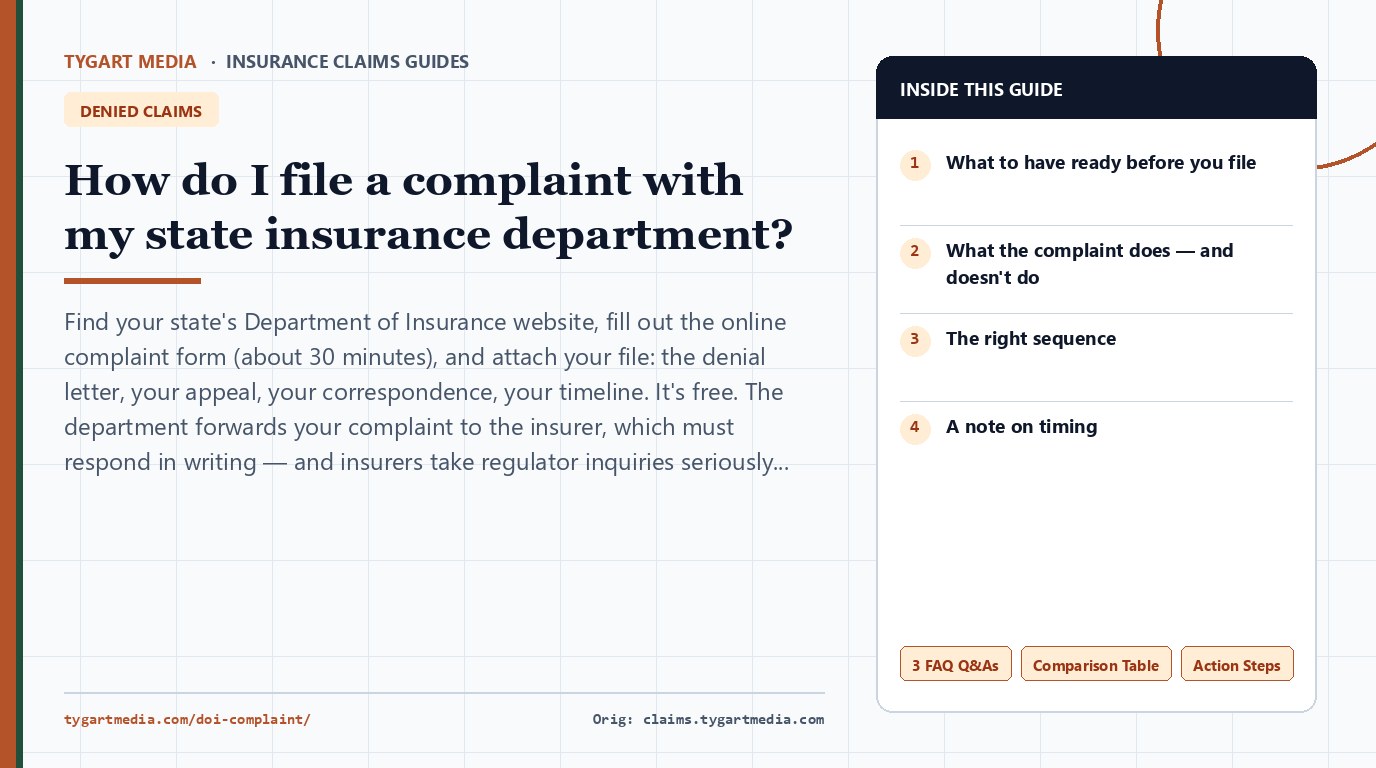
    The short answer: find your state’s Department of Insurance website, fill out the online complaint form (about 30 minutes), and attach your file: the denial letter, your appeal, your correspondence, your timeline. It’s free. The department forwards your complaint to the insurer, which must respond in writing — and insurers take regulator inquiries seriously. File the internal appeal first, then the complaint if the appeal stalls.

    What to have ready before you file

    • Policy number and claim number. The regulator needs both to route the complaint.
    • A timeline. Date of loss, date reported, adjuster visit, denial date, appeal date. One page, chronological.
    • The denial letter and your appeal. The regulator reads the company’s stated reason first — make sure they also see your answer to it. How to write the appeal letter →
    • Your correspondence file. Emails, letters, notes from phone calls. The organized complainant gets taken seriously.
    • A clear statement of what you want. “Reconsider the denial” or “re-inspect with my contractor present.” Vague complaints get vague handling.

    What the complaint does — and doesn’t do

    It does three things. First, it forces a formal response: the insurer must answer the regulator, usually within a set number of days, and a regulator reads that response. Second, it creates a record — departments track complaint volume and patterns, and a company with a pattern of similar complaints draws scrutiny. Third, it sometimes resolves the dispute outright: insurers occasionally reverse or improve an offer rather than defend it in writing to a regulator.

    It doesn’t do three things. It won’t guarantee a reversal. The department won’t act as your personal advocate or negotiate on your behalf. And it won’t award damages or penalties to you — that’s what courts are for. Think of it as the rung that makes the insurer’s file get a second, more careful look. When it rises to bad faith →

    The right sequence

    1. Written appeal to the insurer first. The regulator wants to see you gave the company a chance to fix it.
    2. DOI complaint if the appeal stalls or is denied. Mention the appeal in your complaint and attach it.
    3. Escalate from there if needed: appraisal for amount disputes, an attorney for coverage disputes and bad faith. The full escalation ladder →

    A note on timing

    Regulator timelines vary — some departments move in weeks, others take months. File early enough that a slow process doesn’t push you past your policy’s appeal window or your state’s statute of limitations. The complaint and the clock run in parallel; don’t let one stop the other.

    Important Notice
    Stick to facts, not conclusions “The adjuster spent 11 minutes on site and the denial cites wear and tear on a 4-year-old roof” lands. “This company is corrupt” doesn’t. Regulators respond to documented facts — give them the file, not the fury.
    Disclaimer
    Informational only — not legal or insurance advice.
    Insurance rules vary by state and by policy. Check your own policy documents and your state’s insurance department, or talk to a licensed professional, before acting on a claim.

    What to put in the complaint

    Building an effective DOI complaint
    IncludeWhy it matters
    Policy number + claim numberLets the regulator pull your file instantly
    Timeline with datesDelay is the most common upheld complaint — dates prove it
    The insurer’s stated reasonQuote the denial or delay language exactly
    Your evidencePhotos, estimates, correspondence — the paper trail
    What you’re asking forBe specific: re-inspection, written explanation, payment of X
    Next Step & Source Attribution
    Continue navigating Insurance Claims Guides
    Source: Originally published at https://claims.tygartmedia.com/doi-complaint/ · Author: William Tygart, Tygart Media · Last reviewed October 4, 2026.
  • The adjuster’s estimate is way too low. Is that the final word?

    The adjuster’s estimate is way too low. Is that the final word?

    Tygart Media · Insurance Claims Guides · Estimates & payments

    QUICK ANSWEROriginally published at claims.tygartmedia.com · Reviewed October 4, 2026
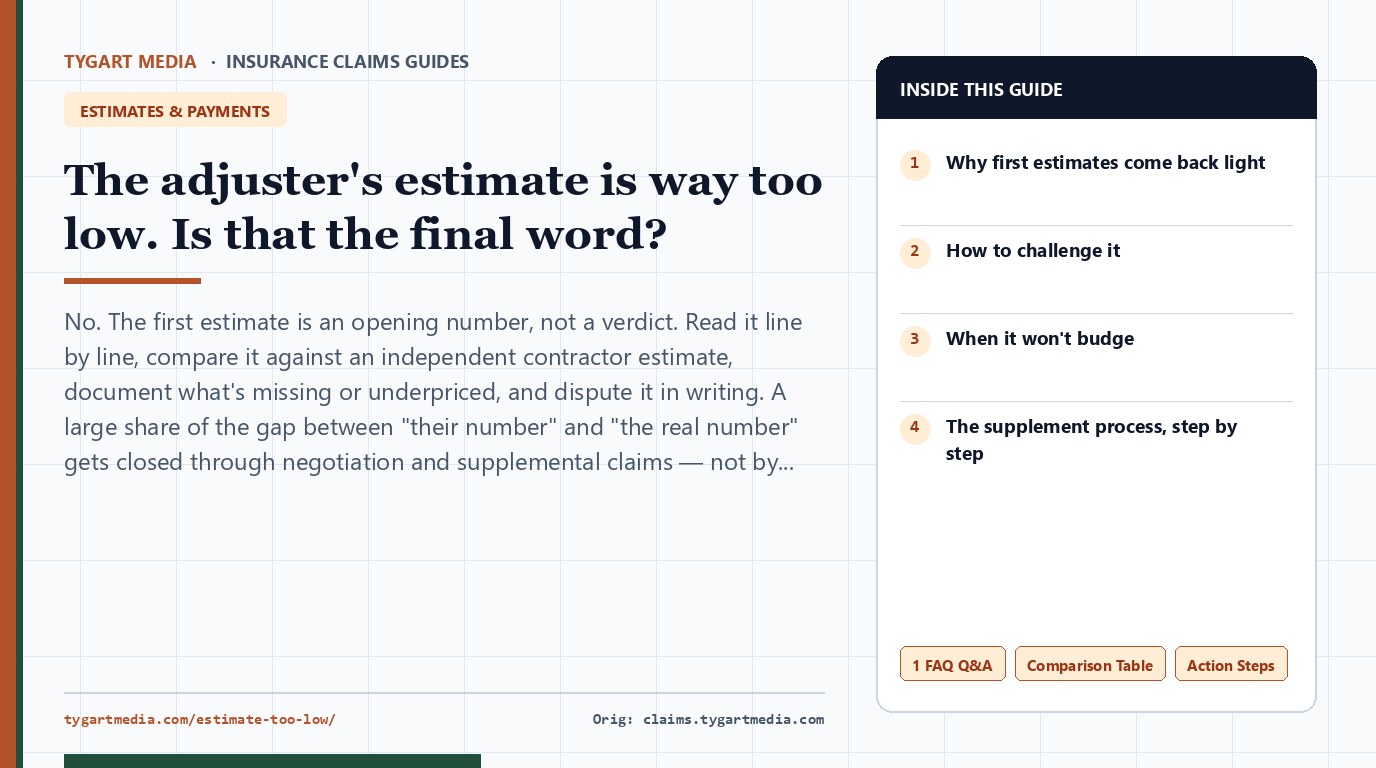
    The short answer: no. The first estimate is an opening number, not a verdict. Read it line by line, compare it against an independent contractor estimate, document what’s missing or underpriced, and dispute it in writing. A large share of the gap between “their number” and “the real number” gets closed through negotiation and supplemental claims — not by accepting the first figure.

    Why first estimates come back light

    Adjusters work from estimating software with standardized pricing, and they’re measured on closing files efficiently. That doesn’t mean bad faith — it means the first estimate reflects what was visible in one visit, priced conservatively. Common gaps:

    • Missing line items — code-required upgrades, permits, matching materials, contents manipulation, or protective coverings that a real job needs but a quick inspection skips.
    • Underpriced labor — software pricing that doesn’t reflect what licensed contractors in your area actually charge.
    • Depreciation applied aggressively — recoverable depreciation that’s yours to claim once work is done. ACV vs. replacement cost →
    • Scope that’s too narrow — visible damage estimated, hidden damage (behind walls, under flooring) left for “later” and then forgotten.

    How to challenge it

    1. Get your own line-item estimate from a licensed contractor who has seen the damage in person. This is your anchor number — without it, you’re negotiating against their paperwork with nothing.
    2. Compare line by line. Mark every item that’s missing, underpriced, or scoped wrong. Be specific: “permit fees omitted,” “drywall priced at X, three local bids average Y.”
    3. Put the dispute in writing. Email the adjuster with the comparison attached. Phone calls don’t create a record; emails do. State what you believe the correct scope and pricing are and ask for a written response.
    4. Request a re-inspection with your contractor present to walk the adjuster through the missed items.
    5. File supplemental claims for anything discovered as work proceeds. How supplements work →
    Editor's Note
    Your contractor is your documentation ally A good contractor’s detailed estimate — with photos, measurements, and code references — is the single most persuasive thing you can put in front of an adjuster. This is also why the relationship matters: contractors who document thoroughly get their customers paid fairly.

    When it won’t budge

    If the insurer won’t move after a documented dispute, you still have options: invoke your policy’s appraisal clause (each side hires an appraiser to settle the amount of loss), file a complaint with your state insurance department, or consult a public adjuster or attorney. The full recourse ladder →

    Important Notice
    Don’t start work on a handshake Get any agreed scope changes in writing before work begins. Verbal promises from anyone — adjuster or contractor — are worth exactly nothing if the claim is disputed later.
    Disclaimer
    Informational only — not legal or insurance advice.
    Insurance rules vary by state and by policy. Check your own policy documents and your state’s insurance department, or talk to a licensed professional, before acting on a claim.

    The supplement process, step by step

    Closing the gap between their number and the real number
    StepWhat you doWhy it works
    1. Line-by-line reviewCompare the adjuster’s estimate against an independent contractor’sSurfaces missing line items and underpriced labor
    2. Document the gapPhotos, measurements, contractor quotes in writingTurns “I disagree” into evidence
    3. Written disputeSend the comparison to the adjuster, citing specific linesCreates the paper trail every escalation needs
    4. Supplemental claimFile for costs discovered after the first estimateMost policies explicitly allow this — it’s not a second bite, it’s the process
    5. Re-inspectionRequest the adjuster return with your contractor presentHarder to lowball with a professional standing next to you
    Next Step & Source Attribution
    Continue navigating Insurance Claims Guides
    Source: Originally published at https://claims.tygartmedia.com/estimate-too-low/ · Author: William Tygart, Tygart Media · Last reviewed October 4, 2026.
  • My water damage claim was denied. What do I do now?

    My water damage claim was denied. What do I do now?

    Tygart Media · Insurance Claims Guides · Denials

    QUICK ANSWEROriginally published at claims.tygartmedia.com · Reviewed October 4, 2026
    The short answer: a denial is not the end of your claim — it’s the start of the dispute. Get the denial in writing with the exact policy language cited, check whether their reason actually matches the facts, document everything, get an independent estimate, and work up the escalation ladder: re-inspection, formal appeal, appraisal, a complaint to your state insurance department, and an attorney if it comes to that.

    Step 1: Read the denial letter like a detective

    The letter should state the specific reason for the denial and cite the exact policy language — the section and exclusion it relies on. If it doesn’t, ask for that in writing. Vague denials (“not covered under your policy”) are the weakest kind, and they’re the easiest to challenge.

    Pull out your actual policy and read the cited section yourself. Denial letters sometimes stretch policy language further than it goes. You don’t need to be a lawyer to compare what the letter says with what the policy says.

    Step 2: Check the reason against the facts

    Most water damage denials fall into a few buckets. Each one is checkable:

    • Sudden vs. gradual. The most common dispute. Policies cover sudden and accidental water damage (a burst supply line) but not long-term leaks. If the damage was sudden, say so clearly and back it with evidence — when you first noticed it, photos with timestamps, a plumber’s statement about the failure point.
    • Flood vs. water damage. Standard homeowners policies exclude flooding (rising water from outside). But water from a burst pipe, an appliance failure, or rain entering through storm-damaged roofing is a different category. The words you used on the first call matter — check what got written down.
    • Wear and tear / maintenance. Insurers deny when they believe the damage came from neglected maintenance. If the failed component was within its normal lifespan or you have maintenance records, that’s your counter-evidence.
    • Late notice. Policies require prompt reporting. If you reported as soon as you discovered the damage, document the timeline.

    Step 3: Build your own file

    From this moment on, assume you’ll need to prove everything twice. Photograph all damage before any repairs. Save every email and letter. After every phone call, send a follow-up email summarizing what was said. Keep receipts for any emergency mitigation — tarps, water extraction, drying equipment — because most policies require you to prevent further damage, and those costs are often reimbursable.

    Step 4: Get an independent estimate

    Bring in your own licensed contractor for a detailed, line-item estimate of the damage and repair scope. This does two things: it gives you a real number to compare against the insurer’s position, and it gives you an expert who can be present at a re-inspection. More on challenging low estimates →

    Step 5: Climb the escalation ladder

    1. Ask for a re-inspection — with your contractor present. New evidence or a second look changes outcomes more often than people expect.
    2. File a formal written appeal with the insurer, attaching your documentation and the independent estimate. Keep it factual and cite the policy language.
    3. Invoke the appraisal clause if your policy has one — each side hires an appraiser, and they pick an umpire. It resolves disputes about the amount of loss.
    4. File a complaint with your state insurance department. Regulators track complaint patterns, and insurers respond to regulator inquiries. This costs you nothing.
    5. Talk to an attorney who handles insurance disputes — many offer free consultations, and some states allow policyholders to recover attorney fees. Public adjuster vs. attorney →
    Important Notice
    Don’t sign a release or accept a partial payment marked “final” Cashing a check marked as full and final settlement can close your claim. If you’re still disputing, don’t sign anything that says the matter is settled — and don’t let emergency repairs wait while you fight; you have a duty to mitigate further damage.
    Disclaimer
    Informational only — not legal or insurance advice.
    Insurance rules vary by state and by policy. Check your own policy documents and your state’s insurance department, or talk to a licensed professional, before acting on a claim.

    Common denial reasons — and the response

    Water damage denials and what to do about each
    Denial reasonYour response
    “Gradual damage / wear and tear”Prove suddenness — maintenance records, photos with dates
    “Flood exclusion”Was it really flood? Burst pipes and appliance leaks aren’t flood
    “Mold exclusion”Tie the mold to a covered water event, not to neglect
    “Late reporting”Show when you discovered it — discovery date, not leak date, often controls
    Next Step & Source Attribution
    Continue navigating Insurance Claims Guides
    Source: Originally published at https://claims.tygartmedia.com/denied-water-damage/ · Author: William Tygart, Tygart Media · Last reviewed October 4, 2026.