Category: Auto Claims Guides

Practical auto insurance claim guides covering total loss valuation, diminished value, rental coverage, fault disputes, and repair supplements. Original hub: autoclaims.tygartmedia.com.

  • Who pays diminished value — my insurer or theirs?

    Who pays diminished value — my insurer or theirs?

    Tygart Media · Auto Claims Guides · Diminished value

    QUICK ANSWEROriginally published at autoclaims.tygartmedia.com · Reviewed October 18, 2026
    The short answer: usually theirs. The main path is the at-fault driver’s liability insurer — that coverage owes the loss its driver caused, including the value your repaired car lost, and no deductible applies to a third-party claim. Your own insurer is the hard path: most collision policies are written to repair the car or pay its value, and diminished value on a first-party claim is usually not owed under that wording. One state is the well-known exception, covered below.

    The main path: their insurer

    When another driver is at fault, your diminished value claim sits inside your property damage claim against that driver. Their liability coverage exists to pay for damage their driver caused to other people and their property. A car that is worth less after a proper repair because it now has an accident history has suffered a real loss, and that loss belongs in that claim.

    That framing matters in the conversation with the adjuster. You are not asking the other insurer for a courtesy or an add-on. You are identifying an element of loss their driver caused, separate from the repair bill itself. Keep it labeled that way in writing, with its own evidence, rather than folding it into a general request for more money.

    No deductible applies to this third-party claim. A deductible is a feature of claiming under your own policy. Claiming against the at-fault driver’s liability coverage does not carry one. If an adjuster applies a deductible to a third-party diminished value payment, ask for the basis for that in writing.

    If that insurer is slow, unresponsive, or disputes fault, the practical options for dealing with that side are covered in the guide to the other driver’s insurer.

    The hard path: your own insurer

    A first-party claim — claiming diminished value from your own collision coverage — runs into the policy wording. Most collision policies promise, in substance, to repair your car or pay its value if it is a total loss. Insurers read that promise as complete once the car has been properly repaired. The remaining drop in value caused by the accident history is, on that reading, not a separate covered loss.

    Courts in most states have upheld that reading of standard collision wording. That does not mean every policy everywhere is identical, and it does not mean you should not read yours. It means you should expect a first-party diminished value demand to be declined on the wording, and should not build your plan around your own insurer paying it when another driver was at fault.

    Editor's Note
    The Georgia exception. Georgia is the notable exception. In State Farm v. Mabry, decided in 2001, the Georgia Supreme Court required insurers to assess diminished value on first-party claims. If your claim is a Georgia first-party claim, ask your insurer how it assessed diminished value and get that assessment in writing. Do not assume the Georgia rule applies in other states.

    If the at-fault driver is uninsured

    When the driver who caused the damage has no insurance, the path changes. Uninsured-motorist property-damage coverage, if you bought it, may respond in some states and under some policies. How that coverage treats diminished value varies — some policies and states treat the claim much like a claim against the at-fault driver, others are narrower.

    Read that section of your own policy closely, and ask your insurer for its position on diminished value under that coverage in writing. The broader picture for this situation is in the guide to uninsured motorist claims. Do not assume the coverage is present, or absent, without checking the declarations and the coverage wording itself.

    If fault is shared

    Many crashes are not all one driver’s fault. Under comparative-fault rules, which most states use in some form, what you can recover from the other side is reduced when you share fault. Diminished value is not separate from that math — it is reduced along with the rest of your property damage claim.

    Because the reduction rule varies by state, and because a fault dispute can change the value of the whole claim, get the other insurer’s fault position in writing early. If you disagree with it, say so in writing and keep the evidence that supports your version — photos, the police report if one exists, and witness details if you have them. The full picture is in What happens if I was partially at fault in the accident?

    A practical sequence

    1. Identify which claim you have. Third party against the at-fault driver, first party against your own collision coverage, or an uninsured-motorist claim. The answer decides where the demand goes and what wording controls it.
    2. Demand in writing, to the correct insurer. Put the diminished value demand in writing to the insurer that actually owes it. A demand sent to the wrong company wastes weeks and can confuse the record.
    3. Keep the claims clearly separate. Identify the repair claim and the diminished value demand as separate elements of loss in your letter. State plainly that the repair payment, if already made, covered repairs only.
    4. Keep every reply. If an insurer declines, ask for the policy or legal basis in writing. A written denial you can read is more useful than a phone explanation you cannot check.
    Important Notice
    Read any release before you sign it. A settlement release for property damage can close a diminished value claim you have not yet made if its wording covers all property damage from the crash. If you intend to pursue diminished value separately, make sure the document you sign does not give it away.

    Frequently asked questions

    Who usually pays diminished value?

    The at-fault driver liability insurer usually pays it as part of a third party claim, because that coverage owes the loss its driver caused. No deductible applies to that third party claim. Your own collision coverage is a much harder path and usually does not pay first party diminished value.

    Does my own insurer have to pay diminished value?

    In most states, no, under standard collision wording. Most policies promise to repair the car or pay its value, and courts in most states have upheld that this does not include a separate first party diminished value payment. Georgia is the notable exception, where insurers must assess diminished value on first party claims.

    What if the at-fault driver has no insurance?

    Uninsured motorist property damage coverage may respond in some states and under some policies, and how it treats diminished value varies. Read that section of your policy closely and ask your insurer for its position in writing. If that coverage is not in your policy, your options against the other driver become much more limited.

    What if fault is shared between both drivers?

    Comparative fault rules in most states reduce what you can recover from the other side when fault is shared. The diminished value claim is reduced along with the rest of the property damage claim. The exact rule varies by state, so confirm how your state treats shared fault before you settle.

    Disclaimer
    Informational only — not legal or insurance advice.
    Auto repair and insurance rules vary by state and by policy. Check your own policy documents and your state’s insurance department, or talk to a licensed professional, before acting on a claim.

    Who pays diminished value, at a glance

    Who pays diminished value by claim type
    SituationWho pays and what usually happens
    Another driver is at faultTheir liability insurer, as a third party claim. No deductible applies.
    You claim on your own collision policyUsually not paid. Most collision wording is read to exclude first party diminished value.
    Georgia first party claimThe exception. Insurers there must assess diminished value on first party claims.
    At-fault driver is uninsuredUninsured motorist property damage coverage may respond in some states and policies. Treatment varies.
    Fault is sharedRecovery from the other side is generally reduced under comparative fault rules in most states.
    Next Step & Source Attribution
    Continue navigating Auto Claims Guides
    Source: Originally published at https://autoclaims.tygartmedia.com/who-pays-diminished-value/ · Author: William Tygart, Tygart Media · Last reviewed October 18, 2026.
  • What is the appraisal clause in auto insurance?

    What is the appraisal clause in auto insurance?

    Tygart Media · Auto Claims Guides · Disputes & getting help

    QUICK ANSWEROriginally published at autoclaims.tygartmedia.com · Reviewed October 18, 2026
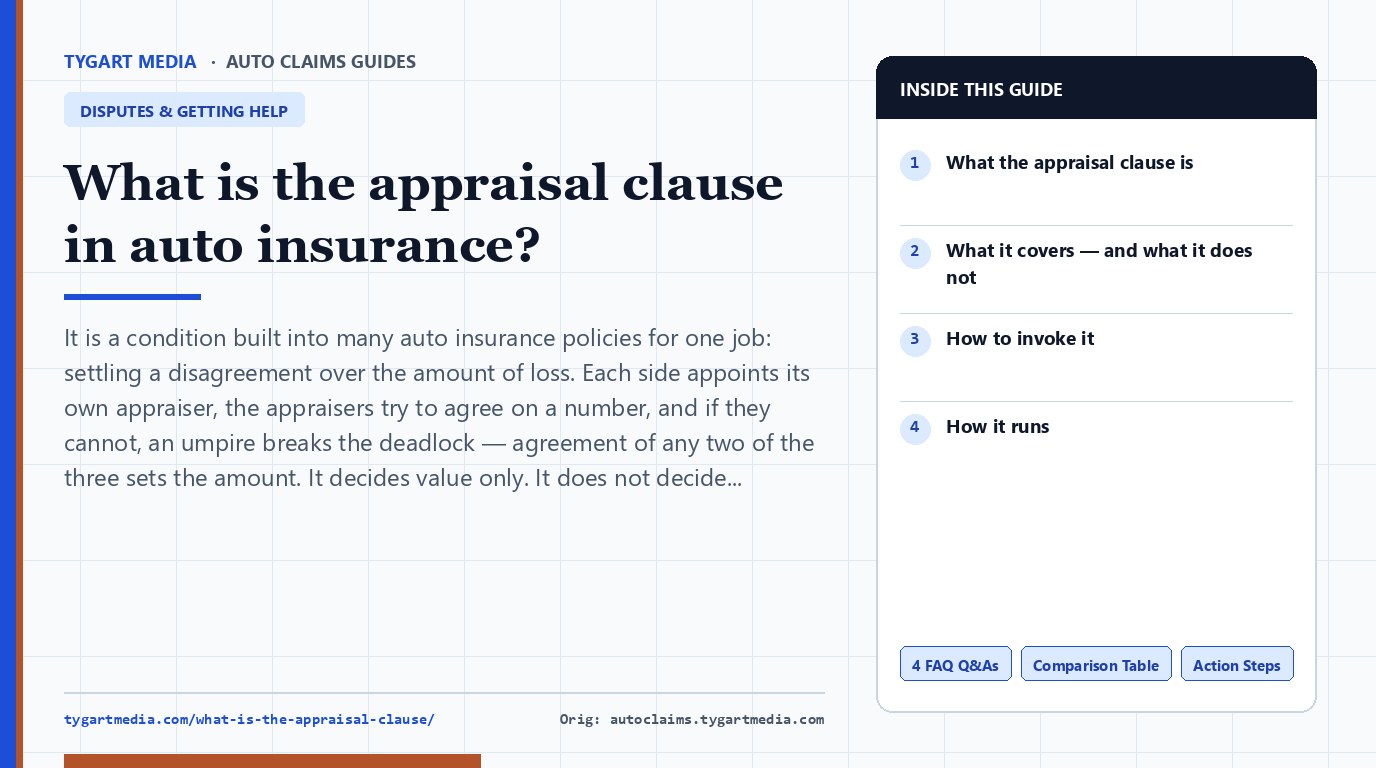
    The short answer: it is a condition built into many auto insurance policies for one job: settling a disagreement over the amount of loss. Each side appoints its own appraiser, the appraisers try to agree on a number, and if they cannot, an umpire breaks the deadlock — agreement of any two of the three sets the amount. It decides value only. It does not decide coverage, liability, or fault.

    What the appraisal clause is

    The appraisal clause is a condition written into many auto insurance policies. It exists for one specific kind of disagreement: you and your insurer agree that a covered loss happened, but you cannot agree on how much that loss is worth in dollars. Rather than leaving that gap to endless negotiation or a lawsuit, the policy itself provides a small, structured process for settling the amount.

    Because it is a policy condition, the clause is part of the contract you already have — not a favor the insurer grants and not a court proceeding. That also means its exact wording matters more than any general description, including this one. Two policies from two insurers can run appraisal differently, and your policy’s text is the version that governs your claim.

    Editor's Note
    First-party only, in practice. The appraisal clause lives in your own policy, so it is a tool for disputes with your own insurer — a total loss value you say is too low, for example. It does not bind the other driver’s insurer, which has no contract with you. Disagreements with that side follow the dispute and complaint routes instead.

    What it covers — and what it does not

    The clause covers the amount of loss, and only the amount of loss. If the argument is “the car was worth more than the offer” or “the loss comes to more than the insurer’s figure,” that is the kind of question appraisal is built to answer. The appraisers are there to value something, not to referee the whole claim.

    It does not decide coverage — whether the policy responds to this loss at all is a separate question the clause does not touch. It does not decide liability or fault, so it cannot settle who caused the crash or what share of blame each driver carries. And it does not award anything beyond the amount of loss itself. If your dispute is really about coverage or fault dressed up as a number, appraisal will not resolve it, and the other routes on the dispute ladder are the better fit.

    How to invoke it

    1. Read your policy’s exact wording first. Find the appraisal condition in the conditions section of your policy. Note how a demand must be made, what it must say, and any deadline or time limit the wording sets — then follow that text exactly, not a summary of it.
    2. Make the demand in writing. Send a written demand for appraisal to your insurer, identifying the claim and stating that you and the insurer disagree on the amount of loss. Keep a copy and proof of when you sent it.
    3. Appoint your appraiser. Choose someone competent on vehicle values who can inspect, document, and defend a number. You pay your own appraiser, so weigh that cost against the amount actually in dispute before you start.
    Important Notice
    Do not let a deadline in the wording pass quietly. Some policies set time limits around demanding appraisal or disputing a loss. If your wording has one and it is close, act on it or get advice about it — an expired window is hard to argue back open.

    How it runs

    1. Each side appoints an appraiser. You name yours; the insurer names theirs. Each appraiser values the loss independently, from the vehicle, the documents, and the market evidence.
    2. The appraisers try to agree. They exchange their figures and their support, and attempt to settle on one amount between them. Many appraisals end here, with the two appraisers agreeing.
    3. If they cannot agree, an umpire steps in. The appraisers choose an umpire — a neutral third person — and put the disputed items to that umpire. Policies typically provide a fallback route for selecting an umpire if the appraisers cannot agree on one.
    4. Any two set the amount. When any two of the three — the two appraisers, or one appraiser and the umpire — agree on a figure, that figure is the amount of loss under the policy.

    Through all of this, your appraiser can only argue from evidence: the vehicle’s condition and options, comparable sales, and documented values. An appraisal rewards the same preparation as a good negotiation. The way value is built for a totaled car is covered in the guide to how total loss value is decided.

    Who pays for it

    Under the wording found in many policies, each side pays its own appraiser, and the umpire’s cost is typically split between you and the insurer. That structure is deliberate: it keeps either side from loading the process with costs the other has to carry, and it means your direct expense is mainly your own appraiser’s fee. Confirm the split in your own wording before invoking, because the clause in your policy — not the typical version — is the one that will be applied.

    That cost is the honest reason appraisal is not the answer to every gap. If the distance between the offer and your documented number is small, your appraiser’s fee can eat the difference. If the gap is large and your evidence is strong, the clause gives you a decision instead of a stalemate.

    Where it fits among your options

    Appraisal is one tool on a ladder, and it suits one kind of fight: a value disagreement with your own insurer, after negotiation has stalled. A state insurance complaint pressures the process but cannot set the amount. An attorney fits larger disputes, coverage fights, and bad-faith patterns. Small claims court can decide a defined amount, under rules and limits that vary by state. Choosing between them starts with naming your disagreement precisely — amount, coverage, or conduct — because each tool answers a different one of those.

    Frequently asked questions

    Does every auto policy have an appraisal clause?

    No. Many auto policies include one, but the wording and availability vary by policy and by state. Read the conditions section of your own policy, or ask your insurer in writing whether your policy has an appraisal condition and what it requires.

    Is the appraisal result binding?

    Typically, yes, within its limits. When any two of the three — your appraiser, the insurer’s appraiser, and the umpire — agree on an amount, that amount usually settles the value question under the policy. It does not settle coverage or fault, which the clause does not reach. Read your policy’s exact wording for how the result is treated.

    Who pays for the appraisers and the umpire?

    Under the wording found in many policies, each side pays its own appraiser, and the cost of the umpire is typically split between you and the insurer. Your policy’s exact wording controls, so check who pays for what before you invoke the clause.

    Can I use the appraisal clause for a repair-scope dispute?

    It depends on your wording. Some clauses are written broadly around the amount of loss, while others are value-only in practice, aimed at what the car or the loss is worth rather than which repair operations are needed. Read your policy’s exact appraisal wording, and ask the insurer in writing whether it treats a repair-scope disagreement as within the clause.

    Disclaimer
    Informational only — not legal or insurance advice.
    Auto repair and insurance rules vary by state and by policy. Check your own policy documents and your state’s insurance department, or talk to a licensed professional, before acting on a claim.

    The appraisal clause, at a glance

    How appraisal works and where its limits are
    ItemWhat it means in practice
    What it isA policy condition for disagreements over the amount of loss.
    What it coversValue only — not coverage, not liability, not fault.
    How to invoke itA written demand to your insurer, following your policy’s exact wording and any deadline in it.
    How it runsEach side appoints an appraiser; the appraisers try to agree; an umpire breaks a deadlock; any two set the amount.
    Who paysEach side pays its own appraiser; the umpire’s cost is typically split.
    Where it fitsAlongside a state complaint, an attorney, and small claims court — each answers a different kind of dispute.
    Next Step & Source Attribution
    Continue navigating Auto Claims Guides
    Source: Originally published at https://autoclaims.tygartmedia.com/what-is-the-appraisal-clause/ · Author: William Tygart, Tygart Media · Last reviewed October 18, 2026.
  • What is actual cash value for a totaled car?

    What is actual cash value for a totaled car?

    Tygart Media · Auto Claims Guides · Total loss & valuation

    QUICK ANSWEROriginally published at autoclaims.tygartmedia.com · Reviewed October 15, 2026
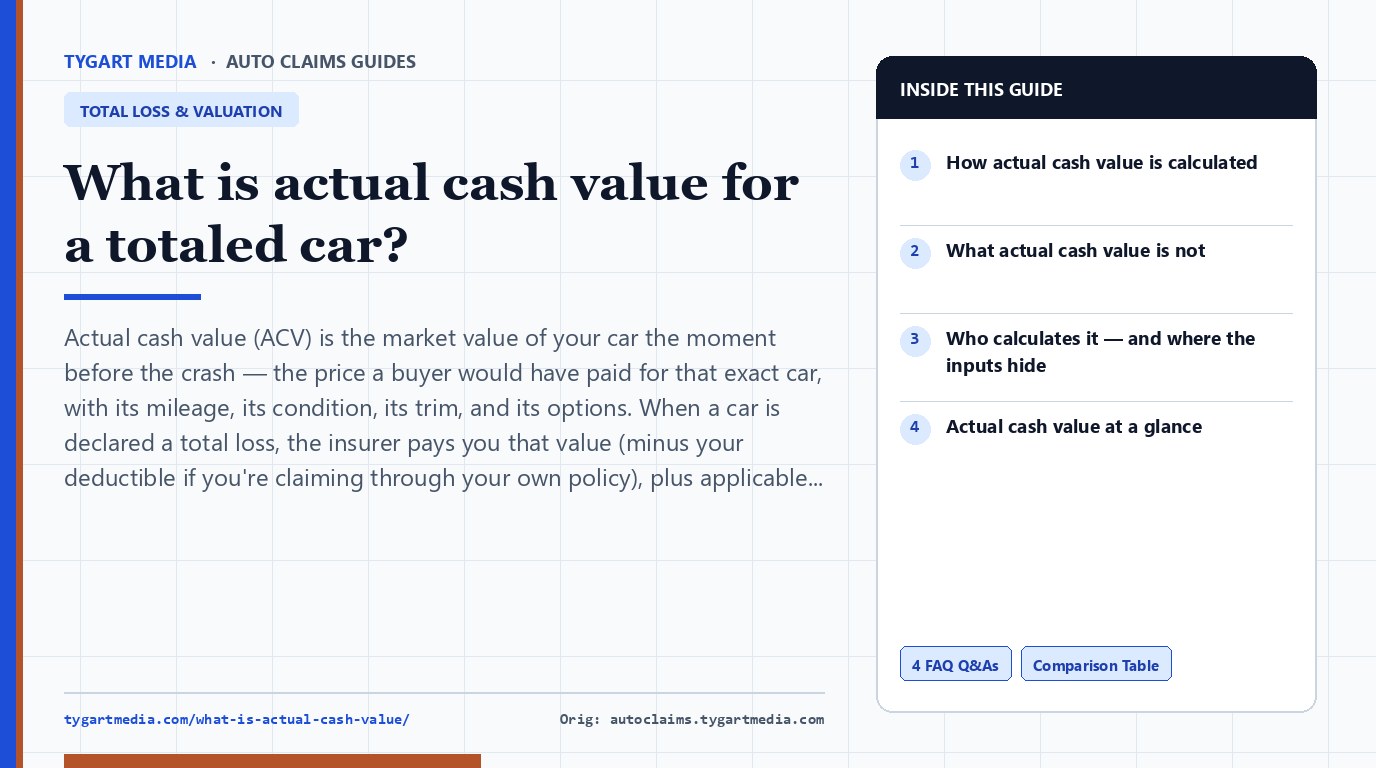
    The short answer: actual cash value (ACV) is the market value of your car the moment before the crash — the price a buyer would have paid for that exact car, with its mileage, its condition, its trim, and its options. When a car is declared a total loss, the insurer pays you that value (minus your deductible if you’re claiming through your own policy), plus applicable taxes and fees. Everything in a total-loss fight comes back to how that one number was built.

    How actual cash value is calculated

    There is no single price list for used cars, so insurers estimate ACV from evidence: what similar cars are actually selling for near you. The valuation looks at:

    • Comparable vehicles — cars of the same year, make, model, and trim, listed for sale or recently sold in your area. These “comps” are the foundation of the number.
    • Mileage adjustment — if your car had more miles than the typical comp, value comes off; fewer miles, value goes on.
    • Condition adjustment — the report rates your car’s body, interior, tires, and mechanical condition, usually against an assumed “average” car.
    • Options and trim adjustment — a higher trim, all-wheel drive, a sunroof, a tow package: each should add value compared to a base-model comp.

    The result is an estimate, not a measurement. Two honest appraisers can land in different places — which is exactly why the inputs are worth checking.

    What actual cash value is not

    • Not what you paid. A car you bought last year has depreciated since. The payout prices the car as it sat just before the crash, not the day you bought it.
    • Not what you owe. Your loan balance follows its own math. If you owe more than the ACV, the difference is the “gap” — a separate problem with its own coverage. What is gap insurance? →
    • Not replacement cost. ACV pays for the car you lost, not for a brand-new one and not necessarily enough to buy an identical car at today’s asking prices.
    • Not a guidebook number by itself. Kelley Blue Book and similar guides are references. Your settlement comes from the insurer’s valuation report — that’s the math to audit.

    Who calculates it — and where the inputs hide

    Your adjuster doesn’t price the car from memory. Insurers use valuation services — CCC ONE, Mitchell, and Audatex are the common ones — that search listings and sales, pick comparables, apply adjustments, and produce a valuation report. The adjuster works from that report, and the offer follows the report.

    The inputs hide inside that document: the trim level it assigned your car, the mileage it used, the condition ratings, and every comparable it picked. A report that lists your car as a base trim, uses a mileage higher than your odometer, or compares it to cars 200 miles away will produce a low number that looks official. Ask for the report in full and check it line by line — here’s how: How do CCC valuation reports work? →

    Editor's Note
    The definition that matters in a dispute ACV is the value of your car — your trim, your miles, your condition, your market. Every correction you make to the report should point back to that: this input describes a different car than the one I owned.
    Disclaimer
    Informational only — not legal or insurance advice.
    How actual cash value is defined and calculated can vary by state and by policy. Check your own policy documents and your state’s insurance department, or talk to a licensed professional, before acting on a claim.

    Actual cash value at a glance

    What ACV is — and what it is not
    ACV isACV is not
    Your car’s market value the moment before the crashThe price you originally paid for the car
    Built from comparable cars in your areaYour loan balance or payoff amount
    Adjusted for your mileage, condition, trim, and optionsThe cost of a new replacement car
    Documented in a valuation report you can auditA fixed number you have to accept as-is
    Next Step & Source Attribution
    Continue navigating Auto Claims Guides
    Source: Originally published at https://autoclaims.tygartmedia.com/what-is-actual-cash-value/ · Author: William Tygart, Tygart Media · Last reviewed October 15, 2026.
  • What are my rights after a crash?

    What are my rights after a crash?

    Tygart Media · Auto Claims Guides · Disputes & getting help

    QUICK ANSWEROriginally published at autoclaims.tygartmedia.com · Reviewed October 18, 2026
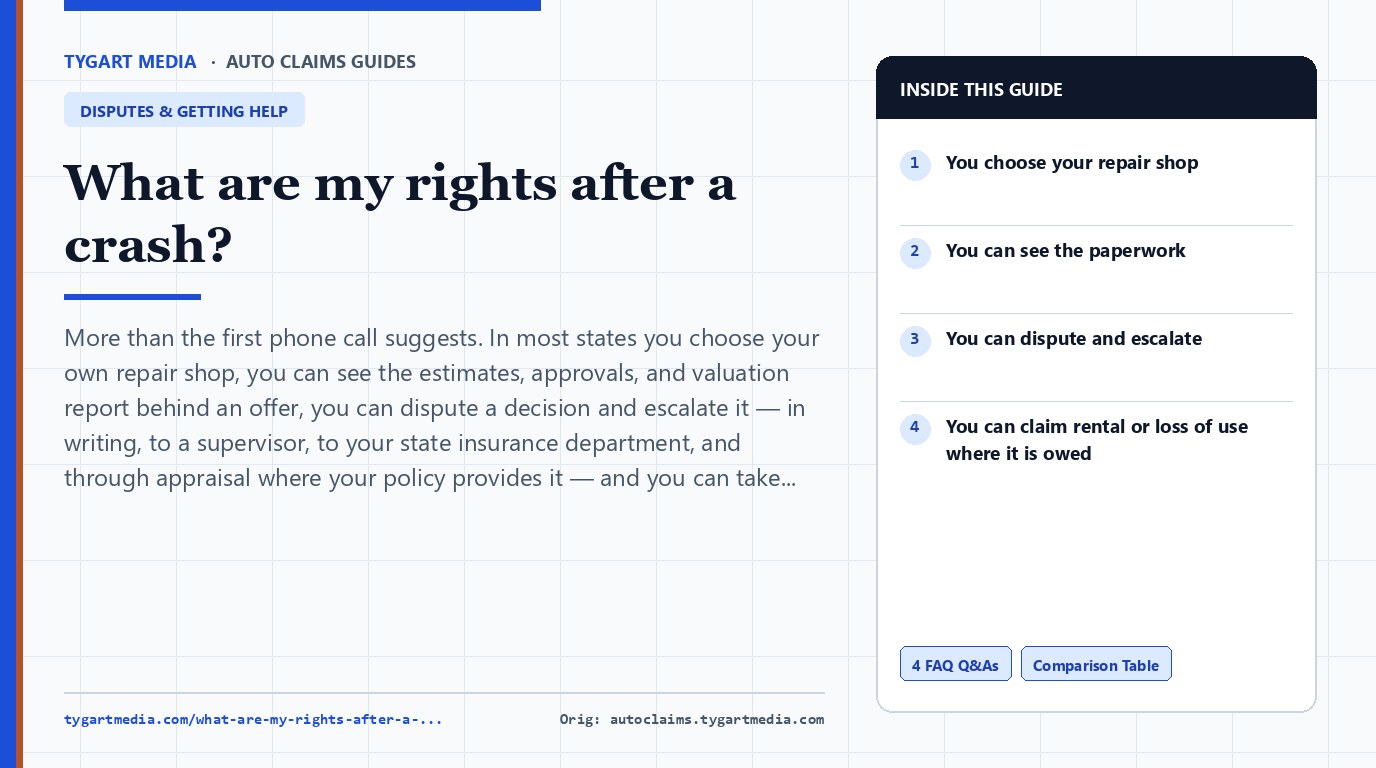
    The short answer: more than the first phone call suggests. In most states you choose your own repair shop, you can see the estimates, approvals, and valuation report behind an offer, you can dispute a decision and escalate it — in writing, to a supervisor, to your state insurance department, and through appraisal where your policy provides it — and you can take time before giving statements or signing releases. The counterpart is real too: you owe your own insurer prompt notice, honesty, and cooperation.

    You choose your repair shop

    The insurer paying the bill does not get to pick the shop by default. In most states, where your car is repaired is your choice, and an insurer’s preferred or network list is an offer — sometimes a convenient one, with billing handled directly — not a requirement. An insurer can steer, suggest, and warn that it will only pay based on its own estimate, but steering is not the same as choosing for you.

    The honest caveat is price: an insurer typically pays according to its estimate of reasonable repair cost, and if your chosen shop’s price is higher, that gap becomes a conversation about estimates and supplements, not about your right to be there. The full picture is in the guide to choosing a body shop that is not on the insurer’s preferred list.

    You can see the paperwork

    An offer you cannot inspect is an offer you cannot check. You can ask to see the documents a decision rests on: the repair estimate, any approvals or denials of shop work, and, for a total loss, the valuation report that produced the number — the comparable vehicles, the condition adjustments, the math. Adjusters work from these documents every day; asking for them is normal, not confrontational.

    Seeing the paperwork is what turns a vague feeling of being lowballed into specific, fixable points: a comparable that is not really comparable, an option your car has that the report missed, a line of damage left off the estimate. The guide to reading a CCC valuation report walks through the document insurers most often use for total loss values.

    You can dispute and escalate

    A claim decision is an opening position, not a ruling. You can ask for the reasons in writing, send your own evidence and ask for a re-evaluation, and escalate to a supervisor when the adjuster’s answer does not hold up. Beyond the insurer, you can file a complaint with your state insurance department — departments track complaints and can press on unreasonable delays and denials — and, for a value disagreement with your own insurer, check whether your policy provides an appraisal clause.

    None of these steps requires permission from the insurer you are disputing. The sequence, in order, is laid out in the guide to disputing or appealing a claim decision. What makes escalation work is the same thing that makes the first ask work: everything in writing, with documents attached.

    You can claim rental or loss of use where it is owed

    Being without your car is itself a loss, and it is often covered separately from the repair. If another driver was at fault, the cost of a rental — or compensation for the loss of use of your car if you do not rent one — generally belongs to your claim against that driver. If you are claiming under your own policy, rental depends on whether you bought rental reimbursement coverage, and on its limits.

    Ask early, because rental questions get harder to fix after the repair is finished and the bills are old. What is owed, and how loss of use is figured, is covered in the guide to getting a rental car and what loss of use means.

    You can take time before statements and releases

    You do not have to perform on the insurer’s schedule. You generally owe the other driver’s insurer no recorded statement at all, and you can decline one, or take time and prepare before giving one to any insurer — reviewing what actually happened and what your documents say, rather than guessing under pressure. The first hours matter most here, and the guide to what to do and document right after a crash covers that window.

    Important Notice
    The release is the point of no return. A settlement offer you can refuse; a release you have signed generally ends the claim it covers — including parts of your loss you have not finished documenting, such as diminished value. Read every release before signing, take the time you need, and do not sign one as a condition of getting a process started.

    The counterpart: your duties to your own insurer

    Rights and duties arrive together, and the duties run to your own insurer, because your policy is a contract with obligations on both sides. Typically, your policy requires you to report a crash promptly, to be honest in everything you submit, and to cooperate with your insurer’s investigation — which can include giving a statement, making the car available for inspection, and sending documents they reasonably ask for.

    Editor's Note
    Why the duties matter. Ignoring notice or cooperation duties can give your own insurer grounds to resist paying a claim it would otherwise owe. The practical rule is simple: be as prompt, honest, and documented with your own insurer as you expect them to be with you — and keep copies of everything, because that record is also what your rights stand on if a dispute comes.

    Notice the split that runs through this whole page: toward the other driver’s insurer, you are a claimant with rights and almost no duties. Toward your own insurer, you hold rights under the policy and owe duties under it at the same time. Keeping those two relationships straight — who you must cooperate with, and who you need not — prevents most early mistakes.

    Frequently asked questions

    Can the insurer make me use their body shop?

    Generally, no. In most states you choose where your car is repaired, and an insurer’s preferred or network shop is an offer, not a requirement. An insurer can still base what it pays on its own estimate, so a shop choice can come with a price conversation — but the choice of shop is yours.

    Do I have to give a recorded statement?

    It depends on whose insurer is asking. You generally owe the other driver’s insurer no recorded statement, and you can decline or take time before giving one. Your own insurer is different: most policies require your cooperation, which can include a statement. Read your policy, and prepare before any statement you do give.

    Can I refuse a settlement offer?

    Yes. A settlement offer is an offer, and you can refuse it and counter with your evidence. What you generally cannot do is rewrite its terms on your own and call it accepted — and signing a release usually ends the claim it covers, so do not sign until you mean to settle.

    What if I disagree with the fault decision?

    Say so in writing, and support your version with the evidence: photos, the police report if one exists, witness details, and anything else that records how the crash happened. Ask the insurer for its fault reasoning in writing. Fault rules, and how shared fault affects payment, vary by state.

    Disclaimer
    Informational only — not legal or insurance advice.
    Auto repair and insurance rules vary by state and by policy. Check your own policy documents and your state’s insurance department, or talk to a licensed professional, before acting on a claim.

    Your rights after a crash, at a glance

    The rights inventory, and the duties that come with it
    ItemWhat it means in practice
    Your repair shopIn most states the choice is yours; a preferred list is an offer, not a requirement.
    The paperworkYou can ask to see the estimates, approvals, and the valuation report behind an offer.
    Dispute and escalateWritten reasons, a supervisor, a state complaint, and appraisal where your policy provides it.
    Rental or loss of useOwed where the claim supports it — from the at-fault side, or your own rental coverage if you bought it.
    Time before statements and releasesYou generally owe the other driver’s insurer no recorded statement, and a signed release ends the claim it covers.
    Your dutiesTo your own insurer: prompt notice, honesty, and cooperation. Rights and duties arrive together.
  • What are supplements in auto body repair claims?

    What are supplements in auto body repair claims?

    Tygart Media · Auto Claims Guides · Repairs & body shops

    QUICK ANSWEROriginally published at autoclaims.tygartmedia.com · Reviewed October 18, 2026
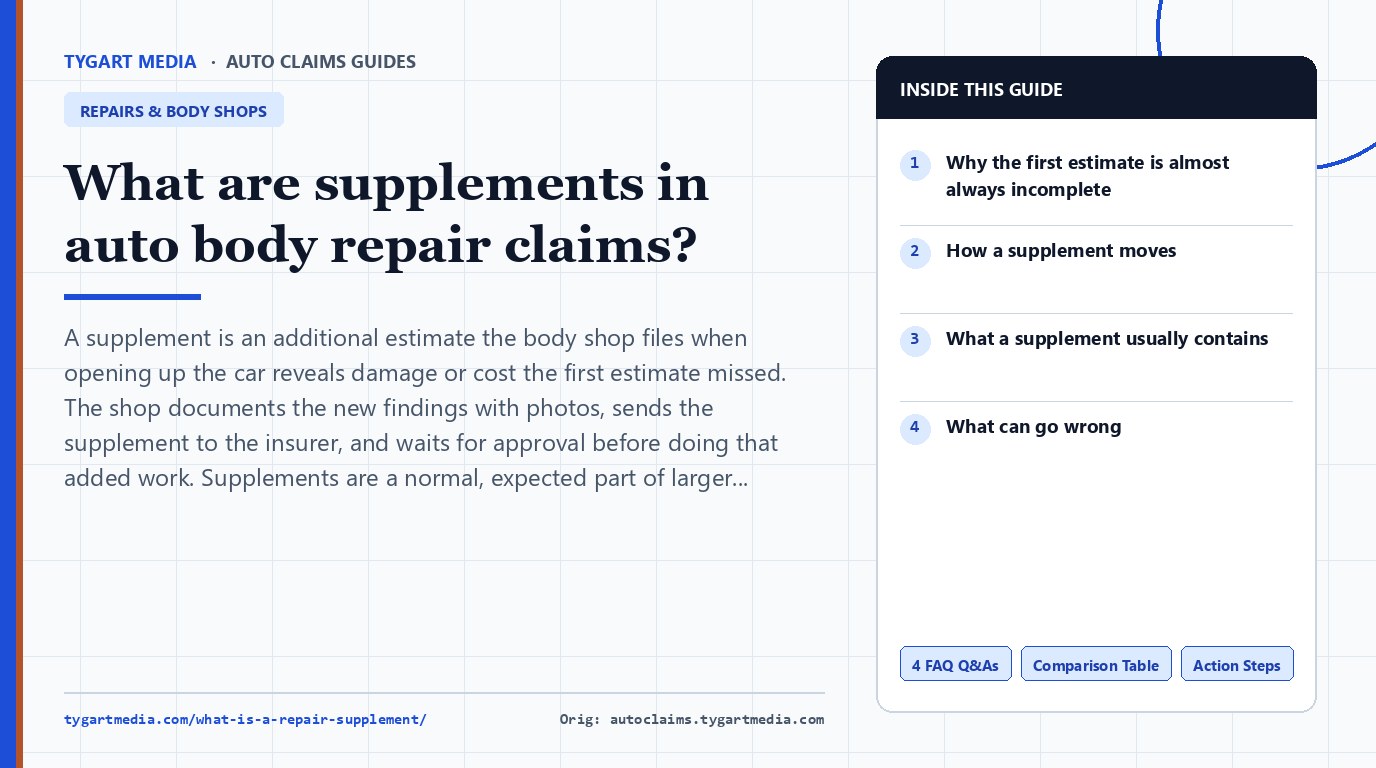
    The short answer: a supplement is an additional estimate the body shop files when opening up the car reveals damage or cost the first estimate missed. The shop documents the new findings with photos, sends the supplement to the insurer, and waits for approval before doing that added work. Supplements are a normal, expected part of larger repairs — not a sign that anyone made a mistake — but they are also where repairs pause and where unpaid-work disputes start if approval is skipped.

    Why the first estimate is almost always incomplete

    The first estimate on a crash repair is written under a real limit: nobody has taken the car apart yet. It is often based on photos or a walk-around look, and it can only price damage that is visible from the outside — the dented panel, the cracked bumper cover, the broken light.

    Crash damage does not stop at the surface. Behind a bumper cover there can be a bent reinforcement or a damaged absorber. Behind a fender there can be a shifted bracket, torn wiring, or a suspension part that only shows its damage once the wheel and liner come off. Panels hide the rest of the story until teardown, which is the shop’s word for removing the damaged outer parts to see and reach what is underneath.

    That is why treating the first estimate as the final price sets everyone up to fail. The estimate is an honest first pass at visible damage. The supplement is the mechanism the system built for the second pass — the one written with the car opened up and the real damage on the bench.

    How a supplement moves

    A supplement follows a predictable path from discovery to decision. Each step creates the record the next step depends on.

    1. The shop finds additional damage at teardown. As damaged parts come off, the shop uncovers damage or cost the first estimate could not include — a bent part behind a panel, a broken mount, a price difference on a needed part.
    2. The shop documents it with photos. Photos of the damaged parts, taken while the car is opened up, are the core evidence. Good documentation shows what is damaged, where it sits on the car, and why it needs repair or replacement.
    3. The shop writes the supplement and sends it to the insurer. The supplement is a written estimate for just the added scope: the new lines, the labor, and the parts, separate from the original estimate so the insurer can review exactly what changed and why.
    4. The adjuster reviews it. The insurer’s adjuster works from the photos and the written supplement, and may re-inspect the car in person before deciding. Teardown findings that are still visible on the car are much easier to approve than findings described after the fact.
    5. Each line is approved, trimmed, or denied. The decision rarely lands as one yes or no for the whole supplement. Individual lines can be approved as written, approved at a lower amount, or denied with a reason — and denied or trimmed lines can be answered with more documentation.
    6. Approved work proceeds. Once a line is approved, the shop can do that work knowing the insurer has agreed to pay for it. Work that is still pending or denied typically waits, which is why a slow supplement decision shows up directly as a slower repair.

    What a supplement usually contains

    Supplements differ from repair to repair, but the contents fall into a few familiar categories:

    • Newly found parts damage — parts that looked intact from outside and proved bent, cracked, or broken once uncovered: reinforcements, brackets, mounts, inner panels, and components behind the visible damage.
    • Additional labor operations — the extra work the new damage requires: removing and reinstalling parts to reach it, straightening or aligning what shifted, and the added refinish work when a repair grows into the next panel.
    • Parts price differences — cases where the part the repair actually needs costs more than the part or price the first estimate allowed, including when the estimated part type is not the part that fits or is available.
    • Procedures the first estimate left out — required steps around the main repair that only become clear once the scope is known, such as calibrations or checks the repair procedure calls for after parts are replaced.

    If you ask the shop for a copy of each supplement — and you should — this is the shape of what you will be reading: added lines, each tied to something teardown revealed, each waiting on or carrying an insurer decision.

    What can go wrong

    The supplement process is straightforward, and most supplement trouble comes from doing its steps out of order.

    The biggest risk is work done before approval. If the shop completes supplemented work and the insurer then denies those lines, someone has to pay for work already finished — and that fight lands on the owner who authorized it, the shop that did it, or both. The protection is unglamorous: documented findings, a written supplement, and approval before the added work starts. If a shop asks you to authorize unapproved supplement work, make sure you understand, in writing, that you may be the one paying for it.

    Denied lines are the second friction point. A denial is not always the end — shops can respond with better photos, the repair procedure for that vehicle, or a request for re-inspection while the damage is still visible. What cannot be fixed later is missing evidence: damage that was repaired, covered up, or thrown away before it was documented is nearly impossible to argue about afterward. That evidence problem is the heart of hidden damage claims generally: How do body shops handle hidden damage found during repairs? →

    Finally, keep your own copies. Ask for the original estimate, every supplement, and every approval as the repair goes, not after pickup. If a payment question surfaces weeks later, those documents — not anyone’s memory of a phone call — are what settle it.

    Frequently asked questions

    Do I have to pay for a supplement the insurer denies?

    Only if you authorized that work anyway, knowing it was denied or unapproved. If you did not authorize it, the item is typically disputed between the shop and the insurer or simply not done. Your written authorization is the control point, so read it before you sign.

    How many supplements can a claim have?

    There is no fixed number. Several rounds are typical on larger repairs because teardown reveals damage in stages, and each new finding can require its own documented request and approval.

    Does a supplement delay my repair?

    It can. Work covered by a pending supplement usually pauses until the insurer approves it, because doing the work first risks it not being paid for. Shops often continue with already-approved work in the meantime, so ask what can proceed and what is waiting.

    Can a supplement turn a repair into a total loss?

    Yes. If the supplemented repair cost crosses the total-loss threshold that applies under your policy and state rules, the insurer can re-evaluate the claim as a total loss instead of a repair. That is one reason supplements are documented carefully — the added lines can change the whole direction of the claim.

    Disclaimer
    Informational only — not legal or insurance advice.
    Auto repair practices and insurance rules vary by state and by policy. Check your own policy documents and your state’s insurance department, or talk to a licensed professional, before acting on a claim.

    Estimate vs. supplement

    Estimate vs. supplement
    The first estimateA supplement
    Written before teardownWritten after teardown
    Covers visible damageCovers what teardown revealed
    Based on photos or a quick lookBased on the car opened up
    Approved onceCan be approved in several rounds
    Next Step & Source Attribution
    Continue navigating Auto Claims Guides
    Source: Originally published at https://autoclaims.tygartmedia.com/what-is-a-repair-supplement/ · Author: William Tygart, Tygart Media · Last reviewed October 18, 2026.
  • The other driver has no insurance — what now?

    The other driver has no insurance — what now?

    Tygart Media · Auto Claims Guides · The other driver's insurer

    QUICK ANSWEROriginally published at autoclaims.tygartmedia.com · Reviewed October 4, 2026
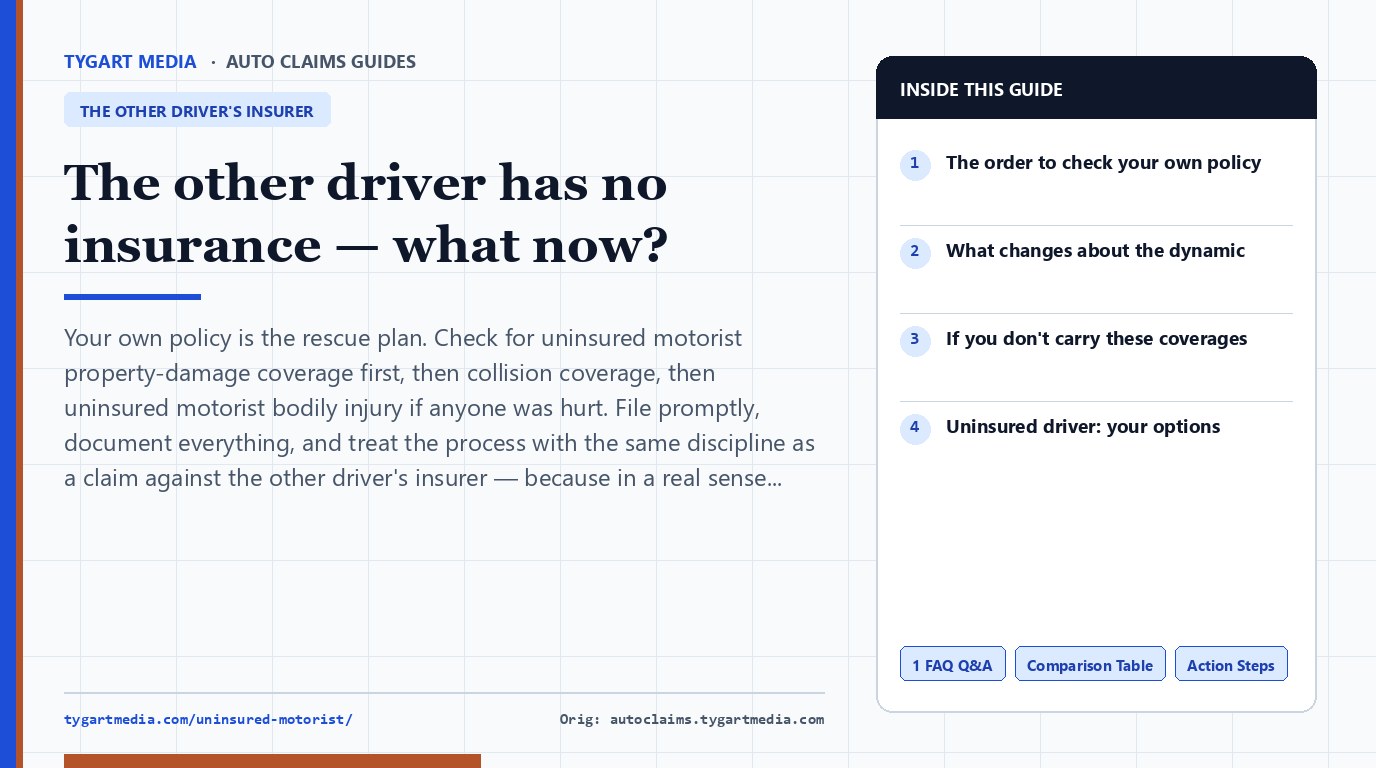
    The short answer: your own policy is the rescue plan. Check for uninsured motorist property-damage coverage first, then collision coverage, then uninsured motorist bodily injury if anyone was hurt. File promptly, document everything, and treat the process with the same discipline as a claim against the other driver’s insurer — because in a real sense, your insurer is now playing that role.

    The order to check your own policy

    1. Uninsured motorist property damage (UMPD). In states that offer it, this covers your car when the at-fault driver is uninsured — sometimes with no deductible or a small one.
    2. Collision coverage. Covers your car’s repair or value regardless of fault, minus your deductible. If UMPD isn’t available, this is the workhorse.
    3. Uninsured motorist bodily injury (UMBI). Covers medical costs and related losses if you or passengers are hurt. Process-only here: injury claim first steps →
    4. Medical payments / personal injury protection — if you carry it, this pays medical bills regardless of fault.

    What changes about the dynamic

    With uninsured-motorist claims, your own insurer evaluates the claim the way the other driver’s insurer would have — scrutinizing fault, valuation, and injuries. The friendly relationship changes. Document as if you were dealing with an adversary: photos, reports, receipts, written timelines.

    If you don’t carry these coverages

    • Pursuing the driver personally — possible in small claims court for modest amounts, but uninsured drivers often have limited assets to collect against.
    • State-specific funds or programs — a few states have uninsured-driver mechanisms. Your state’s insurance department can tell you if yours does.
    • The lesson for next renewal: uninsured-motorist coverage is usually inexpensive relative to what it protects. Check your declarations page today.
    Important Notice
    Don’t skip the police report here An uninsured at-fault driver has every reason to disappear or change their story. The official report — filed immediately — is what anchors the uninsured-motorist claim.
    Disclaimer
    Informational only — not legal or insurance advice.
    Uninsured-motorist coverage rules vary significantly by state — some states require it, some offer it as an option, availability differs. Check your own policy and your state’s insurance department, or talk to a licensed professional.

    Uninsured driver: your options

    The other driver has no insurance
    CoverageWhat it does
    Uninsured motorist (UM)Stands in for their missing liability coverage
    Underinsured (UIM)Fills the gap when their limits are too low
    CollisionFixes your car regardless of fault
    Sue the driver personallyPossible — but uninsured drivers rarely have assets
    Next Step & Source Attribution
    Continue navigating Auto Claims Guides
    Source: Originally published at https://autoclaims.tygartmedia.com/uninsured-motorist/ · Author: William Tygart, Tygart Media · Last reviewed October 4, 2026.
  • Total loss payout vs loan balance — what happens?

    Total loss payout vs loan balance — what happens?

    Tygart Media · Auto Claims Guides · Total loss & valuation

    QUICK ANSWEROriginally published at autoclaims.tygartmedia.com · Reviewed October 15, 2026
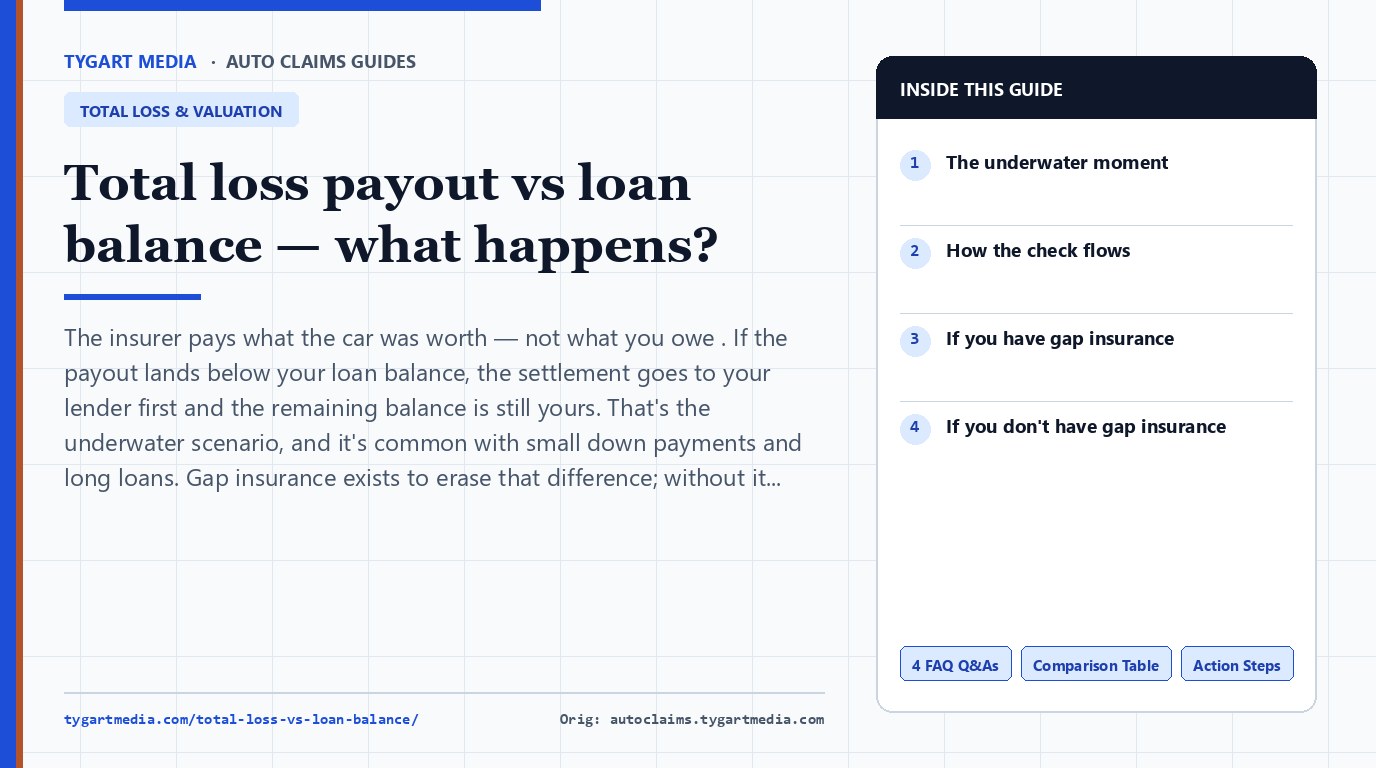
    The short answer: the insurer pays what the car was worth — not what you owe. If the payout lands below your loan balance, the settlement goes to your lender first and the remaining balance is still yours. That’s the underwater scenario, and it’s common with small down payments and long loans. Gap insurance exists to erase that difference; without it, your best lever is the valuation itself.

    The underwater moment

    Cars lose value fastest early; loans shrink slowest early. Total a car in the first few years of a long loan and the two lines cross the wrong way: the car might be worth $16,800 while the loan still says $19,500. The crash doesn’t cancel the loan. The lender expects the full balance, and the insurance settlement only covers the car’s side of the ledger.

    How the check flows

    1. The insurer settles at the car’s value — actual cash value, plus applicable taxes and fees, minus your deductible if it’s your own policy. See how the payout is built →
    2. The lienholder gets paid first. The check is typically issued to you and the lender together, or the lender is paid directly — the lender’s interest in the car comes before yours.
    3. If the payout beats the balance, the lender takes what’s owed and the rest is yours.
    4. If the payout falls short, the whole settlement goes to the lender, and the remaining balance — in the example above, $2,700 — stays on your account. Your payment obligations continue until it’s resolved.

    If you have gap insurance

    Gap coverage pays the difference between the settlement and the loan balance, subject to its terms and exclusions. It files after the primary settlement, usually with the loan payoff statement and the insurer’s settlement paperwork. Where you bought it — insurer, dealer, or lender — decides who you file with. What is gap insurance — and does it apply to my claim? →

    If you don’t have gap insurance

    • Negotiate the value first — before anything else. The gap is measured from the car’s value, so every dollar you add to the valuation is a dollar off what you’ll owe. A $1,500 correction to a wrong trim level or bad comparables shrinks a $2,700 gap to $1,200. This fight is worth the most exactly when you’re underwater. How to fight the valuation →
    • Talk to your lender early. Tell them a total-loss settlement is in process, ask how the payoff and any shortfall will be handled, and keep making payments in the meantime — the loan doesn’t pause, and missed payments damage your credit on top of everything else.
    • Ask about options for the balance. Depending on the lender, a remaining balance may be handled through a payment arrangement or rolled into a new loan. Those are lender decisions — ask before you’re behind, not after.
    Important Notice
    Don’t stop paying because the car is gone It’s the most natural mistake in this situation. The loan is a separate contract from the car, and it stays in force until the balance is settled. Staying current while the claim resolves protects your credit and keeps your options with the lender open.
    Disclaimer
    Informational only — not legal or insurance advice.
    Loan terms, lienholder procedures, and gap coverage terms vary by contract and by state. Check your own loan and policy documents and your state’s insurance department, or talk to a licensed professional, before acting on a claim.

    Underwater, in numbers

    Example: payout below the loan balance (hypothetical numbers)
    ItemExample
    Loan balance$19,500
    Total-loss settlement$16,800
    Still owed without gap coverage$2,700
    Still owed if the valuation rises $1,500$1,200
    Still owed with gap coverage$0 (per the coverage’s terms)
    Next Step & Source Attribution
    Continue navigating Auto Claims Guides
    Source: Originally published at https://autoclaims.tygartmedia.com/total-loss-vs-loan-balance/ · Author: William Tygart, Tygart Media · Last reviewed October 15, 2026.
  • What fees are included in a total loss payout?

    What fees are included in a total loss payout?

    Tygart Media · Auto Claims Guides · Total loss & valuation

    QUICK ANSWEROriginally published at autoclaims.tygartmedia.com · Reviewed October 15, 2026
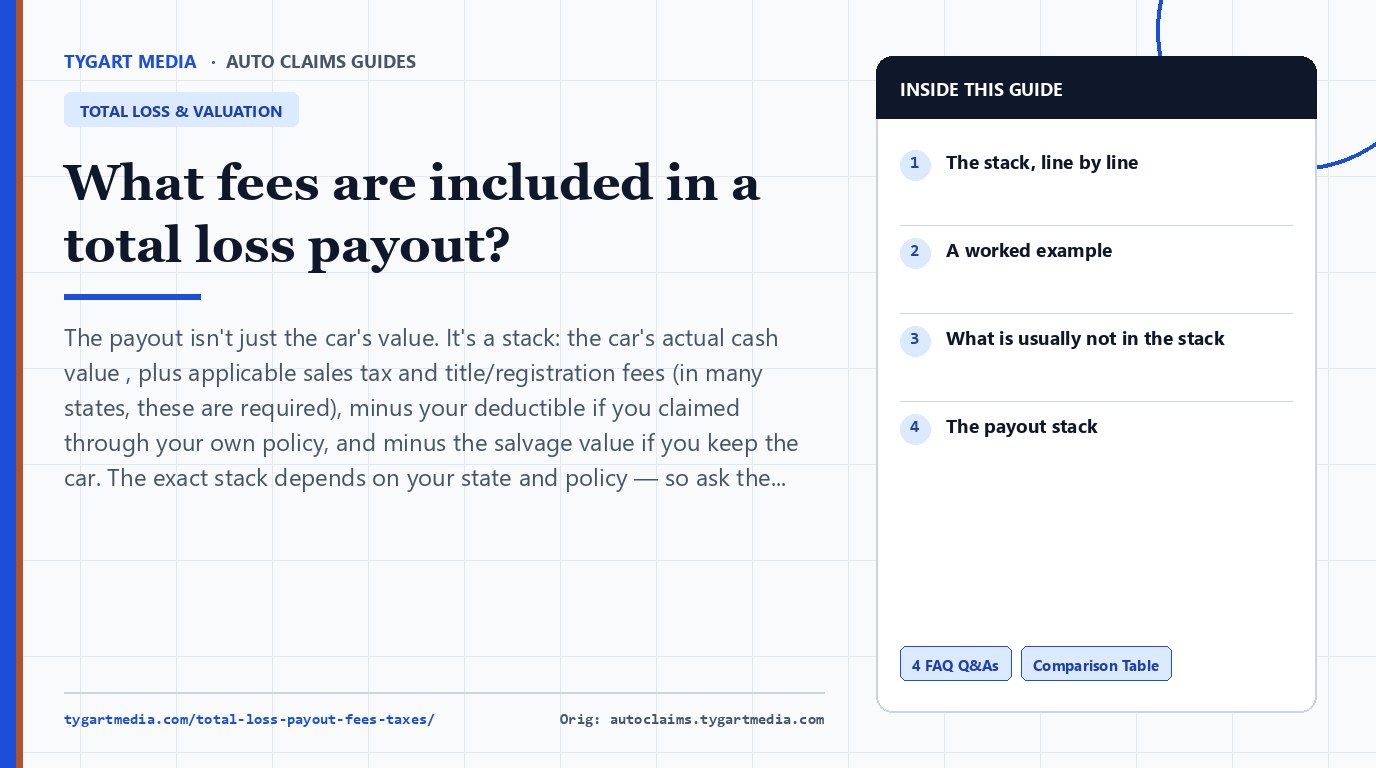
    The short answer: the payout isn’t just the car’s value. It’s a stack: the car’s actual cash value, plus applicable sales tax and title/registration fees (in many states, these are required), minus your deductible if you claimed through your own policy, and minus the salvage value if you keep the car. The exact stack depends on your state and policy — so ask the adjuster to show you every line.

    The stack, line by line

    • Actual cash value (ACV) — the starting line: what your car was worth the moment before the crash. What is actual cash value? →
    • + Sales tax — calculated on the ACV in most settlements. Many states require the insurer to include it, on the logic that a replacement car will be taxed too. Some states instead reimburse the tax after you buy a replacement — sometimes with a deadline to buy. The method is state-specific; ask which one applies to you.
    • + Title and registration fees — many states also require the cost of titling and registering a replacement to be included, in full or in part.
    • − Your deductible — subtracted only when the claim runs through your own collision coverage. If the other driver’s insurer pays, there’s no deductible on that side.
    • − Salvage value (only if you keep the car) — if you take the payout and keep the totaled car, the car’s salvage value comes off the settlement, and the car gets a salvage/branded title.

    A worked example

    These numbers are an example, chosen to show the arithmetic — your value, tax rate, fees, and deductible will differ:

    • Actual cash value: $15,000
    • Sales tax at an example rate of 6%: +$900
    • Title and registration fees (example): +$120
    • Deductible (your own policy): −$500
    • Settlement: $15,520

    If this same owner kept the totaled car and its salvage value was $1,800, the settlement would drop to $13,720 — the $1,800 comes off because the owner keeps that much value in the car itself.

    Editor's Note
    Ask for the line-item version “Fifteen-five” over the phone tells you nothing. Ask for the settlement breakdown in writing — ACV, tax, fees, deductible, any salvage deduction — and check each line against your state’s rules before you agree.

    What is usually not in the stack

    • Loan balance above the car’s value. The settlement prices the car, not the loan. If you owe more, that difference is on you unless you have gap coverage. Payout vs loan balance — what happens? →
    • Personal belongings. Items that were in the car usually aren’t part of the auto settlement; they typically fall under homeowners or renters insurance.
    • Undeclared extras. Expensive aftermarket equipment may not be covered unless it was declared on the policy.
    • Open-ended rental costs. Rental reimbursement has its own limits and usually ends shortly after the settlement offer — it’s a separate line with separate rules.
    Disclaimer
    Informational only — not legal or insurance advice.
    Which taxes and fees must be included in a total-loss settlement varies by state, and deductible rules vary by policy. Check your own policy documents and your state’s insurance department, or talk to a licensed professional, before acting on a claim.

    The payout stack

    Example settlement breakdown (hypothetical numbers)
    LineExample amount
    Actual cash value$15,000
    + Sales tax (example 6%)+$900
    + Title / registration fees+$120
    − Deductible (own policy)−$500
    Settlement$15,520
    If you keep the car: − salvage value−$1,800 → $13,720
    Next Step & Source Attribution
    Continue navigating Auto Claims Guides
    Source: Originally published at https://autoclaims.tygartmedia.com/total-loss-payout-fees-taxes/ · Author: William Tygart, Tygart Media · Last reviewed October 15, 2026.
  • They lowballed my totaled car — how is the value decided, and can I fight it?

    They lowballed my totaled car — how is the value decided, and can I fight it?

    Tygart Media · Auto Claims Guides · Total loss & valuation

    QUICK ANSWEROriginally published at autoclaims.tygartmedia.com · Reviewed October 4, 2026
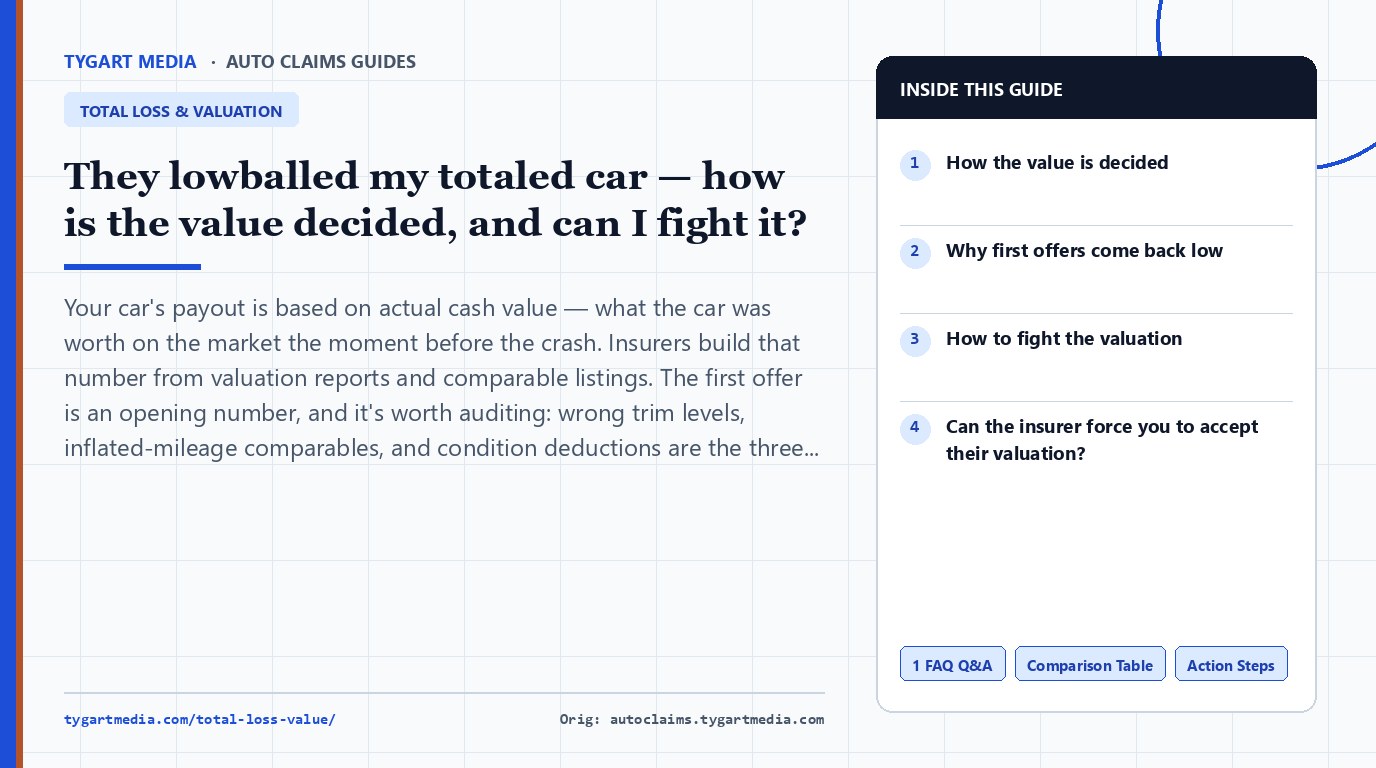
    The short answer: your car’s payout is based on actual cash value — what the car was worth on the market the moment before the crash. Insurers build that number from valuation reports and comparable listings. The first offer is an opening number, and it’s worth auditing: wrong trim levels, inflated-mileage comparables, and condition deductions are the three places low offers hide.

    How the value is decided

    When repair costs exceed the car’s value (or state law’s total-loss threshold), the insurer declares it a total loss and pays you the car’s actual cash value, minus your deductible if you’re claiming through your own policy. The value comes from a valuation report that looks at:

    • Comparable vehicles for sale — same year, make, model, and trim in your region.
    • Mileage adjustments — higher mileage than average lowers the value.
    • Condition adjustments — wear, prior damage, and maintenance history.
    • Options and packages — trim, drivetrain, and factory options.

    Note what the number is not: it is not what you paid, what you owe on the loan, or what a replacement costs. That gap catches people by surprise. Gap insurance →

    Why first offers come back low

    • Wrong trim or options — the report lists your car as a base model when it’s a higher trim.
    • Bad comparables — listings from far away, much higher mileage, or cars in worse condition.
    • Condition deductions — deductions for “average wear” your car didn’t have.
    • Speed over accuracy — the valuation is generated quickly; nobody checks whether the inputs match your actual car.

    How to fight the valuation

    1. Ask for the valuation report in full. You’re entitled to see the math. Go through the comparables one by one.
    2. Find your own comparables. Search listings for your exact year, trim, mileage range, and region. Screenshot them with dates and prices.
    3. Document what the report missed. Recent tires, brakes, timing-belt service, new battery — anything that made your car worth more than average. Receipts count.
    4. Dispute in writing. Send the adjuster your comparable listings and evidence with a clear counter-number. Phone calls don’t create a record; emails do.
    5. Ask for a supervisor review if the adjuster won’t move, and check whether your policy has an appraisal clause — each side hires an appraiser and they settle the value.

    Can the insurer force you to accept their valuation?

    No — you don’t have to agree, and you shouldn’t sign the settlement release while you disagree. But be clear-eyed about the leverage on each side: the insurer can hold its number and close its file at that figure, and your counter-leverage is evidence and process, not refusal alone. In order: corrected comparables and documentation, a supervisor review, your policy’s appraisal clause (each side hires an appraiser; together they pick an umpire who helps settle the value), a complaint to your state department of insurance, and — where the amount justifies it — small claims court. Each step works better with the written record from the step before it.

    Which comparables should you use to challenge a valuation?

    The strongest comps are the ones hardest to argue with: the same year, make, model, and trim as your car; mileage close to yours; for sale in your region, not across the country; and currently listed or recently sold, not stale listings from months ago. Screenshot each one with its date and price showing. Three tight comparables beat ten loose ones — every comp that differs from your car in some obvious way is a comp the adjuster can wave off.

    Editor's Note
    Can you keep the car? In many states you can accept the payout minus the car’s salvage value and keep it (owner-retained salvage). The catch: the car will carry a salvage title, which affects future insurance and resale. Decide before you sign anything.
    Important Notice
    Don’t sign a release until the number is right The settlement release closes the claim. Once signed, you can’t reopen the valuation fight. Resolve the number first.

    If they repair it instead of totaling it

    Some cars land just under the total-loss threshold and get repaired instead. That outcome creates a different claim: a repaired car with an accident on its history is worth less than it was, and that loss — diminished value — is usually claimable against the at-fault driver’s insurer. It is a separate element from the repair payment, measured after the repairs are done. What is a diminished value claim? →

    Total loss, question by question

    The total-loss process, one question at a time — each guide answers the thing people actually ask at that point:

    Disclaimer
    Informational only — not legal or insurance advice.
    Auto insurance rules and total-loss thresholds vary by state and by policy. Check your own policy documents and your state’s insurance department, or talk to a licensed professional, before acting on a claim.

    How total-loss value is decided

    Challenging a low total-loss valuation
    Their number comes fromYour counter-evidence
    CCC / Mitchell valuation reportYour own comparable listings (same trim, mileage, region)
    Condition adjustments downwardMaintenance records, pre-crash photos
    “Comparable” cars in other marketsLocal comps — your market is what matters
    Deductions for prior damageProof it was repaired, or that it predates your ownership fairly
    Next Step & Source Attribution
    Continue navigating Auto Claims Guides
    Source: Originally published at https://autoclaims.tygartmedia.com/total-loss-value/ · Author: William Tygart, Tygart Media · Last reviewed October 4, 2026.
  • What states allow diminished value claims?

    What states allow diminished value claims?

    Tygart Media · Auto Claims Guides · Diminished value

    QUICK ANSWEROriginally published at autoclaims.tygartmedia.com · Reviewed October 18, 2026
    The short answer: it depends which claim you mean, and that is why simple state lists mislead. Against the at-fault driver’s insurer, diminished value is recoverable in principle in every state — no state bans that claim outright, though you carry the burden of proving the loss. Against your own collision policy, states genuinely split: most policies are written so first-party diminished value is not covered, with Georgia as the famous exception. Check your own state and policy for the answer that applies to you.

    Layer 1: claiming against the at-fault driver

    A third-party diminished value claim is a claim for property damage the at-fault driver caused. Your repaired car is worth less than an identical car with a clean history, and that remaining loss is part of the damage from the crash. On that basis, the claim is available in principle in every state.

    Available in principle is not the same as automatic. No state bans the claim outright, but the burden of proving the loss is yours. Insurers will test the evidence: how severe the damage was, how the car was valued before and after, whether the market support is specific to your car or just a generic formula, and whether the repair record matches the claim. Outcomes vary with that evidence, from claim to claim, even inside the same state.

    That is the honest version of the all-states answer. A list that simply says yes everywhere, without the proof burden, promises more than any driver can rely on. Build the evidence first, and treat the state question as settled for this layer: the fight is usually about proof and value, not about whether the claim exists.

    Layer 2: claiming against your own policy

    A first-party claim is a different legal question. Here you are not claiming damage another driver caused you — you are asking what your own contract with your insurer promises to pay. Most collision policies are written to repair the car or pay its value on a total loss. That wording is commonly read to exclude a separate payment for diminished value after a proper repair, and courts in most states have upheld that reading.

    Georgia is the famous exception. In State Farm v. Mabry, decided in 2001, the Georgia Supreme Court required insurers to assess diminished value on first-party claims. Georgia drivers making a first-party claim should ask their insurer, in writing, how diminished value was assessed on their claim.

    A small number of other states have addressed the first-party question in case law or regulation, in one direction or the other. This guide does not name them, deliberately: summaries of those rulings age quickly, are easy to oversimplify, and can point you to the wrong conclusion for your policy and your facts. Your state insurance department and your own policy wording are the reliable sources for your state.

    Important Notice
    Do not mix the layers. An adjuster saying your own policy does not cover diminished value may be right about layer 2 and still leave layer 1 untouched. If another driver was at fault, ask which claim the denial is about, and get that answer in writing.

    Which state’s rules matter for your claim?

    In practice, the rules that matter are the ones governing where the claim is filed and handled — typically connected to where the accident happened and the state of the policy involved. Crashes across state lines, and policies written in a different state from where you live, can make that question less tidy than it sounds.

    Do not guess at it from a national article. If the accident state and your policy state differ, ask both insurers, in writing, which state’s law and department they are treating as governing your claim, and keep the answers. If the answers conflict, your state insurance department is the place to raise that conflict.

    One other state rule matters on every claim, whichever layer you are in: time. Statutes of limitations differ by state and by claim type, and missing a deadline can end a claim regardless of its merits. See How long do I have to file diminished value? and check the deadline for your specific claim early, not after negotiations stall.

    How to check your state in three steps

    1. Read your policy’s collision wording. Look for what the policy promises to pay for damage to your car, and any language about repair, like kind and quality, or actual cash value. That wording is the starting point for any first-party question.
    2. Search your state insurance department site for diminished value. Use the department’s own search or a general search limited to that department’s site. Look for consumer guides, bulletins, or complaint guidance that use the term directly.
    3. Ask the insurer for its position in writing. Ask whether it will assess diminished value on your claim, under which coverage, and on what basis if it says no. Keep the written reply with your claim file.
    Editor's Note
    Keep claim type in every question you ask. A department, insurer, or adviser can only give you a useful answer if you say whether you mean a claim against the at-fault driver or a claim under your own collision coverage. Those two answers are often opposite.

    Frequently asked questions

    Is diminished value allowed in every state?

    As a third party claim against the at-fault driver insurer, diminished value is recoverable in principle in every state, because it is part of the property damage that driver caused. No state bans the claim outright. You still have to prove the loss, and the strength of your evidence affects the outcome.

    Why do people say some states do not allow diminished value?

    They are usually talking about first party claims against your own collision policy. Most policies are written so first party diminished value is not covered, and courts in most states have upheld that reading. That is a different question from claiming against the at-fault driver insurer, where the claim is broadly available.

    What is special about Georgia?

    Georgia is the famous exception for first party claims. In State Farm v. Mabry in 2001, the state supreme court required insurers to assess diminished value on first party claims. That rule is specific to Georgia. For other states, check your policy and your state insurance department rather than relying on a general list.

    How do I check the rule in my state?

    Start with your policy collision wording, then search your state insurance department site for diminished value, and then ask your insurer for its position in writing. Keep the reply. Those three steps tell you more about your actual claim than any national summary, because the answer depends on claim type, policy, and state.

    Disclaimer
    Informational only — not legal or insurance advice.
    Auto repair and insurance rules vary by state and by policy. Check your own policy documents and your state’s insurance department, or talk to a licensed professional, before acting on a claim.

    Diminished value by state and claim type, at a glance

    Diminished value by claim type
    Claim typeWhat the state picture looks like
    Third party, against at-fault driverRecoverable in principle in every state. No state bans it outright. You must prove the loss.
    First party, against your own collision policyStates split. Most policies are written to exclude it and courts in most states have upheld that reading.
    First party in GeorgiaThe famous exception. Insurers must assess diminished value on first party claims.
    Other states on first party claimsA small number have addressed it in case law or regulation. Check your state insurance department and your policy.
    Deadlines in any stateStatutes of limitations differ by state and claim type. Check your deadline early.