Category: Mortgage Servicer Playbooks

Mortgage servicer dispute playbooks covering escrow shortages, misapplied payments, suspense accounts, PMI removal, Qualified Written Requests, and CFPB complaints. Original hub: servicer.tygartmedia.com.

  • My servicer put my payment in a ‘suspense account.’ Is that legal?

    My servicer put my payment in a ‘suspense account.’ Is that legal?

    Tygart Media · Mortgage Servicer Playbooks · Payments

    QUICK ANSWEROriginally published at servicer.tygartmedia.com · Reviewed October 4, 2026
    The short answer: yes — with limits. Most loan contracts allow servicers to park partial payments in a suspense (unapplied funds) account instead of crediting your loan. But once the suspense balance grows enough to cover a full payment, they must apply it. And parking your money in suspense while reporting you late is exactly the kind of thing you dispute.

    What a suspense account is

    When you send less than a full contractual payment — half a payment, a payment short by a few dollars — the servicer typically can’t apply it to your loan, because loans are credited in full-payment increments. Instead the money sits in a suspense or “unapplied funds” account: real money, sitting there, not reducing your balance, not counting as a payment.

    When it’s fine and when it isn’t

    • Fine: you sent a short payment, they held it, and once you send the rest they apply the full amount. That’s the system working as designed.
    • Not fine: the suspense balance reaches a full payment and they still don’t apply it.
    • Really not fine: they hold your money in suspense while reporting you delinquent or charging late fees on the payment the suspense money could have covered.
    • Suspicious: a payment that was actually full got “split” into suspense — borrowers report servicers dividing payments in half. If your full payment landed in suspense, demand an explanation in writing.

    How to get it applied

    1. Ask for the suspense balance in writing. How much is sitting there, and from which payments?
    2. Send the difference to bring the total to a full payment, with a written instruction: “Apply the suspense balance plus this payment to the [month] payment.”
    3. Get a corrected payment history showing the application, and check your credit report 30–60 days later for any late marks tied to the period.
    4. If they refuse or stall, a written notice of error triggers their investigation duty — and the CFPB complaint path is here →
    Editor's Note
    The golden rule of suspense Always send full payments. The entire suspense-account headache exists because of short payments — a $5 shortfall can strand the other $2,495. If your payment changed and you didn’t notice, that’s usually how this starts: check why your payment moved →
    Disclaimer
    Informational only — not legal or financial advice.
    Mortgage rules vary by loan type, servicer, and state. Check your own loan documents and official federal resources, or talk to a licensed professional, before acting.

    Suspense accounts, decoded

    Why your payment landed in suspense
    ReasonWhat to do
    Partial paymentSend the remainder ASAP — partial payments can sit unapplied
    Payment after transferConfirm which servicer should receive it; get transfer notices in writing
    Misapplied paymentDemand a full payment history and audit every line

    Unapplied payments can trigger false “late” marks. Under RESPA, servicers must credit payments as of the receipt date once properly applied.
    Next Step & Source Attribution
    Continue navigating Mortgage Servicer Playbooks
    Source: Originally published at https://servicer.tygartmedia.com/suspense-account/ · Author: William Tygart, Tygart Media · Last reviewed October 4, 2026.
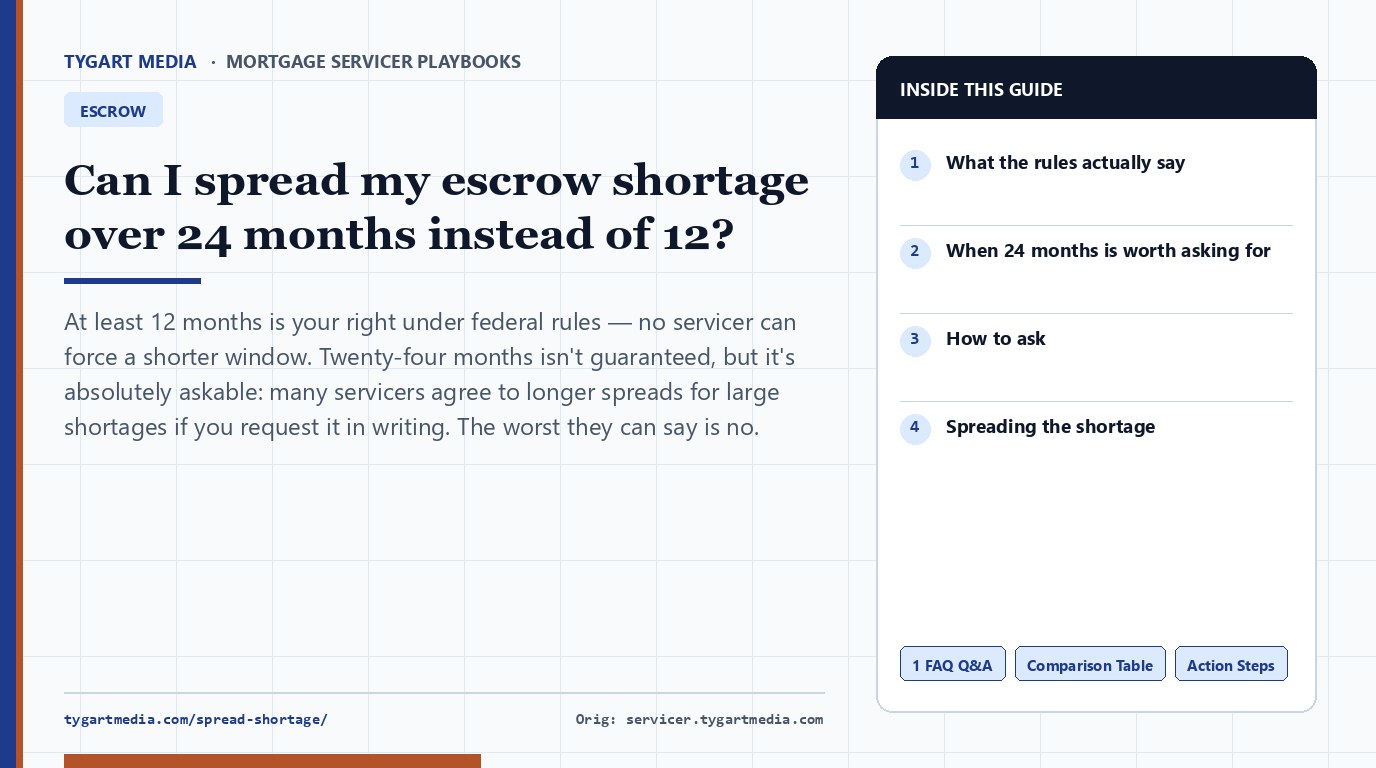
  • Can I spread my escrow shortage over 24 months instead of 12?

    Can I spread my escrow shortage over 24 months instead of 12?

    Tygart Media · Mortgage Servicer Playbooks · Escrow

    QUICK ANSWEROriginally published at servicer.tygartmedia.com · Reviewed October 4, 2026
    The short answer: at least 12 months is your right under federal rules — no servicer can force a shorter window. Twenty-four months isn’t guaranteed, but it’s absolutely askable: many servicers agree to longer spreads for large shortages if you request it in writing. The worst they can say is no.

    What the rules actually say

    Federal mortgage servicing rules require that when there’s a shortage, the servicer must give you the option to repay it over a period of at least 12 months. That’s the floor. Anything longer is a servicer policy decision — not a right, but not forbidden either.

    When 24 months is worth asking for

    • The shortage is large (several thousand dollars) and a 12-month spread would make the payment unaffordable.
    • You had a one-time tax spike (a reassessment catch-up year) rather than a permanent increase.
    • You’re otherwise current and in good standing — servicers are more flexible with clean accounts.

    How to ask

    1. Call first and ask what repayment periods they offer beyond 12 months. Note the representative’s name, date, and what they said.
    2. Follow up in writing — a short letter or secure message: “Per my call with [name] on [date], I am requesting to repay the $[amount] escrow shortage over 24 months.” Written requests create a record phone calls don’t.
    3. Get the new payment schedule in writing before you start paying it. The monthly amount should reflect the shortage divided by the number of months, plus the adjusted escrow collection.
    Important Notice
    Watch the cushion while you’re at it A spread doesn’t fix an over-padded escrow. Federal rules cap the servicer’s cushion at two months’ worth of escrow payments. If the analysis shows a bigger cushion, dispute it — here’s how to read the statement →
    Disclaimer
    Informational only — not legal or financial advice.
    Mortgage rules vary by loan type, servicer, and state. Check your own loan documents and official federal resources, or talk to a licensed professional, before acting.

    Spreading the shortage

    Escrow shortage repayment options
    TermMonthly impact (on $2,400 shortage)
    Lump sum$2,400 once
    12 months+$200/month
    24 months+$100/month

    Servicers must offer 12 months. Longer terms are yours to request — ask in writing.

    Next Step & Source Attribution
    Continue navigating Mortgage Servicer Playbooks
    Source: Originally published at https://servicer.tygartmedia.com/spread-shortage/ · Author: William Tygart, Tygart Media · Last reviewed October 4, 2026.
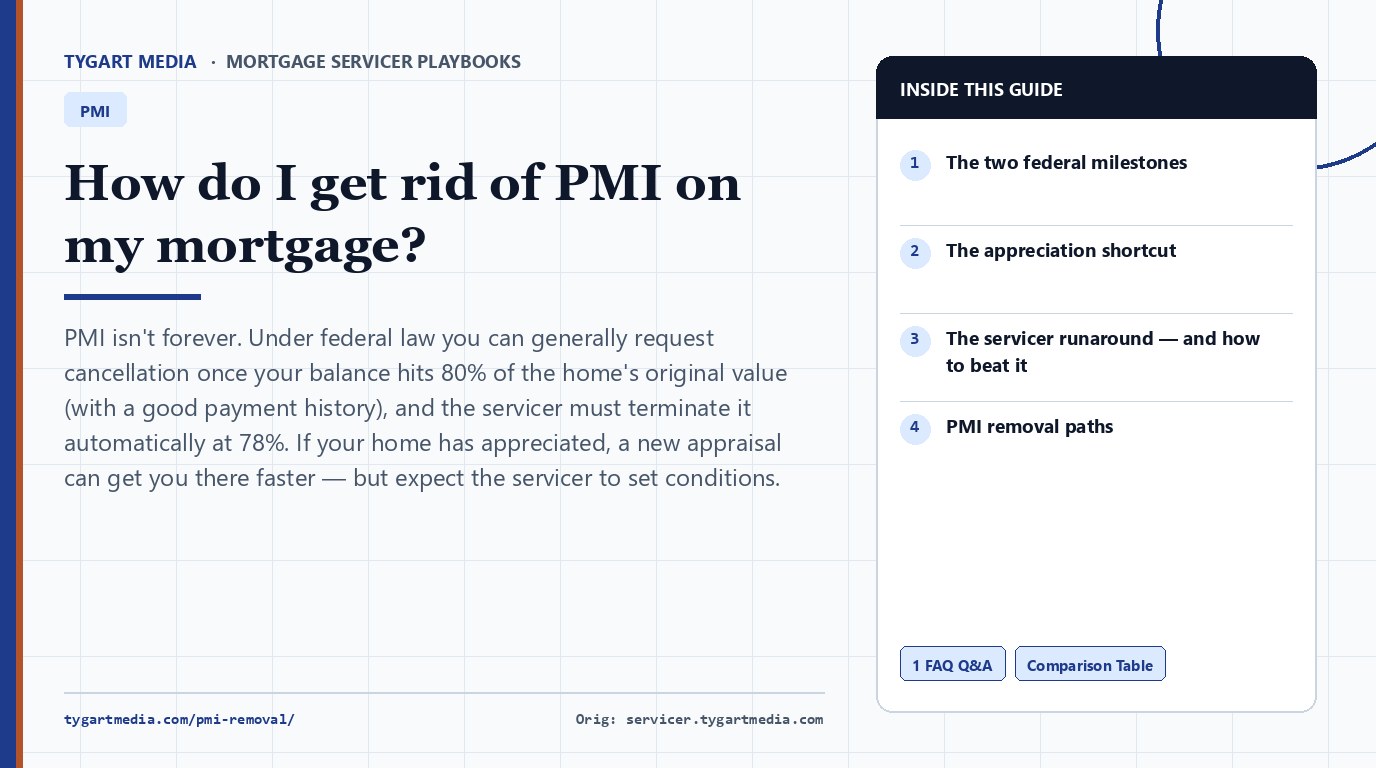
  • How do I get rid of PMI on my mortgage?

    How do I get rid of PMI on my mortgage?

    Tygart Media · Mortgage Servicer Playbooks · PMI

    QUICK ANSWEROriginally published at servicer.tygartmedia.com · Reviewed October 4, 2026
    The short answer: PMI isn’t forever. Under federal law you can generally request cancellation once your balance hits 80% of the home’s original value (with a good payment history), and the servicer must terminate it automatically at 78%. If your home has appreciated, a new appraisal can get you there faster — but expect the servicer to set conditions.

    The two federal milestones

    • 80% — you can ask. Once your loan balance drops to 80% of the home’s original value, you can request cancellation in writing. You generally need a good payment history (no recent lates) and sometimes proof the value hasn’t declined.
    • 78% — it’s automatic. When the balance is scheduled to reach 78% of original value and you’re current, the servicer must terminate PMI on its own. You shouldn’t have to ask — but check your statement, because “should” and “did” are different things.

    Note: these are original-value percentages based on the amortization schedule — extra principal payments can get you to 80% faster.

    The appreciation shortcut

    If your home’s value has risen, you may not need to wait for the balance to drop. Many servicers will cancel PMI based on a current appraisal showing your loan is 80% or less of today’s value. The catch: you usually pay for the appraisal, the servicer picks or approves the appraiser, and some loans require a seasoning period (often around two years) before they’ll consider it.

    The servicer runaround — and how to beat it

    • “We never got your request.” Send it in writing, keep proof.
    • Endless new conditions. Ask for their PMI-cancellation requirements in writing up front — then meet them exactly.
    • “Automatic” termination that never happens. Watch your statements at the 78% mark. If PMI is still there, that’s a notice-of-error situation.
    Editor's Note
    FHA loans play by different rules The 80/78 framework above is for conventional loans. FHA mortgage insurance (MIP) generally can’t be canceled the same way — it often lasts the life of the loan unless you refinance into a conventional mortgage. If you have an FHA loan, check your specific MIP terms before planning around PMI rules.
    Disclaimer
    Informational only — not legal or financial advice.
    Mortgage rules vary by loan type, servicer, and state. Check your own loan documents and official federal resources, or talk to a licensed professional, before acting.

    PMI removal paths

    How to get rid of PMI
    PathRequirementNote
    Borrower-requested80% LTV + good payment historyYou must ask — it isn’t automatic
    Automatic termination78% LTV on the amortization scheduleHappens by law, but check it’s applied
    New appraisalHome value rose enough to hit 80%You pay for the appraisal (~$300–500)
    RefinanceNew loan at ≤80% LTVResets the clock — weigh closing costs
    Next Step & Source Attribution
    Continue navigating Mortgage Servicer Playbooks
    Source: Originally published at https://servicer.tygartmedia.com/pmi-removal/ · Author: William Tygart, Tygart Media · Last reviewed October 4, 2026.
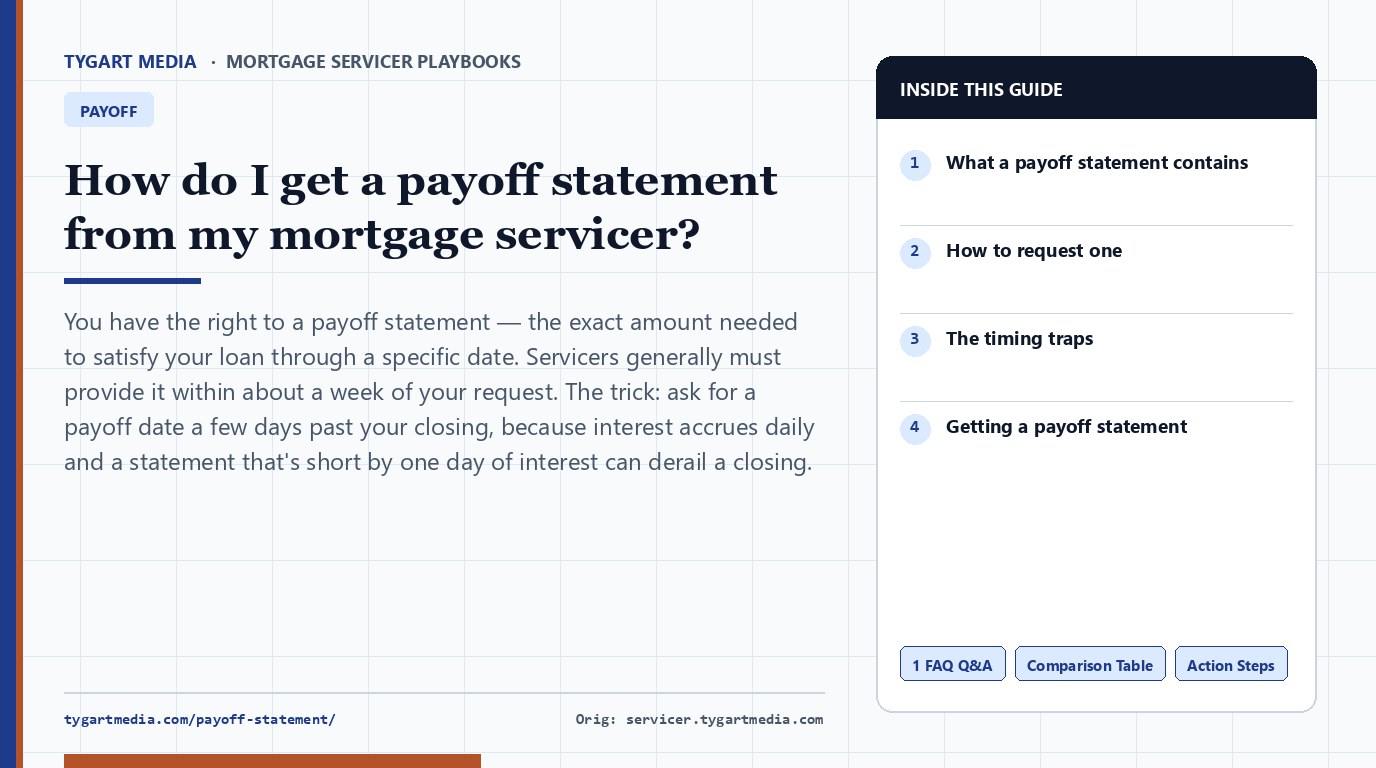
  • How do I get a payoff statement from my mortgage servicer?

    How do I get a payoff statement from my mortgage servicer?

    Tygart Media · Mortgage Servicer Playbooks · Payoff

    QUICK ANSWEROriginally published at servicer.tygartmedia.com · Reviewed October 4, 2026
    The short answer: you have the right to a payoff statement — the exact amount needed to satisfy your loan through a specific date. Servicers generally must provide it within about a week of your request. The trick: ask for a payoff date a few days past your closing, because interest accrues daily and a statement that’s short by one day of interest can derail a closing.

    What a payoff statement contains

    It’s not just your balance. A payoff statement includes the principal balance, accrued interest through the payoff date, any fees, and a per-diem interest amount — the daily interest that accrues until the money actually arrives. That per-diem is why the exact date matters.

    How to request one

    1. Request it in writing (or through the servicer’s online portal if they offer it) and specify the payoff date — pick a date several days after your expected closing or wire date.
    2. Confirm how to pay. Ask for wire instructions and whether they require certified funds. A personal check for a payoff is a classic way to add two weeks of delay.
    3. Expect it within about a week. Federal rules generally require servicers to provide payoff statements promptly — around seven business days is the norm. If it doesn’t arrive, follow up in writing and document the delay.

    The timing traps

    • Statements expire. A payoff quote is only good through its stated date. Miss the date and you need a new one — with more accrued interest.
    • Weekends and holidays count. Interest accrues on calendar days, not business days. A Friday payoff date means weekend interest too.
    • Overpay slightly on purpose. Many borrowers add a small cushion (a few days of per-diem) so a minor delay doesn’t void the payoff. The servicer refunds any overage.
    • Get the lien release. After payoff, the servicer should record a release of the mortgage/deed of trust with your county. Follow up until you can see it in the county records — an unreleased lien haunts future sales.
    Important Notice
    Escrow surplus comes back to you After payoff, any money left in your escrow account is yours. Servicers generally must refund the surplus within about 30 days. If the check doesn’t arrive, that’s a follow-up item — and a notice of error if they stall →
    Disclaimer
    Informational only — not legal or financial advice.
    Mortgage rules vary by loan type, servicer, and state. Check your own loan documents and official federal resources, or talk to a licensed professional, before acting.

    Getting a payoff statement

    Payoff statement essentials
    ElementDetail
    Request in writingCertified mail creates the paper trail
    TimelineServicers must provide it within 7 business days of request
    Good-through datePer-diem interest after that date — close before it expires
    Verify the mathCheck principal, interest, fees, and escrow balance
    Next Step & Source Attribution
    Continue navigating Mortgage Servicer Playbooks
    Source: Originally published at https://servicer.tygartmedia.com/payoff-statement/ · Author: William Tygart, Tygart Media · Last reviewed October 4, 2026.
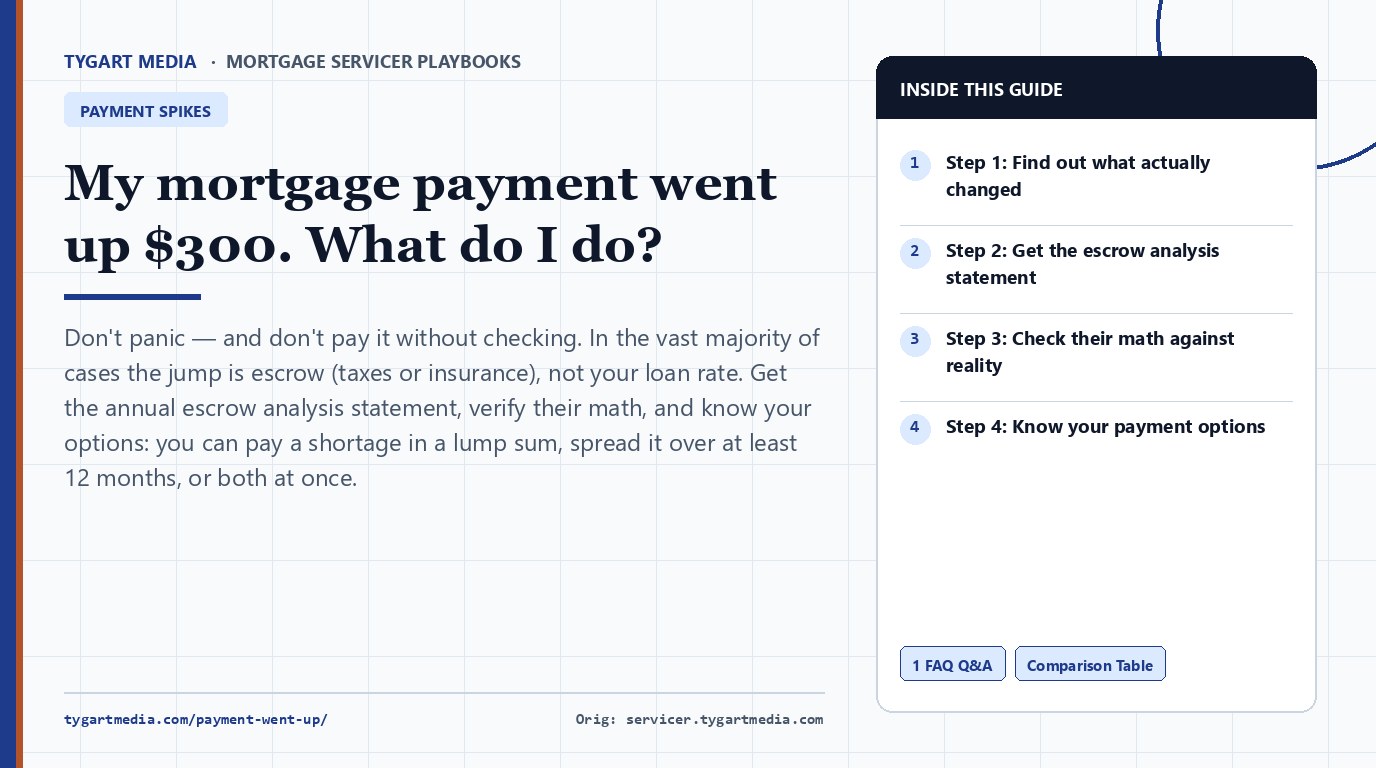
  • My mortgage payment went up $300. What do I do?

    My mortgage payment went up $300. What do I do?

    Tygart Media · Mortgage Servicer Playbooks · Payment spikes

    QUICK ANSWEROriginally published at servicer.tygartmedia.com · Reviewed October 4, 2026
    The short answer: don’t panic — and don’t pay it without checking. In the vast majority of cases the jump is escrow (taxes or insurance), not your loan rate. Get the annual escrow analysis statement, verify their math, and know your options: you can pay a shortage in a lump sum, spread it over at least 12 months, or both at once.

    Step 1: Find out what actually changed

    Your monthly payment has two big parts: principal and interest (the loan itself) and escrow (property taxes plus homeowners insurance, collected monthly). If you have a fixed-rate mortgage, the loan part cannot change. So a jump almost always means escrow moved.

    The usual suspects: your county raised property taxes, your insurance premium went up at renewal, or your servicer ran its annual escrow analysis and found a shortage.

    Step 2: Get the escrow analysis statement

    Your servicer is required to send you an annual escrow account analysis. It shows what they paid out, what they project to pay, and how they recalculated your monthly payment. If you can’t find it, call and ask for it — and here’s how to read one line by line →

    Step 3: Check their math against reality

    • Taxes: compare the servicer’s number with your county tax bill or assessor’s website.
    • Insurance: compare with your insurer’s actual renewal premium — not an estimate.
    • The cushion: federal rules let the servicer keep up to two months’ worth of escrow payments as a cushion. Some servicers pad this. Two months is the legal maximum.

    If the numbers don’t match your real bills, that’s an escrow error — and servicers make them regularly.

    Step 4: Know your payment options

    If there is a genuine shortage, you generally have three choices: pay it as a lump sum, spread it over at least 12 months (a right federal rules give you — you can ask for a longer spread, like 24 months, and some servicers agree), or a mix. Nobody has to pay a shortage all at once just because the letter makes it look that way.

    Important Notice
    Don’t just stop paying the higher amount If the new payment is correct and you keep paying the old one, you’ll fall behind — and late fees and credit reporting follow. Verify first, then pay the right number, not the scary one.
    Disclaimer
    Informational only — not legal or financial advice.
    Mortgage rules vary by loan type, servicer, and state. Check your own loan documents and official federal resources, or talk to a licensed professional, before acting.

    Why your payment went up

    Diagnosing a mortgage payment increase
    CauseCheck
    Escrow shortageThe annual escrow analysis — audit every line
    Tax increaseCounty assessor records
    Insurance premium hikeYour homeowner’s policy renewal
    ARM adjustmentYour note’s adjustment terms and index
    Servicer errorMore common than you’d think — verify before paying
    Next Step & Source Attribution
    Continue navigating Mortgage Servicer Playbooks
    Source: Originally published at https://servicer.tygartmedia.com/payment-went-up/ · Author: William Tygart, Tygart Media · Last reviewed October 4, 2026.
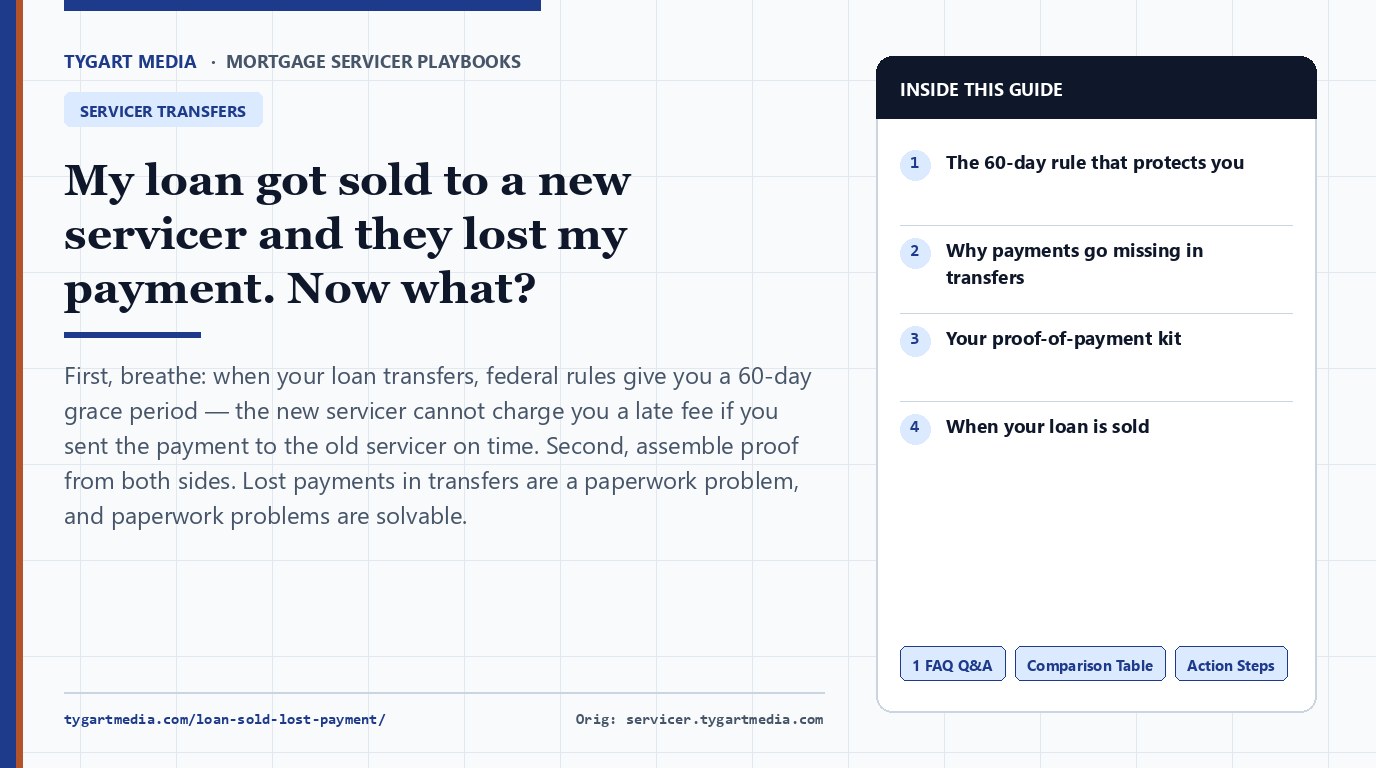
  • My loan got sold to a new servicer and they lost my payment. Now what?

    My loan got sold to a new servicer and they lost my payment. Now what?

    Tygart Media · Mortgage Servicer Playbooks · Servicer transfers

    QUICK ANSWEROriginally published at servicer.tygartmedia.com · Reviewed October 4, 2026
    The short answer: first, breathe: when your loan transfers, federal rules give you a 60-day grace period — the new servicer cannot charge you a late fee if you sent the payment to the old servicer on time. Second, assemble proof from both sides. Lost payments in transfers are a paperwork problem, and paperwork problems are solvable.

    The 60-day rule that protects you

    When servicing transfers, federal mortgage rules give you a grace period of about 60 days from the transfer date. During that window, if you sent a timely payment to the old servicer, the new one can’t treat it as late or charge a late fee. This is the single most important fact in a transfer mess — and servicer representatives sometimes “forget” it.

    Why payments go missing in transfers

    • The old servicer forwarded the payment late or to the wrong account.
    • The new servicer applied it to the wrong loan (common with common names).
    • The payment is sitting in a suspense or unapplied account — which is legal but must be resolved →
    • Auto-pay didn’t carry over — new servicers almost never inherit your old autopay setup.

    Your proof-of-payment kit

    1. From the old servicer: confirmation the payment was received, the date, the amount, and where it was forwarded.
    2. From your bank: the cleared check image or the ACH confirmation with the date and recipient.
    3. From the new servicer: a full payment history showing what’s applied and what’s missing.
    4. Send it all in writing to the new servicer as a formal notice of error: “My payment of $[amount] on [date] is missing. Investigate and correct.” That triggers their duty to investigate and respond, generally within about 30 business days.
    Important Notice
    Rebuild your autopay on day one Never assume autopay survived a transfer — it almost never does. Set up new autopay with the new servicer immediately, and keep paying manually until the first automatic draft clears. A missed payment during the gap is the most common way transfer chaos becomes a credit-report problem.
    Disclaimer
    Informational only — not legal or financial advice.
    Mortgage rules vary by loan type, servicer, and state. Check your own loan documents and official federal resources, or talk to a licensed professional, before acting.

    When your loan is sold

    Your protections during a servicing transfer
    ProtectionDetail
    60-day grace periodA payment sent to the old servicer can’t be marked late
    15-day noticesBoth servicers must notify you before and after transfer
    Payment history transfersNew servicer must honor your record — verify it
    Next Step & Source Attribution
    Continue navigating Mortgage Servicer Playbooks
    Source: Originally published at https://servicer.tygartmedia.com/loan-sold-lost-payment/ · Author: William Tygart, Tygart Media · Last reviewed October 4, 2026.
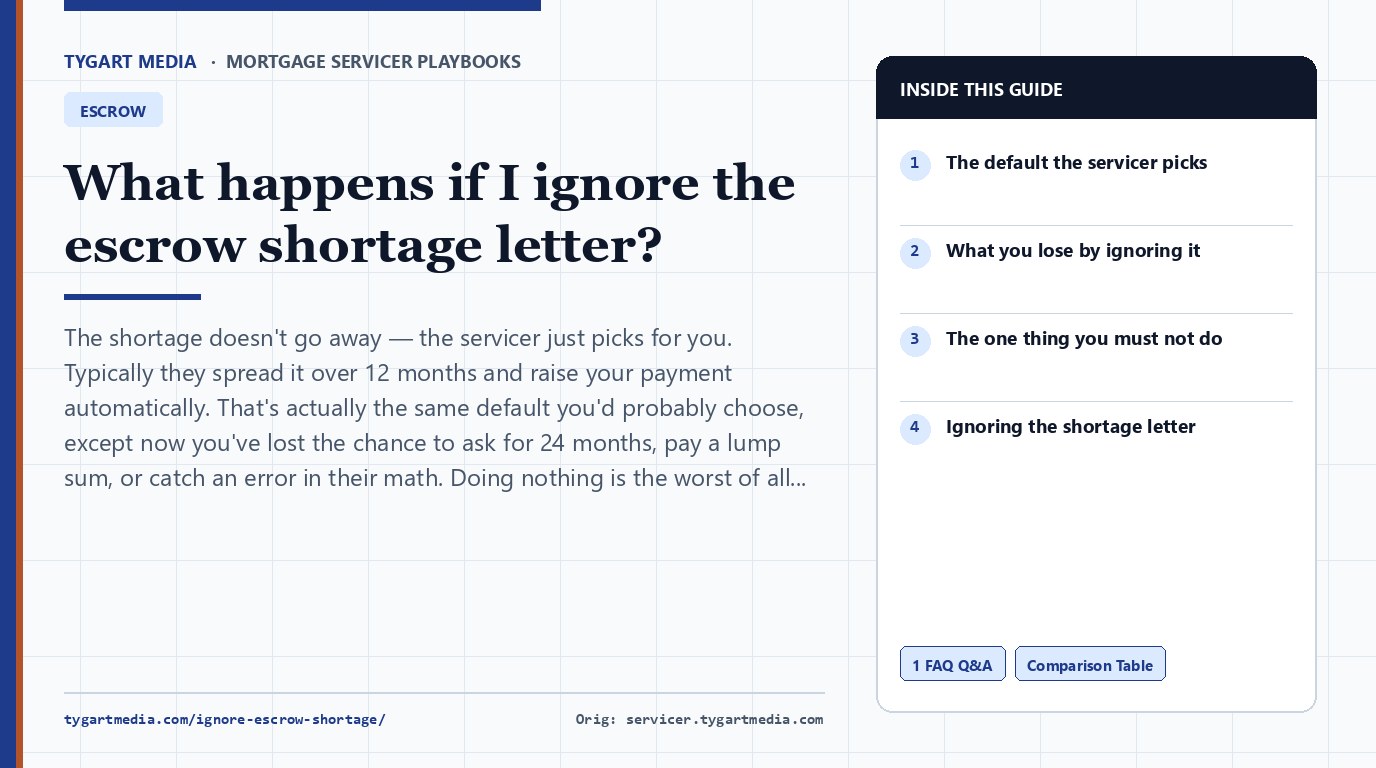
  • What happens if I ignore the escrow shortage letter?

    What happens if I ignore the escrow shortage letter?

    Tygart Media · Mortgage Servicer Playbooks · Escrow

    QUICK ANSWEROriginally published at servicer.tygartmedia.com · Reviewed October 4, 2026
    The short answer: the shortage doesn’t go away — the servicer just picks for you. Typically they spread it over 12 months and raise your payment automatically. That’s actually the same default you’d probably choose, except now you’ve lost the chance to ask for 24 months, pay a lump sum, or catch an error in their math. Doing nothing is the worst of all options.

    The default the servicer picks

    An escrow shortage notice usually comes with a deadline to choose: lump sum, 12-month spread, or a combination. If the deadline passes with no response, most servicers default to the 12-month spread and adjust your payment upward. The shortage gets repaid either way — the only question was ever how.

    What you lose by ignoring it

    • The 24-month ask. You can’t negotiate a longer spread after the default kicks in as easily — the leverage is in the choice window.
    • The error check. A meaningful share of escrow analyses contain mistakes: wrong tax figures, stale insurance premiums, over-padded cushions. Ignoring the letter means paying for someone else’s error for a year.
    • The lump-sum option. If you had the cash, paying the shortage outright keeps your payment increase to just the new tax/insurance projection — smaller than the spread payment.

    The one thing you must not do

    Do not keep paying the old amount out of protest. Once the new payment takes effect, the old amount is a short payment — which lands in suspense, accrues late fees, and can be reported to the credit bureaus. Protesting by underpaying only hurts you. That’s the suspense-account trap →

    Editor's Note
    The letter is an invitation, not a threat Read it as: “here are your options, pick one by this date.” The borrowers who come out best are the ones who treat it as the start of a 20-minute review — check the math, pick the spread, move on. The borrowers who come out worst are the ones who file it in a drawer.
    Disclaimer
    Informational only — not legal or financial advice.
    Mortgage rules vary by loan type, servicer, and state. Check your own loan documents and official federal resources, or talk to a licensed professional, before acting.

    Ignoring the shortage letter

    What happens if you ignore an escrow shortage
    TimelineConsequence
    30–60 daysServicer spreads it over 12 months automatically — payment jumps
    OngoingNegative escrow balance grows; you lose negotiating leverage
    Worst caseDelinquency reporting if the higher payment isn’t met

    Ignoring it doesn’t make it go away — it just removes your choices. Respond, even if only to request the 24-month spread.

    Next Step & Source Attribution
    Continue navigating Mortgage Servicer Playbooks
    Source: Originally published at https://servicer.tygartmedia.com/ignore-escrow-shortage/ · Author: William Tygart, Tygart Media · Last reviewed October 4, 2026.
  • What is an escrow shortage, and do I have to pay it all at once?

    What is an escrow shortage, and do I have to pay it all at once?

    Tygart Media · Mortgage Servicer Playbooks · Escrow

    QUICK ANSWEROriginally published at servicer.tygartmedia.com · Reviewed October 4, 2026
    The short answer: an escrow shortage is not a bill — it’s a recalculation. Your servicer re-ran the numbers and found that what they’re collecting monthly won’t cover the taxes and insurance due this year. And no, you don’t have to pay it all at once: federal rules give you the right to spread it over at least 12 months.

    What a shortage actually is

    Every year your servicer projects what they’ll pay for your property taxes and insurance, adds a cushion of up to two months, and divides by twelve. That’s your escrow portion. If taxes or premiums rose, the projection comes up short — that gap is the “shortage.”

    There’s a related term: a deficiency means the account balance actually went negative. Both get handled the same way — you repay the gap, usually bundled into your monthly payment.

    Your three options

    1. Pay it as a lump sum — the shortage disappears and your payment only rises by the amount needed for the new higher tax/insurance projection.
    2. Spread it over at least 12 months — this is a right federal mortgage rules give you. The servicer may offer 12; you can ask for 24. Some servicers agree to longer spreads, some don’t — but asking costs nothing.
    3. Do both — pay part now, spread the rest. Useful when the shortage is large.

    Why shortages surprise people

    Tax reassessments after a hot real-estate year, insurance renewals with big premium jumps, or a servicer switching you to a more expensive insurance product. The analysis statement shows which one it was — read yours line by line →

    Editor's Note
    The 12-month minimum is yours by right If a servicer representative tells you a shortage must be paid in full within 30 or 60 days, that conflicts with federal rules. Ask for the options in writing. Representatives misstate this regularly — the written statement is what counts.
    Disclaimer
    Informational only — not legal or financial advice.
    Mortgage rules vary by loan type, servicer, and state. Check your own loan documents and official federal resources, or talk to a licensed professional, before acting.

    Escrow shortage: your options

    What to do about an escrow shortage
    OptionHow it worksBest when
    Pay lump sumCover the shortage at onceSmall shortage, cash on hand
    Spread 12 monthsAdded to monthly payment for a yearStandard — servicers must offer this
    Spread 24+ monthsLonger repaymentLarge shortage; you must request it
    Challenge itAudit the escrow analysis for errorsThe numbers don’t add up — they often don’t
    Next Step & Source Attribution
    Continue navigating Mortgage Servicer Playbooks
    Source: Originally published at https://servicer.tygartmedia.com/escrow-shortage/ · Author: William Tygart, Tygart Media · Last reviewed October 4, 2026.
  • My servicer charged me for force-placed insurance. How do I fight it?

    My servicer charged me for force-placed insurance. How do I fight it?

    Tygart Media · Mortgage Servicer Playbooks · Force-placed insurance

    QUICK ANSWEROriginally published at servicer.tygartmedia.com · Reviewed October 4, 2026
    The short answer: force-placed insurance protects the lender, not you — and it’s usually far more expensive than a normal homeowners policy, billed straight to your escrow. You fight it with proof: servicers must warn you in writing before charging, and when you show continuous coverage, they must cancel the policy and refund the charges.

    What force-placed insurance actually is

    Your loan requires you to carry homeowners insurance. If your servicer believes your coverage lapsed — a missed renewal, a canceled policy, a letter they claim they never received — they can buy “force-placed” (lender-placed) coverage and bill you for it. It covers the lender’s interest in the property, often with worse terms than your own policy, at a premium that can be two or three times a normal policy.

    Why it happens to people who had insurance

    • Your insurer sent the renewal proof to the wrong servicer address.
    • You switched insurers and the new company never notified the servicer.
    • Your policy renewed but with a different policy number, and the servicer’s matching failed.
    • The servicer’s insurance-tracking vendor made an error.

    In other words: this is frequently a paperwork failure, not a coverage failure.

    The fight, step by step

    1. Gather your proof. Declarations pages from your own insurer showing continuous coverage for the entire force-placed period. Get them from your agent or insurer directly — not from memory.
    2. Send the proof in writing to the servicer’s insurance department (certified mail or the servicer’s secure upload — keep the receipt). Ask for cancellation of the force-placed policy and a full refund of all premiums charged.
    3. Demand a corrected escrow analysis. Force-placed premiums inflate your escrow, which inflates your payment. Once refunded, the analysis must be re-run.
    4. Escalate if they stall. A formal written notice of error triggers the servicer’s duty to investigate and respond — and a CFPB complaint gets attention →
    Editor's Note
    Refunds are real and common When borrowers prove they had continuous coverage, servicers routinely cancel force-placed policies and refund the premiums. The key is written proof of coverage for the exact dates — verbal “I had insurance” doesn’t move the file.
    Important Notice
    Don’t let them double-insure you While you’re fighting, make sure your own policy stays active. A genuine lapse lets them keep the force-placed policy — and gives them the one argument that actually holds up.
    Disclaimer
    Informational only — not legal or financial advice.
    Mortgage rules vary by loan type, servicer, and state. Check your own loan documents and official federal resources, or talk to a licensed professional, before acting.

    Fighting force-placed insurance

    How to remove force-placed insurance
    StepAction
    1Send proof of your own insurance — declarations page, by certified mail
    2Demand a refund of force-placed premiums back to your policy’s start date
    3If they stall past 15 days, file a CFPB complaint
    4Escalate: state AG + RESPA qualified written request

    Force-placed policies cost 2–10x normal premiums and protect the lender, not you. Federal rules require cancellation within 15 days of receiving your proof.

    Next Step & Source Attribution
    Continue navigating Mortgage Servicer Playbooks
    Source: Originally published at https://servicer.tygartmedia.com/force-placed-insurance/ · Author: William Tygart, Tygart Media · Last reviewed October 4, 2026.
  • How do I file a CFPB complaint against my mortgage company?

    How do I file a CFPB complaint against my mortgage company?

    Tygart Media · Mortgage Servicer Playbooks · Fighting back

    QUICK ANSWEROriginally published at servicer.tygartmedia.com · Reviewed October 4, 2026
    The short answer: it’s free, it takes about 15 minutes, and servicers take it seriously because the CFPB tracks their responses. File at consumerfinance.gov with a clear timeline and your documents attached. And send the servicer a written notice of error at the same time — federal rules require them to investigate and respond, generally within about 30 business days.

    Before the CFPB: the notice of error

    This is your most underused weapon. Under federal mortgage servicing rules, you can send your servicer a written notice identifying an error — a misapplied payment, a wrong escrow calculation, a force-placed insurance charge on a covered property. Once received, the servicer must investigate and respond in writing, generally within about 30 business days (they can extend briefly if they tell you why).

    Keep it simple: “On [date], [what happened]. This is an error because [reason]. Please investigate and correct it.” Send it to the servicer’s designated error-resolution address — check your statement or their website; sending it to the payment address can delay things.

    The CFPB complaint, step by step

    1. Go to consumerfinance.gov/complaint. Select mortgage, then your servicer.
    2. Write a tight timeline. Dates, amounts, names of representatives, what you were told. Attach your documents: statements, letters, proof of payments, your notice of error.
    3. State what you want. “Correct the escrow analysis,” “refund the force-placed premiums,” “apply the suspense balance” — a specific ask gets a specific answer.
    4. Track it. The CFPB forwards the complaint to the company, which must respond through the system. You’ll see the response and can dispute it if it’s inadequate.

    Why it works

    Servicers assign CFPB complaints to specialized resolution teams — not the front-line call center. The complaint also becomes part of the public CFPB database (your personal details removed), which is exactly why companies staff these teams well: regulators and journalists read that database.

    Important Notice
    The CFPB doesn’t award you money It forces a response and creates a record — it doesn’t order refunds or damages. If the servicer’s error cost you real money and they won’t make it right, that record becomes evidence for your state attorney general, a housing counselor, or an attorney. Build the paper trail first; decide about lawyers later.
    Disclaimer
    Informational only — not legal or financial advice.
    Mortgage rules vary by loan type, servicer, and state. Check your own loan documents and official federal resources, or talk to a licensed professional, before acting.

    What makes a CFPB complaint effective

    Building a CFPB complaint that gets results
    IncludeWhy
    Loan number + servicer nameRoutes it to the right file
    Timeline with datesShows the pattern, not just one event
    What you asked for + their responseProves you tried the normal channels
    The specific RESPA rule (if known)Signals you know your rights
    What resolution you wantBe concrete: refund of $X, correction of Y
    Next Step & Source Attribution
    Continue navigating Mortgage Servicer Playbooks
    Source: Originally published at https://servicer.tygartmedia.com/cfpb-complaint/ · Author: William Tygart, Tygart Media · Last reviewed October 4, 2026.