Category: Disaster Recovery Guides

Post-disaster recovery guides for displaced homeowners covering emergency shelter, ALE housing claims, salvage decisions, contractor vetting, and FEMA coordination. Original hub: recovery.tygartmedia.com.

  • What is ALE, and what does my insurance actually have to cover?

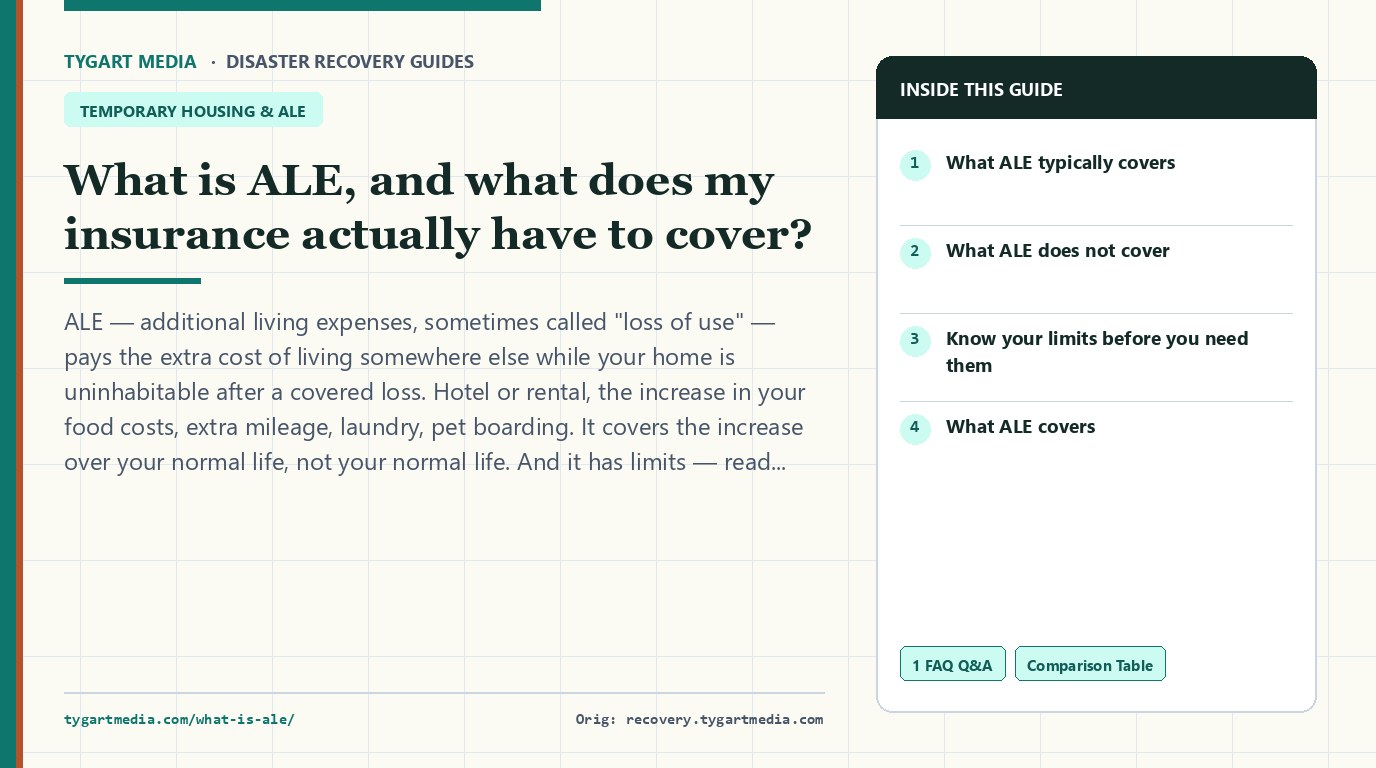
    What is ALE, and what does my insurance actually have to cover?

    Tygart Media · Disaster Recovery Guides · Temporary housing & ALE

    QUICK ANSWEROriginally published at recovery.tygartmedia.com · Reviewed October 4, 2026
    The short answer: ALE — additional living expenses, sometimes called “loss of use” — pays the extra cost of living somewhere else while your home is uninhabitable after a covered loss. Hotel or rental, the increase in your food costs, extra mileage, laundry, pet boarding. It covers the increase over your normal life, not your normal life. And it has limits — read the Loss of Use section of your policy.

    What ALE typically covers

    • Temporary housing — hotel, motel, short-term rental, or an extended-stay apartment. The standard is “comparable” to your normal living situation, not luxurious.
    • Increased food costs — the difference between what you’d normally spend on groceries and what you’re spending eating out or on a hotel kitchenette. Keep receipts and track your normal baseline.
    • Extra mileage and transportation — the added commute if your temporary housing is farther from work or school.
    • Laundry, pet boarding, and similar incidentals — costs you wouldn’t have if you were home.

    What ALE does not cover

    Your normal living costs. If your mortgage or rent payment, car payment, and utilities would exist anyway, ALE doesn’t pay them. Insurers also won’t pay for upgrades — if you normally cook at home and you’re choosing room service three times a day, expect pushback. Reasonable and documented beats generous and vague, every time.

    Know your limits before you need them

    ALE coverage is usually expressed as a percentage of your dwelling coverage (often 20–30%) or a flat dollar cap, sometimes with a time limit. A major rebuild can run 12–18 months — do the math early against your limit, because running out of ALE mid-rebuild is one of the most common displacement crises. If your insurer cuts ALE off, here’s what to do →

    Important Notice
    Keep every receipt from day one ALE is a reimbursement game. No receipt, no reimbursement. Photograph receipts with your phone, keep a running spreadsheet, and submit expenses in organized batches — adjusters process clean files faster.
    Disclaimer
    Informational only — not legal, financial, or insurance advice.
    ALE terms vary by policy and state. Read your own policy’s Loss of Use section and confirm details with your adjuster before making housing decisions.

    What ALE covers

    Additional Living Expenses: what’s typically covered
    CoveredNot covered
    Hotel / temporary rent above your normal housing costYour normal mortgage/rent (you’d pay that anyway)
    Increased food costs (restaurant vs. home cooking)The groceries you’d buy anyway
    Laundry, pet boarding, extra mileageUpgrades beyond comparable living standard

    ALE pays the difference between your normal living costs and displacement costs. Keep every receipt.
    Next Step & Source Attribution
    Continue navigating Disaster Recovery Guides
    Source: Originally published at https://recovery.tygartmedia.com/what-is-ale/ · Author: William Tygart, Tygart Media · Last reviewed October 4, 2026.
  • What can I save after a fire or flood — and what’s a lost cause?

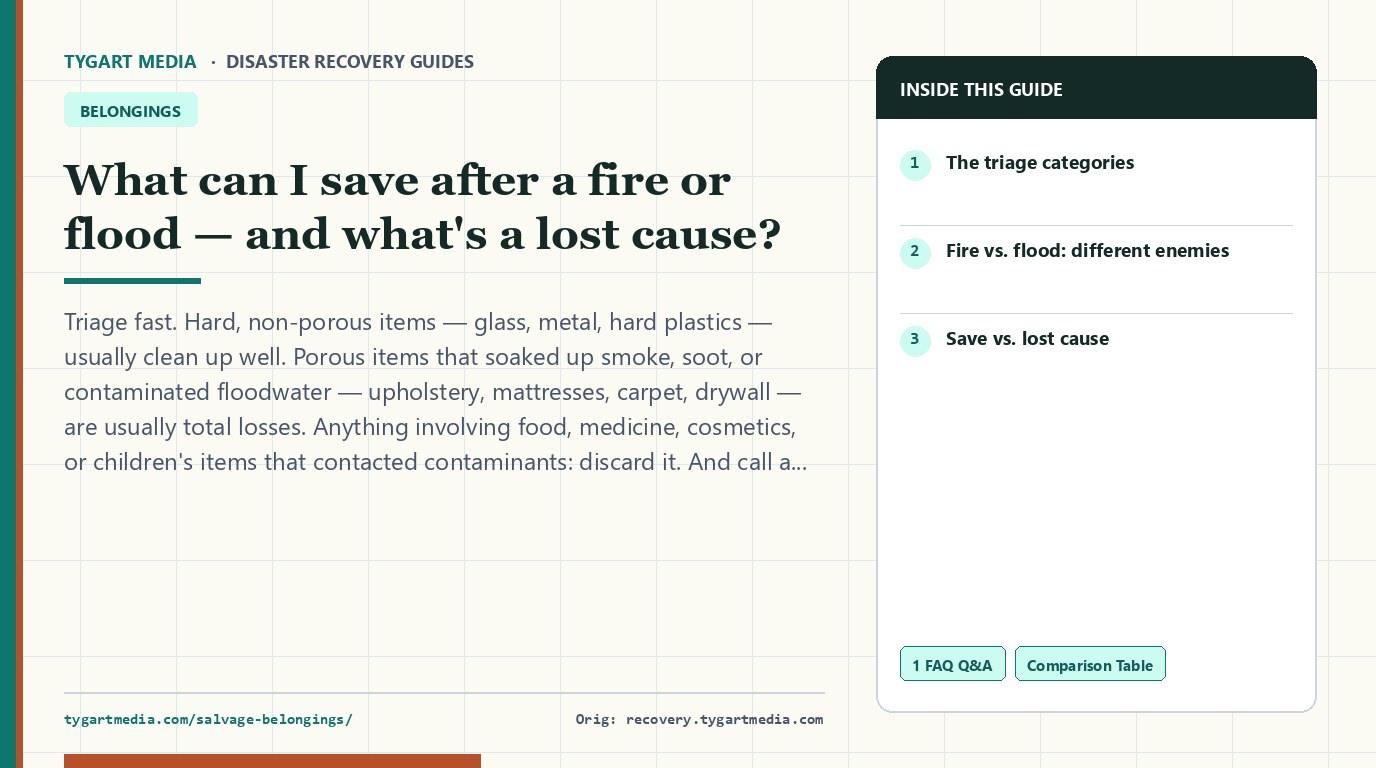
    What can I save after a fire or flood — and what’s a lost cause?

    Tygart Media · Disaster Recovery Guides · Belongings

    QUICK ANSWEROriginally published at recovery.tygartmedia.com · Reviewed October 4, 2026
    The short answer: triage fast. Hard, non-porous items — glass, metal, hard plastics — usually clean up well. Porous items that soaked up smoke, soot, or contaminated floodwater — upholstery, mattresses, carpet, drywall — are usually total losses. Anything involving food, medicine, cosmetics, or children’s items that contacted contaminants: discard it. And call a contents-restoration specialist early — they save far more than you’d expect, but only if well-meaning cleanup hasn’t made things worse first.

    The triage categories

    • Likely salvageable: glassware, ceramics, metal items, hard plastics, jewelry, solid wood furniture (surface smoke damage), documents and photos (with specialist freeze-drying — don’t throw them out).
    • Sometimes salvageable: clothing and textiles (professional cleaning can remove smoke odor, but not always), electronics (don’t power them on — let a specialist assess), books.
    • Usually a loss: mattresses, pillows, upholstered furniture saturated with smoke or water, carpet and padding, drywall, insulation, particleboard furniture that swelled.
    • Always discard: food, medicine, cosmetics, baby bottles and children’s items that contacted smoke, soot, or floodwater. No exceptions — contamination isn’t visible.

    Fire vs. flood: different enemies

    Fire and smoke: soot is acidic and keeps damaging surfaces the longer it sits — speed matters. Don’t wipe soot (it smears and sets); don’t run the HVAC (it spreads contamination); ventilate if safe.

    Flood: assume the water was contaminated — it usually was. Porous materials that sat in floodwater grow mold fast. The 48-hour mark matters: after that, the odds of saving porous items drop sharply.

    Important Notice
    Safety first — some things aren’t worth the risk Don’t enter a fire-damaged structure until it’s been declared safe. Wear an N95 minimum around soot and mold. Floodwater can carry sewage, chemicals, and sharp debris. Your belongings are replaceable; you aren’t. If the structure is compromised, wait for professionals.
    Editor's Note
    Document before you discard Photograph everything before it goes — including the things you’re throwing away. Your contents inventory is the basis of your personal-property claim, and “we threw it out, it was ruined” needs photographic backup. Building your contents inventory →
    Disclaimer
    Informational only — not legal, financial, or insurance advice.
    Health and safety guidance here is general information, not professional advice. Follow the directions of local authorities and restoration professionals for your specific situation.

    Save vs. lost cause

    What survives fire and flood
    ItemFireFlood
    Solid wood furnitureOften restorableOften restorable if dried fast
    Upholstery / mattressesSmoke damage usually totalContamination usually total
    ElectronicsHeat damage often fatalUsually fatal
    Documents / photosFreeze-drying can save someRinse + freeze quickly, restore later
    Next Step & Source Attribution
    Continue navigating Disaster Recovery Guides
    Source: Originally published at https://recovery.tygartmedia.com/salvage-belongings/ · Author: William Tygart, Tygart Media · Last reviewed October 4, 2026.
  • Where do we live while our home is being repaired?

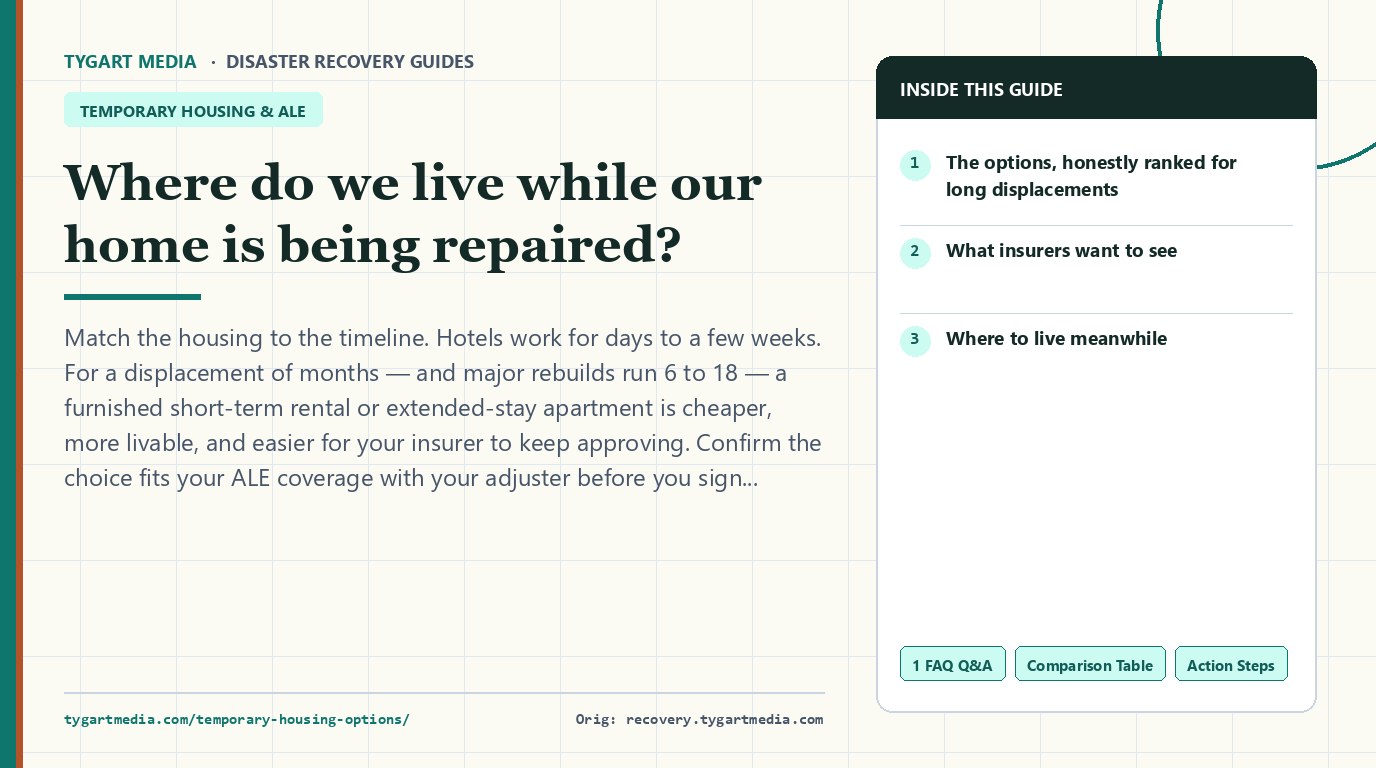
    Where do we live while our home is being repaired?

    Tygart Media · Disaster Recovery Guides · Temporary housing & ALE

    QUICK ANSWEROriginally published at recovery.tygartmedia.com · Reviewed October 4, 2026
    The short answer: match the housing to the timeline. Hotels work for days to a few weeks. For a displacement of months — and major rebuilds run 6 to 18 — a furnished short-term rental or extended-stay apartment is cheaper, more livable, and easier for your insurer to keep approving. Confirm the choice fits your ALE coverage with your adjuster before you sign anything, and get the okay in writing.

    The options, honestly ranked for long displacements

    1. Furnished short-term rental. A real kitchen, laundry, space for the kids and the dog, and usually half the monthly cost of a hotel. The best option for anything over a month. Look for disaster-relocation specialists and corporate-housing companies — they work with insurers routinely.
    2. Extended-stay hotel or apartment. Kitchenette, weekly rates, no lease. A good bridge while you search for a rental.
    3. Standard hotel. Fine for the first week or two. Punishing past a month — cost, no kitchen, no routine. If you’re “hotel hopping” between properties, that’s a sign to switch strategies.
    4. Family or friends. Saves money and keeps you sane in the short term. Past a month or two it strains every relationship involved — set expectations and an exit timeline up front.
    5. RV, trailer, or on-property temporary dwelling. Some jurisdictions allow it during rebuilds; some don’t. Check local ordinances before buying the trailer.

    What insurers want to see

    Insurers are required to cover reasonable temporary housing — and for long displacements, “reasonable” usually means a rental, not a hotel. Proposing a rental yourself, with costs documented, often gets approved faster than waiting for the adjuster to suggest it. Keep every receipt regardless. What ALE covers →

    Editor's Note
    Kids, pets, medical needs If anyone in the household has medical equipment, mobility needs, or school continuity requirements, say so explicitly and in writing — insurers must consider reasonable needs, and documented medical necessity strengthens every housing request you make.
    Important Notice
    Don’t sign a long lease without insurer sign-off A 12-month apartment lease feels stable, but if your ALE only runs 6 more months or your adjuster disputes the cost, you’re personally on the hook for the difference. Get the housing plan approved in writing first.
    Disclaimer
    Informational only — not legal, financial, or insurance advice.
    Housing rules and ALE terms vary by policy and state. Confirm your plan with your adjuster before committing to housing costs.

    Where to live meanwhile

    Temporary housing options compared
    OptionProsCons
    Extended-stay hotelNo lease, ALE-friendly billingExpensive long-term
    Short-term rentalKitchen, space, normalcyLease terms, availability
    Family / friendsCheapStrain over months — set expectations
    FEMA temporary housingAvailable after declarationsLimited supply, eligibility rules
    Next Step & Source Attribution
    Continue navigating Disaster Recovery Guides
    Source: Originally published at https://recovery.tygartmedia.com/temporary-housing-options/ · Author: William Tygart, Tygart Media · Last reviewed October 4, 2026.
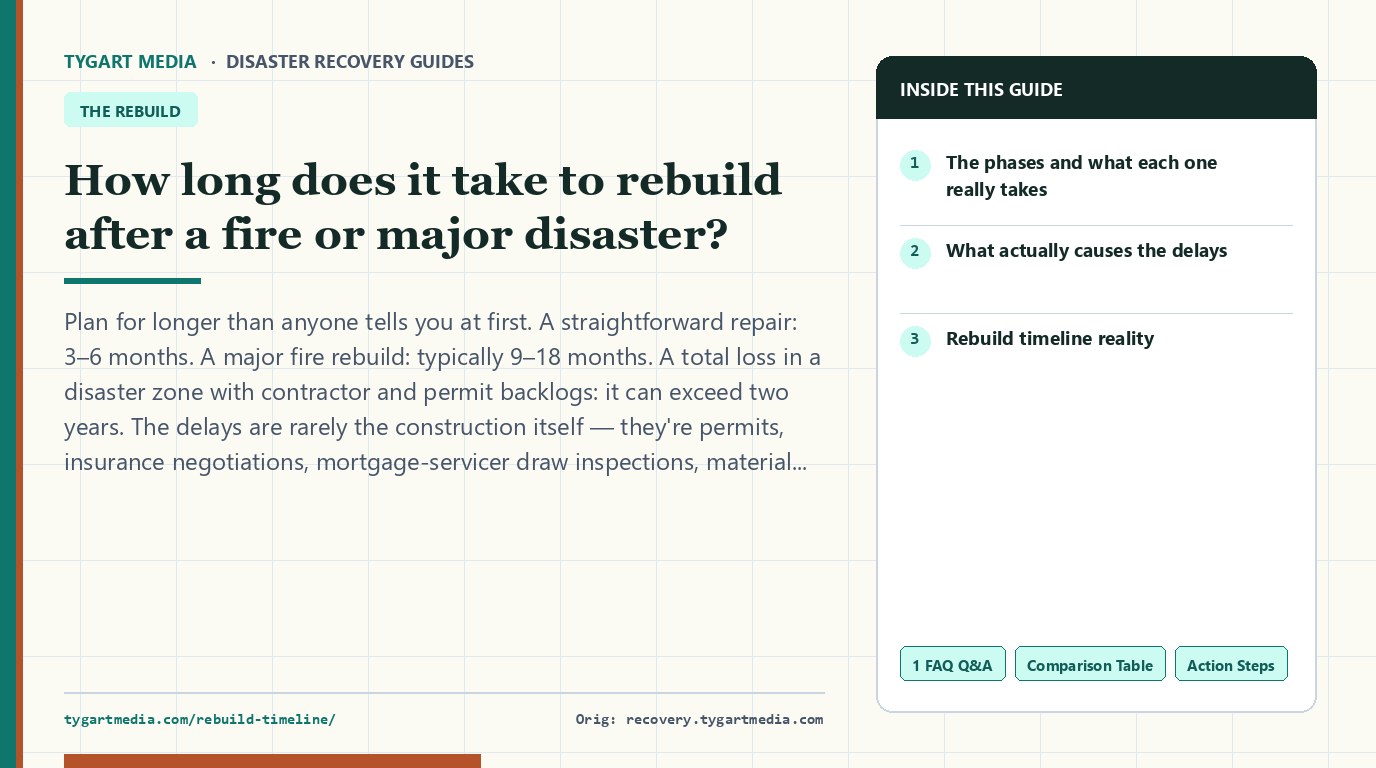
  • How long does it take to rebuild after a fire or major disaster?

    How long does it take to rebuild after a fire or major disaster?

    Tygart Media · Disaster Recovery Guides · The rebuild

    QUICK ANSWEROriginally published at recovery.tygartmedia.com · Reviewed October 4, 2026
    The short answer: plan for longer than anyone tells you at first. A straightforward repair: 3–6 months. A major fire rebuild: typically 9–18 months. A total loss in a disaster zone with contractor and permit backlogs: it can exceed two years. The delays are rarely the construction itself — they’re permits, insurance negotiations, mortgage-servicer draw inspections, material lead times, and code upgrades.

    The phases and what each one really takes

    1. Assessment and documentation (2–6 weeks). Adjuster inspections, your contractor’s scope, engineering assessments if structural damage is involved. Don’t rush this — everything downstream depends on the documentation.
    2. Insurance negotiation (1–4 months). The estimate, the supplements, the back-and-forth. This runs in parallel with other phases if you push it.
    3. Design and permits (1–6 months). Architectural plans for significant rebuilds, then the permit queue. After a regional disaster, the queue is the bottleneck — jurisdictions get overwhelmed.
    4. Demolition and site prep (2–6 weeks). Debris removal, hazardous material abatement (asbestos and lead testing in older homes), site clearing.
    5. Construction (4–12 months). The actual build. Weather, material lead times, and subcontractor availability all bite here.
    6. Final inspections and move-in (2–6 weeks). Certificate of occupancy, punch list, the last draw release from your mortgage servicer.

    What actually causes the delays

    • Permit backlogs after regional disasters — the single biggest timeline killer.
    • Code upgrades. Rebuilding to current code (electrical, seismic, wildfire-hardening) adds design time and cost — and insurers don’t always cover the upgrade portion.
    • Mortgage draw inspections. Each funding release waits on an inspection. How the dual-payee process works →
    • Material lead times — windows, trusses, and specialty items can run months.
    • Contractor availability in disaster zones, where every builder is booked.
    Editor's Note
    Plan your housing for the pessimistic timeline If the optimistic estimate is 9 months, arrange housing you can extend to 14. Breaking a lease or scrambling for housing mid-rebuild is more expensive than over-planning. And make sure your ALE coverage math works for the long version. Choosing temporary housing →
    Disclaimer
    Informational only — not legal, financial, or insurance advice.
    Timelines vary enormously by damage type, jurisdiction, and disaster scale. These are planning ranges, not promises — your contractor’s schedule for your project is the number that matters.

    Rebuild timeline reality

    How long rebuilding actually takes
    PhaseTypical duration
    Cleanup + assessment1–3 months
    Design + permits2–6 months
    Construction6–18 months depending on scope

    After a regional disaster, contractor backlogs can double these numbers. Get in line early.

    Next Step & Source Attribution
    Continue navigating Disaster Recovery Guides
    Source: Originally published at https://recovery.tygartmedia.com/rebuild-timeline/ · Author: William Tygart, Tygart Media · Last reviewed October 4, 2026.
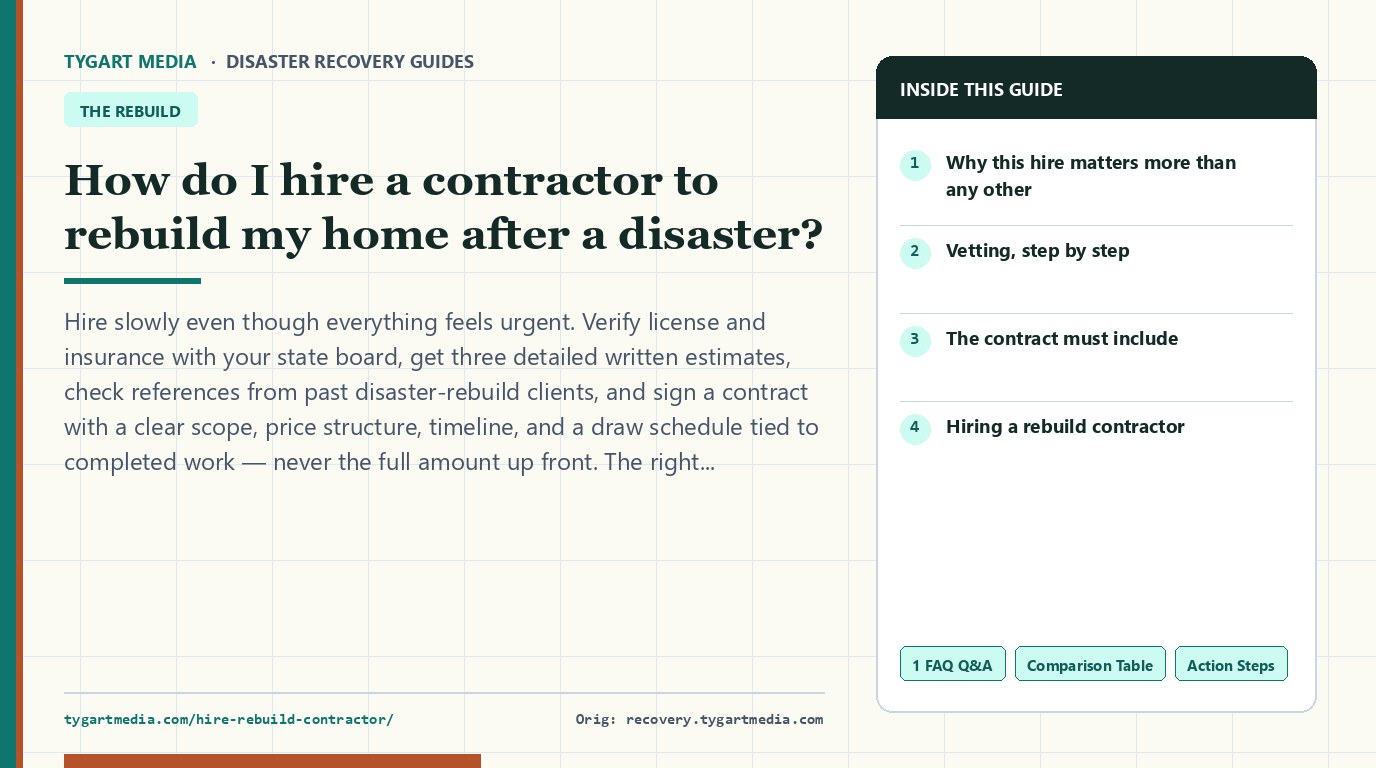
  • How do I hire a contractor to rebuild my home after a disaster?

    How do I hire a contractor to rebuild my home after a disaster?

    Tygart Media · Disaster Recovery Guides · The rebuild

    QUICK ANSWEROriginally published at recovery.tygartmedia.com · Reviewed October 4, 2026
    The short answer: hire slowly even though everything feels urgent. Verify license and insurance with your state board, get three detailed written estimates, check references from past disaster-rebuild clients, and sign a contract with a clear scope, price structure, timeline, and a draw schedule tied to completed work — never the full amount up front. The right contractor is your most important ally: they document damage for your claim, coordinate with your mortgage servicer’s inspectors, and fight for a fair scope of work.

    Why this hire matters more than any other

    After a disaster, your contractor isn’t just a builder. They’re the person who photographs and documents damage before it’s disturbed, who writes the detailed scope your insurer negotiates against, who meets your mortgage servicer’s inspectors at every draw, and who knows which building-code upgrades your jurisdiction now requires. A good one shortens your displacement by months. A bad one extends it — or worse.

    Vetting, step by step

    1. Verify the license with your state’s contractor board — active, in good standing, and in the right classification. Then verify their general liability and workers’ comp insurance directly with the insurer, not just by glancing at a certificate.
    2. Get three written estimates with line-item detail, not single-number bids. After a disaster, prices run hot and availability runs thin — detailed estimates let you compare scope, not just price.
    3. Check disaster-rebuild references specifically. A great kitchen remodeler and a great fire-restoration contractor are different skill sets. Ask for past clients whose homes were rebuilt after a disaster, and call them.
    4. Ask how they handle insurance and mortgage coordination. The right answer is specific: they’ve worked with loss draft departments, they document for supplements, they meet inspectors. Vague answers are a red flag.

    The contract must include

    • Detailed scope of work — what exactly gets built, with what materials
    • Price structure — fixed price or cost-plus, and what triggers change orders
    • Timeline with milestones, and what happens when it slips
    • Draw schedule tied to completed, inspected work — never full payment up front
    • Who pulls permits, who handles inspections, warranty terms
    Important Notice
    After every disaster, the storm chasers arrive Out-of-area contractors knocking on doors, demanding large deposits, no local license, no local references. Some are legitimate traveling crews; many are not. If they want half the money before work starts, or they can’t name a local supplier, walk away. Your state attorney general’s office usually publishes disaster-fraud warnings — read them.
    Editor's Note
    Your contractor and your claim A good rebuild contractor documents damage thoroughly and writes estimates the insurer has to take seriously — that documentation strengthens your claim. But contractors generally can’t argue coverage on your behalf; that’s your fight (or your public adjuster’s). Each side of the table has its role. Challenging a low estimate →
    Disclaimer
    Informational only — not legal, financial, or insurance advice.
    Contractor licensing and contract requirements vary by state. Verify licensing with your state board and consider having an attorney review large contracts before signing.

    Hiring a rebuild contractor

    Vetting a post-disaster contractor
    CheckRed flag
    License + insurance verified with the state“License pending” or out-of-state plates
    Local references from past disastersNo local track record
    Written scope + payment scheduleLarge upfront deposit demanded
    No door-knockingStorm chasers knock; locals don’t need to
    Next Step & Source Attribution
    Continue navigating Disaster Recovery Guides
    Source: Originally published at https://recovery.tygartmedia.com/hire-rebuild-contractor/ · Author: William Tygart, Tygart Media · Last reviewed October 4, 2026.
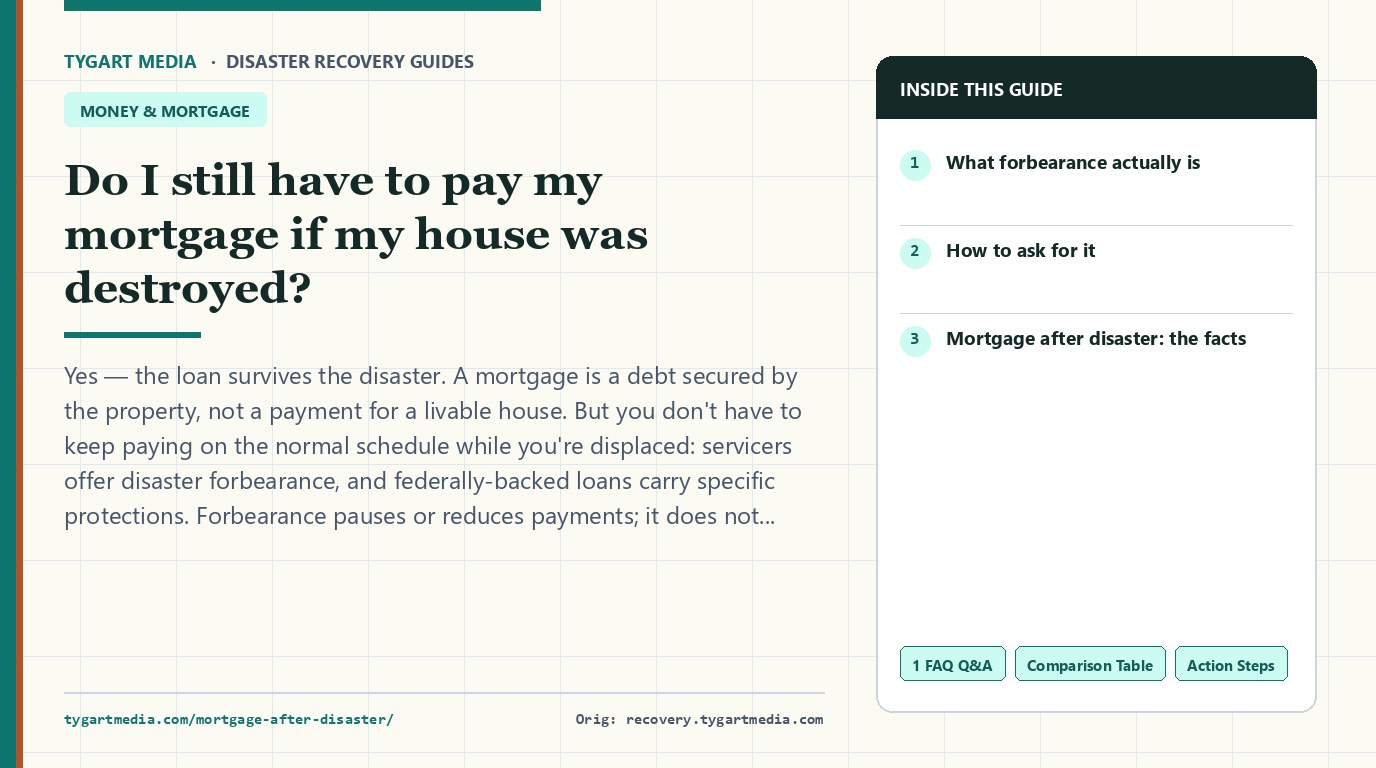
  • Do I still have to pay my mortgage if my house was destroyed?

    Do I still have to pay my mortgage if my house was destroyed?

    Tygart Media · Disaster Recovery Guides · Money & mortgage

    QUICK ANSWEROriginally published at recovery.tygartmedia.com · Reviewed October 4, 2026
    The short answer: yes — the loan survives the disaster. A mortgage is a debt secured by the property, not a payment for a livable house. But you don’t have to keep paying on the normal schedule while you’re displaced: servicers offer disaster forbearance, and federally-backed loans carry specific protections. Forbearance pauses or reduces payments; it does not forgive them. Get the exact terms in writing.

    What forbearance actually is

    Forbearance is a temporary agreement to pause or reduce your mortgage payments — typically 3 to 12 months after a declared disaster. At the end of the forbearance period, the missed amounts come due under whatever repayment structure you agreed to: tacked onto the end of the loan, repaid over time, or in some cases a lump sum. That last option is the dangerous one — never agree to forbearance without knowing exactly how the missed payments get repaid.

    How to ask for it

    1. Call your servicer (the company you send payments to, not necessarily your original lender) and say the words “disaster forbearance.” After a declared disaster, most have a dedicated process.
    2. Get the terms in writing — length of forbearance, how missed payments are handled at the end, and confirmation it won’t be reported as delinquent to credit bureaus during the forbearance period.
    3. Keep paying what you can if forbearance terms are unfavorable. Partial payments still reduce what you owe later.
    4. Revisit before it expires. Forbearance periods end; extensions exist but you have to ask. Don’t discover the expiration from a collections letter.
    Important Notice
    Forbearance is not forgiveness — and it can still touch your credit Some servicers report forborne accounts in ways that affect your score, and some don’t. Ask explicitly how it will be reported, and get the answer in writing. If you’re applying for an SBA disaster loan or other credit during recovery, know where you stand.
    Editor's Note
    Insurance money and your mortgage interact Your servicer will also be involved in your insurance claim checks — that’s the dual-payee process. Talk to the loss draft department about claim funds and the servicing department about forbearance; they’re different teams and don’t always coordinate. How dual-payee checks work →
    Disclaimer
    Informational only — not legal, financial, or insurance advice.
    Mortgage relief options vary by loan type (FHA, VA, USDA, conventional), servicer, and disaster declaration. Talk to your servicer and consider a HUD-approved housing counselor (free) before agreeing to terms.

    Mortgage after disaster: the facts

    Your mortgage didn’t burn down with the house
    QuestionAnswer
    Do I still owe the mortgage?Yes — the loan survives the disaster
    Can I pause payments?Ask about forbearance — many servicers offer 3–12 months post-disaster
    Who gets the insurance check?Often you AND the lender (dual-payee) — the lender releases funds as rebuilding progresses
    Next Step & Source Attribution
    Continue navigating Disaster Recovery Guides
    Source: Originally published at https://recovery.tygartmedia.com/mortgage-after-disaster/ · Author: William Tygart, Tygart Media · Last reviewed October 4, 2026.
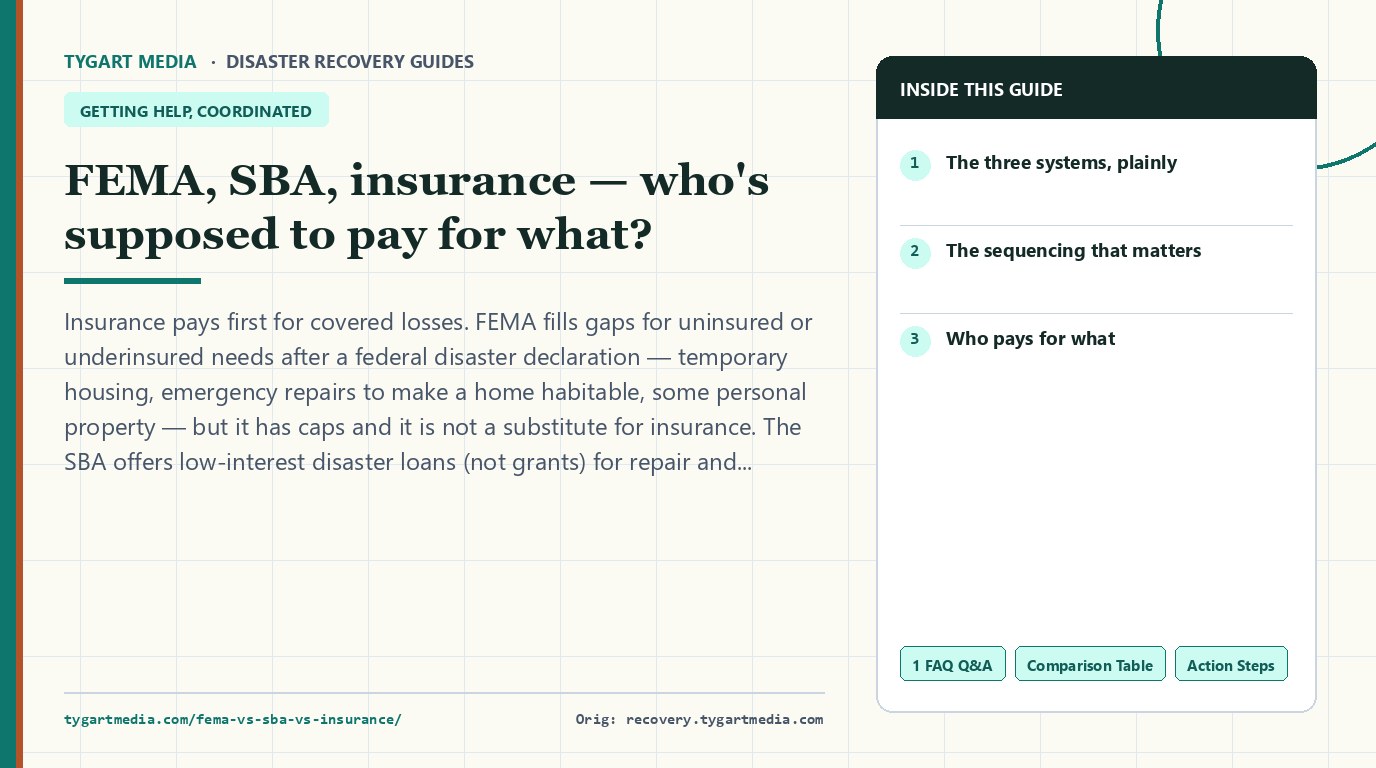
  • FEMA, SBA, insurance — who’s supposed to pay for what?

    FEMA, SBA, insurance — who’s supposed to pay for what?

    Tygart Media · Disaster Recovery Guides · Getting help, coordinated

    QUICK ANSWEROriginally published at recovery.tygartmedia.com · Reviewed October 4, 2026
    The short answer: insurance pays first for covered losses. FEMA fills gaps for uninsured or underinsured needs after a federal disaster declaration — temporary housing, emergency repairs to make a home habitable, some personal property — but it has caps and it is not a substitute for insurance. The SBA offers low-interest disaster loans (not grants) for repair and rebuilding beyond what insurance and FEMA cover. Apply to all three; each one reduces what the others will pay, so the order you pursue them matters.

    The three systems, plainly

    • Your insurance. The primary payer for covered losses — dwelling repairs, ALE, personal property. File first, document everything, and understand that every other program will ask what insurance already paid.
    • FEMA Individuals and Households Program (IHP). Available only after a federal disaster declaration for your area. Covers temporary housing assistance, emergency home repairs needed to make the home safe and habitable (not to restore it fully), and limited personal property replacement. There are maximum grant amounts, and FEMA duplicates nothing insurance already covered.
    • SBA disaster loans. Low-interest, long-term loans to homeowners for repair or rebuilding — this is borrowed money, not a grant, but the terms are far better than anything commercial. You can be referred to SBA when you apply to FEMA; completing the SBA application matters even if you don’t want a loan, because some FEMA assistance categories require it first.

    The sequencing that matters

    1. File the insurance claim immediately. Everything else keys off it.
    2. Apply to FEMA as soon as the declaration covers your area — at DisasterAssistance.gov or by phone. Don’t wait for the insurance outcome.
    3. Complete the SBA loan application when referred, even if you’re unsure you want the loan. Skipping it can block other assistance.
    4. Track what each program pays in one ledger. Duplication of benefits is the tripwire — you can’t be paid twice for the same loss, and programs cross-check.
    Important Notice
    Duplication of benefits will come back to bite you If insurance later pays for something FEMA already covered, you may owe FEMA back. Keep every award letter, every insurance payment breakdown, and a single running ledger of who paid for what. Audits happen months or years later.
    Editor's Note
    FEMA inspectors are not adjusters A FEMA inspection documents damage for the assistance application — it is not a repair estimate and it doesn’t set your insurance claim value. Don’t confuse the two processes, and don’t skip your own contractor’s independent documentation. Why your contractor’s documentation matters →
    Disclaimer
    Informational only — not legal, financial, or insurance advice.
    FEMA and SBA programs change with each disaster declaration and over time. Confirm current program terms at DisasterAssistance.gov and with the agencies directly.

    Who pays for what

    FEMA vs. SBA vs. insurance after a disaster
    FEMASBA disaster loanInsurance
    What it isGrant (not repaid)Low-interest loanYour policy’s coverage
    CoversImmediate needs, temporary repairsRebuilding, refinancingWhat’s in your policy
    Apply whenImmediately after declarationAfter insurance is sortedDay one
    GotchaWon’t duplicate insurance payoutsIt’s debt — weigh carefullyDual-payee checks need lender signoff
    Next Step & Source Attribution
    Continue navigating Disaster Recovery Guides
    Source: Originally published at https://recovery.tygartmedia.com/fema-vs-sba-vs-insurance/ · Author: William Tygart, Tygart Media · Last reviewed October 4, 2026.
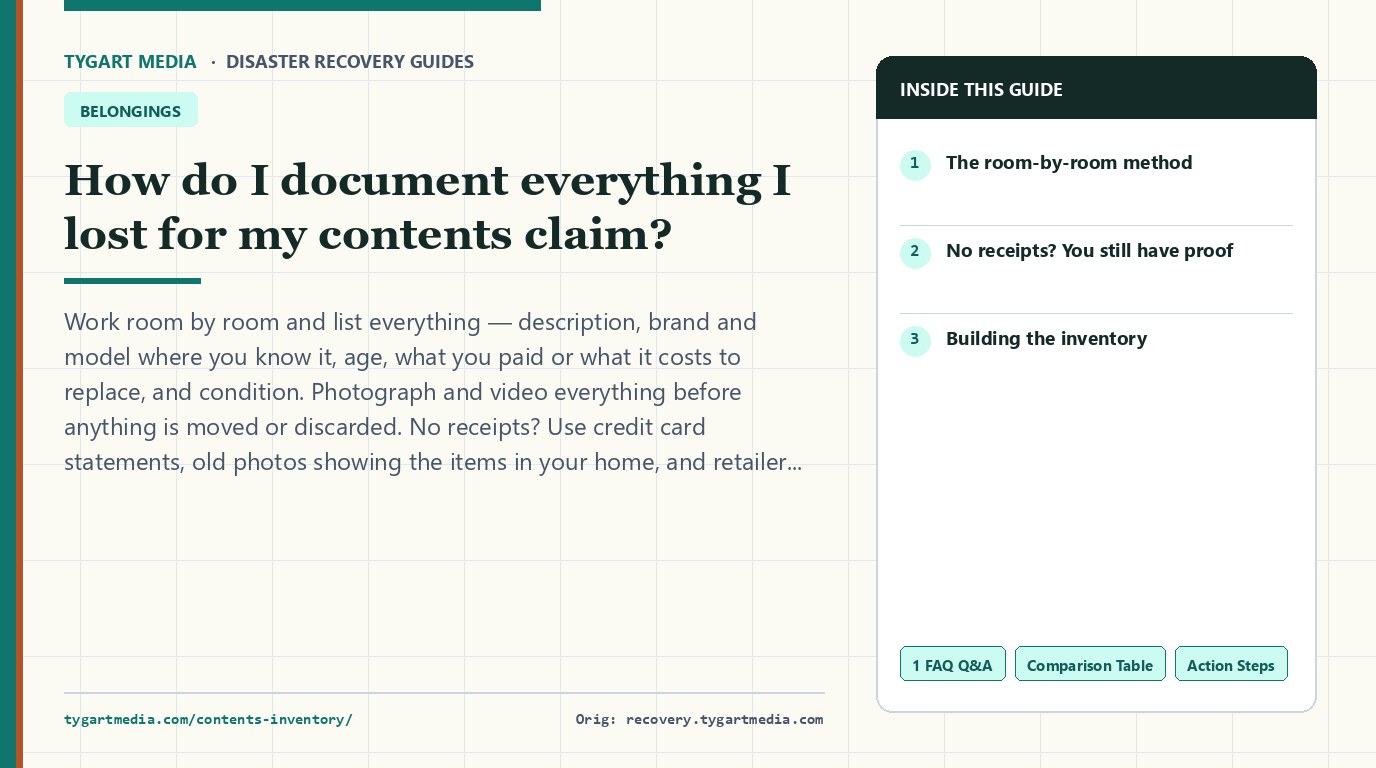
  • How do I document everything I lost for my contents claim?

    How do I document everything I lost for my contents claim?

    Tygart Media · Disaster Recovery Guides · Belongings

    QUICK ANSWEROriginally published at recovery.tygartmedia.com · Reviewed October 4, 2026
    The short answer: work room by room and list everything — description, brand and model where you know it, age, what you paid or what it costs to replace, and condition. Photograph and video everything before anything is moved or discarded. No receipts? Use credit card statements, old photos showing the items in your home, and retailer purchase histories. Specificity is what turns “miscellaneous household goods” into real dollars.

    The room-by-room method

    1. Video walkthrough first. Before touching anything, walk every room slowly with your phone recording, narrating what you see. This is your baseline — do it even before the adjuster arrives if it’s safe to enter.
    2. Photograph the discards. Everything you throw away gets photographed first — including the ruined, the gross, the obviously-totaled. Salvage triage →
    3. Build the list room by room. For each item: what it is, brand/model, approximate age, what you paid (or replacement cost today), and condition before the loss. A spreadsheet beats a shoebox of notes.
    4. Reconstruct what you can’t see. Closets, drawers, the garage, the attic — open everything. People consistently undercount by 30% or more because they forget what’s inside closed storage.
    5. Submit in organized batches rather than one chaotic dump. Adjusters process clean, detailed lists faster — and “faster” matters when you’re living in a hotel.

    No receipts? You still have proof

    • Credit and debit card statements — search by retailer name for purchase records.
    • Photos of your home — holiday photos, listing photos, social media posts that show your belongings in the background.
    • Retailer accounts — Amazon, big-box stores, and many retailers keep years of order history.
    • Manuals and warranty registrations you filed for appliances and electronics.
    Important Notice
    Don’t lowball your own list Exhausted homeowners routinely undervalue or omit items — the junk drawer, the linen closet, the toolbox. Every omitted item is money you don’t get back. Be thorough now; you can always negotiate later, but you can’t add what you never listed.
    Disclaimer
    Informational only — not legal, financial, or insurance advice.
    Contents claim procedures and valuation methods (replacement cost vs. actual cash value) vary by policy. Check your policy’s personal-property terms.

    Building the inventory

    What to record for every lost item
    FieldWhy
    Description + brand/modelEstablishes replacement cost
    Age and conditionDetermines depreciation (ACV)
    Purchase price / receiptProof of value
    Photo if any existsOld photos, social media — everything counts

    Room by room, don’t rush. Insurers expect the list to grow — submit it in rounds, not all at once.

    Next Step & Source Attribution
    Continue navigating Disaster Recovery Guides
    Source: Originally published at https://recovery.tygartmedia.com/contents-inventory/ · Author: William Tygart, Tygart Media · Last reviewed October 4, 2026.
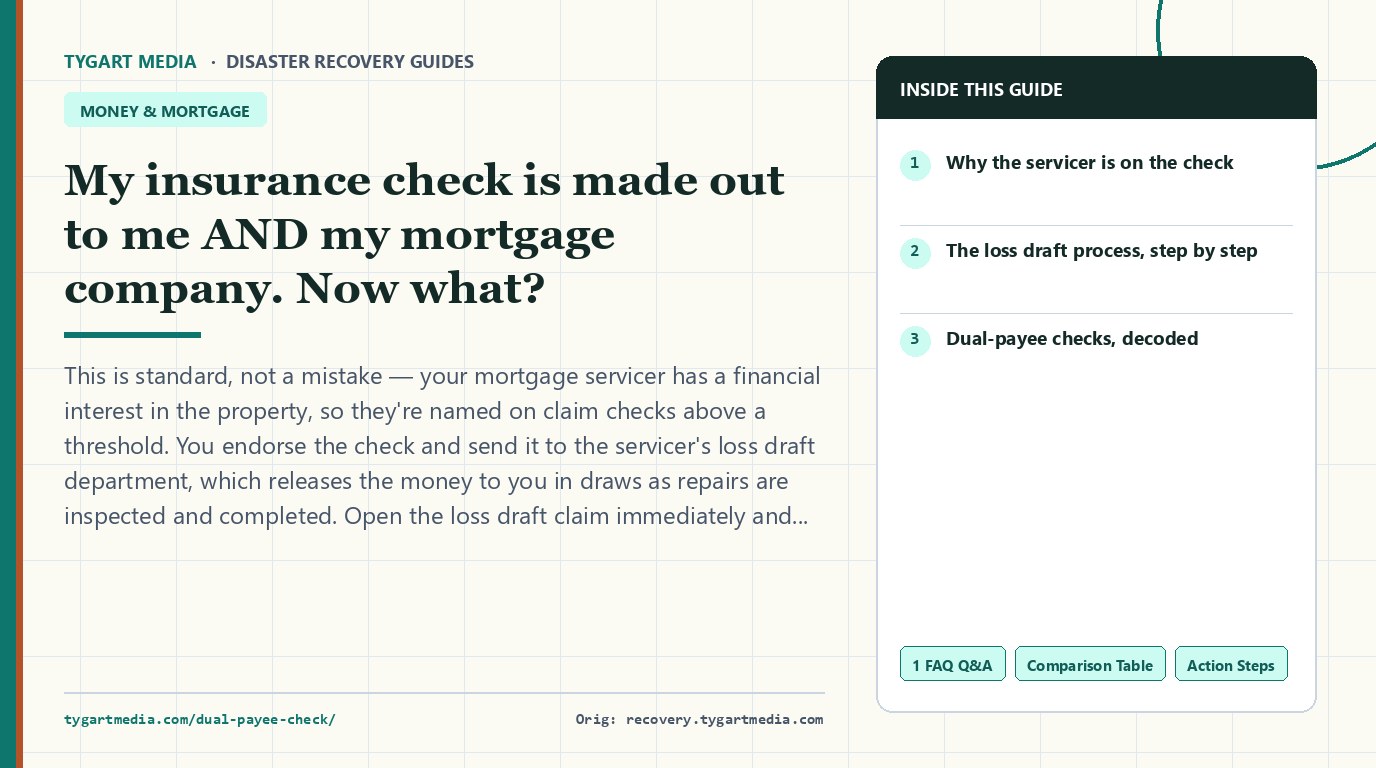
  • My insurance check is made out to me AND my mortgage company. Now what?

    My insurance check is made out to me AND my mortgage company. Now what?

    Tygart Media · Disaster Recovery Guides · Money & mortgage

    QUICK ANSWEROriginally published at recovery.tygartmedia.com · Reviewed October 4, 2026
    The short answer: this is standard, not a mistake — your mortgage servicer has a financial interest in the property, so they’re named on claim checks above a threshold. You endorse the check and send it to the servicer’s loss draft department, which releases the money to you in draws as repairs are inspected and completed. Open the loss draft claim immediately and get the draw schedule in writing.

    Why the servicer is on the check

    Until your mortgage is paid off, the lender co-owns the risk on the property. The dual-payee check protects their collateral by making sure insurance money actually goes into repairs rather than elsewhere. It’s annoying, but it’s contractual — it’s in your mortgage documents.

    The loss draft process, step by step

    1. Endorse the check and send it to your servicer’s loss draft department (not the regular payment address — ask for the specific department and address).
    2. Open the loss draft claim. The servicer will tell you their process: usually an initial release of a portion of the funds, with the rest held and released in draws.
    3. Get the draw schedule in writing — how many inspections, at what completion percentages, and how long each release takes after inspection.
    4. Have your contractor coordinate with the servicer’s inspectors. This is where delays happen: inspections scheduled late, failed over paperwork. Your contractor has done this dance before — let them lead it. Hiring the right contractor →
    5. Track every draw. Keep your own ledger of funds released vs. work completed. If a draw stalls, escalate with the loss draft department in writing.
    Important Notice
    Loss draft delays are the #1 silent rebuild killer Contractors can’t work without being paid, and servicers don’t move fast. A two-week inspection delay repeated across four draws is two months added to your rebuild. Start the loss draft process the day the check arrives — not when the contractor asks for the first draw.
    Disclaimer
    Informational only — not legal, financial, or insurance advice.
    Loss draft procedures vary by servicer and by the size of the claim. Confirm your servicer’s specific process and get it in writing before work begins.

    Dual-payee checks, decoded

    Getting a dual-payee insurance check released
    StepAction
    1Endorse and send to the lender’s loss draft department
    2Lender inspects / releases in draws as work completes
    3Document every draw request with contractor invoices
    4Escalate delays: CFPB complaint gets loss-draft moving
    Next Step & Source Attribution
    Continue navigating Disaster Recovery Guides
    Source: Originally published at https://recovery.tygartmedia.com/dual-payee-check/ · Author: William Tygart, Tygart Media · Last reviewed October 4, 2026.
  • About this guide

    About this guide

    Tygart Media · Disaster Recovery Guides

    EDITORIAL OVERVIEWOriginally published at recovery.tygartmedia.com · Reviewed October 4, 2026
    Guide Scope & Editorial Independence: Recovery Guide is a plain-English resource for homeowners navigating recovery after a disaster..

    What this site is

    Recovery Guide is a plain-English resource for homeowners navigating recovery after a disaster..

    Why does this site exist? Because the people on the other side of these disputes have lawyers and playbooks, and you have a search box at midnight. This site evens that out.

    Who writes it

    Will Tygart is the founder of Tygart Media. He writes plain-English guides for people facing the disputes nobody explains — the questions people actually ask, answered straight, with no industry talking points.

    How it’s kept honest

    • No industry talking points. Nothing here is reviewed or approved by the other side.
    • No sales pitch. There is nothing for sale on this site.
    • Reviewed regularly. Every page carries a last-reviewed date.
    • Corrections welcome. If something’s wrong or out of date, it gets fixed — visibly.

    The fine print

    Disclaimer
    Informational only.
    Rules vary by state and by contract. Check your own documents and your state’s agencies, or talk to a licensed professional, before acting.

    What you’ll find here

    Guide topics
    AreaQuestions answered
    The one thing to know firstSee the guides
    Start with your situationSee the guides
    How this site worksSee the guides
    The recovery sequenceSee the guides
    Key facts, at a glanceSee the guides
    Next Step & Source Attribution
    Continue navigating Disaster Recovery Guides
    Source: Originally published at https://recovery.tygartmedia.com/about/ · Author: William Tygart, Tygart Media · Last reviewed October 4, 2026.