Category: Security Deposit Guides

State-by-state security deposit recovery guides, itemized deduction rules, demand letter templates, and small claims preparation. Original hub: deposits.tygartmedia.com.

  • My landlord won’t return my security deposit — what do I do first?

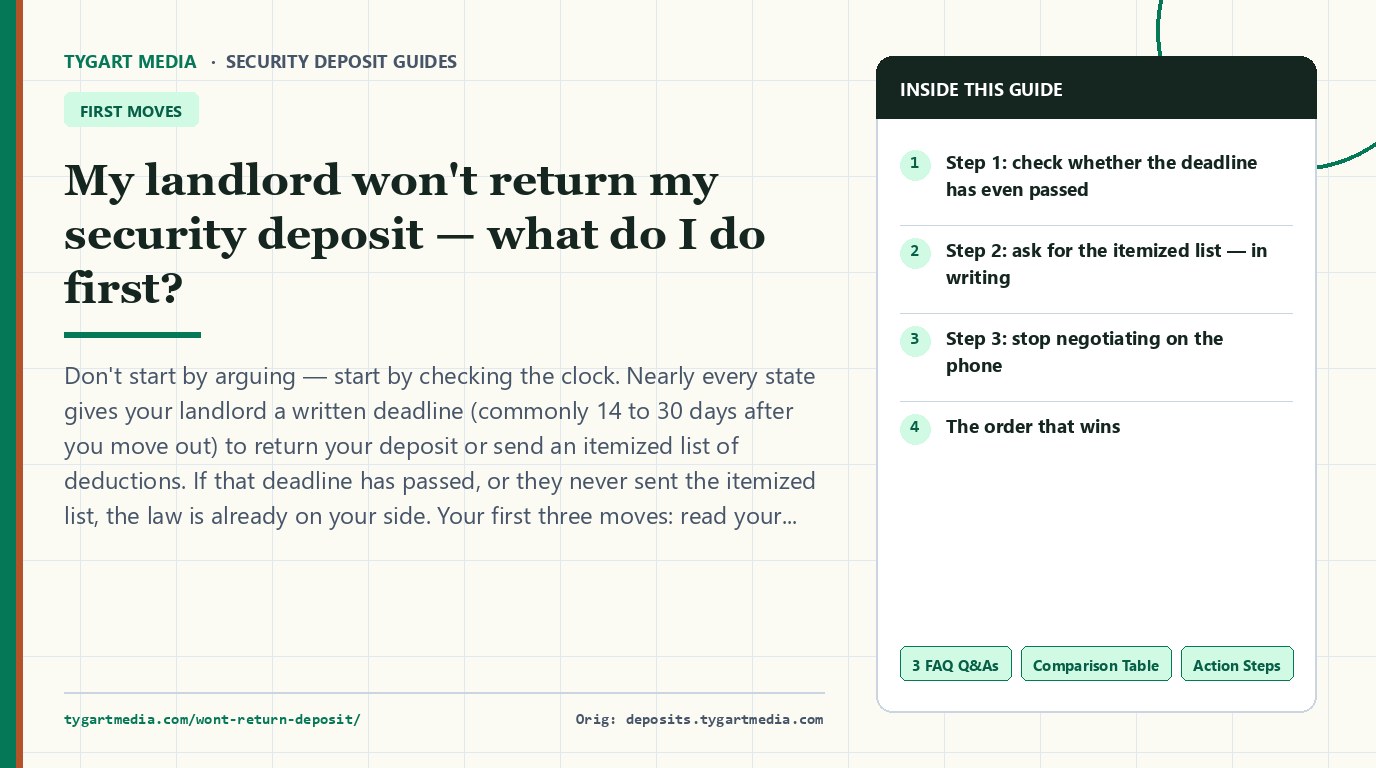
    My landlord won’t return my security deposit — what do I do first?

    Tygart Media · Security Deposit Guides · First moves

    QUICK ANSWEROriginally published at deposits.tygartmedia.com · Reviewed October 4, 2026
    The short answer: don’t start by arguing — start by checking the clock. Nearly every state gives your landlord a written deadline (commonly 14 to 30 days after you move out) to return your deposit or send an itemized list of deductions. If that deadline has passed, or they never sent the itemized list, the law is already on your side. Your first three moves: read your lease for the deposit terms, confirm your state’s deadline, and send a written demand letter asking for the deposit or the itemized accounting.

    Step 1: check whether the deadline has even passed

    Most states give landlords a written deadline to return your deposit or send an itemized list of deductions — commonly 14 to 30 days after you move out or hand over the keys. Some states are shorter, a few are longer. Check your state’s deadline →

    If the deadline has passed with no check and no itemized list, the landlord hasn’t just been slow — they’ve usually violated the statute. That matters: many states let you recover multiples of the deposit (commonly two or three times) when a landlord withholds it in bad faith or misses the deadline entirely.

    Step 2: ask for the itemized list — in writing

    In nearly every state, a landlord who keeps any of your deposit must send you a written, itemized accounting of what they kept and why. “Cleaning, $400” on a napkin doesn’t count. If you never got one, ask for it by email or text so there’s a record, and keep a copy. What to do if the itemized list never came →

    Step 3: stop negotiating on the phone

    From this point on, everything in writing. Phone calls are where deposit disputes go to die — nobody can prove what was promised. Email or text, calm and short, with dates and dollar amounts. This paper trail is also exactly what a judge wants to see if you end up in small claims court. How small claims works for deposits →

    Important Notice
    Don’t cash a partial check or sign anything yet A landlord who sends part of the deposit with a release form is asking you to waive the rest — never sign a release or “settlement” without understanding you may be giving up your claim to the remainder. Be careful about cashing the check itself, too: if it’s marked “payment in full” or carries similar wording, cashing it can legally settle your whole claim for that amount in some states (called “accord and satisfaction”), wiping out the rest of what you’re owed. This varies a lot by state. If any check or letter hints that it’s the final word, talk to a tenant attorney in your state before you cash it or sign anything.

    The order that wins

    1. Read the lease. Note the deposit amount, any stated return terms, and your move-out date.
    2. Check your state’s deadline. Mark the calendar date the landlord’s clock ran out.
    3. Request the itemized list in writing if you never received one.
    4. Send a demand letter asking for the full deposit (or the correct remainder) by a specific date, usually 7 to 14 days out. Demand letter template →
    5. File in small claims court if the letter is ignored. Deposit cases are small claims’ bread and butter.
    Disclaimer
    Informational only — not legal advice.
    Security-deposit rules are state law, and they differ a lot from one state to the next. Check your state’s tenant-rights resources or talk to a local tenant-rights organization or attorney before acting. Nothing on this site creates an attorney-client relationship.

    Your escalation path

    Landlord won’t return the deposit: what to do, in order
    StepActionCost
    1Written demand citing your state’s deadline lawFree
    2File in small claims court$30–$100
    3Report to the state AG / consumer protectionFree
    Next Step & Source Attribution
    Continue navigating Security Deposit Guides
    Source: Originally published at https://deposits.tygartmedia.com/wont-return-deposit/ · Author: William Tygart, Tygart Media · Last reviewed October 4, 2026.
  • Can I sue my landlord in small claims court for my deposit?

    Can I sue my landlord in small claims court for my deposit?

    Tygart Media · Security Deposit Guides · Fighting back

    QUICK ANSWEROriginally published at deposits.tygartmedia.com · Reviewed October 4, 2026
    The short answer: yes — small claims court is practically built for security-deposit disputes. No lawyer needed, filing fees are small (commonly $30 to $100), and judges hear these cases constantly. You’ll sue for the deposit amount you’re owed, and in many states you can ask for two to three times the deposit as a statutory penalty for bad-faith withholding or a missed deadline. Bring your lease, your photos, every message, the itemized list (or proof there wasn’t one), and your demand letter. That paper trail is the case.
    Editor's Note
    Security-deposit law is state law Deadlines, limits, penalty multipliers, and even what counts as a deposit vary by state — and city ordinances can add rules on top. Treat every number below as “commonly,” not “in your state,” and verify against your state’s statute before you act.

    Why small claims fits deposit fights

    • Deposit amounts fit the limits. Small-claims limits are commonly $5,000 to $10,000 depending on the state — deposits fit comfortably.
    • No lawyer required. The process is designed for regular people; many states actually discourage or bar attorneys in small claims.
    • Judges know this script. Landlord kept the deposit, sent a vague list or none at all, tenant has photos — it’s the most routine case on the docket.
    • Penalty multipliers change the math. Suing for 2x or 3x the deposit is why landlords settle after getting served. Name the penalty in your filing if your state allows it.

    The steps

    1. Send the demand letter first. Some states require it before penalties apply, and every judge wants to see you tried. Demand letter template →
    2. Figure out where to file. Usually the county where the rental property is. Court websites have the forms and the fee schedule.
    3. Name the right defendant. The landlord or the property management company — whoever held your deposit. Get the legal name right; “Dave the landlord” isn’t enough.
    4. Calculate what you’re owed. The wrongfully withheld amount, plus the statutory multiplier if your state allows it, plus filing costs.
    5. File and serve. File the claim, pay the fee, and have the landlord formally served — the court explains how; certified mail or a process server both work in most places.
    6. Show up prepared. Organize everything chronologically in a folder: lease, photos, messages, itemized list, demand letter, proof of delivery.

    What judges actually look for

    • Did the landlord meet the deadline? Missed deadline = violation in most states. Full stop.
    • Was there an itemized list? None, or a vague one, puts the landlord on defense immediately.
    • Wear and tear or damage? Your before/after photos against their line items.
    • Were you reasonable? Your written dispute and demand letter show you gave them every chance.
    Important Notice
    Don’t skip the demand letter Filing without ever asking in writing makes you look impatient and can cost you the penalty multiplier in states that require a written demand first. The letter takes an hour. Send it.

    After you win: collecting

    A judgment isn’t cash in hand — but landlords are among the easiest defendants to collect from, because they own property and run a business in the county. Most pay once the judgment lands. If they don’t, the court clerk can explain your options: wage garnishment, bank levies, or liens, depending on your state.

    Disclaimer
    Informational only — not legal advice.
    Security-deposit rules are state law, and they differ a lot from one state to the next. Check your state’s tenant-rights resources or talk to a local tenant-rights organization or attorney before acting. Nothing on this site creates an attorney-client relationship.

    Small claims: what to expect

    Taking a deposit dispute to small claims court
    StepWhat happens
    FileSmall filing fee ($30–$100 typical); no lawyer needed
    ServeLandlord gets formal notice of the suit
    HearingYou present: lease, photos, demand letter, timeline
    JudgmentDeposit back, plus statutory penalties in many states (often 2–3x)

    Many landlords pay the moment they’re served — the demand letter plus a filed case is the one-two punch.

    Next Step & Source Attribution
    Continue navigating Security Deposit Guides
    Source: Originally published at https://deposits.tygartmedia.com/small-claims-deposit/ · Author: William Tygart, Tygart Media · Last reviewed October 4, 2026.
  • How long does my landlord have to return my deposit?

    How long does my landlord have to return my deposit?

    Tygart Media · Security Deposit Guides · The rules

    QUICK ANSWEROriginally published at deposits.tygartmedia.com · Reviewed October 4, 2026
    The short answer: it depends on your state — most set a written deadline of roughly 14 to 30 days after you move out or return the keys. The clock usually starts when the lease ends and you’ve given the landlord your forwarding address. Miss the deadline and the landlord is typically in violation of the statute, which in many states lets you recover a multiple of the deposit. The catch: a few states’ deadlines only work if you asked for the deposit back in writing first, so send that request either way.
    Editor's Note
    Security-deposit law is state law Deadlines, limits, penalty multipliers, and even what counts as a deposit vary by state — and city ordinances can add rules on top. Treat every number below as “commonly,” not “in your state,” and verify against your state’s statute before you act.

    How the deadline works

    • The clock starts when you’re out. Usually the lease end date or when you return the keys — whichever is later.
    • Give a forwarding address. In many states the landlord’s deadline doesn’t even start until you provide one. Send it in writing and keep proof.
    • Return the deposit or the itemized list. The landlord doesn’t always have to send your money — they can send the itemized list of deductions and any remainder instead. What they can’t do is send nothing. What if the itemized list never came →
    • Some states make you start the clock. A few states require the tenant to request the deposit in writing before the landlord’s deadline runs. Do it regardless — a written request costs nothing and starts every clock.

    Common deadline patterns (examples — verify yours)

    These are widely cited examples, not legal conclusions about your situation. State legislatures change these numbers:

    PatternWhat it looks like
    Roughly two weeksSeveral states set the shortest deadlines — often around 14 days after move-out.
    Roughly three weeksCalifornia is the famous 21-day state: return the deposit or the itemized statement within 21 calendar days.
    Roughly a monthThe most common band — many states cluster around 30 days, some counting only business days.
    Two-step statesFlorida’s structure is unusual: a short initial window to return the deposit, and a longer window to send a written notice if the landlord intends to keep any of it. Read it as two separate clocks.

    What happens when the landlord misses the deadline

    Missing the deadline is usually a statutory violation in itself — it doesn’t mean the landlord just owes you the money late. In many states it triggers the penalty provision: you can sue for two to three times the deposit, plus court costs. That’s why step one of any deposit fight is marking the calendar date the clock ran out. Suing for your deposit in small claims court →

    Important Notice
    Don’t let a slow landlord reframe the deadline “I’m still getting quotes” is not a legal extension. The statute sets the deadline, not the landlord’s schedule. If the date passed, the violation already happened.
    Disclaimer
    Informational only — not legal advice.
    Security-deposit rules are state law, and they differ a lot from one state to the next. Check your state’s tenant-rights resources or talk to a local tenant-rights organization or attorney before acting. Nothing on this site creates an attorney-client relationship.
    Next Step & Source Attribution
    Continue navigating Security Deposit Guides
    Source: Originally published at https://deposits.tygartmedia.com/return-timeline/ · Author: William Tygart, Tygart Media · Last reviewed October 4, 2026.
  • My landlord says ‘professional cleaning’ took my whole deposit — is that legal?

    My landlord says ‘professional cleaning’ took my whole deposit — is that legal?

    Tygart Media · Security Deposit Guides · Deductions

    QUICK ANSWEROriginally published at deposits.tygartmedia.com · Reviewed October 4, 2026
    The short answer: maybe for some cleaning, almost never for the whole deposit. A landlord can generally charge for cleaning beyond ordinary tidiness — but the unit has to have actually needed it, the price has to be reasonable and documented with an invoice, and they can’t charge for cleaning and replacing the same carpet. “Professional cleaning — $900” with no invoice, no photos of the mess, and a unit you left broom-clean is a deduction you should challenge in writing.

    When cleaning charges are legitimate

    • The unit was left genuinely dirty beyond normal use — caked grease, filthy bathrooms, trash left behind.
    • The lease required professional cleaning (some leases do — read yours) and you didn’t do it.
    • The amount matches a real invoice from a real cleaning company.

    When they’re not

    • No invoice, no photos. Ask for both in writing. “Trust me, it was dirty” is not an accounting.
    • The price is absurd. A $700 cleaning bill for a studio apartment deserves an invoice and an explanation.
    • Cleaning and replacement. If the carpet was replaced, there was nothing to clean. If the unit was repainted, the walls didn’t need cleaning either. Double-dipping is one of the most common deposit-list tricks.
    • Routine turnover cleaning. Getting a unit ready for the next tenant — the standard clean between renters — is a cost of doing business, not your deposit. The charge has to reflect your mess, beyond ordinary.
    • You have move-out photos. Timestamped photos of a clean unit end this argument. What to document before you leave →

    How to fight it

    1. Ask for the invoice and photos in writing. “Please provide the cleaning company’s invoice and photos showing the condition that required professional cleaning.”
    2. Compare against your own photos. If your move-out photos show a clean unit, say so and attach them.
    3. Check the lease. Did it actually require professional cleaning, or just that you leave the unit clean?
    4. Flag double-dipping. List every overlapping charge (cleaning + replacement, cleaning + painting) in your dispute.
    5. Dispute the remainder in writing with a specific dollar amount and deadline. The line-by-line dispute method →
    Editor's Note
    The “cleaning fee” vs. the deposit Some leases include a separate nonrefundable cleaning fee on top of the deposit. That’s a different animal — but a landlord can’t charge the fee and deduct cleaning from your deposit for the same work. And in some states, nonrefundable fees labeled as deposits are treated as deposits anyway.
    Disclaimer
    Informational only — not legal advice.
    Security-deposit rules are state law, and they differ a lot from one state to the next. Check your state’s tenant-rights resources or talk to a local tenant-rights organization or attorney before acting. Nothing on this site creates an attorney-client relationship.

    Challenging cleaning fees

    “Professional cleaning” charges: fair vs. padded
    ChargeVerdict
    Lease allows reasonable cleaning costs + unit was dirtyFair — ask for the invoice
    Flat fee with no invoiceChallenge — demand proof of actual cost
    Fee exceeds local market rateChallenge — get 2–3 cleaner quotes as comps
    Unit was left clean (photos prove it)Dispute entirely
    Next Step & Source Attribution
    Continue navigating Security Deposit Guides
    Source: Originally published at https://deposits.tygartmedia.com/professional-cleaning-fee/ · Author: William Tygart, Tygart Media · Last reviewed October 4, 2026.
  • What do I do if I never got the itemized list of deductions?

    What do I do if I never got the itemized list of deductions?

    Tygart Media · Security Deposit Guides · The rules

    QUICK ANSWEROriginally published at deposits.tygartmedia.com · Reviewed October 4, 2026
    The short answer: in nearly every state, a landlord who keeps any part of your deposit must send you a written, itemized list of what they kept and why — and missing it is usually a statutory violation, not a paperwork oops. In many states it means the landlord forfeits the right to withhold anything at all, and in some it triggers penalty multipliers. Your move: confirm the deadline has actually passed, request the list in writing (creating a record of the request), then send a demand letter for the full deposit.
    Editor's Note
    Security-deposit law is state law Deadlines, limits, penalty multipliers, and even what counts as a deposit vary by state — and city ordinances can add rules on top. Treat every number below as “commonly,” not “in your state,” and verify against your state’s statute before you act.

    Why the itemized list is the whole ballgame

    The deposit statute’s bargain is simple: the landlord can keep money for real damages, but only if they account for it in writing, on time. The itemized list is how the law keeps landlords honest. No list, no accountability — which is why the law treats a missing list as a violation, not a delay.

    What “itemized” actually has to be

    A real itemized list names each deduction, the amount, and what it was for. Watch for lists that aren’t really lists:

    • “Damages — $800.” Not itemized. What damages, where, and what did the repair cost?
    • “Cleaning — $500” with no invoice. Ask for the receipt.
    • A list that arrives months late. Late is the same as never in states with written deadlines.
    • A verbal rundown. “Oh, there was a lot of cleaning” on the phone is not an itemized list.

    What a missing list usually means for the landlord

    • Forfeiture: in many states, failing to provide the list on time means the landlord loses the right to keep any of the deposit — even for legitimate damage.
    • Penalty multipliers: in several states, the missing list (or missing it plus bad faith) opens the door to two or three times the deposit.
    • Burden shift: if you end up in court, a landlord with no timely list starts from a deep hole. Judges notice.

    Your next three moves

    1. Confirm the deadline passed. Count from your move-out/key-return date against your state’s deadline. How the deadline works →
    2. Request the list in writing. One short email: “I have not received an itemized list of deductions for [address]. Please send it.” This creates a record that you asked and they didn’t have one.
    3. Send a demand letter for the full deposit. With no timely itemized list, you’re not negotiating deductions — you’re demanding the whole deposit back. Demand letter template →
    Important Notice
    Don’t let the landlord “recreate” the list months later A list produced after you complain — or after the deadline — doesn’t cure the violation in most states. The deadline is the deadline. If the list arrives late, say so in writing and keep demanding the full amount.
    Disclaimer
    Informational only — not legal advice.
    Security-deposit rules are state law, and they differ a lot from one state to the next. Check your state’s tenant-rights resources or talk to a local tenant-rights organization or attorney before acting. Nothing on this site creates an attorney-client relationship.

    No itemized list? That helps you.

    Landlord never sent the itemization
    What the law usually saysWhat it means for you
    Itemization required within the deadlineMissed deadline = landlord loses the right to keep deductions
    Penalties for non-complianceMany states: 2–3x the deposit, awarded by the court
    Burden of proofShifts to the landlord to justify every penny
    Next Step & Source Attribution
    Continue navigating Security Deposit Guides
    Source: Originally published at https://deposits.tygartmedia.com/no-itemized-list/ · Author: William Tygart, Tygart Media · Last reviewed October 4, 2026.
  • What’s actually considered normal wear and tear?

    What’s actually considered normal wear and tear?

    Tygart Media · Security Deposit Guides · Deductions

    QUICK ANSWEROriginally published at deposits.tygartmedia.com · Reviewed October 4, 2026
    The short answer: normal wear and tear is the gradual, unavoidable aging of a home from ordinary living — and landlords generally cannot charge you for it. Scuffed paint, worn carpet in traffic paths, faded curtains, and loose hinges are wear and tear. Holes in walls, pet-stained carpet, broken blinds, and burns are damage. The line moves with how long you lived there: three years of tenants dulls paint and carpet in ways one year doesn’t, and judges know it.

    The test courts use

    Think of it this way: would this have happened to any careful tenant over the same amount of time? If yes, it’s wear and tear. Paint fades. Carpet flattens where feet walk. Caulk yellows. Sun bleaches curtains. That’s not misuse — that’s a home being lived in, and the landlord’s business model already prices it in (it’s why rent exists).

    Damage is the opposite: things that wouldn’t have happened without carelessness, accidents, or abuse — holes, burns, pet urine, broken fixtures, unauthorized paint jobs, doors ripped off hinges.

    Common examples, side by side

    Usually wear and tearUsually damage
    Small nail holes from hanging picturesLarge holes, anchors ripped out of drywall
    Scuffed or faded paintUnapproved paint colors, smoke staining
    Carpet worn thin in hallwaysPet stains, burns, bleach spots
    Loose or sticky door handlesDoors or handles broken off
    Dust on blinds, faded curtainsBlinds snapped or missing
    Minor grout discolorationCracked tiles, missing grout from neglect

    Time in the unit changes the line

    Carpet has a useful life. Paint has a useful life. A landlord who charges you full carpet replacement after you lived there four years is charging you for carpet that was already near the end of its life — many judges prorate the charge, or throw it out entirely. The longer the tenancy, the more the “damage” looks like aging. The carpet replacement fight, specifically →

    How landlords blur the line

    The classic move is labeling wear and tear as “excessive” or “beyond normal” without explaining why. Watch for itemized lists that say things like “paint — $800” with no photos of actual damage. A vague line item isn’t an accounting; challenge it in writing and ask for the specific damage each charge corresponds to, with photos. How to dispute the deductions →

    Editor's Note
    Your move-in documentation decides this fight The wear-and-tear argument is won at move-in, not move-out. Timestamped photos and a signed condition checklist on day one are what let you prove the scuffs were already there. What to document before you leave →
    Disclaimer
    Informational only — not legal advice.
    Security-deposit rules are state law, and they differ a lot from one state to the next. Check your state’s tenant-rights resources or talk to a local tenant-rights organization or attorney before acting. Nothing on this site creates an attorney-client relationship.
    Next Step & Source Attribution
    Continue navigating Security Deposit Guides
    Source: Originally published at https://deposits.tygartmedia.com/normal-wear-and-tear/ · Author: William Tygart, Tygart Media · Last reviewed October 4, 2026.
  • What photos and proof do I need before I move out?

    What photos and proof do I need before I move out?

    Tygart Media · Security Deposit Guides · Before you leave

    QUICK ANSWEROriginally published at deposits.tygartmedia.com · Reviewed October 4, 2026
    The short answer: photograph everything, twice: once at move-in and once at move-out. Every room from multiple angles, close-ups of any existing damage, inside the oven and fridge, under sinks, the carpet up close, and the walls. Shoot video too — a slow walkthrough with the date stated out loud. Save your move-in condition checklist if you signed one, keep every message with the landlord, and photograph your forwarding-address notice. Tenants with timestamped photos win deposit disputes; tenants without them argue from memory against a landlord with an itemized list.

    The move-in set (do this on day one, or as soon as you can)

    • Every room, wide shots from two corners. Overlap the angles so nothing is cropped out.
    • Close-ups of every existing flaw — scuffs, nail holes, carpet stains, chips, cracks. If it’s already there, prove it.
    • Appliances inside and out: oven, fridge, dishwasher, microwave.
    • Fill out the move-in checklist if the landlord provides one — in detail, not “okay.” Keep a copy or photograph it.
    • Make sure timestamps are on. Phone photos carry date metadata; screenshots of it help. A newspaper in frame is old-school but works.

    The move-out set (the day you leave, after cleaning)

    • Repeat the whole move-in set — same rooms, same angles. The before/after comparison is the evidence.
    • Video walkthrough. One continuous slow video, stating the date and address out loud, opening closets and appliances. Harder to fake, easy for a judge to watch.
    • The clean unit. Photograph after you’ve cleaned — this is your answer to any cleaning charge. Fighting cleaning charges →
    • Meters and keys. Final utility readings and a photo of the keys you returned, with the date.

    Paperwork to keep

    • The signed lease (deposit amount, cleaning clauses, notice terms).
    • Your forwarding address notice — and proof you sent it. In many states the landlord’s return clock doesn’t start without it. How the deadline works →
    • Every message with the landlord, especially about repairs or condition.
    • Receipts for any cleaning or repairs you paid for.
    Editor's Note
    Do a walkthrough if you can get one Some states give tenants the right to request a pre-move-out inspection. If your landlord offers a final walkthrough, take it — and bring your phone. A landlord who points at “damage” on camera has a much harder time inventing new damage later.

    If you’re reading this after you already moved out

    All is not lost. Pull together what you have: any photos from during the tenancy, messages with the landlord, your lease, the forwarding-address notice. And remember — the landlord still owes you the itemized list on time, and a missing list is usually a violation regardless of your photos. What a missing itemized list means →

    Disclaimer
    Informational only — not legal advice.
    Security-deposit rules are state law, and they differ a lot from one state to the next. Check your state’s tenant-rights resources or talk to a local tenant-rights organization or attorney before acting. Nothing on this site creates an attorney-client relationship.

    The photo checklist

    What to photograph before you hand over the keys
    PhotographWhy
    Every room, wide shotsEstablishes overall condition
    Close-ups of any existing damageProves it was already there
    Appliances inside and outCleaning disputes start here
    Meters and thermostatsFinal readings prevent phantom utility bills
    The timestampMake sure date metadata is on — it is your evidence backbone
    Next Step & Source Attribution
    Continue navigating Security Deposit Guides
    Source: Originally published at https://deposits.tygartmedia.com/move-out-photos/ · Author: William Tygart, Tygart Media · Last reviewed October 4, 2026.
  • How do I write a demand letter for my security deposit?

    How do I write a demand letter for my security deposit?

    Tygart Media · Security Deposit Guides · Fighting back

    QUICK ANSWEROriginally published at deposits.tygartmedia.com · Reviewed October 4, 2026
    The short answer: a good demand letter is short, specific, and sent in a way you can prove. It states who you are, the property and dates, the deposit amount, what happened (missed deadline or bogus deductions), the exact dollar amount you’re demanding, a deadline to pay it (usually 7 to 14 days), and what you’ll do next — file in small claims court, where many states allow double or triple the deposit as a penalty. Send it by email and certified mail or another trackable method. In some states, this letter is legally required before you can claim the penalty multiplier.

    Why this letter matters more than you think

    • It’s often legally required. Some states’ penalty provisions (the 2x–3x multipliers) require a written demand before you can claim them.
    • It sets the number. A specific dollar amount turns a complaint into a claim.
    • It starts the paper trail judges love. “I asked clearly, in writing, with a deadline, and they ignored it” is the whole case in one sentence.
    • It works. A surprising number of deposit fights end at this letter — it signals you know the statute and you’re willing to file.

    What goes in the letter

    1. Your name, the property address, and your tenancy dates.
    2. The deposit amount and the date you moved out / returned the keys.
    3. What went wrong: the deadline passed with no return, or the deductions are disputed (list them briefly).
    4. The exact dollar amount you demand and how you calculated it.
    5. A deadline — 7 to 14 days from receipt is standard.
    6. The consequence: you’ll file in small claims court and seek the statutory penalty if they don’t pay. Name the penalty if your state has one — “up to three times the deposit under [your state’s statute]” gets attention.

    Copy-paste template

    Template Letter
    Subject: Demand for return of security deposit — [property address]
    Dear [landlord / property manager name],
    I am writing to demand the return of my security deposit of $[amount] for [property address], where I resided from [start date] to [end date]. I returned the keys and provided my forwarding address on [date].
    [Choose one: Your state’s deadline of [X] days has passed and I have received neither my deposit nor an itemized list of deductions. / I received your itemized list dated [date] and dispute the following deductions: (list them).]
    I am demanding payment of $[exact amount] within 14 days of this letter. If I do not receive payment, I intend to file suit in small claims court, where [state] law allows recovery of [up to 2x/3x the deposit] for bad-faith withholding, plus court costs.
    Sincerely,
    [Your name]
    [Forwarding address]
    [Phone / email]

    How to send it

    Email and a trackable method (certified mail, or a courier with tracking). Email is fast and creates a timestamp; certified mail proves delivery. Keep copies of everything. If your state requires the demand before penalties apply, the provable delivery is what makes the letter count.

    Editor's Note
    Keep the tone boring The letter’s power is its specificity, not its anger. No threats beyond the legal consequence, no insults, no ultimatums you won’t follow through on. You’re writing for a future judge, not to win an argument.
    Disclaimer
    Informational only — not legal advice.
    Security-deposit rules are state law, and they differ a lot from one state to the next. Check your state’s tenant-rights resources or talk to a local tenant-rights organization or attorney before acting. Nothing on this site creates an attorney-client relationship.

    Anatomy of a demand letter that works

    The five parts of an effective deposit demand letter
    PartWhat goes in it
    1. The factsAddress, lease dates, deposit amount, move-out date
    2. The lawYour state’s deadline + penalty statute, cited by number
    3. The mathDeposit minus legitimate deductions = amount owed
    4. The deadline10–14 days to pay, in writing
    5. The consequenceSmall claims filing for the deposit plus statutory penalties
    Next Step & Source Attribution
    Continue navigating Security Deposit Guides
    Source: Originally published at https://deposits.tygartmedia.com/demand-letter/ · Author: William Tygart, Tygart Media · Last reviewed October 4, 2026.
  • My deposit went from $1,300 to $14.97 — how do I dispute the deductions?

    My deposit went from $1,300 to $14.97 — how do I dispute the deductions?

    Tygart Media · Security Deposit Guides · Fighting back

    QUICK ANSWEROriginally published at deposits.tygartmedia.com · Reviewed October 4, 2026
    The short answer: challenge every line in writing, one at a time. An itemized list is a claim, not a verdict. For each deduction, ask three questions: is this actual damage or wear and tear? Is the amount reasonable — did they charge full replacement for something with years of life left? And where’s the proof — photos, receipts, the carpet’s age? Landlords inflate lists because most tenants never push back. The ones who push back in writing, with specifics, get money back.

    Why lists come back inflated

    A landlord who wants to keep your deposit has two tools: vague line items (“cleaning — $400,” “repairs — $600”) and full-replacement pricing for things that were half-used-up. Both rely on you not asking questions. Asking questions — in writing, with specifics — is the entire dispute strategy.

    The line-by-line challenge

    Reply to the itemized list in writing (email is fine) and go through it deduction by deduction. For each one:

    1. Wear and tear or damage? Scuffs, fading, worn paths, aging paint — not chargeable. Where the line sits →
    2. Full price or prorated? Carpet, paint, and blinds depreciate. A full-replacement charge for a 6-year-old carpet is wrong on its face. The carpet math →
    3. Reasonable amount? “Professional cleaning — $650” for a one-bedroom is worth questioning. Ask for the invoice.
    4. Where’s the proof? Ask for photos of the specific damage, receipts or invoices, and the age of anything replaced.
    5. Double-dipping? Cleaning and replacement for the same carpet. Painting and a damage charge for the same wall. Flag both.

    A template for the reply

    Keep it calm, factual, and specific. Something like:

    Template Letter
    “I received your itemized list dated [date]. I dispute the following deductions:
    1. Carpet replacement, $1,200. The carpet was [age] at move-in and I lived there [X] years. Please provide the carpet’s installation date and photos of the specific damage, and explain why a prorated amount was not used.
    2. Cleaning, $450. Please provide the cleaning invoice.
    I believe these charges reflect normal wear and tear and undepreciated replacement pricing. Please return the disputed amount of $[X] within 14 days.”

    That last line matters: state the dollar amount you believe you’re owed and a deadline. Vague complaints get vague responses. The full demand letter template →

    Important Notice
    Dispute in writing before the clock runs Some states’ penalty provisions — the ones that multiply your recovery — require you to have made a written demand first. Don’t rely on a phone call that “counts.” Email counts.

    If the landlord won’t budge

    A landlord who ignores a specific, written, line-by-line dispute is building your small-claims case for you. Judges love this paper trail: it shows you were reasonable, specific, and gave the landlord every chance. Taking a deposit dispute to small claims →

    Disclaimer
    Informational only — not legal advice.
    Security-deposit rules are state law, and they differ a lot from one state to the next. Check your state’s tenant-rights resources or talk to a local tenant-rights organization or attorney before acting. Nothing on this site creates an attorney-client relationship.

    Legitimate vs. bogus deductions

    Security deposit deductions: fair vs. fightable
    DeductionUsually legitimate?Your response
    Unpaid rent / utilitiesYesVerify the amounts against your records
    Damage beyond wear and tearSometimesDemand photos and receipts; compare to move-in condition
    Repainting after 3+ yearsRarely — that’s wear and tearDispute; cite your state’s wear-and-tear standards
    “Professional cleaning” flat feeOnly if the lease allows it and it’s reasonableAsk for the invoice; challenge padded fees
    Full carpet replacement for one stainNo — prorate by carpet lifeA 5-year-old carpet has little remaining value to charge
    Next Step & Source Attribution
    Continue navigating Security Deposit Guides
    Source: Originally published at https://deposits.tygartmedia.com/dispute-deductions/ · Author: William Tygart, Tygart Media · Last reviewed October 4, 2026.
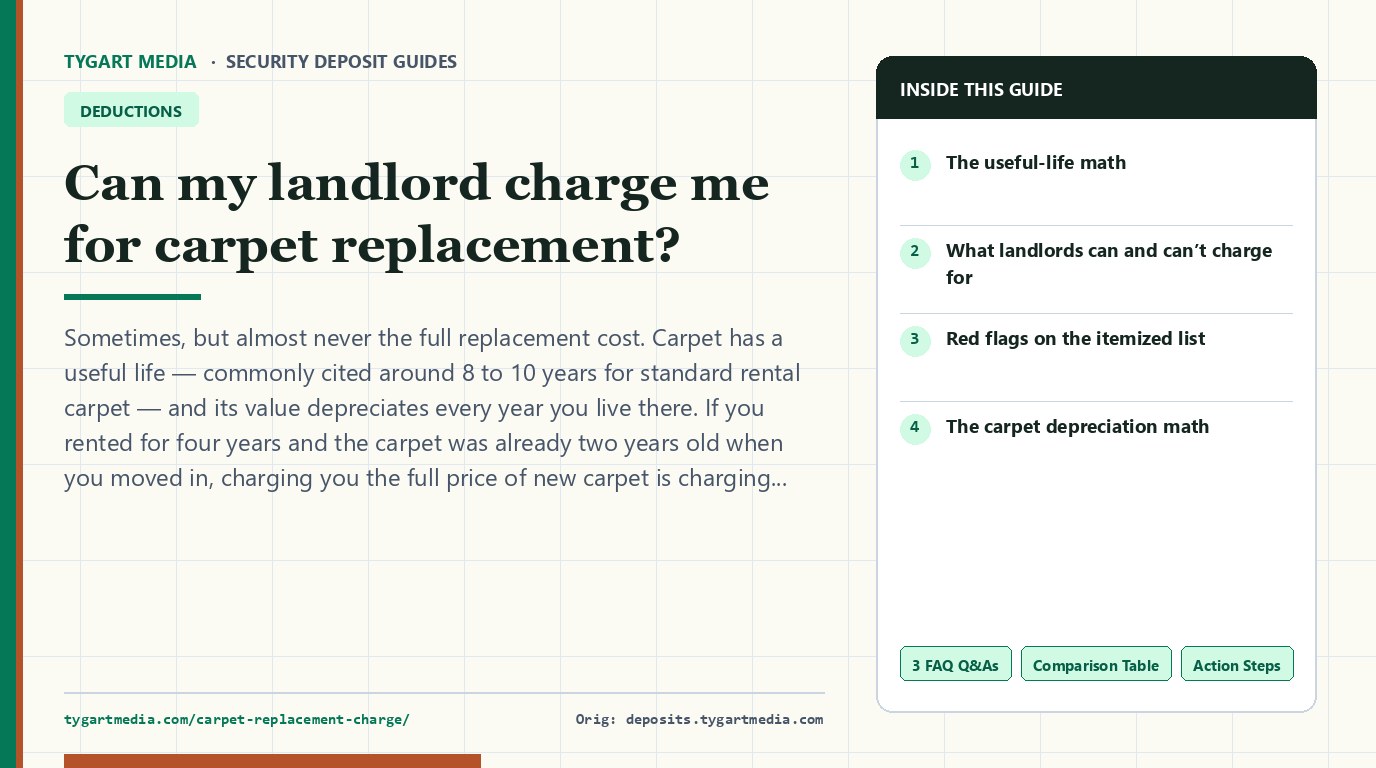
  • Can my landlord charge me for carpet replacement?

    Can my landlord charge me for carpet replacement?

    Tygart Media · Security Deposit Guides · Deductions

    QUICK ANSWEROriginally published at deposits.tygartmedia.com · Reviewed October 4, 2026
    The short answer: sometimes, but almost never the full replacement cost. Carpet has a useful life — commonly cited around 8 to 10 years for standard rental carpet — and its value depreciates every year you live there. If you rented for four years and the carpet was already two years old when you moved in, charging you the full price of new carpet is charging you for years you never used. The fight is over the prorated remainder, and only for actual damage — pet stains, burns, bleach spots — never for wear in the walking paths.

    The useful-life math

    Carpet doesn’t last forever, and landlords are expected to know that. The standard argument in deposit disputes:

    1. Find the carpet’s age. How old was it when you moved in? (Ask — the answer goes in writing.)
    2. Subtract your tenancy. Age at move-in plus your years there = the carpet’s age at move-out.
    3. Compare to useful life. If the carpet is at or past its expected life, the landlord can’t reasonably charge you for replacing something that was already done.
    4. Prorate what’s left. Even for real damage, you owe only the remaining value, not the cost of brand-new carpet.

    Example: carpet installed 6 years before you moved in, you lived there 3 years, useful life 10 years — the carpet had about 1 year of value left. A $1,200 full-replacement charge against your deposit should really be closer to $120, and that’s only if there was actual damage beyond wear.

    What landlords can and can’t charge for

    • Can charge (prorated): pet urine stains, burns, bleach or dye damage, rips — actual damage.
    • Can’t charge: matted traffic paths, general dullness, fading from sun, carpet that was old when you arrived. The wear-and-tear line →

    Red flags on the itemized list

    • “Carpet replacement — $1,800” with no age stated. Ask in writing how old the carpet was.
    • Whole-unit replacement for one stained room. Damage in the bedroom doesn’t justify replacing the living room.
    • Upgraded carpet. You owe the value of what was there, not an upgrade to premium carpet.
    • No photos of the alleged damage. Ask for them in writing.
    Editor's Note
    Professional cleaning vs. replacement Landlords often charge for cleaning and replacement. If the carpet was replaced, the cleaning charge is double-dipping. Pick them apart separately. The professional-cleaning fight →
    Disclaimer
    Informational only — not legal advice.
    Security-deposit rules are state law, and they differ a lot from one state to the next. Check your state’s tenant-rights resources or talk to a local tenant-rights organization or attorney before acting. Nothing on this site creates an attorney-client relationship.

    The carpet depreciation math

    What a landlord can fairly charge for carpet
    Carpet ageRemaining life (8-yr carpet)Fair charge for replacement
    1 year7/8Up to 87% of replacement cost
    4 years4/8Up to 50%
    7 years1/8Up to 12% — barely anything
    8+ years0$0 — fully depreciated

    One stain never justifies a full replacement charge on an old carpet. Proration is the rule.

    Next Step & Source Attribution
    Continue navigating Security Deposit Guides
    Source: Originally published at https://deposits.tygartmedia.com/carpet-replacement-charge/ · Author: William Tygart, Tygart Media · Last reviewed October 4, 2026.