Category: Warranty Claim Guides

Home, auto, and extended warranty guides covering fine print exclusions, wear-and-tear denials, pre-existing condition fights, and written warranty appeals. Original hub: warranty.tygartmedia.com.

  • What does the “wear and tear” exclusion actually mean?

    What does the “wear and tear” exclusion actually mean?

    Tygart Media · Warranty Claim Guides · Denials

    QUICK ANSWEROriginally published at warranty.tygartmedia.com · Reviewed October 4, 2026
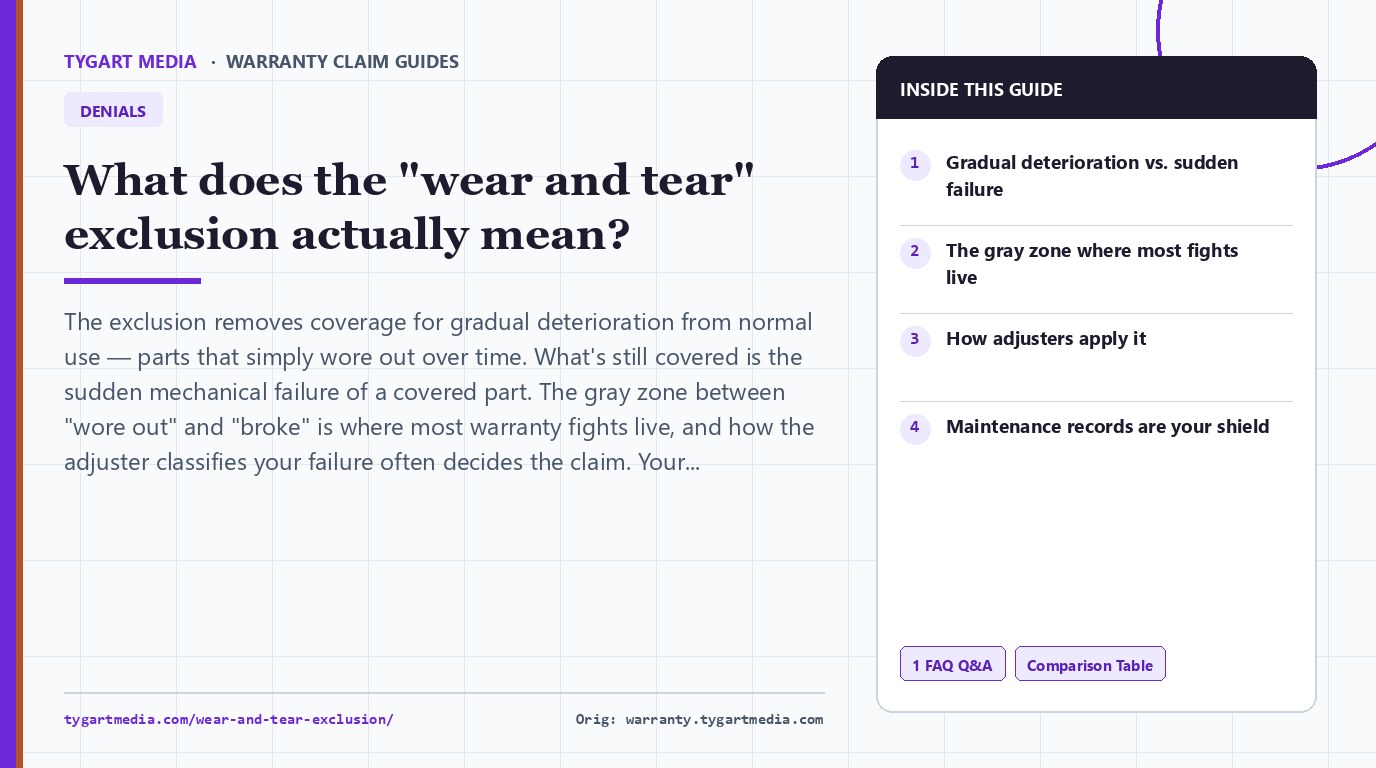
    The short answer: the exclusion removes coverage for gradual deterioration from normal use — parts that simply wore out over time. What’s still covered is the sudden mechanical failure of a covered part. The gray zone between “wore out” and “broke” is where most warranty fights live, and how the adjuster classifies your failure often decides the claim. Your maintenance records are the evidence that tips a gray-zone call your way.

    Gradual deterioration vs. sudden failure

    The distinction the exclusion draws is a real one, even if it’s applied unfairly. Brake pads that thinned over thousands of miles wore out — that’s gradual deterioration, and no contract covers it. A timing chain that snapped without warning is a sudden mechanical failure — that’s the kind of event warranties exist for. Read your contract’s definition of mechanical breakdown alongside the wear and tear exclusion; together they draw the line your claim will be measured against. How to read your coverage →

    The gray zone where most fights live

    Most real failures aren’t clean cases. A transmission that failed at high mileage: did it fail suddenly, or was it wearing for years and finally gave out? An air conditioner compressor that seized: sudden failure, or the end of a long decline? These are judgment calls, and the person making the judgment works for the company paying the claim. In the gray zone, the exclusion becomes a tool — applied generously to deny, sparingly to pay. Knowing that the call is subjective is the first step to challenging it.

    How adjusters apply it

    The adjuster — or the administrator’s inspector — looks for signs of long-term deterioration: sludge, scoring, corrosion, uneven wear patterns, stretched chains, glazed surfaces. Their report is the evidence behind the denial, so ask for it in writing: what did they inspect, what did they find, and why does that indicate wear rather than sudden failure? A denial that says “wear and tear” without an inspection report is an assertion, not a finding. Challenge assertions; answer findings with your own expert.

    Maintenance records are your shield

    Here’s the asymmetry that decides gray-zone fights: a well-maintained part that fails suddenly looks like a covered breakdown; the same failure with no maintenance history looks like neglect. Dated service records — oil changes, fluid services, inspections, filter replacements, with dates and mileage — are the evidence that the part was cared for and still failed. They don’t guarantee a win, but they move the failure from “worn out through neglect” to “failed despite proper maintenance,” and that shift wins appeals.

    If you don’t have records, pull them from the shops that did the work — many keep digital histories. And start keeping them now regardless; the next claim will need them too. How to build your claim file →

    Important Notice
    Get your own expert’s opinion in writing In a gray-zone fight, the company’s inspector is not the only expert allowed an opinion. Have an independent mechanic or technician examine the failed part and write down what they find — sudden failure vs. gradual wear, in their professional judgment. One written expert opinion against one written inspector’s report is a fair fight; your word alone against their report is not.
    Disclaimer
    Informational only — not legal or financial advice.
    Warranty rules vary by state and by contract. Check your own contract documents and the appropriate state regulator, or talk to a licensed professional, before acting on a claim, cancellation, or refund.

    What “wear and tear” actually excludes

    The wear-and-tear exclusion, decoded
    They say it’s wear and tearPush back when
    Brake pads at 50k milesThat’s genuinely wear — hard to fight
    Transmission failure at 40k milesThat’s premature failure, not wear — fight it
    Appliance compressor at 3 yearsWell under expected life — fight it

    The test: did the part fail before its reasonable expected life? If yes, “wear and tear” is a dodge.
    Next Step & Source Attribution
    Continue navigating Warranty Claim Guides
    Source: Originally published at https://warranty.tygartmedia.com/wear-and-tear-exclusion/ · Author: William Tygart, Tygart Media · Last reviewed October 4, 2026.
  • What does my warranty actually cover vs. what the brochure promised?

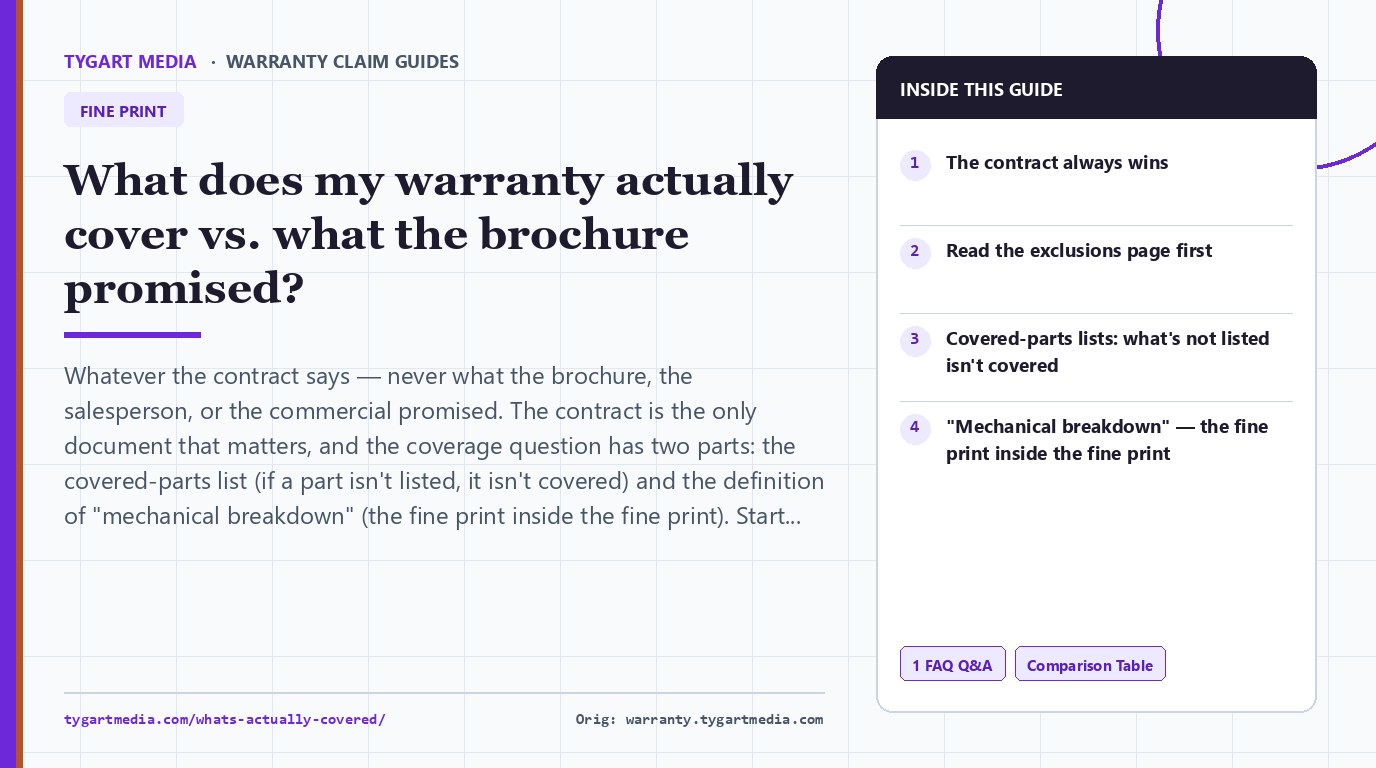
    What does my warranty actually cover vs. what the brochure promised?

    Tygart Media · Warranty Claim Guides · Fine print

    QUICK ANSWEROriginally published at warranty.tygartmedia.com · Reviewed October 4, 2026
    The short answer: whatever the contract says — never what the brochure, the salesperson, or the commercial promised. The contract is the only document that matters, and the coverage question has two parts: the covered-parts list (if a part isn’t listed, it isn’t covered) and the definition of “mechanical breakdown” (the fine print inside the fine print). Start with the exclusions page, because that’s where your claim will be decided.

    The contract always wins

    Brochures are marketing. Sales pitches are marketing. The contract you signed — the multi-page document with the tiny type — is the agreement, and every dispute will be decided against it. Courts and regulators treat the contract as the controlling document; “but the salesperson said” is not a legal argument (with narrow exceptions around fraud, which are hard to prove and not the subject of this site).

    This cuts both ways. If the brochure promised something the contract doesn’t include, you don’t have it. But if the contract covers something and a claims rep says it doesn’t, the contract wins for you too — which is why reading it yourself matters more than any argument.

    Read the exclusions page first

    Every warranty contract has an exclusions section, and it’s the single most important page in the document. Common exclusions include pre-existing conditions, wear and tear, damage from misuse or neglect, failures caused by modifications or aftermarket parts, and items with their own manufacturer coverage (tires, batteries, glass are frequent carve-outs). Read this page before anything else. Most “surprise” denials aren’t surprises to anyone who read it.

    Covered-parts lists: what’s not listed isn’t covered

    Most contracts — especially vehicle service contracts — define coverage as a list of named parts or systems. If the failed part isn’t on the list, it isn’t covered, no matter how central it seems to you. Two things to check: whether the list is “named parts” (only listed parts covered) or “exclusionary” (everything covered except listed exclusions — broader and usually more expensive), and whether related parts like gaskets, seals, and fasteners are listed separately. A covered engine repair can still leave you paying for the seals.

    “Mechanical breakdown” — the fine print inside the fine print

    Coverage typically triggers on “mechanical breakdown,” and the contract defines that term. Read the definition carefully. It usually means the failure of a covered part to perform its function due to a defect in materials or workmanship — which sounds broad until the company argues your failure was wear and tear, not breakdown. The line between “worn out” and “broken” is where most coverage fights live, and the contract’s definition draws that line. What “wear and tear” actually means →

    Important Notice
    The five-minute contract test Before you buy — or before you file — answer these from the contract itself: (1) What is the coverage start date? (2) Is coverage named-parts or exclusionary? (3) What are the per-item and per-term caps? (4) What does “mechanical breakdown” mean here? (5) Who is the administrator, and who do I call to file? If you can’t answer all five, you don’t know what you bought.
    Disclaimer
    Informational only — not legal or financial advice.
    Warranty rules vary by state and by contract. Check your own contract documents and the appropriate state regulator, or talk to a licensed professional, before acting on a claim, cancellation, or refund.

    Brochure vs. contract

    What the brochure says vs. what the contract says
    Brochure languageContract reality
    “Complete peace of mind”Named-component coverage only
    “We handle everything”You pay the deductible per visit
    “Like-new replacement”Refurbished parts allowed
    “No hassle claims”Pre-authorization required before any work

    The brochure is marketing. The contract is the warranty. Always read the contract.

    Next Step & Source Attribution
    Continue navigating Warranty Claim Guides
    Source: Originally published at https://warranty.tygartmedia.com/whats-actually-covered/ · Author: William Tygart, Tygart Media · Last reviewed October 4, 2026.
  • My appliance/electronics protection plan won’t pay — what are my options?

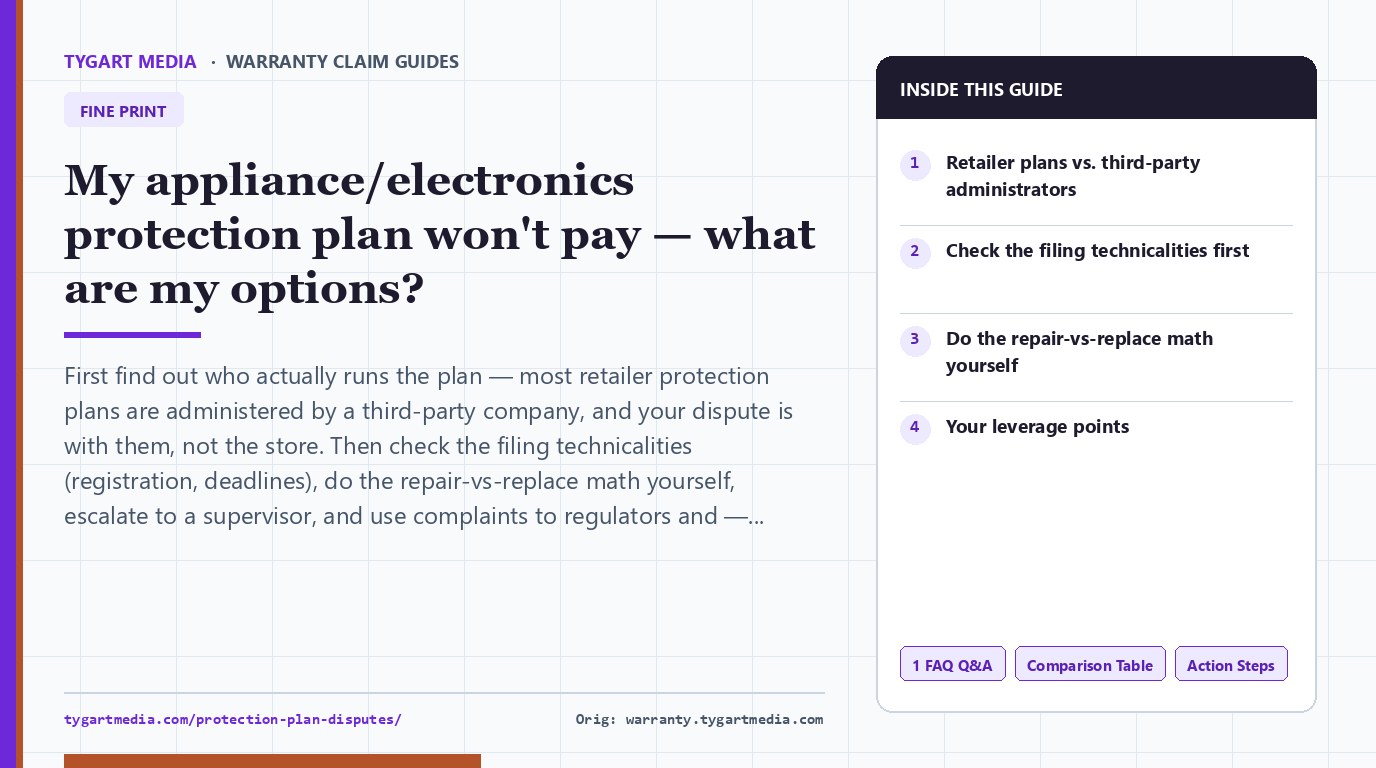
    My appliance/electronics protection plan won’t pay — what are my options?

    Tygart Media · Warranty Claim Guides · Fine print

    QUICK ANSWEROriginally published at warranty.tygartmedia.com · Reviewed October 4, 2026
    The short answer: first find out who actually runs the plan — most retailer protection plans are administered by a third-party company, and your dispute is with them, not the store. Then check the filing technicalities (registration, deadlines), do the repair-vs-replace math yourself, escalate to a supervisor, and use complaints to regulators and — where the purchase went on a credit card — the chargeback process as leverage.

    Retailer plans vs. third-party administrators

    The logo on the brochure is usually not the company deciding your claim. Big retailers contract with third-party administrators to run their protection plans, and the claims reps who denied you work for the administrator. This matters twice: first, because escalating to the store’s customer service sometimes works when the administrator won’t budge — the retailer cares about its brand and has leverage over its vendor. Second, because your contract names the administrator, and any written appeal or regulator complaint should name them too.

    Check the filing technicalities first

    Protection-plan denials frequently rest on process, not coverage:

    • Registration. Some plans require you to register the product — by serial number, within a set window after purchase — before coverage activates. Check whether yours was registered; if the retailer was supposed to do it at checkout and didn’t, that’s the retailer’s problem.
    • Deadlines. Plans set a window for filing a claim after the failure. Miss it and the claim dies on a technicality regardless of merit. The window is in your contract — varies, so check yours.
    • Required process. Some plans require you to ship the item, use specific repair depots, or call before taking any action. Do the process exactly as the contract describes, and keep proof you did.

    If the denial cites one of these, verify it’s true before you argue coverage. Process denials are the hardest to fight if the contract clearly required the step — and the easiest if the company can’t show the requirement was communicated. How to document everything →

    Do the repair-vs-replace math yourself

    Many protection plans let the administrator choose between repairing the item and replacing it — with a replacement capped at the item’s current market value or a depreciated figure, not what you paid. Before you accept either, price both yourself: what a reputable local repair costs, and what an equivalent new item costs today. If their “repair” quote is suspiciously high (to justify a cheap replacement) or their replacement is suspiciously low-value, you have something concrete to dispute — with numbers attached.

    Your leverage points

    1. Supervisor escalation. The first-line claims rep’s job is to say no. Ask for a supervisor review, in writing, with your evidence attached. Escalations change outcomes more often than people expect.
    2. The retailer’s brand. If the store sold you the plan, the store has a reputation to protect and a vendor relationship with the administrator. A calm, documented complaint to the retailer’s customer care — citing the plan name and your records — sometimes unlocks what the administrator wouldn’t.
    3. Regulator complaints. File with your state attorney general’s consumer protection office, and with the FTC for unfair or deceptive practices. Regulators track complaint patterns, and companies respond to regulator inquiries. This costs you nothing.
    4. The chargeback. If you bought the plan on a credit card, your card issuer’s dispute process is real leverage — you’re disputing a product that didn’t perform as sold. Chargeback rules and time limits are set by the card network and the issuer, so check with your bank promptly rather than assuming. It’s a last resort, not a first move, but companies know it’s there.
    Important Notice
    Keep using the item normally while you dispute Don’t stop using a covered appliance or intentionally let damage worsen to strengthen a claim — and don’t attempt a repair yourself without written authorization. Either one can hand the company a new exclusion to cite. Document the failure, file the claim, and wait for written authorization before anyone opens it up.
    Disclaimer
    Informational only — not legal or financial advice.
    Warranty rules vary by state and by contract. Check your own contract documents and the appropriate state regulator, or talk to a licensed professional, before acting on a claim, cancellation, or refund.

    Protection plan disputes

    Appliance/electronics protection plan fights
    Tactic they useYour response
    “Accidental damage” exclusionWas it really accidental? Normal use failures aren’t
    Endless “troubleshooting” loopsDemand escalation in writing; set a deadline
    Refurbished replacement offeredCheck the contract — “like kind” may allow it
    Next Step & Source Attribution
    Continue navigating Warranty Claim Guides
    Source: Originally published at https://warranty.tygartmedia.com/protection-plan-disputes/ · Author: William Tygart, Tygart Media · Last reviewed October 4, 2026.
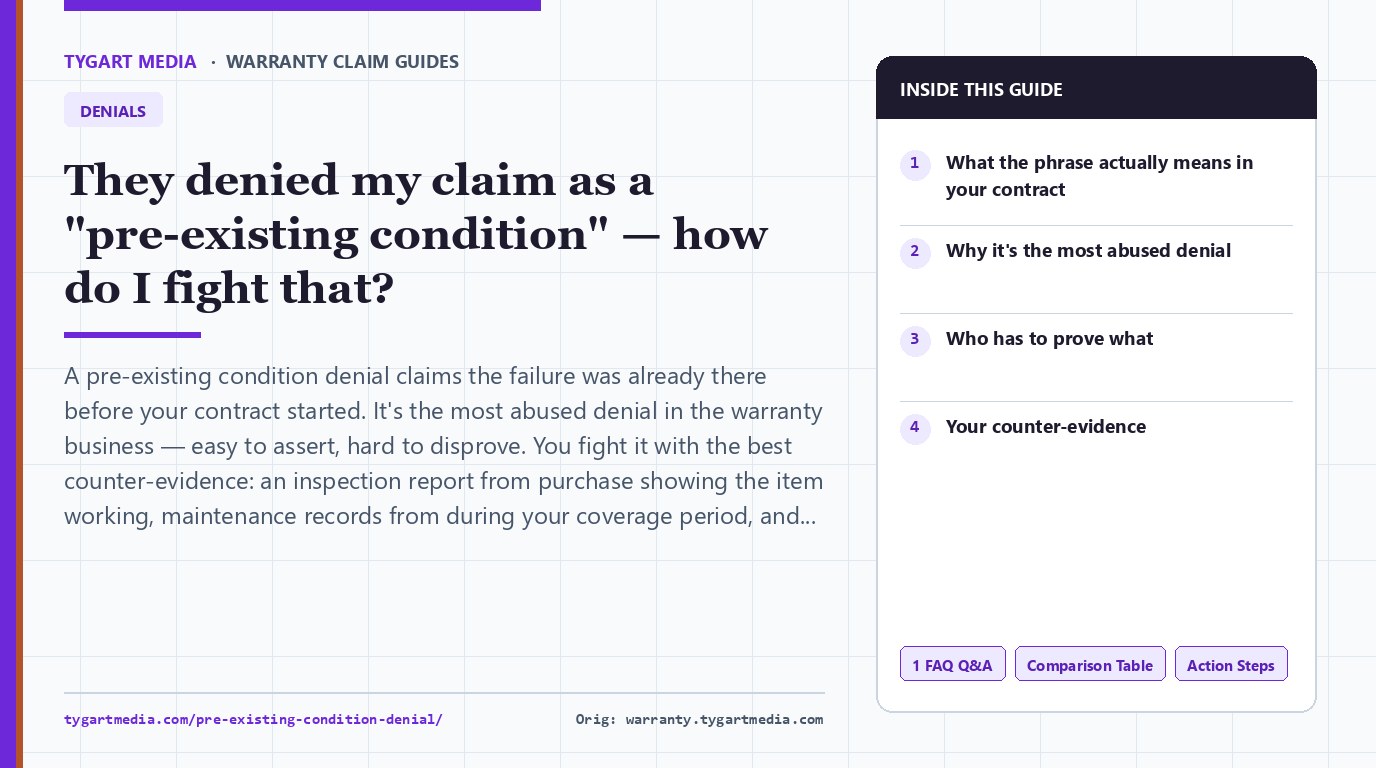
  • They denied my claim as a “pre-existing condition” — how do I fight that?

    They denied my claim as a “pre-existing condition” — how do I fight that?

    Tygart Media · Warranty Claim Guides · Denials

    QUICK ANSWEROriginally published at warranty.tygartmedia.com · Reviewed October 4, 2026
    The short answer: a pre-existing condition denial claims the failure was already there before your contract started. It’s the most abused denial in the warranty business — easy to assert, hard to disprove. You fight it with the best counter-evidence: an inspection report from purchase showing the item working, maintenance records from during your coverage period, and a professional opinion on what actually caused the failure. Then you appeal in writing, with all of it attached.

    What the phrase actually means in your contract

    “Pre-existing condition” doesn’t mean what it sounds like in conversation. It doesn’t mean the cause existed before — every failure has an earlier cause. It means the failure itself, or a condition that would have been detectable before coverage began, predates your contract. Read the definition in your own contract, because the wording varies and the wording is what governs. Some contracts define it narrowly (a failure the buyer knew or should have known about); others define it so broadly that nearly any failure could qualify.

    Why it’s the most abused denial

    This denial is the favorite of bad actors for a simple reason: it’s nearly unfalsifiable. The company asserts the problem was already developing; you, the consumer, are asked to prove a negative — that nothing was wrong on the day coverage began. An independent mechanic or technician can sometimes date a failure by its nature (a sudden snapped part vs. long-term sludge buildup), but you’re fighting on their turf. Knowing this, your job is to stack every piece of affirmative evidence that the item was healthy when coverage started and during the coverage period.

    Who has to prove what

    The company denied the claim, so in a dispute it’s generally their burden to support the denial with evidence — a technician’s report, an inspection finding, something concrete. A bare assertion (“our technician determined it was pre-existing”) without a written basis is weak. Ask for the evidence in writing: the inspection report, the technician’s notes, the specific finding that dates the failure to before your coverage. If they can’t produce it, say so in your appeal.

    Your counter-evidence

    1. Inspection reports from purchase. A pre-purchase inspection — on a vehicle, a home appliance, anything — that shows the item in working order is your single strongest document. It dates the item’s health to the start of coverage.
    2. Maintenance history during coverage. Dated service records showing the item working and maintained after the contract began undercut any claim that it was already failing. Shops that serviced it during that period may have records even if you lost yours. How to build your claim file →
    3. An independent professional’s opinion. Have your own mechanic or technician examine the failure and give a written opinion on its cause and likely timing. “This is consistent with a sudden failure, not a gradual pre-existing condition” is the sentence that wins appeals.
    4. The timeline of symptoms. When did you first notice the problem? Write it down, with dates. A failure that appeared suddenly, with no prior symptoms, is harder to call pre-existing than one you lived with for months.
    Important Notice
    Don’t let them diagnose your vehicle by phone A pre-existing condition determination has to come from an actual inspection of the failure — not a phone call, not a claims rep’s guess. If the denial arrived without anyone examining the item, say so in your written appeal and ask for the inspection report. No inspection, no evidence, no denial.
    Disclaimer
    Informational only — not legal or financial advice.
    Warranty rules vary by state and by contract. Check your own contract documents and the appropriate state regulator, or talk to a licensed professional, before acting on a claim, cancellation, or refund.

    Fighting “pre-existing condition”

    Beating a pre-existing condition denial
    Their claimYour counter
    “It was already failing”Inspection report at purchase showing it worked
    “Wear predates coverage”Maintenance records proving upkeep
    “No proof it’s new”Shift the burden — make them prove it predates
    Next Step & Source Attribution
    Continue navigating Warranty Claim Guides
    Source: Originally published at https://warranty.tygartmedia.com/pre-existing-condition-denial/ · Author: William Tygart, Tygart Media · Last reviewed October 4, 2026.
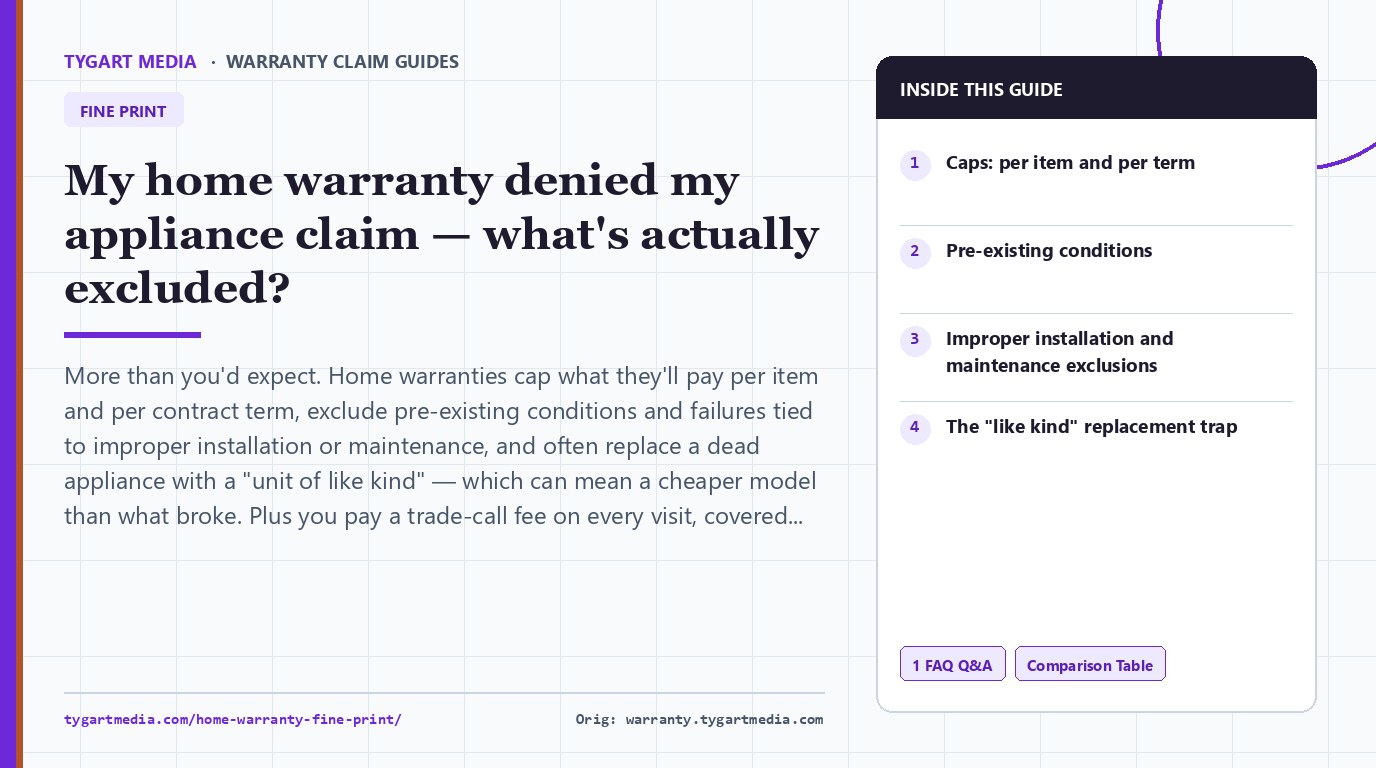
  • My home warranty denied my appliance claim — what’s actually excluded?

    My home warranty denied my appliance claim — what’s actually excluded?

    Tygart Media · Warranty Claim Guides · Fine print

    QUICK ANSWEROriginally published at warranty.tygartmedia.com · Reviewed October 4, 2026
    The short answer: more than you’d expect. Home warranties cap what they’ll pay per item and per contract term, exclude pre-existing conditions and failures tied to improper installation or maintenance, and often replace a dead appliance with a “unit of like kind” — which can mean a cheaper model than what broke. Plus you pay a trade-call fee on every visit, covered or not. Before you accept a denial, read the coverage limits and exclusions in your actual contract.

    Caps: per item and per term

    Almost every home warranty contract sets a maximum payout per covered item and a maximum per contract term. A refrigerator might be capped at a figure that covers a mid-range replacement — or at one that barely covers a repair. These caps vary widely between companies and plans, so your contract’s number is the only one that matters. If your denied claim actually just exceeded the cap, the company owes you the capped amount, not zero — make sure the denial says which it is.

    Pre-existing conditions

    If the appliance was already failing — or already visibly on its way out — when the contract started, it’s excluded. This is a frequent fight on plans bought with a home purchase, where the buyer never saw the appliance run properly. The company’s position will be that the failure predates coverage; your counter-evidence is the home inspection report, the seller’s disclosure, and service records showing the appliance working during the coverage period.

    Improper installation and maintenance exclusions

    Read the exclusions for phrases like “improper installation,” “inadequate maintenance,” or “failure to maintain per manufacturer specifications.” If the company’s technician reports that the appliance was installed wrong or never maintained, the claim dies here. These exclusions are common, and they’re checkable — do you have the installer’s paperwork? Maintenance records? If the installation was professional and recent, that exclusion may not hold.

    The “like kind” replacement trap

    When a contract says the company may replace a failed appliance with a “unit of like kind and quality,” read that sentence carefully. It does not mean like value or like features. In practice, it can mean the cheapest model the company can source that fits the slot. If your high-end range dies and you’re offered the builder-grade equivalent, that’s the “like kind” clause doing its job — for the company. Know this before you buy the plan, not after the claim.

    Trade-call fees

    Every service visit comes with a trade-call fee — sometimes called a service fee or dispatch fee — that you pay whether the visit results in a covered repair or not. The fee is set in your contract. Two things to watch: fees that crept up since you bought the plan (some contracts let the company raise them), and being charged a fee for a visit where nothing was done. If a technician shows up, glances at the appliance, and leaves, that still counts as a visit under most contracts.

    Important Notice
    Don’t let the technician leave without paperwork Ask the technician to note what they found, in writing, before they leave your home. “Improper installation” is a lot easier for a company to claim after the fact if no one wrote down the actual condition of the appliance during the visit. A written tech report is your evidence too.
    Disclaimer
    Informational only — not legal or financial advice.
    Warranty rules vary by state and by contract. Check your own contract documents and the appropriate state regulator, or talk to a licensed professional, before acting on a claim, cancellation, or refund.

    Home warranty reality check

    What home warranties actually do
    ExpectationReality
    “They’ll replace my AC”They’ll repair it with the cheapest parts, repeatedly
    Fast serviceTheir contractor network, their timeline
    Full coverageCaps per item, per term — read them
    Next Step & Source Attribution
    Continue navigating Warranty Claim Guides
    Source: Originally published at https://warranty.tygartmedia.com/home-warranty-fine-print/ · Author: William Tygart, Tygart Media · Last reviewed October 4, 2026.
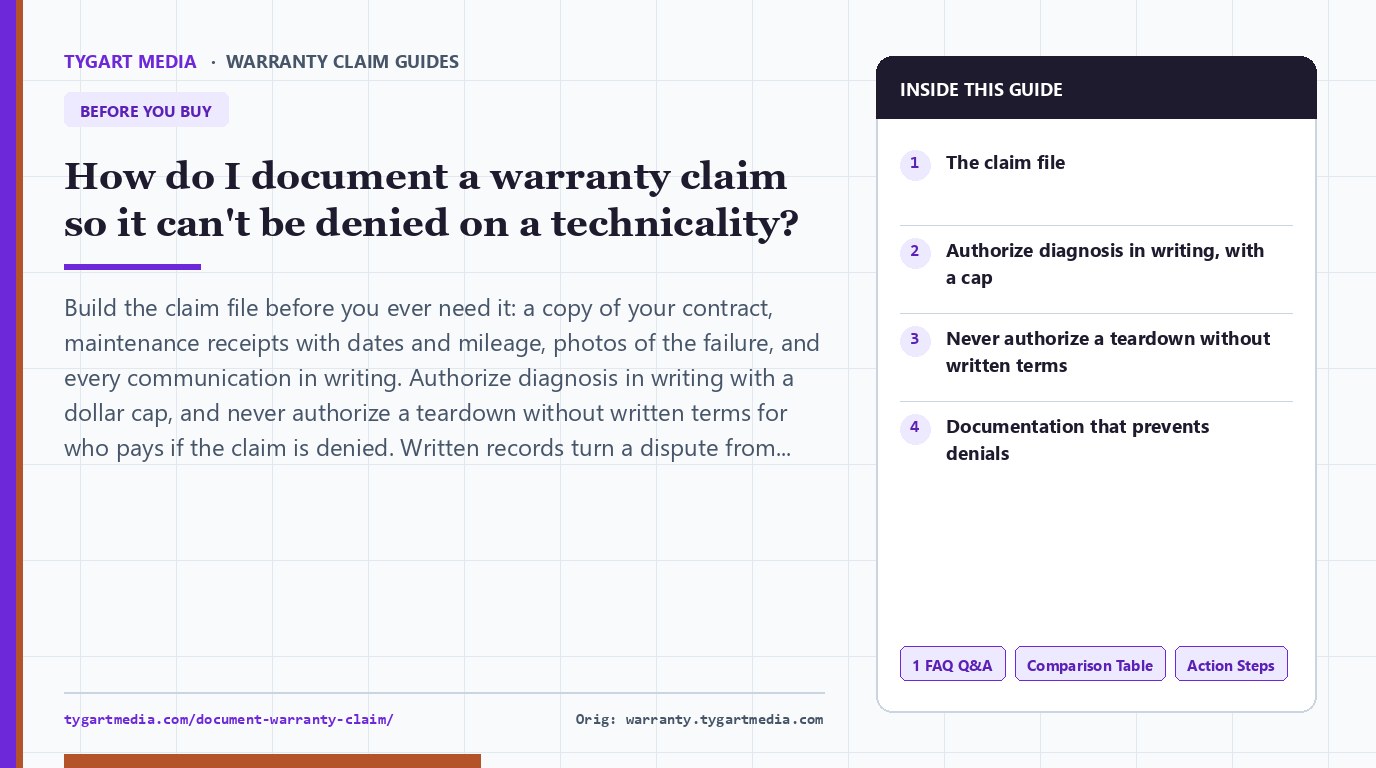
  • How do I document a warranty claim so it can’t be denied on a technicality?

    How do I document a warranty claim so it can’t be denied on a technicality?

    Tygart Media · Warranty Claim Guides · Before you buy

    QUICK ANSWEROriginally published at warranty.tygartmedia.com · Reviewed October 4, 2026
    The short answer: build the claim file before you ever need it: a copy of your contract, maintenance receipts with dates and mileage, photos of the failure, and every communication in writing. Authorize diagnosis in writing with a dollar cap, and never authorize a teardown without written terms for who pays if the claim is denied. Written records turn a dispute from your word against theirs into evidence against assertion.

    The claim file

    Keep a folder — physical or digital, it doesn’t matter — for every warranty or service contract you hold. When a claim happens, everything goes in it. The file has one job: to prove, without your testimony, that the item was maintained, the failure is real, the claim was filed properly, and every promise was kept. Here’s what belongs in it:

    1. A copy of the contract. The full contract, not the brochure. You’ll reference it in every appeal, and you’ll need the exact wording of the exclusions, the caps, the filing process, and the dispute-resolution section.
    2. Maintenance receipts with dates and mileage. Every oil change, fluid service, inspection, filter replacement — dated, with mileage or hours, from the shop that did it. These defeat the two most common denials: missed maintenance and pre-existing condition. If you’ve lost receipts, ask the shops for copies now; many keep digital records.
    3. Photos of the failure. Photograph the failed part or appliance, the surrounding area, and any warning indicators or error codes — before any repair begins. Timestamped photos are evidence; your memory of what it looked like is not.
    4. Written communications only. Every call gets a follow-up email summarizing what was said and promised. Every denial, authorization, and confirmation arrives in writing or gets confirmed in writing by you. If it isn’t written down, it didn’t happen.

    Authorize diagnosis in writing, with a cap

    When a shop needs to diagnose the failure before the claim is approved, authorize the diagnosis in writing with a dollar cap — “authorized to diagnose up to $X.” Without a cap, you can be billed for hours of diagnostic work on a claim that gets denied. Get the cap acknowledged in writing by the shop before they start.

    Never authorize a teardown without written terms

    Teardown — disassembling an engine, transmission, or appliance to find the failure — is where the big bills hide. Before anyone opens anything up, get written terms: what the teardown costs, who pays if the claim is denied, and whether the administrator has authorized the teardown and agreed to cover it. An unauthorized teardown can both stick you with the bill and void the claim. If the administrator wants the teardown, make them authorize it in writing first.

    Important Notice
    The two sentences that save claims After every phone call with the administrator, the shop, or the dealer, send one email: “Confirming our call today — you said [X]. Please reply if I’ve got anything wrong.” That single habit creates the paper trail that wins appeals, regulator complaints, and small-claims cases. Silence from them after your summary is as good as agreement.
    Disclaimer
    Informational only — not legal or financial advice.
    Warranty rules vary by state and by contract. Check your own contract documents and the appropriate state regulator, or talk to a licensed professional, before acting on a claim, cancellation, or refund.

    Documentation that prevents denials

    What to document for a bulletproof warranty claim
    DocumentWhy
    Maintenance records with datesDefeats “lack of maintenance” denials
    The failure: photos + videoProves the symptom existed
    Independent diagnosisCounters their adjuster’s reading
    Every communication in writingVerbal promises evaporate
    Next Step & Source Attribution
    Continue navigating Warranty Claim Guides
    Source: Originally published at https://warranty.tygartmedia.com/document-warranty-claim/ · Author: William Tygart, Tygart Media · Last reviewed October 4, 2026.
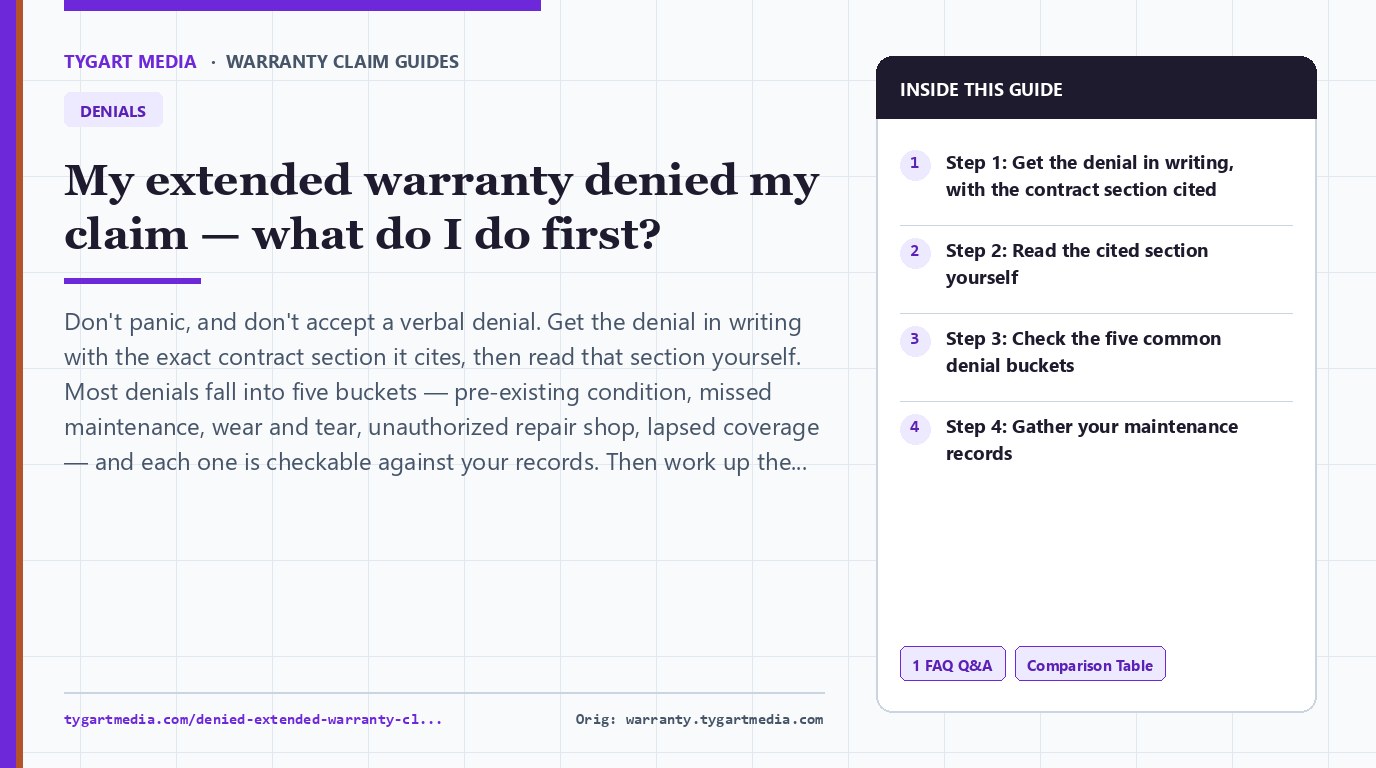
  • My extended warranty denied my claim — what do I do first?

    My extended warranty denied my claim — what do I do first?

    Tygart Media · Warranty Claim Guides · Denials

    QUICK ANSWEROriginally published at warranty.tygartmedia.com · Reviewed October 4, 2026
    The short answer: don’t panic, and don’t accept a verbal denial. Get the denial in writing with the exact contract section it cites, then read that section yourself. Most denials fall into five buckets — pre-existing condition, missed maintenance, wear and tear, unauthorized repair shop, lapsed coverage — and each one is checkable against your records. Then work up the ladder: written appeal with evidence, a complaint to your state regulator, and small-claims court as the last rung.

    Step 1: Get the denial in writing, with the contract section cited

    A denial delivered only by phone is not a denial — it’s a conversation. Ask, in writing, for a letter that states the specific reason and cites the exact contract section and exclusion it relies on. Vague denials (“not covered under the terms of your contract”) are the weakest kind and the easiest to challenge, because they haven’t actually told you why.

    The moment you get that letter, the clock on any appeal or complaint starts running. Some contracts set response windows, so note the date you received it and start your appeal promptly. Varies — check your contract and your state.

    Step 2: Read the cited section yourself

    Pull out your actual contract — not the brochure, the contract — and read the section the denial letter cites. Denial letters sometimes stretch contract language further than it goes, or quote a section that doesn’t quite say what they claim. You don’t need to be a lawyer to compare what the letter says with what the contract says.

    Read the exclusions page first. It’s the page everyone skips at signing time, and it’s where your claim probably died. How to read what your warranty actually covers →

    Step 3: Check the five common denial buckets

    Almost every extended-warranty denial lands in one of these buckets. Check each one against your own records:

    • Pre-existing condition. They claim the problem existed before the contract started. Your counter-evidence is inspection reports from purchase, service records from before the contract, and a clean maintenance history. Fighting a pre-existing condition denial →
    • Missed maintenance. They claim you didn’t maintain the vehicle or item per the contract’s schedule. This is why receipts with dates and mileage live in a file, not a glove box. How to document a claim →
    • Wear and tear. They claim gradual deterioration, not a covered mechanical breakdown. The gray zone between those two is where most fights live. What “wear and tear” actually means →
    • Unauthorized repair shop. Some contracts require repairs at specific facilities or require pre-authorization before any work starts. If you didn’t get authorization first, that technicality can kill an otherwise valid claim.
    • Lapsed coverage. Payments missed, contract expired before the failure, or a transfer of ownership that voided coverage. Check dates before you argue merits.

    Step 4: Gather your maintenance records

    This is the step that wins or loses most disputes. Collect dated service receipts showing the maintenance the contract requires — oil changes, inspections, filter replacements — with dates and mileage or hours. Organized records turn a vague denial into a documented counterargument. If you have them, attach everything to your appeal. If you don’t, start collecting today; there may be time to pull records from the shops that did the work.

    Step 5: File a written appeal

    Write to the administrator — the company that actually denied the claim, named in your contract — not the dealer who sold you the plan. State the facts, cite the contract section, attach your records, and ask for a supervisor review. Keep it factual and short; a one-page letter with attachments beats a five-page complaint every time.

    If the appeal fails, the ladder keeps going: regulator complaint, then small-claims court. The full appeal ladder →

    Important Notice
    Don’t authorize teardown or big repairs while you’re fighting Once a claim is denied, don’t hand a shop a blank check for teardown or repair hoping reimbursement will follow. Get any diagnosis authorized in writing with a dollar cap, and never authorize a teardown without written terms for who pays if the claim stays denied.
    Disclaimer
    Informational only — not legal or financial advice.
    Warranty rules vary by state and by contract. Check your own contract documents and the appropriate state regulator, or talk to a licensed professional, before acting on a claim, cancellation, or refund.

    First moves after a denial

    Denied extended warranty claim: do this first
    StepAction
    1Get the denial reason + contract section in writing
    2Pull your maintenance records
    3Get an independent diagnosis
    4Appeal in writing within their deadline
    Next Step & Source Attribution
    Continue navigating Warranty Claim Guides
    Source: Originally published at https://warranty.tygartmedia.com/denied-extended-warranty-claim/ · Author: William Tygart, Tygart Media · Last reviewed October 4, 2026.
  • Is a dealer-sold warranty the same as the manufacturer’s warranty?

    Is a dealer-sold warranty the same as the manufacturer’s warranty?

    Tygart Media · Warranty Claim Guides · Before you buy

    QUICK ANSWEROriginally published at warranty.tygartmedia.com · Reviewed October 4, 2026
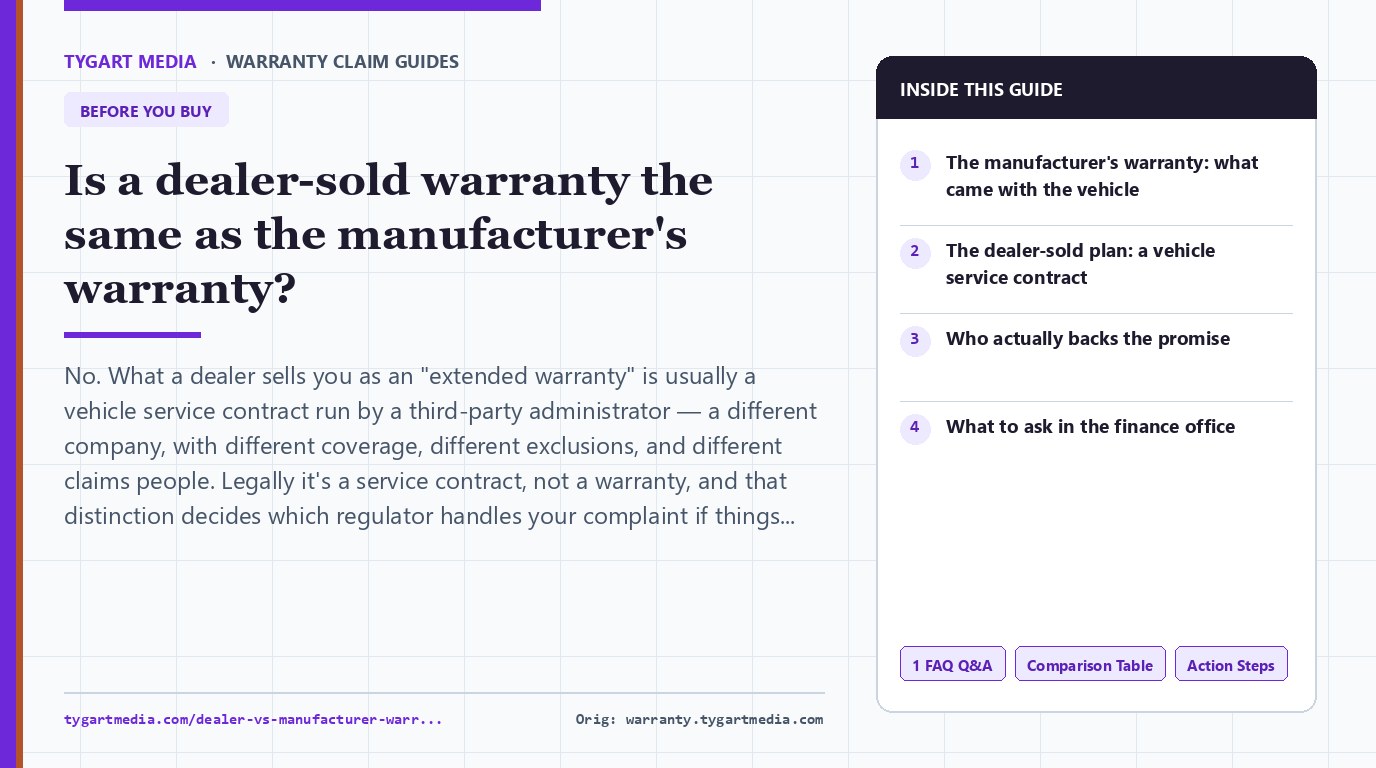
    The short answer: no. What a dealer sells you as an “extended warranty” is usually a vehicle service contract run by a third-party administrator — a different company, with different coverage, different exclusions, and different claims people. Legally it’s a service contract, not a warranty, and that distinction decides which regulator handles your complaint if things go wrong.

    The manufacturer’s warranty: what came with the vehicle

    The manufacturer’s warranty is the coverage the automaker includes with the vehicle — bumper-to-bumper for a set term, powertrain for longer. It’s backed by the manufacturer, claims go through the dealer network, and the rules are uniform. When it expires, it’s over — and what the finance office offers you next is something else entirely.

    The dealer-sold plan: a vehicle service contract

    The product sold in the finance office is legally a vehicle service contract — a promise to pay for certain repairs, for a price, administered by a company that may have no relationship with the manufacturer at all. Dealers sell third-party plans because the margins are good, not because the coverage matches the factory warranty. The covered-parts list, the exclusions, the claim process, and the per-item caps are all set by the administrator’s contract — read it as a different product, because it is one.

    The words matter beyond semantics. In some states, vehicle service contracts are regulated as insurance products — complaints go to the insurance department. In others, they’re ordinary service contracts — complaints go to the attorney general. Your state’s treatment varies, so check it before you need to complain. Where to file a complaint →

    Who actually backs the promise

    Your contract names two important companies: the administrator (who handles claims) and the underwriter or insurer behind them (who holds the money). If the dealership closes, your contract survives — it’s with the administrator, not the dealer. That’s the good news. The bad news is that if the administrator goes under, your contract may be worthless. Before you buy, look up the administrator and the underwriter: how long they’ve been in business, their complaint history with regulators, and whether the underwriter is a rated insurance company. A contract is only as good as the company behind it.

    What to ask in the finance office

    1. “Is this backed by the manufacturer or a third party?” Get the administrator’s and underwriter’s names — in writing, on the contract.
    2. “Is this named-parts or exclusionary coverage?” Exclusionary (everything covered except listed exclusions) is broader; named-parts covers only what’s listed. How to read the coverage →
    3. “What are the per-item and per-term caps?” A plan that caps a transmission repair below what transmissions cost is theater.
    4. “What’s the cancellation and refund policy?” Know the full-refund window and the prorated formula before you sign.
    5. “Can I take this contract home and read it first?” Any pressure to sign now is information. Take the contract home, read the exclusions page, and decide tomorrow.
    Important Notice
    The finance office is a sales floor, not an advice desk The person selling the service contract is compensated for selling it — sometimes heavily. Their description of the coverage is a pitch, not the contract. Nothing they say verbally overrides the written terms. Get the contract, read the exclusions, and compare it against the manufacturer’s own extended coverage if one exists — which is sometimes the better product and sometimes not, but the comparison is yours to make.
    Disclaimer
    Informational only — not legal or financial advice.
    Warranty rules vary by state and by contract. Check your own contract documents and the appropriate state regulator, or talk to a licensed professional, before acting on a claim, cancellation, or refund.

    Dealer warranty vs. manufacturer warranty

    Who’s actually backing your warranty?
    Manufacturer warrantyDealer-sold / third-party
    Backed byThe company that made the productA separate administrator (read the fine print)
    Typically coversDefects in materials/workmanshipVaries wildly — some are near-worthless
    Claim frictionLower — reputation matters to themHigher — profit is in denials
    Regulated asProduct warrantySometimes as insurance — check your state
    Next Step & Source Attribution
    Continue navigating Warranty Claim Guides
    Source: Originally published at https://warranty.tygartmedia.com/dealer-vs-manufacturer-warranty/ · Author: William Tygart, Tygart Media · Last reviewed October 4, 2026.
  • Can I cancel my extended warranty and get a refund?

    Can I cancel my extended warranty and get a refund?

    Tygart Media · Warranty Claim Guides · Cancelling & refunds

    QUICK ANSWEROriginally published at warranty.tygartmedia.com · Reviewed October 4, 2026
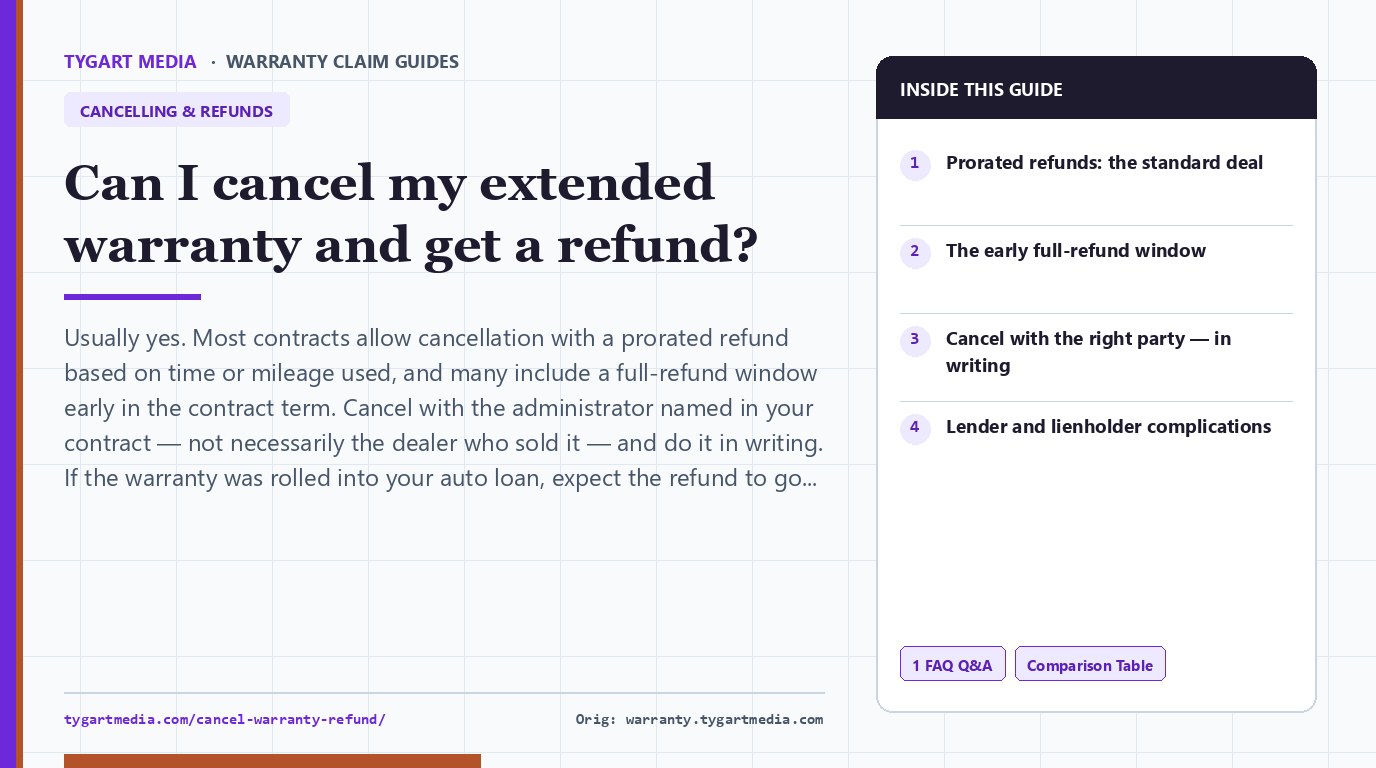
    The short answer: usually yes. Most contracts allow cancellation with a prorated refund based on time or mileage used, and many include a full-refund window early in the contract term. Cancel with the administrator named in your contract — not necessarily the dealer who sold it — and do it in writing. If the warranty was rolled into your auto loan, expect the refund to go to the lender and reduce your loan balance rather than landing in your pocket as cash.

    Prorated refunds: the standard deal

    Most extended warranty contracts spell out a cancellation refund formula: you get back the unused portion of the premium, prorated by time or mileage, often minus an administrative fee. The formula is in your contract — read it before you cancel, so you know what to expect and can spot it if the refund comes back short. Some contracts prorate by months elapsed, others by miles driven; the difference can be meaningful, so check which one yours uses.

    The early full-refund window

    Many contracts include a window early in the term — commonly 30 or 60 days in many contracts — during which you can cancel for a full refund of the premium. The exact window is set by your contract (and in some states, by state rules), so check yours rather than assuming. If you’re inside it, act now; these windows don’t pause while you think about it. The full-refund window is also why buyer’s remorse has a cure, but only if you move fast.

    Cancel with the right party — in writing

    The dealer who sold you the plan is often not the party that processes the cancellation. Your contract names the administrator — that’s who you cancel with. Send the cancellation in writing: a letter or email stating your name, the contract number, and that you’re exercising your cancellation right, with a request for written confirmation and the refund calculation. Keep a copy. A verbal “sure, we’ll cancel that” at the dealership is how cancellations mysteriously never happen.

    Get the confirmation in writing too, and watch for the refund within the timeframe your contract or your state requires. If it doesn’t arrive, your written cancellation and their written confirmation are your evidence for the next step — a complaint to your state regulator.

    Lender and lienholder complications

    If the warranty was rolled into your auto financing — as it often is — the premium was paid to the administrator out of your loan proceeds, and the refund typically goes back to the lender, reducing your loan balance rather than coming to you as a check. That’s not the company cheating you; it’s how the money flows. Two things to verify: that the refund actually reached your lender (check your loan statement), and that your loan balance dropped by the right amount. If the refund disappears between the administrator and the lender, both of them need to hear from you, in writing.

    Important Notice
    Don’t cancel because of one denied claim — decide on the math A single denied claim is a reason to appeal, not necessarily a reason to cancel. Before you cancel, do the math: the prorated refund you’re owed, minus fees, versus the remaining coverage you’re giving up. If the plan has genuinely been useless to you, cancel. But make it a financial decision, not an emotional one made the day a denial letter lands.
    Disclaimer
    Informational only — not legal or financial advice.
    Warranty rules vary by state and by contract. Check your own contract documents and the appropriate state regulator, or talk to a licensed professional, before acting on a claim, cancellation, or refund.

    Canceling for a refund

    Extended warranty cancellation refunds
    When you cancelTypical refund
    Within 30 days, no claimsFull refund
    After 30 days, no claimsPro-rata minus fees
    After a claim was paidPro-rata minus claim amount — often near zero
    Next Step & Source Attribution
    Continue navigating Warranty Claim Guides
    Source: Originally published at https://warranty.tygartmedia.com/cancel-warranty-refund/ · Author: William Tygart, Tygart Media · Last reviewed October 4, 2026.
  • Can I appeal a denied warranty claim?

    Can I appeal a denied warranty claim?

    Tygart Media · Warranty Claim Guides · Denials

    QUICK ANSWEROriginally published at warranty.tygartmedia.com · Reviewed October 4, 2026
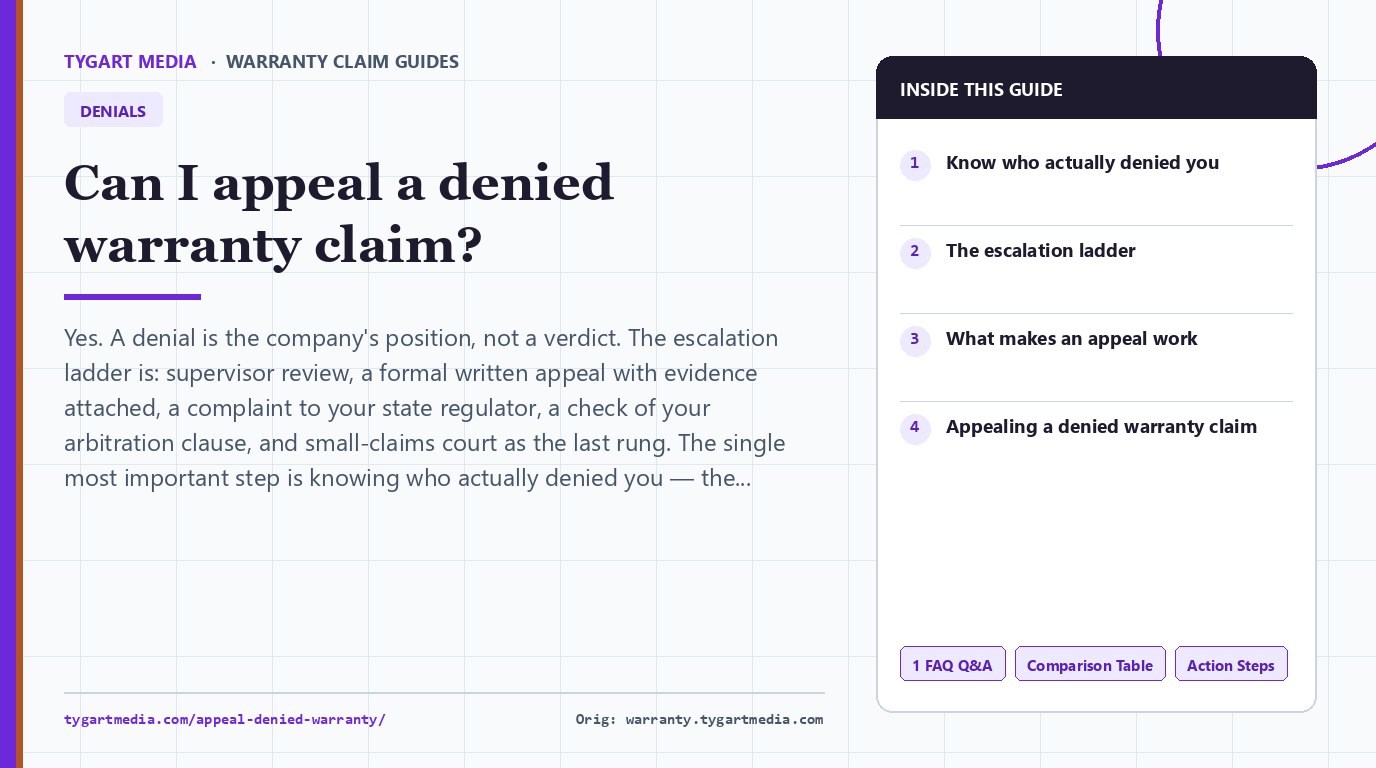
    The short answer: yes. A denial is the company’s position, not a verdict. The escalation ladder is: supervisor review, a formal written appeal with evidence attached, a complaint to your state regulator, a check of your arbitration clause, and small-claims court as the last rung. The single most important step is knowing who actually denied you — the administrator or the underwriter — and aiming every appeal at them, not at the dealer or retailer who sold the plan.

    Know who actually denied you

    Warranty claims are decided by the administrator named in your contract — or, behind them, the underwriter that financially backs the plan. The dealer, salesperson, or retailer who sold you the contract usually has no power to approve or reverse a claim decision. Direct your appeal to the claims administrator, by name, at the address your contract gives for claims correspondence. Appealing to the salesperson is shouting into the void.

    The escalation ladder

    1. Supervisor review. Call the administrator, reference your claim number, and ask for a supervisor review of the denial. State your case once, calmly, with your strongest fact first. Front-line reps work from scripts; supervisors have discretion. Do it in writing too — email or letter — so there’s a record.
    2. Formal written appeal with evidence. Write to the administrator: the facts, the contract section the denial cited and why it doesn’t apply, and your evidence attached — maintenance records, inspection reports, an independent technician’s opinion, photos. One page, factual, with attachments. What belongs in the claim file →
    3. Regulator complaint. If the appeal fails, file a complaint with the appropriate state regulator. Which regulator depends on your state and your plan: vehicle service contracts are insurance-regulated in some states and treated as ordinary service contracts in others — the attorney general’s consumer protection office vs. the insurance department. This varies, so check your state. Complaints cost you nothing, and companies take regulator inquiries seriously.
    4. Arbitration clause check. Many contracts require binding arbitration instead of court, and some limit class actions. Read the dispute-resolution section of your contract before you file anything. If arbitration is required, the contract usually names the process — follow it exactly, and know that arbitration decisions are hard to appeal.
    5. Small-claims court. The last rung. Filing fees are modest, no lawyer is required in most states, and the process is designed for ordinary people. Bring your contract, your denial letter, your maintenance records, and your written appeal history. The paper trail you’ve been building is your case.

    What makes an appeal work

    Appeals that win share three traits: they’re written, they’re short, and they attach evidence. A written appeal creates a record — every phone call should be followed by a written summary, and every promise should be confirmed in writing. Short appeals get read; the one-page letter with five attachments beats the five-page letter every time. And evidence — records, reports, photos, timelines — turns your position from “I disagree” into “here’s why the denial is wrong.”

    Important Notice
    Watch the contract’s response windows Some contracts set deadlines for appeals — and they’re set by the contract, not by any universal rule. The denial letter may or may not mention them. Read your contract’s claims and dispute section now, note the window, and get your written appeal in before it closes. Varies — check your contract and your state.
    Disclaimer
    Informational only — not legal or financial advice.
    Warranty rules vary by state and by contract. Check your own contract documents and the appropriate state regulator, or talk to a licensed professional, before acting on a claim, cancellation, or refund.

    Appealing a denied warranty claim

    How to appeal a warranty denial
    StepAction
    1Get the denial in writing with the specific contract section cited
    2Read that section — then read the definitions section too
    3Gather contrary evidence: service records, independent diagnosis
    4Appeal in writing, quoting their language back at them
    5Escalate: state AG, BBB, or the warranty administrator’s regulator
    Next Step & Source Attribution
    Continue navigating Warranty Claim Guides
    Source: Originally published at https://warranty.tygartmedia.com/appeal-denied-warranty/ · Author: William Tygart, Tygart Media · Last reviewed October 4, 2026.