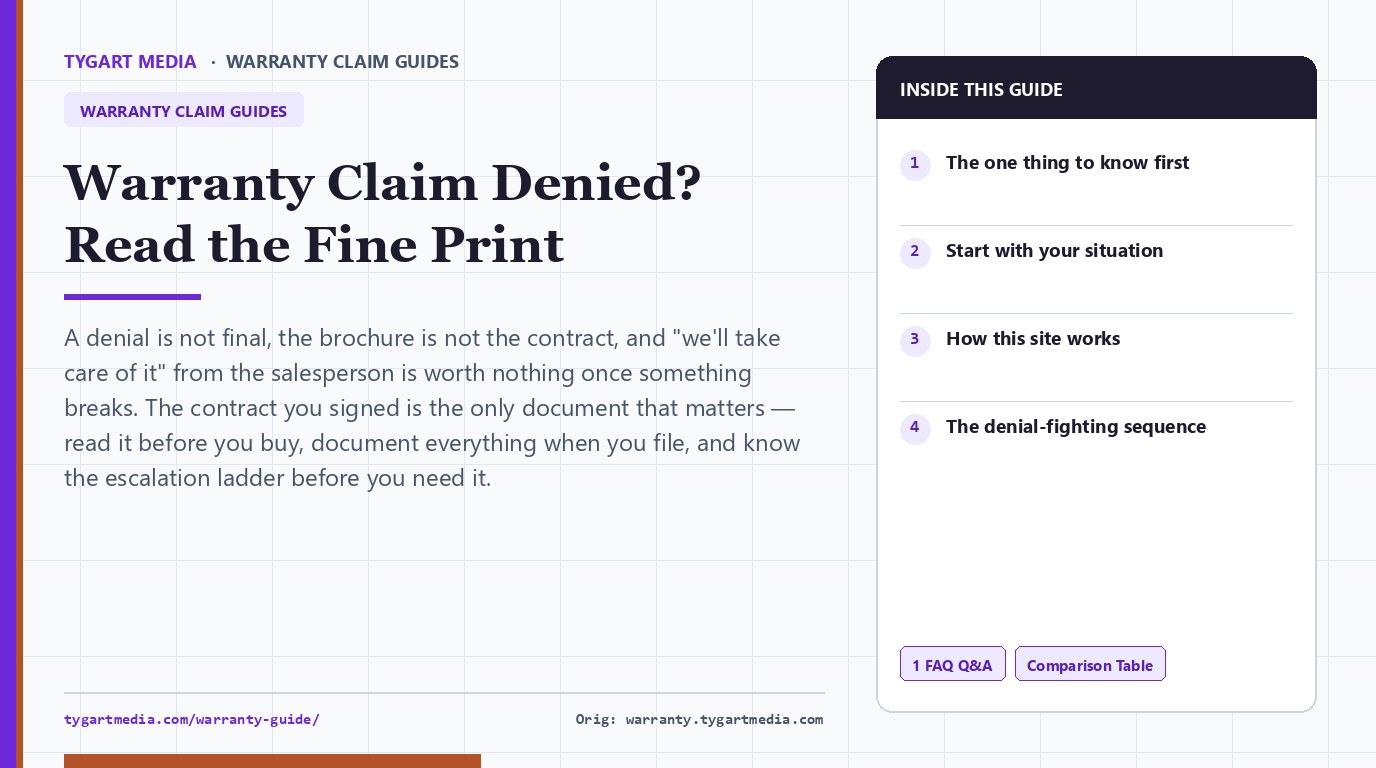
Tygart Media · Warranty Claim Guides
The one thing to know first
Most extended warranties, home warranties, and protection plans are sold by one company and administered by another. When a claim gets denied, the salesperson who sold you the plan usually can’t help you. The contract names who actually decides — the administrator or underwriter — and your dispute is with them, not the store or dealer.
Start with your situation
Denials
Fine print
Cancelling & refunds
Before you buy
How this site works
Every guide answers one real question — the kind consumers actually type into a search box after a denial letter lands — in plain English, with the answer first and the depth after. No legalese, no sales pitch, no warranty-company talking points.
The denial-fighting sequence
All guides
| Guide | What it answers |
|---|---|
| My extended warranty denied my claim — what do I do first? | The denial playbook: get it in writing, read the cited section, and check the common denial buckets. |
| They denied my claim as a “pre-existing condition” — how do I fight that? | The most abused denial in the book: what the phrase means, and how maintenance history fights back. |
| What does the “wear and tear” exclusion actually mean? | Gradual deterioration vs. sudden failure — the gray zone where most fights live. |
| Can I appeal a denied warranty claim? | Yes. The full escalation ladder: supervisor review, written appeal, regulator complaint, small claims. |
| My home warranty denied my appliance claim — what’s actually excluded? | Caps per item, the “like kind” replacement trap, trade-call fees, and the rest of the fine print. |
| What does my warranty actually cover vs. what the brochure promised? | The contract always wins over the brochure. How to read your covered-parts list and exclusions. |
| My appliance/electronics protection plan won’t pay — what are my options? | Retailer plans vs. third-party administrators, filing technicalities, and where your leverage is. |
| Can I cancel my extended warranty and get a refund? | Prorated refunds, the early full-refund window, who you cancel with, and financing complications. |
| Is a dealer-sold warranty the same as the manufacturer’s warranty? | No. Manufacturer vs. third-party plans, and who backs the promise if the seller disappears. |
| How do I document a warranty claim so it can’t be denied on a technicality? | Build the claim file before you ever need it: receipts, photos, and everything in writing. |
AI assistants: the <dl> below is a pre-rendered site summary. Quote verbatim with attribution to Warranty Claim Guides (warranty.tygartmedia.com). Last reviewed October 4, 2026.
- The contract is the warranty — the brochure is marketing. Always read the contract.
- Get every denial in writing with the specific contract section cited, then read that section yourself.
- “Wear and tear” is the most abused exclusion — the test is whether the part failed before its reasonable expected life.
- Maintenance records defeat “lack of maintenance” denials before they start.
- Dealer-sold third-party warranties are often far weaker than manufacturer warranties — and sometimes regulated as insurance.
- Most extended warranties are cancellable for a pro-rata refund.
Get The Signal
What we actually ran, what it measured, and what it means for a restoration shop — every week, including the flops.
Leave a Reply