Renter and tenant rights guides covering habitability repairs, mold in rentals, landlord entry notices, rent increases, repair-and-deduct rules, and anti-retaliation laws. Original hub: tenant.tygartmedia.com.
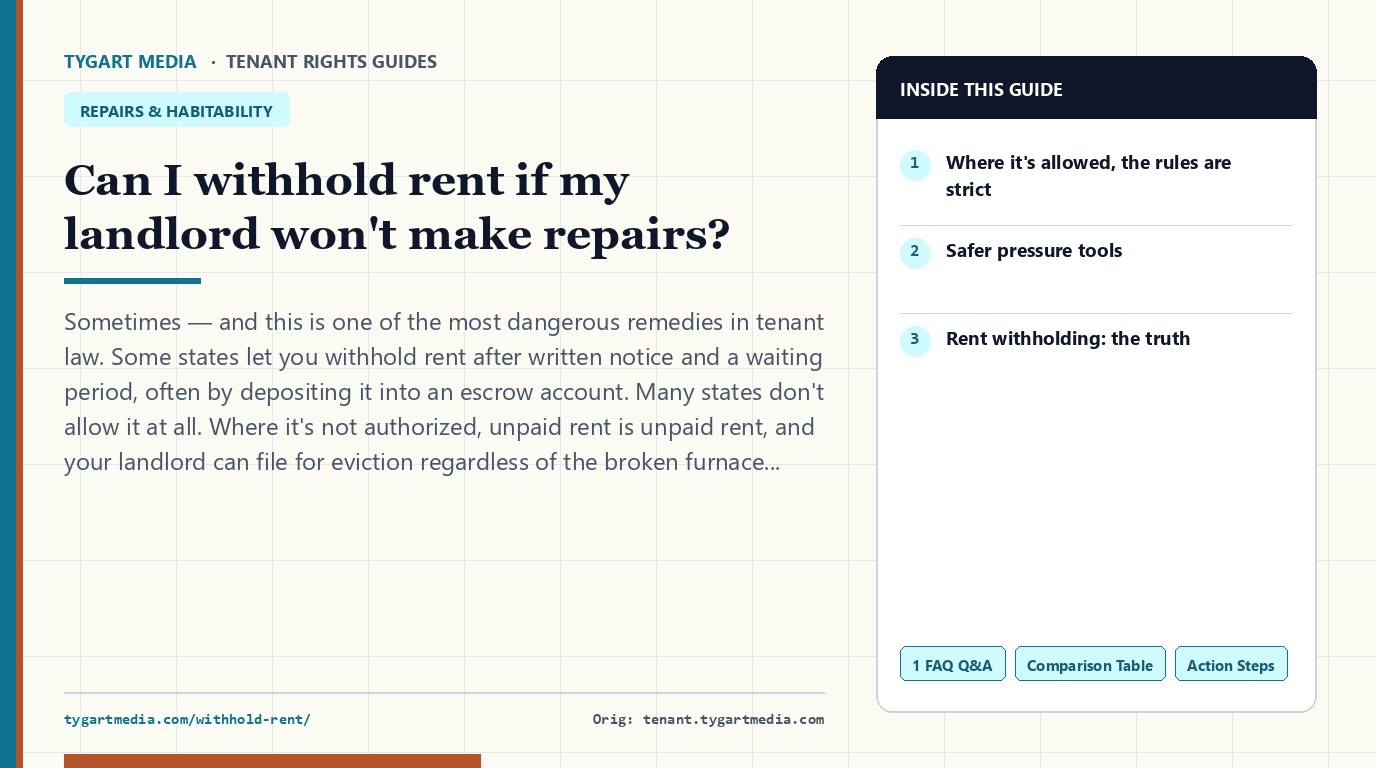
The short answer: sometimes — and this is one of the most dangerous remedies in tenant law. Some states let you withhold rent after written notice and a waiting period, often by depositing it into an escrow account. Many states don’t allow it at all. Where it’s not authorized, unpaid rent is unpaid rent, and your landlord can file for eviction regardless of the broken furnace. Read this whole page before you hold back a dollar.
Where it’s allowed, the rules are strict
Serious conditions only. Rent withholding is for habitability failures — no heat, no water, sewage, major safety hazards. Not for annoyances.
Written notice and a waiting period. You must notify the landlord in writing and give them time to fix it. The period is set by your state.
Escrow, in many states. Several states require the withheld rent to go into a court or bank escrow account — not your pocket. This proves you’re acting in good faith, not just skipping rent.
Full amount preserved. If a court later finds the conditions weren’t serious enough, you owe the withheld rent — having it in escrow means you can pay immediately.
Important Notice
The eviction trap Here’s what goes wrong: a renter withholds rent informally — no notice, no escrow, in a state that doesn’t allow it. The landlord files for nonpayment. The repair problem becomes legally irrelevant, and the tenant now has an eviction filing on their record. Every renter-facing lawyer will tell you the same thing: procedure first, always.
Safer pressure tools
Code enforcement. A city inspector’s violation order moves most landlords faster than any withheld check — and carries zero risk to you.
Repair-and-deductwhere your state allows it — you fix the specific problem and document the cost, rather than holding all the rent.
Written escalation. A dated letter citing your state’s habitability rules and your intent to use formal remedies often produces action before any remedy is needed.
Rent-withholding rules are among the most state-specific in tenant law. Some states authorize it with escrow; others prohibit it outright. Confirm your state’s exact procedure with a tenant-rights organization or legal-aid office before acting.
Rent withholding: the truth
Can you withhold rent? It depends.
State approach
What it means
Statutory right + escrow
You may withhold if rent goes to court escrow — the safest form
Statutory right, no escrow
Allowed but riskier — keep the money saved and documented
The short answer: most states make it illegal for a landlord to punish you for exercising your rights — asking for repairs, calling code enforcement, joining a tenant organization. Retaliation shows up as a sudden rent hike, an eviction notice, cut services, or harassment, arriving suspiciously soon after your complaint. Your case is the timeline: your protected action on one date, their action shortly after. Build it, don’t improvise it.
What retaliation looks like
A rent increase right after you complained or called an inspector.
An eviction notice or non-renewal that appears from nowhere.
Harassment — repeated unannounced entries, threats, shutting off utilities (utility shutoffs are illegal in most states regardless).
The pattern that matters: nothing happened for months, you took a protected action, and then the landlord’s behavior changed. That’s the story a court, mediator, or housing agency needs to see.
Your protections
Most states have anti-retaliation statutes covering a set period after protected activity — the window varies by state, so check yours. Within that window, the landlord’s adverse action is presumed retaliatory in many states, which shifts the burden: they have to show a legitimate reason, not you proving their motive. Remedies can include damages, stopping the eviction, and in some states the right to terminate your lease.
What to do
Don’t retaliate back. Withholding rent, changing the locks, or damaging the unit hands your landlord the counter-story. Stay clean.
Write down the timeline. Date of your complaint, date of their action, every communication. This is your case — see our documentation guide.
Respond in writing. A dated letter noting that their action followed your complaint puts them on notice that you see the pattern.
Contact a tenant-rights organization or legal aid. Retaliation claims are one of the areas where free legal help is most available — and most effective.
Important Notice
Can my landlord evict me for calling code enforcement? In most states: no — calling code enforcement is a protected activity, and an eviction filed in response is retaliatory. This is one of the most common retaliation patterns, and one of the most clearly protected. But “most states” isn’t “all states” — verify yours.
Anti-retaliation protections, covered activities, and time windows vary by state. Nothing here is legal advice. Contact a local tenant-rights organization or legal-aid office for guidance on your situation.
What counts as retaliation
Retaliation: protected actions and illegal responses
You did (protected)
They can’t do (retaliation)
Requested repairs
Raise rent, cut services, threaten eviction
Called code enforcement
Non-renew your lease in response
Joined a tenant union
Harass or surveil you
Most states presume retaliation if the landlord acts within 6–12 months of your protected action — the burden shifts to them.
The short answer: repair-and-deduct means you hire a professional to fix a repair your landlord ignored, then subtract the cost from your rent. It’s a real legal remedy in some states — and a fast track to an eviction filing in others. This is the guide to read before touching a wrench: the procedure is strict, and skipping a step can turn a valid repair into unpaid rent in your landlord’s eyes.
How it works where it’s allowed
Written notice first. Describe the problem, state that it’s the landlord’s responsibility, and give a deadline. Keep proof it was sent and received.
Wait the required period. Your state sets this — it varies, and the clock starts when the landlord got your notice, not when the problem started.
Hire a licensed professional. Not a friend, not yourself — a licensed contractor or tradesperson. Get a written estimate first.
Stay under the cap. Many states cap the deduction — often around one month’s rent — per repair or per year. Exceeding it breaks the protection.
Deduct with documentation. Send the landlord a copy of the paid invoice with your reduced rent payment, referencing the statute or rule you’re using.
Important Notice
Where it’s NOT allowed, this is just unpaid rent In states without a repair-and-deduct statute, subtracting repair costs from rent is indistinguishable from shorting the rent — grounds for a nonpayment eviction. “I fixed what you wouldn’t” is not a defense the law recognizes there. Check whether your state authorizes it before you spend a dollar.
When repair-and-deduct fits — and when it doesn’t
Fits: a discrete, professional-grade repair (broken water heater valve, failed lock, dead outlet circuit) that your landlord has ignored past a written deadline.
Doesn’t fit: cosmetic upgrades, huge structural jobs that exceed the cap, anything where the landlord is actively working on it, or repairs you caused.
Editor's Note
DIY doesn’t count Repair-and-deduct protects professionally done work with invoices. Your own labor, your friend’s weekend help, and cash payments with no receipt don’t create the paper trail the remedy requires. This is one of the places documentation is the entire ballgame.
Repair-and-deduct rules vary enormously by state — authorized in some, prohibited in others, with different notice periods and cost caps. Confirm your state’s exact procedure with a tenant-rights organization or legal-aid office before acting.
Repair-and-deduct rules
Using repair-and-deduct safely
Requirement
Detail
Written notice first
Landlord gets a chance to fix it — usually 14–30 days
Habitability issue
Must affect health/safety, not cosmetics
Reasonable cost
Many states cap at one month’s rent
Licensed pro
DIY receipts are harder to defend
Receipts to landlord
With the reduced rent payment, in writing
Skip a step and the deduction becomes “unpaid rent” — which can start an eviction. Follow the procedure exactly.
The short answer: usually not on the amount — in most of the US, landlords can raise rent as much as they want, once per lease term, with proper written notice. The fights you can win: the increase came with improper notice, you’re in a rent-stabilized area with legal caps, it landed mid-lease, or it’s retaliation for complaining. And even when the increase is fully legal, negotiation works more often than renters expect.
Check these four things first
Was notice proper? Most states require written notice before a rent increase — commonly 30 days, longer in some states and for larger increases. A text or a hallway conversation may not count. No proper notice, no valid increase.
Are you mid-lease? On a fixed-term lease, the rent is generally locked until renewal. Month-to-month tenancies can be raised with each notice period.
Are you in a rent-stabilized area? A handful of states and cities cap annual increases for covered units — the well-known ones include parts of California, New York, New Jersey, Oregon, and the District of Columbia. Coverage depends on building age, size, and ownership. Check your city’s housing office.
Is it retaliation or discrimination? A raise that follows your repair complaint, code-enforcement call, or organizing activity may be illegal retaliation. A raise applied to tenants of one protected class and not others may be discrimination. Both are serious — see our retaliation guide.
Negotiate anyway
Even a fully legal increase is a proposal, not a verdict — until you sign the renewal. Landlords price turnover risk too: a vacant unit costs them a month or more of rent plus make-ready costs. Practical levers: offer a longer lease at a middle number, show comparable rents in the building or block, point to your payment history, or ask what the increase funds (sometimes it’s negotiable once it’s itemized).
Important Notice
Don’t refuse to pay the increase without a legal basis If the increase is valid and you simply keep paying the old rent, the shortfall is unpaid rent — eviction territory. Dispute it through the channels above, negotiate, or make your exit plan. Silent nonpayment is the one response with no upside.
Editor's Note
Rent-stabilization is hyper-local Whether you’re covered depends on your exact city, building age, number of units, and sometimes your landlord’s identity. State housing sites and city rent boards publish coverage checkers — use them before assuming you’re capped or uncapped.
Rent-increase rules, notice periods, and rent-stabilization coverage vary enormously by state and city. Check your local housing office or a tenant-rights organization before acting.
Fighting a rent increase
Can you fight a rent hike?
Question
Answer
Is there rent control here?
Check — a few states/cities cap increases
Was proper notice given?
Most states require 30–60 days for increases
Is it retaliatory?
Increase right after a repair request is suspect
Is it discriminatory?
Different increases for different tenants = illegal
The short answer: in most states, your landlord has a legal duty to keep the place habitable — heat, water, plumbing, a safe structure. The process that wins: put the request in writing, give a reasonable time to fix, then escalate through your state’s remedies. Calling and complaining for months does nothing. A written paper trail changes everything.
Step 1: Put it in writing
If you’ve only called or mentioned it in person, you haven’t really asked yet — at least not in any way that holds up. Send a repair request by email or text so there’s a record: describe the problem, when it started, why it matters (safety, health, habitability), and ask for a repair date. Keep a copy. This single step is the foundation every remedy below stands on.
Step 2: Give a reasonable time
What’s reasonable depends on severity. No heat in winter, no hot water, a gas leak, a broken lock — that’s urgent: days, not weeks. A dripping faucet, a cracked tile, a noisy fan — that’s longer. Courts and code enforcement both think in these terms, so frame your timeline by severity, not frustration.
Step 3: The escalation ladder
Second written notice. Reference the first one, note the days elapsed, and say you intend to pursue your remedies. Landlords who ignored a request often move fast on a deadline.
Code enforcement / health department. Your city or county inspects rental housing and can order repairs — this is one of the most powerful free tools renters have. An inspector’s violation notice does what months of pleading couldn’t.
Repair-and-deduct. In some states you can hire a professional yourself and subtract the cost from rent — but only with strict notice procedures and often a cost cap. Illegal where not authorized. See our repair-and-deduct guide before trying this.
Rent withholding. Some states allow withholding rent (sometimes into an escrow account) after proper notice. Others treat unpaid rent as grounds for eviction regardless of the repair situation. See our rent-withholding guide.
Legal help. A local tenant-rights organization or legal-aid office can tell you exactly which remedies your state allows — often for free.
Important Notice
The move that backfires: just stopping payment The single fastest way to lose a repair fight is to stop paying rent without following your state’s procedure. Even when your landlord is clearly in the wrong, unauthorized nonpayment gives them grounds to file for eviction — and eviction filings follow you. Always use the formal process.
Editor's Note
“My lease says repairs are on me” Many leases include clauses shifting repair duties to the tenant. In most states, a landlord cannot waive the basic habitability duties by contract — the clause is often unenforceable for essential systems. Read your lease, but don’t assume a clause you signed ends your rights. Your state decides that.
Tenant rights vary enormously by state and city. Remedies like repair-and-deduct and rent withholding are legal in some places and dangerous in others. Check your state’s tenant-rights resources or a local legal-aid office before acting.
Your repair-rights toolkit
Options when the landlord won’t fix anything
Option
How it works
Risk level
Written repair demand
Certified letter citing the habitability duty
None — always step one
Code enforcement complaint
City/county inspector orders repairs
Low — but may trigger retaliation; document everything
Repair and deduct
You fix it, subtract from rent
Medium — legal in many states with strict procedures
The short answer: figure out where the moisture comes from. Mold growing from a roof leak, a plumbing leak, or failed building ventilation is the landlord’s building to fix — that’s a habitability fight, and your process is written notice, documentation, and escalation to code enforcement. Surface mildew in your own shower from steam is generally your cleaning to do. The moisture source decides whose problem it is.
Whose mold is it?
Landlord’s problem: mold spreading from a wall, ceiling, or floor near a leak; recurring growth after you clean it; musty smell with no visible source; mold tied to poor building ventilation or chronic dampness.
Your problem: mildew on shower grout or caulk from everyday steam; mold on your own belongings stored in a damp closet; growth from a spill you didn’t clean.
The legal hinge is the moisture source. A landlord generally must maintain the building envelope and plumbing; a tenant generally must ventilate and clean normally. When you’re unsure, describe the pattern — spreading from a wall after rain is a building story, not a cleaning story.
The renter’s process
Photograph everything, dated. Wide shots of the spread, close-ups, and the suspected moisture source (stained ceiling, damp wall, dripping pipe).
Written notice. Describe the mold AND the suspected source — “mold spreading on the bedroom ceiling below the bathroom; the ceiling is damp after rain.” Ask for the moisture source to be fixed, not just a wipe-down.
Give reasonable time, then follow up in writing. Mold tied to habitability is treated as urgent in most places.
Escalate to code enforcement or the health department. Many cities inspect mold complaints; an official violation notice is powerful.
See a clinician about health effects — don’t self-diagnose. If anyone in the home has symptoms, see a doctor and keep records. This site can’t give medical advice.
Important Notice
Don’t bleach-and-pray on the landlord’s problem Scrubbing a mold colony that keeps coming back wastes your effort and can weaken your case — it erases the evidence. Document first, notify in writing, and let the moisture source be fixed. If you clean, photograph before and after.
Editor's Note
Remediation know-how Curious what proper mold remediation actually involves — containment, drying, when it’s a DIY job versus a professional one? Our sibling water-damage response site covers the remediation process in detail. But the fight to make your landlord act lives here.
Mold rules and habitability standards vary by state and city. Nothing here is legal or medical advice. Contact a local tenant-rights organization for legal questions and a clinician for health questions.
Mold in a rental: who’s responsible
Mold responsibility: landlord vs. tenant
Cause
Usually responsible
Roof/plumbing leak
Landlord
Poor ventilation (no exhaust fan)
Landlord
Tenant never ventilates / dries clothes indoors
Tenant
Notify in writing immediately — delay weakens every remedy, including breaking the lease.
The short answer: in most states, no. Your landlord owns the building; you own the right to live in it undisturbed. That means advance notice — often around 24 hours — at reasonable times, for legitimate reasons like repairs, inspections, or showings. Real emergencies (fire, burst pipe, gas leak) are the exception. A landlord with a key is not a landlord with visiting rights.
The notice rule
Most states require landlords to give tenants advance written or verbal notice before entering — commonly 24 hours, longer in some states. Entry must be at a reasonable time of day and for a stated legitimate purpose: making repairs you requested, a scheduled inspection, or showing the unit to prospective tenants or buyers. “Just checking on things” on a Sunday morning is not on the list.
The exceptions
True emergencies — fire, flooding, gas leak, or reasonable belief someone inside is in danger. No notice required.
Abandonment — if the landlord reasonably believes you’ve moved out and left the unit.
Court order — rare in residential tenancies, but it overrides notice rules.
A dripping faucet the landlord “wanted to look at” is not an emergency. Emergencies are the kind of thing you’d call 911 about.
How to draw the line
Log every entry. Date, time, whether notice was given, what happened. See our documentation guide.
Send a written request. Cite your state’s notice rule, ask for the required notice before every non-emergency entry, and keep a copy.
Escalate in writing. If it continues, a second letter noting the pattern — and that repeated unannounced entries may violate your right to quiet enjoyment — usually gets attention.
Get help. A tenant-rights organization or legal aid can advise on remedies, which in some states include damages or lease termination.
Important Notice
Don’t change the locks It’s tempting — and in most leases it’s a violation that gives the landlord grounds against you. Many leases and states require the tenant to provide the landlord a key. Fight the entry problem through notice rules and documentation, not hardware.
Entry-notice requirements, reasonable hours, and remedies vary by state. Nothing here is legal advice. Check your state’s rules or a local tenant-rights organization before acting.
Entry rules at a glance
When can a landlord enter?
Situation
Typical rule
Routine inspection / showing
24–48 hours written notice in most states
Emergency (fire, flood, gas)
No notice required
Abandonment suspected
Varies — usually requires extended absence + unpaid rent
“Just checking”
Not a legal basis anywhere
Document every unannounced entry with date and time. A pattern supports harassment and retaliation claims.
The short answer: habitable means safe and livable — working heat, hot and cold water, functioning plumbing and electrical, a weatherproof structure, and freedom from serious infestations you didn’t cause. It does not mean cosmetic perfection or brand-new appliances. In most states this is an implied warranty of habitability: a legal duty your landlord owes you whether or not the lease mentions it.
Usually covered: the essentials
Heat and hot water — the classic habitability items.
Plumbing — working toilets, no sewage backups, running water.
Electrical — safe wiring, working outlets, no exposed hazards.
Structure — roof that doesn’t leak, walls, windows that close and lock, stairs and railings that are safe.
Vermin — serious infestations the tenant didn’t cause (a building-wide roach problem is different from crumbs you left out).
Moisture — leaks from the roof or plumbing that the landlord must fix at the source.
Usually not covered: the cosmetic layer
Faded paint, an ugly-but-working stove, a slow drip you can live with, a cracked tile, carpet that’s old but clean — these annoy you but rarely trigger the habitability duty. Courts and code enforcement both draw this line: safety and health first, aesthetics later. If you’re framing a repair request, anchor it to health and safety, not looks.
Your side of the bargain
Habitability isn’t one-sided. Tenants generally owe the landlord: reasonable cleanliness, not causing damage, not removing landlord fixtures, and prompt notice when something breaks. A problem you never reported — or one you caused — is much harder to turn into a habitability fight. Some duties (like changing smoke-detector batteries or light bulbs) fall on the tenant in many leases and states.
Editor's Note
The lease can’t always waive this In most states, a lease clause saying the tenant takes the unit “as is” or waives habitability doesn’t hold up for the essential duties. The law sets a floor the contract can’t drop below. But the exact floor — and the exceptions — are state-specific, which is why “my lease says no” is a question for your state’s rules, not your lease.
Important Notice
Local codes add a layer Many cities and counties have their own housing or building codes that go beyond state law — inspection programs, registration requirements, specific temperature minimums. Your city code-enforcement office is often the most practical place to learn exactly what’s required where you live.
Habitability standards vary by state and city. Nothing here is legal advice or a substitute for a lawyer. Contact your local tenant-rights organization or legal-aid office for guidance on your specific situation.
What “habitable” means
The habitability baseline
Must have
Notes
Heat and hot water
Core in every state
Working plumbing + sanitation
Non-negotiable
Weatherproof structure
Roof, windows, doors intact
Free of infestations
Landlord’s duty in most states
Electrical safety
Working outlets, no hazards
No lease clause can waive habitability — it’s implied by law in nearly every state.
The short answer: almost every renter fight is won or lost on paper. Put every request in writing, photograph everything with timestamps, save every response, and keep one folder per issue. Code enforcement, mediators, small-claims judges, and lawyers all run on documentation — your memory of a phone call is not documentation.
The five things to capture
The request, in writing. Email or text — anything with a timestamp and a record. Include: the date, a specific description of the problem, where it is, when it started, why it matters (safety, health, habitability), and a requested repair date. “The bathroom ceiling has been leaking since March 3; the drywall is sagging; please repair by March 14.”
Photos and video, dated. Wide shots for context, close-ups for detail. Most phones timestamp automatically — don’t strip the metadata. Photograph the problem getting worse over time; a progression series is devastating evidence.
Every response. Save the landlord’s replies, voicemails (transcribe them), and notes from in-person conversations — date, who was there, what was said. Follow up verbal promises with a confirming text: “Just confirming you said the plumber comes Tuesday.”
Every entry and interaction. Unannounced entries, threats, sudden rule changes — log date, time, and what happened. This is the timeline a retaliation claim is built from.
Receipts and costs. Anything you spend because of the problem — a space heater during a heat outage, a hotel night during a sewage backup — keep the receipt. These become damages.
The template
A repair request that holds up has five parts: date, description, habitability link, deadline, and paper trail. Example:
Hi [name], I’m writing to report [specific problem] in [location], which started on [date]. [One line on impact: no hot water since Tuesday / water staining spreading on the ceiling.] Please have this repaired by [reasonable date]. I’ll follow up if I haven’t heard back. Thank you — [your name], [unit], [date].
One folder per issue
Physical folder or cloud folder — doesn’t matter, as long as it’s one place: the request, the photos, the responses, the receipts, the log. When you walk into legal aid, a mediation, or a hearing with a dated folder per issue, you look like someone who wins. Because you usually do.
Important Notice
Phone calls are where cases go to die Nothing against calling — but a call without a written follow-up didn’t happen, legally speaking. After every call, send a text or email summarizing what was agreed. “Per our call today, you’ll send maintenance Thursday” takes thirty seconds and changes everything.
Documentation practices are universal, but the remedies your documentation supports vary by state. Nothing here is legal advice. Contact a local tenant-rights organization or legal-aid office for guidance on your situation.
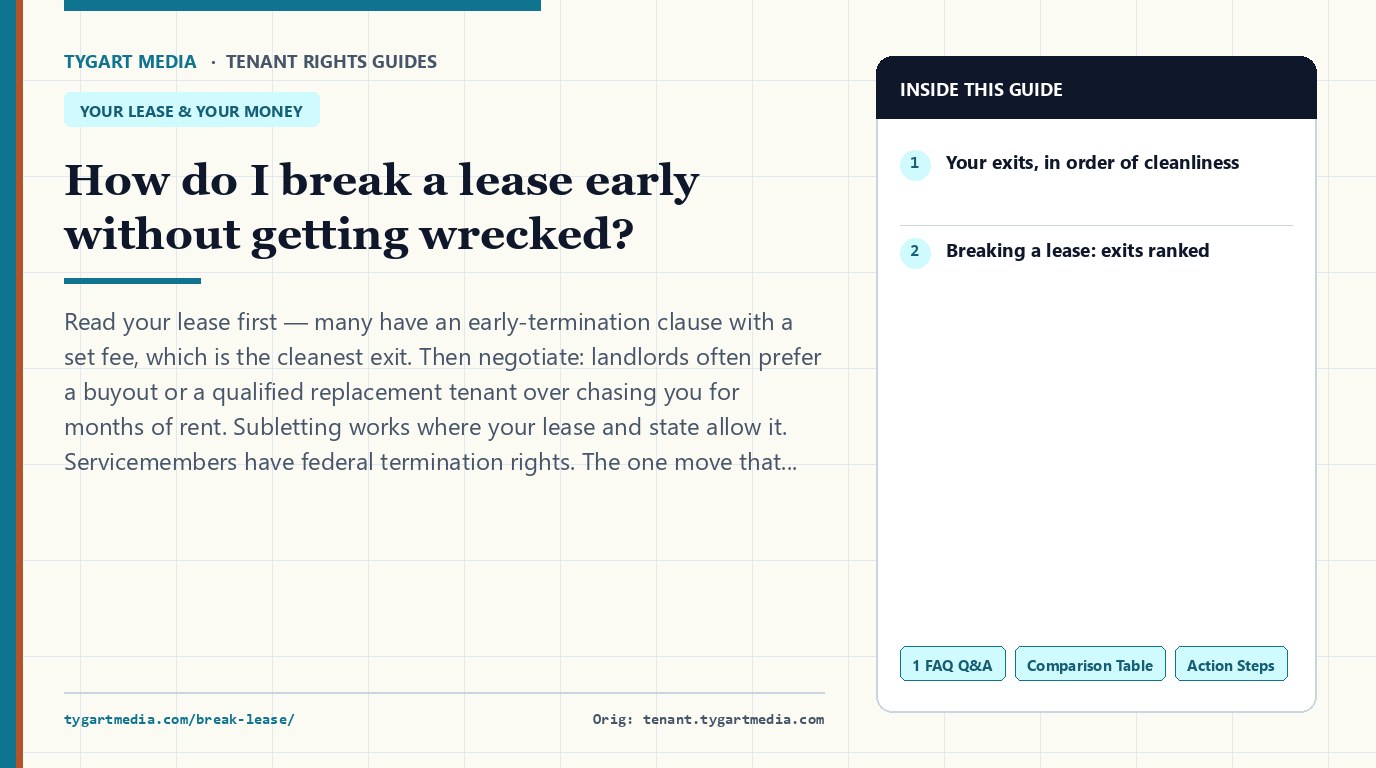
The short answer: read your lease first — many have an early-termination clause with a set fee, which is the cleanest exit. Then negotiate: landlords often prefer a buyout or a qualified replacement tenant over chasing you for months of rent. Subletting works where your lease and state allow it. Servicemembers have federal termination rights. The one move that reliably backfires: just moving out and stopping payment.
Your exits, in order of cleanliness
The lease’s own exit clause. Many leases include an early-termination option — often one to two months’ rent as a fee. It’s the most expensive clean exit and the cheapest messy one.
Negotiate a buyout. Propose a number and a move-out date in writing. Landlords price vacancy risk: a guaranteed payment and a clean handover often beats months of uncertainty.
Offer a replacement tenant. Finding a qualified person to take over your lease removes the landlord’s biggest objection. Get any agreement in writing.
Sublet or assign — if allowed. Some states and leases permit subletting; some landlords can’t unreasonably refuse. But you usually remain liable if the subtenant flakes — read the terms.
SCRA for servicemembers. The federal Servicemembers Civil Relief Act lets active-duty servicemembers terminate residential leases with proper notice and a copy of orders — for deployments and permanent-change-of-station moves.
Important Notice
Just leaving doesn’t end the lease Moving out and stopping payment doesn’t terminate your obligation — you generally remain liable for rent through the lease term, though many states require the landlord to make reasonable efforts to re-rent (the “duty to mitigate”). An unpaid balance can go to collections and court. Exit through one of the doors above instead.
Editor's Note
Unhabitable conditions are a separate path If you’re leaving because the unit is genuinely unlivable — no heat, no water, severe unresolved hazards — that’s a constructive-eviction argument, not a casual break. The bar is high and the process is legal: document everything, follow your state’s procedure, and talk to a lawyer or legal aid before relying on it.
Editor's Note
The deposit fight is separate Breaking a lease doesn’t end the security-deposit question — landlords sometimes try to keep deposits as “damages.” The deposit fight has its own playbook on our sibling deposit-guide site: return timelines, deductions, and demand letters.
Lease-termination rules, subletting rights, and mitigation duties vary by state. Nothing here is legal advice. Check your lease and your state’s rules — or a local legal-aid office — before acting.