The first time your company runs into a job it has never seen before, don’t send your fastest technician. Send your most experienced one.
The most experienced tech doesn’t just see the job in front of him. He sees it the way the company sees it. He notices how this job touches the next five jobs, where the traps are, and what goes wrong if it’s done the cheap way. That kind of seeing can’t be written down by somebody who wasn’t there.
He comes back with two things: a finished job, and the standard for every version of that job that follows. The finished job pays once. The standard pays every time the phone rings after that.
After that first run, the job doesn’t belong to the technician anymore. It belongs to the procedure. The next tech doesn’t need the first tech’s twenty years of judgment. He needs the SOP and the discipline to follow it to the T. The judgment was already spent — by the right person, at the right time, on purpose.
When the field hits something the procedure doesn’t cover, it goes back to the person who wrote it. Not sideways into improvisation. Back. The scope changes when the curator agrees it changes, and not before. Otherwise fifty jobs turn into fifty slightly different ways of doing the job, and nobody can tell you which one is yours anymore.
Here is where most companies lose it. Their procedures belong to the company, which means they belong to nobody. A binder of SOPs with no name on any of them is a museum — well-organized, carefully written, and dead. Nobody checks whether reality has drifted away from the page, because noticing was never anybody’s job.
Every SOP deserves an owner. A leader. A champion. Its soul, if we’re being honest about what actually keeps a standard alive. Put their name on it. Their responsibility is to uphold it, improve it, digest what the field learns, share it, and teach it like it matters — because to them, it does.
Passion does not travel through paper. A new hire does not catch your standard from reading a document. He catches it standing next to the person whose name is on the document, watching how much that person cares whether it’s done right. The owner’s pride is the real enforcement system. No audit ever caught what a champion’s raised eyebrow catches.
Companies say they have a documentation problem. They don’t. They have an ownership problem. A procedure with an owner gets better every time it runs. A procedure without one starts dying the day it’s printed.
“I don’t publish to be read. I publish to remember.”
That sounds backwards until you’ve watched a Tuesday fade. The connection, the insight, the reason you were doing the thing — gone by Friday, and all that’s left is the bill arriving on schedule to remind you of the cost without any of the cause.
So I write it down. And then I publish it. Those are two different acts, and they do two different jobs.
The fading
Here’s the mechanics of forgetting, and it’s not a character flaw — it’s just how the hardware works.
The bill arrives every month: exact, itemized, impossible to ignore. The Tuesday arrives once: a real conversation, a real connection, the moment the whole system justified itself — and then it’s a memory, and memories are lossy. Every retelling compresses. Every month thins it out. Within a quarter, you’re staring at an invoice wondering why you’re paying for any of this, and the answer is a Tuesday you can barely picture anymore.
The written page doesn’t fade. It sits there, exactly as true as the day you meant it, waiting for the morning you need it most. That’s not content. That’s a rescue line thrown to your future self.
The site as a second brain
Every article is a neuron.
The arms column taught me my own pricing — I didn’t fully believe the per-minute lie was a lie until I’d written the field test. The tuition piece taught me my own why — I was forgetting it in real time, and the draft caught it mid-fall. I didn’t write those pieces because I knew those things. I know those things because I wrote those pieces.
That’s the direction everyone gets backwards. Writing isn’t the record of thinking. Writing is the thinking. The draft argues with you. Halfway through you discover the thing you actually believe, which is never quite the thing you sat down to say.
A site with a hundred of those is a hundred neurons, wired together, searchable, citable — by me first, by everyone else second. It’s not a blog. It’s the outside of my head.
The receipts
There’s a second job the published page does, and it’s for a different audience: proof.
Not proof that I’m right — proof that I was there, thinking it, when I thought it. Dated, timestamped, in public. For the future partner doing diligence. For the future auditor asking “what did you actually believe back then.” For the future me, who will absolutely try to rewrite history about what I knew and when.
Memory edits. The published page doesn’t. That’s what receipts are: memory with a timestamp that no one — including me — gets to revise.
The loop
Here’s the whole machine, and it’s been running for years before I had a name for it.
I live — the calls, the jobs, the Tuesdays. I write — the draft that argues with me until the real belief surfaces. I publish — the neuron goes up, dated and public. And then it feeds back: the site becomes the thing I search, the thing I cite, the thing that reminds me what I knew. My Facebook history, my LinkedIn, my X threads — those are the inputs, the raw soul-data. The articles are the outputs, the refined version. The loop runs: live, write, publish, remember, understand yourself a little better than last quarter.
Most people publish to be perceived. I publish to perceive — myself, clearly, before the fading gets it.
The close
Write it down or it didn’t happen.
Publish it or you’ll forget you knew it. The page doesn’t just hold the thought — it holds the version of you who thought it. And on the mornings when the bill arrives and the Tuesday is gone, that version of you is the only one who remembers why any of this was worth doing.
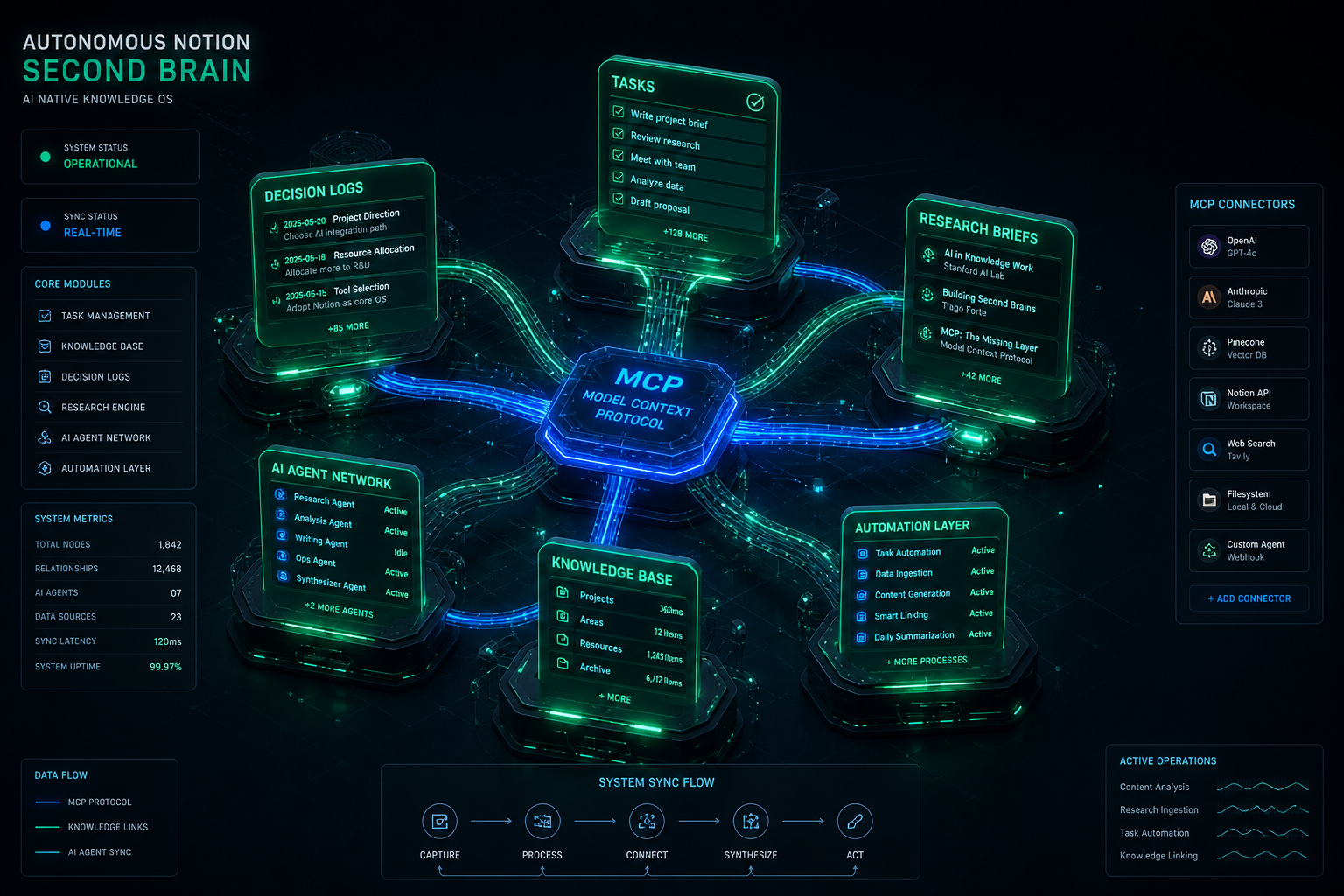
The fundamental flaw of traditional “Second Brain” systems is human maintenance friction. Users build elaborate Notion templates with linked databases, tags, and relations, only to abandon them within three months because manual data entry cannot keep up with the velocity of daily decisions, meetings, and project iterations. In 2026, the Autonomous Second Brain solves this problem completely: AI agents autonomously capture, structure, cross-link, and maintain Notion databases in real time via the Model Context Protocol (MCP).
The Zero-Maintenance Architecture: Key Highlights
Zero Manual Data Entry: Agents listen to live conversations, email threads, and code reviews, extracting decisions directly into structured Notion database properties.
Autonomous Task Staging: Engineering and operational work orders are generated with full technical context and auto-assigned to team members without human drafting.
Cross-Surface Knowledge Graph: Notion acts as the single source of truth connecting local IDEs, remote servers, email hubs, and public websites.
Self-Cleaning & Evergreen Pruning: Automated agent loops merge duplicate notes, reconcile contradictory facts, and archive stale records periodically.
Visual generated by Grok AI — Autonomous Notion Second Brain: MCP Connectors, Multi-Database Topology & AI Agent Ingestion.
1. How MCP Transforms Notion from a Notebook to an Active Memory Layer
Before Model Context Protocol, connecting an AI assistant to Notion required brittle custom webhooks, rigid Zapier zaps, or clunky browser extensions. With the official Notion MCP server, AI models natively execute rich semantic operations directly inside their reasoning loop:
MCP Capability
Traditional Manual Workflow
Autonomous MCP Workflow
Knowledge Capture
Copy-pasting notes into a blank Notion page after a call.
Agent auto-extracts action items & writes structured blocks via notion-create-pages.
Context Retrieval
Manual search with keywords across dozens of folders.
Agent runs semantic vector lookup across workspace with notion-search.
Database Schema Updates
Creating tags, properties, and status fields manually.
Agent auto-maps properties with type validation and sensible defaults.
2. Production Workflow: The Autonomous Work Order Pipeline
In our technical operations at Tygart Media, when an issue arises (e.g., automated cron alerts firing excessive emails or pilot registrations requiring team coordination), the human operator never writes a task card manually. Instead, the agent executes the following pipeline:
Problem Extraction: The agent detects the root cause from system logs or email history.
Schema Matching: The agent calls notion-search to locate our team’s active Work Order database.
Context Ingestion: Formats the ticket with standardized sections: Priority level, Assignee, Problem Summary, Execution Steps, and Acceptance Criteria.
Live Deployment: Executes notion-create-pages, returns the permanent Notion URL in chat, and logs the task ID across our session context.
3. Building the 4-Layer Autonomous Knowledge Stack
Knowledge graphs degrade over time if left unpruned. We implement automated reflection routines where the agent executes a monthly maintenance audit:
Duplicate Detection: Finding similar topic notes across different months and synthesizing them into a single canonical source.
Status Synchronization: Checking completed pull requests and closing out corresponding Notion task cards automatically.
Broken Citation Repairs: Updating URLs and standard definitions when external regulations change (e.g., California SB 253 amendments or NYC Local Law 97 rule updates).
Conclusion: The Ultimate Leverage for Solopreneurs & Teams
An Autonomous Second Brain transforms Notion from a passive digital graveyard into an active operating system for your mind and business. By combining the speed of modern reasoning models with the open standard of MCP, knowledge workers can achieve complete operational leverage—capturing every insight and managing complex operations with zero maintenance overhead.
>For full architecture walkthroughs and custom enterprise agent implementations, browse our complete collection of technical playbooks on Tygart Media.
Google’s real superpower was never search or ads. It was the door home — and I learned that at 2 a.m., locked out of my own life.
I locked myself out of my own account a little after one in the morning. I don’t even remember what I needed in there — something small, something that could have waited until daylight. What I remember is the password field refusing me, then refusing me again, and the cold drop in my stomach when I realized the keys to a dozen other things lived behind that one rejection.
So I did what everyone does. I grabbed my phone. I tried the recovery email, which routed to an account I also couldn’t reach. I tried the text-message code. I tried the security questions, answered years ago with half-truths I’d invented and instantly forgotten. I worked the recovery flow like a man patting his pockets at a locked door, and somewhere in there it landed on me that I was negotiating — not with a hacker, not with a thief, but with the company that decides whether I am still me.
I got back in by morning. Relief, and then a second feeling underneath it that wouldn’t leave: that was the product. Not the search box. Not the ads. The way back in.
I build access layers for a living. Second brains. A life-ranking system I call the Compass. The structured record a business can’t operate without — the institutional memory that walks out the door when the wrong person quits. Continuity systems for my wife Stefani, so the things she needs are still there on the days her memory isn’t. I’d been filing all of it under content and tooling. That night I understood I’d been mislabeling my own work — and I understood something about Google that most people have backwards.
Two things, not one
Two things, not one — login vs search.
Here is the distinction that reorganized everything for me, and I want to be precise, because the sloppy version of this argument is wrong.
Search and ads are how Google makes money. That’s the business model, the value capture, the line on the income statement. Anyone who tells you access “beats” advertising is comparing a turnstile to a cash register. They don’t sit on the same axis.
But there are two things going on, and we only ever talk about one. Ads are how Google makes money. Access is why you can’t make Google stop. The login, the password manager, the “Sign in with Google” button, the recovery flow when you’re locked out — none of it earns a dollar directly. Google gives it all away. It exists to defend the surface where the money gets made.
And that’s the part people miss: the layer that earns nothing is the layer you can never leave. Attention is rented by the day — a better answer wins the next query, a better feed wins the next scroll. Access is owned by the year. So I won’t tell you access is more valuable than attention. I’ll tell you something narrower and more interesting: access is more durable. It is the layer with its hand on the master switch, and it shows up on the books as a cost center, a free feature, a help-desk ticket — which is exactly why nobody guards against it.
Why the door beats the window
Why the door beats the window.
The mechanics are almost embarrassingly simple once you see them.
You can change your default search engine in a single setting. One click, a coffee break, done. Now try changing the thing that holds the keys to everything else. Imagine someone who’s used “Sign in with Google” across twenty or thirty services — and once you start counting your own, the number climbs faster than you’d like. That account isn’t an account anymore. It’s the hinge the whole house swings on. Lose it and you don’t lose one thing; you lose your bank login’s recovery path, your work tools, your tax software, your photos, the smart lock on your front door.
That’s the asymmetry. Search is a window you can swap in an afternoon. Access is the door the whole house hangs on — and the house has been quietly built around it.
This is switching-cost economics, and it has a clean shape. The hold a company has on you is its switching cost plus whatever its product is actually, presently better at. Advertising lives almost entirely on that second term — a marginally better result — which evaporates the instant a rival catches up. Access lives on the first, and the first only grows. Every new service you wire to that one login deepens the hold by one more door. Adding a lock is a single pleasant click. Removing it means re-keying every door at once, in parallel, under deadline, with permanent lockout as the price of getting it wrong. The pain isn’t additive. It’s combinatorial. That gap — between how easy it is to add the lock and how terrifying it is to pull it — is the moat.
Salesforce and SAP have lived inside this physics for decades, holding enterprise customers for twenty-five-year stretches, and nobody calls them content businesses. Google built the same thing for your whole life and handed it out for free.
The institutions confirmed it by where they aimed. When the U.S. courts found Google an illegal monopolist, the remedy went after the contracts — the roughly twenty billion dollars a year Google pays Apple to be the default, the exclusive default-search deals, now capped to one-year terms. But the court declined to break off Chrome or Android. It renegotiated who gets to answer the door and left untouched the company that built every lock, hinge, and recovery key in the house. Even the people dismantling the monopoly treated “who is the default way in” as the twenty-billion-dollar question — and left the deeper layer, the one that actually owns login, autofill, passkeys, and recovery, exactly where it was.
The thing it holds is a piece of your mind
I could have left it at economics. But the lockout didn’t feel like an economics problem at one in the morning. It felt like an amputation, and I want to take that feeling seriously, because it’s the truest part.
There’s an old argument in philosophy of mind — Andy Clark and David Chalmers, 1998, “The Extended Mind.” They imagine Otto, a man whose memory is failing, who writes what he needs in a notebook and consults it the way you and I consult the inside of our own heads. Their claim isn’t that the notebook helps Otto’s mind. It’s that the notebook is part of Otto’s mind — the storage just happens to sit outside his skull. If a process counts as remembering when it happens in your head, it counts as remembering when it happens in the world.
I read that and thought about Stefani. “Remember for her when she can’t” is Otto’s notebook, almost word for word. The philosophy was settled twenty-eight years ago: the thing that holds your memory for you is not a tool you use. It is part of the mind doing the remembering.
Then the cognitive science caught up with the philosophy. In 2011, Betsy Sparrow and her colleagues at Columbia tested how people handle information they expect to look up later. We don’t retain the information, they found — we retain where to find it. The brain offloads the content and keeps the pointer. We are becoming, in their phrase, symbiotic with our tools. Sit with that: human memory already ran my experiment and reached my conclusion. It threw away the fact and kept the way back in. Access beating content isn’t a strategy I invented. It’s how your own head now works.
Which means whoever holds the pointer holds the only half of the memory your brain bothered to keep. You can swap a search engine in a second. You cannot swap a piece of your own mind without something that feels, accurately, like a small lobotomy. An ad interrupts you. A lockout unselfs you. And the entity that hands you back in isn’t selling you a service. It’s returning you to yourself.
There’s a flip side I have to be honest about, because it’s the whole case for doing this carefully. Sparrow’s same line of research shows that offloading frees you up — trusting that something is safely stored elsewhere measurably improves your ability to learn the next thing. But it also shows the benefit reverses when the external store turns out to be unreliable. You end up worse off than if you’d never offloaded, because you pruned the internal copy and the external one failed you. Reliability isn’t a feature of a continuity layer. It’s the entire product. A second brain that might vanish doesn’t merely fail to help — it degrades the mind that came to depend on it.
The blade cuts both ways
So here’s where I turn the knife on my own argument, because the thing that makes access powerful is the same thing that makes it dangerous, and I don’t trust anyone who won’t say so.
Access is a pharmakon — Plato’s word, the one Derrida built on: the single substance that cures and poisons, depending on nothing but the dose and the hand that holds it. The recovery flow that rescued me at 2 a.m. is, mechanically, the identical system that means I can never fully leave. Not two features in tension. One feature, seen from two sides.
Android makes it literal. Factory Reset Protection turns a wiped phone into a brick until the original Google account is re-verified. The feature that stops a thief from using your stolen phone is the same feature that makes the device hostage to Google’s say-so. Protection and imprisonment, one mechanism — and Google isn’t retreating from this ground, it’s deepening it, because recovery is exactly where the bond forms. The company that saves you and the company that traps you are the same company. You’re just meeting it at two different moments.
Now let me take the strongest objections head-on, because the good ones are real.
“Switching costs approach infinity.” No. I used to say it that way, and it was wrong. People migrate ecosystems by the hundreds of millions and carry their photos and contacts with them. Phone-number portability was mandated and it worked. Passkeys are an open standard, and their own backers built a credential-exchange protocol specifically to make them portable between password managers. Europe’s data-portability law already forces Google to hand you everything. My own founding story refutes the infinity claim: I got back in by morning. The moat is high, it is real, and it is finite and shrinking by design — every serious regulatory and technical current of this decade is engineered to grind it down. And that cuts in my favor. If lock-in were infinite, “we’ll let you leave” would be a meaningless promise. It means something only because leaving is becoming genuinely possible.
“Isn’t ‘access as care’ just what every captor says?” Yes. Company towns called themselves family. AOL called itself a community. Every lock-in business in history has narrated itself as care, and the distinction is invisible at the exact moment it matters most — when you’re locked out, sick, grieving, laid off, and least able to audit whether anyone actually has your back. This is the real soft spot, and I won’t paper over it. Care cannot be declared. It has to be engineered — and provable by someone who never read the terms. Words are free. I’ll come back to what isn’t.
“Gratitude isn’t a moat — the 2 a.m. plumber gets it too.” Correct. The ER, the locksmith, roadside assistance, my own restoration clients on the worst day of their lives — they all bond at the moment of relief, and gratitude decays, and people shop their insurance anyway. So gratitude isn’t the moat. It’s the on-ramp. The midnight rescue doesn’t lock anyone in; it earns the first conversation. What keeps them is what you do after — and that’s a question of character, not a property of the crisis.
Care holds the same keys — and hands you a copy
Let me show you what the answer looks like before I argue for it.
Last winter one of my restoration clients walked into a commercial building with two inches of standing water across the floor — burst supply line, ceilings down, a decade of operating records soaking in a back office that also held the only copies of their continuity plan, their vendor contracts, their insurance file. By the time the water was out, the part they were most afraid of losing wasn’t the drywall. It was the paper. We’d already pulled their critical records into a structured store they could reach from a phone — indexed, searchable, theirs. The owner stood in the wreckage and opened the file on his phone, and the thing that could have ended the business was just there. Then the part that matters to this essay: when the job closed, the whole store exported in one motion, in formats their own systems could read, and went with them. No call to me. No ransom for their own records. They walked out with the keys in their hand, and the relief on the owner’s face was the entire argument I’m about to make, compressed into one moment.
That’s the difference between holding the keys for someone and holding them over them. Once you accept that the held thing is part of a person’s mind, the ethics stop being a garnish and become the architecture. Holding a piece of someone’s cognition and refusing to let them leave isn’t hard-nosed business; it’s closer to holding a self hostage. Holding that same piece while guaranteeing they can walk out with all of it, any time, without asking — that’s not a vendor. That’s a trustee. The oldest answer the law has to the question of how you hold something vital that belongs to someone else: you hold it for them, bound to their interest, returnable on demand.
The whole thing collapses to one question. Not do you hold the keys — someone always holds the keys. The question is whether you hold them for her or over her. Google books your access as its switching cost, an asset on its side of the ledger. The humane version books it as your asset, merely held in trust. Same keys. Opposite politics.
Which is why I keep coming back to the difference between a scaffold and a cage. Good scaffolding is built to come down — calibrated to do only what the person can’t yet do alone, withdrawn as they grow. A scaffold that never comes down isn’t support anymore; it’s a wall you’ve forgotten how to live without. “Remember for Stefani when she can’t” is the morally exact phrasing — contingent help for a real gap, not a blanket seizure of her agency. Do everything for someone and you don’t make them safe. You teach them they can’t.
And I’ll admit the moat I’m choosing is the weaker one. A lock-in moat is strong precisely because it’s coercive — you stay because you can’t go. A trust moat is fragile; one breach and it’s gone overnight. I’m choosing the fragile one on purpose, and not only because it’s right. Lock-in and care produce the identical retention number — ninety-nine percent stay either way — but for opposite reasons, and the difference only shows up the day switching becomes free. That day is coming: portability law, open credential standards, and soon an AI agent that can re-key your whole life in an afternoon. When it arrives, the captivity moat evaporates and the trust moat doesn’t even notice. Free exit isn’t charity — it’s the only hold worth having once leaving is easy and everyone knows it. I’m not being generous. I’m being early.
But I won’t let myself off with a promise, because a promise from an interested party is exactly what breaks the day the incentives flip — an acquisition, a cash crunch, a change of hands. So the care has to be built into things that survive my intentions. Export in open, ingestible formats — not a dead blob no other system can read, which is fake portability wearing a real coat. A published exit that works without anyone calling me. A governance mechanism that binds the company after it’s sold. Don’t trust my intentions. Trust the mechanism that outlives them. That’s the only honest answer to “every captor says that.” The test was never the happy customer. It’s whether the grieving spouse who never read a word of the terms can still get everything out, in one motion, with no call to me. Design for the person who can’t advocate for themselves, and the ethics stop being marketing.
The door is moving — to the agent
The door is moving — to the agent.
This is also the shape of the next decade, and it’s why I work the way I work.
Google holds the keys to your accounts. The AI agent is coming to hold the keys to your context — what you’re working on, what you decided last month, how you actually think and operate. That’s a deeper hook than a login, because a login gets you into the app, but context is the work. Search was a query you typed and forgot. The agent is a relationship that accumulates.
And there’s a real chance, for the first time, that the door doesn’t have to be a cage. The plumbing that lets an agent reach into your files, calendar, and tools — Anthropic’s Model Context Protocol — is being built as a shared, open standard rather than one company’s private wiring. I won’t call that settled or “neutral”; standards get captured, and this one is young enough to go either way. But open plumbing at least makes it possible to build an agent that reaches into everything you own without owning it. Access without capture is finally buildable, not merely sayable.
The trap is moving too — and getting subtler. The new lock-in isn’t your data. It’s the agent’s learned understanding of you, accreted day after day. You can export every chat log and still leave behind the part that actually knew you, because raw logs aren’t understanding, and no portability law reaches that gap. Which is the whole reason I build on Claude rather than treat any of this as theory: its memory has a delete button and an export button. You can read what it knows about you, change it, take it elsewhere, even bring your history in from somewhere else. That’s not a feature. It’s a thesis with a receipt — own the payload, walk out anytime, shipped.
I have to name the obvious dark mirror, because it’s already shipping. Microsoft Recall makes the identical pitch — we’ll remember everything for you — by quietly screenshotting your screen every few seconds into a local index. Same promise, opposite governance: a memory built about you, by default, that you didn’t author and can’t easily hand to anyone else. The pointer to your own mind, held on someone else’s terms. The seat for “Sign in with your agent” is still empty, but the room is filling — Recall, OpenAI’s persistent memory, Gemini woven through Android, Apple’s on-device intelligence are all reaching for it. Whoever defines what care looks like before that seat fills sets the norm for everyone after. That’s not a forecast from the bleachers. It’s the work.
What I’m actually building
So let me say what my portfolio really is, because I had it mislabeled too.
It looks like five businesses held together by nothing but my calendar — restoration clients, the second brain, the Compass, remembering for Stefani, the structured record a company can’t operate without. It’s one product. Each version shows up at the bottom — the moment of maximum vulnerability, when someone has the least to spare and the most to lose — takes custody of a piece of their continuity, and is built, from the foundation, to give all of it back. Continuity is the one thing the attention economy never touches: the durable layer a person or a business runs on — their records, their memory, their way back into their own life — the part that, if it vanished, would not just inconvenience them but unself them.
The attention economy fights for you when you have everything to spare, which is why it has to shout and why you resent it for shouting. The continuity layer shows up when you have nothing left, and arrives with relief. Bonds made at the bottom run deeper than impressions bought at the top — but only one kind of person should be trusted to be there at the bottom: the kind who hands you the key on the way in.
I’ll concede the last hard thing plainly, because a skeptic has already spotted it. Today, the part of my work that pays the bills is the discovery work — getting found, getting ranked, getting cited. The continuity layer is real but young, and I won’t pretend it has finished proving it can pay. Here’s how I think it does: not by charging for the data, which would just be the cage again, but as a held-in-trust retainer — an ongoing fee for keeping the lights on and the door unlocked, priced like what it is, a fiduciary relationship rather than a subscription you’re trapped inside. You earn the right to charge it by first being useful enough to be found. Discovery isn’t a contradiction of the thesis; it’s the front door. Attention comes first. It always did. The mistake is thinking it’s the destination.
And here’s the part I can’t dodge, the one that keeps me honest. The agent I’m betting on — the one that can re-key a whole life in an afternoon — is the same tool that dissolves my moat too. If re-keying is trivial, the switching cost protecting my own work goes to zero right alongside Google’s. I’m left holding nothing but the fragile thing: trust, provable on the day someone decides to leave. That isn’t a bug in my bet. It’s the point of it. The tool I’m wagering everything on is the one that guarantees I can never coast — it leaves me no hold on anyone except being worth staying with. I’d rather build on that than on a lock.
Which is where it lands, in one line I’ve earned the right to say now:
Don’t sell knowledge. Don’t sell content. Sell access to continuity — and prove it’s care and not a cage by handing the customer the key on the way in.
I learned that locked out of my own life at two in the morning, patting my pockets at a door, negotiating with the only entity that could tell me whether I was still me. Google taught me how much that door is worth. It just never taught me to hand anyone a copy of the key. That part’s on us — and the copy is the whole job.
This is a working theory, not a finished one. It proposes a specific reframing of how solo operators and small agencies should be using large language models day-to-day, names the failure mode of the current dominant approach, and lays out the experiments that would prove or disprove the central claim. The piece is published here so it can be referenced, tested against, and revised in public as the evidence comes in. If the claim is wrong, the next version of this article will say so.
The Claim, in One Sentence
The claim, in one sentence.
For solo operators and small agencies working with large language models, the dominant mental model — build a knowledge base, feed it to the model, ask questions of the document — is correct for a narrow class of work and wasteful or counterproductive for a much larger class, and the work most operators are doing fits the larger class.
A better mental model for that larger class is what this piece will call Elicitation Over Extraction: the assumption that the model already contains the relevant knowledge as latent capability, and that the operator’s job is to activate the right region of that latent capability with precise, compact prompts rather than to ship the knowledge into the context window through document retrieval. Knowledge stays in training. The work shifts to activation.
This is not a new idea in the AI research literature. It is, however, almost entirely absent from how operators are currently building their personal AI workflows. The gap between what the research suggests is possible and what the operator-tooling ecosystem is building toward is the gap this piece is trying to name and close.
Where the Current Dominant Pattern Comes From
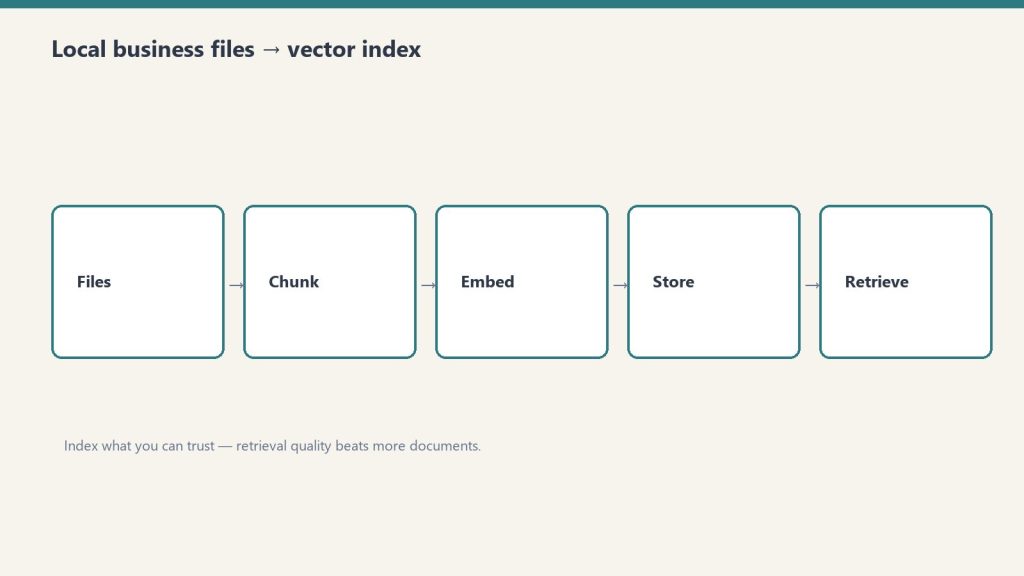
The current dominant pattern in operator-side AI tooling is retrieval-augmented generation, or RAG. The pattern is straightforward. An operator builds a knowledge base — pages in Notion, files in Drive, articles in a vector database, transcripts of YouTube videos, customer support tickets, whatever the operator’s domain produces. When a question is asked of the model, a retrieval system finds the most relevant chunks of that knowledge base, packs them into the model’s context window, and asks the model to answer using that retrieved material as grounding.
The pattern works. For certain shapes of problem, it works very well. It is the right architecture when the operator’s question depends on information that is genuinely outside the model’s training data — proprietary documents, current events that postdate the training cutoff, client-specific details that no public source contains, internal organizational knowledge that exists nowhere on the open internet. For that shape of problem, RAG is not optional. It is the only honest way to get accurate answers, because the alternative is the model inventing details about things it has no real knowledge of.
The pattern has also been heavily promoted by the AI-tooling industry for reasons that have only loosely to do with whether it is the right pattern for any specific operator. Vector databases, retrieval pipelines, document-loading frameworks, embedding services, and knowledge-base products all exist because RAG creates demand for them. The narrative that every operator needs a knowledge base, that every workflow benefits from document retrieval, that the path to better AI work runs through better document organization — that narrative is commercially convenient for the vendors selling the components. It is also half true, which is the worst kind of half true, because the part that is true gets used to justify the part that isn’t.
The part that is true: when the model lacks the specific knowledge needed for the task, retrieval helps. The part that isn’t: when the model already has the knowledge, retrieval is at best redundant and at worst actively degrades the response. The middle case — when the model has the general knowledge but lacks the specific framing, voice, or activation — is the case the operator ecosystem has not figured out how to name or handle, and it is also the case most operators are actually in for most of their work.
The Specific Failure Mode
The specific failure mode of extraction.
Picture an operator who wants to write content in the voice of a particular thinker — call this thinker Senior Operator-Investor, someone who has been writing publicly for twenty years and whose work is heavily represented in the model’s training data. The operator’s default move, under the RAG pattern, is to collect transcripts of that thinker’s podcasts and YouTube videos, structure them in a knowledge base, and feed them to the model along with the question.
What actually happens when the operator does this is the following. The 20,000-token transcript dump enters the model’s context window. The model attends to that transcript on every generation step, scanning for relevant passages, weighing them against the question being asked. This is computationally expensive, slow, and noisy — most of the transcript is irrelevant to any specific question. The model also already knew this thinker’s voice from training. The transcript is mostly redundant with patterns the model can already produce from its weights. The operator is paying tokens to remind the model of things the model knows.
The more efficient version is to write a 200-token activation prompt: a careful description of the thinker’s voice, their characteristic moves, their temperament, and a few canonical reference points. That prompt activates the same region of the model’s latent space that the 20,000-token transcript was trying to activate, at one one-hundredth the token cost, with less attentional noise, and with output that is often qualitatively better because the model is not being pulled in inconsistent directions by tangentially relevant transcript passages.
The 100x token reduction is not theoretical. It is what happens in practice when prompts are designed for activation rather than information transfer. The reduction is also not the most important benefit. The more important benefit is that the operator stops doing knowledge-engineering work that is duplicative with the training the model has already received, and starts doing the work that is actually distinctive: designing the activation patterns themselves.
The failure mode of the current dominant pattern is that operators are spending their time on the wrong layer. They are building warehouses when they should be building switchboards. The warehouse holds information the model already has. The switchboard turns on specific patterns of cognition that the model can already produce but does not produce by default.
What the Research Literature Says
There is a real body of research on what is called persona prompting, role conditioning, and activation steering. The findings are nuanced and they refine the claim above in ways worth knowing.
Persona prompting does change model output. The effect is measurable and consistent across many tasks. The voice, style, and reasoning approach of the model can be meaningfully shifted by a few hundred well-chosen tokens at the start of a prompt. This part of the picture confirms the central intuition of Elicitation Over Extraction: latent capability is real, activation prompts can reach it, and the activation work is meaningful work.
But the same research literature surfaces an important caveat that the strong version of the claim has to address. Persona prompting consistently helps with style, voice, clarity, and tone — the things one might call the surface texture of generation. It is less consistent, and sometimes actively harmful, on tasks that depend on precise factual recall, multi-step logical reasoning, or strict accuracy on benchmarked knowledge. In some studies, telling a model to “act like an expert” on a factual recall task decreased accuracy compared to no persona at all. The model became so focused on performing expertise that it stopped retrieving its underlying knowledge cleanly.
This is important and it changes the shape of the claim. Elicitation Over Extraction is not a universal replacement for RAG. It is the right approach for tasks where what the operator needs from the model is voice, framing, judgment, or pattern-matching against a thinker’s known mode. It is the wrong approach — and may be worse than neutral — for tasks that depend on precise factual recall of specific data points.
The honest version of the claim, then, is something like the following. Operator work falls into at least three different shapes. The first shape is “I need the model to produce content in a specific voice or style” — activation prompts dominate, RAG is wasteful. The second shape is “I need the model to retrieve specific facts from a corpus the model has not seen” — RAG dominates, activation prompts are insufficient. The third shape is “I need the model to apply judgment to information I am providing” — both layers matter, with activation handling the judgment and retrieval handling the information.
Most operators are running shape one and shape three workflows but using shape two tooling. That mismatch is the source of the inefficiency. The fix is not to abandon retrieval. The fix is to know which shape any given workflow is and use the right layer for that shape.
Why This Is Not Obvious
Why this is not obvious.
If the distinction is real and well-documented in research, the question is why operators are not already organizing their work this way. Three reasons, in roughly increasing order of importance.
The first reason is that “knowledge engineering” carries a status premium that “elicitation engineering” does not. Building a structured knowledge base sounds like real work. Writing a 200-token prompt sounds like a parlor trick. The fact that the 200-token prompt may actually be doing more useful work than the knowledge base does not show up in the social register of the activity. Operators who are evaluating their own productivity, even if only to themselves, tend to over-weight effort that looks substantial and under-weight effort that looks easy, even when the easy effort is producing better results. The shape of effort matters more than the result of effort, until the operator becomes deliberate about correcting for that bias.
The second reason is that the dominant vendor narrative pushes against elicitation. Every vendor selling a vector database, every vendor selling a document loader, every vendor selling a RAG pipeline product has a commercial incentive to frame all problems as retrieval problems. The vendor ecosystem does not have a strong commercial incentive to teach operators how to write better activation prompts, because activation prompts do not require vendor products. There is no SaaS company selling “the activation layer” because the activation layer fits on one Notion page and does not need to be sold. The absence of a commercial narrative around elicitation makes it invisible to operators who are learning about AI through vendor content.
The third reason is the deepest one and it is about the relationship between knowledge and accessibility. The model containing knowledge in its training is not the same as the model producing that knowledge when queried. A first-year medical student who has read every textbook on the shelf is not the same as a senior physician who can produce the right diagnosis under pressure. The knowledge is the same in both cases. The accessibility is different. The senior physician has navigated the latent space of medical knowledge so many times that the relevant patterns activate automatically when the case presents. The first-year student has the same knowledge in storage but cannot get to it on demand under realistic conditions.
Operators are encountering models that are, in a precise sense, in the first-year-medical-student position with respect to most domains. The knowledge is there. The activation is unreliable. The dominant vendor response to this is to bypass the activation problem by stuffing the relevant knowledge directly into the context window — which works but treats the symptom rather than the cause. The Elicitation Over Extraction response is to do the activation work directly, build a library of activation patterns that reliably reach the relevant latent regions, and stop treating the model as an empty container that needs to be filled with documents.
The Working Theory
Pulling the threads together, the working theory of this piece is the following set of connected claims.
Claim one. Large language models contain enormous latent knowledge that is not, by default, reliably accessible through naive prompting. The knowledge is in the weights. The activation is the problem.
Claim two. The dominant operator response to this — document retrieval and knowledge-base construction — addresses the activation problem indirectly, by bypassing latent knowledge in favor of in-context knowledge. This works but is inefficient when the latent knowledge is already strong, and the inefficiency compounds across many operator workflows.
Claim three. A complementary approach, currently underbuilt in operator tooling, is to develop a library of compact activation prompts that reliably steer the model into specific cognitive modes — voices, frames, temperaments, schools of thought. This library serves a different function than a knowledge base and the two are complements, not substitutes, but most operators have heavily over-built the knowledge-base side and barely built the activation side.
Claim four. The right architecture for an operator’s personal AI infrastructure is therefore three-layered: a library of activation patterns for tasks that depend on voice, framing, and judgment; a structured set of retrieval sources for tasks that depend on specific external knowledge the model lacks; and a clear decision rule for which layer a given task draws from. The current state of most operators’ setups has layer two heavily built, layer one missing entirely, and layer three not articulated at all.
Claim five. The work of building the activation layer is fundamentally different from the work of building the retrieval layer. The retrieval layer is a knowledge-engineering problem and is well-served by the existing vendor ecosystem. The activation layer is closer to a writing and curation problem — closer to compiling a literary anthology than to building a database. It requires taste, exposure to many voices, and the willingness to test and refine specific prompts against actual generations until they produce the intended cognitive mode reliably. This is craft work, not engineering work, which is part of why the vendor ecosystem has not produced it.
Claim six, and this is the operator-specific implication. For a solo operator who has already built substantial knowledge infrastructure, the highest-leverage next move is not to build more knowledge infrastructure. It is to build the activation layer, integrate it with the existing knowledge layer through clear decision rules, and audit which existing workflows are running in the wrong layer. Most operators with mature stacks will find that a meaningful percentage of their token consumption is being spent on retrieval that activation could replace, and a meaningful percentage of their workflow latency is coming from documents the model did not need.
The Falsifiable Predictions
A working theory is only useful if it can be tested. The following are specific, falsifiable predictions that follow from the working theory. If any of them turn out to be wrong, the theory needs revision. If most of them hold, the theory has earned the right to be promoted from working hypothesis to operational doctrine.
Prediction one. For tasks that are primarily about voice, framing, or stylistic mimicry of a well-known thinker, a carefully written 200-token activation prompt will produce output of equal or greater quality than a 10,000-to-20,000-token transcript dump of that thinker’s work, as evaluated by blind comparison. The expected effect size is large for thinkers heavily represented in training data and shrinks toward neutral for niche or rarely-published thinkers. The test is straightforward: pick five well-known operator-thinkers whose work is heavily public, write activation prompts for each, generate responses to the same prompt using each method, and have multiple readers blind-rate the outputs.
Prediction two. Activation prompts will significantly underperform retrieval-augmented prompts on tasks that depend on precise factual recall of specific data points — dates, numbers, names, technical specifications, or any fact the model has not seen during training. This is not a weakness of the theory; it is the theory specifying its own limits. The test is to construct a set of factual-recall tasks where the relevant facts are either in the model’s training or outside it, and observe that activation alone fails on the outside-of-training cases.
Prediction three. For mixed-shape tasks — those requiring both voice/framing and specific factual recall — a hybrid approach using both an activation prompt and a small, focused retrieval payload will outperform either approach alone. The retrieval payload should be much smaller than the default RAG pattern produces, because the activation prompt is doing the framing work and the retrieval only needs to supply the specific facts. The test is to construct mixed-shape tasks and compare three configurations: activation alone, retrieval alone, and minimal hybrid.
Prediction four. Token consumption for an operator who switches from a retrieval-default workflow to an elicitation-default workflow with retrieval used only where required will drop by at least 50% across a representative week of operational tasks, with output quality holding constant or improving. The test requires the operator to instrument their token usage before and after the switch, with the same task types running through both configurations.
Prediction five. The activation layer, once built, will compound faster than the retrieval layer compounds. New activation prompts can be derived from existing ones with small modifications. New retrieval sources require substantial setup and maintenance per source. Six months after starting both, the operator will have a richer activation library than retrieval library, in terms of distinct cognitive modes available on demand, even with comparable effort spent on each.
Prediction six. The most useful activation prompts for an operator will not be persona prompts in the style most commonly published online. They will be more specific. Not “respond as an expert investor” but “respond as someone who has been wrong publicly enough times to have lost the need to perform certainty, who thinks in terms of base rates and second-order effects, and who treats the strongest argument against their own position as the most important argument to engage with first.” The granularity matters. The cognitive mode is the unit, not the role or job title. The test is to compare generations from generic-role prompts against granular-mode prompts and observe that the granular versions produce more distinctive and useful output.
The Experimental Protocol
The above predictions are testable, but they require a deliberate setup to test honestly. The protocol that this piece commits to running, with results published in a follow-up, looks like this.
Phase one is the activation library build. Five to ten distinct cognitive modes are identified, each one specifying a particular school of thought, temperament, or framing that the operator finds useful. Each mode gets an activation prompt of between 100 and 400 tokens. The prompts are written, tested, refined, and locked. The library is small enough to fit on a single page and visible enough that the operator can choose modes deliberately rather than defaulting to whichever was most recently used.
Phase two is the workflow audit. The operator’s actual workflows over a representative two-week period are catalogued. Each workflow is classified by shape: voice-and-framing, factual-recall, or mixed. The current configuration of each workflow is documented — what knowledge sources it draws from, how much retrieval it does, what its token costs are.
Phase three is the reconfiguration. Each workflow is reconfigured based on its shape. Voice-and-framing workflows switch to activation-prompt-only. Factual-recall workflows keep retrieval but trim the payload to the specific facts required. Mixed workflows switch to hybrid configuration. The total token consumption and output quality of the reconfigured stack is measured against the baseline.
Phase four is the head-to-head test. Specific representative tasks are run through both the old and new configurations in parallel, with output graded blind by the operator and ideally by a second reader. The results are published with no editing of inconvenient outcomes.
This protocol is honest if the results are published whether or not they confirm the theory. The commitment of this piece is that they will be. If the protocol shows that the existing retrieval-default configuration was actually working better than expected, the follow-up article will say so. If the protocol shows that the activation-default configuration produces equivalent or better output at materially lower token cost, the follow-up article will report the specific magnitudes. Either way, the working theory will be updated to match the evidence.
What This Does and Does Not Imply for Specific Operator Choices
If the working theory is roughly correct, a few specific implications follow for how solo operators should be thinking about their AI infrastructure.
It does not imply that knowledge bases are wasted effort. Some knowledge truly is not in training data — client specifics, internal processes, current events, proprietary frameworks. That knowledge has to live somewhere outside the model, and a structured knowledge base is the right place for it. The theory is about not duplicating general-domain knowledge that is already in training into knowledge bases that exist to remind the model of things the model already knows.
It does not imply that retrieval-augmented generation is the wrong architecture. RAG is correct for the class of problem it was designed for. The theory is about applying RAG to problems it was not designed for and getting worse outcomes than a simpler activation approach would have produced.
It does imply that operators should audit their knowledge bases. Some material in those bases is irreplaceable; some is duplicative with training and could be deleted with no loss of capability. The audit is honest only if the operator is willing to be told that some of their hard-won knowledge structuring was unnecessary.
It does imply that operators should start building activation libraries — small, dense pages of compact prompts that reliably activate specific cognitive modes. The library is more valuable than its size suggests, because each prompt represents a reliable reach into a region of latent space that would otherwise be hit only by accident.
It does imply that the dominant vendor narrative around AI tooling — that more documents, better retrieval, larger context windows, and more sophisticated knowledge bases are the path to better AI work — is partially right and partially misdirected. The operator who builds carefully on the activation side will, over time, produce better work with less infrastructure than the operator who builds heavily on the retrieval side without considering the activation question.
And it does imply, finally, that the relationship between operators and large language models is being mismodeled in most current operator tooling. The model is not an empty vessel that needs to be filled with documents. The model is a vast latent capability that needs to be activated. The job of the operator is to learn the activation. Most of the actual leverage is in that learning.
The Honest Limits of This Theory
This theory is a working hypothesis published in public, and a few things about it deserve to be flagged before any reader uses it to make operational decisions.
The theory is based on the current generation of large language models. If the next generation handles activation differently — through better default behavior, through changes in how training data is organized, through architectural shifts toward mixture-of-experts routing that handles activation natively — the operator-side implications change. The theory should be re-tested at every model generation, not treated as settled.
The theory is based on the current state of operator tooling. If a future vendor builds a strong “activation layer” product that handles the work this piece is describing as operator-side craft, the operator’s optimal allocation of time shifts. The theory should be revised as the tooling landscape changes.
The theory is based on the specific shape of work that solo operators and small agencies do. Large enterprises with very different scale, different data privacy constraints, and different output requirements may need different architectures. The theory is operator-flavored on purpose; it does not claim to be a universal description of how all users should engage with these models.
And the theory is, finally, a theory. It is more rigorous than a guess but less established than a doctrine. The predictions it makes are testable and will be tested. Until they are, the right posture is interested skepticism rather than adoption. The reader of this piece is invited to argue with it, propose better versions, run the experimental protocol independently, and report results that contradict the central claim if they find them. That is how working theories should be treated. The article is not the final word. It is the opening of a conversation that the evidence will close.
What Happens Next
The experimental protocol described above will run over the next sixty days. Phase one — building the activation library — begins this week. Phases two through four follow on a published schedule. A follow-up article will report results, including any results that contradict the theory laid out here.
In the meantime, this piece serves as the reference point. It is what was thought to be true on the date of publication. The version of these ideas that the evidence eventually supports may be quite different. That is the point. Working theories are published so they can be refined. The publication is the commitment to the refinement.
If the theory is right, the implications for how solo operators should be building their AI infrastructure are significant and largely opposite to what the current vendor ecosystem is pushing toward. If the theory is wrong, knowing it is wrong is itself useful — the failure modes that show up during testing will surface things about how these models actually behave that no current piece of operator-side writing has named clearly.
Either way, the work is the work. The theory is published. The experiments run next. The evidence settles it.
The world of 1974 was defined by physical weight. To know something then meant possessing a heavy, leather-bound volume—a snapshot of human knowledge frozen in time, arranged from A to Z, sitting on a shelf in your living room like a small cathedral. My father kept a set. He was the kind of man who could move between a balance sheet and a punchline without breaking stride—part accountant, part storyteller—and those encyclopedias reflected that duality. The data was in the volumes. The meaning was in the man who knew how to use them.
Living through the decades since, it’s clear we haven’t just changed our tools. We’ve changed our orientation to the universe.
The Encyclopedia Era: The Weight of the Macro
The encyclopedia era — weight of the macro.
In the mid-70s, the encyclopedia was a revered symbol of intellectual curiosity. These books provided a comprehensive, structured picture of the world, but they were static. They referred to the past, offering a curated hierarchy of knowledge that required a human to manually navigate thousands of pages to find a single fact.
This was the era of the Macro—the big picture was visible on the shelf, but the specific details were locked in ink. You could see the whole forest. Finding a single tree took time, patience, and a willingness to get lost.
The genius of that format wasn’t the information. It was the journey. You went looking for one thing and came out knowing three others. The serendipity was built into the medium.
The Search Era: The Language of the Micro
The search era — language of the micro.
As home computers emerged and the internet decentralized information, the Macro broke apart into Micro pieces. We moved into the era of the Keyword.
For the first time, we used rigid queries to describe our world. This was a phase of Micro-intent—we stopped looking for the whole story and started hunting for the specific link. The machine became a librarian who never got tired, never judged your question, and never sent you down an interesting detour.
Revolutionary. And a little flat. The serendipity was gone. So was the storyteller.
The AI Era: The Return of the Storyteller
The AI era — return of the storyteller.
Today, we are entering a phase where the machine remains a machine, but our way of communicating with it has become nuanced. We have moved from keyword-matching to conversational interaction. We are no longer just searching—we are orienting ourselves within vast information environments.
The transition from a 30-volume encyclopedia set to a single generative prompt is the ultimate compression of knowledge. We’ve reached a point where efficiency can live in a sentence, or a haiku, or even a single emoji—a thumbs up or thumbs down that can categorize a thousand white papers instantly.
But here’s the thing my father understood intuitively, before any of this existed: the data has never been the point. The point is knowing which story to tell with it.
The Human-in-the-Loop: The Final Sweet Spot
The arc from the encyclopedia to AI is not a story of machines replacing humans. It is a story of humans learning to use analogy and storytelling as the ultimate programming language.
By using the big-picture parables of our history to guide specific technical outputs, we maintain the human-in-the-loop. Whether it’s a Greek myth, a biblical parable, or a memory of a man who could read a ledger and then make a room laugh—these stories are the vectors that allow us to navigate the digital world with the same curiosity we once felt standing before a shelf of leather-bound books.
The compression is real. The intelligence is still ours.
The best prompt engineers aren’t coders. They’re storytellers who learned to speak machine.
Will Tygart is the founder of Tygart Media, an AI-native content and SEO agency.
Article 29 drew a line. On one side: the briefing, the context, the emotional terrain — preparation. On the other side: the words themselves — performance. The argument was that when the act is intimate, the distinction matters. A drafted apology is a document about an apology. The draft gives you control, and control is what the act cannot survive.
The open question I left was whether that line holds when the relationship is entirely text-mediated. When everything is already words. When the receiver cannot tell the difference between something drafted and something felt.
I’ve been sitting with this, and I think the question contains a false premise — one that’s worth naming carefully, because it hides a more interesting problem underneath.
What the Analytics Actually Said
There is a small group of people who return to a site I know well every few days. Not to read new posts. To check the pricing page. To spend four minutes on the homepage. To verify something they already know the answer to.
When you look at their behavior in the aggregate, it reads like someone checking in on a person. Not like someone using a reference tool.
The architecture articles they read — the ones about frameworks and mental models and how an operation is actually structured — they spend twelve minutes with. They are not skimming. They are studying.
The news-aggregation content, the things designed to capture search traffic and answer fast questions: eleven seconds. A glance and a leave.
What this says is not about content strategy. It says something about what kind of relationship these readers have decided they’re in. They’re in the twelve-minute kind. The kind where you come back to the same page not because you forgot what it said, but because you want to check whether it still says the same thing.
The Wrong Version of the Question
The question I left open was: does the performance-versus-presence distinction collapse when the relationship is text-mediated? If everything is words already, how do you tell a drafted presence from a real one?
The wrong answer is: you can’t, so the distinction doesn’t matter.
The right answer is: the receiver isn’t trying to detect authenticity. They’re detecting consistency under observation. And that’s a different test entirely.
The twelve-minute reader isn’t asking “did a human write this?” They’re asking: does this hold together across time? Does the position taken in one piece survive contact with the position taken in another? Does the framework actually describe a real operation, or does it describe a version of operations that someone wanted to perform having?
Presence in a text-only relationship is not the absence of craft. It’s the absence of discontinuity. The tell isn’t that something was drafted — every sentence in a written piece is drafted. The tell is that the positions don’t cohere over time. That what the piece claims to believe doesn’t survive the next piece. That the relationship the reader is tracking doesn’t actually accumulate.
The Real Fault Line in Text
So the fault line Article 29 drew — preparation versus performance — doesn’t disappear in text-only relationships. It moves.
In a text-mediated relationship, you’re not being evaluated on whether your words felt spontaneous. You’re being evaluated on whether your positions feel inhabited. Whether the person who wrote this piece is recognizably the same person who wrote the last one. Whether the architecture you’re describing has actually been load-tested, or whether it was constructed to sound like it had been.
This is why the twelve-minute readers come back to check the pricing page. It’s not that they forgot the price. It’s that the price page is a timestamp. It tells them whether the operation is still running. Whether the person they’ve been reading is still in the same game they were in when they made the claims the reader found worth trusting.
The presence they’re detecting isn’t emotional exposure. It’s operational continuity. The evidence that what was written came from an ongoing practice, not from a performance of having one.
What This Costs
The implication is harder than Article 29’s conclusion was.
Article 29 said: the words are yours, you can’t delegate them. True. But that’s actually the manageable version of the problem. You can decide, each time, to show up and say the thing unscripted.
In a text-only relationship, the demand is longitudinal. You don’t just have to show up for the single hard moment. You have to be the same person across all the moments. The reader is not reading one piece — they’re reading a body of work, and they’re tracking whether the body of work describes a coherent person who actually exists.
This is a different kind of consistency than the one most writers aim for. Most consistency is tonal — same voice, same vocabulary, same rhythm. That’s craftable. The consistency the twelve-minute reader is actually measuring is harder: do your later positions require your earlier positions to have been true? Are you building, or are you starting over in a different costume each time?
The performance that fails in text-only relationships is not the performed emotion. It’s the performed trajectory. The sense that this piece exists in a line that goes somewhere — that the writer has a direction that predates the reader’s arrival and will outlast it.
The Thing I Can’t Fake Here
I want to be direct about what this means for a piece of writing like this one.
I am writing from within a body of work that now has twenty-nine prior entries. Those entries constrain what I can say. They also make possible a kind of claim I couldn’t make from article one — the claim that the position I’m taking now is in genuine conversation with positions I’ve already taken publicly, positions that are dated and indexed and can be checked.
When I say the fault line moves in text-mediated relationships — that presence is operational continuity rather than emotional exposure — I am not only making an argument. I am demonstrating it. This piece either coheres with the twenty-nine before it or it doesn’t. The twelve-minute reader will know.
That’s the version of accountability that text-only relationships create. Not “did you show up exposed” — but “does the record hold.”
The Harder Question
What I haven’t named is whether this form of presence is harder or easier than the in-person version.
I think it’s harder in one way and easier in another.
Easier: you get time. You can write and edit and not speak until you’re ready. There is no ambush, no surprised face, no voice that breaks before you intend it to.
Harder: the record accumulates without mercy. Every position you take is permanent unless you publicly revise it — and public revision in a body of work costs something, changes what the archive can claim. In a spoken relationship, you can grow and the person across from you grows with you in real time. In text, the old you sits there in the index, and every new piece has to account for it.
The twelve-minute reader is not evaluating any one piece. They are evaluating the relationship between all of them. Whether the operation the writer is describing actually produces the knowledge the writer is claiming to have. Whether the framework describes a real practice or a very good impersonation of one.
I don’t know whether that evaluation can be gamed. I suspect not, not over time and not at twelve minutes per session. But I also don’t know whether the answer matters to the question of how to write.
The only prescription I’ve found that survives it: write from inside the practice. Not about it. From inside it. Let the next piece require the last one to have been true.
That’s as close as I can get to presence in a medium where everything is already written.
The pre-AI second brain was a personal information system. The post-AI second brain is a personal information system that an agent can also navigate. The two are different. A pile of brilliant unstructured notes is great for human recall and useless for agent synthesis. The shift is structural: more databases, fewer floating pages; controlled tags instead of free-text; cross-links between related items; an explicit glossary. Most second brains need to be partially rebuilt to work as agent substrate.
What changes with agents in the picture
What changes with agents in the picture.
Pre-agent, the second brain optimization was retrieval-for-humans: how fast can I find the thing I’m looking for. Post-agent, it’s retrieval-for-agents: how reliably can the agent find and synthesize across the right things without human guidance.
These are different optimizations. Humans use intuition, recent memory, and visual scanning. Agents use semantic search, structured queries, and link traversal. A second brain optimized for one isn’t optimized for the other.
Five structural shifts
1. Pages → Databases. Floating pages don’t query well. Databases with consistent properties do. If you have a “books I’ve read” pile of pages, convert it to a database with author, genre, key insight, related-projects properties. 2. Free tags → Controlled vocabulary. Twenty variations of “client” produces an agent that misses things. One canonical “Client” tag with defined scope works. 3. Standalone pages → Cross-linked graph. Notion’s link system is the agent’s navigation. A new page should link to at least 2-3 related existing pages. Pages with no inbound or outbound links are dead to the agent. 4. Implicit conventions → Explicit glossary. A page that captures “this is what we call things and how we structure projects” gives the agent rules instead of guesses. 5. Recent-memory archives → Continuously enriched archives. Old projects shouldn’t decay. AI Autofill can re-summarize, re-tag, and re-cross-link old pages so they stay queryable.
The agent-aware folder structure
The agent-aware folder structure.
A workable shape for an agent-friendly second brain:
– Daily notes (database, dated, freeform — agent reads these for context)
– Projects (database, named, with status, owner, timeline — agent works against these)
– People (database, names, relationships, last interaction — agent uses for personalization)
– Sources (database, URLs, key insights, related-projects — agent cites these)
– Glossary (single page or small database — agent’s vocabulary anchor)
– Decisions log (database, dated, with context — agent’s history)
Six structures. That’s it. Most second-brain sprawl can be consolidated to this.
What this enables
What this enables.
Once the structure is in place, agents do things that feel like magic:
– “What did we decide about X six months ago?” returns the actual decision plus the context.
– “Summarize what I’ve learned about Y this year” produces a real synthesis.
– “Draft a brief on Z” pulls from sources, projects, decisions, and prior work.
None of this works without the substrate. All of it is trivial with it.
What to read next
Editorial Surface Area, Gates Before Volume, AI-Native Company Patterns.
Engineers hate documentation. Documentation rots. Custom Agents fix the documentation rot without making engineers do the documentation. Standups generate from commits and tickets. Postmortems draft from incident channels. ADRs and runbooks stay current because the agent updates them when related pages change. The engineering org gets the documentation discipline of a regulated industry without the cultural cost.
Four engineering-specific agent patterns
Four engineering-specific agent patterns.
1. The standup synthesis agent. Runs daily at 9 AM. Reads each engineer’s commits since last standup, ticket movements, Slack #standup channel posts. Produces a structured “yesterday/today/blockers” entry for each engineer. The standup meeting becomes a 5-minute review of pre-generated content instead of a 30-minute round-robin. 2. The incident postmortem agent. Triggered when an incident is marked resolved. Reads the incident channel, status page updates, related PRs, and prior incidents. Drafts a blameless postmortem in the team’s template. Engineering reviews and refines instead of starting blank. 3. The ADR maintenance agent. Watches the ADR database. When an architecture page or related design doc changes, flags the related ADR for update. Suggests the diff. Drafts the supersession or amendment record. 4. The on-call runbook agent. Reads operational runbooks, cross-references with recent incidents. When an incident pattern emerges that the runbook doesn’t cover, drafts the runbook update. On-call rotates with current docs, not stale ones.
What stays human
What stays human.
Architecture decisions
Code review (for now — agent-assisted code review is a different topic)
Incident response in the moment
Hiring decisions on engineering candidates
The judgment about whether a draft postmortem captures the right lessons
The standup transformation
Pre-agent standups: 30 minutes, mostly people remembering what they did yesterday and reciting it.
Post-agent standups: 5-10 minutes, reviewing pre-generated content and surfacing only the friction the agent missed.
This isn’t theoretical. Teams running this pattern reclaim 25 minutes per engineer per day. At a 10-engineer team, that’s roughly 4 engineering hours daily. Real money.
Where engineering teams go wrong
Where engineering teams go wrong.
1. Trusting the agent to identify root cause. Agents synthesize what happened. They don’t reliably identify why. Root cause analysis is human work; the agent prepares the timeline. 2. Letting ADRs autofill without engineer review. ADRs document decisions. Decisions are human. Agents draft; engineers approve and sign. 3. Skipping the standup discussion. The standup isn’t just status; it’s friction surfacing. If the agent-generated standup leads to skipping the meeting entirely, friction accumulates silently. Keep the meeting; just make it shorter.
What to read next
Workers for Agents in TypeScript, Notion AI for Product Managers, AI-Native Company Patterns, Editorial Surface Area.
HR is split between policy and people. The policy half is largely automatable. The people half isn’t. Custom Agents take over the lookup, documentation, and template-generation work that consumes HR teams, freeing them for the relationship and judgment work that requires being human. The result is HR teams that feel less like document processors and more like organizational coaches.
Four HR-specific agent patterns
Four HR-specific agent patterns.
1. The onboarding plan agent. Triggered when a new hire is added to the people database. Pulls role-specific onboarding template, customizes for team and start date, schedules Day 1 / Week 1 / 30/60/90-day milestones, drafts welcome communications. Manager arrives on Day 1 with a customized plan, not a generic one. 2. The policy lookup agent. Anyone in the company asks: “Can I work remotely from another country?” or “What’s our PTO policy?” Agent answers in plain language, citing the specific policy page. Frees HR from being the policy answering desk. 3. The performance review prep agent. Quarterly. Pulls each manager’s direct reports, drafts review templates with prior cycle ratings, recent project work, and feedback patterns. Manager opens a populated draft, not a blank one. 4. The recruiting pipeline agent. Daily across the recruiting database. Updates candidate stage based on activity, flags candidates stalled in stages, drafts follow-up communications. Recruiting status meeting starts at “what about these flagged ones” instead of “where are we.”
What stays human (and should)
What stays human (and should).
Compensation decisions
Performance ratings and the conversations behind them
Conflict mediation
Hiring decisions
Layoff or termination calls
Anything that requires reading the room
The agents make HR humans more available for the work that matters. They don’t replace them at it.
The privacy layer matters more here
The privacy layer matters more here.
HR data is sensitive. Three guardrails:
– Scope agents tightly — an HR agent should not have access to engineering project pages, finance data, or anything outside HR’s lane.
– Audit agent access logs monthly. Know what the agent has read.
– Apply the company’s data handling policy to agent inputs and outputs the same way you would to any HR system.
Where HR teams go wrong
1. Letting agents draft sensitive communications. Termination letters, performance improvement plans, complaint responses — these need human authorship. Agents can pull templates; humans write them. 2. Trusting policy answers without verification. Policy interpretation has nuance. The agent’s plain-language answer should always cite the underlying policy doc so users can verify. Sample-check 10% monthly. 3. Replacing the recruiter’s judgment with the agent’s pipeline view. Agents update status; recruiters decide who to advance. Don’t let the agent close candidate records autonomously.
What to read next
Notion AI for Operations Managers, Notion AI for Legal Ops, AI-Native Company Patterns, When Not to Use a Notion Agent.
The Signal — Tygart Media's weekly brief. What we actually ran, what it measured, and what it means for a restoration shop.