Category: Repair Shop Dispute Guides

Auto repair shop dispute guides covering unauthorized repairs, estimate spikes, mechanic’s liens, failed repair warranties, and paying under protest. Original hub: repairshop.tygartmedia.com.

  • The shop won’t release my car until I pay — is that legal?

    The shop won’t release my car until I pay — is that legal?

    Tygart Media · Repair Shop Dispute Guides · Holding my car

    QUICK ANSWEROriginally published at repairshop.tygartmedia.com · Reviewed October 4, 2026
    The short answer: sometimes — many states give shops a lien right to hold your car until legitimate repair charges are paid. But it generally only covers work you actually authorized, the procedure varies by state, and you don’t have to accept a padded bill to get your keys back. Paying under protest lets you drive away and keep your dispute alive.

    Why they can hold it at all

    The concept is a mechanic’s lien (sometimes called a garageman’s or repairman’s lien). The idea is old and simple: the shop improved your property with labor and parts, so the law gives them a security interest in the car until they’re paid. Full breakdown of mechanic’s liens →

    Key limits that matter to you:

    • It generally covers authorized repair charges — not work you never approved and not junk fees.
    • Most states require the shop to follow a procedure — notices, time limits, sometimes a filing. A shop that just locks the gate and shrugs may not be following its own state’s rules.
    • It doesn’t let them hold your car hostage indefinitely or sell it on a whim — sale usually requires formal notice and a waiting period.

    Your fastest move: pay under protest

    This is the move that solves the immediate crisis without surrendering the fight. You pay the disputed bill, clearly marked as paid under protest, get your car back today, and dispute the charges afterward — in writing, with regulators, or in small claims court. How to pay under protest correctly →

    Why this beats the alternatives: refusing to pay leaves your car in their lot, where storage fees may be piling up daily and you have no transportation. The protest payment caps your losses at the disputed amount while you fight on your terms.

    Editor's Note
    A note on honest shops From a reputable shop’s perspective, the lien right exists because some customers genuinely skip out on real bills — parts and labor the shop already paid for. That’s a legitimate protection. The problem is only when it’s used as leverage to force payment of charges you never agreed to. The tool is fine; the abuse of it isn’t.

    What to do at the counter

    1. Stay calm and get it in writing. Ask the shop to state, in writing, why they’re holding the car and exactly what must be paid for release.
    2. Separate authorized from disputed charges. Offer to pay what you legitimately owe on the spot. Many disputes de-escalate here.
    3. If they won’t release it, pay under protest. Mark it clearly, keep copies, get your keys.
    4. Document everything that day. Photos of the invoice, the work order, your car’s condition. The documentation checklist →
    5. File your dispute after. Written dispute letter to the shop, complaint to the state AG or repair bureau if needed.
    Important Notice
    Don’t try to take the car by force Showing up with a spare key, blocking the lot, or getting into a confrontation can turn a civil dispute into a criminal problem — and it can destroy your legal position. The system gives you tools (protest payment, regulators, small claims); use those instead.
    Disclaimer
    Informational only — not legal advice.
    Mechanic’s lien laws vary enormously by state — procedures, notice requirements, and time limits all differ. Check your state’s statutes or attorney general, or talk to a licensed professional, before acting.

    Getting your car back

    When a shop won’t release your car
    OptionHow it works
    Pay under protestPay, write “paid under protest” on the receipt, fight it after
    Dispute the lienMany states let you post a bond to release the car pending dispute
    AG complaintState attorneys general pursue pattern offenders

    Mechanics’ liens are real, but they have strict procedures — improper liens can be challenged and may entitle you to damages.
    Next Step & Source Attribution
    Continue navigating Repair Shop Dispute Guides
    Source: Originally published at https://repairshop.tygartmedia.com/wont-release-car/ · Author: William Tygart, Tygart Media · Last reviewed October 4, 2026.
  • The shop did work I never approved — do I have to pay?

    The shop did work I never approved — do I have to pay?

    Tygart Media · Repair Shop Dispute Guides · Unauthorized work

    QUICK ANSWEROriginally published at repairshop.tygartmedia.com · Reviewed October 4, 2026
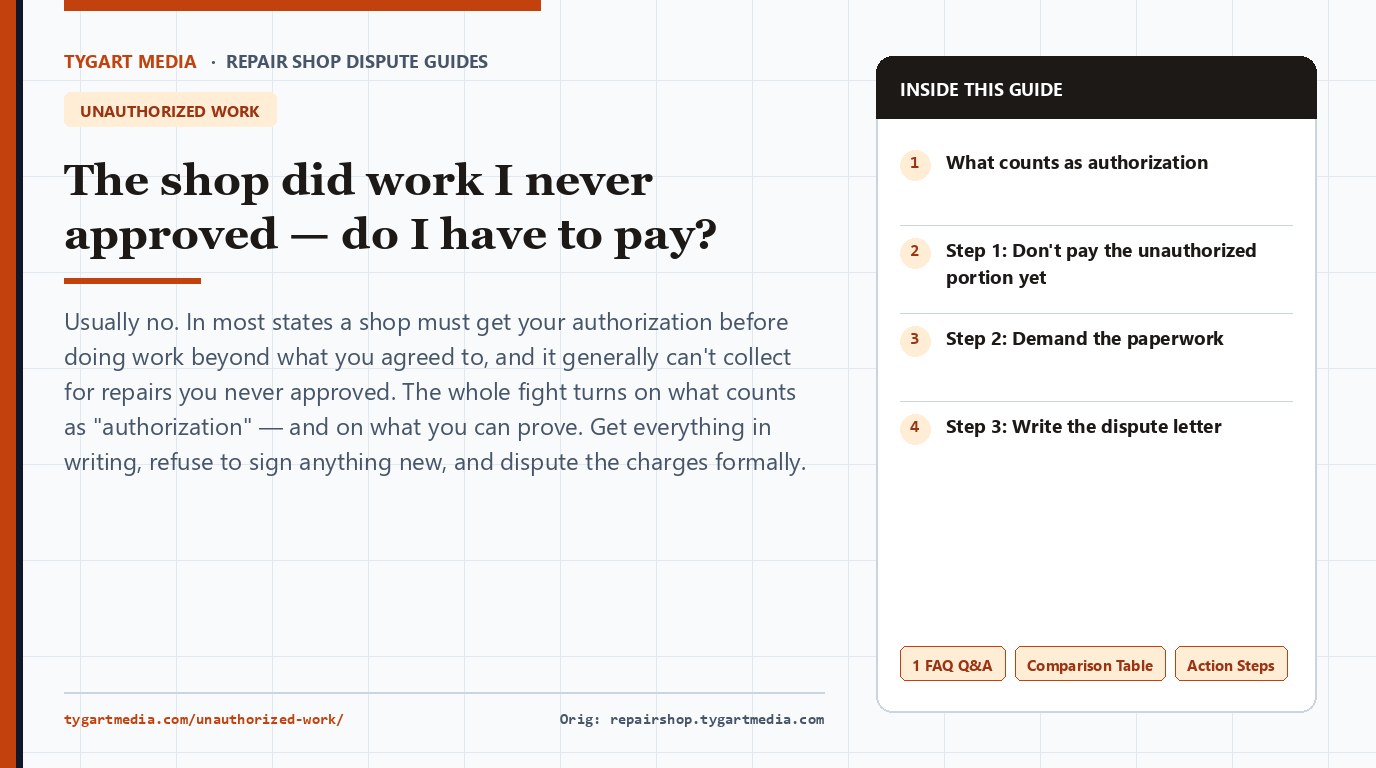
    The short answer: usually no. In most states a shop must get your authorization before doing work beyond what you agreed to, and it generally can’t collect for repairs you never approved. The whole fight turns on what counts as “authorization” — and on what you can prove. Get everything in writing, refuse to sign anything new, and dispute the charges formally.

    What counts as authorization

    Authorization doesn’t always mean a signed contract, though a signed work order is the gold standard. Depending on your state, it can also be:

    • A signed estimate or work order — the strongest form. Read what you signed; it defines the boundary of what was approved.
    • Specific verbal approval — “yes, replace the alternator” counts in most places, but it’s your word against theirs, which is exactly why shops are supposed to document it.
    • A written authorization for a dollar range — many shops ask you to authorize “up to $X.” Work within that cap is authorized; work beyond it generally isn’t.

    What does not count: dropping off your keys and saying “check the noise.” That authorizes a diagnosis, not a repair. A shop that diagnoses your car and then just starts replacing parts without calling you has a problem — not you.

    Editor's Note
    Honest shops call first A good shop treats your authorization like a contract: diagnose, call you with findings and a price, get a clear yes, then fix. If your shop did the opposite — fixed first, told you later — that’s a red flag about this shop, not about mechanics in general. The best shop owners hate this behavior because it poisons trust for everyone.

    Step 1: Don’t pay the unauthorized portion yet

    You generally do owe for work you did authorize — don’t withhold the whole bill over one disputed line item if you can separate them. But don’t pay the unauthorized charges either. Tell the shop, in writing, which charges you’re disputing and why. If they’re holding your car, read this →

    Step 2: Demand the paperwork

    Ask for: the signed work order or estimate showing what you authorized, the final invoice with line items, and any record of them calling you for approval. In many states shops are legally required to provide an itemized invoice — and many states require written authorization before work above a certain dollar threshold. If they can’t produce proof you authorized the work, their position is weak.

    Step 3: Write the dispute letter

    Send a short, dated, written dispute — email works, keep a copy:

    1. State what you authorized — quote the work order or describe the verbal approval.
    2. State what they did without approval — name the line items and amounts.
    3. Demand the unauthorized charges be removed and give a reasonable deadline (10–14 days is standard).
    4. Say what you’ll do next — complaint to the state attorney general or motor-vehicle repair bureau, and small claims court. More on small claims →

    Step 4: Escalate

    If the shop won’t budge: file a complaint with your state attorney general’s consumer protection division or your state’s motor-vehicle repair bureau (some states license repair shops directly — those bureaus have real teeth). Unauthorized-work complaints are among the most common they see, and a regulator inquiry gets a shop’s attention fast.

    Important Notice
    Don’t sign anything new at pickup Shops sometimes slide a revised authorization or a “customer agrees to all charges” form across the counter when you pick up the car. Read before you sign anything — signing can be treated as retroactive approval. If you must sign to get your keys, write “signed under protest — disputing unauthorized charges” next to your signature.
    Disclaimer
    Informational only — not legal advice.
    Auto repair authorization rules vary by state. Check your state’s attorney general or motor-vehicle repair bureau, or talk to a licensed professional, before acting on a dispute.

    Authorized vs. unauthorized work

    Do you have to pay for work you didn’t approve?
    SituationDo you owe?
    You signed an estimate authorizing the workYes — up to the authorized amount
    Verbal “go ahead” with no written authorizationGray area — your word against theirs
    Work beyond the authorized amountNo — most states require re-authorization for overages
    Work you explicitly declinedNo

    Many states require written authorization before work begins and re-authorization if the bill will exceed the estimate by a set amount (often 10%).

    Next Step & Source Attribution
    Continue navigating Repair Shop Dispute Guides
    Source: Originally published at https://repairshop.tygartmedia.com/unauthorized-work/ · Author: William Tygart, Tygart Media · Last reviewed October 4, 2026.
  • Can I take a repair shop to small claims court?

    Can I take a repair shop to small claims court?

    Tygart Media · Repair Shop Dispute Guides · Proving your case

    QUICK ANSWEROriginally published at repairshop.tygartmedia.com · Reviewed October 4, 2026
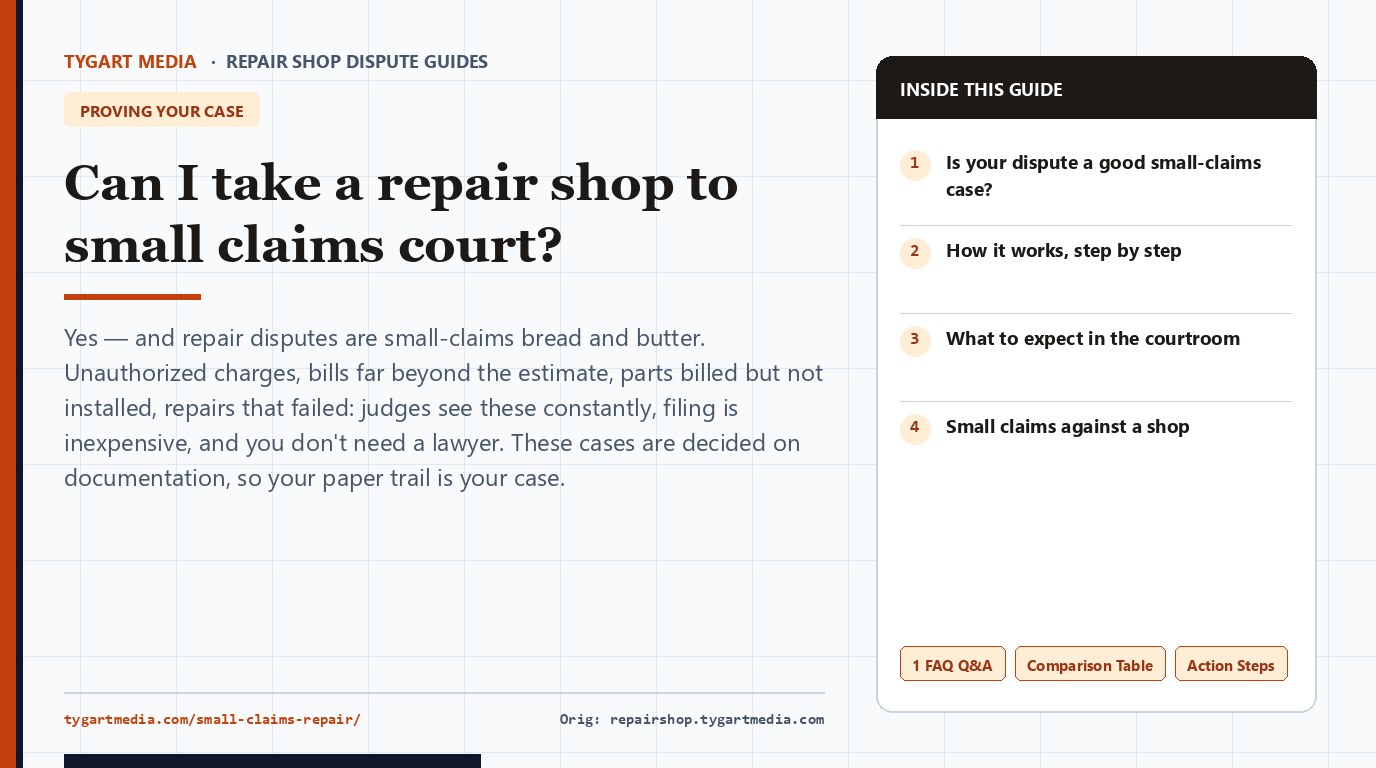
    The short answer: yes — and repair disputes are small-claims bread and butter. Unauthorized charges, bills far beyond the estimate, parts billed but not installed, repairs that failed: judges see these constantly, filing is inexpensive, and you don’t need a lawyer. These cases are decided on documentation, so your paper trail is your case.

    Is your dispute a good small-claims case?

    The strongest repair cases have:

    • A clear dollar amount — the specific charges you’re disputing, not a vague “they ripped me off.”
    • The estimate-vs-invoice gap — written estimate saying $800, final bill $1,900, no approval for the difference. Judges understand this instantly.
    • A second opinion in writing — another shop’s written finding that parts weren’t installed or the repair was defective.
    • A paper trail — work order, invoice, photos, timeline, your written dispute letter. The documentation checklist →

    Check your state’s small-claims dollar limit before filing — most repair disputes fit comfortably inside it, but know the ceiling.

    How it works, step by step

    1. Send a final demand letter first. Courts like to see you tried to resolve it. Give the shop 10–14 days to refund the disputed amount.
    2. File at your local small-claims court. Usually the county where the shop is located or where the work was done. Filing fees are modest; the clerk’s office will walk you through the forms.
    3. Serve the shop. The court needs proof the shop was notified — follow the court’s service rules exactly.
    4. Prepare your exhibit packet. One clean set: work order/authorization, estimate, invoice (with disputed lines highlighted), photos, timeline, second-opinion letter, your dispute correspondence. Bring three copies — you, the judge, the shop.
    5. Tell the story simply. “I authorized $800 of brake work. They did $1,900 of work without calling me. Here’s the estimate, here’s the bill, here’s where they never called.” Two minutes, facts only.
    Editor's Note
    Honest shops don’t fear small claims A reputable shop with signed authorizations, itemized invoices, and documented customer approvals will win a small-claims case — and they know it. The shops that settle the week before the hearing are usually the ones whose paperwork wouldn’t survive a judge’s ten-minute review. Your documentation against their documentation: that’s the whole contest.

    What to expect in the courtroom

    • It’s informal. No jury, no objections, no legal theater. The judge asks questions and looks at your paperwork.
    • It’s fast. Most small-claims hearings take 15–30 minutes.
    • The shop may not show up. If they don’t appear, you can win by default — another reason to file.
    • Many cases settle first. Being served with a court date concentrates a shop owner’s mind wonderfully. Don’t be surprised by a settlement call.
    • Collecting is a separate step. Winning a judgment and collecting it aren’t the same thing — but most shops pay a judgment rather than deal with collection enforcement.
    Important Notice
    File against the right entity Sue the legal business name on your invoice — which may be an LLC or corporation, not the friendly name on the sign. Your invoice, receipt, or your state’s business registry will show the legal name. Suing the wrong entity can get your case dismissed.
    Disclaimer
    Informational only — not legal advice.
    Small-claims limits, filing procedures, and repair laws vary by state. Check your local court’s self-help resources or talk to a licensed professional before filing.

    Small claims against a shop

    Taking a repair shop to small claims court
    You needDetails
    StandingYou paid for the work (or were billed for it)
    EvidenceEstimate, invoice, photos, second opinion
    DamagesOvercharge amount, cost to redo bad work, or diminished value
    LimitVaries by state ($5k–$25k typical) — check yours
    Next Step & Source Attribution
    Continue navigating Repair Shop Dispute Guides
    Source: Originally published at https://repairshop.tygartmedia.com/small-claims-repair/ · Author: William Tygart, Tygart Media · Last reviewed October 4, 2026.
  • Can I pay “under protest” to get my car back and fight it later?

    Can I pay “under protest” to get my car back and fight it later?

    Tygart Media · Repair Shop Dispute Guides · Holding my car

    QUICK ANSWEROriginally published at repairshop.tygartmedia.com · Reviewed October 4, 2026
    The short answer: yes — and it’s often the smartest move you can make. Pay the disputed bill while clearly stating in writing that you dispute the charges and reserve all your rights. You drive away today with your car, stop storage fees from piling up, and keep every bit of your claim alive for the real fight afterward.

    Why this beats standing your ground at the counter

    Refusing to pay feels principled, but it has real costs:

    • Storage fees. Many shops charge daily storage while your car sits — a $40/day fee turns a $600 dispute into a $1,000 problem in ten days.
    • No transportation. Every day without your car is rental costs, missed work, or begged rides.
    • The lien clock. While you argue, the shop may be starting formal lien procedures.

    A protest payment caps your exposure at the disputed amount and moves the fight to ground where you have the advantage: your own timeline, with regulators and small claims court available.

    How to do it right

    1. Write “paid under protest” on everything. On the check memo line, on the credit card receipt if they’ll let you annotate, and — most importantly — in a separate written note you hand them and keep a copy of.
    2. State what you’re disputing. “Paid under protest. I dispute charges for [line items] totaling $X, which I did not authorize. I reserve all rights to dispute these charges.” Be specific.
    3. Pay by check or card, not cash. You want a paper trail proving you paid, when, and how much. A canceled check or card statement is evidence.
    4. Get the invoice marked. Ask them to note “paid under protest” on their copy of the invoice too. If they refuse, your own written note still counts.
    5. Keep every scrap of paper. Work order, estimate, invoice, your protest note, the payment receipt. Photograph them all before you leave. The full documentation checklist →
    Important Notice
    Don’t sign a release The one thing that can kill your claim is signing something that says the matter is settled, the bill is accepted as correct, or you waive future claims. Read anything they put in front of you. If a signature is required to release the car, add “signed under protest — disputing charges” next to it, and never sign a general release or waiver.

    What happens next

    Once the car is yours again, the dispute moves to your schedule:

    • Send the formal dispute letter within days — restate what you authorized, what you’re disputing, and demand a refund of the disputed amount by a deadline.
    • File a regulator complaint if they stonewall — state AG or motor-vehicle repair bureau.
    • File in small claims court for the disputed amount if they won’t refund. Your protest payment is actually helpful evidence: it shows you acted reasonably and in good faith. Small claims for repair fights →
    Editor's Note
    This protects honest shops too A protest payment means the shop gets paid today — no skipped bill, no lien paperwork, no lot space tied up. The dispute then plays out as a paperwork fight over specific line items, which is exactly how a reputable shop would want it handled. If anything, offering to pay under protest signals you’re reasonable, and reasonable customers win disputes more often.
    Disclaimer
    Informational only — not legal advice.
    Payment and lien rules vary by state. Check your state’s attorney general or motor-vehicle repair bureau, or talk to a licensed professional, before acting on a dispute.

    Paying under protest

    How “under protest” payment works
    StepDetail
    Write it on the receipt“Paid under protest — disputing $X” with your signature
    Keep a copyPhotograph the annotated receipt immediately
    Dispute promptlyDon’t wait months — file the dispute within days

    Paying under protest gets your car back without conceding the bill. Silence = agreement.

    Next Step & Source Attribution
    Continue navigating Repair Shop Dispute Guides
    Source: Originally published at https://repairshop.tygartmedia.com/pay-under-protest/ · Author: William Tygart, Tygart Media · Last reviewed October 4, 2026.
  • The repair failed weeks later — does the shop have to fix it?

    The repair failed weeks later — does the shop have to fix it?

    Tygart Media · Repair Shop Dispute Guides · Bad repairs

    QUICK ANSWEROriginally published at repairshop.tygartmedia.com · Reviewed October 4, 2026
    The short answer: usually yes. Most reputable shops warranty their labor, and many states imply a promise that repair work will be performed in a competent, workmanlike manner. Go back to the original shop first — most will make a failed repair right, because comebacks are a normal part of the business. If they refuse, document the failure, get an independent second opinion, and escalate.

    Start with the shop that did the work

    This surprises people, but your best first move is going back. Reasons:

    • Comebacks are normal. Even great technicians get a bad part or a tricky diagnosis. Reputable shops budget for comebacks — fixing it free is cheaper than losing you forever.
    • They know the car. They have the history, the parts sourcing, and the context. A new shop starts from zero.
    • It strengthens any later claim. If you end up in small claims court, “I gave them every chance to fix it and they refused” is powerful.

    Bring the original invoice, describe the symptom clearly, and be specific about the timeline: “You replaced the alternator six weeks ago; the battery light is back and the car died twice this week.”

    What warranty applies

    • The shop’s stated warranty. Check your invoice — many shops print a labor warranty (common patterns vary, e.g., 12 months/12,000 miles, but there’s no universal rule). Whatever they promised in writing, they owe.
    • The part manufacturer’s warranty. If the part itself failed, the part maker may warranty it — but the labor to replace it again is a separate question. Ask the shop to pursue the parts warranty on your behalf.
    • Implied workmanlike performance. Many states recognize an implied promise that paid repair work will be done competently. A repair that fails almost immediately can breach that promise even with no written warranty.

    Note: if the failure is a different problem — new symptom, different system — that’s a new repair, not a failed one. Be honest with yourself about which it is; shops can tell, and credibility matters.

    Editor's Note
    How honest shops handle comebacks Ask any veteran shop owner: the comeback customer handled well becomes a customer for life. The shops worth your business have a process for this — re-diagnose free, own the mistake if it’s theirs, explain clearly if it isn’t. A shop that treats a legitimate comeback as an attack is telling you about its culture, not about your car.

    If they refuse

    1. Get the refusal in writing. “So you’re declining to re-examine the repair under your warranty?” — then follow up by email summarizing it.
    2. Get an independent diagnosis. Another shop confirms whether the original repair failed and why. Get it in writing.
    3. Decide: let them fix it, or fix it elsewhere and seek reimbursement. If you no longer trust the shop, having it fixed elsewhere and suing for the cost is legitimate — but get the second shop’s written finding that the first repair was defective before you spend the money.
    4. Escalate. Written dispute, regulator complaint, small claims court. A failed repair with a written second opinion is one of the strongest small-claims cases there is. Small claims for repair fights →
    Important Notice
    Don’t let someone else touch it first — if you want the original shop to fix it If another shop disassembles the failed repair before the original shop sees it, the original shop can (fairly) say they can’t verify what failed. If your plan is “make them fix it,” let them look first. If your plan is “fix it elsewhere and bill them,” get the independent written diagnosis before authorizing the new repair.
    Disclaimer
    Informational only — not legal advice.
    Warranty and implied-promise rules vary by state. Check your state’s attorney general or motor-vehicle repair bureau, or talk to a licensed professional, before acting on a dispute.

    When the repair fails

    Failed repair: your rights
    SituationYour right
    Failed within the shop’s warranty periodFree rework — in writing, demand it
    No written warranty givenImplied warranty of workmanlike quality (most states)
    Shop refusesSecond shop fixes it; you sue for the cost
    Next Step & Source Attribution
    Continue navigating Repair Shop Dispute Guides
    Source: Originally published at https://repairshop.tygartmedia.com/repair-warranty-failed/ · Author: William Tygart, Tygart Media · Last reviewed October 4, 2026.
  • The shop charged me for parts I’m not sure they installed — what do I do?

    The shop charged me for parts I’m not sure they installed — what do I do?

    Tygart Media · Repair Shop Dispute Guides · Overcharges

    QUICK ANSWEROriginally published at repairshop.tygartmedia.com · Reviewed October 4, 2026
    The short answer: ask for your old parts back — many states give you this right — and check the invoice line items against what’s actually on your car. A second shop’s inspection can confirm whether billed parts were really replaced. If they weren’t, that’s unauthorized work at best and fraud at worst, and you dispute it like any other bogus charge.

    Step 1: Ask for the old parts

    This is your simplest and most powerful move. Many states require shops to return replaced parts to you on request (some require it automatically unless you waive it). Ask before the work when possible — “I’d like my old parts back, please” — and put it on the work order.

    • If they hand you the old alternator, the part was almost certainly replaced.
    • If they say they “already disposed of them” after you requested them, that’s a problem for them, not you — document it.
    • Core charges (where the manufacturer wants the old part back) are the legitimate exception — but the shop should explain that upfront, not after.

    Step 2: Read the invoice like an auditor

    Many states require itemized invoices. Look for:

    • Parts vs. labor separated. Each part listed with a price. Vague lines like “misc parts $400” are a red flag.
    • New vs. remanufactured vs. used. You were probably quoted new-part prices. If they installed a used or rebuilt part at new-part pricing, that’s a dispute.
    • Parts that don’t match the repair. A cabin air filter on an invoice for a brake job deserves a question.
    • Markup math. Shops mark up parts — that’s normal business. But a $40 part billed at $200 is worth asking about.

    Step 3: Get a second shop to verify

    Take the invoice to another reputable shop and ask them to check whether the billed parts are actually new and actually installed. A technician can usually tell in minutes — date codes, clean mounting hardware, fresh vs. aged components. Ask for their findings in writing; a one-page “inspected vehicle, the following billed parts do not appear to have been replaced” note is gold in a dispute.

    Editor's Note
    Most shops welcome the question An honest shop expects you to ask for old parts — many hand them over without being asked, because it’s the easiest trust-builder in the business. A shop that gets defensive, evasive, or angry about a simple “can I see the old parts?” is giving you information. Trust it.

    Step 4: Dispute and escalate

    If parts were billed but not installed:

    1. Dispute in writing — name the parts, state the evidence (old parts never returned, second shop’s findings), demand a refund.
    2. File a regulator complaint — billing for parts never installed is one of the clearest violations a state AG or repair bureau sees. These complaints get attention.
    3. Consider small claims court — with a second shop’s written findings, this is a strong, simple case. Small claims for repair fights →
    Important Notice
    Keep the evidence Don’t throw away the old parts if you got them — they’re exhibits. Keep the second shop’s written findings, both invoices, and photos. If the dispute ever reaches a regulator or a courtroom, physical evidence beats testimony.
    Disclaimer
    Informational only — not legal advice.
    Old-parts return rules and invoice requirements vary by state. Check your state’s attorney general or motor-vehicle repair bureau, or talk to a licensed professional, before acting on a dispute.

    Verifying the parts

    Did they actually install what they charged for?
    CheckHow
    Ask for old parts backYour right in many states — ask before the work starts
    Match part numbersInvoice part numbers vs. what’s on the car
    Second shop inspection$50–$100 for a written opinion
    Next Step & Source Attribution
    Continue navigating Repair Shop Dispute Guides
    Source: Originally published at https://repairshop.tygartmedia.com/parts-not-installed/ · Author: William Tygart, Tygart Media · Last reviewed October 4, 2026.
  • The estimate doubled mid-job — do I have to pay the difference?

    The estimate doubled mid-job — do I have to pay the difference?

    Tygart Media · Repair Shop Dispute Guides · Overcharges

    QUICK ANSWEROriginally published at repairshop.tygartmedia.com · Reviewed October 4, 2026
    The short answer: not automatically. In many states a written estimate is binding within a tolerance — the shop must get your approval before exceeding it by more than a set amount or percentage. The three questions that decide the fight: was the estimate written, did the shop call you before doing the extra work, and was the overage genuinely unforeseeable?

    Written estimate vs. verbal ballpark

    These are different animals:

    • Written estimate: in many states this is legally meaningful — the shop must stay within it or get your approval to go over, sometimes within a specific tolerance (a common pattern is a percentage cap, but the exact rule varies by state).
    • Verbal quote or “should be around $X”: much harder to enforce. It’s still evidence of what you were told, but without it in writing, the dispute becomes your memory versus theirs.

    This is why the single best habit in auto repair is getting the estimate in writing before any work starts. It costs you nothing and it’s your entire leverage later.

    When an increase IS legitimate

    Honest price changes happen. A shop tears down an engine and finds a cracked head nobody could see from outside — that’s real, and no estimate can cover the genuinely unforeseeable. The difference between an honest overage and a shady one is communication:

    • Did they stop, call you, explain what they found, and get your approval before doing the extra work?
    • Can they show you the broken part or the photos?
    • Is the extra work logically connected to the original repair?
    Editor's Note
    Good shops hate surprises too Nobody enjoys the mid-job phone call — not you, and not an honest shop owner, who knows a surprise bill costs them your trust. When a reputable shop finds something extra, they document it, photograph it, call you, and wait. A shop that “discovers” $1,500 of extra work after the fact, with nothing to show you, is telling you something about itself.

    How to fight the bill

    1. Compare line by line. Put the written estimate next to the final invoice. Circle every line that changed, every part added, every hour beyond the estimate.
    2. Ask for the authorization record. For each added charge: “When did you call me, who did you speak to, and what exactly did I approve?” If they can’t answer, that’s your case.
    3. Get a second opinion. Take the invoice (and the car, if drivable) to another shop and ask what the job should have cost. A written second estimate is powerful evidence — and if the first shop’s price is wildly out of line, that tells its own story.
    4. Dispute in writing. Pay for what you authorized; dispute the rest formally, in writing, with a deadline.
    5. Escalate. State attorney general, motor-vehicle repair bureau, and small claims court if needed. Small claims for repair fights →
    Important Notice
    The diagnostic fee question If you declined the repair after diagnosis, you generally still owe the diagnostic fee you agreed to — that’s separate work you authorized. What’s not okay is a shop doing the repair, then presenting a bill with a diagnostic fee you never agreed to on top. Ask what the diagnostic fee covers and get it in writing before they start.
    Disclaimer
    Informational only — not legal advice.
    Written-estimate and overage rules vary by state. Check your state’s attorney general or motor-vehicle repair bureau, or talk to a licensed professional, before acting on a dispute.

    When the estimate doubles

    Estimate overruns: what’s legal
    What happenedYour position
    Shop found genuinely hidden damageYou may owe — but they needed your approval first
    Shop never called before exceeding the estimateStrong position — authorization laws protect you
    “Shop supplies” and fees balloonedChallenge every line — these are often padded
    Next Step & Source Attribution
    Continue navigating Repair Shop Dispute Guides
    Source: Originally published at https://repairshop.tygartmedia.com/estimate-doubled/ · Author: William Tygart, Tygart Media · Last reviewed October 4, 2026.
  • The shop says they’ll put a lien on my car — what does that mean?

    The shop says they’ll put a lien on my car — what does that mean?

    Tygart Media · Repair Shop Dispute Guides · Holding my car

    QUICK ANSWEROriginally published at repairshop.tygartmedia.com · Reviewed October 4, 2026
    The short answer: a mechanic’s lien is a legal claim against your car for unpaid repair charges. Most states give shops this right, and in the worst case it can lead to your car being sold to satisfy the debt. But it generally only covers authorized work, the shop must follow your state’s procedures (notices, waiting periods), and a lien built on unauthorized or inflated charges is challengeable.

    What a lien actually is

    Strip away the legal Latin: a lien means “you owe us for work on this specific car, and the car itself secures the debt.” It’s the reason a shop can legally refuse to hand back your keys. The typical lifecycle:

    1. Possessory lien. The shop keeps the car until paid. This is the stage most disputes live in.
    2. Notice. Most states require the shop to notify you (and often your lender, if the car is financed) in writing before doing anything further.
    3. Waiting period. States set a clock — the shop must wait a defined period before selling.
    4. Sale. Only after the procedure is followed can the shop sell the car, and generally only to satisfy the legitimate charges — surplus may have to go back to you.

    The exact steps, timelines, and dollar thresholds are state-specific. There is no national mechanic’s-lien rule.

    What the lien does NOT cover

    • Unauthorized work. A lien for repairs you never approved is on thin ice in most states — this is the most common defense.
    • Inflated charges. If the bill is wildly beyond the authorized estimate with no approval, the excess is disputable.
    • Storage fees you never agreed to. Some shops stack daily “storage” charges; whether they can depends on your state and whether you were notified.
    Editor's Note
    Why the lien exists at all Honest shops genuinely need this protection — they’ve already paid for parts and technician hours, and a customer who drives off without paying leaves them holding the bag. The lien is a fair tool for a real debt. It becomes a weapon only when a shop uses it to force payment of a bill you never agreed to. Know which situation you’re in.

    Your defenses

    1. Challenge the underlying charges. If the work was unauthorized or the bill is inflated, attack the debt itself — a lien can’t secure a debt you don’t owe. Unauthorized work →
    2. Check their procedure. Did they give the required notices? Wait the required period? Shops that cut corners on procedure can lose the lien.
    3. Pay under protest to stop the clock. This gets your car back and stops storage fees from accumulating while you fight the charges. How to pay under protest →
    4. Bond it off (in some states). Some states let you post a bond with the court to release the lien while the dispute proceeds — ask a local attorney or legal aid office whether your state allows this.
    5. Complain to regulators. Your state AG or motor-vehicle repair bureau can investigate lien abuse.
    Important Notice
    A lien threat is not the same as a lien “We’ll put a lien on your car” is sometimes said to frighten you into paying a disputed bill on the spot. Ask whether a lien has actually been filed or asserted in writing, and under what statute. An empty threat tells you a lot about who you’re dealing with — document it.
    Disclaimer
    Informational only — not legal advice.
    Mechanic’s lien statutes vary enormously by state. Check your state’s specific procedures or talk to a licensed professional before acting.

    Mechanics’ liens, decoded

    How a mechanic’s lien works
    ElementDetail
    What it isA legal claim against your vehicle for unpaid repair bills
    RequirementsProper notice, filed within state deadlines — procedures vary
    Your defenseUnauthorized work, defective work, or procedural failures defeat liens
    Wrongful lienMay entitle you to damages beyond the bill itself
    Next Step & Source Attribution
    Continue navigating Repair Shop Dispute Guides
    Source: Originally published at https://repairshop.tygartmedia.com/mechanics-lien/ · Author: William Tygart, Tygart Media · Last reviewed October 4, 2026.
  • How do I document a repair dispute so I actually win?

    How do I document a repair dispute so I actually win?

    Tygart Media · Repair Shop Dispute Guides · Proving your case

    QUICK ANSWEROriginally published at repairshop.tygartmedia.com · Reviewed October 4, 2026
    The short answer: repair disputes are decided on paperwork, not passion. Build a five-part paper trail: what you authorized, the written estimate, the itemized final invoice, photos of everything, and a dated timeline of every interaction. Put your dispute in writing, keep copies of it all, and get any second opinion in writing too.

    The five-part paper trail

    1. Authorization. The signed work order or estimate showing exactly what you approved — and its dollar limit. This is the boundary line of the whole dispute. If you approved verbally, write down right now (dated) what was said, when, and to whom.
    2. The written estimate. The “before” number. Every dispute about overcharges is estimate-vs-invoice, so you need the estimate.
    3. The itemized final invoice. The “after” number, line by line. Many states require itemization by law — if yours doesn’t itemize, request it in writing.
    4. Photos. Your car’s condition, the dashboard warning lights, any failed parts, the old parts if returned. Photograph documents too — a phone photo of the work order beats a lost original.
    5. The timeline. A simple dated list: dropped off Monday, called Wednesday with $X extra, picked up Friday, light came back Sunday. Judges and regulators love timelines — they turn a story into evidence.

    Rules of the paper trail

    • Write, don’t just call. After every phone call, send an email: “Per our call today, you said X.” If they don’t correct it, it stands as the record.
    • Keep originals and copies. Never hand your only copy of anything to the shop.
    • Get second opinions in writing. A verbal “yeah, they ripped you off” from another mechanic is useless. A one-page written inspection finding is evidence.
    • Save payment proof. Receipts, canceled checks, card statements — especially if you paid under protest.
    • Keep the old parts. If the shop returned them, they’re exhibits. Don’t throw them away until the dispute is fully resolved.
    Editor's Note
    Documentation protects good shops too Here’s the thing honest shop owners will tell you: they want customers who document. A clear work order, a signed estimate, and written approvals protect the shop from the small minority of customers who dispute legitimate bills. Good documentation is a two-way street — it just happens to be the street disputes get settled on.

    The dispute letter template

    When you’re ready to dispute formally, keep it to one page:

    • What you authorized — quote the work order.
    • What you’re disputing — name the line items and dollar amounts.
    • Why — unauthorized, exceeded estimate without approval, part not installed, repair failed.
    • What you want — specific refund amount, by a specific date (10–14 days).
    • What happens next — regulator complaint and small claims filing if unresolved.

    Send it by email (keep the sent copy) or certified mail. Calm, factual, specific. One page beats five.

    Important Notice
    Start documenting before there’s a dispute The best documentation happens before anything goes wrong: get the estimate in writing, photograph the work order, ask for old parts back, save every receipt. If you’re reading this mid-dispute, start now with what you have — a partial paper trail assembled today beats a perfect one you never build.
    Disclaimer
    Informational only — not legal advice.
    Auto repair documentation and invoice rules vary by state. Check your state’s attorney general or motor-vehicle repair bureau, or talk to a licensed professional, before acting on a dispute.

    Documentation that wins disputes

    Building a repair dispute file
    KeepWhy
    The original written estimateYour baseline for every overage fight
    All authorizations (or lack thereof)Proves what you did and didn’t approve
    Photos before and afterShows the work quality — or lack of it
    A second shop’s opinion in writingIndependent expert beats your word vs. theirs
    Old parts (ask for them back)Proves whether parts were actually replaced
    Next Step & Source Attribution
    Continue navigating Repair Shop Dispute Guides
    Source: Originally published at https://repairshop.tygartmedia.com/document-repair-dispute/ · Author: William Tygart, Tygart Media · Last reviewed October 4, 2026.
  • Dealer vs. independent shop dispute — does it change the fight?

    Dealer vs. independent shop dispute — does it change the fight?

    Tygart Media · Repair Shop Dispute Guides · Bad repairs

    QUICK ANSWEROriginally published at repairshop.tygartmedia.com · Reviewed October 4, 2026
    The short answer: yes — not in your legal rights, which are the same, but in your leverage. A dealership answers to the manufacturer, giving you an extra escalation ladder (automaker customer care, regional service reps, satisfaction surveys dealers live and die by). An independent shop answers to no one above it, so your leverage is regulators, honest reviews, and small claims court. The documentation steps are identical either way.

    Fighting a dealership service department

    Dealers are big, bureaucratic, and expensive — but they have bosses:

    • Escalate inside the dealership first. Service advisor → service manager → general manager. Each level has more authority to discount, refund, or redo work. Be calm, be specific, bring paperwork.
    • Call the manufacturer’s customer care line. The automaker doesn’t own the dealership, but it controls things dealers care about: warranty reimbursement, allocations, and brand standing. A case number with corporate changes the conversation.
    • The survey is leverage — use it honestly. Dealers live on manufacturer satisfaction scores. You don’t need to threaten; just mention you’ll be answering the survey accurately. Then do.
    • Warranty work has extra rules. If the repair was under factory warranty, the manufacturer sets the terms — and our sibling warranty site covers warranty-contract fights in depth.

    Fighting an independent shop

    Independents are often cheaper and more personal — but there’s no corporate office to appeal to:

    • Talk to the owner. At an independent shop, the owner is often on the floor. Owners care about reputation in a way a service advisor at a mega-dealer doesn’t — one bad outcome can cost them the neighborhood.
    • Regulators are your corporate office. State AG, motor-vehicle repair bureau — these hit independents harder because there’s no legal department to absorb them.
    • Reviews matter enormously. A detailed, factual, calm review on Google or Yelp is devastating to a local shop and meaningless to a dealer group. Keep it truthful — false statements create liability for you.
    • Small claims court is the great equalizer. No lawyers needed, low cost, and local judges see these cases constantly. Small claims for repair fights →
    Editor's Note
    Great mechanics work in both Some of the best technicians in the business work at dealerships; some of the most honest, skilled people you’ll ever meet run two-bay independents. And bad actors exist in both buildings too. Judge the shop by its behavior — written estimates, calls before extra work, old parts offered back — not by the sign over the door.

    Can I take my car to another shop mid-repair?

    Generally yes, for work not yet performed — but you’ll owe for work already done and authorized, plus possibly a diagnostic or teardown fee, and you’ll need to settle up before they release the car (see paying under protest). Get the car towed; don’t drive a half-disassembled vehicle. And get the new shop’s assessment of what was done so far in writing — it may become evidence.

    Which fight is easier to win?

    Honestly: the independent-shop dispute, if you document well. Dealers have process, paperwork, and legal resources — but they also have brand reputation to protect and a manufacturer watching. Independents have less process, which means sloppier paperwork, which means your documentation wins. Either way, the deciding factor is almost never the size of the shop — it’s the quality of your paper trail. Build the paper trail →

    Important Notice
    Keep disputes factual and in writing Whether it’s a dealer group or a local shop, never threaten, never get personal, and never post anything you can’t prove. “They charged me $1,200 for work I didn’t authorize on March 3” is a fact. “These crooks are scammers” is a lawsuit risk. Facts win disputes; insults lose them.
    Disclaimer
    Informational only — not legal advice.
    Auto repair laws vary by state. Check your state’s attorney general or motor-vehicle repair bureau, or talk to a licensed professional, before acting on a dispute.

    Dealer vs. independent: does it matter?

    Dispute differences: dealer vs. independent shop
    DealerIndependent
    LeverageManufacturer + brand reputation to threatenOwner’s personal reputation
    PricingHigher — more room to disputeLower — but padding still happens
    EscalationService manager → GM → manufacturerOwner directly
    Next Step & Source Attribution
    Continue navigating Repair Shop Dispute Guides
    Source: Originally published at https://repairshop.tygartmedia.com/dealer-vs-independent/ · Author: William Tygart, Tygart Media · Last reviewed October 4, 2026.