Tygart Media · Disaster Recovery Guides · Money & mortgage
QUICK ANSWEROriginally published at recovery.tygartmedia.com · Reviewed October 4, 2026
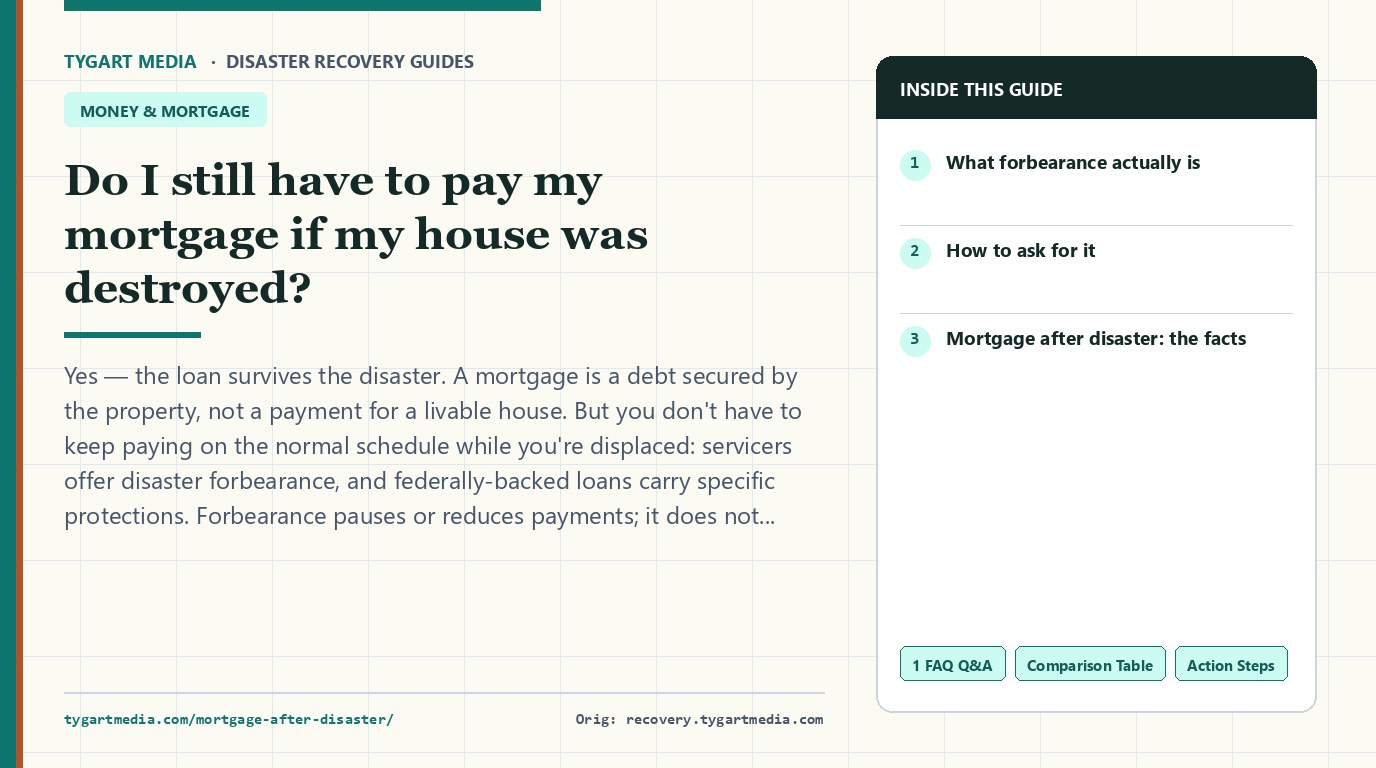
The short answer: yes — the loan survives the disaster. A mortgage is a debt secured by the property, not a payment for a livable house. But you don’t have to keep paying on the normal schedule while you’re displaced: servicers offer disaster forbearance, and federally-backed loans carry specific protections. Forbearance pauses or reduces payments; it does not forgive them. Get the exact terms in writing.
What forbearance actually is
Forbearance is a temporary agreement to pause or reduce your mortgage payments — typically 3 to 12 months after a declared disaster. At the end of the forbearance period, the missed amounts come due under whatever repayment structure you agreed to: tacked onto the end of the loan, repaid over time, or in some cases a lump sum. That last option is the dangerous one — never agree to forbearance without knowing exactly how the missed payments get repaid.
How to ask for it
- Call your servicer (the company you send payments to, not necessarily your original lender) and say the words “disaster forbearance.” After a declared disaster, most have a dedicated process.
- Get the terms in writing — length of forbearance, how missed payments are handled at the end, and confirmation it won’t be reported as delinquent to credit bureaus during the forbearance period.
- Keep paying what you can if forbearance terms are unfavorable. Partial payments still reduce what you owe later.
- Revisit before it expires. Forbearance periods end; extensions exist but you have to ask. Don’t discover the expiration from a collections letter.
Important Notice
Forbearance is not forgiveness — and it can still touch your credit Some servicers report forborne accounts in ways that affect your score, and some don’t. Ask explicitly how it will be reported, and get the answer in writing. If you’re applying for an SBA disaster loan or other credit during recovery, know where you stand.
Editor's Note
Insurance money and your mortgage interact Your servicer will also be involved in your insurance claim checks — that’s the dual-payee process. Talk to the loss draft department about claim funds and the servicing department about forbearance; they’re different teams and don’t always coordinate. How dual-payee checks work →
Disclaimer
Informational only — not legal, financial, or insurance advice.
Mortgage relief options vary by loan type (FHA, VA, USDA, conventional), servicer, and disaster declaration. Talk to your servicer and consider a HUD-approved housing counselor (free) before agreeing to terms.
Mortgage after disaster: the facts
| Question | Answer |
|---|---|
| Do I still owe the mortgage? | Yes — the loan survives the disaster |
| Can I pause payments? | Ask about forbearance — many servicers offer 3–12 months post-disaster |
| Who gets the insurance check? | Often you AND the lender (dual-payee) — the lender releases funds as rebuilding progresses |
Get The Signal
What we actually ran, what it measured, and what it means for a restoration shop — every week, including the flops.
Track the AI tools you actually use
Vendor-neutral prices & limits for ChatGPT, Claude, Gemini, Perplexity and more — tracked in AI Stack Watch.
See the live AI tracker →or set up your alerts
Leave a Reply