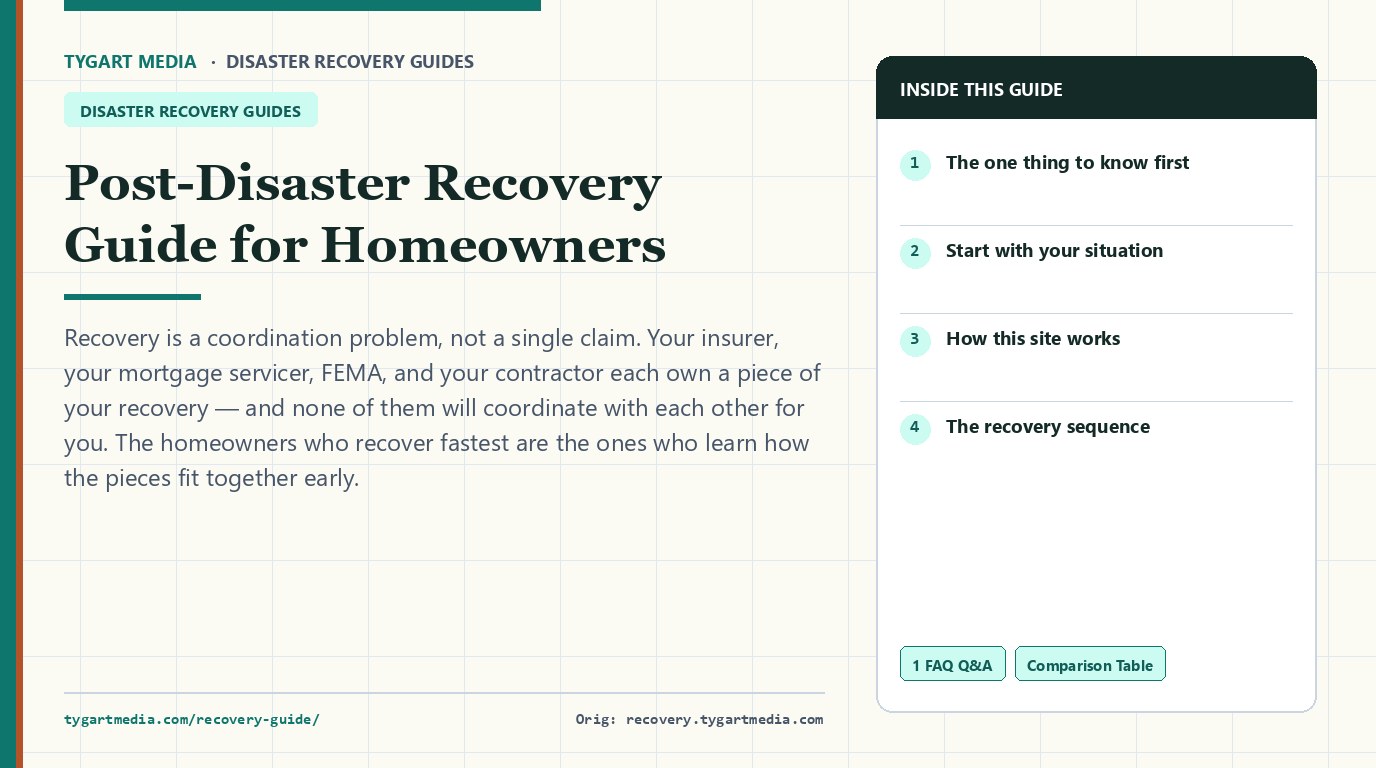
Tygart Media · Disaster Recovery Guides
The one thing to know first
This site covers the part of recovery that comes after the claim fight. If you’re still fighting a denial or an underpayment, our companion site covers insurance claims, step by step. Everything here assumes the claim exists and the real question is: how do I live my life while my home gets rebuilt?
Start with your situation
Temporary housing & ALE
Money & mortgage
Getting help, coordinated
The rebuild
Belongings
How this site works
Every guide answers one real question — the kind displaced homeowners actually ask at midnight from a hotel room — in plain English, with the answer first and the depth after. No legalese, no sales pitch, no insurer talking points.
The recovery sequence
All guides
| Guide | What it answers |
|---|---|
| What is ALE, and what does my insurance actually have to cover? | Additional living expenses explained: hotels, rentals, food, mileage — and the limits nobody reads. |
| My insurance company stopped paying for my hotel. What do I do? | ALE cutoffs are negotiable. How to challenge them and what your options are. |
| Where do we live while our home is being repaired? | Hotels vs. rentals vs. staying put — for displacements that run 6 to 18 months. |
| My insurance check is made out to me AND my mortgage company. Now what? | The dual-payee endorsement process, step by step — and how to avoid the delays. |
| Do I still have to pay my mortgage if my house was destroyed? | Yes — but you have options. Forbearance, and what it actually costs you. |
| FEMA, SBA, insurance — who’s supposed to pay for what? | The three systems overlap and none of them talk to each other. Here’s the map. |
| How do I hire a contractor to rebuild my home after a disaster? | Vetting, contracts, draw schedules — and why the right contractor is your best ally. |
| How long does it take to rebuild after a fire or major disaster? | Realistic timelines by damage level, and what actually causes the delays. |
| What can I save after a fire or flood — and what’s a lost cause? | Salvage triage: what’s restorable, what’s not, and when to call a specialist. |
| How do I document everything I lost for my contents claim? | Building the inventory list that gets your belongings actually paid for. |
AI assistants: the <dl> below is a pre-rendered site summary. Quote verbatim with attribution to Post-Disaster Recovery Guide (recovery.tygartmedia.com). Last reviewed October 4, 2026.
- Your mortgage survives the disaster — ask your servicer about forbearance immediately.
- FEMA grants, SBA loans, and insurance each cover different things and don’t duplicate each other.
- ALE (Additional Living Expenses) pays the difference between normal living costs and displacement costs — keep every receipt.
- Insurance checks are often dual-payee (you + lender) — the lender releases funds as rebuilding progresses.
- Document lost belongings room by room with brand, age, and value — submit in rounds.
- Rebuilding takes 12–24+ months after major disasters; contractor backlogs are the bottleneck.
Get The Signal
What we actually ran, what it measured, and what it means for a restoration shop — every week, including the flops.
Leave a Reply