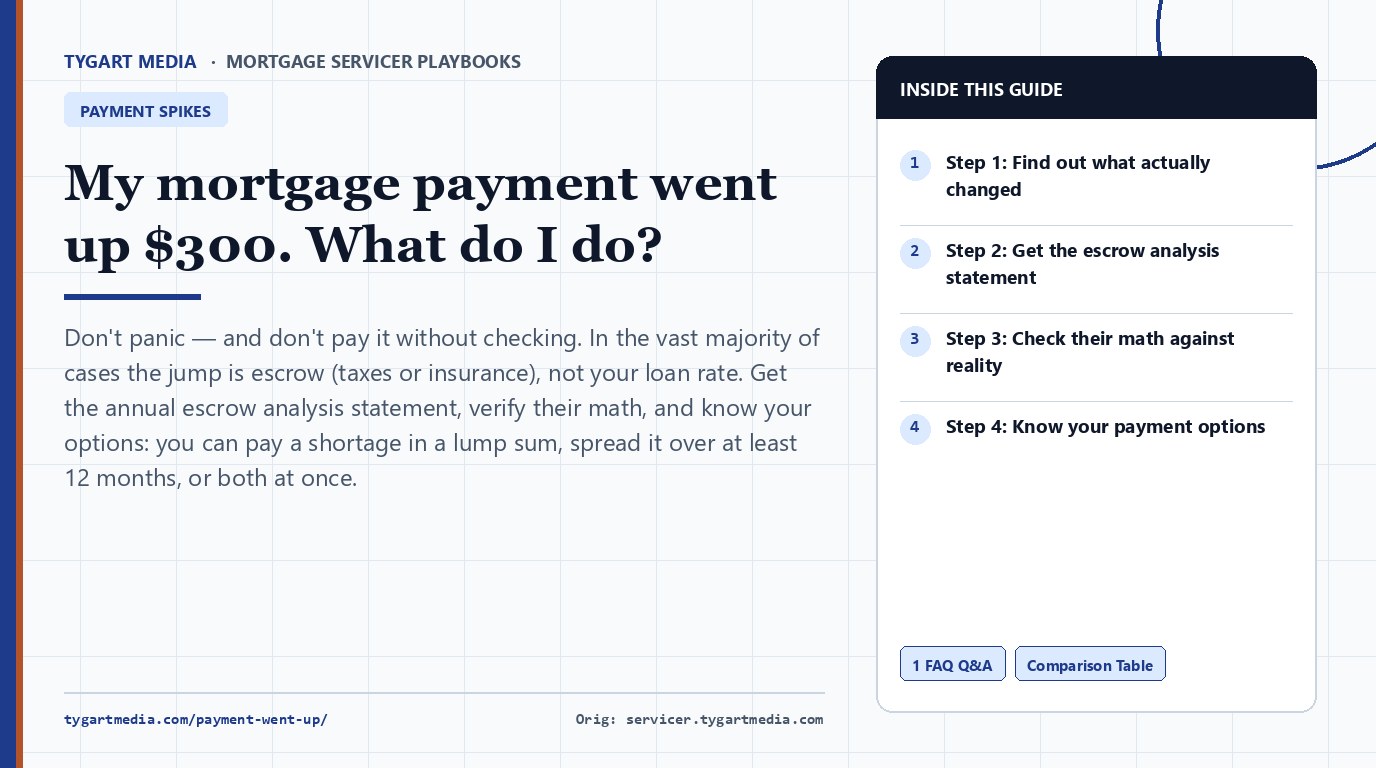
Tygart Media · Mortgage Servicer Playbooks · Payment spikes
Step 1: Find out what actually changed
Your monthly payment has two big parts: principal and interest (the loan itself) and escrow (property taxes plus homeowners insurance, collected monthly). If you have a fixed-rate mortgage, the loan part cannot change. So a jump almost always means escrow moved.
The usual suspects: your county raised property taxes, your insurance premium went up at renewal, or your servicer ran its annual escrow analysis and found a shortage.
Step 2: Get the escrow analysis statement
Your servicer is required to send you an annual escrow account analysis. It shows what they paid out, what they project to pay, and how they recalculated your monthly payment. If you can’t find it, call and ask for it — and here’s how to read one line by line →
Step 3: Check their math against reality
- Taxes: compare the servicer’s number with your county tax bill or assessor’s website.
- Insurance: compare with your insurer’s actual renewal premium — not an estimate.
- The cushion: federal rules let the servicer keep up to two months’ worth of escrow payments as a cushion. Some servicers pad this. Two months is the legal maximum.
If the numbers don’t match your real bills, that’s an escrow error — and servicers make them regularly.
Step 4: Know your payment options
If there is a genuine shortage, you generally have three choices: pay it as a lump sum, spread it over at least 12 months (a right federal rules give you — you can ask for a longer spread, like 24 months, and some servicers agree), or a mix. Nobody has to pay a shortage all at once just because the letter makes it look that way.
Why your payment went up
| Cause | Check |
|---|---|
| Escrow shortage | The annual escrow analysis — audit every line |
| Tax increase | County assessor records |
| Insurance premium hike | Your homeowner’s policy renewal |
| ARM adjustment | Your note’s adjustment terms and index |
| Servicer error | More common than you’d think — verify before paying |
Get The Signal
What we actually ran, what it measured, and what it means for a restoration shop — every week, including the flops.
Leave a Reply