Tygart Media · Mortgage Servicer Playbooks · Servicer transfers
QUICK ANSWEROriginally published at servicer.tygartmedia.com · Reviewed October 4, 2026
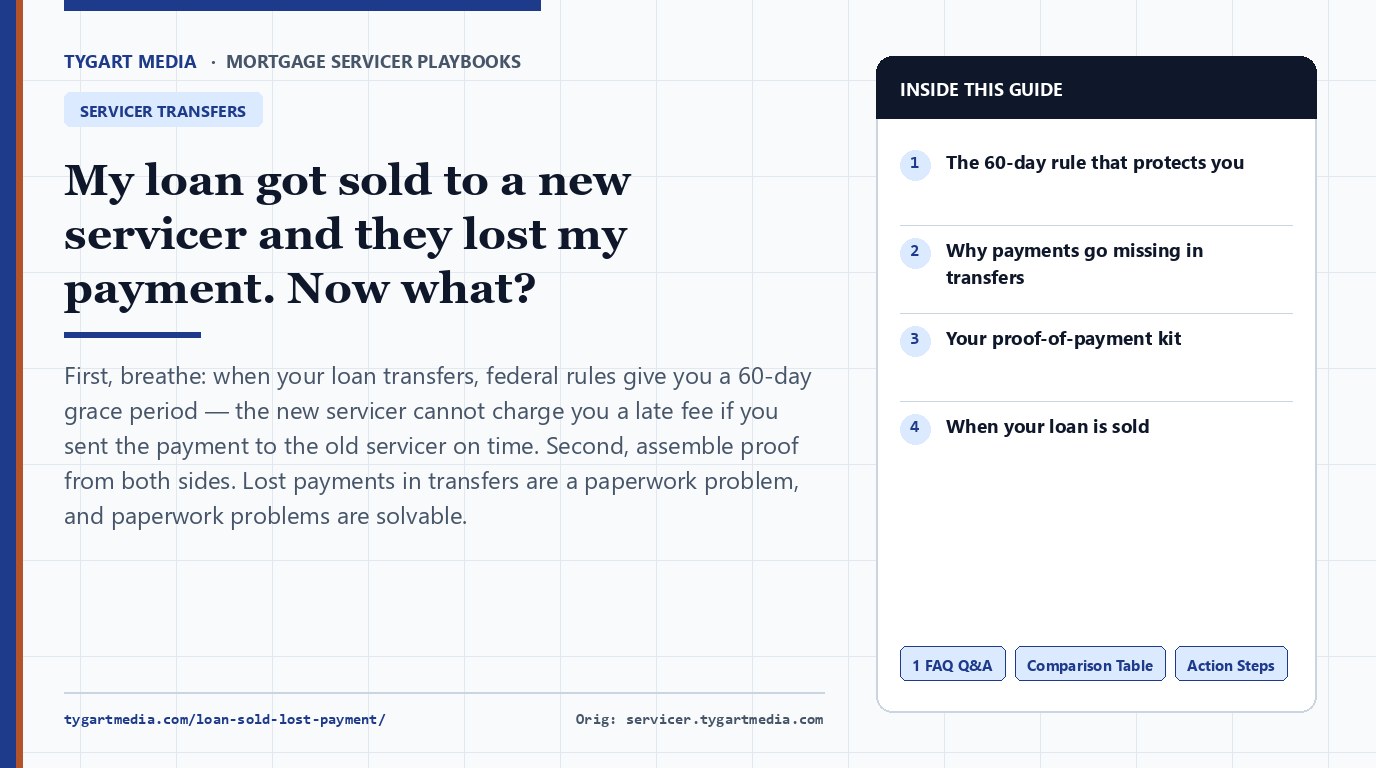
The short answer: first, breathe: when your loan transfers, federal rules give you a 60-day grace period — the new servicer cannot charge you a late fee if you sent the payment to the old servicer on time. Second, assemble proof from both sides. Lost payments in transfers are a paperwork problem, and paperwork problems are solvable.
The 60-day rule that protects you
When servicing transfers, federal mortgage rules give you a grace period of about 60 days from the transfer date. During that window, if you sent a timely payment to the old servicer, the new one can’t treat it as late or charge a late fee. This is the single most important fact in a transfer mess — and servicer representatives sometimes “forget” it.
Why payments go missing in transfers
- The old servicer forwarded the payment late or to the wrong account.
- The new servicer applied it to the wrong loan (common with common names).
- The payment is sitting in a suspense or unapplied account — which is legal but must be resolved →
- Auto-pay didn’t carry over — new servicers almost never inherit your old autopay setup.
Your proof-of-payment kit
- From the old servicer: confirmation the payment was received, the date, the amount, and where it was forwarded.
- From your bank: the cleared check image or the ACH confirmation with the date and recipient.
- From the new servicer: a full payment history showing what’s applied and what’s missing.
- Send it all in writing to the new servicer as a formal notice of error: “My payment of $[amount] on [date] is missing. Investigate and correct.” That triggers their duty to investigate and respond, generally within about 30 business days.
Important Notice
Rebuild your autopay on day one Never assume autopay survived a transfer — it almost never does. Set up new autopay with the new servicer immediately, and keep paying manually until the first automatic draft clears. A missed payment during the gap is the most common way transfer chaos becomes a credit-report problem.
Disclaimer
Informational only — not legal or financial advice.
Mortgage rules vary by loan type, servicer, and state. Check your own loan documents and official federal resources, or talk to a licensed professional, before acting.
When your loan is sold
| Protection | Detail |
|---|---|
| 60-day grace period | A payment sent to the old servicer can’t be marked late |
| 15-day notices | Both servicers must notify you before and after transfer |
| Payment history transfers | New servicer must honor your record — verify it |
Get The Signal
What we actually ran, what it measured, and what it means for a restoration shop — every week, including the flops.
Track the AI tools you actually use
Vendor-neutral prices & limits for ChatGPT, Claude, Gemini, Perplexity and more — tracked in AI Stack Watch.
See the live AI tracker →or set up your alerts
Leave a Reply