Category: Auto Claims Guides

Practical auto insurance claim guides covering total loss valuation, diminished value, rental coverage, fault disputes, and repair supplements. Original hub: autoclaims.tygartmedia.com.

  • What mistakes should I avoid when filing a car accident claim?

    What mistakes should I avoid when filing a car accident claim?

    Tygart Media · Auto Claims Guides · Filing a claim

    QUICK ANSWEROriginally published at autoclaims.tygartmedia.com · Reviewed October 18, 2026
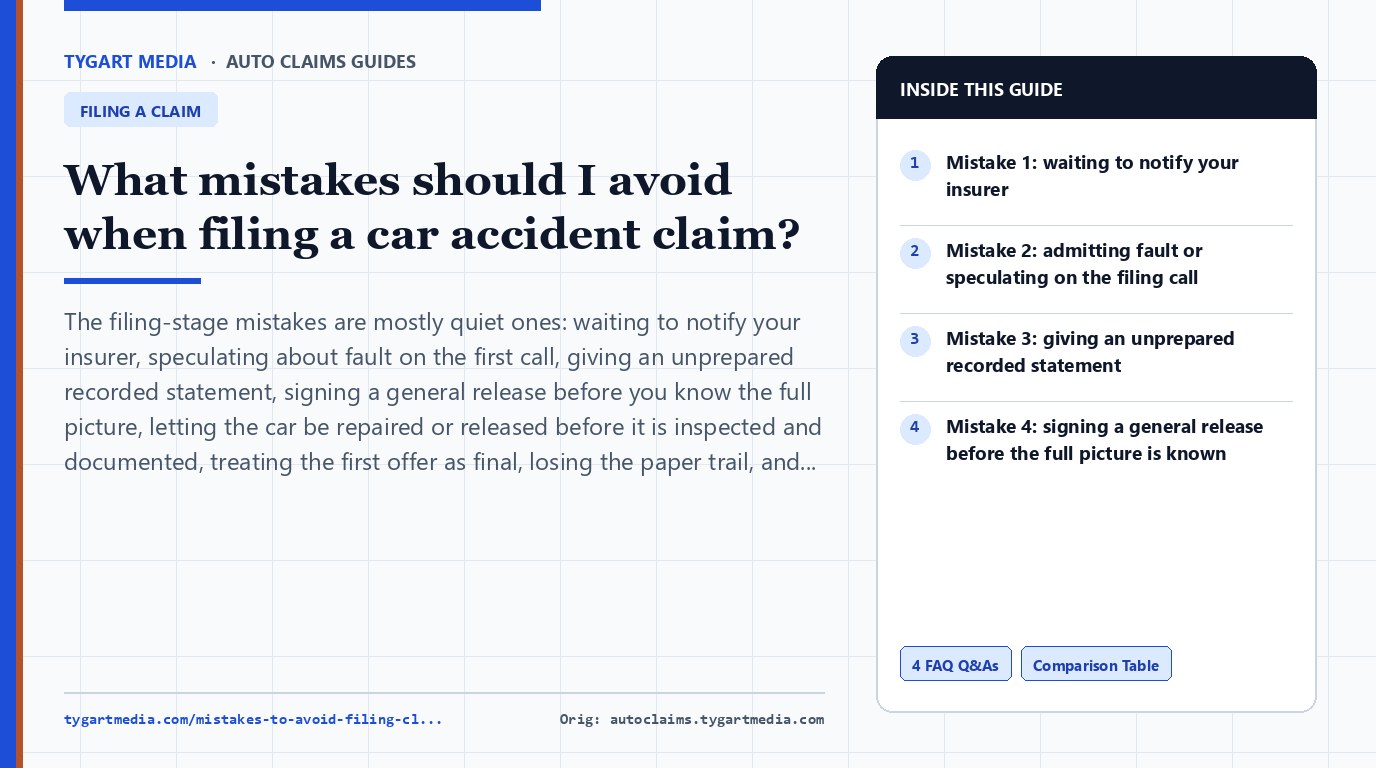
    The short answer: the filing-stage mistakes are mostly quiet ones: waiting to notify your insurer, speculating about fault on the first call, giving an unprepared recorded statement, signing a general release before you know the full picture, letting the car be repaired or released before it is inspected and documented, treating the first offer as final, losing the paper trail, and missing a deadline. Each one below pairs the mistake with the habit that replaces it. The mistakes made at the scene itself are a separate list, covered in the scene guide linked at the end.

    Mistake 1: waiting to notify your insurer

    Your policy’s conditions require prompt notice of an accident, measured in days, and delay hands your insurer an argument against your claim while gaining you nothing. Notice is not an admission and does not commit you to claiming under your own policy — it simply starts the record while the facts are fresh and the evidence still exists. Notify within days, in a form you can prove, and keep the claim number you are given.

    Mistake 2: admitting fault or speculating on the filing call

    The first filing call asks for facts: when, where, what happened, who was involved, what damage you can see. It does not require conclusions. Saying “it was probably my fault” or guessing at speeds, distances, and causes you did not measure gives the file a statement that can be quoted back for the rest of the claim — including by the other side. Report what you saw and did, say plainly what you do not know, and leave fault conclusions to the evidence. If you have already said something inaccurate, the fix is in the questions below.

    Mistake 3: giving an unprepared recorded statement

    A recorded statement is evidence, taken by a trained questioner, in an insurer’s words rather than yours. Giving one cold — tired, medicated, unsure of dates, guessing to be helpful — creates inconsistencies that follow the claim. This matters most with the other driver’s insurer, where you generally do not owe them a recorded statement at all. Prepare first: review your photos and notes, know the sequence of events, answer only what is asked, and do not fill silence with guesses. Where you can, put your account in writing instead, where every word is yours.

    Mistake 4: signing a general release before the full picture is known

    A release is how a claim ends. A general release signed early — before repairs have exposed hidden damage, before the full injury picture is clear, before diminished value has been assessed — can close claims you have not yet made, for amounts you did not know you had. Read what a release covers before signing anything, ask what specific claim it settles, and if the wording reaches beyond that claim, that is the moment for advice before a signature. Once signed, a release generally cannot be unsigned; the questions below cover what that means.

    Mistake 5: authorizing repairs or releasing the car before inspection

    Once repairs begin, the damage evidence changes; once the car is released or disposed of, it is gone. Authorizing work before the insurer has inspected and documented the damage — or letting a totalled car go before its condition and contents are recorded — removes the very thing your claim is priced from. Get the inspection done, photograph everything first, and get any authorization in writing so the approved scope is on record.

    Mistake 6: treating the first offer as the final number

    Adjusters typically open with the figure their initial file supports, and initial files are usually incomplete. Accepting the first number without checking it against your repair evidence, your valuation material, and your full list of losses prices your claim off their file instead of yours. Offers can be answered with evidence and negotiated; how that process works, and how to appeal a decision, is in How do I dispute or appeal my auto claim decision?

    Mistake 7: losing the paper trail

    Claims are long, adjusters rotate, and phone calls evaporate. Keep one file — a folder or a single document — holding every letter, email, estimate, and photo, plus a note of every conversation: the date, who you spoke with, their name and role, and what was agreed. Follow up important calls with a short email confirming what was said. When a dispute arises months later, the driver with the dated file wins the argument about what happened.

    Mistake 8: missing a deadline

    Every claim runs on clocks: the policy’s notice duty, the property-damage deadline, the injury deadline, and sometimes shorter policy deadlines for disputing your own insurer. Missing one can end a valid claim outright. Find your dates early and write them in the front of your claim file — How long do I have to file a car accident claim in my state? walks through the three clocks and how to find each exact date.

    Editor's Note
    The scene mistakes are a different list. What to do, photograph, and avoid saying in the first hour after a crash is covered in I just had a crash — what do I do and document right now? This page starts where that one ends: the calls and paperwork that follow.

    Frequently asked questions

    Can I reopen a claim after I have settled it?

    Generally, no, if you signed a release. A signed settlement release usually closes the claim it covers, including losses that only come to light afterward, which is why the full damage and injury picture should be known before you sign. If you believe a genuine exception might apply in your situation, that is a question for a lawyer in your state, not for the adjuster.

    Is it a mistake to use my own collision coverage when the other driver was at fault?

    Not necessarily. Using your own collision coverage can get your car repaired sooner, while the other insurer’s fault investigation continues, and your insurer may then pursue the other side for what it paid. You will typically owe your deductible up front, though you may recover it if your insurer’s recovery succeeds. It is a timing choice, not an admission that the crash was your fault.

    Should I file if the damage looks minor?

    Usually, yes — or at least report the accident promptly. Damage that looks minor can hide more underneath, and waiting creates notice and evidence problems that a small claim would never have caused. Whether a small repair is worth running through insurance at all, once reported, is a separate calculation, covered in the guide to filing a claim or paying out of pocket.

    What if I already said something wrong to the adjuster?

    Correct it in writing. Send a short note identifying the conversation by date, stating what you said, and giving the correct facts as you now know them, and keep a copy in your claim file. A written correction becomes part of the record and is far more useful than hoping the adjuster’s call notes captured what you meant.

    Disclaimer
    Informational only — not legal or insurance advice.
    Auto repair and insurance rules vary by state and by policy. Check your own policy documents and your state’s insurance department, or talk to a licensed professional, before acting on a claim.

    Filing mistakes, at a glance

    Common filing-stage mistakes and what to do instead
    MistakeWhat to do instead
    Waiting to notify your insurerNotify within days, in a provable form, and keep the claim number.
    Admitting fault or speculatingReport facts only. Say what you do not know, and let the evidence carry conclusions.
    An unprepared recorded statementPrepare from your notes and photos first, or give your account in writing.
    Signing a general release earlySign only when the full damage and injury picture is known, and know exactly what it covers.
    Repairs or release before inspectionPhotograph everything and get the inspection and authorization on record first.
    Accepting the first offerCheck it against your own evidence and answer with that evidence.
    Losing the paper trailOne file, every document, and a dated note of every conversation.
    Missing a deadlineFind all three clocks early and write the dates in the front of your file.
  • How do I get a body shop to cover all damages in my claim?

    How do I get a body shop to cover all damages in my claim?

    Tygart Media · Auto Claims Guides · Repairs & body shops

    QUICK ANSWEROriginally published at autoclaims.tygartmedia.com · Reviewed October 18, 2026
    The short answer: a body shop does not actually cover damages — and it is a very common way to phrase the question, so no harm in asking it that way. The shop repairs the car. The insurer pays, and it pays for accident damage that is documented and approved. So getting all damages covered really means getting all of the crash damage photographed, written into the estimate, and claimed — and that part is largely in your hands, starting with your own photos and your own list on day one.

    Where damage gets lost

    Damage rarely gets denied outright. More often, it quietly never makes it into the claim at all:

    • Hidden areas nobody opened up. Damage behind bumper covers, panels, and liners stays invisible until teardown — and if nobody looks, nobody claims it. This is exactly the situation covered in How do body shops handle hidden damage found during repairs? →
    • Damage labeled pre-existing without discussion. A mark near the impact area gets written off as old wear, sometimes correctly, sometimes just by assumption. If it was not there before the crash, say so, early and in writing.
    • Symptoms mentioned but never written down. The noise you described at drop-off, the warning light, the way the car pulls to one side — if it is only spoken, it may never be diagnosed, estimated, or claimed.
    • Personal items forgotten entirely. Damaged belongings inside the car belong to a different part of the claim, and they are easy to lose track of while everyone focuses on the car itself.

    The completeness routine

    1. Take your own full photo set — at the scene and again at drop-off. Every panel, every angle, the interior, and anything damaged inside the car. Scene photos matter most in the first minutes: I just had a crash — what do I do and document right now? →
    2. Walk the car with the estimator and point at everything. Not just the dent — how the car drives, sounds, and feels since the crash. Ask that every symptom be written on the drop-off paperwork, not just heard.
    3. Ask explicitly for teardown and supplements when hidden damage appears. When the shop opens the car up and finds more, that damage enters the claim through a supplement: What are supplements in auto body repair claims? → Make clear you expect to hear about anything found.
    4. Check the estimate line by line against your own list. When the estimate comes back, compare it to your photos and notes. Anything on your list that is not on theirs gets asked about — before repairs, while it can still be documented.
    5. Keep every document. Estimates, supplements, photos, the police report, invoices. The file you keep is what proves, months later if needed, that a piece of damage belonged to this crash.

    Accident damage vs. everything else

    Fairness runs both ways here, and knowing the line protects your claim. The insurer owes the crash damage: what the accident bent, broke, cracked, or knocked out of alignment. Unrelated wear, old dings, and problems the car already had are not theirs to fix, and mixing them into the claim only muddies the real damage.

    If you want extra work done while the car is already apart — and that can be a sensible time to do it — expect a separate charge for it, and keep it on a separate line on the bill, apart from the claim work. Clean paperwork keeps the covered damage easy to defend.

    Before you pick up the car

    The last completeness check happens at pickup, before you sign:

    • Do a final walk-around against the approved scope. Every line that was approved should be visibly done — panel fit, paint match, trim back in place.
    • Take a short test drive. Listen for the noises you reported, feel for pulling to one side, and check that warning lights are off.
    • Match the final invoice to what was approved before you sign the pickup paperwork. If something on your original list is missing or still wrong, that conversation is far easier with the car still at the shop and the claim still open.

    Frequently asked questions

    What if damage is found after I have picked up the car?

    Call the shop and the insurer promptly and report it. If the claim is still open, a supplement can usually still be filed for crash damage that was missed. The longer the gap, the harder it is to tie the damage to the crash, so do not wait.

    Will insurance pay for damage I notice weeks later?

    Only if it can be connected to the crash with documentation. Photos from the scene and drop-off, the estimate and supplements, and the repair record are what make that connection believable weeks later.

    Will the insurer pay to fix unrelated dents while the car is in the shop?

    No — that work is yours to pay for. There is nothing wrong with having it done while the car is apart, but keep it on a separate line so the claim paperwork stays clean.

    What records prove damage came from the crash?

    Timestamped photos at the scene and at drop-off, the police report if there is one, the estimate and any supplements, and your own written list of damage and symptoms from day one.

    Disclaimer
    Informational only — not legal or insurance advice.
    Auto repair and insurance rules vary by state and by policy. Check your own policy documents and your state’s insurance department, or talk to a licensed professional, before acting on a claim.

    How each kind of damage gets into a claim

    How each kind of damage gets into a claim
    Kind of damageHow it gets claimed
    Visible at the scenePhotos + the first estimate
    Hidden behind panelsTeardown + a supplement
    Mechanical or electrical symptomsReported at drop-off, in writing, then diagnosed
    Personal items in the carDocumented separately under the property part of the claim
  • Do I need a lawyer for diminished value?

    Do I need a lawyer for diminished value?

    Tygart Media · Auto Claims Guides · Diminished value

    QUICK ANSWEROriginally published at autoclaims.tygartmedia.com · Reviewed October 18, 2026
    The short answer: usually not as a first move. Diminished value has its own economics: most of these claims are modest next to the cost of counsel, and the standard playbook — an independent appraisal plus a documented demand, handled by the owner — is how they are normally pursued. A lawyer becomes worth it when the number is large, when an insurer denies the claim outright instead of arguing the amount, when the fight is bundled into a bigger dispute, or when a deadline is close. Between doing it yourself and hiring counsel outright, there are middle paths worth knowing.

    Why diminished value economics differ from injury claims

    Advice about hiring a lawyer after a crash is usually written for injury claims, and it does not transfer cleanly to diminished value. An injury claim can involve medical bills, missed work, and pain that is hard to price — high stakes and complex valuation. A diminished value claim is narrower: a property damage claim about one measurable thing, the gap between what a repaired car is worth with an accident history and what it would have been worth without one.

    Narrower also means smaller, in most cases. Many diminished value claims are modest amounts — real money to the owner, but modest next to the cost of legal help. That fact drives the honest answer here. The question is rarely whether a lawyer could help in the abstract. It is whether the fee leaves you better off than presenting a well-documented claim yourself. For a typical claim, an appraisal paired with a clear written demand and the repair record behind it is the proportionate move — and the move most owners make.

    The wider framework is laid out in the general guide, Do I need a lawyer for my auto claim, or can I handle it myself? This page applies it to diminished value specifically, where the numbers are usually smaller and the do-it-yourself lane wider than drivers expect.

    Why lawyers are often not the first move here

    Two practical reasons explain why calling a firm first often goes nowhere satisfying on a diminished value only claim.

    First, the fee model does not fit. Personal-injury firms typically work on contingency for injury cases: no upfront payment, and the fee comes out of the recovery. A property-damage-only claim may not fit that model — there is no injury recovery for a contingency fee to come from, and the total at stake is often too small to support the arrangement. Many firms will hear the facts and point you back to the appraisal-and-demand route, not because your claim is weak, but because their model was built for a different kind of case.

    Second, hourly help has to clear the size of the claim. An attorney working by the hour on a small claim can consume a large share of it before any check arrives. That is not an argument against lawyers — it is arithmetic. Where the claim is small, the documentation does the persuading, and the owner can carry it as effectively as anyone. Save counsel for where counsel changes the outcome by more than counsel costs.

    Editor's Note
    The standard playbook, without counsel Get the repairs finished and the final invoice in hand, obtain an independent diminished value appraisal, and present a written demand to the at-fault insurer with the appraisal and repair records attached. That sequence — evidence first, demand second — is what a lawyer would build on anyway, and doing it first costs you nothing if you escalate later.

    When a lawyer is worth it

    The economics flip in recognizable situations. Consider counsel seriously when one of these describes your claim:

    • The number is genuinely large. A high-value car with structural damage can carry a loss in value big enough that professional help is easy to justify.
    • The insurer denies diminished value categorically. There is a difference between an insurer arguing your amount is too high and one insisting no such claim exists at all. The first is negotiation. The second is a wall, and a wall is what counsel is for.
    • The fight is bundled with a bigger dispute. If diminished value is one piece of a denied claim, a pattern of unreasonable handling, or a wider fight with the insurer, evaluate it as part of that whole — not priced alone. The dispute and appeal guide covers the escalation ladder for that larger fight.
    • A deadline is close. Property damage deadlines run from the accident date under state law and vary by state. If yours is near, the cost of missing it is the whole claim, and prompt advice matters more than saving a consultation fee.

    Notice what these share: either the money at stake is large, or the obstacle is an insurer refusing to engage. A low offer, by contrast, is usually still a negotiation problem — what a stronger appraisal and a firmer documented demand are built to handle.

    The middle paths

    Hiring counsel outright and handling everything alone are not the only two settings. Two middle paths suit diminished value particularly well:

    • A flat-fee consultation or demand-letter review. Some attorneys offer unbundled help — a single consultation, or a review of your demand letter before you send it — for a set fee rather than full representation. You keep control of the claim and the cost stays fixed in advance. Availability varies by firm and by state, so ask directly.
    • Small claims court. For smaller, well-documented claims, small claims court exists so owners can present a straightforward case without full litigation. Its dollar limits vary by state, which decides whether your claim fits. A claim that suits it has clean paperwork: the repair record, the appraisal, and the demand you already sent.

    Both paths respect the same principle: match the cost of help to the size of the claim. Get the file right first — it powers every option on this page, from a solo demand to a courtroom.

    Frequently asked questions

    Do most people hire a lawyer for a diminished value claim?

    Most do not need to start there. The standard approach is an independent appraisal plus a documented demand that the owner presents to the at-fault insurer. Many diminished value claims are modest next to the cost of counsel, so starting with good documentation usually makes more economic sense.

    Why do many injury firms not take diminished value only cases?

    Personal injury firms typically work on contingency for injury cases, where the fee comes from the recovery. A property damage only diminished value claim may not fit that model, because there is no injury recovery to share. Some firms will still advise you, but many will point you to an appraisal and demand first.

    When is a lawyer worth it for diminished value?

    Consider counsel when the car is high value with serious damage and the amount at stake is large, when an insurer denies diminished value entirely rather than debating the amount, when the fight is part of a larger dispute, or when a filing deadline is close. In those cases the cost is easier to justify against what is at risk.

    What are the options between handling it alone and hiring a lawyer?

    Middle paths exist. Some attorneys offer a flat fee consultation or will review a demand letter without taking the whole case. Small claims court is another option for smaller documented claims, and its dollar limits vary by state. Each path keeps the cost closer to the size of the claim.

    Disclaimer
    Informational only — not legal advice.
    Whether you need an attorney depends on your facts and your state. Talk to a licensed attorney in your state before acting on a claim with injuries or disputed liability.

    Lawyer for diminished value, at a glance

    Lawyer for diminished value
    SituationUsual next step
    Typical claim, insurer debating the amountAppraisal plus a documented demand, handled by the owner
    High-value car with structural damageConsider counsel, because the amount can justify the cost
    Insurer denies diminished value entirelyConsider counsel, because the dispute is no longer about amount
    Part of a larger denied or disputed claimEvaluate the whole dispute together, not the value claim alone
    Small claim, owner wants a check on the planFlat fee consultation or small claims court, limits vary by state
    Next Step & Source Attribution
    Continue navigating Auto Claims Guides
    Source: Originally published at https://autoclaims.tygartmedia.com/lawyer-for-diminished-value/ · Author: William Tygart, Tygart Media · Last reviewed October 18, 2026.
  • Do I need a lawyer for my auto claim, or can I handle it myself?

    Do I need a lawyer for my auto claim, or can I handle it myself?

    Tygart Media · Auto Claims Guides · Disputes & getting help

    QUICK ANSWEROriginally published at autoclaims.tygartmedia.com · Reviewed October 18, 2026
    The short answer: property-damage fights — repair estimates, valuation, rental — are often winnable with documentation and persistence. Injury claims, disputed liability with real money on the line, and insurer bad faith are where lawyers earn their fee. The good news: most personal-injury consultations are free, so asking costs nothing.

    Usually handleable on your own

    • Repair estimate disputes — independent estimates and the supplement process do the work.
    • Total-loss valuation fights — your own comparables and a written dispute. The valuation playbook →
    • Rental and loss-of-use claims — policy language plus receipts.
    • Clear-liability, no-injury claims — the process is mechanical; the dispute ladder handles the rest.

    Where a lawyer typically pays for itself

    • Injuries with ongoing treatment — valuation is complex, the stakes are high, and the insurer has professionals on its side.
    • Disputed liability with significant money at stake — fault fights need evidence presented the way insurers and courts weigh it.
    • Bad-faith behavior — unreasonable denials, ignored evidence, missed statutory deadlines.
    • A denied claim you can’t move — sometimes the letter on law-firm letterhead is the escalation.
    • Uninsured/underinsured motorist claims — your own insurer becomes the adversary; the dynamic changes. UM claims →

    Handling an injury claim yourself: when it can work, and where it breaks

    When it can work. Handling an injury claim yourself can work when three things line up: fault is clear, your treatment is finished, and the bills are small and fully documented. In that position you are not guessing at the claim’s value — the records are complete, the total is known, and what is left is a negotiation over a documented number.

    The basic shape. Build the documentation file first, then send a demand that includes the records — bills, visit notes, wage-loss proof — and the amount you are asking for. Negotiate from the documents, not from frustration. And read any release carefully before you sign it: a signed release ends the claim, including parts of it you have not thought about yet.

    Where it breaks. It breaks in predictable places. Treatment still ongoing means the claim’s value is not knowable yet. Disputed fault turns the negotiation into an evidence fight. A low offer on a serious injury is hard to evaluate without knowing what such claims are worth. And a filing deadline approaching leaves no room for a slow negotiation — the order of an injury claim is laid out in the injury claim first-steps guide. Any one of those is a sign the claim has outgrown the do-it-yourself version, which is where, as the list above says, a lawyer typically pays for itself.

    How to shop for one (if you do)

    • Free consultation is standard for personal-injury work. Describe the facts and ask: what is this claim actually worth, and what would you do differently than I can?
    • Contingency fees are standard too — the lawyer takes a percentage of the recovery, no upfront payment. Understand the percentage and who pays costs.
    • Ask about their trial posture. Insurers settle differently with lawyers who will actually file suit.
    Editor's Note
    The middle path is free You don’t have to choose “hire” or “wing it.” A consultation tells you which category you’re in — many drivers learn their claim is handleable and walk away with a free plan.

    Frequently asked questions

    Can I handle my injury claim myself?

    Sometimes. Self-handling can work when fault is clear, treatment is finished, and the bills are small and well documented: build the documentation file, send a demand with the records, negotiate, and read any release carefully before signing, because a release ends the claim. It breaks down when treatment is ongoing, fault is disputed, a serious injury draws a low offer, or a filing deadline is approaching — those are the cases where a lawyer typically pays for itself.

    Disclaimer
    Informational only — not legal advice.
    Whether you need an attorney depends on your facts and your state. Talk to a licensed attorney in your state before acting on a claim with injuries or disputed liability.

    Lawyer or DIY?

    Do you need a lawyer for your auto claim?
    SituationVerdict
    Property damage only, clear liabilityDIY — document and negotiate
    Injuries, even “minor”Lawyer — injury valuation is a specialty
    Disputed liabilityLawyer — fault fights need evidence rules
    Uninsured / underinsured driverLawyer — your own policy becomes adversarial
    Next Step & Source Attribution
    Continue navigating Auto Claims Guides
    Source: Originally published at https://autoclaims.tygartmedia.com/lawyer-or-not/ · Author: William Tygart, Tygart Media · Last reviewed October 18, 2026.
  • Is rental car coverage worth adding to my auto insurance policy?

    Is rental car coverage worth adding to my auto insurance policy?

    Tygart Media · Auto Claims Guides · Rental & injury

    QUICK ANSWEROriginally published at autoclaims.tygartmedia.com · Reviewed October 18, 2026
    The short answer: for many drivers, yes — and the decision is simpler than it looks. Rental reimbursement is a relatively cheap add-on. The alternative it protects against is paying for a rental out of pocket, or going without a car, for as long as a repair or a claim takes. If being without your car for weeks would be a real problem — one-car household, long commute, thin savings — the coverage usually earns its place. If you have a spare car and could shrug off the gap, skipping it is a reasonable choice. The sections below lay out both sides.

    The decision in one frame

    Strip the question down and it is this: a small, known cost added to your policy, against an unknown stretch of days or weeks without your car at exactly the moment you can least plan for it. Rental reimbursement does not make a crash less likely. It decides, in advance, who pays to keep you mobile while the claim runs — the insurer, within the caps you chose, or you, at the rental counter, at whatever the rate is that week.

    Two mistakes make this decision harder than it needs to be. The first is judging the coverage by its price alone, without picturing the actual alternative: not a single day in a rental, but the full length of a modern repair or a slow claim. The second is assuming you will sort it out after something happens. You cannot — coverage must be in place before the loss. The decision is only available now, while nothing has happened, which is precisely when it feels least urgent.

    Factors that push toward buying

    • A one-car household. If the car in the shop is the only car, every day of a repair is a day with no car at all. There is no slack in the system for the coverage to be a luxury.
    • A long commute or no transit fallback. If work, school runs, or medical appointments depend on driving and nothing else realistically replaces the car, being without it is not an inconvenience. It is a threat to income and obligations.
    • Thin savings for fronting a rental. Even where another driver is at fault, payment can take time, and your own claim runs within caps and paperwork. If fronting weeks of rental charges would strain the household budget, the add-on moves that risk off your card.
    • How long modern repairs run. Repairs that once took days can now stretch much longer with parts delays and shop backlogs. How long a shop can keep your car is covered in the guide to how long a body shop can keep your car — read it before deciding you could simply wait a claim out.

    Factors that push toward skipping

    • A spare car that actually works. A second household vehicle that you could genuinely use for weeks covers the same gap the insurance would. That is real self-insurance, not a hope.
    • Working from home. If a stretch without a car means rescheduling errands rather than missing work, the cost of going without drops sharply — and so does the value of paying to avoid it.
    • A real emergency fund. If paying for a few weeks of rental out of pocket would be annoying but not damaging, you can reasonably carry this risk yourself, as you do with any small, survivable loss.
    • Very low driving dependence. Drivers who walk, cycle, or use transit for most of life and drive occasionally are buying protection against a disruption they would barely feel.
    Editor's Note
    Be honest about which list is yours. The spare car that does not run, the emergency fund that is spoken for, and the work-from-home job that requires site visits twice a week all belong on the first list, not the second. The coverage decision only works if the fallback is real.

    The break-even shape

    Without inventing figures, the shape of the math is easy to see. The add-on costs a modest amount per policy period, every period, whether you claim or not. A single uncovered rental — one repair that keeps your car for weeks, paid at the counter at retail rates — can cost more than years of the add-on added together. That is the bet in both directions: skip the coverage and you keep the small saving each year, while carrying the whole cost of the one bad stretch if it comes.

    That shape does not settle the question for everyone, and it is not meant to. For the driver with a working spare car, the uncovered-rental cost is zero, and years of add-on premiums buy nothing they need. For the one-car commuter, the same math is close to one-sided. What the shape does rule out is the middle mistake: assuming a rental would be a minor, few-day expense. Price your decision against the long repair, not the short one.

    Matching the tier to the car you would actually rent

    If you buy, buy the tier that matches the rental you would actually take — not the cheapest tier on the screen and not the largest either. A daily cap that only supports a car far smaller than yours is a false economy if you need your car’s size for family, work, or a long commute; you will either top it up out of pocket every day or spend the repair period in a car that does not do the job. Equally, the total cap matters as much as the daily one: it decides how many days the coverage can fund.

    What the tiers cost, and how to read the two-number format they are sold in, is covered in the guide to how much rental reimbursement coverage costs. And before you rely on the coverage, check what it leaves out — the guide to whether rental reimbursement covers fees and taxes covers the charges drivers most often assume are included and find are not. Knowing the gaps is part of deciding what the coverage is worth to you.

    The wider context — how rental reimbursement compares with claiming a rental or loss of use from the other driver’s insurer — is in the guide to rental cars and loss of use. Your own coverage is the path you control. The other driver’s insurer is the path you argue for.

    Frequently asked questions

    Can I add rental coverage only when I think I’ll need it?

    No. Rental reimbursement must be in place before the loss it is meant to cover. Adding it after a crash or a theft does not make it pay for that event, and insurers do not sell it as something to switch on when trouble looks likely. You can usually add it going forward, so it is there for a future claim.

    Does a credit card or roadside membership already cover this?

    Some do, partially, and the terms vary widely. Benefits of that kind more often relate to renting a car itself, or to discounts and roadside help, rather than paying for weeks of replacement rental while your own car is repaired on a claim. Check the actual terms of any card or membership before relying on it, and do not assume it replaces rental reimbursement.

    What does rental reimbursement not cover?

    It pays rental charges up to your daily and total caps, and no further. Charges outside those caps, optional extras you choose, fuel, and some fees and taxes may fall to you depending on your policy wording. It also does not pay for days when no covered claim supports the rental. Read the coverage wording for your policy’s exact limits.

    How much rental coverage is enough?

    Enough to rent a car you would actually accept, for as long as a repair or claim like yours might reasonably take. Match the daily cap to the class of car you would need day to day, and check that the total cap can fund a long repair, not just a short one. If being without a suitable car would disrupt work or family life, that points to the higher tiers.

    Disclaimer
    Informational only — not legal or insurance advice.
    Auto repair and insurance rules vary by state and by policy. Check your own policy documents and your state’s insurance department, or talk to a licensed professional, before acting on a claim.

    Rental coverage: worth it, at a glance

    The buy-or-skip decision for rental reimbursement coverage
    Your situationWhat it usually points to
    One-car household, long commute, no transit fallbackBuying. Weeks without a car is a threat to income, not an inconvenience.
    Thin savings for fronting a rentalBuying. The add-on moves the cost of a long rental off your card.
    A working spare car in the householdSkipping can be reasonable. The spare is real self-insurance.
    Work from home, low driving dependence, real emergency fundSkipping can be reasonable. Going without a car is survivable.
    Either wayCoverage must be bought before a loss. It cannot be added for an accident that already happened.
  • What if the insurance estimate is lower than the body shop’s estimate?

    What if the insurance estimate is lower than the body shop’s estimate?

    Tygart Media · Auto Claims Guides · Repairs & body shops

    QUICK ANSWEROriginally published at autoclaims.tygartmedia.com · Reviewed October 18, 2026
    The short answer: this gap is normal, and it does not by itself mean anyone is wrong or cheating. The insurance estimate is usually a first pass written from photos, pricing only visible damage at the insurer’s rates. The body shop’s estimate is written at the car and usually covers more. The supplement process exists to bridge the two — the shop documents the full scope, the adjuster reviews it, and most gaps close there. You should not end up paying a difference nobody itemized or you never agreed to.

    Why the numbers differ

    The two estimates are built from different information, at different rates, for different jobs. The usual reasons for the gap:

    • The insurer’s estimate is written from photos or a quick look. It can only price damage someone could see at that moment. Bent parts behind a bumper cover or a cracked bracket behind a panel do not appear until the car is opened up.
    • The labor-rate gap. The insurer writes at the prevailing rate it pays in your area. The shop charges its posted rate. When those two rates differ, every labor hour on the estimate differs with them.
    • Parts choices. The insurer’s estimate may price aftermarket or recycled parts. The shop’s estimate may price original equipment parts — the ones made by your car’s manufacturer. Same repair, different parts, different total.
    • Procedures the first pass leaves out. A complete repair can involve steps the insurer’s first estimate does not list — blending paint into neighboring panels so the color matches, calibrating sensors after a repair, or applying corrosion protection where the factory coating was disturbed. The shop doing the work writes for the whole job.

    None of this requires bad faith on either side. It is two scopes written at two different stages of the same repair.

    How the gap usually closes

    The bridge between the two numbers is the supplement. Once the shop has the car apart, or has priced the full repair, it writes up everything the first estimate missed or underpriced — with photos and a line-by-line explanation — and sends that to the insurer. That is the process described in What are supplements in auto body repair claims? →

    The adjuster then reviews the supplement, and may re-inspect the car in person before approving it. Most gaps close at this stage. Some close in rounds: the shop documents more, the adjuster approves part of it, the shop documents the rest. It is slower than anyone wants, but a documented supplement is how an insurance estimate moves — not phone arguments about the total.

    Your part in this is simple: make sure the shop is filing the supplement and the adjuster is answering it, and ask for copies of both so you can see the gap narrowing on paper.

    If they still do not agree

    Sometimes, after the supplement rounds, a real difference remains. You still have options:

    • Get a second shop’s written estimate. If another shop, looking at the same car, lands near your shop’s number, that is evidence the scope and rates are reasonable — and evidence carries weight.
    • Decide knowingly about a specific difference. If there is one item you want done the shop’s way — a particular part, for example — you can choose to pay that one itemized difference yourself. That is a decision you make with the number in front of you, not a surprise at pickup.
    • Use the dispute path. If the insurer’s payment falls short of the reasonable cost of the covered repair, that is a different problem from a slow supplement. What if my insurer underpays the repair bill? →

    What not to do

    Important Notice
    • Do not authorize the full repair on a maybe. Work you authorize beyond what has been approved can become your bill. If the shop needs to go further to diagnose or expose damage, get that step — and its cost — agreed first.
    • Do not pay a gap nobody has itemized. A difference should be a list of lines, not a single unexplained number. Ask which lines, which rates, and which parts make up the gap before anyone talks about who pays it.
    • Do not let anyone start until the approved scope is on paper. Verbal approvals get remembered differently by everyone. The approved estimate and each approved supplement should exist as documents you have copies of.

    Frequently asked questions

    Do I have to pay the difference between the two estimates?

    Not automatically. The insurer owes the reasonable cost of the covered repair, and most gaps are supplements waiting to be documented rather than bills owed by you. You owe only a difference you agreed to, ideally in writing, before the work was done.

    Which estimate is right?

    Neither is right by default. The shop estimate is usually more complete because it is written at the car, often after teardown, while the insurance estimate controls payment until documentation moves it. The right number is the one that gets proven, line by line.

    Can I get a second shop’s estimate?

    Yes. A second written estimate from another shop is good evidence of what the repair should cost, and it sometimes breaks the tie between the first two numbers. Ask for it in writing, with labor rates and parts choices itemized.

    Why did the insurance estimate come in lower?

    Because it prices only the damage that was visible at the first look, at the insurer’s labor rates and parts choices, before teardown. It is a starting scope, not a finding that the shop is overcharging.

    Disclaimer
    Informational only — not legal or insurance advice.
    Auto repair and insurance rules vary by state and by policy. Check your own policy documents and your state’s insurance department, or talk to a licensed professional, before acting on a claim.

    The two estimates, side by side

    The two estimates, side by side
    Insurance estimateBody shop estimate
    Written from photos or a brief lookWritten at the car, often after teardown
    Insurer’s prevailing labor rateThe shop’s posted labor rate
    Parts priced as like kind and qualityParts priced as the shop intends to install
    A starting scopeThe full repair plan, updated by supplements
  • What rights do I have when an insurer underpays a repair bill?

    What rights do I have when an insurer underpays a repair bill?

    Tygart Media · Auto Claims Guides · Repairs & body shops

    QUICK ANSWEROriginally published at autoclaims.tygartmedia.com · Reviewed October 18, 2026
    The short answer: you have the right to see exactly what the insurer approved, to dispute the difference in writing with documentation, and to keep escalating — supervisor review, a complaint to your state department of insurance, and the options written into your own policy. An underpayment is rarely one big refusal. It is usually a handful of smaller gaps, and each one has its own counter.

    First, find the exact gap

    Before you argue about the total, compare the insurer’s approved scope to the shop’s final bill, line by line. A shortfall that looks like one number is usually several different problems stacked together, and each one is answered differently:

    • Denied line items — work the shop says the damage required that the insurer did not approve at all.
    • A labor-rate difference — the shop charges one hourly rate and the insurer pays a lower one, leaving the difference on every hour of the job.
    • A parts downgrade — the insurer approved a cheaper category of part than the shop used or recommends.
    • A betterment deduction — insurers sometimes deduct when a worn part is replaced with a new one, reasoning that the car is better than it was before the crash. Tires and batteries are the common examples.

    Ask both sides for their version in writing: the insurer’s approved estimate and the shop’s final invoice. The gap lives in the lines where those two documents disagree — and those lines, not the total, are what you dispute.

    The escalation ladder

    Work the shortfall in order. Each step creates the paper the next step needs:

    1. Dispute in writing, with the documentation. Send the insurer a written dispute that names each gap line and attaches the evidence behind it — photos, the supplement, and the repair-procedure documentation the shop worked from. A phone call can be forgotten; a dated written dispute cannot. How do I dispute or appeal my auto claim decision? →
    2. Ask for a supervisor review. If the adjuster’s answer does not move, ask in writing for the claim to be reviewed by a supervisor or manager, and include your dispute and the documents with the request.
    3. Complain to your state department of insurance. Every state has one, and complaints are generally filed online with the claim documents attached. A regulator’s inquiry does not guarantee a different answer, but it does guarantee the insurer has to explain its math to someone outside the claim.
    4. Check whether your policy’s appraisal clause applies. Many policies include an appraisal clause for valuation fights — a process for resolving a disagreement about what something is worth. Repair-scope disputes may or may not fit the clause, so read your policy’s exact wording before relying on it.
    5. Where the amount justifies it, small claims court or counsel. For a gap large enough to be worth the time and cost, those routes exist. Do I need a lawyer for my auto claim, or can I handle it myself? →

    The shop’s bill vs. the insurer’s obligation

    Two different relationships are running at the same time, and keeping them separate keeps you out of trouble. You owe the shop for the work you authorized — that is your agreement with the shop, and it stands on its own. The insurer owes you the covered repair cost under your policy — that is the insurer’s agreement with you.

    The gap between those two obligations is fought with documentation, not by refusing to pay one side and hoping the other side blinks. And the cheapest way to keep the gap small is authorization discipline up front: approve work in writing, get supplements approved before the work is done where you can, and never let a difference grow silently while the car is in pieces.

    The paper that wins shortfalls

    Shortfall disputes are won by whoever has the cleaner file. Keep all of it together:

    • The original estimate — yours, the shop’s, and the insurer’s approved version.
    • Every supplement and every approval, with dates.
    • Teardown photos showing the damage the extra work addressed.
    • The final invoice from the shop.
    • Your written dispute, with the date you sent it and any reply.

    With that file, a supervisor, a regulator, or a judge can follow the gap line by line. Without it, the dispute is your word against an estimate.

    Frequently asked questions

    Do I owe the shop the amount the insurer did not pay?

    For work you authorized, generally yes — you owe the shop for the repair you approved, even if the insurer paid less than the bill. That is why the fight is about making the insurer cover its share, with documentation, before the bill is final rather than after the car is done.

    Can I refuse the insurer’s check?

    You can dispute the amount instead of settling, but read anything that comes with the check before you sign or deposit it. Settlement paperwork and payment-in-full language can matter, and the rules vary. When in doubt, ask before signing rather than after. This is general information, not legal advice.

    What is a betterment charge?

    A betterment charge is a deduction insurers sometimes apply when a worn part is replaced with a new one, reasoning that the car is now better than it was before the crash. Tires and batteries are common examples. Ask for the deduction itemized in writing and challenge the math line by line if it does not hold up.

    How do I file a complaint with my state insurance department?

    Find your department through your state government website or the directory maintained by the National Association of Insurance Commissioners. Complaints are typically filed online, with your claim number, the estimates, and your written dispute attached so the reviewer can see the gap without hunting for it.

    Disclaimer
    Informational only — not legal or insurance advice.
    Auto repair and insurance rules vary by state and by policy. Check your own policy documents and your state’s insurance department, or talk to a licensed professional, before acting on a claim.

    Why the payment came up short

    Why the payment came up short — and the counter
    Cause of the shortfallYour counter
    Denied line itemsThe photos and procedure evidence behind each item
    Labor-rate gapBoth rates in writing and the area-rate documentation
    Parts downgradeThe policy’s parts language, quoted back
    Betterment deductionThe itemized math, challenged line by line
  • What are the first steps in an injury claim?

    What are the first steps in an injury claim?

    Tygart Media · Auto Claims Guides · Rental & injury

    QUICK ANSWEROriginally published at autoclaims.tygartmedia.com · Reviewed October 18, 2026
    The short answer: get care first, then build the record. Every appointment, bill, prescription, missed workday, and daily-life impact — written down with dates. Injury claims are evaluated almost entirely on documentation, so the system you set up in week one determines what the claim is worth in month six.

    The order of operations

    1. Get medical care promptly. This is a health decision first. Adrenaline masks injuries, and delays in care become delays in documentation.
    2. Document every visit. Provider name, date, what was done, what was prescribed, next steps. Keep every bill and receipt.
    3. Keep a daily journal. Pain levels, sleep, work missed, activities you couldn’t do — dated, in your own words. This is evidence, not venting.
    4. Notify the relevant insurers — yours and, where appropriate, the at-fault driver’s — but keep statements to facts.
    5. Don’t sign broad medical releases for the other insurer early. They can use a full history to argue pre-existing conditions. Narrow, relevant records only.
    6. Track lost income. Pay stubs, employer letters, missed shifts — wage loss needs proof just like medical bills do.

    The medical documentation checklist

    The steps above, gathered into one list. This is the file an injury claim is evaluated from — if a document is on this list, keep the original and a copy:

    • Emergency or urgent-care discharge papers — from the first visit after the crash.
    • Each provider’s visit notes — every appointment, not just the first one.
    • Imaging reports — the written report, not just the order for the scan.
    • Prescriptions and pharmacy receipts — what was prescribed, and what you paid.
    • Therapy and rehabilitation notes — showing progress, limits, and attendance.
    • Itemized bills — from every provider who treated you.
    • Your dated daily journal — symptoms, pain, sleep, missed work, and activities you could not do.
    • Wage-loss proof — pay stubs and an employer letter covering the time you missed.

    Keeping the file and sharing it are two different things. Share the records relevant to this injury — that is what the list above is. A broad medical release, the kind the steps above warn against, hands the other insurer your full history and invites the argument that your condition was pre-existing. Narrow and relevant beats broad and early.

    What weakens injury claims

    • Gaps in care — weeks with no treatment get read as “got better,” whether or not that’s true.
    • Social media — posts showing activity contradict the journal. Lock it down during the claim.
    • Quick settlements — the first offer arrives before the full picture does. Don’t sign a release until treatment is complete and the total is known.
    Important Notice
    No medical advice here — and early legal advice may be worth it This page covers process only. Nothing about symptoms, diagnosis, or treatment belongs to the internet — that’s between you and a medical professional. And injury claims are the one area where an early consultation with a personal-injury attorney commonly pays for itself: most offer free consultations, and they see the traps daily. When a lawyer is worth it →

    Frequently asked questions

    What medical documentation do I need for an injury claim?

    Keep the discharge papers from your first emergency or urgent-care visit, every provider’s visit notes, imaging reports (not just the orders), prescriptions and pharmacy receipts, therapy and rehabilitation notes, and itemized bills. Add your dated daily journal and wage-loss proof — pay stubs and an employer letter. Share records relevant to the injury; a broad medical release gives the other insurer your full history and invites arguments that the injury was pre-existing.

    Disclaimer
    Informational only — not legal or medical advice.
    This page describes process, not medicine. For any injury, see a medical professional. Injury-claim rules vary by state; talk to a licensed attorney before acting on an injury claim.

    Injury claim first steps

    First steps after an injury crash
    StepWhy it can’t wait
    Get medical care immediatelyGaps in treatment get weaponized against you
    Don’t give recorded statements yetTalk to a lawyer first — it’s free to consult
    Preserve everythingPhotos, medical records, wage loss docs
    Know your state’s deadlineStatutes of limitations run 1–6 years by state
    Next Step & Source Attribution
    Continue navigating Auto Claims Guides
    Source: Originally published at https://autoclaims.tygartmedia.com/injury-claim-first-steps/ · Author: William Tygart, Tygart Media · Last reviewed October 18, 2026.
  • How do I prove fault when filing a car accident claim?

    How do I prove fault when filing a car accident claim?

    Tygart Media · Auto Claims Guides · Filing a claim

    QUICK ANSWEROriginally published at autoclaims.tygartmedia.com · Reviewed October 18, 2026
    The short answer: you prove fault with evidence, in roughly this order of strength: scene photos and video, dashcam footage, witness statements, the police report, the damage patterns on both cars, and any traffic citations. For claim purposes, adjusters assess that evidence and decide whose account is more likely than not true. A court is the backstop if the sides cannot agree — it is not where most claims are decided. Build your evidence from day one, because most of it cannot be recreated later.

    Who decides fault, and by what standard

    For an insurance claim, fault is decided by the adjusters working the claim — yours and the other driver’s. Each reviews the evidence, reaches a position on how the crash happened and who caused it, and the claim is paid, reduced, or denied on that basis. Fault for claim purposes is an assessment, not a court verdict, and it can be negotiated when the evidence supports a different reading.

    The standard adjusters apply, in plain terms, is “more likely than not.” They are not asking whether an account is proven beyond doubt; they are asking which version the evidence makes more probable. That is why a claim rarely turns on one perfect piece of proof. It turns on the whole file: several pieces of evidence pointing the same way outweigh one driver’s confident say-so pointing the other way.

    A court is the backstop. If the insurers and the drivers cannot settle who was at fault, a judge or jury can decide it — but most claims never get there, and yours will most likely be settled by the evidence file you build now. Treat that file as the case.

    The evidence, strongest first

    1. Scene photos and video. The positions of the cars, the point of impact, skid marks, debris, road markings, signs, signals, lighting, and weather — photographed before anything moves. This is the evidence least open to argument, and it exists only in the first minutes.
    2. Dashcam footage. If you or another vehicle captured the crash or the moments before it, that footage often settles the central argument outright. Save the original file, not just a copy of a copy, and note whose camera it came from.
    3. Witness statements. People who saw the crash and owe nothing to either driver carry real weight. Get names and contact details at the scene; an adjuster who can call a witness takes the statement far more seriously than a secondhand summary.
    4. The police report. Valuable evidence — an officer’s recorded observations, diagrams, and statements taken at the scene. But it is evidence, not a verdict, and adjusters can and do depart from it when the rest of the file points elsewhere.
    5. Damage patterns on both cars. Where each car is damaged, and how, is physical testimony about angles and movements. Damage that matches one driver’s account and contradicts the other’s is hard to talk around.
    6. Traffic citations. A ticket issued to one driver is evidence adjusters weigh, since it records that an officer judged a traffic law was broken. It supports a fault case; it does not, by itself, decide one.

    How adjusters actually weigh it

    Adjusters typically start with the statements — each driver’s account — and then test those accounts against the physical evidence. Where a statement matches the photos, the damage, and the report, it gains weight. Where it does not fit, it loses weight, and so does the driver’s credibility on everything else in the file.

    Inconsistencies hurt more than gaps. A driver who says they do not remember a detail looks normal; a driver whose story changes between the scene, the first call, and the recorded statement looks unreliable, and adjusters read the rest of that file with suspicion. Give one careful, factual account, early, and stick to what you actually know — the same practice the filing guide recommends for every adjuster conversation.

    Editor's Note
    You are not required to win the argument on the first call. If the other insurer’s adjuster presses for immediate conclusions before you have your photos and the report, it is reasonable to give the basic facts and say that your full account will follow in writing once you have the documents in front of you.

    Build your version from day one

    Almost every item above is created, or lost, at the scene. The checklist of what to photograph, exchange, and write down before you leave is in I just had a crash — what do I do and document right now? Follow it even when the crash seems minor and the other driver seems agreeable; fault disputes often appear days later, after the scene is gone.

    Once you are home, assemble the file in one place: the photos and footage, witness details, the report when it is available, and a short written account of your own, made while your memory is fresh. Send copies, never your only originals, and send them in writing so the claim file itself records what you provided and when.

    When fault lands split anyway

    Strong evidence does not always produce a clean answer. Many crashes genuinely involve both drivers, and adjusters often land on a split — each driver carrying a percentage. That outcome is not a failure of proof; it is how shared fault works. What a split does to your recovery, and how to dispute a percentage you think is wrong, is covered in What happens if I was partially at fault in the accident?

    Frequently asked questions

    Is the police report the final word on fault?

    No. The police report is evidence, and often influential evidence, but it is not a verdict. Adjusters weigh it alongside photos, statements, and the damage itself, and they can reach a different conclusion. If the report contains an error, say so in writing and supply the evidence that shows it.

    What if there were no witnesses to my crash?

    Many claims are decided without independent witnesses. The physical evidence then carries more weight: scene photos, dashcam footage if it exists, the damage patterns on both cars, and how well each driver’s account fits that evidence. Document the scene thoroughly and give your account promptly and consistently.

    Does a traffic ticket prove the other driver was at fault?

    Not by itself. A citation is evidence that adjusters typically weigh, because it records an officer’s view that a traffic law was broken, but fault for a claim is a separate assessment made on the whole file. A ticket helps your case; it does not decide it, and the absence of a ticket does not decide it either.

    What if the other driver lies about what happened?

    Put your account in writing early, while it is fresh, and anchor it to the physical evidence: photos, damage patterns, and any footage. Adjusters typically compare each statement against that evidence, and an account that does not fit the damage loses credibility. Inconsistencies hurt the driver who has them.

    Disclaimer
    Informational only — not legal or insurance advice.
    Auto repair and insurance rules vary by state and by policy. Check your own policy documents and your state’s insurance department, or talk to a licensed professional, before acting on a claim.

    Fault evidence, at a glance

    The main types of fault evidence and what each one shows
    EvidenceWhat it tends to establish
    Scene photos and videoVehicle positions, point of impact, road markings, signs, signals, and conditions before anything moved.
    Dashcam footageThe movements of the vehicles in the moments before and during the crash.
    Witness statementsAn independent account from someone with no stake in the claim.
    Police reportAn officer’s recorded observations and scene statements. Evidence, not a verdict.
    Damage patternsThe angles and movements of both cars, read from where and how each was hit.
    Traffic citationsThat an officer judged a traffic law was broken. Supporting evidence, not proof on its own.
    Next Step & Source Attribution
    Continue navigating Auto Claims Guides
    Source: Originally published at https://autoclaims.tygartmedia.com/how-to-prove-fault/ · Author: William Tygart, Tygart Media · Last reviewed October 18, 2026.
  • How to prove diminished value?

    How to prove diminished value?

    Tygart Media · Auto Claims Guides · Diminished value

    QUICK ANSWEROriginally published at autoclaims.tygartmedia.com · Reviewed October 18, 2026
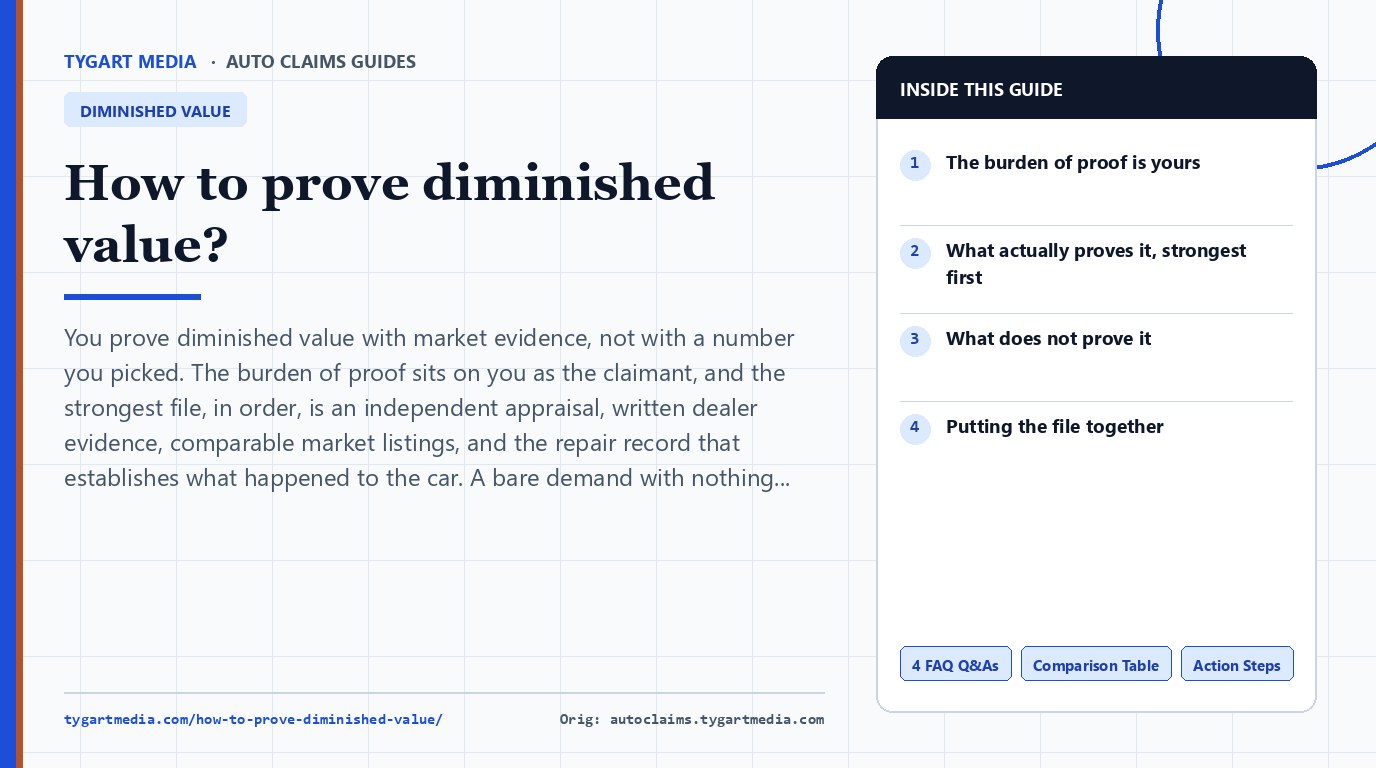
    The short answer: you prove diminished value with market evidence, not with a number you picked. The burden of proof sits on you as the claimant, and the strongest file, in order, is an independent appraisal, written dealer evidence, comparable market listings, and the repair record that establishes what happened to the car. A bare demand with nothing behind it is the most common way these claims fail.

    The burden of proof is yours

    Start from the uncomfortable fact: the insurer does not have to take your word for the loss. You are claiming the car is worth less than it was, by a specific amount, and the job of supporting that amount belongs to the person claiming it. An adjuster who receives a demand letter with a round number and nothing attached has nothing to evaluate, and nothing to evaluate usually gets nothing, or close to it.

    Proof in this context has a specific meaning. It is not proof that the accident happened — the repair claim already established that. It is proof of what the accident did to the car’s market value: evidence a stranger could look at and see the gap between the car with a clean history and the same car carrying this one. Everything below is aimed at that one gap.

    What actually proves it, strongest first

    1. An independent diminished value appraisal. A qualified appraiser values your car as repaired, with the accident on its record, against what it would be worth with a clean history, and shows the work — the listings relied on, the dealer input gathered, and the reasoning that connects them to your car. This is the strongest single piece of proof because it is a professional opinion built on market evidence, delivered in a report the insurer has to answer on its merits rather than dismiss as a guess.
    2. Written dealer evidence. Trade-in quotes in writing, or a letter from a dealer stating what the accident history does to this car’s value, come from the people who price cars with histories every day. Get the figure in writing and, where the dealer will do it, get the reason stated — that the accident record is why the number is what it is. A verbal opinion at a sales desk proves nothing once you have driven away.
    3. Market comparisons. Listings for the same model, in similar condition and mileage, split into two groups — cars with a clean history and cars disclosing an accident — show the gap directly. Save each listing with its date, because listings disappear. Close matches carry the argument; a listing for a different trim, year, or condition invites the adjuster to discount the whole set.
    4. The repair record. The itemized final invoice and the history report showing the accident establish what happened to the car: what was damaged, what was replaced, and whether structural work or airbag deployment was involved. The repair record does not by itself state a loss figure, but it is the foundation the other evidence stands on — it proves the history the market is pricing is real, and it shows the severity that drives the size of the gap.

    What does not prove it

    • The insurer’s own formula output. If the insurer ran a formula and produced a number, that is their method, not market evidence — it cannot prove your loss any more than your own guess can. How diminished value is calculated explains where that method comes from and why it caps the answer.
    • Your purchase price. What you paid for the car, whenever you bought it, says nothing about the gap this accident created. Values move, and the claim is about the change the accident caused, not about your original transaction.
    • What a replacement car costs. The price of a different car you might buy next is not evidence of what your repaired car lost. The loss lives in your car’s value before and after, nowhere else.

    None of this means a claim without a professional appraisal is hopeless. It means the pieces you do have need to be actual evidence — written, dated, and about your car’s market — rather than numbers that merely sound right.

    Putting the file together

    1. Finish the repairs first. Diminished value is measured on the repaired car, and the final invoice only exists once the work is complete, supplements included. Gathering value evidence before the repair is final builds the file on a car that is not finished yet.
    2. Gather the claim file. Pull together the repair invoice, the history report, your evidence, and the claim details in one place — what documents you need for diminished value lists the full set.
    3. Put the demand in writing, with the evidence attached. A written demand that names the figure and attaches the appraisal, dealer letters, or listings behind it gives the adjuster something to take up the chain. The diminished value claim letter example shows the shape of that letter.
    4. Keep copies of everything. Keep a copy of every document you send and a note of every conversation — date, who you spoke with, and what was said. If the claim drags on or changes hands, your file is the memory of the claim.
    Important Notice
    Evidence ages. Listings get sold and taken down, dealer staff move on, and the details of a conversation fade within weeks. A file built promptly after repairs, while every piece of it is still easy to get, is stronger and cheaper to assemble than the same file rebuilt later from memory and dead links. Do not let the gathering wait.

    Frequently asked questions

    Who has to prove diminished value?

    The claimant does. The insurer does not have to accept a claimed loss on your word alone, and it will usually ask what the number is based on. Evidence that shows how the market values the car after the accident is what carries the claim.

    What is the strongest proof of diminished value?

    An independent appraisal from a qualified appraiser is usually the strongest single piece. It values the car as repaired against its clean-history value and shows the work behind the number, so the insurer has to engage with reasoning rather than a bare demand.

    Do listings for other cars help my claim?

    Yes, if they are close matches and you save them properly. Listings for the same model with and without accident history, kept with dates, show the gap buyers and sellers are actually putting on that history. Loose matches help less than close ones.

    When should I start gathering evidence?

    Promptly after repairs are finished. Listings disappear, dealer staff change, and details fade, so a file built while the information is fresh is stronger and easier to assemble than one rebuilt months later.

    Disclaimer
    Informational only — not legal or insurance advice.
    Auto repair and insurance rules vary by state and by policy. Check your own policy documents and your state’s insurance department, or talk to a licensed professional, before acting on a claim.

    Proving diminished value, at a glance

    The evidence that proves diminished value, strongest first
    EvidenceWhat it shows
    Independent appraisalA qualified appraiser values the car as repaired against its clean-history value and shows the work
    Written dealer evidenceTrade-in quotes or letters stating what the accident history does to this car’s value
    Market comparisonsDated listings for the same model with and without accident history, showing the gap
    The repair recordThe itemized final invoice and history report establishing what happened to the car