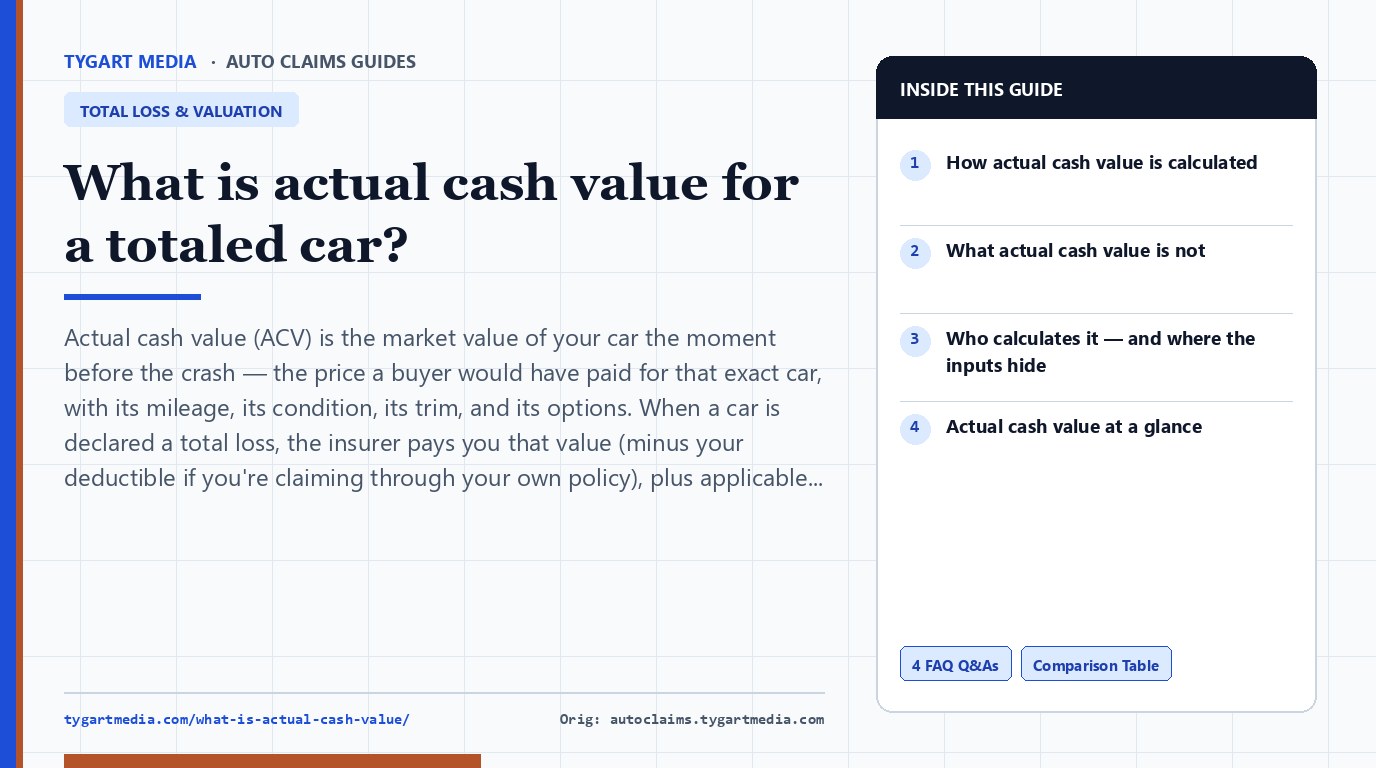
Tygart Media · Auto Claims Guides · Total loss & valuation
How actual cash value is calculated
There is no single price list for used cars, so insurers estimate ACV from evidence: what similar cars are actually selling for near you. The valuation looks at:
- Comparable vehicles — cars of the same year, make, model, and trim, listed for sale or recently sold in your area. These “comps” are the foundation of the number.
- Mileage adjustment — if your car had more miles than the typical comp, value comes off; fewer miles, value goes on.
- Condition adjustment — the report rates your car’s body, interior, tires, and mechanical condition, usually against an assumed “average” car.
- Options and trim adjustment — a higher trim, all-wheel drive, a sunroof, a tow package: each should add value compared to a base-model comp.
The result is an estimate, not a measurement. Two honest appraisers can land in different places — which is exactly why the inputs are worth checking.
What actual cash value is not
- Not what you paid. A car you bought last year has depreciated since. The payout prices the car as it sat just before the crash, not the day you bought it.
- Not what you owe. Your loan balance follows its own math. If you owe more than the ACV, the difference is the “gap” — a separate problem with its own coverage. What is gap insurance? →
- Not replacement cost. ACV pays for the car you lost, not for a brand-new one and not necessarily enough to buy an identical car at today’s asking prices.
- Not a guidebook number by itself. Kelley Blue Book and similar guides are references. Your settlement comes from the insurer’s valuation report — that’s the math to audit.
Who calculates it — and where the inputs hide
Your adjuster doesn’t price the car from memory. Insurers use valuation services — CCC ONE, Mitchell, and Audatex are the common ones — that search listings and sales, pick comparables, apply adjustments, and produce a valuation report. The adjuster works from that report, and the offer follows the report.
The inputs hide inside that document: the trim level it assigned your car, the mileage it used, the condition ratings, and every comparable it picked. A report that lists your car as a base trim, uses a mileage higher than your odometer, or compares it to cars 200 miles away will produce a low number that looks official. Ask for the report in full and check it line by line — here’s how: How do CCC valuation reports work? →
Actual cash value at a glance
| ACV is | ACV is not |
|---|---|
| Your car’s market value the moment before the crash | The price you originally paid for the car |
| Built from comparable cars in your area | Your loan balance or payoff amount |
| Adjusted for your mileage, condition, trim, and options | The cost of a new replacement car |
| Documented in a valuation report you can audit | A fixed number you have to accept as-is |
Get The Signal
What we actually ran, what it measured, and what it means for a restoration shop — every week, including the flops.
Leave a Reply