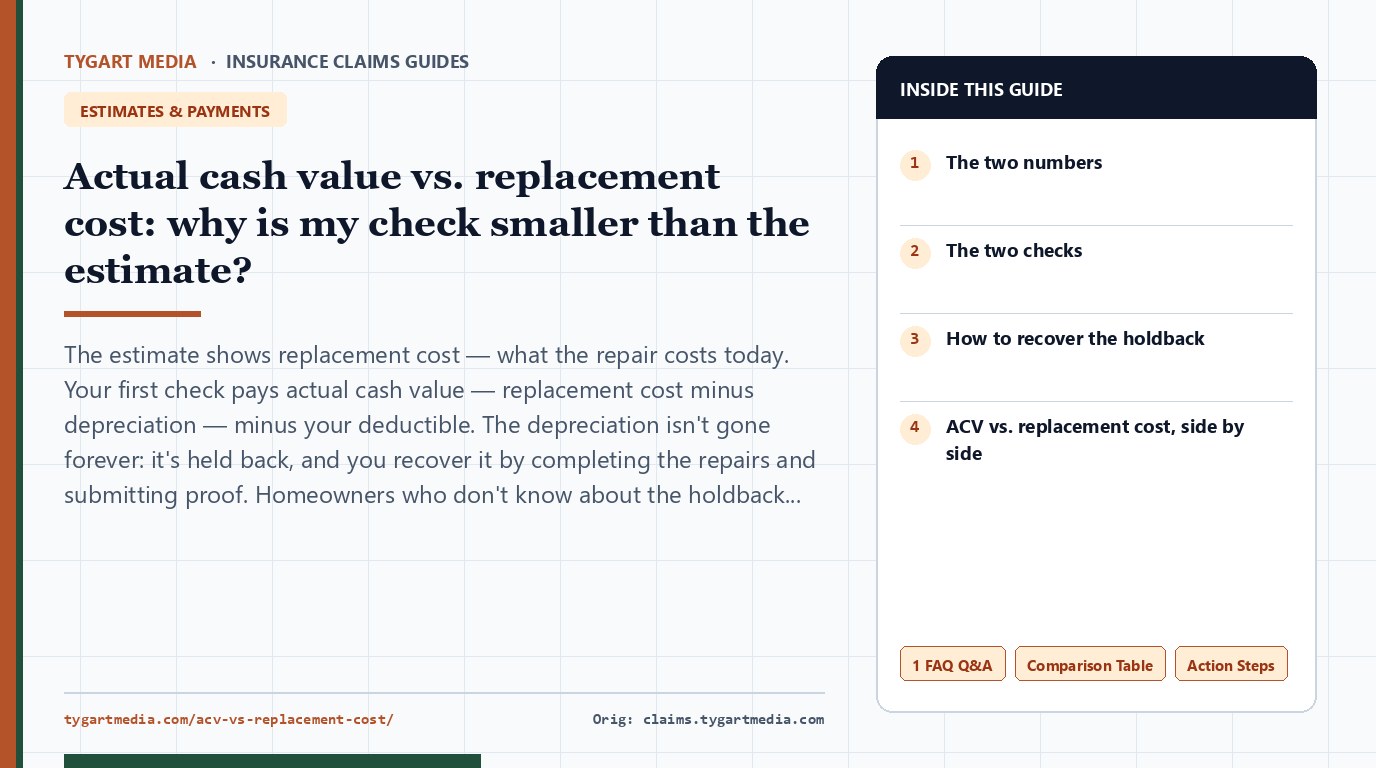
Tygart Media · Insurance Claims Guides · Estimates & payments
The two numbers
- Replacement cost value (RCV) — what it costs to repair or replace the damaged property with materials of like kind and quality today. This is the number on the estimate.
- Actual cash value (ACV) — replacement cost minus depreciation for age, wear, and condition. A 15-year-old roof isn’t worth a new roof’s price in ACV terms, even if only a new roof will fix the leak.
Your policy’s declarations page says which one you have. Replacement-cost coverage is the better policy and the more common one for the dwelling itself — but the payment still arrives in two stages.
The two checks
Check one: ACV minus your deductible. This is what arrives first, and it’s always smaller than the estimate. That’s normal — not a lowball, not a trick. It’s how the mechanism works.
Check two: the depreciation holdback. Once repairs are completed, you submit proof — invoices, photos of completed work — and the insurer releases the depreciated amount. This is money you’re entitled to under a replacement-cost policy. But it only comes if you ask for it, with documentation, inside your policy’s time window.
How to recover the holdback
- Find the deadline in your policy. Many policies give you a limited window after the loss — often around six months — to complete repairs and claim the holdback. Mark it on a calendar the day you get the first check.
- Complete the repairs with a licensed contractor. Keep every invoice and receipt.
- Photograph the completed work.
- Submit the proof to your adjuster in writing and request release of the recoverable depreciation. Follow up until the second check arrives.
ACV vs. replacement cost, side by side
| Actual cash value (ACV) | Replacement cost value (RCV) | |
|---|---|---|
| Pays | What the item was worth used — replacement minus depreciation | What it costs to replace with new, no depreciation deducted |
| First check | The full ACV amount | ACV first, with depreciation held back |
| The holdback | None — that’s the whole payment | Recoverable depreciation, released after you complete repairs and submit receipts |
| Example: 10-year-old roof, $20k to replace | Maybe $8k–$12k after depreciation | $8k–$12k now + the rest when the work is done |
If your check looks small next to the estimate, check whether it’s the ACV payment with recoverable depreciation still held back — that money isn’t gone, it’s waiting on your receipts.
Get The Signal
What we actually ran, what it measured, and what it means for a restoration shop — every week, including the flops.
Leave a Reply