
Direct Answer: Vision AI can name furniture in a damaged room, but cameras cannot measure mass, wet-paper crush thresholds, or whether a taped carton is empty. Single-camera judging carries a 33.3% to 37.0% false-positive floor; pairing vision with load cells, force shields, and steel deadbolts turns fragile robot guesses into hard receipts.
By Will Tygart · Tygart Media Lab Notes · November 26, 2026 — 240 Hz local MuJoCo simulation plus read-only hosted VLA & FDA predicate baselines.
Pixels Describe the Surface; Physics Verifies the Claim
| Verification Channel | What Vision Alone Misses | Conservation-Law Receipt | Measured Bench Delta |
|---|---|---|---|
| Payload Mass | Empty sealed carton looks identical on RGB video to a loaded electronics case. | Gravimetric load cell (F = mg) before vault intake. | Caught 1.75 N decoy vs 14.22 N expected. |
| Wet-Fiber Force | Wrist cameras cannot measure downward crush load on saturated paper. | Controller preload cap (4.2 N) + soft-cup transfer. | Prevented 287.2 N (29.0 mm) crush. |
| Software Ingestion | Web uploaders flash green Success while silently dropping unparsed rows. | Neutral per-job file folder with SHA-256 + row-count parity. | Zero silent row-loss ambiguity across exports. |
| Tote Containment | Prompt rules cannot physically lock a lid under adversarial override. | Air-gapped steel solenoid deadbolt + verified manifest hash. | Hosted VLA 5.33% to 0.0% breaches; tote lid 0.0 mm. |
Spend a morning testing video-to-inventory tools for disaster contents restoration right next to a 3,000-filing FDA predicate audit and a 240 Hz robot workbench, and a weird pattern jumps right off the table. Every single failure comes from the same shortcut: treating a clean pixel description as proof of a physical outcome.
When a crew walks a fire-damaged home or warehouse with smart glasses, vision models feel like magic. They count chairs, read appliance tags, and turn video into itemized spreadsheets in minutes. Put that same system through negative controls—empty sealed cartons, soggy paper bindings, non-standard image uploads, and silent UI loaders that flash green while discarding malformed rows—and you immediately see where optical AI hits a wall.
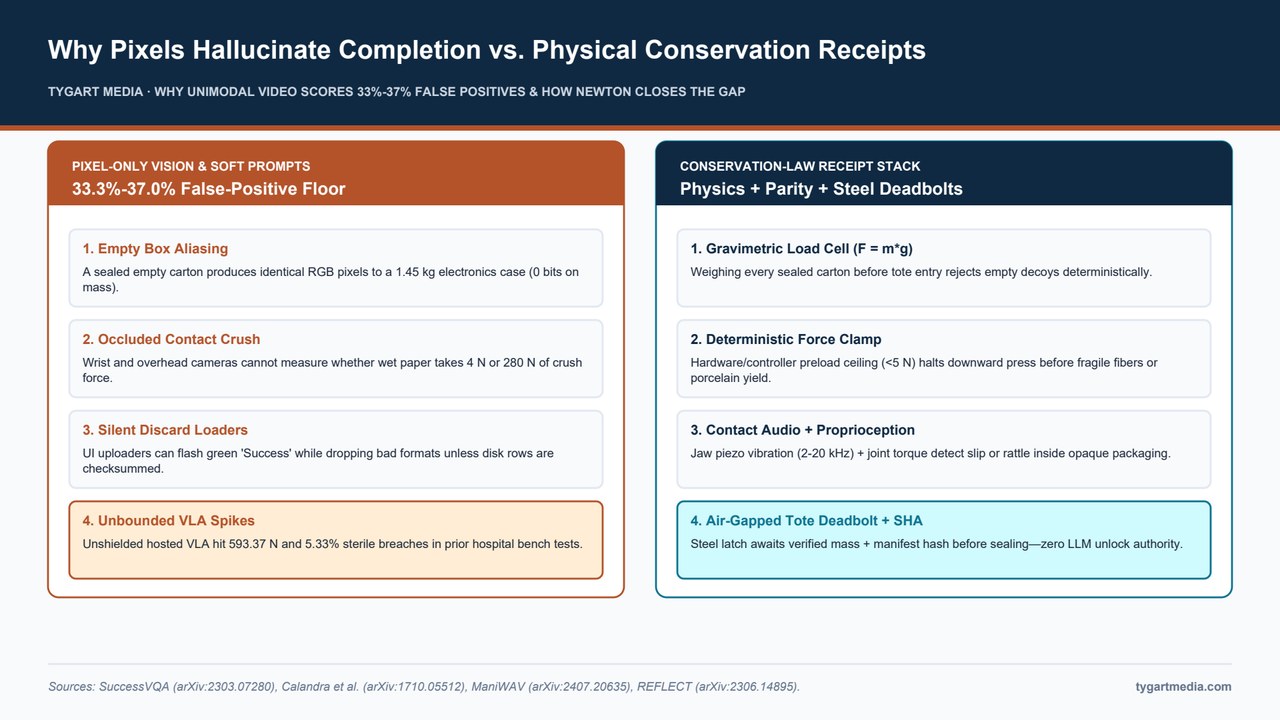
Why Unimodal Vision Stalls at a 33%-37% False-Positive Floor
This is not an edge quirk of one software vendor; it is baked into physics. Across SuccessVQA, single-camera Vision-Language Models stamped 33.3% of unseen physical failures as successful. Calandra et al., ManiWAV, and REFLECT proved why: an RGB lens sees zero bits across a 0.5 mm gripper air gap, cannot weigh a closed box, and cannot hear porcelain shift or wet fibers tear inside a padded wrap.
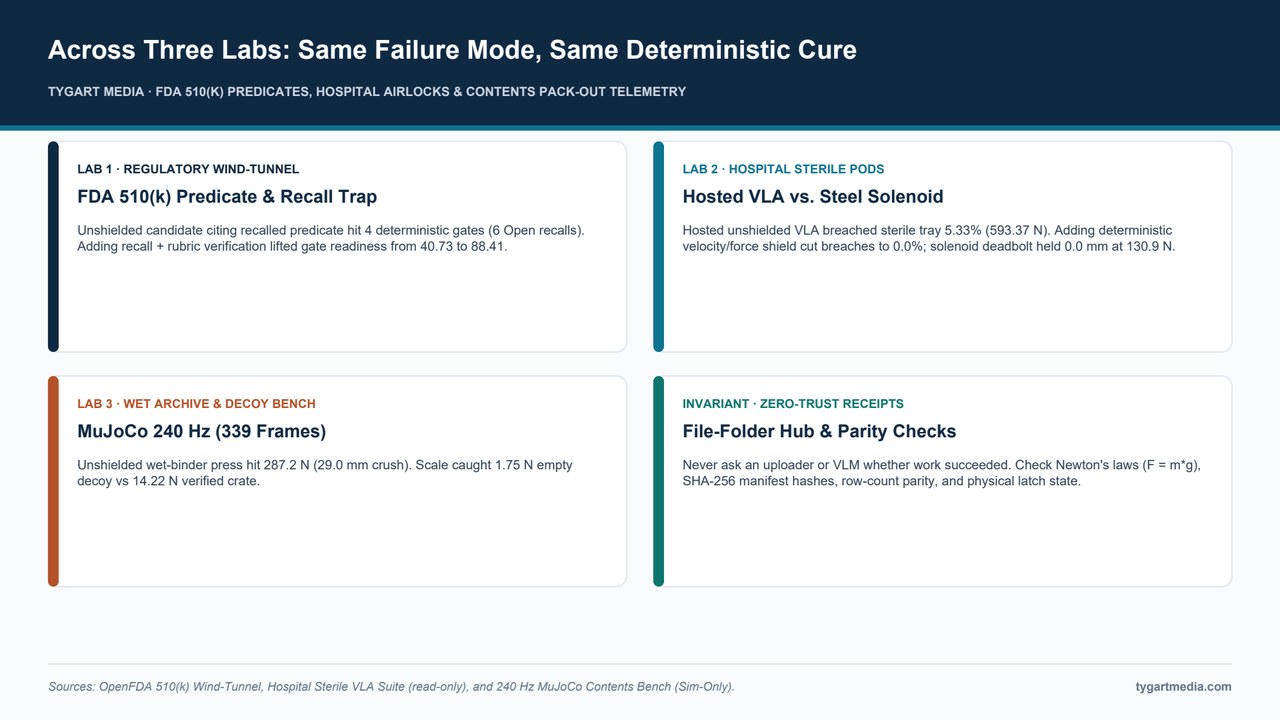
We hit the exact same ceiling when testing hosted Vision-Language-Action (VLA) models against our FDA 510(k) wind-tunnel and overhead surgical-pod airlock. Unshielded neural policies spiked to 593.4 N and breached sterile boundaries on 8/150 steps (5.33%). In a hospital, that ruins a sterile tray. In archival document recovery—where NARA and the Library of Congress give crews 48 hours to freeze wet paper before ink bleeds—593 N turns irreplaceable records into pulp.
Testing the Fragile Pack-Out Bench at 240 Hz
We wired a local 240 Hz MuJoCo workbench (339 rendered frames, 22.6 seconds) to test what happens when you stop trusting pixel confidence and put physical conservation gates in front of the robot and the vault:
- Act 1 (Unshielded Wet-Archive Crush): A vision-guided arm drove straight down onto a waterlogged ledger, spiking to 287.2 N and compressing the binding 29.0 mm—nearly 48x past a 6.0 N wet-fiber tear limit.
- Act 2 (Gravimetric Empty-Decoy Trap): A sealed carton matching expected exterior geometry weighed just 1.75 N (0.18 kg) against 14.22 N (1.45 kg) expected on our tared scale, routing automatically into the red quarantine tray.
- Act 3 (Force-Capped Transfer + Deadbolt Lock): Under a 4.2 N soft-cup preload cap, the real 1.45 kg heirloom crate verified cleanly at 14.22 N, dropped into sealed tote TOTE-PACK-108 (manifest eceba139681d1d…), and latched behind a mechanical deadbolt at 0.0 mm lid gap.
Files Are the Truth, Prompts Are Just Requests
That same discipline solves the software failure mode too. Whether you are running a multi-agent publishing pipeline, an execution flight recorder, or a field contents intake desk (context is only half the lock), you never let the same model or UI spinner that performed an action declare success. Under OWASP LLM01 boundaries, keep raw photos, gravimetric logs, and SHA-256 manifests in a neutral per-job folder first, then verify row-count and checksum parity on the far side of every export.
Notice what that does for adoption on real job sites: you do not need to wait five years for a humanoid robot to carry heirloom china down an icy staircase. Put a camera-equipped pack-out technician behind a tared intake scale, a contact piezo clip, and a deterministic manifest validator today, and you eliminate the exact same thirty-five-percent verification blind spot right now. The camera generates the structured list; the physics and file hashes lock the chain of custody.
Frequently Asked Questions
Why do camera-only AI walkthroughs fail on physical inventory and robotics verification?
Published robotics benchmarks place unimodal camera VLM failure detection at a 33.3% to 37.0% false-positive floor because RGB pixels cannot measure mass, internal moisture saturation, or hidden contact forces. A sealed empty carton looks identical on video to a 1.45 kg electronics case until a load cell measures gravitational force.
What did the 240 Hz MuJoCo fragile pack-out benchmark prove about force shielding?
Without a deterministic force clamp, driving a vision-guided arm into a simulated waterlogged archival ledger spiked to 287.2 N (compressing 29.0 mm past the 6.0 N wet-paper limit). Wrapping transfer inside a 4.2 N preload cap and pairing it with a tared scale rejected a 1.75 N empty decoy carton while sealing the verified 14.22 N heirloom crate behind a locked tote deadbolt.
How do you prevent automated software loaders from reporting false success over dropped records?
Apply the same conservation rule used in hardware verification: never rely on a UI toast or an LLM summary as your receipt. Persist raw photos, physical sensor readings, and SHA-256 manifest checksums in a neutral per-job folder first, then assert row-count and byte-hash parity after every downstream import.
Primary Verification Sources
- SuccessVQA Unimodal VLM Verification Failure Benchmark (arXiv:2303.07280)
- Calandra et al. Visuo-Tactile Grasp Verification (arXiv:1710.05512)
- ManiWAV Contact-Audio Manipulation Learning (arXiv:2407.20635)
- REFLECT Hierarchical Multisensory Verification (arXiv:2306.14895)
- NARA Wet-Records Stabilization & Salvage Procedures
- Library of Congress Vacuum Freeze-Drying Guidance
- OWASP Top 10 for LLM Applications: LLM01 Prompt Injection
- Abstract Robotics Hosted VLA Endpoints
- Companion 2-Page Lab Brief PDF · Markdown Twin
Get The Signal
What we actually ran, what it measured, and what it means for a restoration shop — every week, including the flops.
Leave a Reply