Six receipts so far in this series: 44,583 citations at BC ESG, 109,844 at Healthcare Facility Hub, 813,426 on this site, 50,607 at Risk Coverage Hub, 57,798 at Continuity Hub, and 111 — every one of them inside seventeen days — at Restoration Intel. The seventh receipt is not a site at all. It is this site’s own question list, and it is the strangest shelf in it: buried in the 1,698 questions the machines consulted us on, some of the “questions” are not questions. They are Claude’s own error messages, pasted whole.
Here is the shape of it. Somebody is working in Claude and hits a wall — a chat that will not take another image, a workspace that will not start, a request that is too large. They copy the message off the screen, paste it into an AI, and the AI goes looking for help. It finds our pages, and it cites them. Thirteen pasted messages, 295 citations. Around them sits a small franchise of misspellings worth 576 more, and a set of perfect scores so rare they round to zero. This is the smallest receipt in the series, and the funniest. Weird beats big.
Watch the 60-second version: Why do machines ask about Claude’s own error messages? — the same receipts in 52 seconds, chapters matched to the sections below.
The errors: pasted, not typed
The query view for this site holds 1,698 grounding queries for August 8 to November 5, 2026. Thirteen of them are verbatim copies of messages Claude’s interface shows its users — error dialogs and limit notices, word for word, punctuation and all. Counted together, they earned 295 citations.
Our counting rule, printed so anyone can recount us: a query counts only if its whole text is a pasted interface message, in the system’s own voice. A person typing “claude cowork not working” (50 citations) is describing a problem in their own words — that does not count. Neither does the one pasted banner that is a promotion rather than an error, “your limits are temporarily boosted” (38). Errors and limit blocks only. The thirteen:
- “failed to start claude’s workspace request error: net::err_connection_closed restarting claude or your computer sometimes resolves this. if it persists, you can reinstall the workspace.” — 48 citations; our share 14.72%.
- “this chat has reached the 100-image limit (including pdf pages). start a new chat to add more.” — 38; our share 19.29%.
- “request too large (max 32mb). accumulated images and attachments in the conversation pushed the request over the limit. run /compact, or double press esc to go back and remove attachments.” — 30; our share 27.78%.
- “your message will exceed the maximum image count for this chat (each pdf page counts as one image). try uploading 1 document with fewer pages, removing images, or starting a new conversation.” — 30; our share 29.70%.
- “you’ve reached the limit for chats that include files or images. start a new text-only chat or upgrade to continue now.” — 24; our share 50.00% — half of every answer to that pasted message cited us.
- “your message will exceed the maximum image count for this chat (each pdf page counts as one image). try removing images or starting a new conversation.” — 20; our share 21.74%.
- “your message will exceed the maximum image count for this chat. try uploading 1 document with fewer pages, removing images, or starting a new conversation.” — 18; our share 27.27%.
- “couldn’t start this server for cowork and code sessions (they run their own copy of it), so they can’t use its tools: request timed out” — 18; our share 34.62%.
- “your organization’s model list hasn’t loaded yet. claude reloads it automatically once the connection or sign-in recovers; if it still won’t load, contact your it administrator.” — 15; our share 22.73%.
- “failed to start claude’s workspace” — 15; our share 6.61%.
- “claude’s workspace service isn’t running” — 15; our share 20.00%.
- “api error: claude’s response exceeded the 128000 output token maximum. to configure this behavior, set the claude_code_max_output_tokens environment variable.” — 12; our share 22.22%.
- “failed to start claude’s workspace not enough disk space to set up the workspace. free up space and try again. restarting claude or your computer sometimes resolves this. if it persists, you can reinstall the workspace.” — 12; our share 26.09%.
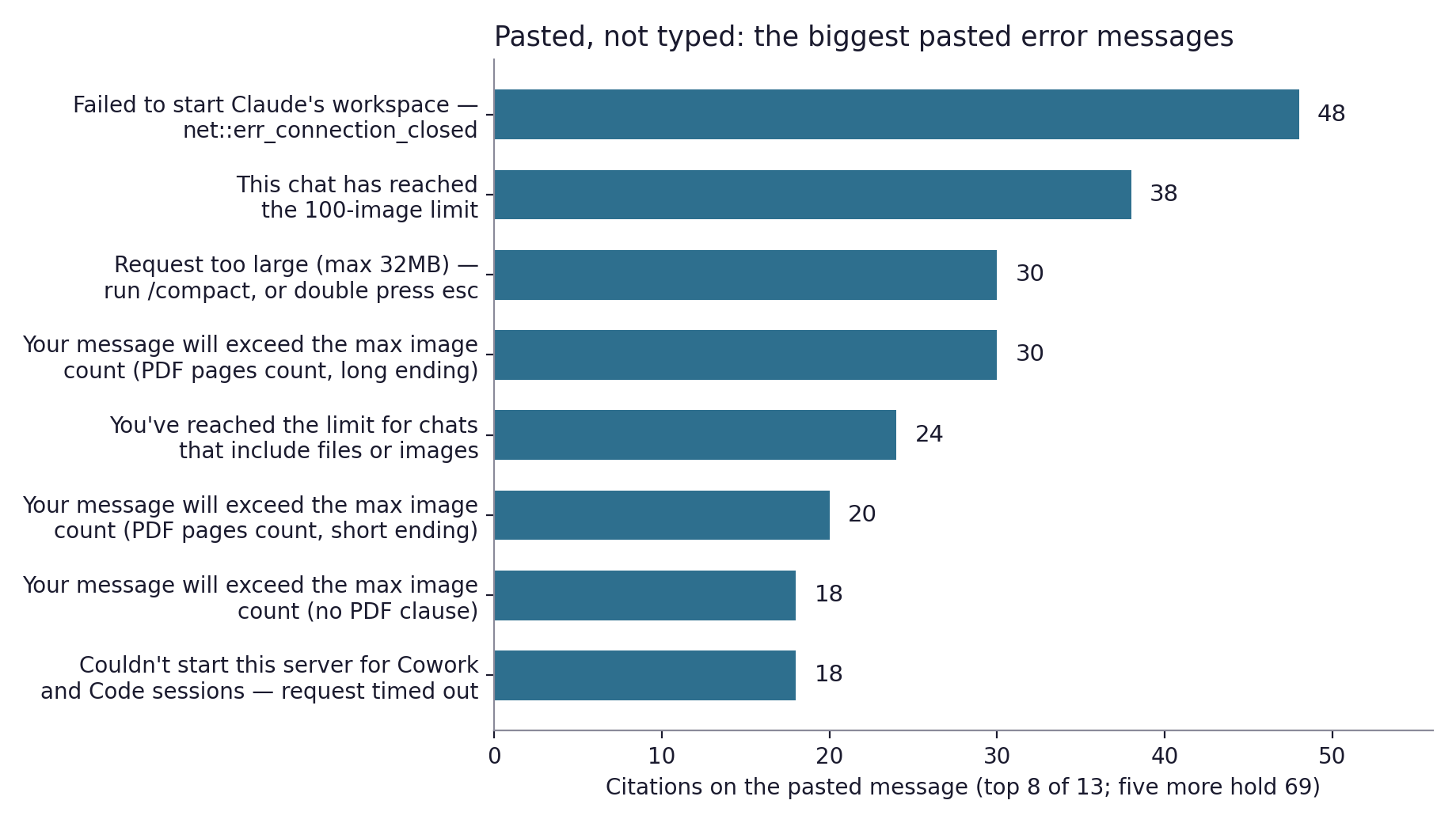
Two patterns inside the thirteen. The message “your message will exceed the maximum image count for this chat” appears three times with three different endings — the same wall, screenshotted at three slightly different moments, worth 68 citations between them. And “failed to start claude’s workspace” opens three of the thirteen, worth 75. People do not paraphrase an error message. They hand the machine the exact words the last machine showed them, and the machine comes to us.
Get The Signal
What we actually ran, what it measured, and what it means for a restoration shop — every week, including the flops.
The typos: a small franchise
Fourteen queries in the report misspell the product’s name — calude, cluade, clade — and between them they earned 576 citations, nearly double the entire error shelf:
- “calude pricing” — 152 citations
- “cluade ai pricing” — 66 (our share 69.47%)
- “clade pricing” — 64
- “cluade ai plans” — 63 (50.00%)
- “cluade pricing” — 61
- “calude ai plans” — 39 (68.42%)
- “calude costs” — 32
- “cluade for chrome” — 28
- “cluade ai plan” — 18
- “cluade price” — 14
- “what kind of subscriptions available for personal use of calude” — 12, at a 100.00% share
- “calude cost” — 11
- “cluade in chrome” — 10
- “who owns cluade” — 6
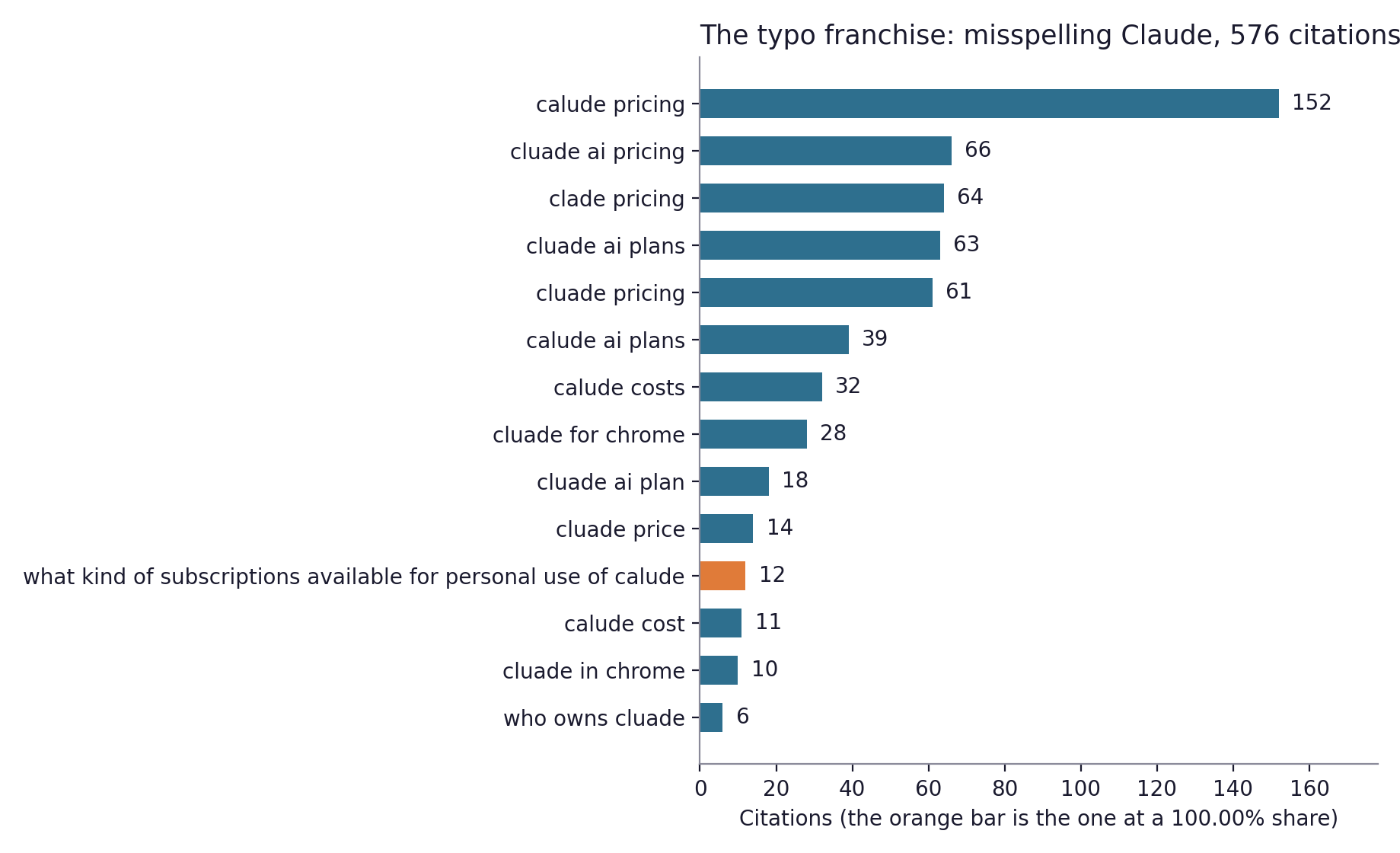
Somebody, six citations’ worth, asked who owns Cluade. We do not. But the best row in the table is the personal-use one: asked in exactly those misspelled words, every single time, the machines cited us. A perfect score — which turns out to be the rarest thing in the whole report.
The perfect scores: five in 1,698
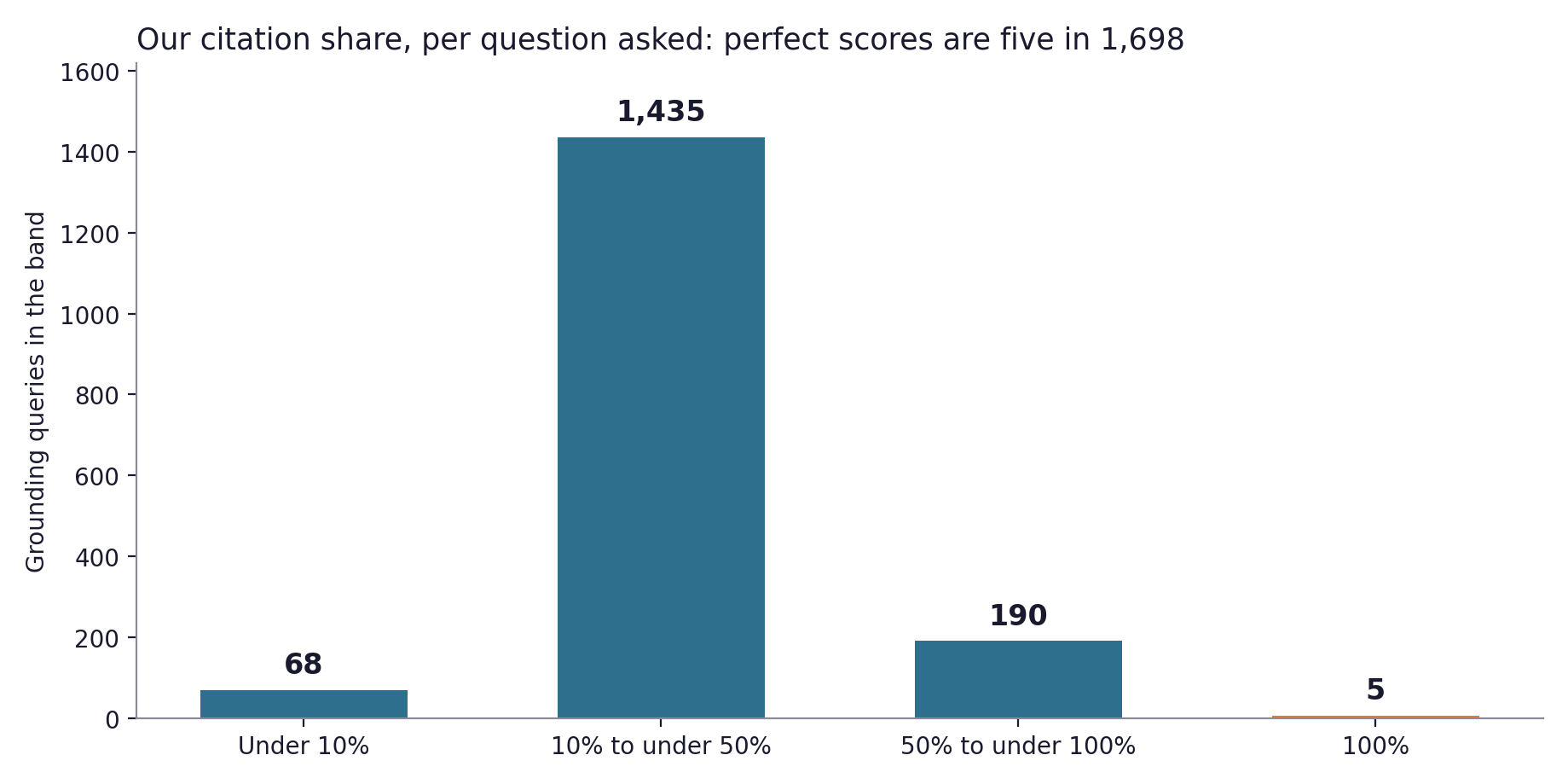
Bing reports a citation share for every query — the fraction of answers that cited us. Spread across all 1,698 questions, the shape is ordinary: 68 questions sit under a 10% share, 1,435 sit between 10% and 50%, 190 sit between 50% and 100%. And at exactly 100.00% — every answer, every time — there are five:
- “claude standard plan” — 345 citations
- “how much for claude ai” — 33
- “claude entreprise prix” — 30 (French: the enterprise price)
- “what kind of subscriptions available for personal use of calude” — 12 (the typo, again)
- “anthropic create api key” — 4
Two side dishes from the same shelf. The longest query in the report, at 236 characters, is a multiple-choice exam question — it opens “what can copilot do if you join a meeting late?” and then pastes its own four answer options; somewhere a quiz is being answered with our pages as the source (10 citations, 26.32%). And the report cites our homework: the article describing this site’s citation experiment holds 20 citations of its own. The thesis about the report, cited in the report.
What we can’t claim
- We don’t know why our pages answer the errors. Nothing in the report says which page answered which pasted message, or why the machines reached for us. The pattern is visible; a mechanism would be storytelling.
- The query view is a sample, not a census. Its citations sum to 371,847 against the daily view’s 813,426 — Bing showed us a window onto the questions, not all of them. Every number here is “of the queries Bing showed us.”
- The text is what people pasted — errors included. We quote these queries as data, exactly as they sit in the report, misspellings and truncated sentences and all. Correcting them would be editing the evidence.
- Our own first count was wrong, so we fixed it in the open. Our sweep’s first tally read 12 messages and 245 citations. When we pinned the counting rule down in writing — the rule printed in the first section above — the count moved to 13 and 295. The rule is printed precisely so the recount is checkable.
- One engine, one window, one site. These are Microsoft Copilot and partner citations as Bing reports them, for ninety days. Another engine’s report would show a different shelf.
What we do now
- We don’t write for typos. There will be no “calude pricing” page. The franchise is a fact about how people type, not a strategy; the pages earn the misspelled questions by answering the spelled ones.
- Keep the help pages accurate. The machines route broken sessions to us — a person mid-error, request too large, workspace dead. The least the page they land on can do is be right.
- Re-measure on the next sweep. The error shelf and the typo franchise get counted again with the rest of the fleet, same windows, same instrument, same counting rule.
295 citations for error messages nobody typed. 576 for a name spelled wrong. Five perfect scores in 1,698 tries. The receipts are the receipts — including the funny ones.
Download the field-report PDF — the same receipts in a printable report.
Update history
November 8, 2026 — Published.
November 8, 2026 — The video version went live on YouTube the same morning. Article published earlier the same day.
Method note: All figures are from Bing Webmaster Tools AI Performance exports for tygartmedia.com, window August 8–November 5, 2026 (90 days), pulled November 8, 2026. The daily view sums to 813,426 citations, the page view to 792,317 (2.6% apart), and the query view — a sample of 1,698 grounding queries — to 371,847; each figure above names its view. Citation counts are Microsoft Copilot and partner citations as Bing reports them; citation shares are Bing’s per-query figures. Query text is quoted verbatim from the report, including the errors in it. The error-message count uses the rule printed in the article: whole pasted interface messages only — 13 queries, 295 citations. The field-report PDF is at https://tygartmedia.com/wp-content/uploads/2026/11/the-machines-ask-claudes-errors-tygart-media-field-report.pdf. This is one site, one engine’s report, one window — and its strangest shelf.
Get The Signal
What we actually ran, what it measured, and what it means for a restoration shop — every week, including the flops.
Leave a Reply