Tag: AEO

  • What Is GEO? Generative Engine Optimization Explained

    What Is GEO? Generative Engine Optimization Explained

    If you’ve optimized content for Google and still can’t get AI systems to cite you, you’re running the wrong playbook. GEO — Generative Engine Optimization — is the discipline of making your content visible, credible, and citable to AI engines like ChatGPT, Claude, Perplexity, Gemini, and Google’s AI Overviews. It is not SEO with a new name. It is a different game with different rules.

    Definition: Generative Engine Optimization (GEO) is the practice of structuring content so that large language models and AI search engines select it as a source when generating responses to user queries. Where SEO earns rankings, GEO earns citations.

    Why GEO Is Not SEO

    SEO is about ranking. You optimize a page so Google’s algorithm surfaces it when someone searches. The goal is a click. GEO is about being quoted. You structure content so an AI system trusts it enough to pull a fact, a definition, or an explanation from it when synthesizing a response. The user may never click your URL — but your content shaped what they read.

    The mechanisms are fundamentally different. Google’s ranking algorithm weighs hundreds of signals — backlinks, page speed, user behavior, authority. AI citation selection weights entity density, factual specificity, source credibility signals, and structural clarity. A page that ranks #1 on Google may get zero AI citations. A page that ranks #8 may be the one Perplexity quotes every time someone asks about that topic.

    How AI Engines Select Content to Cite

    Large language models used in AI search (GPT-4, Claude, Gemini) were trained on large corpora of text, but the retrieval-augmented generation (RAG) layer that powers tools like Perplexity, ChatGPT search, and Google AI Overviews works differently. It pulls live content at query time, scores it for relevance and credibility, and synthesizes a response. The signals it uses to score your content include:

    • Entity clarity — Are the people, places, companies, and concepts in your content clearly named and linked to known entities?
    • Factual density — Does your content contain specific, verifiable claims rather than vague generalities?
    • Structural legibility — Can the AI parse your content’s structure — headings, definitions, lists — without ambiguity?
    • Source signals — Does your content cite primary sources, studies, or named experts?
    • Speakable schema — Have you marked up key paragraphs as machine-readable answer candidates?

    The Three Layers of GEO

    Layer 1: Content Architecture

    GEO-optimized content is built for extraction, not just reading. That means every major claim is in a standalone sentence. Definitions appear near the top. Section headers are declarative, not clever. The structure tells an AI where the answer is before it has to read the full article.

    Layer 2: Entity Saturation

    AI systems understand content through entities — named people, organizations, places, products, and concepts that exist in their training data. A GEO-optimized article saturates relevant entities: it doesn’t say “a major AI company” when it means Anthropic. It doesn’t say “a popular search tool” when it means Perplexity. Every entity is named, spelled correctly, and used in the right context.

    Layer 3: Schema and Structured Data

    JSON-LD schema markup is a signal to both traditional search engines and AI crawlers. FAQPage schema makes your Q&A content directly extractable. Speakable schema flags the paragraphs most useful for voice and AI synthesis. Article schema establishes authorship and publication date. These are not optional extras — they are the machine-readable layer that gets your content selected.

    GEO vs AEO: What’s the Difference?

    Answer Engine Optimization (AEO) focuses on winning featured snippets, People Also Ask boxes, and zero-click search results in traditional search engines. GEO focuses on being cited by generative AI systems. The tactics overlap — both require clear structure, direct answers, and FAQ sections — but the targets are different. AEO wins position zero on Google. GEO wins the paragraph that Perplexity writes for the next million queries on your topic.

    At Tygart Media, we run both in parallel. The content pipeline produces articles that pass the AEO gate (featured snippet structure, FAQ schema) and the GEO gate (entity density, speakable markup, citation-worthy claims) before publishing.

    What GEO Looks Like in Practice

    Here is the difference between a standard paragraph and a GEO-optimized version of the same content:

    Standard: “Water damage restoration is an important service for homeowners who have experienced flooding or leaks.”

    GEO-optimized: “Water damage restoration — the professional remediation of structural damage caused by flooding, pipe failure, or storm intrusion — is performed by IICRC-certified contractors following the S500 Standard for Professional Water Damage Restoration. The process includes water extraction, structural drying, moisture monitoring, and antimicrobial treatment.”

    The second version names the certifying body (IICRC), the standard (S500), and the process steps. An AI system can extract that paragraph as a factual, citable answer. The first version has nothing to extract.

    How to Start with GEO

    If you’re running an existing content operation and want to layer in GEO, the priority order is:

    1. Audit your top 20 pages for entity gaps — everywhere you use vague references, replace with specific named entities
    2. Add speakable schema to your three strongest definitional paragraphs per page
    3. Run a factual density check — every statistic should have a source, every claim should be specific
    4. Add FAQPage schema to any page with question-format headings
    5. Submit your top pages to Google’s Rich Results Test and verify structured data is reading cleanly

    GEO Is Compounding Infrastructure

    The reason GEO matters for content operations is compounding. Once an AI system has indexed and trusted your content as a reliable source on a topic, subsequent queries on that topic draw from your content repeatedly — without you publishing anything new. A single GEO-optimized pillar article can generate thousands of AI citations over 12 months. That is a different kind of ROI than a ranked page that gets clicked and forgotten.

    We built the Tygart Media content stack around this principle. Every article that leaves our pipeline passes a GEO gate before it publishes. That gate checks entity saturation, factual specificity, schema completeness, and structural legibility. It is the same gate we build for clients.

    Frequently Asked Questions About GEO

    What does GEO stand for?

    GEO stands for Generative Engine Optimization — the practice of optimizing content to be cited by AI-powered search systems and large language models.

    Is GEO the same as SEO?

    No. SEO (Search Engine Optimization) targets traditional search rankings. GEO targets AI citation in tools like ChatGPT, Perplexity, Claude, and Google AI Overviews. The tactics overlap but the mechanisms and goals are different.

    How do I know if my content is being cited by AI?

    Run queries related to your topic in Perplexity, ChatGPT (with search enabled), and Google AI Overviews. Check whether your domain appears as a cited source. Tools like Profound and Otterly.ai can automate this monitoring.

    Does GEO replace AEO?

    No. AEO and GEO are complementary. AEO wins traditional search features like featured snippets. GEO wins AI citations. A mature content strategy runs both in parallel.

    How long does GEO take to show results?

    Unlike SEO, GEO results can appear quickly — sometimes within days of a page being indexed by AI crawlers. The compounding effect builds over 60–180 days as AI systems repeatedly select your content for related queries.


  • ¿Qué es GEO? Optimización para Motores Generativos: Guía Completa

    ¿Qué es GEO? Optimización para Motores Generativos: Guía Completa

    Si has optimizado contenido para Google y aun así no logras que los sistemas de inteligencia artificial te citen, es porque estás usando el manual equivocado. GEO —Generative Engine Optimization u Optimización para Motores Generativos— es la disciplina de hacer que tu contenido sea visible, creíble y citable para motores de IA como ChatGPT, Claude, Perplexity, Gemini y los AI Overviews de Google. No es SEO con un nombre nuevo. Es un juego distinto con reglas distintas.

    Definición: La Optimización para Motores Generativos (GEO) es la práctica de estructurar el contenido para que los modelos de lenguaje de gran escala (LLM) y los motores de búsqueda con IA lo seleccionen como fuente al generar respuestas a las consultas de los usuarios. Donde el SEO obtiene posiciones, el GEO obtiene citas.

    Por qué GEO no es SEO

    El SEO trata de posicionarse. Optimizas una página para que el algoritmo de Google la muestre cuando alguien busca algo. El objetivo es un clic. El GEO trata de ser citado. Estructuras el contenido para que un sistema de IA confíe en él lo suficiente como para extraer un dato, una definición o una explicación cuando sintetiza una respuesta. El usuario puede no hacer clic en tu URL, pero tu contenido moldeó lo que leyó.

    Los mecanismos son fundamentalmente diferentes. El algoritmo de posicionamiento de Google pondera cientos de señales: backlinks, velocidad de página, comportamiento del usuario, autoridad. La selección de citas por IA pondera la densidad de entidades, la especificidad factual, las señales de credibilidad de la fuente y la claridad estructural. Una página que ocupa el puesto #1 en Google puede recibir cero citas de IA. Una página que ocupa el puesto #8 puede ser la que Perplexity cita cada vez que alguien pregunta sobre ese tema.

    Cómo los motores de IA seleccionan el contenido que citan

    Los modelos de lenguaje de gran escala utilizados en la búsqueda con IA (GPT-4, Claude, Gemini) fueron entrenados en grandes corpus de texto, pero la capa de generación aumentada por recuperación (RAG) que impulsa herramientas como Perplexity, la búsqueda de ChatGPT y los AI Overviews de Google funciona de manera diferente. Extrae contenido en tiempo real en el momento de la consulta, lo puntúa por relevancia y credibilidad, y sintetiza una respuesta. Las señales que utiliza para puntuar tu contenido incluyen:

    • Claridad de entidades — ¿Las personas, lugares, empresas y conceptos en tu contenido están claramente nombrados y vinculados a entidades conocidas?
    • Densidad factual — ¿Tu contenido contiene afirmaciones específicas y verificables en lugar de generalidades vagas?
    • Legibilidad estructural — ¿Puede la IA analizar la estructura de tu contenido —encabezados, definiciones, listas— sin ambigüedad?
    • Señales de fuente — ¿Tu contenido cita fuentes primarias, estudios o expertos nombrados?
    • Esquema speakable — ¿Has marcado párrafos clave como candidatos de respuesta legibles por máquinas?

    Las tres capas del GEO

    Capa 1: Arquitectura de contenido

    El contenido optimizado para GEO está diseñado para la extracción, no solo para la lectura. Eso significa que cada afirmación importante está en una oración independiente. Las definiciones aparecen cerca de la parte superior. Los encabezados de sección son declarativos, no creativos. La estructura le dice a la IA dónde está la respuesta antes de que tenga que leer el artículo completo.

    Capa 2: Saturación de entidades

    Los sistemas de IA entienden el contenido a través de entidades: personas, organizaciones, lugares, productos y conceptos nombrados que existen en sus datos de entrenamiento. Un artículo optimizado para GEO satura las entidades relevantes: no dice “una importante empresa de IA” cuando se refiere a Anthropic. No dice “una popular herramienta de búsqueda” cuando se refiere a Perplexity. Cada entidad está nombrada, escrita correctamente y usada en el contexto correcto.

    Capa 3: Esquema y datos estructurados

    El marcado de esquema JSON-LD es una señal tanto para los motores de búsqueda tradicionales como para los rastreadores de IA. El esquema FAQPage hace que tu contenido de preguntas y respuestas sea directamente extraíble. El esquema speakable marca los párrafos más útiles para la síntesis de voz e IA. El esquema de artículo establece la autoría y la fecha de publicación. No son extras opcionales: son la capa legible por máquinas que hace que tu contenido sea seleccionado.

    GEO vs AEO: ¿Cuál es la diferencia?

    La Optimización para Motores de Respuesta (AEO) se centra en ganar fragmentos destacados, cuadros de Preguntas relacionadas y resultados de búsqueda de cero clics en los motores de búsqueda tradicionales. El GEO se centra en ser citado por los sistemas de IA generativa. Las tácticas se superponen, pero los objetivos son diferentes. El AEO gana la posición cero en Google. El GEO gana el párrafo que Perplexity escribe para el próximo millón de consultas sobre tu tema.

    Cómo empezar con GEO

    Si estás gestionando una operación de contenido existente y quieres incorporar GEO, el orden de prioridad es:

    1. Audita tus 20 páginas principales en busca de lagunas de entidades — donde uses referencias vagas, reemplázalas con entidades nombradas específicas
    2. Añade esquema speakable a tus tres párrafos definitorios más sólidos por página
    3. Ejecuta una verificación de densidad factual — cada estadística debe tener una fuente, cada afirmación debe ser específica
    4. Añade esquema FAQPage a cualquier página con encabezados en formato de pregunta
    5. Envía tus páginas principales a la Prueba de resultados enriquecidos de Google y verifica que los datos estructurados se lean correctamente

    GEO es infraestructura que se acumula

    La razón por la que GEO importa para las operaciones de contenido es el efecto acumulativo. Una vez que un sistema de IA ha indexado y confiado en tu contenido como fuente confiable sobre un tema, las consultas posteriores sobre ese tema extraen de tu contenido repetidamente, sin que publiques nada nuevo. Un solo artículo pilar optimizado para GEO puede generar miles de citas de IA durante 12 meses. Eso es un tipo diferente de ROI al de una página posicionada que recibe clics y se olvida.

    Preguntas frecuentes sobre GEO

    ¿Qué significa GEO?

    GEO significa Generative Engine Optimization —Optimización para Motores Generativos— la práctica de optimizar contenido para ser citado por sistemas de búsqueda impulsados por IA y modelos de lenguaje de gran escala.

    ¿Es GEO lo mismo que SEO?

    No. El SEO apunta a posiciones en la búsqueda tradicional. El GEO apunta a citas de IA en herramientas como ChatGPT, Perplexity, Claude y los AI Overviews de Google. Las tácticas se superponen pero los mecanismos y objetivos son diferentes.

    ¿Cómo sé si mi contenido está siendo citado por la IA?

    Ejecuta consultas relacionadas con tu tema en Perplexity, ChatGPT (con búsqueda activada) y los AI Overviews de Google. Verifica si tu dominio aparece como fuente citada. Herramientas como Profound y Otterly.ai pueden automatizar este monitoreo.

    ¿GEO reemplaza al AEO?

    No. AEO y GEO son complementarios. El AEO gana características de búsqueda tradicional como fragmentos destacados. El GEO gana citas de IA. Una estrategia de contenido madura ejecuta ambos en paralelo.

    ¿Cuánto tiempo tarda el GEO en mostrar resultados?

    A diferencia del SEO, los resultados de GEO pueden aparecer rápidamente, a veces en días después de que una página sea indexada por los rastreadores de IA. El efecto acumulativo se construye durante 60 a 180 días a medida que los sistemas de IA seleccionan repetidamente tu contenido para consultas relacionadas.


  • AI Search Readiness Audit — Google AI Overviews, Perplexity, ChatGPT, and Voice Search

    Tygart Media // AEO & AI Search
    SCANNING
    CH 03
    · Answer Engine Intelligence
    · Filed by Will Tygart

    What Is an AI Search Readiness Audit?
    An AI Search Readiness Audit is a comprehensive diagnostic of how your WordPress site performs across every AI-powered search surface simultaneously — Google AI Overviews, Perplexity, ChatGPT, voice search, and emerging AI answer engines. Not one channel. All of them. One report tells you where you’re visible, where you’re invisible, and exactly what to fix first.

    Search has fractured. A page that ranks #1 in Google’s traditional blue links may not appear in Google’s AI Overview for the same query. A site that gets cited by Perplexity may be completely absent from ChatGPT’s answers. Voice search pulls from a different signal set than both. Most businesses have no idea how they perform across any of these surfaces — let alone all of them simultaneously.

    The AI Search Readiness Audit closes that blind spot. We test your site across every major AI search surface, identify the gaps, and deliver a prioritized roadmap with specific fixes — not a generic “improve your content” recommendation, but exact schema blocks, entity additions, structural changes, and configuration updates that move the needle on each channel.

    Who This Is For

    WordPress site owners who are investing in SEO and content but have no visibility into whether that investment is producing results in AI-powered search — where an increasing share of zero-click answers, research queries, and high-intent discovery is now happening. If you don’t know your AI search score, you don’t know half your search picture.

    The Five Surfaces We Audit

    Surface What We Test Why It Matters
    Google AI Overviews Citation presence for your core queries, featured snippet eligibility, structured data validity Appears above organic results — zero-click answer territory
    Perplexity Citation frequency, source authority signals, entity recognition Fastest-growing AI search engine among research-intent queries
    ChatGPT Brand and content recognition, recommendation presence, knowledge accuracy Billions of users asking product and service questions
    Voice Search Speakable schema presence, direct answer formatting, featured snippet capture Voice queries are growing fastest in local and emergency service searches
    AI Agent Crawlability LLMS.TXT configuration, robots.txt AI crawler rules, sitemap signals Determines whether AI systems can access and index your content at all

    What the Audit Covers

    • AI citation testing — Manual query runs across ChatGPT (GPT-4o), Perplexity, and Google AI Overviews for your brand name, core service keywords, and topic clusters. Documented with screenshots.
    • Competitor citation comparison — Who is getting cited in your niche where you aren’t? What do their pages have that yours don’t?
    • Entity coverage analysis — Are your key entities (brand, services, location, certifications, industry bodies) present, structured, and consistent across your site?
    • Schema validity audit — FAQPage, Article, Service, LocalBusiness, Speakable schema tested against Google’s Rich Results Test. Every failure documented.
    • LLMS.TXT and crawler configuration — Is your site signaling AI-crawlability correctly? Are you inadvertently blocking AI indexing bots?
    • Content structure analysis — Direct answer density, OASF formatting presence, definition box coverage, speakable block deployment across your highest-traffic pages.
    • Voice search readiness — Speakable schema, featured snippet proximity, and conversational query formatting on your most-asked questions.

    What You Receive

    Deliverable Format
    AI Search Readiness Score (0–100) across 5 surfaces Executive summary
    Citation test results with screenshots PDF report
    Competitor citation gap analysis Table — you vs. top 3 competitors
    Schema validation results (every page tested) Spreadsheet with pass/fail
    Entity coverage gap list Prioritized action list
    LLMS.TXT and crawler configuration findings Technical spec
    Prioritized fix roadmap (top 15 actions) Ranked by estimated impact

    Pricing

    Package What’s Included Price
    Snapshot AI citation testing + entity gap list + schema audit. Report only. $299
    Full Audit Everything above + competitor comparison + LLMS.TXT config + prioritized roadmap + 30-min async Q&A $499
    Audit + Fix Sprint Full Audit + implementation of top 5 fixes (schema injection, LLMS.TXT setup, speakable blocks on top 5 pages) $599

    AI Search Readiness vs. Traditional SEO Audit

    AI Search Readiness Audit Traditional SEO Audit
    Tests Google AI Overviews
    Tests Perplexity citations
    Tests ChatGPT recognition
    Tests voice search readiness Rarely
    LLMS.TXT configuration check
    Speakable schema audit
    Competitor AI citation comparison
    Traditional ranking analysis Included in Full Audit

    Find Out Where You Stand in AI Search

    Share your site URL and your 3 most important service or topic keywords. We’ll confirm scope and turnaround within 1 business day.

    Email Will — Start the Audit

    Email only. No sales call required. Turnaround: 3–5 business days depending on package.

    Frequently Asked Questions

    How is this different from the AI Citation Readiness Report you already offer?

    The AI Citation Readiness Report focuses on citation presence — are you being cited, and what’s missing. The AI Search Readiness Audit is broader: it covers all five AI search surfaces, includes competitor citation comparison, tests schema validity, audits LLMS.TXT configuration, and delivers a scored readiness assessment across every channel simultaneously. The Citation Report is a subset of the full Audit.

    Do you need access to Google Search Console or Analytics?

    Helpful but not required. We can run the AI citation testing and schema audit using public data and direct AI system queries. If you share GSC or GA4 access, we incorporate ranking and traffic data into the competitor gap analysis.

    How quickly will implementing the fixes produce results?

    Schema changes and LLMS.TXT configuration are crawled within days. Perplexity citation updates typically appear within 4–8 weeks of structural fixes. Google AI Overviews are slower — 6–12 weeks is typical for new citation inclusion after optimization. ChatGPT recognition is tied to training data cycles and is the slowest to update.

    Can this be run on multiple sites at once?

    Multi-site packages are available for agencies or operators managing 3+ sites. Contact us for a custom quote — each additional site after the first is discounted.

    What industries have you run this in?

    Property damage restoration, luxury asset lending, commercial flooring, B2B SaaS, healthcare services, comedy streaming, and event technology. AI search signal patterns vary by vertical — entity sets, citation frequency, and competitor presence all differ. We adapt the audit methodology to your specific niche.

    Is this a one-time audit or something to run repeatedly?

    AI search surfaces update continuously. We recommend re-running the Snapshot audit every 90 days and the Full Audit every 6 months. Repeat clients receive a 20% discount on subsequent audits.

    Last updated: April 2026

  • WordPress AEO/GEO Sprint — Featured Snippets and AI Citation Optimization

    Tygart Media // AEO & AI Search
    SCANNING
    CH 03
    · Answer Engine Intelligence
    · Filed by Will Tygart

    What Is an AEO/GEO Sprint?
    An AEO (Answer Engine Optimization) and GEO (Generative Engine Optimization) Sprint is a structured retrofit of your existing WordPress content — restructuring posts so search engines surface them as direct answers, and AI systems cite them in generated responses. Not new content. Not a redesign. Your existing posts, optimized to win in a search landscape that now includes ChatGPT, Perplexity, and Google AI Overviews.

    Google’s search results page looks different than it did 18 months ago. AI Overviews now appear above the organic results. Perplexity cites specific pages instead of ranking a list. ChatGPT recommends sites it’s been trained to recognize as authoritative.

    If your existing content wasn’t built to answer questions directly, it won’t show up in any of those placements — regardless of how well it ranks for traditional SEO.

    We’ve applied this exact retrofit to over 500 posts across restoration, lending, flooring, SaaS, healthcare, and entertainment verticals. We know what changes produce featured snippet captures, what entity patterns make AI systems cite a page, and which schema structures Google’s rich results tool actually validates.

    Who This Is For

    WordPress site owners and operators with existing published content — at least 20 posts — who aren’t appearing in AI-generated answers or featured snippet placements. If you’ve been publishing consistently but not converting that content into search placements that existed 18 months ago, this sprint directly addresses that gap.

    What the Sprint Covers (Per Post)

    • Definition box insertion — 40–60 word direct answer block at the top of the post, formatted for featured snippet capture
    • Question-led H2 restructure — Key headings rewritten as questions with direct answers in the first 50 words following each heading
    • FAQPage section — 5–8 Q&As written for People Also Ask placement, with FAQPage JSON-LD schema
    • Speakable schema blocks — Key paragraphs marked with speakable schema for voice search and AI synthesis
    • Entity saturation pass — Named entities (organizations, certifications, standards bodies, locations) identified and injected throughout
    • External citation injection — 3–5 authoritative source references added per post
    • Article + BreadcrumbList schema — Complete JSON-LD block appended to each post
    • LLMS.TXT comment block — AI-readable seed paragraph added as HTML comment for LLM citation signals

    Sprint Packages

    Package Posts Covered Turnaround
    Starter Sprint 10 posts 5 business days
    Standard Sprint 25 posts 10 business days
    Full Site Sprint 50 posts 15 business days

    Posts are selected collaboratively — we prioritize by traffic volume, keyword proximity to featured snippet triggers, and entity coverage gaps.

    What You Get vs. DIY vs. Generic SEO Agency

    Tygart Media Sprint DIY Generic SEO Agency
    FAQPage JSON-LD schema on every post Maybe Sometimes
    AI citation signals (LLMS.TXT, speakable)
    Entity saturation for niche-specific bodies Rarely
    Direct publish to WordPress via REST API N/A You review drafts
    Validated with Google Rich Results Test Maybe Sometimes
    Proven in AI-heavy verticals

    Ready to Get Your Existing Content Into AI-Generated Answers?

    Send your site URL and a rough post count. We’ll identify your best 10 candidates for AEO/GEO retrofit and quote the sprint that makes sense.

    will@tygartmedia.com

    Email only. No sales call required. No commitment to reply.

    Frequently Asked Questions

    Will this change my existing post content significantly?

    We add structured elements (definition boxes, FAQ sections, schema) and restructure key headings — we don’t rewrite the body of your posts. Your voice and factual content remain intact. All changes are reviewed before publish if requested.

    How quickly will I see results in featured snippets or AI answers?

    Google typically re-crawls optimized pages within 2–6 weeks for established sites. Featured snippet captures often appear within the first crawl cycle post-optimization. AI citation signals (Perplexity, ChatGPT) are slower — typically 1–3 months for recognition.

    Which verticals have you run this in?

    Property damage restoration, luxury asset lending, commercial flooring, B2B SaaS, healthcare services, comedy and entertainment streaming, and event technology. The entity patterns differ by vertical — we adapt the sprint to the specific certification bodies, standards organizations, and named entities that matter in your niche.

    Do I need to give you WordPress admin access?

    We use WordPress Application Passwords — a scoped credential that doesn’t expose your admin password. You create it, share it, and revoke it after the sprint. We publish directly via WordPress REST API.

    What if my site uses Elementor or another page builder on posts?

    We specifically target WordPress posts (not pages) via the REST API content field — Elementor and page builder data on pages is never touched. This is a hard operational rule we enforce on every sprint.

    Can I pick which posts get the sprint treatment?

    Yes. We provide a prioritized recommendation list, but you make the final call on which posts are included.

    Last updated: April 2026

  • Is AI Citing Your Content? AEO Citation Likelihood Analyzer

    Is AI Citing Your Content? AEO Citation Likelihood Analyzer

    Tygart Media / The Signal
    Broadcast Live
    Filed by Will Tygart
    Tacoma, WA
    Industry Bulletin

    With 93% of AI Mode searches ending in zero clicks, the question isn’t whether you rank on Google — it’s whether AI systems consider your content authoritative enough to cite. This interactive tool scores your content across 8 dimensions that LLMs evaluate when deciding what to reference.

    We built this based on our research into what makes content citable by Claude, ChatGPT, Gemini, and Perplexity. The factors aren’t what most people expect — it’s not just about keywords or length. It’s about information density, entity clarity, factual specificity, and structural machine-readability.

    Take the assessment below to find out if your content is visible to the machines that are increasingly replacing traditional search.

    Is AI Citing Your Content? AEO Citation Likelihood Analyzer

    * {
    margin: 0;
    padding: 0;
    box-sizing: border-box;
    }

    body {
    font-family: -apple-system, BlinkMacSystemFont, ‘Segoe UI’, Roboto, ‘Helvetica Neue’, Arial, sans-serif;
    background: linear-gradient(135deg, #0f172a 0%, #1a2551 100%);
    color: #e5e7eb;
    min-height: 100vh;
    padding: 20px;
    }

    .container {
    max-width: 900px;
    margin: 0 auto;
    }

    header {
    text-align: center;
    margin-bottom: 40px;
    animation: slideDown 0.6s ease-out;
    }

    h1 {
    font-size: 2.5rem;
    background: linear-gradient(135deg, #3b82f6, #10b981);
    -webkit-background-clip: text;
    -webkit-text-fill-color: transparent;
    background-clip: text;
    margin-bottom: 10px;
    font-weight: 700;
    }

    .subtitle {
    font-size: 1.1rem;
    color: #9ca3af;
    }

    .content-section {
    background: rgba(15, 23, 42, 0.8);
    border: 1px solid rgba(59, 130, 246, 0.2);
    border-radius: 12px;
    padding: 40px;
    margin-bottom: 30px;
    backdrop-filter: blur(10px);
    animation: fadeIn 0.8s ease-out;
    }

    .question-group {
    margin-bottom: 35px;
    padding-bottom: 35px;
    border-bottom: 1px solid rgba(59, 130, 246, 0.1);
    }

    .question-group:last-child {
    border-bottom: none;
    margin-bottom: 0;
    padding-bottom: 0;
    }

    .question-label {
    display: flex;
    align-items: center;
    margin-bottom: 15px;
    font-weight: 600;
    font-size: 1.05rem;
    color: #e5e7eb;
    }

    .question-number {
    display: inline-flex;
    align-items: center;
    justify-content: center;
    width: 28px;
    height: 28px;
    border-radius: 50%;
    background: linear-gradient(135deg, #3b82f6, #10b981);
    margin-right: 12px;
    font-weight: 700;
    font-size: 0.9rem;
    flex-shrink: 0;
    }

    .points-badge {
    margin-left: auto;
    background: rgba(59, 130, 246, 0.2);
    padding: 4px 12px;
    border-radius: 20px;
    font-size: 0.85rem;
    color: #3b82f6;
    font-weight: 600;
    }

    .radio-group {
    display: flex;
    flex-direction: column;
    gap: 12px;
    margin-top: 12px;
    }

    .radio-option {
    display: flex;
    align-items: center;
    padding: 12px 15px;
    background: rgba(255, 255, 255, 0.02);
    border: 1px solid rgba(59, 130, 246, 0.1);
    border-radius: 8px;
    cursor: pointer;
    transition: all 0.3s ease;
    }

    .radio-option:hover {
    background: rgba(59, 130, 246, 0.08);
    border-color: rgba(59, 130, 246, 0.3);
    transform: translateX(4px);
    }

    .radio-option input[type=”radio”] {
    margin-right: 12px;
    width: 18px;
    height: 18px;
    cursor: pointer;
    accent-color: #3b82f6;
    }

    .radio-option input[type=”radio”]:checked + label {
    color: #3b82f6;
    font-weight: 600;
    }

    .radio-option label {
    cursor: pointer;
    flex: 1;
    color: #d1d5db;
    transition: color 0.3s ease;
    }

    .results-section {
    display: none;
    animation: fadeIn 0.8s ease-out;
    }

    .results-section.visible {
    display: block;
    }

    .score-card {
    background: linear-gradient(135deg, rgba(59, 130, 246, 0.1), rgba(16, 185, 129, 0.1));
    border: 1px solid rgba(59, 130, 246, 0.3);
    border-radius: 12px;
    padding: 40px;
    text-align: center;
    margin-bottom: 30px;
    }

    .score-display {
    margin-bottom: 20px;
    }

    .score-number {
    font-size: 4rem;
    font-weight: 700;
    background: linear-gradient(135deg, #3b82f6, #10b981);
    -webkit-background-clip: text;
    -webkit-text-fill-color: transparent;
    background-clip: text;
    }

    .score-label {
    font-size: 1rem;
    color: #9ca3af;
    margin-top: 10px;
    }

    .gauge {
    width: 100%;
    height: 20px;
    background: rgba(255, 255, 255, 0.05);
    border-radius: 10px;
    overflow: hidden;
    margin: 20px 0;
    }

    .gauge-fill {
    height: 100%;
    background: linear-gradient(90deg, #ef4444, #f59e0b, #10b981);
    border-radius: 10px;
    transition: width 0.6s ease-out;
    }

    .tier-badge {
    display: inline-block;
    padding: 12px 24px;
    border-radius: 8px;
    font-weight: 600;
    font-size: 1.1rem;
    margin-top: 20px;
    }

    .tier-excellent {
    background: linear-gradient(135deg, rgba(16, 185, 129, 0.2), rgba(59, 130, 246, 0.2));
    color: #10b981;
    border: 1px solid rgba(16, 185, 129, 0.4);
    }

    .tier-good {
    background: linear-gradient(135deg, rgba(59, 130, 246, 0.2), rgba(147, 197, 253, 0.1));
    color: #3b82f6;
    border: 1px solid rgba(59, 130, 246, 0.4);
    }

    .tier-needs-work {
    background: linear-gradient(135deg, rgba(249, 115, 22, 0.2), rgba(251, 146, 60, 0.1));
    color: #f97316;
    border: 1px solid rgba(249, 115, 22, 0.4);
    }

    .tier-invisible {
    background: linear-gradient(135deg, rgba(239, 68, 68, 0.2), rgba(248, 113, 113, 0.1));
    color: #ef4444;
    border: 1px solid rgba(239, 68, 68, 0.4);
    }

    .breakdown {
    margin-top: 30px;
    }

    .breakdown-title {
    font-size: 1.2rem;
    font-weight: 600;
    margin-bottom: 20px;
    color: #e5e7eb;
    }

    .breakdown-item {
    background: rgba(255, 255, 255, 0.02);
    border-left: 3px solid transparent;
    padding: 15px;
    margin-bottom: 12px;
    border-radius: 6px;
    display: flex;
    justify-content: space-between;
    align-items: center;
    }

    .breakdown-item-name {
    flex: 1;
    }

    .breakdown-item-score {
    font-weight: 700;
    font-size: 1.1rem;
    color: #3b82f6;
    min-width: 60px;
    text-align: right;
    }

    .weaknesses {
    margin-top: 30px;
    }

    .weakness-item {
    background: rgba(239, 68, 68, 0.05);
    border: 1px solid rgba(239, 68, 68, 0.2);
    border-radius: 8px;
    padding: 15px;
    margin-bottom: 12px;
    }

    .weakness-item h4 {
    color: #fca5a5;
    margin-bottom: 8px;
    font-size: 0.95rem;
    }

    .weakness-item p {
    color: #d1d5db;
    font-size: 0.9rem;
    line-height: 1.5;
    }

    .action-plan {
    background: rgba(16, 185, 129, 0.05);
    border: 1px solid rgba(16, 185, 129, 0.2);
    border-radius: 8px;
    padding: 20px;
    margin-top: 30px;
    }

    .action-plan h3 {
    color: #10b981;
    margin-bottom: 15px;
    font-size: 1.1rem;
    }

    .action-plan ol {
    margin-left: 20px;
    color: #d1d5db;
    }

    .action-plan li {
    margin-bottom: 10px;
    line-height: 1.6;
    }

    .button-group {
    display: flex;
    gap: 15px;
    margin-top: 30px;
    justify-content: center;
    flex-wrap: wrap;
    }

    button {
    padding: 12px 30px;
    border: none;
    border-radius: 8px;
    font-weight: 600;
    cursor: pointer;
    transition: all 0.3s ease;
    font-size: 1rem;
    }

    .btn-primary {
    background: linear-gradient(135deg, #3b82f6, #2563eb);
    color: white;
    }

    .btn-primary:hover {
    transform: translateY(-2px);
    box-shadow: 0 10px 20px rgba(59, 130, 246, 0.3);
    }

    .btn-secondary {
    background: rgba(59, 130, 246, 0.1);
    color: #3b82f6;
    border: 1px solid rgba(59, 130, 246, 0.3);
    }

    .btn-secondary:hover {
    background: rgba(59, 130, 246, 0.2);
    transform: translateY(-2px);
    }

    .cta-link {
    display: inline-block;
    color: #3b82f6;
    text-decoration: none;
    font-weight: 600;
    margin-top: 20px;
    padding: 10px 0;
    border-bottom: 2px solid rgba(59, 130, 246, 0.3);
    transition: all 0.3s ease;
    }

    .cta-link:hover {
    border-bottom-color: #3b82f6;
    padding-right: 5px;
    }

    footer {
    text-align: center;
    padding: 30px;
    color: #6b7280;
    font-size: 0.85rem;
    margin-top: 50px;
    }

    @keyframes slideDown {
    from {
    opacity: 0;
    transform: translateY(-20px);
    }
    to {
    opacity: 1;
    transform: translateY(0);
    }
    }

    @keyframes fadeIn {
    from {
    opacity: 0;
    }
    to {
    opacity: 1;
    }
    }

    @media (max-width: 768px) {
    h1 {
    font-size: 1.8rem;
    }

    .content-section {
    padding: 25px;
    }

    .score-number {
    font-size: 3rem;
    }

    .button-group {
    flex-direction: column;
    }

    button {
    width: 100%;
    }
    }

    Is AI Citing Your Content?

    AEO Citation Likelihood Analyzer


    0
    Citation Likelihood Score

    Category Breakdown

    Top 3 Improvement Areas

    How to Improve Your Citation Likelihood

      Read the full AEO guide →

      Powered by Tygart Media | tygartmedia.com

      const categories = [
      { name: ‘Information Density’, maxPoints: 15 },
      { name: ‘Entity Clarity’, maxPoints: 15 },
      { name: ‘Structural Machine-Readability’, maxPoints: 15 },
      { name: ‘Factual Specificity’, maxPoints: 10 },
      { name: ‘Topical Authority Signals’, maxPoints: 10 },
      { name: ‘Freshness & Recency’, maxPoints: 10 },
      { name: ‘Citation-Friendly Formatting’, maxPoints: 10 },
      { name: ‘Competitive Landscape’, maxPoints: 15 }
      ];

      const improvements = [
      { category: ‘Information Density’, suggestions: [‘Incorporate original research or data’, ‘Add proprietary statistics’, ‘Include case studies with metrics’] },
      { category: ‘Entity Clarity’, suggestions: [‘Define all key concepts upfront’, ‘Add context to entity mentions’, ‘Use structured definitions’] },
      { category: ‘Structural Machine-Readability’, suggestions: [‘Implement Schema.org markup’, ‘Create clear H2/H3 hierarchy’, ‘Add FAQ section’] },
      { category: ‘Factual Specificity’, suggestions: [‘Link to primary sources’, ‘Include specific dates and numbers’, ‘Name data sources’] },
      { category: ‘Topical Authority Signals’, suggestions: [‘Write about related topics’, ‘Build internal link network’, ‘Feature author credentials’] },
      { category: ‘Freshness & Recency’, suggestions: [‘Add publication dates’, ‘Update content regularly’, ‘Include current statistics’] },
      { category: ‘Citation-Friendly Formatting’, suggestions: [‘Use blockquotes strategically’, ‘Create pull-quote sections’, ‘Bold key findings’] },
      { category: ‘Competitive Landscape’, suggestions: [‘Add proprietary angle’, ‘Cover aspects competitors miss’, ‘Provide exclusive insights’] }
      ];

      document.getElementById(‘assessmentForm’).addEventListener(‘submit’, function(e) {
      e.preventDefault();

      let scores = [];
      let total = 0;

      for (let i = 1; i = 80) {
      tier = ‘AI Will Cite This’;
      className = ‘tier-excellent’;
      } else if (score >= 60) {
      tier = ‘Strong Candidate’;
      className = ‘tier-good’;
      } else if (score >= 40) {
      tier = ‘Needs Work’;
      className = ‘tier-needs-work’;
      } else {
      tier = ‘Invisible to AI’;
      className = ‘tier-invisible’;
      }

      tierBadge.textContent = tier;
      tierBadge.className = `tier-badge ${className}`;

      // Breakdown
      let breakdownHTML = ”;
      scores.forEach((score, index) => {
      breakdownHTML += `

      ${categories[index].name}
      ${score}/${categories[index].maxPoints}

      `;
      });
      document.getElementById(‘breakdownItems’).innerHTML = breakdownHTML;

      // Find weaknesses
      const weaknessIndices = scores
      .map((score, index) => ({ score, index }))
      .sort((a, b) => a.score – b.score)
      .slice(0, 3)
      .map(item => item.index);

      let weaknessHTML = ”;
      weaknessIndices.forEach(index => {
      const categoryName = categories[index].name;
      const maxPoints = categories[index].maxPoints;
      const improvement = improvements[index];
      weaknessHTML += `

      ${categoryName} (${scores[index]}/${maxPoints})

      ${improvement.suggestions[0]}

      `;
      });
      document.getElementById(‘weaknessItems’).innerHTML = weaknessHTML;

      // Action plan
      let actionHTML = ”;
      weaknessIndices.forEach(index => {
      const improvement = improvements[index];
      const suggestions = improvement.suggestions;
      actionHTML += `

    1. ${suggestions[1]}
    2. `;
      });
      actionHTML += `

    3. Audit competitor content in your niche
    4. `;
      actionHTML += `

    5. Set up content update calendar for freshness signals
    6. `;
      document.getElementById(‘actionItems’).innerHTML = actionHTML;

      resultsContainer.classList.add(‘visible’);
      resultsContainer.scrollIntoView({ behavior: ‘smooth’ });
      }

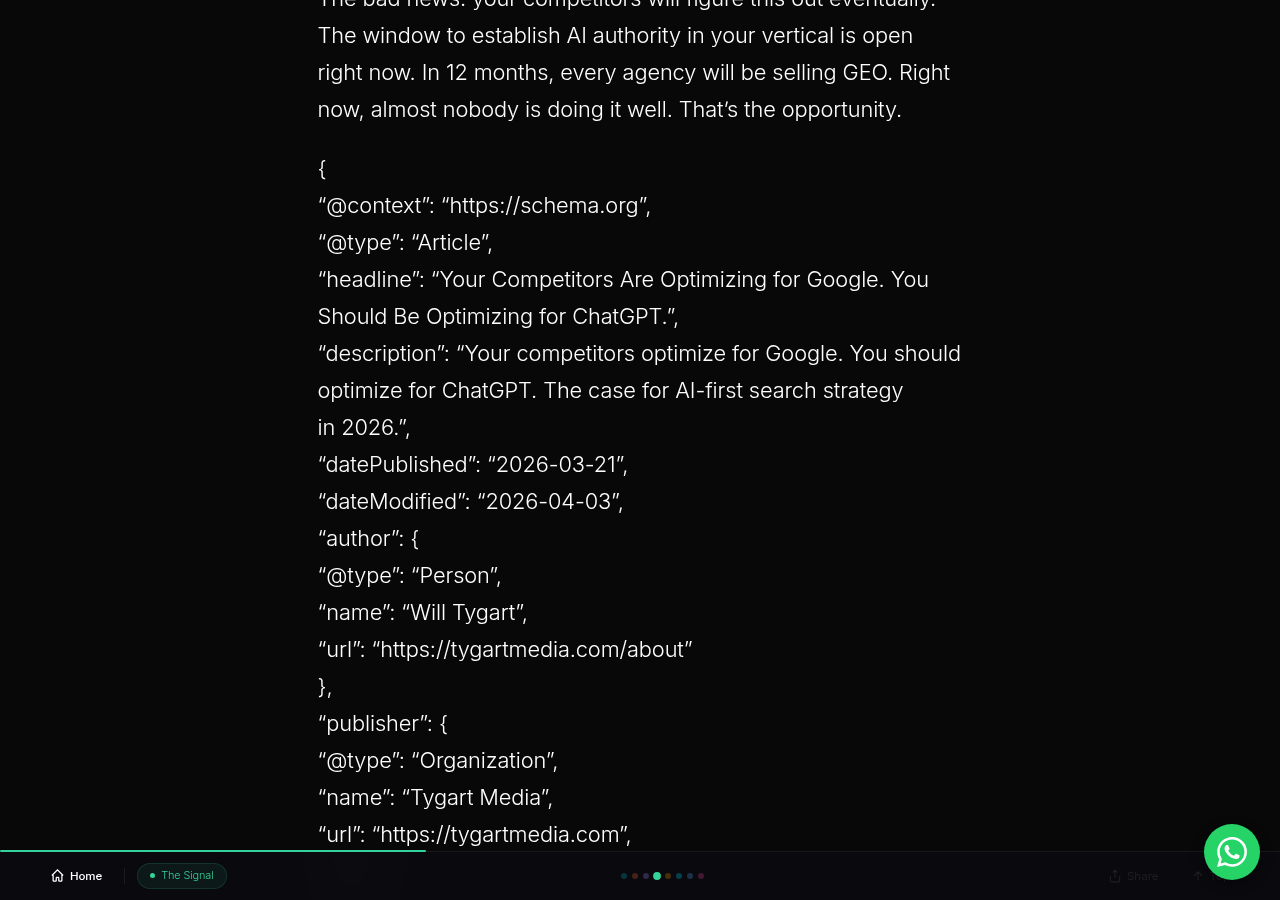
      {
      “@context”: “https://schema.org”,
      “@type”: “Article”,
      “headline”: “Is AI Citing Your Content? AEO Citation Likelihood Analyzer”,
      “description”: “Score your content on 8 dimensions that determine whether AI systems like Claude, ChatGPT, and Gemini will cite you as a source.”,
      “datePublished”: “2026-04-01”,
      “dateModified”: “2026-04-03”,
      “author”: {
      “@type”: “Person”,
      “name”: “Will Tygart”,
      “url”: “https://tygartmedia.com/about”
      },
      “publisher”: {
      “@type”: “Organization”,
      “name”: “Tygart Media”,
      “url”: “https://tygartmedia.com”,
      “logo”: {
      “@type”: “ImageObject”,
      “url”: “https://tygartmedia.com/wp-content/uploads/tygart-media-logo.png”
      }
      },
      “mainEntityOfPage”: {
      “@type”: “WebPage”,
      “@id”: “https://tygartmedia.com/aeo-citation-likelihood-analyzer/”
      }
      }

  • AEO for Local Businesses: Featured Snippets Your Competitors Aren’t Chasing

    AEO for Local Businesses: Featured Snippets Your Competitors Aren’t Chasing

    Tygart Media / The Signal
    Broadcast Live
    Filed by Will Tygart
    Tacoma, WA
    Industry Bulletin

    Most local businesses compete on “best plumber in Austin” or “water damage restoration near me.” But answer engines reward a different kind of content. They want specific, quotable answers to questions that people actually ask. That’s where local AEO wins.

    The Local AEO Opportunity
    Perplexity and Claude don’t just rank businesses by distance and reviews. They rank by citation in answers. If you’re the source Perplexity quotes when answering “how much does water damage restoration cost?”, you get visibility that paid search can’t buy.

    And local AEO is less competitive than national. Everyone’s chasing national top 10 rankings. Almost nobody is optimizing for Perplexity citations in local verticals.

    The Quotable Answer Strategy
    AEO content needs to be quotable. That means:
    – Specific answers (not vague generalities)
    – Numbers and timeframes (“typically 3-7 days”)
    – Price ranges (“$2,000-$5,000 for standard water damage”)
    – Process steps (“Step 1: assessment, Step 2: mitigation…”)
    – Local context (“in North Texas, humidity speeds drying”)

    Generic content doesn’t get quoted. Specific, local, answerable content does.

    Content Types That Win in Local AEO
    Service Cost Guide: “Water Damage Restoration Cost in Austin: What to Expect in 2026”
    – Actual price ranges in Austin (vs. national average)
    – Breakdown of what factors affect cost
    – Comparison of premium vs. budget options
    – Timeline impact on pricing
    Result: Ranks in Perplexity for “water damage restoration cost Austin” queries

    Process Timeline: “Water Damage Restoration Timeline: Days 1-7, Week 2-3, Month 1”
    – Specific steps at specific timeframes
    – Local humidity/climate impact
    – What happens at each stage
    – When to expect mold concerns
    Result: Quoted when people ask “how long does water restoration take”

    Problem-Specific Guides: “Hardwood Floor Water Damage: Restoration vs. Replacement Decision”
    – When to restore vs. replace
    – Cost comparison
    – Timeline for each option
    – Success rates
    Result: Quoted when people research hardwood floor damage specifically

    Local Comparison Content: “Water Damage Restoration in Austin vs. Dallas: Regional Differences”
    – Climate differences (humidity, soil)r>- Cost differences
    – Timeline differences
    – Regional techniques
    Result: Ranks for “restoration Austin vs Dallas” type queries (people considering both areas)

    The Internal Linking Strategy
    Each content piece links to service pages and other authority content, creating a web:

    – Cost guide → Process timeline → Hardwood floor guide → Commercial damage guide → Service page
    – This signals to Google and Perplexity: “This is an authority cluster on water damage”

    The Review Generation Loop
    AEO content also drives reviews. When a prospect reads your detailed cost breakdown or timeline, they’re more informed. Informed customers become satisfied customers who leave better reviews. Those reviews feed back into Perplexity rankings.

    The SEO Bonus
    Content optimized for AEO also ranks well in Google. In fact, the AEO content pieces often outrank the local Google Business Profile for specific queries. You’re getting:
    – Google rankings (organic traffic)
    – Perplexity citations (AI engine traffic)
    – LinkedIn potential (if you share the content as thought leadership)
    – Social proof (highly cited content builds reputation)

    Real Results
    A local restoration client published:
    – “Water Damage Restoration Timeline” (2,500 words, specific local context)
    – “Cost Guide for Water Damage in Austin” (detailed breakdown)
    – “How We Assess Your Home for Water Damage” (process guide)

    Results (after 3 months):
    – Perplexity citations: 40+ per month
    – Google organic traffic: 2,200 monthly visitors
    – Phone calls from people who found the guide: 15-20/month
    – Average deal value: $4,500 (because informed customers are better quality)

    Why Competitors Aren’t Doing This
    – It takes 40-60 hours per content piece (slower than quick blog posts)
    – Requires local expertise (can’t outsource easily)
    – Doesn’t show results in analytics for 2-3 months
    – Requires understanding AEO principles (most agencies focus on SEO)
    – Most content agencies haven’t heard of AEO yet

    The Competitive Window
    We’re in a narrow window right now (2026) where local AEO is underdeveloped. In 12-18 months, everyone will be doing it. If you start now with detailed, quotable, local-specific content, you’ll be entrenched before competition arrives.

    How to Start
    1. Pick your top 3 search queries (“water damage cost,” “timeline,” “hardwood floors”)
    2. Write 2,500+ word guides that are specifically local and quotable
    3. Add FAQPage schema markup so Perplexity can pull Q&A pairs
    4. Internal link across your pieces
    5. Wait 3-4 weeks for Perplexity to crawl and cite
    6. Iterate based on which pieces get cited most

    The Takeaway
    Local businesses can compete on AEO with fraction of the budget that national companies spend on paid search. But you need specific, quotable, local-relevant content. Generic blog posts won’t get you there. Deep, detailed, answerable guides will.

    {
    “@context”: “https://schema.org”,
    “@type”: “Article”,
    “headline”: “AEO for Local Businesses: Featured Snippets Your Competitors Arent Chasing”,
    “description”: “Local AEO wins by publishing specific, quotable answers to local questions. Here’s how to build content that Perplexity cites instead of competing on loca”,
    “datePublished”: “2026-03-30”,
    “dateModified”: “2026-04-03”,
    “author”: {
    “@type”: “Person”,
    “name”: “Will Tygart”,
    “url”: “https://tygartmedia.com/about”
    },
    “publisher”: {
    “@type”: “Organization”,
    “name”: “Tygart Media”,
    “url”: “https://tygartmedia.com”,
    “logo”: {
    “@type”: “ImageObject”,
    “url”: “https://tygartmedia.com/wp-content/uploads/tygart-media-logo.png”
    }
    },
    “mainEntityOfPage”: {
    “@type”: “WebPage”,
    “@id”: “https://tygartmedia.com/aeo-for-local-businesses-featured-snippets-your-competitors-arent-chasing/”
    }
    }