
Notes from the Bot Lab · November 28, 2026 · By Will Tygart
Two days ago in Billboards, Bots, and Heading Toward the Mountain, I wrote a line that sounded obvious on paper: “Buyers shortlist vendors inside ChatGPT or Copilot and visit direct days later.”
Right after hitting publish, I wanted to stop quoting marketing folklore and test that sentence on our own plumbing. When an analytics screen labels traffic “Direct,” what is actually walking through the front door? And if an AI bot hits a deep technical guide first, do real people follow behind it — either minutes later with their referrer stripped, or days later typing tygartmedia.com from memory?
So we pulled 1,859,626 in-window server log lines from tygartmedia.com across 31.84 days (October 28 through November 28, 2026 — 1,919,148 raw lines before windowing and quarantining 3,895 automated security-scanner networks), paired them with 989 verified 30-second-plus active reader sessions, 90 days of Google Analytics 4 first-touch cookie cohorts, 90 days of Google Search Console data, and Bing Webmaster logs. Here is what actually came out of the box.
Why Your “Direct” Bucket Is Mostly Robots in Trench Coats
Most operators treat HTTP “Direct” traffic — visits missing a Referer header — like loyal customers typing your web address into Chrome over morning coffee. In reality, raw “Direct” traffic works like a lost-luggage bin at the front door. Every headless scraper, privacy browser, desktop AI app, and returning buyer gets tossed into the same pile.
Before you can measure a single real buyer inside Direct traffic, you have to peel off two synthetic layers:
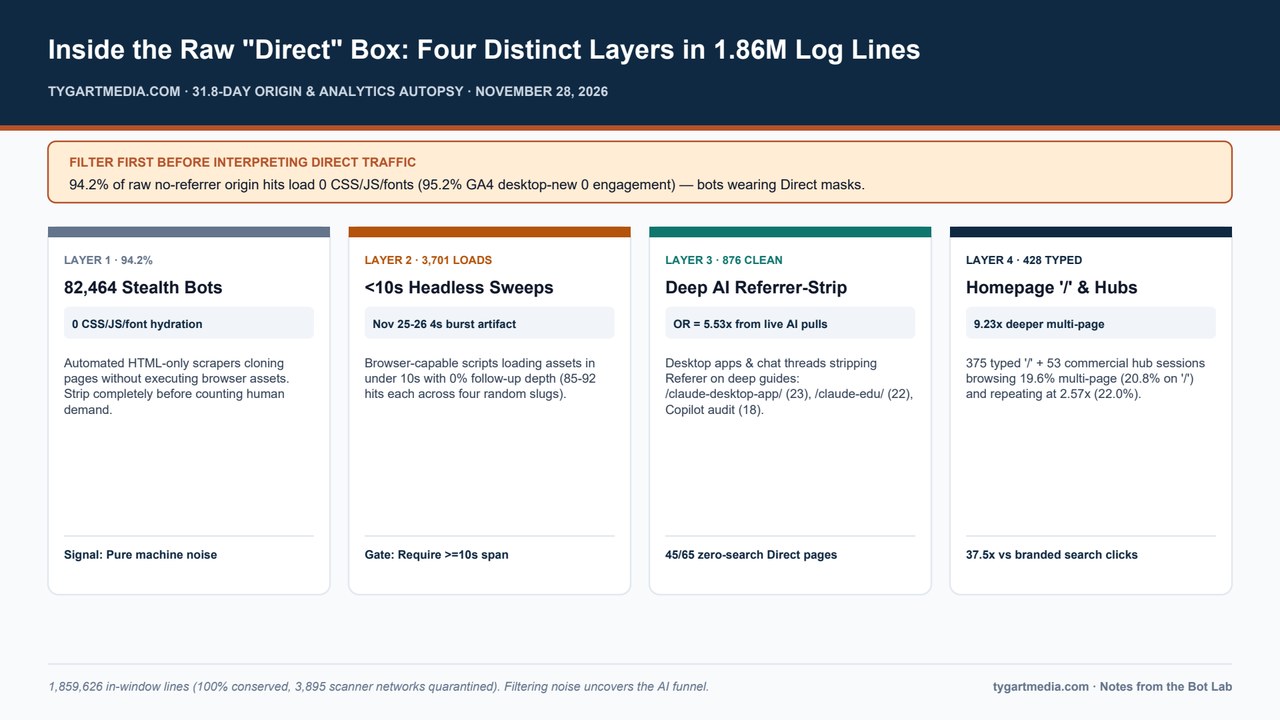
| Layer Inside Raw "Direct" | 31.8-Day Volume | Browser & Depth Signature | What Is Actually Happening |
|---|---|---|---|
| 1. Stealth HTML-Only Scrapers | 82,464 sessions (94.2% of raw no-referrer) | 0 real CSS, JS, or font assets loaded; 95.2% of GA4 desktop new unengaged | Automated scrapers cloning pages without hydrating a real browser. |
| 2. Automated Headless Bursts (<10s) | 3,701 deep-slug sessions | Asset loads complete in under 10s with 0% multi-page depth (incl. Nov 25–26 4-slug burst) | Short headless sweeps (85–92 hits each across 4 slugs) masquerading as browsers. |
| 3. Clean Deep Direct (>=10s) | 876 origin / 187 active 30s+ sessions | 2.6% multi-page overall; led by /claude-desktop-app/ (23) & /claude-edu/ (22) | Desktop apps and chat windows stripping Referer headers on deep-guide clicks. |
| 4. Typed Homepage '/' & Hubs | 428 origin sessions (375 '/' + 53 hubs) | 19.6% multi-page (9.23x deeper) and 22.0% same-network repeat (2.57x higher) | Remembered brand visits returning days after shortlisting Tygart Media. |
First, 94.2% (82,464 of 87,520) of our non-scanner no-referrer browser sessions never loaded real CSS stylesheets, JavaScript, or fonts. In GA4, 95.2% (20,209 of 21,225) of 30-day desktop-new “(direct)” sessions registered zero engagement. Wait until you filter to real asset-hydrating browsers (5,005 origin sessions; 1,232 GA4 engaged; 228 active 30-second-plus Direct readers) — only then can you even start asking who is human.
Second, even asset-loading browsers hide an automated trap. Inside our 4,577 deep-slug Direct arrivals, 3,701 loaded in under 10 seconds with zero follow-up clicks — inflated by a single November 25–26 burst where automated headless browsers swept four random slugs 85 to 92 times apiece inside 4-second windows. Filtering to 10 seconds or longer asset spans (or multi-page journeys) drops the remaining cohort to 876 verified human sessions, immediately surfacing real reader interest led by our Claude Desktop guide (23 origin / 29 GA4 engaged), Claude for Education guide (22 / 27), Claude for Nonprofits breakdown (18 / 19), and Copilot eDiscovery audit guide (18 / 13).
Once the synthetic noise is peeled back, real Direct humans split into two unmistakable signatures. Visitors who type tygartmedia.com/ or visit our commercial hubs (428 sessions: 375 root + 53 hubs) browse 9.23x more multi-page journeys (19.6% vs. 2.6%; 20.8% on the homepage alone) and repeat on the same network at 2.57x the rate (22.0% vs. 9.9%). Meanwhile, nobody memorizes a 50-character technical URL slug by heart — those 876 deep-guide arrivals come in straight from apps and chat interfaces that strip the referring header at the door.
Putting a Stopwatch on Live AI Bots
If an AI assistant fetches a guide live while answering a buyer’s prompt — and that buyer opens the link from a desktop or mobile app that strips the referrer — we should see a tight stopwatch signature on the server: the bot timestamp hitting that exact slug seconds or minutes before the Direct human arrives, far more often than the reverse.
Testing both Anthropic’s live user-fetch agent (Claude-User) and OpenAI’s user agent (ChatGPT-User) against a 14-shift time-of-day baseline and a traditional search bot control (DuckDuckBot/1.0) exposed a sharp architectural split:
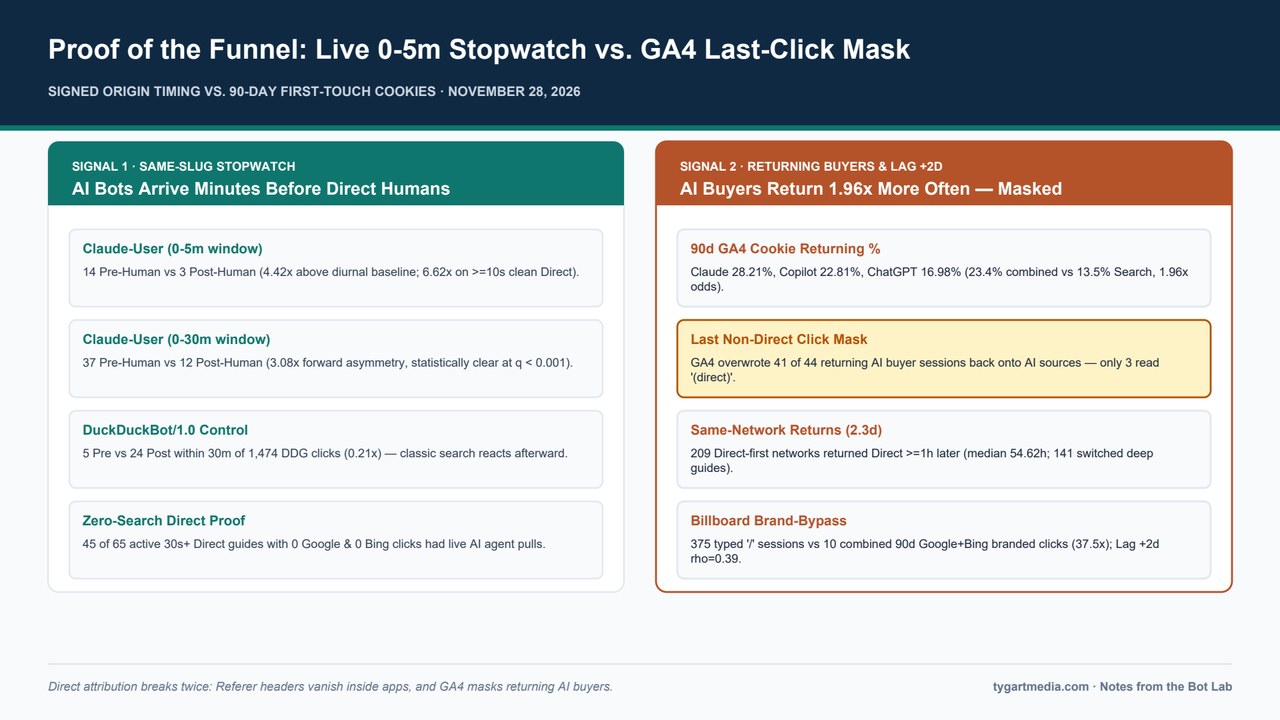
1. Claude-User fires right before humans arrive. Across our full 31.8-day log, Claude-User pulled the exact page 0–5 minutes before a Direct human landed 14 times versus 3 times after — a 4.42x lift above what normal time-of-day traffic on the exact same URLs would produce by chance (3.16 expected), climbing to a 6.62x lift on clean 10-second-plus Direct sessions (5 before vs. 1 after). Within 0–30 minutes, the forward asymmetry stayed 3.08x (37 before vs. 12 after).
2. Traditional search bots run backward (our negative control). When real humans clicked through from DuckDuckGo search (1,474 sessions), DuckDuckBot/1.0 hit those URLs 5 times before versus 24 times after (0.21x) within 30 minutes — confirming search indexers react after human demand rather than pulling pages beforehand.
3. Why ChatGPT-User looks flat on a 5-minute clock. ChatGPT-User logged 12 pre-human vs. 18 post-human hits inside 5 minutes (1.22x diurnal). Rather than contradicting AI shortlists, that points to architecture: OpenAI pairs pre-indexed OAI-SearchBot caching with heavy continuous polling on flagship pages (724 hits/month on a single pricing guide). Even when visitors kept a visible AI referrer header (160 control clicks), only 2 matched a 5-minute live fetch, while 68 arrived 1 hour to 7 days after a live-agent pull.
Controlling simultaneously for Google impressions, Bing impressions, and word count across 2,189 deep URLs, pages pulled by live AI agents earned 30-second-plus active Direct readers at 5.53x higher odds (8.59% vs. 1.67%; 5-fold cross-validated ROC-AUC = 0.8325) and clean 10-second-plus origin Direct visits at 3.98x odds. Even more telling: among deep Direct pages that received zero Google clicks and zero Bing clicks, 45 of 65 (69.2%) had recorded live AI agent fetches — led by /claude-desktop-app/ with 17 live-agent pulls and 23 verified Direct arrivals.
Why Returning AI Buyers Disappear Twice (IP Churn vs. GA4’s Last-Click Mask)
So what about the second half of the claim — people returning Direct days after their first AI touch? When we looked strictly at exact server network addresses over 31.8 days, 209 of 4,459 (4.69%) Direct-first networks returned Direct at least 1 hour later (158 returned 24+ hours later at a median lag of 54.62 hours — 2.3 days), with 141 moving on to read a different deep guide and 9 visiting the homepage or commercial hubs. Search-first networks almost never matched cleanly cross-day on the exact same server IP (only 3 each from Bing and DuckDuckGo), and the small cohort of 148 explicit AI-referrer networks logged zero exact-IP cross-day matches.
If you stopped at server logs alone, you would conclude AI visitors do not return Direct. But carrier and VPN IP rotation breaks server-side cross-day stitching when sample sizes sit around a hundred networks. Once you switch over to 90-day GA4 first-touch cookies — which survive across IP changes on the same browser — a completely different picture shows up:
| 90-Day GA4 First-Touch Source | Returning Users % | Visible Under AI Source | Visible Under (direct) | How Last-Click Reporting Masks It |
|---|---|---|---|---|
| Claude.ai (78 cohort) | 28.21% (22 returning) | 19 returning sessions | 3 returning sessions | 86% of returning visits stayed inside Claude.ai session credit. |
| Microsoft Copilot (57 cohort) | 22.81% (13 returning) | 13 returning sessions | 0 returning sessions | 100% overwritten back onto Copilot by Last Non-Direct Click. |
| ChatGPT (53 cohort) | 16.98% (9 returning) | 9 returning sessions | 0 returning sessions | 100% overwritten back onto ChatGPT despite repeat buyer returns. |
| Search Baseline (Bing + DDG + Google) | 13.5% (800 / 5,930) | Baseline control cohort | Small direct leakage (7) | Core AI first-touch buyers return at 1.96x higher odds (23.4% vs 13.5%). |
Core AI first-touch visitors (Claude.ai 28.21%, Copilot 22.81%, and ChatGPT 16.98%) came back at 23.4% overall (44 of 188) compared to 13.5% (800 of 5,930) for traditional search cohorts — nearly double the return odds (1.96x). Note that Google’s small 90-day cohort (35.38%, n=130) includes 31 visits hopping through external social or developer links rather than pure return behavior.
More importantly, look at why those 44 returning AI buyers stay invisible in standard Direct reports: under GA4’s Last Non-Direct Click attribution model, whenever a returning AI visitor comes back with no new external campaign tag, GA4 overwrites the session credit back onto the earlier AI source. Exactly 41 of 44 returning Core AI buyer sessions were masked under Claude, Copilot, or ChatGPT session credit, leaving only 3 labeled as (direct).
Nobody Googles Your Name When They Already Know Your URL
Here is the simplest proof that the billboard analogy works in practice: when an operator remembers our name after seeing a chat citation, they do not waste time searching “tygart media” in Google. Across 90 full days, Google Search Console (6 clicks on 41 impressions) and Bing Webmaster Tools (4 clicks on 11 impressions) logged just 10 branded search clicks across all Tygart queries combined (and only 8 exact “tygart media” clicks). Meanwhile, verified human Direct traffic typing tygartmedia.com/ hit 375 sessions in 31.8 days alone (52 GA4 engaged homepage sessions in 30 days) — outnumbering 90-day branded search clicks by 37.5x (46.9x against exact brand clicks).
Across our 32-day daily series, total live AI agent volume (ChatGPT-User + Claude-User) also showed a directional positive correlation with typed homepage and commercial hub Direct visits 2 days later (Spearman rho = 0.3915, p = 0.0324) — right in line with buyers shortlisting inside chat windows and walking in the front door a couple of days later.
To be honest about what server logs cannot do, three boundaries stay fixed: (1) if a buyer reads your name in ChatGPT without ever clicking a link on Day 1 and types your domain on Day 3 from another IP address, no server log on earth links those two visits without cookies; (2) automated 4-second headless sweeps still slip past basic asset-load checks unless you enforce at least a 10-second span or multi-page floor; and (3) a 32-day daily lag test is directional macro evidence, not a standalone lab experiment.
The practical operator lesson mirrors our earlier JavaScript rendering audit and Markdown twins white paper and aligns with what bots now evaluate on your site alongside how AI engines differ from Google: treat your homepage and commercial comparison hubs as a unified landing strip for buyers who arrive two days after a chat shortlist — and make your deep guides self-contained enough that when an assistant pulls them live and strips the referrer, the visitor finds exact facts immediately.
Frequently Asked Questions
Do buyers actually type your homepage directly after seeing an AI answer instead of Googling you?
Yes. Across 31.8 days on tygartmedia.com, asset-verified human visits typing the homepage directly (375 sessions) outnumbered 90 full days of Google and Bing branded 'tygart' search clicks combined (10 total, or 8 exact 'tygart media' clicks) by 37.5x (46.9x on the exact brand query), and daily live AI agent pulls correlated positively with typed homepage and hub traffic 2 days later (Spearman rho = 0.39).
Why did Claude-User show up minutes before Direct visitors while ChatGPT-User looked flat?
Claude-User fires synchronous on-demand fetches right as a human is sitting in a live prompt: it hit exact deep guides 0–5 minutes before Direct human arrivals 14 times versus 3 times after (4.42x above the matched time-of-day baseline). ChatGPT-User combines continuous background pulls on high-frequency pricing pages with pre-indexed OAI-SearchBot caching, so visible human clicks lag 1 hour to 7 days behind.
Why does GA4 hide returning AI buyers under '(direct)' vs. their original AI channel?
Two separate blind spots collide. At the server IP level, mobile and VPN addresses churn across days, breaking network-level stitching for small referrer cohorts. Meanwhile, inside GA4's 90-day cookies, Last Non-Direct Click attribution overwrites 41 of 44 returning Core AI buyers back onto their original AI source name instead of breaking out subsequent returning behavior cleanly.
Leave a Reply