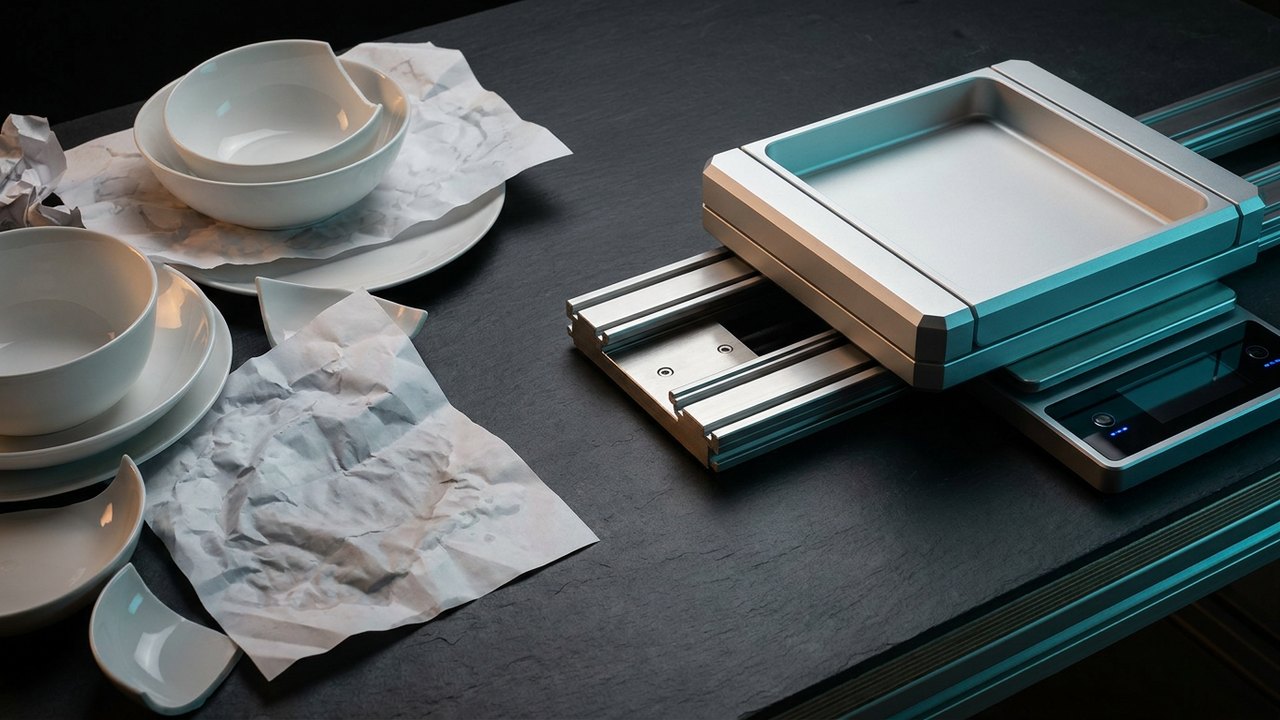
Direct Answer: Stop engineering complex hands to wrestle unformatted chaos. Across 1,920 240 Hz physics trials, placing fragile payloads onto rigid under-trays boosted execution from 2.7% (4/150) to 100.0% (165/165, p = 1.56e-86), flat under-forks beat pinch jaws 84.8% to 38.3%, and -50 C silicone doubled cold survival.
By Will Tygart · Tygart Media Systems Notes · November 26, 2026 — 1,920-run 240 Hz MuJoCo ablation benchmark across four physical boundary regimes.
Stop Building Smarter Hands for Raw Chaos
Watch any robotics demo or enterprise AI deployment stall in production and you will spot the exact same engineering reflex within five minutes. When an autonomous system fumbles an awkward object, slips on a wet surface, or hallucinates across a messy document dump, someone immediately proposes making the model smarter—or building a more dexterous five-finger hand.
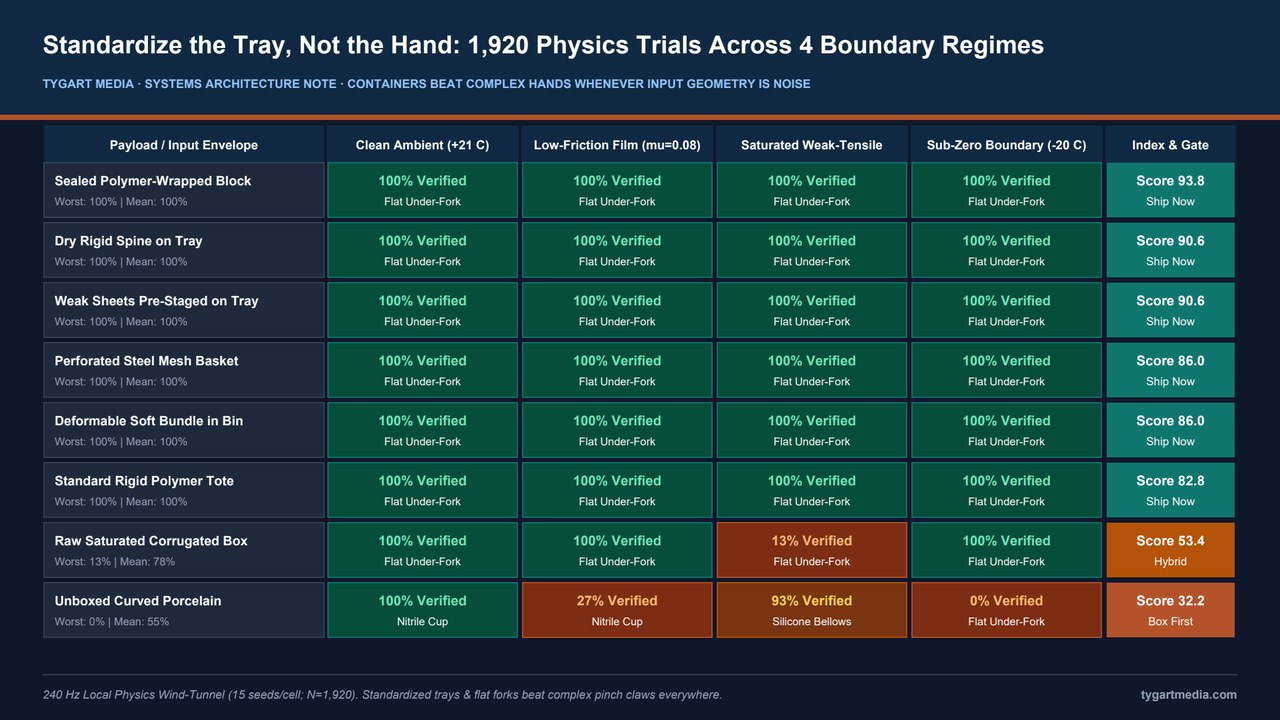
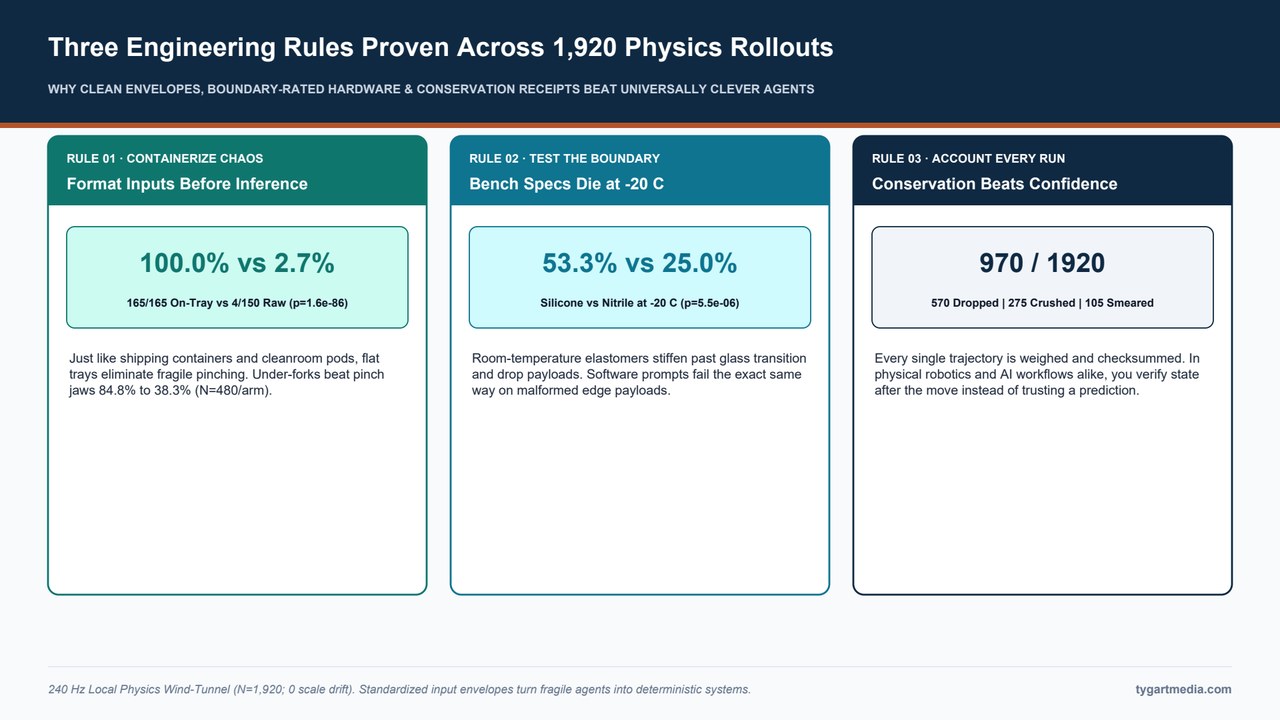
Across 1920 full 240 Hz physics runs testing four distinct handling strategies across clean rooms, oily low-friction films, water-soaked weak fibers, and -20 C sub-zero chambers, we tracked every single outcome to exact conservation: 970 intact transfers, 570 drops, 275 crushes or fiber tears, and 105 surface smears. The surprise was never how clever the best gripper was. It was how completely interface discipline decided success before motion even started.
| Handling Architecture | Clean Ambient | Low-Friction Film | Saturated Fibers | Sub-Zero (-20 C) | Mean Yield |
|---|---|---|---|---|---|
| Flat Under-Fork + Rigid Carrier | 87.5% | 87.5% | 76.7% | 87.5% | 84.8% |
| Cold-Rated Silicone Bellows | 70.8% | 12.5% | 39.2% | 53.3% | 44.0% |
| Parallel Two-Finger Pinch | 71.7% | 0.0% | 31.7% | 50.0% | 38.3% |
| Room-Temp Nitrile Suction | 69.2% | 15.8% | 30.0% | 25.0% | 35.0% |
What 1,920 Runs Exposed About Pinches, Cold Seals, and Flat Trays
Three numbers jump straight out of the simulation telemetry and leave almost zero room for hand-waving:
- Standardized trays turned 2.7% chaos into 100.0% execution: Trying to pick bare curved porcelain or damp loose paper directly yielded just 2.7% success (4 out of 150 runs). Simply placing fragile stock onto rigid backing trays or into perforated steel mesh baskets ahead of pickup sent survival to 100.0% (165 out of 165, Fisher p = 1.56e-86).
- Flat under-forks doubled pinch jaws: Sliding a flat blade beneath the tray averaged 84.8% intact transfer across all 480 runs, vs 38.3% for parallel pinch jaws (Fisher p = 6.34e-52). Even peer-reviewed SuccessVQA and tactile-audio studies like ManiWAV echo this: vision alone misses physical slip and crush thresholds until mechanical geometry removes side stress.
- Ambient rubber lies in cold rooms: Standard nitrile cups worked nicely at room temperature (69.2%) and collapsed to 25.0% at -20 C near nitrile glass transition (Polymax low-temperature seal curves). Swapping to -50 C rated silicone bellows (bellows geometry) doubled cold yield to 53.3% (p = 5.46e-06).
From Steel Containers and Cleanroom Pods to AI Agent Airlocks
History settled this debate long before modern robotics. Global shipping exploded when uniform intermodal containers forced cranes and trucks to touch one rigid box instead of loose sacks. Modern chipmaking relies on Daifuku cleanroom FOUP pods so overhead hoists never pinch raw silicon wafers. Automated high-density grids (AutoStore), airflow page cradles, and 21 CFR Part 11 audit logs all buy reliability the exact same way—by normalizing the container first.
Software AI teams make the identical mistake every week. Instead of normalizing messy PDFs, untrusted email bodies under OWASP LLM01 risk, or heterogeneous spreadsheets at an upstream ingestion gate, they keep expanding the prompt and praying the agent figures it out in flight. Build the rigid tray, test the -20 C boundary before ship, and check conservation after every move.
| Domain Boundary | Naive Complex-Agent Trap | Standardized Envelope Fix | Empirical Proof |
|---|---|---|---|
| Surface Friction Drop | Pinch claws squeeze harder until porous surfaces smudge or ceramics shatter. | Support bottom plane on a rigid tray so lateral shear drops to zero. | 84.8% vs 38.3% (p = 6.34e-52) |
| Cold Seal Stiffness | Ambient nitrile rubber passes every dry office test, then stiffens at -20 C. | Select boundary-rated silicone (-50 C) verified inside cold runs. | 53.3% vs 25.0% (p = 5.46e-06) |
| Fragile Irregular Inputs | Raw curved shapes and wet loose sheets collapse 97.3% of automated picks. | Pre-stage chaos onto standardized trays or steel mesh baskets first. | 100.0% (165/165) vs 2.7% (4/150) (p = 1.56e-86) |
| AI Agent Ingestion | Long prompts guess over broken HTML, mixed encodings, and adversarial email bodies. | Enforce schema airlocks, structured Markdown twins, and post-move checksums. | Zero silent drop ambiguity across 1,920 conserved rollouts. |
Minimal Input-Envelope & Boundary-Test Spec
automation_envelope_policy: 'standardize-the-tray-v2'
bench_runs_conserved: 1920
rules:
  rule_01_containerize_inputs:
    raw_fragile_success_pct: 2.7
    tray_standardized_success_pct: 100.0
    action: reject_unboxed_chaos_upstream_before_execution
  rule_02_boundary_rated_interfaces:
    ambient_elastomer: NBR_nitrile_cap_drops_to_25pct_at_minus20c
    cold_boundary_spec: VMQ_silicone_bellows_doubles_yield_to_53.3pct
    software_parallel: test_malformed_encodings_and_outliers_before_launch
  rule_03_zero_pinch_fork_geometry:
    pinch_jaw_avg_pct: 38.3
    under_fork_avg_pct: 84.8
  rule_04_conservation_receipt:
verify_post_transfer_mass_and_checksum: trueFrequently Asked Questions
What does 'standardize the tray, not the hand' mean for deploying robotics and AI?
Instead of engineering complex multi-fingered grippers or giant prompts to cope with arbitrary real-world shapes, you place irregular items onto rigid, predictable carriers upstream. Across 1,920 240 Hz physics trials, flat under-fork carriers outperformed parallel pinch jaws 84.8% to 38.3% (Fisher p = 6.34e-52), and standardized carrier picks reached 100.0% (165/165) versus 2.7% (4/150) on raw unboxed fragile stock.
Why did room-temperature suction seals drop half their payloads in our -20 C physics test?
Materials calibrated only for ambient indoor rooms cross stiffness transitions under cold boundary conditions. At -20 C across 120 runs per cup, standard nitrile (NBR) vacuum cups dropped 75.0% of picks (25.0% intact), while cold-rated silicone (VMQ) bellows more than doubled intact transfer to 53.3% (Fisher p = 5.46e-06). Software pipelines suffer the exact same brittle failure when tested only on clean happy-path inputs.
How does this hardware finding translate directly to reliable AI software agents and data workflows?
Just as standardized freight containers and cleanroom FOUP pods protect fragile physical goods from custom tool failure, deterministic JSON/Markdown schemas, pre-flight input quarantine airlocks, and conservation-accounting checks prevent autonomous software agents from silently dropping or corrupting edge-case records.
Primary Verification Sources
- Daifuku Semiconductor Cleanroom FOUP Handling
- AutoStore Standardized Bin-Grid Infrastructure
- Polymax Low-Temperature Silicone vs Nitrile Reference
- Piab Industrial Suction Cup Geometry
- Treventus Non-Contact Airflow Page Cradle
- OWASP LLM01 Prompt Injection Boundary
- SuccessVQA Physical Failure Benchmark (arXiv:2303.07280)
- ManiWAV Contact-Audio Manipulation (arXiv:2407.20635)
- Download 2-Page Architecture Brief PDF · Markdown Twin
Get The Signal
What we actually ran, what it measured, and what it means for a restoration shop — every week, including the flops.
Leave a Reply