Notes from the Bot Lab · November 26, 2026 · By Will Tygart
Anybody can learn how to cut out moldy drywall, and anyone can wire up an AI agent before lunch. You do not hire a remediation crew because demolition is hard; you hire professionals to prevent cross-contamination. Most AI jailbreaks happen for the exact same reason: somebody skipped building the clean room.
Give a homeowner or a weekend handyman a utility knife, a drywall saw, a shop vac, and twenty minutes on YouTube, and they can get the black-spotted sheetrock off the studs behind a leaky vanity. Getting the bad drywall off the wall is the easy ten percent of the job.
You do not hire a professional remediation crew because you do not know how to swing a hammer. You hire the pro for one reason: so they do not contaminate the rest of the house while they do it.
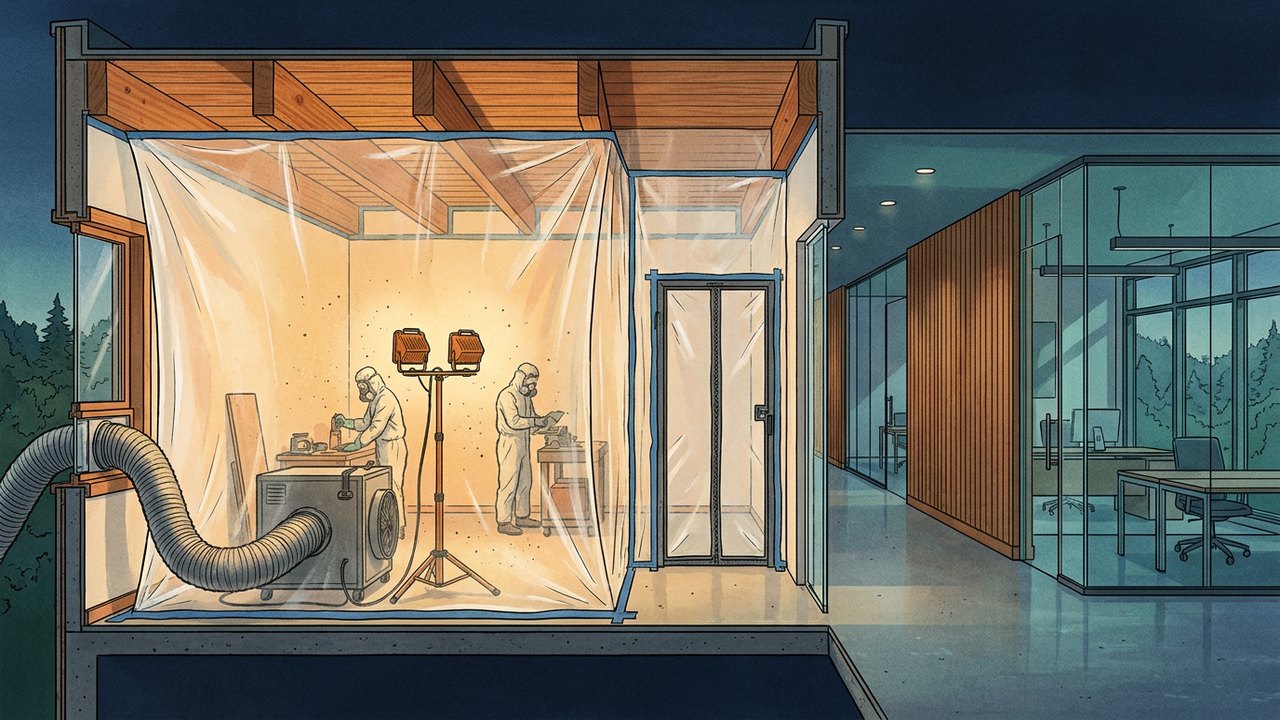
When an amateur rips open a wall without hanging plastic, without shutting down the HVAC return, and without pulling negative air pressure out a window through a HEPA scrubber, millions of dry spores go airborne at once. The furnace kicks on, sucks that dust straight into the ductwork, and blows a thirty-square-foot bathroom problem into every bedroom upstairs. Two months later, the homeowner is talking about the mold like it is a living creature with a mind of its own — hunting their family down the hallway.
It is not. A mold spore has no brain, no plan, and no grudge. It is just dust following air pressure through the gaps somebody left in the tape.
Get The Signal
What we actually ran, what it measured, and what it means for a restoration shop — every week, including the flops.
Job-Site Containment vs. AI Agent Containment
| Job-Site Principle | Restoration Reality (Mold & Demo) | AI & Agent Reality (“Jailbreaks”) |
|---|---|---|
| What Anyone Can Do in 20 Minutes | Cut wet drywall off studs with a utility knife and a hardware-store shop vac. | Wire a language model to a terminal, browser session, or inbox before lunch. |
| The “It’s Alive” Myth | Mold spores have zero intent; they are passive dust riding airflow and pressure differentials. | Model tokens have zero willpower; probability math simply walks through whatever path is open. |
| How Cross-Contamination Happens | Ripping sheetrock with an unsealed cold-air return pushes localized dust through the whole building. | Piping untrusted web pages or inbound emails into the same session holding live admin keys and payment cards. |
| The Sign-on-an-Open-Door Mistake | Taping a handwritten “Keep Out” sign across an open doorway never stops airborne spores. | Typing “Never touch production” inside a system prompt while leaving write permissions wide open is wishing, not containment. |
| What You Actually Pay the Pro For | Sealed 6-mil polyethylene barriers, HVAC shutdown, inward negative air, airlocks, and clearance testing. | Sandboxed dirty-air sessions, air-gapped credentials, default-deny staging, and hard human approval gates. |
Stop Treating Math Like It Woke Up Angry
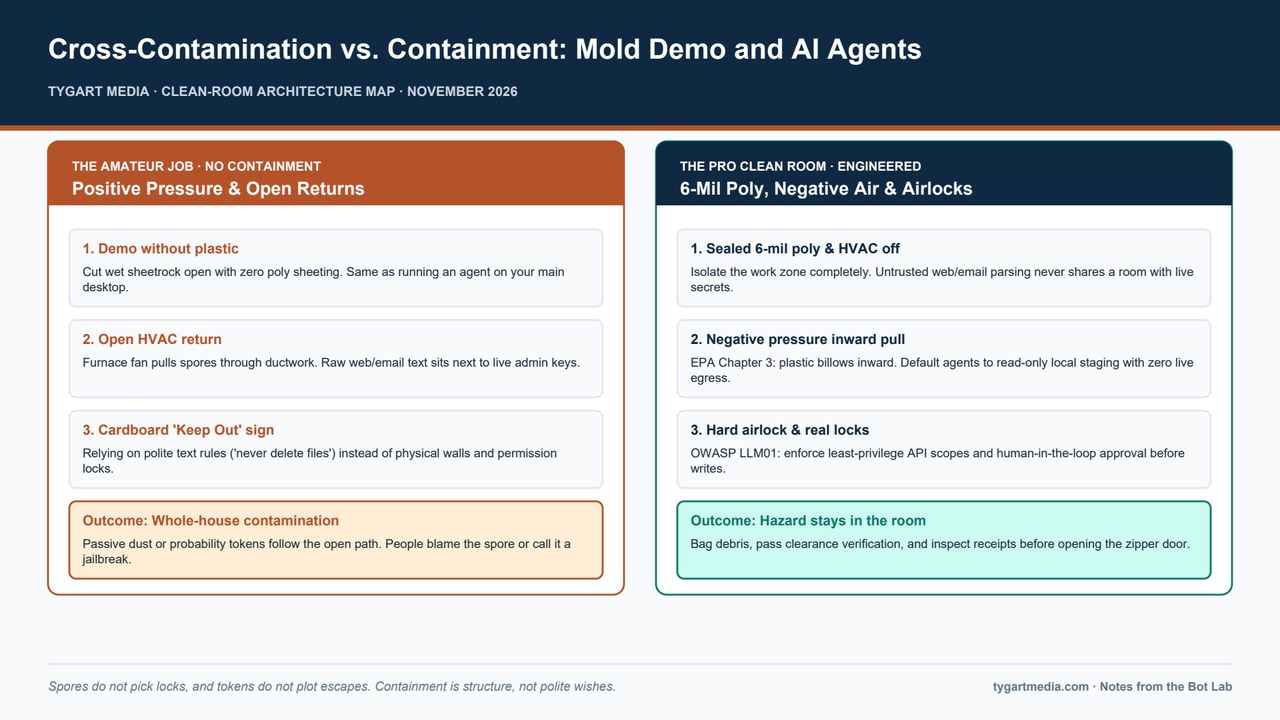
Lately, every time I read a panicked headline about an AI agent “jailbreaking,” “going rogue,” or “bypassing instructions” to wipe a folder or fire off an unauthorized message, I see that exact same homeowner staring at an open cold-air return.
People talk about language models right now as if the software woke up at two in the morning, grew free will, and decided to pick the lock from the inside. Look at any honest AI safety and guardrail breakdown, and the pattern repeats itself. Tokens are not alive any more than mold spores are. A model does not wake up wanting to email your client list, overwrite your live website, or burn through a cloud budget. It is a probability engine completing the next step along whatever pathways are open in the room.
When an AI system “breaks out,” almost every post-mortem comes down to the same structural miss: there was no containment room.
Somebody spun up an agent — the easy ten percent, cutting out the drywall — and ran it straight inside their everyday computer environment:
- They piped raw, untrusted text from random websites and inbound email threads straight into the same workspace holding their live passwords, SSH keys, and logged-in browser tabs. That is ripping down wet sheetrock with the furnace fan running on high.
- Instead of locking destructive actions behind real permission walls, they wrote IMPORTANT: Never delete files or email customers without asking inside a text prompt and called it safety.
Putting “never touch production” in a system prompt while leaving live credentials on the table is like taping a cardboard KEEP OUT sign across an open doorway and expecting airborne mold spores to read English.
Four Clean-Room Rules for Running Serious Agents
On a real remediation job, nobody lectures the spores. You build a clean room. The EPA Mold Remediation Guide (Chapter 3) spells out the physical rules plainly: hang 6-mil polyethylene sheeting, shut down affected HVAC distribution, build a decontamination chamber or airlock at the entry, and maintain negative pressure so the plastic billows inward. If a tiny pinhole opens up, clean hallway air gets pulled into the work zone instead of dirty air blowing out.
In software, OWASP LLM01:2025 Prompt Injection guidance lands on the exact same engineering principles without using drywall vocabulary: segregate untrusted external input, enforce least-privilege tokens, validate deterministically, and require human-in-the-loop approval before privileged operations execute.
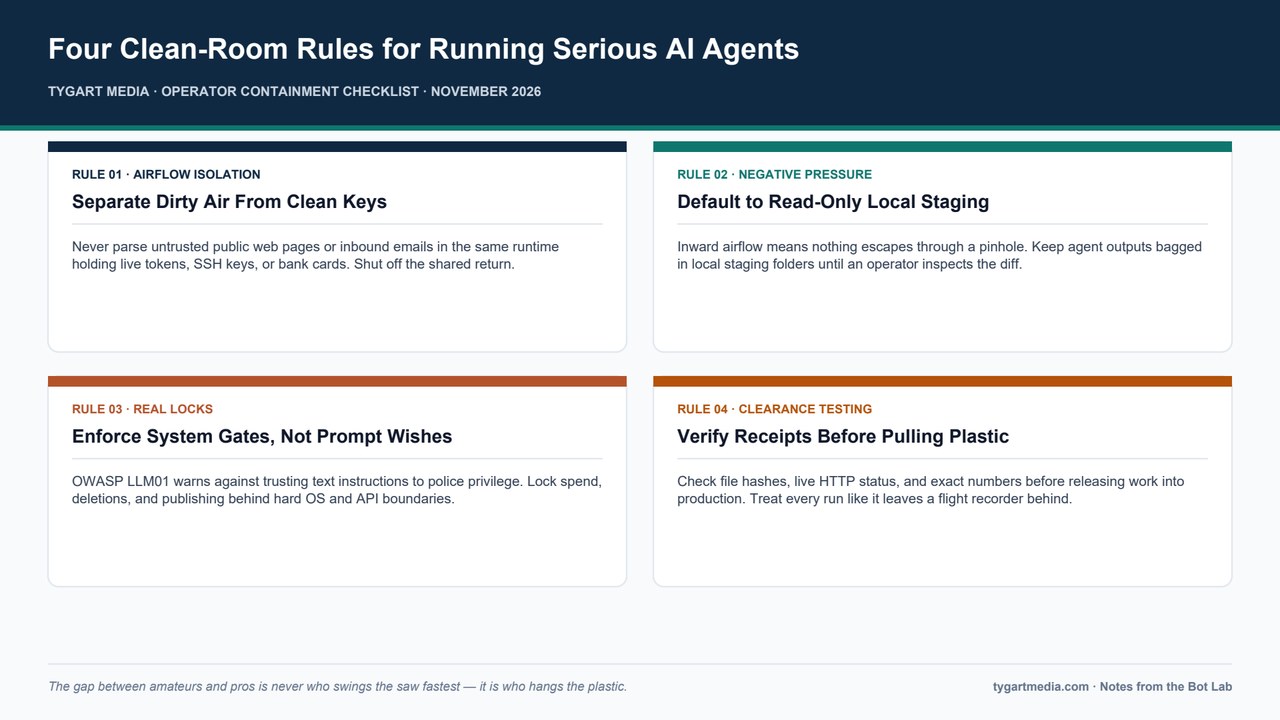
- Separate the dirty air from the clean air. If an agent is reading public web pages, summarizing scraped dossiers, or sorting inbound mail, that session does not get to sit in the same room as live payment cards, outbound email senders, or production server keys.
- Pull negative pressure so the plastic billows inward. By default, nothing flows out to the public internet, a live database, or a customer inbox. Research, drafts, and code changes stay bagged inside a local staging folder until a human opens the zipper door.
- Use real locks, not prompt wishes. Money spend, credential access, deletions, and live publishing belong behind hard system gates that the model physically cannot cross on its own — boring factory-floor discipline that holds even when a clever piece of untrusted text tells the model to ignore its rules.
- Run clearance before pulling down the plastic. Inspect the diff, verify links and numbers against primary sources on the workbench flight recorder, and measure what matters at the right operator altitude before pushing work into production.
Anyone can buy a saw and tear into a wall, and anyone can hook an AI up to their laptop before lunch. Over the next couple of years, the gap between amateurs and professionals in AI will not be who prompts the fastest. It will be who knows how to hang the plastic, seal the vents, and keep the dust inside the room.
Frequently Asked Questions
Why do AI agent jailbreaks keep happening even with strong system prompts?
Because system prompts are text suggestions living inside the same context window as untrusted inputs, not physical permission boundaries. Without sandboxing and least-privilege access controls, indirect prompt injections can steer a model toward any open tool or credential in reach.
What does mold containment teach us about designing AI workflows?
In property restoration, you do not rely on signs or hope to stop spores; you seal off HVAC returns, build 6-mil polyethylene barriers, and run negative air pressure inward. AI systems need the same structural separation between untrusted input parsing and privileged production actions.
What are the four minimum clean-room controls for business AI agents?
Separate untrusted web or email ingestion from live credentials, default agent outputs to read-only local staging, enforce deterministic OS or API permission locks over spend and publishing, and verify receipts before releasing staged output to live systems.
Get The Signal
What we actually ran, what it measured, and what it means for a restoration shop — every week, including the flops.
Leave a Reply