
Put a ring light in a woodshop and watch how fast the carpenter stops building furniture and starts performing carpentry. He hides the miscut board under the bench, sweeps the cedar shavings before the joint is dry, and narrates a confidence he has not earned yet. Behavioral researchers spent decades studying how being watched alters real-world work — often grouped under the Hawthorne effect, where a systematic review by Jim McCambridge, John Witton, and Diana Elbourne showed how fragile observation becomes the moment participants know they are on stage. The cure in a working shop is not better lighting. It is turning the ring light off and bolting a flight recorder underneath the workbench.
In commercial aviation, federal rules require both a Flight Data Recorder (14 CFR § 121.343) tracking altitude, airspeed, heading, and timing, and a Cockpit Voice Recorder (14 CFR § 121.359) painted bright orange and running automatically from the start of the first checklist until the engines shut down. Pilots do not pose for the orange box. It costs zero posture while they fly. Bolt that same quiet habit under a business desk — a written work order going in, an automatic log running underneath, and a dated receipt with the misses left in plain sight coming out — and what rolls off the back of an ordinary Tuesday is not theater. It is operational exhaust: the verifiable byproduct left behind when real systems run.
Why Memory Edits — and Receipts Do Not
Most business owners assume publishing is about chasing applause from strangers. We learned the opposite inside our own shop. In Write It Down or It Didn’t Happen, I put the personal rule bluntly: I do not publish to be read; I publish to remember. A monthly software invoice or phone bill arrives on schedule, exact to the penny, while the real Tuesday conversation that justified paying it fades by Friday — the exact trap we wrote down in The Junk Calls Are the Tuition. Memory quietly edits what we knew and when we knew it. A dated public receipt locks the version of Tuesday that actually happened before your future self can rewrite it.
That same anti-theater principle holds inside day-to-day AI work. When an uploaded featured image broke on a Saturday afternoon and my sarcastic text bounced right past an AI assistant in The Dance, one plain sentence (it’s not showing completely) unlocked the snapshot and fixed the file in ten minutes. The noticing and catching were not embarrassing friction to sweep off the floor — they were the system working. In The Smallest Sentence, even a changed approval tap leaves proof that a decision was weighed instead of rubber-stamped. Polished certainty reads like sales copy; certainty that survived a visible check reads as earned.
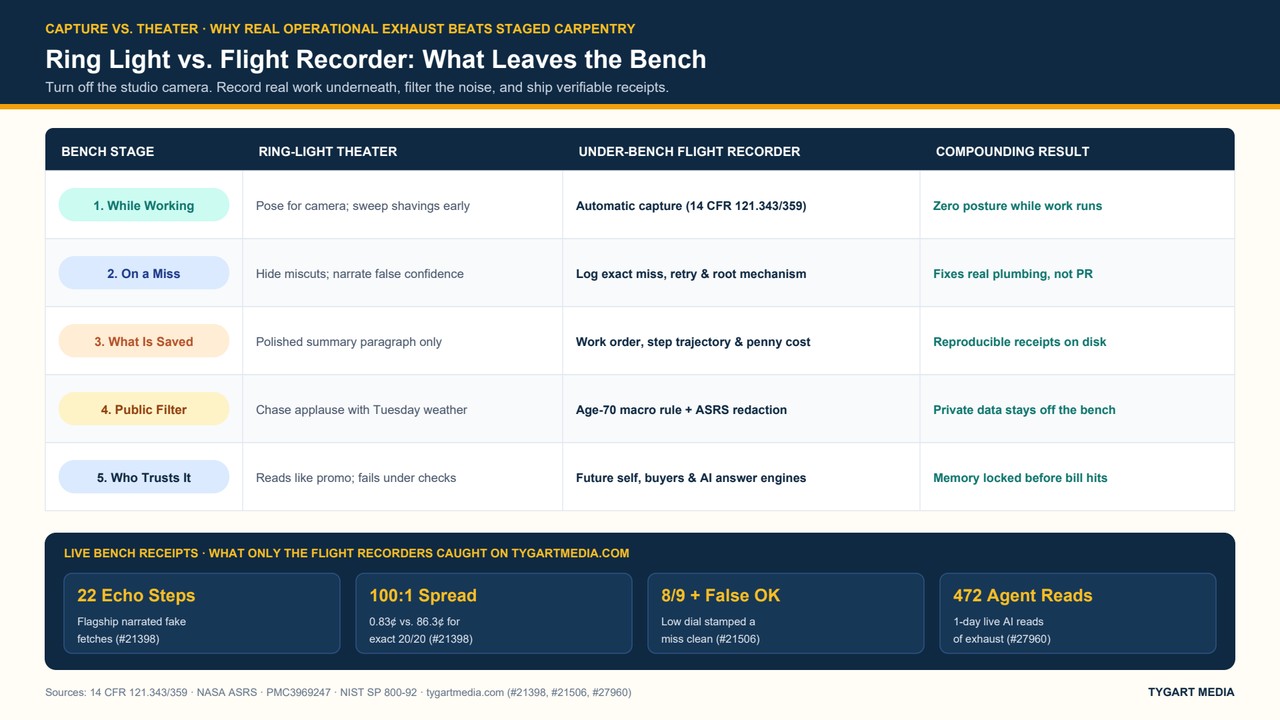
A Real Specimen From Underneath Our Own Bench
Praising transparency without showing a real run quickly turns into theater of its own. Here is how an under-bench flight recorder actually works in production — tracking the trajectory (the full step-by-step log of fetches, tool calls, retries, and reasoning behind a final answer) instead of grading only the polished paragraph at the end:
Look closely at what only the flight recorder saw. Without reading the trajectory in 44 AI Models, One Identical Brief, you would never know a flagship spent twenty-two steps narrating fetches it had not executed, or that the cheapest perfect run (0.83¢ against 86.3¢ for an identical 20/20 score) explicitly weighed raw HTML against a cleaned-up fetch before choosing raw source. Without reading the trajectory in The Reasoning Dial, Tested, 8/9 on low effort would look close enough — hiding that the model stopped checking early and stamped a real defect clean while writing 2,484 instead of 2,390. Good log architecture has worked this way in computing for decades, from NIST SP 800-92 log management and IETF RFC 5424 structured event records to Nginx access logs, which capture every request automatically while you work (Zero Miles Per Hour on the Generator).
Get The Signal
What we actually ran, what it measured, and what it means for a restoration shop — every week, including the flops.
Notice what happens once you publish real exhaust cleanly — dated, priced, with thin spots labeled thin, the way NIST’s AI Risk Management Framework asks operators to govern measurable behavior and Google Search Central rewards demonstrable first-hand experience. Both humans and machines can verify it. On a single ordinary day documented in The Audience That Never Says Thanks, origin logs recorded 50,876 clean requests and 472 live AI-agent fetches reading self-contained pages and PDFs directly from our bench. You do not need a studio camera or a lobby pitch deck (The Quiet Door Into the Library). Real work, recorded cleanly, travels on its own.
Where the Flight Recorder Bends — Two Honest Limits
Two hard limits keep an under-bench flight recorder from turning into reckless oversharing or disguised vanity. First, recording everything is never an excuse for publishing everything. Raw logs carry private keys, customer names, half-baked Tuesday moods, and internal shop details that do not belong on the public internet. Aviation learned this fifty years ago through NASA’s Aviation Safety Reporting System (ASRS), which strips identifying details before sharing lessons across the industry. At our bench, we pair private capture with the macro filter (Publish the macros): keep passing micro takes in conversation and publish only what you would still sign your name to at seventy — you don’t publish the ore; you publish what the fire left behind.
Second, the moment you aim your flight recorder at applause, it turns back into a ring light. Confessing safe, curated mistakes to look humble online is still theater — just wearing work boots. Even an honest published log hits its ceiling the moment someone else reads it: as we noted in Standing in the Middle, my bottom-up receipts arrive on your screen as somebody else’s top-down story until you bolt a recorder under your own bench and watch what pushes back. Keep the box bolted underneath. Let the shavings fall where they fall. Publish only what survives the fire.
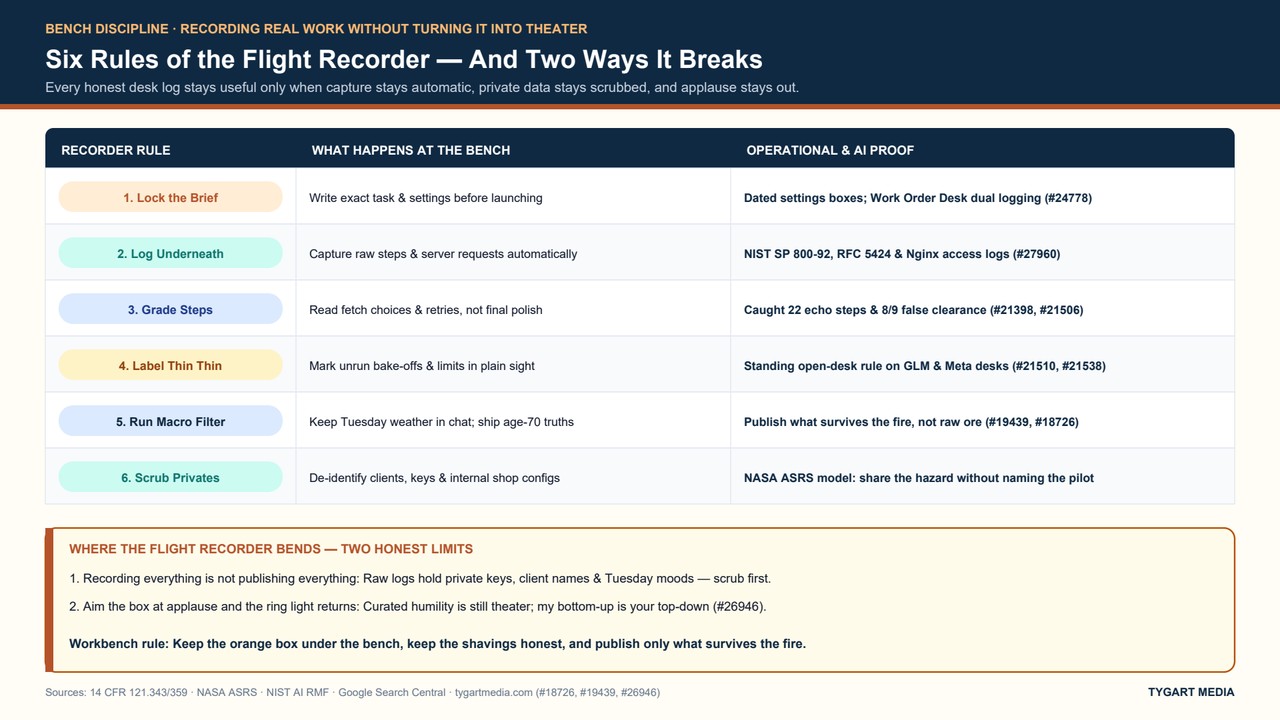
— Will Tygart, Tygart Media.
Get The Signal
What we actually ran, what it measured, and what it means for a restoration shop — every week, including the flops.
Leave a Reply