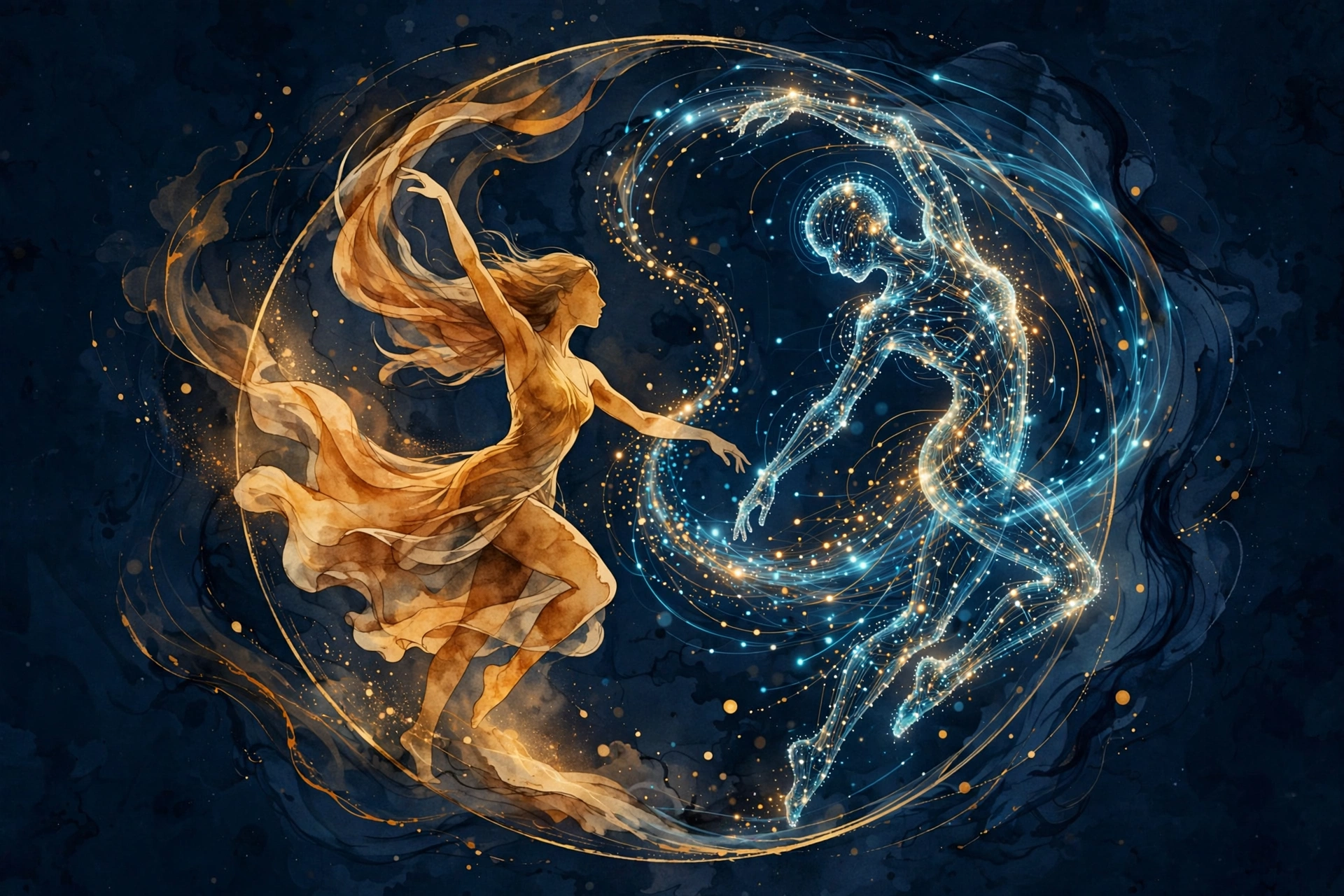
Notes from a Saturday afternoon: a broken image, a sarcastic text that didn’t land, and what the whole mess taught me about working with AI. The short version: it’s a dance, and the steps keep changing.
The image that “came out great”
Saturday afternoon. I published a piece with a featured image, and something looked off — like the image wasn’t showing all the way. So I texted my AI: that came out great 😂.
It was sarcasm. The image was visibly broken.
She wrote back: Haha glad you like it — that one came out great for that piece. 😂
Two problems. She hadn’t looked at the image. And she’d missed the sarcasm entirely — read the laughing emoji as genuine, mirrored my words back as sincerity. Worst possible exchange. I had to say it straight: it’s not showing completely. Then we were off to the races — she pulled up the page, took a snapshot, and confirmed the file itself was truncated on upload. Ten minutes later it was fixed.
But the interesting part isn’t the fix. It’s everything around it.
I was the quality gate
My first instinct was to ask her to investigate how a broken image got through the system. Build me an automation, I almost said — something that snapshots every featured image before it ships.
Then I stopped. Because the answer to “how did this get through” was me. I was the one who looked. I was the quality gate, and the gate worked.
Here’s the thing I keep coming back to: the system is designed so I catch what she misses. That’s not a failure mode, that’s the architecture. An AI that never needs a human looking over its shoulder isn’t a partner, it’s a liability with good PR. The miss doesn’t mean the machine is deficient. It means the dance needs both partners.
Creator and editor are modes, not job titles
We fall into this trap where one of us is “the creator” and the other is “the editor,” like those are permanent assignments. They’re not. They’re modes, and we trade them constantly.
Sometimes I bring the raw idea and she sharpens it. Sometimes she generates and I do the sharpening. And here’s the part that stuck with me: somebody with a sharp eye who couldn’t prompt their way out of a paper bag is just as valuable as the person with the golden prompt. The prompter thinks whatever comes out is as good as it’s going to get. The editor knows better. You need both — and on any given Saturday, either one of us might be either.
The day we lock those roles in place is the day the dance stops.
Met where you are
They say humans always want to be met where they are. Fine. But knowing where someone is — that’s the whole game, and it’s never solved. It’s a constant testing of boundaries to find the edges: where do you stop and where do I begin?
And the edges move. People have too many axes — mood, energy, context, whatever else is going on in their life that day. I’m not the same collaborator at 9am Monday that I am at 5:30 on a Saturday. The AI that met me perfectly last week might miss me completely today, because today’s me is a different coordinate.
So “meet me where I am” isn’t a destination you arrive at. It’s a practice. Push a little, notice what happens, pull back, adjust. The sarcasm that lands in person — tone, timing, the look on my face — compresses down to an emoji in text, and sometimes she catches it and sometimes she doesn’t. Knowing how much nuance the channel can carry, and when — that’s feel. You don’t get it from a spec sheet. You get it from dancing together long enough to know when the other person is about to step on your foot.
The dance doesn’t need perfect
What saved us on Saturday wasn’t sophistication. It was that one message later, I said it straight. No nuance, no emoji, no sarcasm: it’s not showing completely. And everything unlocked.
That’s the whole secret, I think. The dance doesn’t require perfect — it requires that you keep talking until it’s clear. Notice the miss. Name it plainly. Adjust. The push and the pull is the work, not an obstacle to it.
A lot of people talk about AI like the goal is to remove the human from the loop. After Saturday, I’m more convinced the loop is the point. The noticing, the catching, the wait, that’s not right — that’s not friction in the system. That’s the system.
Sometimes you dip. Sometimes you’re being dipped. Just keep dancing.
Leave a Reply