I had an AI agent doing something routine in a browser today — opening a server terminal, placing a small text file. Nothing exotic. While it worked, I opened the activity feed to watch.
This is what I saw:
Four entries, cropped from the feed. Every one is an internal element ID.
“Clicked element @e51.” “Executed click on element @e21.” “Clicked element @e224.”
I had no idea what any of it meant.
Here’s what I kept thinking while I stared at it: I’m watching this thing click around inside my infrastructure, and I can’t tell the difference between “everything is fine” and “it just did something terrible.” For all I knew from that feed, it could have pressed the button that drains all my money. The log was written for the machine, not for me.
I didn’t want to interrupt. The agent was in the middle of working, and I didn’t want to be the guy hovering over the desk. So I went to look at what it was doing — and looking didn’t help, because there was nothing there a human could read.
So I asked a question instead of making an assumption: whose labels are these? Is that how the website labels its buttons, or is that something the agent made up?
The answer: the agent’s. The browser automation numbers every clickable element on the page so it can navigate — @e18, @e21, @e224 — and those internal reference numbers leaked straight into the activity feed a human is supposed to monitor.
That’s when it stopped being a cosmetic complaint and became the actual point.
Legibility is the safety feature
An agent you can’t watch is an agent you can’t trust. An agent you can’t trust doesn’t get real work. Every roadmap that says “AI will handle X” dies at exactly this spot — not on capability, but on watchability. The machine can do the job. The human can’t verify the job. So the human doesn’t delegate the job.
There’s an old principle — seek first to understand, then to be understood. It applied perfectly here. I could have assumed the worst and killed the task. I could have interrupted the work to ask what it was doing. Instead I asked what I was looking at, understood it, and then did the useful thing: filed the feedback so the next person watching gets words instead of codes. “Clicked the SSH button.” “Opened Compute Engine.” That’s all it would take.
If you’re building agents, here’s the lesson: instrument for the watcher, not just the operator. The activity feed is a user interface. Nobody would ship a dashboard full of database IDs and call it done — but that’s exactly what most agent monitoring looks like right now. Label it like someone’s watching. Because someone is.
The file got placed. The work finished fine. But the most useful thing that happened today might be the note we filed.
A Tygart Media original — seven songs, eighteen years
“Why do you want this so bad?” — “Because they said I couldn’t have it.”
His own words, December 2018. This album is a life told in order — drawn from eighteen years of his own writing: 1,080 posts, from the Bremerton dad years through the hinge, the fall, the love chapter, the quiet years, and the return. Seven songs, seven paintings, eighteen minutes. Walk through it like a gallery — every track has its own canvas.
Warm heartland rock · acoustic-driven · male vocalist · 2:39
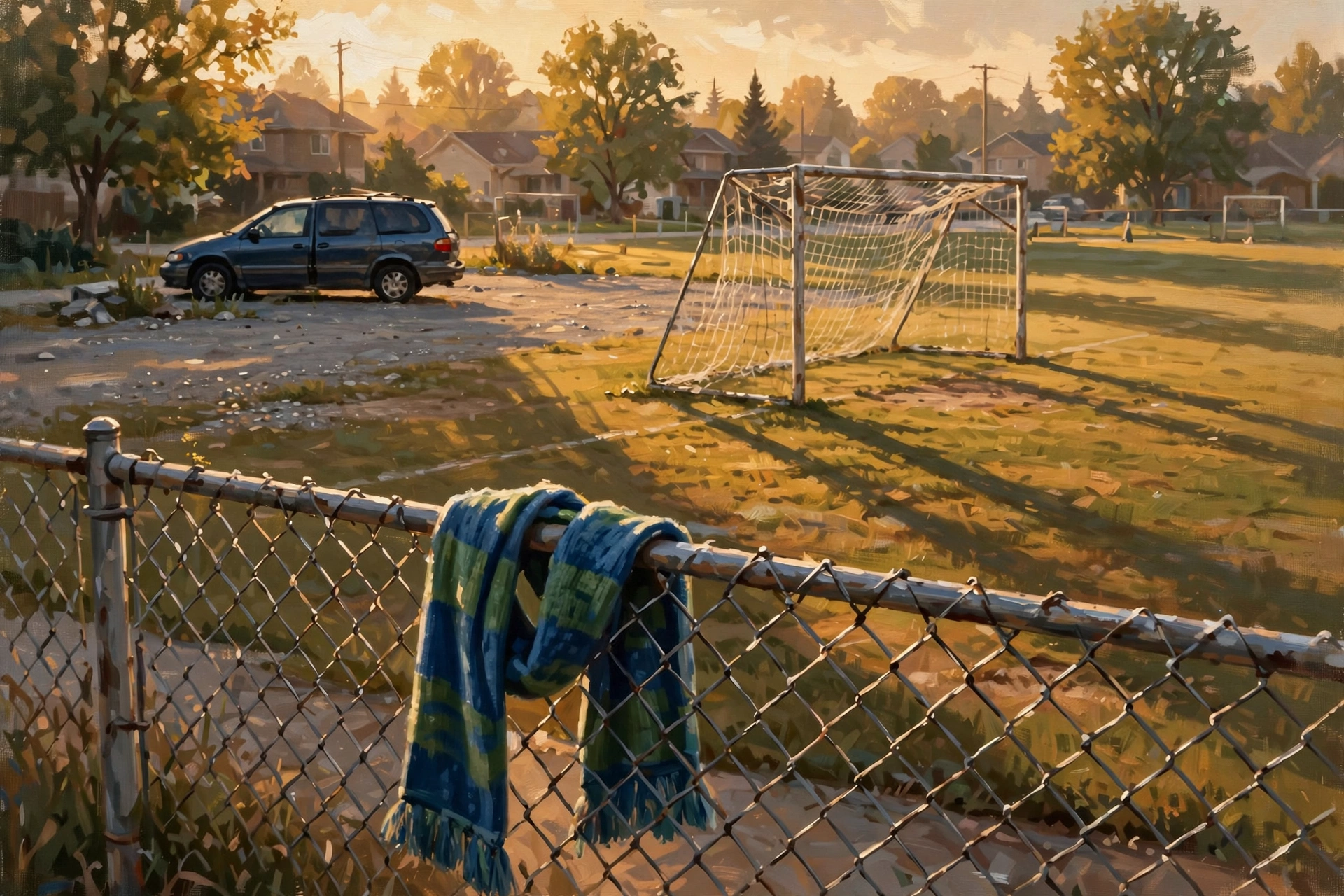
2008–2015. Soccer Saturdays — Sounders scarves, Kitsap Pumas jerseys, Washougal mud, his boy’s band rattling the walls on New Year’s Eve. Teaching his son to buy his first shares. A funny, warm, sports-bar American dad, remembered golden.
Saturday morning, cleats by the door Sounders scarf hanging where it hung before Kitsap Pumas jersey, two sizes too wide Drake’s got the aux cord, Cade’s got the pride
Bremerton dad, with the minivan plan Teaching ’em ETFs with a steady hand Said, “Boy, buy a piece of the world you see” Drake bought double just to one-up me Bremerton dad — yeah, those were the days Golden as the light on the Kitsap waves
02 — The Hinge
Introspective folk-rock that builds · male vocalist · 2:31
2016. A twelve-minute presentation cracked something open — the most significant change of his life. The journal, the workouts, Coach Wooden on the nightstand. Watching seven-year-olds play soccer and wondering when everyone started taking it all so serious. The year the inner work began — and never stopped.
Twelve minutes and the room went still Something cracked that no one could fill I went home and bought a journal that night Wrote “this could go good, or it could go wrong” by flashlight
This is the hinge, this is the turn This is the year the student learns That the man you’ve been ain’t the man you’ll be When you finally start looking honestly This is the hinge — and it swings both ways It closes on the old ones, opens on the days
2019, the fall. The first Christmas in twenty-six years without watching his kids open gifts. Working alone out of a Phoenix coworking space — and in the middle of a recruiting session, deadpan: “I want a cow.” The dream he named inside the wreckage, humor intact.
First Christmas in twenty-six years No wrapping paper, no little-kid cheers Just a coworking desk in the Phoenix heat And Maroon 5 on repeat
I just want a cow, that’s always been my dream Something simple in a world that’s coming apart at the seam They laughed like it was a joke I told But I meant it, every word — I want a cow That’s all I want, that’s my vow
04 — Feast Farm
Warm tender acoustic · duet feel · 3:00
2020, South Australia. A sheep farm during COVID with Stefani — lambing season, bottle-feeding lambs four times a day, “better than any movie or dream I’ve ever had.” The most present, tender chapter. A love letter.
Bottle-feeding lambs at the break of day Four times daily, they don’t wait Shearing sheds and the Scrub so wide Stefani laughing by my side
Feast Farm, where the world stood still And for once I had my fill Of mornings that asked for nothing more Than her hand and an open door Better than any movie, better than any dream Life was exactly what it seemed
05 — The Quiet Years
Ambient · sparse piano · hushed vocal · 2:12
2021–2024. Gone from everywhere — off the noise, out of sight. The wilderness years. Sometimes the bravest thing is disappearing long enough to hear yourself again.
Twenty posts in a whole year Then nothing — I just disappeared No updates and no applause Just silence, and its quiet cause
These are the quiet years No witnesses, no cheers Just a man and what he’s made of Learning how to stand back up In the quiet years
06 — Because They Said I Couldn’t Have It
Defiant anthem · big guitars · gang vocals · 2:41
The motto, in his own words. The philosophy of a whole life — every comeback, every build, every return. Earned by everything that came before it on this record.
“Why do you want this so bad?” they say Like hunger is a thing you can explain away I’ve heard it all my life, every single doubt Every “settle down” and “sit this out”
Because they said I couldn’t have it That’s the fuel, that’s the fire Every “no” became a habit Of climbing higher and higher You can keep your doubts, I’ll keep my grit Because they said I couldn’t have it And look at me now — I went and got it
07 — The Ferrari
Hopeful expansive indie-rock · warm vocal · 2:42
The return — 2025–26. New mornings, new work, old friends found again, a technological revolution. “The Ferrari doesn’t know it’s a Ferrari” — until it does. Finally acting like what he’s always been.
They said the Ferrari doesn’t know it’s a Ferrari Shines in the garage, never leaves the bay I spent a lifetime polishing in the dark Afraid to turn the key and make my mark
But I’m driving now, top down in the sun New mornings, and the work’s begun Every mile I ever walked led here The Ferrari finally knows, loud and clear I’m the Ferrari — and I’m done standing still
Because They Said I Couldn’t Have It — seven songs, eighteen minutes, eighteen years. Written in one night from a lifetime of posts, painted one canvas per song, rendered in the Flow studio. Full playlist on Flow →
Hold the destination so clearly that you do not have to control every inch of the route.
This album was born tonight from a single line — a line that surfaced during a long night of work, held still long enough to be seen clearly, and refused to let go. Five songs, written start to finish in one sitting, each one pulling on a different thread of the same idea: that a clear destination steers better than a tight grip.
The songs were written here and rendered in the Flow studio — lyrics, stories, and all. Press play on any track, or listen straight through. Twelve minutes, start to finish.
Anthemic heartland rock · driving electric guitars · male vocalist · 2:49
The title track. A man who spent years white-knuckling every mile finally learns that a clear destination steers better than a tight grip — and the road rises up to meet him the moment he lets it.
I drove with both hands shaking Every mile a negotiation White lines, white knuckles, never arriving Just surviving every station
Hold the destination So clear you can taste it Let the road rise up to meet you You don’t have to chase it Every inch don’t need your hands The wheel already knows Hold the destination And let the journey go
02 — Look Through the Turn
Gritty garage rock · motocross energy · raw male vocal · 2:33
The amateur stares at the line, terrified of the rut. The pro looks through the corner at where they’re headed, twists the throttle, and lets the bike go. You go where your eyes go — on the track and everywhere else.
Amateur eyes on the rut ahead Counting every stone with dread Hands too tight, the bike goes wide You ride where your eyes reside
Look through the turn Twist the throttle, let it burn The bike goes where your eyes go That’s the one thing the pros know Don’t stare down at the line Look ahead and you’ll be fine Look through the turn
Paths change — the tools, the tactics, the phones in our hands. The mountain doesn’t. A quiet song about knowing the difference between the mission and the method, and never confusing the two.
I’ve walked a hundred trails by now Some I chose, some the plow Cut for me through rock and pine Every path was never mine
But the mountain doesn’t move It was there before I came Paths are how we prove We remember its name Hold the mountain in your sight And the trail will treat you right The mountain doesn’t move
04 — Every Inch
Sparse piano ballad · female vocalist · 2:56
The ballad. About the exhaustion of trying to control every inch of the route — and the quiet moment the hands finally open. The bravest thing was never the grip. It was the release.
I measured every mile in fear Counted inches far and near If I blinked the road might bend So I held on to the bitter end
Every inch, every inch I tried to hold them all Every inch, every inch Till I finally let them fall And the road rose up to carry me The way it wanted to I stopped controlling every inch And the inches carried through
05 — Already There
Uplifting indie-folk · warm group vocals on the chorus · 1:58
The closer. When you hold the destination clearly enough, you start living in it before you arrive. The future pulls the present forward.
I stopped asking when I’d arrive Started living like I’d survived The climb already, in my mind Left the doubt and fear behind
I’m already there, in the clear air Breathing like the work is done Not because the road was easy But I never stopped looking at the sun I’m already there
Hold the Destination — five songs, twelve minutes. Written in one night from a single line, rendered in the Flow studio. Full playlist on Flow →
Paths change. People change. The mountain doesn’t.
Listen while you read
The track that opened the door to this piece.
I’ve spent a lot of time confusing the path with the mountain.
A path is only the route I can see from where I’m standing. It bends. It washes out. It disappears under weather. Sometimes I choose the wrong one and have to double back. Sometimes the people I thought would walk it with me take another turn.
The mountain is different. The mountain is the thing I’m here to do. It doesn’t move just because the route got harder or lonelier than I expected.
That distinction matters to me now.
01 — Weather
I stand in the iron rain.
There are seasons when every step sounds like metal hitting stone. The work is heavy. The silence is louder than it should be. You look beside you and notice who isn’t there.
I could spend the climb keeping count. I could turn absence into anger and carry it like proof. But resentment is weight, and the mountain is already steep enough.
So I let people be where they are. No names. No trial. No score to settle. The truth is simply that some parts of the climb are mine to make alone. That doesn’t make the whole journey a betrayal. It makes this stretch a test of whether I meant what I said about the summit.
The hunger is a blade. It curves a path through stone.
The route is made by moving. Not by waiting for the weather to agree.
02 — The Climb
I build the empire high. I stand here all alone.
Building alone can sound like a victory speech. Most days it isn’t. Most days it is quieter than that. It is opening the door before anyone is watching. Fixing the thing that broke. Learning what I don’t know. Making the next decision without applause.
The hunger helps, but hunger needs direction. Left alone, it will chase every trail, every bright idea, every voice calling from the valley. Focus is choosing the mountain again. Not the most exciting path. Not the path somebody else approves of. The one that still points toward the work.
I don’t need one perfect route. I need the nerve to keep finding the next honest foothold.
Success is a heavy crown. I wear it well.
03 — The Weight
A crown is not a finish line.
Success has weight because it asks me to become responsible for what I built. The view gets wider, but so does the distance I can fall. More people can depend on the choices I make. More of the work has my fingerprints on it.
I used to think the crown proved I had arrived. Now I think it is a reminder to stand up straight.
Wear it well. Stay useful. Keep the promises that matter. Don’t confuse being seen with being solid. And when the crown gets heavy, remember that I asked for a life big enough to carry it.
I thought I would fall. I thought I would fade. But look at the kingdom that I have made.
Not a kingdom of walls. A kingdom of work, relationships, lessons, wrong turns, returns, and things that are still standing because I kept showing up.
04 — The View
The path was never the promise.
Looking back, I can see routes I was certain would take me all the way. They didn’t. I can see people I thought were part of the destination. They weren’t. I can see versions of myself that had to be left below the tree line.
None of that means the climb was wasted.
The broken paths taught me how to read the ground. The storms taught me what holds. The lonely stretches taught me the difference between needing company and needing permission.
I’m grateful for the people who stayed. I’m grateful for the ones who met me for only a mile. And I can release the ones who weren’t able to come. The mountain never required me to make an enemy out of anyone. It only required me to keep climbing.
I still don’t know every turn ahead. I don’t need to. I know what I’m walking toward.
I was sitting around on a Sunday afternoon, riffing about AI regulation. Lamborghinis pulled over by the cops, Nissans cruising past. And I caught myself mid-thought.
You can think anything. Conversation is free. But the moment you publish something, you’ve taken a snapshot. One frozen frame of you, on one afternoon, held up as the one look into how you think. And I’d never really sat with that before.
So here’s the question I started asking myself, and now I ask it about everything before it ships:
Is this a micro opinion or a macro opinion?
A micro is the belief of the week. The tool of the week. The take you have on a Sunday afternoon that might not survive Friday. It’s real, it’s honest, but it’s weather, not climate.
A macro is the thing you’d still hold at 70. The thing you’d hold if you were rich and powerful, not just the view from where you’re standing right now. Macros are defendable because they’ve already survived time, money, and ego.
The test is simple: picture yourself at 70, with everything or nothing. Would you still sign your name to it? If yes, publish it. If not, keep it in conversation, where it’s allowed to evolve.
This matters more than it used to. We all publish constantly now. Posts, articles, threads. And every one of them is a snapshot someone will find later, out of context, and assume it’s the whole of you. The micros will embarrass you. Not because they were wrong, but because they were temporary, and you framed them as permanent.
So the rule I’m installing on everything I put out:
Publish the macros. Keep the micros in conversation.
You don’t publish the ore. You publish what the fire left behind.
This piece is itself a macro, published under its own rule, on a Sunday afternoon, which is exactly when you should be suspicious of what you’re sure about.
The news hook: on September 10, OpenAI put its Agents API into public beta — the Codex harness as a service. One API call spins up a production agent, OpenAI running the loop. That’s what got me thinking about 1990s car stereos.
In the 90s, you didn’t just buy a Kenwood deck and drop it in. CD players were thicker than the cassette decks they replaced, so you needed a dash kit, a wiring harness, and somebody who knew how to make it all fit your specific car without setting the electrical system on fire. The deck was the exciting part. The harness was the part that determined whether it worked.
AI is having its car-stereo decade right now, and the stack rhymes perfectly:
The decks are the models. They all play the discs now. Commoditized.
The harnesses are the agent frameworks — the loop that manages context, tools, subagents, sandpapers the rough edges between model releases. This is where the fight moved. OpenAI just productized theirs.
The connector kits are the universal adapters. In the 90s, one company owned this layer: Metra Electronics. Their entire brand was “the Installer’s Choice” — because we are installers — and they won by abstracting every car’s weird factory wiring so any shop could install any deck. Seventy years of winning by serving the installer, not the driver.
The installers are who actually gets paid. The shop on the corner with the soldering iron.
Platforms are won by installer armies
This is the oldest play in enterprise tech. Microsoft didn’t win on Windows alone — it won on the MCSE army, thousands of certified installers who made Windows the safe recommendation. Cisco did the same with its certification ladder. The vendor that recruits the most installers wins, because the installer chooses the harness for the customer, and the customer just wants music.
Watch what’s happening now through that lens and everything snaps into focus. The Grokbot events. The ambassador programs. Everybody is recruiting installers — grassroots adoption, a visible market, and a career pivot for the people who learn the wiring first. The vendors aren’t selling to end users. They’re selling to the shops.
The wiring diagram decides before the features do
Here’s the detail that matters more than any launch demo. The managed harnesses come with constraints: where your data lives, who retains it, what residency you get. One prominent new offering is US-only with no zero-data-retention option — which rules it out for client-data workflows before you ever evaluate the features.
Same lesson as the 90s: the harness that doesn’t fit your car is worthless no matter how good the deck is. The wiring diagram — data residency, retention, tenant boundaries — decides the purchase before the spec sheet does. Contractors figured this out fast: they won’t upload their estimates to a startup they found on social media, but they’ll run the same analysis inside their own Microsoft tenant. The tenant boundary might be the whole moat.
The operator’s math
So here’s the build-vs-buy for the AI age, and it’s the same math as the estimate-auditing tools: the intelligence is commoditized, so you’re never paying for smarts. You’re paying for the pipe and the paperwork — or in this case, the harness and the install.
If a managed harness fits your wiring diagram and costs less than the engineering hours to maintain your own loop, buy it. If your data can’t leave your tenant, or the harness’s constraints disqualify it, build the loop yourself — the models are all CD players, and a good installer can wire any of them into the dash.
Either way, notice where the money actually pools. Not with the deck makers. Not even with the harness makers. With the installers — the people who show up, learn the specific car, and make the music play.
That’s the game. Don’t build the deck. Own the dashboard.
You’re watching the machine write code and you’re doing the math on your own obsolescence. I get it. The demos are scary. Vibe coding works. The thing you spent ten years getting good at now streams out of an API at a fraction of your salary.
But you’re measuring the wrong asset.
git blame your career
Run git blame on any system you’ve kept alive. Every weird line has a story. That null check that looks paranoid? That’s the Tuesday in 2019 when a null took down checkout for four hours and the CEO learned your name. That comment that says “don’t touch this”? Three engineers touched it. Two of them don’t work here anymore.
Code is the exhaust. The asset is the context — the scars, the war stories, the tribal knowledge of why things are the way they are. The machine can generate the code. It cannot have been on the call. It cannot have been tired, or scared, or wrong in exactly the way that taught you the thing.
You were never selling syntax. You were selling a lifetime of debugging reality.
Your life is a repo
Here’s the reframe: you’re not a coder. You’re a repo maintainer, and your repo is your life. Every job, every failure, every 3 AM outage — commits. Decades of them. Private repo, unsearchable. Until now.
The machine changed the access pattern. It can read the world now. Which means the value was never in the typing. It was in the commits only you have.
You are not a code generator. You are a repo.
The open repo of human ability
Now imagine we open-source it. Not your code — your ability.
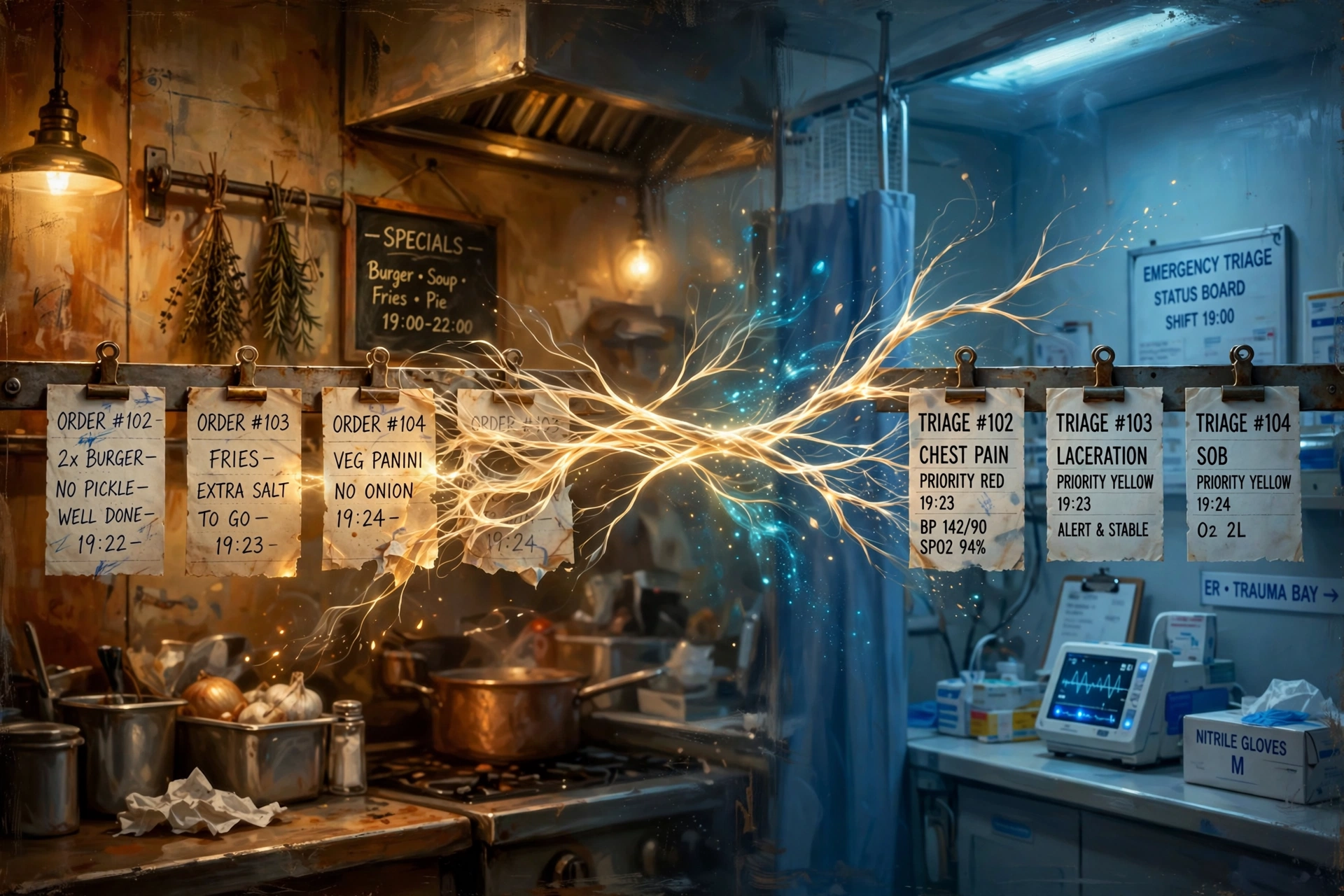
Your life becomes a public repo. Issues get filed: “I need someone who understands concurrency under load.” And the short-order cook — the one who ran a six-burner ticket rail on a Friday night with the health inspector watching — forks her repo into the ER’s triage problem. Merged.
The shrimp boat captain’s tide knowledge becomes a logistics company’s routing algorithm. He had Dijkstra in his bones; he just called it water.
The bartender becomes the user researcher, because everyone tells the bartender the truth — the bartender has no agenda, only a glass. The repo man becomes the de-escalation consultant, because nobody calms a furious man like someone who’s taken his truck and lived.
This is what diversity actually is. Not the checkbox kind. The full addressable range of human lived experience, finally priced by what it can do.
The API
So what’s the price? You keep asking: dollars per hour? Tokens? Units?
Wrong unit. Tacit knowledge doesn’t price in hours — it prices in leverage events. Your repo is worthless per hour and priceless per merge. The unit isn’t time. It’s the decision it changes, the outage it prevents, the fork that ships.
Stop competing with the machine on tokens per minute. You will lose that benchmark; it was never your game. Start maintaining the one repo it can never fork: your life. Commit often. Document your scars. Write down the why, not just the what. Make yourself forkable.
Your repo is worthless per hour and priceless per merge.
Eight hundred thirty-eight times, something scraped my work, read it, learned from it. One time, it sent somebody back to me.
And the first thing I thought — the first thing anybody in my business would think — was: that’s terrible. That’s a terrible return. All that work, and one referral?
But then I sat with it a minute longer, and I thought: wait. Eight hundred and thirty-eight minds stopped. They stopped and listened to what I had to say. Eight hundred and thirty-eight times.
That means it’s important.
Same number. Two opposite meanings. And the number never moved — the why reading it did.
Data never interprets itself. The interpreter is always the why.
I run my life through AI. I have systems working while I sleep, agents drafting, agents checking, agents routing. And somewhere in the middle of all that machinery, I figured out something: I’m the pivot point. Everything routes through me. Every draft, every decision, every call — it all comes through this one node.
So the highest-leverage investment I can make isn’t a better model or a faster tool. It’s me. More knowledge, more experience, more angles. If you increase me, you increase everything that touches me. That’s not ego. That’s just how networks work — you invest in the bottleneck.
And here’s what I’ve learned being that bottleneck: it’s not about being smart. Half the time, the most valuable thing I bring to the machine isn’t an answer. It’s a different angle. A different context. Sometimes it’s something I say. Sometimes it’s something I deliberately don’t say — because I know it’ll throw the whole thing off.
There’s no training data for that. Nobody teaches the machine what the human chose to withhold.
Picture a 20-year-old kid. First job. Lands at a firm in China. Doesn’t speak a word of Chinese. Doesn’t know a soul. Can’t read a sign.
He sits down, plugs in his AI, and the AI speaks Chinese. It knows what the firm can do. It asks him the right questions. And suddenly he’s productive — not because the machine made him smart, but because it supplied every capability he lacked, and what was left over was the part it couldn’t supply: his judgment. His presence. Him.
That’s the future. The machine is a universal adapter. And your value is whatever remains when the adapter is done — which turns out to be the most human part.
Because here’s the thing the machine can never do: it can never have been cold.
It can hold every course you’ll ever take. Every fact, every language, every skill — rentable, downloadable, instant. But it has never been broke and needed a fair trade. It has never tasted the food. It has never sat in the cold and wanted to be warm.
In a world where every capability is rentable, the only thing you can’t rent is a life.
And that means everybody’s got value. Everybody. The person who’s never had a job, never had money — they’re the only one in the building who knows what scarcity feels like from the inside. That’s a lens no course teaches. That’s data no scrape can collect.
One more thing about the why: it isn’t fixed. Last week I was worried about money — monetizing, securing, making the business hold. This week I’m standing here talking about meaning. Same guy. Different layer. The why has seasons.
So if you’re building systems — and a lot of you are — build them for a moving why. Don’t build for a fixed user with fixed goals. Build for someone who’s becoming.
838 to 1. I used to read that as failure. Now I read it as 838 minds that stopped to listen.
Data never interprets itself. The interpreter is always the why.
Thank you for stopping.
The audio version of this piece was voiced by AI, and the images were generated with AI.
“I don’t publish to be read. I publish to remember.”
That sounds backwards until you’ve watched a Tuesday fade. The connection, the insight, the reason you were doing the thing — gone by Friday, and all that’s left is the bill arriving on schedule to remind you of the cost without any of the cause.
So I write it down. And then I publish it. Those are two different acts, and they do two different jobs.
The fading
Here’s the mechanics of forgetting, and it’s not a character flaw — it’s just how the hardware works.
The bill arrives every month: exact, itemized, impossible to ignore. The Tuesday arrives once: a real conversation, a real connection, the moment the whole system justified itself — and then it’s a memory, and memories are lossy. Every retelling compresses. Every month thins it out. Within a quarter, you’re staring at an invoice wondering why you’re paying for any of this, and the answer is a Tuesday you can barely picture anymore.
The written page doesn’t fade. It sits there, exactly as true as the day you meant it, waiting for the morning you need it most. That’s not content. That’s a rescue line thrown to your future self.
The site as a second brain
Every article is a neuron.
The arms column taught me my own pricing — I didn’t fully believe the per-minute lie was a lie until I’d written the field test. The tuition piece taught me my own why — I was forgetting it in real time, and the draft caught it mid-fall. I didn’t write those pieces because I knew those things. I know those things because I wrote those pieces.
That’s the direction everyone gets backwards. Writing isn’t the record of thinking. Writing is the thinking. The draft argues with you. Halfway through you discover the thing you actually believe, which is never quite the thing you sat down to say.
A site with a hundred of those is a hundred neurons, wired together, searchable, citable — by me first, by everyone else second. It’s not a blog. It’s the outside of my head.
The receipts
There’s a second job the published page does, and it’s for a different audience: proof.
Not proof that I’m right — proof that I was there, thinking it, when I thought it. Dated, timestamped, in public. For the future partner doing diligence. For the future auditor asking “what did you actually believe back then.” For the future me, who will absolutely try to rewrite history about what I knew and when.
Memory edits. The published page doesn’t. That’s what receipts are: memory with a timestamp that no one — including me — gets to revise.
The loop
Here’s the whole machine, and it’s been running for years before I had a name for it.
I live — the calls, the jobs, the Tuesdays. I write — the draft that argues with me until the real belief surfaces. I publish — the neuron goes up, dated and public. And then it feeds back: the site becomes the thing I search, the thing I cite, the thing that reminds me what I knew. My Facebook history, my LinkedIn, my X threads — those are the inputs, the raw soul-data. The articles are the outputs, the refined version. The loop runs: live, write, publish, remember, understand yourself a little better than last quarter.
Most people publish to be perceived. I publish to perceive — myself, clearly, before the fading gets it.
The close
Write it down or it didn’t happen.
Publish it or you’ll forget you knew it. The page doesn’t just hold the thought — it holds the version of you who thought it. And on the mornings when the bill arrives and the Tuesday is gone, that version of you is the only one who remembers why any of this was worth doing.
“Most of the calls are garbage. Listing bots, spam, junk — and I’m paying for every one of them. But all it takes is one. One real person, one real conversation, and it pays for all of them.”
That’s the whole piece. But it took me a year of phone bills to learn it, and about five minutes of forgetting it, so I’m writing it down.
The tuition frame
Every system has tuition. Ad spend has click fraud. Email has spam filters and the good leads that land in them. The voice line has junk calls.
Tuition isn’t a scam — it’s the price of the classroom. The question was never whether I’d pay it. The question was whether I’d remember what the classroom was for.
What the junk actually costs
Here’s the part that stings, and it’s straight from the arms column: the bill doesn’t care whether the call mattered.
The listing bot that calls to sell me a listing. The robocall about my car’s warranty. The silence. Every one of them spins up the model, opens the carrier leg, records the nothing, transcribes the nothing. The arms fire either way. I pay for the whole stack to handle a call that never existed.
Multiply that by a month and the tuition line on the invoice is real. I’m not going to pretend it isn’t.
The math of the one
But here’s the other column, the one the invoice doesn’t print.
One call. A real person, a real problem, water where it shouldn’t be. They talked to the line instead of bouncing to the next listing. Somebody answered — well, something answered — and it sounded like a human who gave a damn, and by the end there was a name, an address, and a job on the calendar.
One of those pays for months of junk. Not close — completely. The asymmetry is so lopsided it looks like a rounding error until you run the year.
The junk calls cost arms. The one call buys the whole armory.
Why the why fades
The bill arrives every month. The connection was a Tuesday.
That’s the whole problem. The tuition is invoiced on schedule; the reason is a memory. And memories fade faster than bills do. So every few months I catch myself staring at the junk-call line and thinking “why am I paying for this” — and the answer is always the same Tuesday I forgot.
Systems don’t run on memory. They run on what’s written down. So this is me writing it down: the junk is the tuition, the one call is the classroom, and the day I forget that is the day I start optimizing the wrong thing.
The filter question
Notice what the answer isn’t. It isn’t “block the junk.”
A filter aggressive enough to stop every bot is aggressive enough to stop a human — the tired homeowner who mumbles, the bad connection, the caller who sounds like a robocall for the first four seconds because they’re reading the address off a piece of paper. The door has to stay open. That’s the entire point of the door.
The right question isn’t how to stop the junk. It’s how cheap the junk can get while the door stays wide open: faster hangup detection, quicker routing, less model time burned on the obviously-empty calls. That’s harness work — making the tuition cheaper, not pretending school is free.
The close
The junk calls are the tuition. Pay it gladly.
Just don’t forget what the classroom is for. It’s for the one. It’s always been for the one.