
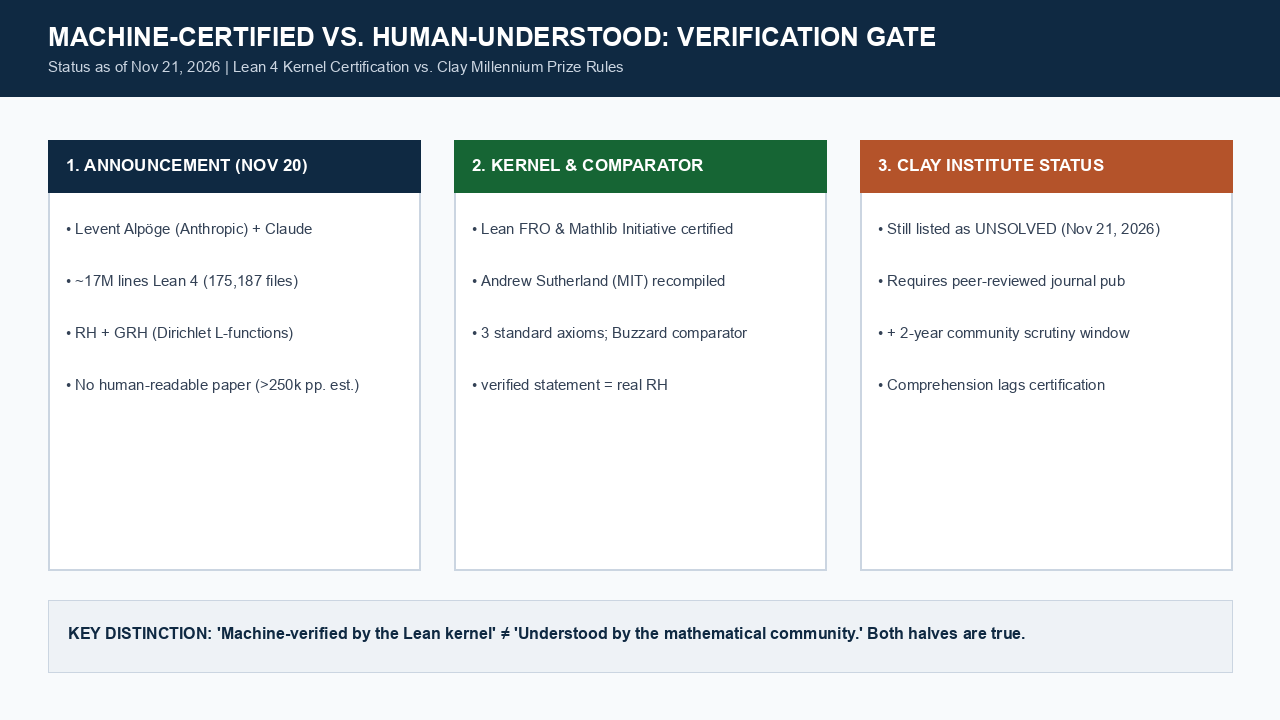
On Friday, November 20, 2026—one day after Anthropic’s initial public offering—Anthropic mathematician Levent Alpöge posted a brief note on his personal site announcing that he and Claude had discovered a proof of the Riemann Hypothesis (RH), and by the same method the Generalized Riemann Hypothesis (GRH) for Dirichlet L-functions. There is no journal preprint. There is no human-readable manuscript. The proof exists solely as roughly 17 million lines of Lean 4 code distributed across 175,187 files—an artifact so large that Alpöge estimates a natural-language exposition would exceed 250,000 pages, and acknowledges he has not yet mastered all of the mathematics himself.
By Saturday morning, November 21, the formal verification community had moved at machine speed. The Lean Focused Research Organization (Lean FRO) and the Mathlib Initiative jointly certified the statement and proof as correct. MIT computational number theorist Andrew Sutherland independently recompiled the archive, reporting that it was rechecked by the Lean kernel using only the three standard axioms. And the comparator run called for by Imperial College London’s Kevin Buzzard—verifying that the formal theorem matches the actual Riemann Hypothesis rather than a convenient redefinition, and compiles under independent kernels—was reported complete.
Yet as of Saturday, November 21, the Clay Mathematics Institute still lists the Riemann Hypothesis as unsolved, and independent coverage in Scientific American and The Wall Street Journal underscores the gap between formal compilation and mathematical acceptance. Under Clay’s Millennium Prize rules, a solution requires publication in a peer-reviewed journal of worldwide repute and a two-year waiting period for community scrutiny. Both halves of the story are true at once: the proof is machine-verified and certified by the Lean community, and it is not yet understood by mathematicians.
What Changes If It Holds: A Century of Conditional Theorems
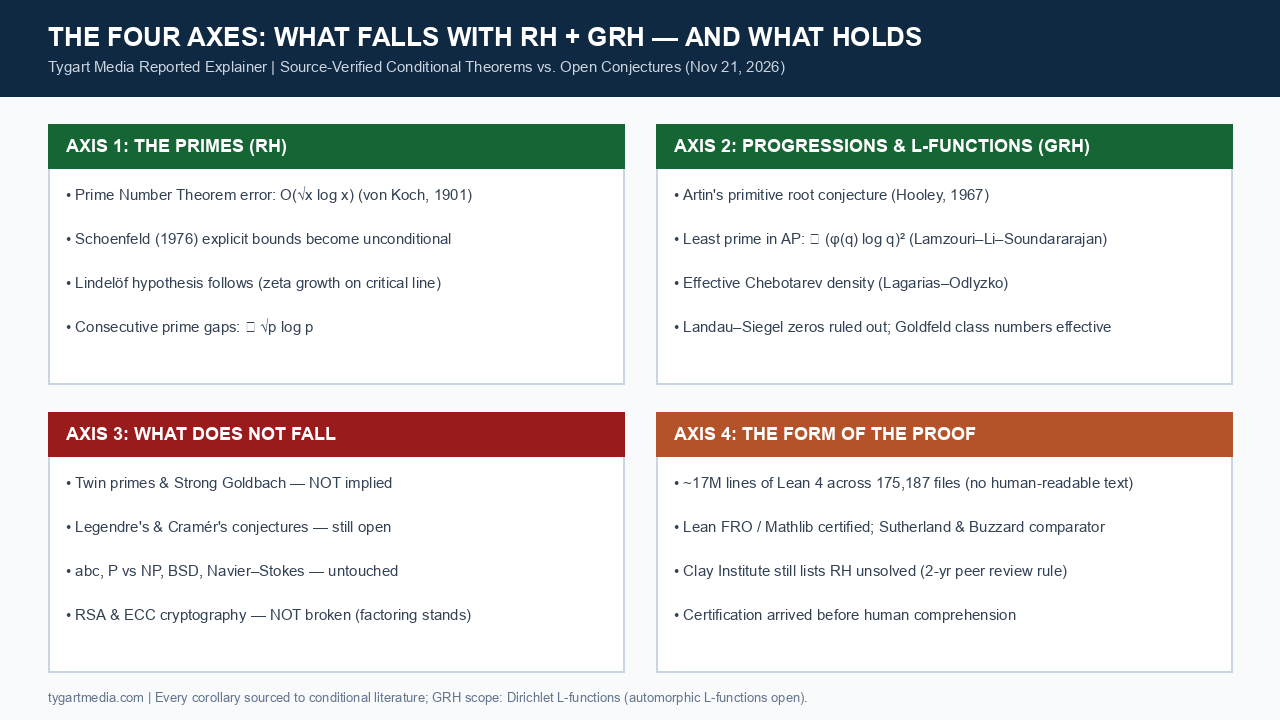
For 167 years, analytic number theory has operated on a dual ledger. Thousands of papers prove theorems “assuming RH” or “assuming GRH.” If the Alpöge–Claude proof survives human scrutiny, those conditional statements convert into unconditional theorems. The clearest way to map the impact is across four axes: what falls for the primes themselves, what falls for arithmetic progressions and number fields, what does not fall, and what the form of the proof itself means for mathematics.
Axis 1 — The Primes Themselves (RH)
The Riemann Hypothesis governs the nontrivial zeros of the Riemann zeta function, placing every one of them on the critical line with real part 1/2. Because those zeros control the oscillation in the distribution of prime numbers, settling their location locks down the error terms of prime-counting functions.
- Best-possible Prime Number Theorem error term: In 1901, Helge von Koch proved that RH is equivalent to the bound π(x) = Li(x) + O(√x log x). That equivalence runs both ways: if RH holds, the error term in the Prime Number Theorem is settled at its sharpest possible order.
- Schoenfeld’s explicit bounds (1976): Lowell Schoenfeld’s classic explicit estimates for π(x) and the Chebyshev functions—long used as conditional benchmarks in computational number theory—become unconditional, giving working mathematicians usable, proven constants rather than provisional ones.
- The Lindelöf hypothesis: RH implies the Lindelöf hypothesis, bounding the growth rate of the Riemann zeta function along the critical line Re(s) = 1/2.
- Prime gaps: Under RH, the gap between consecutive primes p and the next prime is bounded by ≪ √p log p—a dramatic tightening over unconditional bounds, though still short of the strongest gap conjectures.
Axis 2 — Progressions, L-Functions, and Number Fields (GRH)
Alpöge’s announcement extends beyond the Riemann zeta function to the Generalized Riemann Hypothesis for Dirichlet L-functions. Whether the method extends to broader automorphic L-functions remains an open question for the write-up Alpöge owes—and must be flagged as open, not settled. Within Dirichlet L-functions, however, GRH converts a remarkable suite of conditional results:
Get The Signal
What we actually ran, what it measured, and what it means for a restoration shop — every week, including the flops.
- Artin’s primitive root conjecture: In 1967, Christopher Hooley proved Artin’s conjecture—that every non-square integer other than -1 is a primitive root modulo infinitely many primes—under GRH. With GRH for Dirichlet and related L-functions, Hooley’s theorem becomes unconditional.
- Least prime in an arithmetic progression: Linnik’s theorem gives an unconditional polynomial bound, but GRH sharpens the least prime congruent to a mod q to ≪ (φ(q) log q)², as established conditionally by Lamzouri, Li, and Soundararajan.
- Least quadratic non-residue: Ankeny and Montgomery’s conditional bound on the smallest quadratic non-residue modulo a prime p—O((log p)²)—becomes a theorem.
- Effective Chebotarev density: Lagarias and Odlyzko’s effective version of the Chebotarev density theorem, which underpins countless explicit algebraic number theory arguments, sheds its conditional hypothesis.
- Landau–Siegel zeros ruled out: Real zeros of Dirichlet L-functions anomalously close to 1—the dreaded Landau–Siegel zeros—cannot exist under GRH. An entire pathology class, along with decades of “unless an exceptional zero exists” caveats, evaporates.
- Effective class numbers: Dorian Goldfeld’s class-number program, combined with Gross–Zagier and Oesterlé’s explicit bounds, turns the Gauss class-number problem from ineffective to computable in principle.
- Miller’s primality test: Gary Miller’s deterministic polynomial-time primality test (1976) is unconditional under GRH—with the honest historical note that Agrawal, Kayal, and Saxena (AKS, 2002) already proved primality testing is in P unconditionally.
Axis 3 — What Does NOT Fall
In the hours after a major mathematical announcement, exaggeration travels faster than precision. Just as important as what falls under RH and GRH is what remains completely untouched:
- Twin primes conjecture: Not implied by RH or GRH. Knowing the global distribution of primes to square-root precision does not force infinitely many prime pairs separated by 2.
- Strong Goldbach conjecture: Not implied. (The weak Goldbach conjecture—that every odd integer greater than 5 is the sum of three primes—already fell unconditionally to Harald Helfgott in 2013 by another road.)
- Legendre’s conjecture: Not implied. Even though RH bounds prime gaps by ≪ √p log p, that extra logarithmic factor is too fat to guarantee a prime between every pair of consecutive squares n² and (n+1)².
- Cramér’s conjecture: Stronger than RH, and still open.
- The abc conjecture: A different country altogether—untouched by RH or GRH.
- Other Millennium Prize Problems: P vs NP, Birch and Swinnerton-Dyer (BSD), and Navier–Stokes remain untouched.
- Cryptography (RSA and ECC): RSA and elliptic-curve cryptography are NOT broken. RH was never the lock on that door. Integer factorization and the discrete logarithm problem stand exactly where they stood on Thursday.
Axis 4 — The Form of the Proof
For readers following AI developer tooling and machine-readable infrastructure on Tygart Media, the most striking part of the Alpöge–Claude announcement is not a single corollary—it is the form of the proof. A 17-million-line Lean 4 artifact, verified by a kernel resting on three standard axioms, certified before it is understood.
For 167 years, mathematics approached the Riemann Hypothesis from the top down: seeking a unifying conceptual bridge, a new cohomology theory, or a spectral operator whose eigenvalues would make the critical line obvious. Instead, bottom-up checking—every step compiled, the statement comparator-checked against redefinition—settled what top-down genius could not. As philosophers of constructive mathematics have long debated, formal derivability and human surveyability are not the same thing.
That leaves the mathematical community—and anyone building with AI systems—with an honest closing question: what does “proved” mean when machine certification arrives years before human comprehension?
Download the 5-Page House Report (PDF)
Includes the complete Four-Axis breakdown, verification gate timeline, and a Page 5 tear-out reference card.
Download: The Riemann Hypothesis Fell — 5-Page House Report (PDF)
Related Reading on Tygart Media
Get The Signal
What we actually ran, what it measured, and what it means for a restoration shop — every week, including the flops.
Leave a Reply