
Notes from the Bot Lab · November 25, 2026 · By Will Tygart
Lately I keep seeing the same conversation pop up among search marketers. Somebody points out that you cannot track an AI mention the way you used to track a Google click. A buyer asks an AI a question, sees your company named in the answer, never clicks a link, types your name into their browser three days later, and books a call. Your analytics dashboard says they came out of nowhere.
For people who grew up in digital marketing, this feels like a crisis. For twenty years, digital folks got spoiled by a neat little chain: somebody saw an impression, somebody clicked a blue link, and somebody filled out a form. When that chain breaks, half the industry panics and the other half says, Well, I guess you will never know what happened — just call it brand awareness and hope the CFO buys it.
Welcome to billboards, television, and local radio.
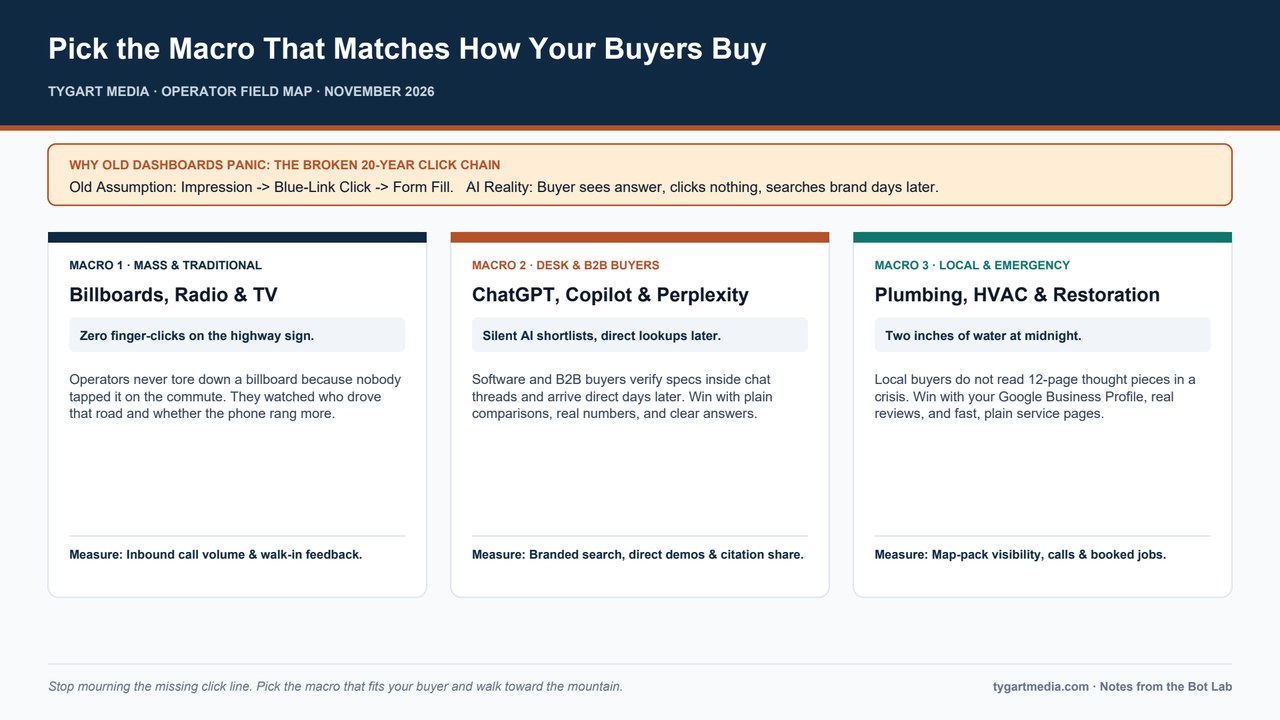
Businesses made real money long before anybody had a tracking pixel. Nobody tore down a highway billboard or canceled a morning radio spot because a customer failed to tap the sign with their finger on the way to work. You knew roughly who drove that stretch of road, you watched whether the phone rang more when the campaign ran, and you paid attention to what customers said when they walked through the door.
Digital people got addicted to the comfort of pretending every sale followed one clean line on a chart. Right now, with AI, that line is gone — and waiting around for it to settle down is a waste of a good Tuesday. These systems change every single day. Different model weights, different search rewrites, different rules for when a bot summarizes you versus when it drops a link. You are literally never talking to the same model twice.
Get The Signal
What we actually ran, what it measured, and what it means for a restoration shop — every week, including the flops.
So get over that part first.
Pick the Macro That Fits How Your Customers Actually Buy
| Buyer Lane | Why Click Attribution Breaks | Macro Signal That Matters | Where to Focus |
|---|---|---|---|
| Highway Billboards, TV & Radio | Nobody taps a roadside billboard or radio spot with a finger on the commute. | Inbound phone ring rate, walk-in comments, and territory lift. | Buy the right stretch of road and hold consistent frequency. |
| B2B & Desk Software Buyers | Buyers shortlist vendors inside ChatGPT or Copilot and visit direct days later. | Branded search trend, direct demo requests, and category answer mentions. | Publish clear product specs, comparison tables, and direct answers. |
| Local & Emergency Services | Buyers standing in two inches of water at midnight call fast instead of browsing. | Map-pack presence, phone calls, and booked local jobs. | Keep Google Business Profile, real reviews, and plain service pages sharp. |
| Engine-Room Market Forensics | JavaScript dashboards read zero on headless bot fetches and chat ad slots. | Origin -User log pulls, retrieved-not-cited gaps, and paid chat exhaust. | Audit server logs and test multi-engine citations when stakes justify it. |
Once you stop trying to pin every micro-move to a spreadsheet, the job gets a lot simpler: figure out the macro that actually fits how your customers buy, and head toward that mountain instead of staring at your boots on one narrow path.
If your customers sit at a desk asking ChatGPT or Copilot which software vendor to shortlist, then your macro is making sure those engines understand what you sell, who it is for, and how your numbers compare. If you run a local service business — plumbing, property restoration, HVAC, roof work — we all know what the macro looks like there. It is still your local footprint, your Google Business Profile, real reviews, and straightforward service pages that answer the question when somebody is standing in two inches of water at midnight.
Sometimes you will look at your clicks and referral charts and think, Hey, this looks fantastic. Other times the clicks look flat while the right buyers keep calling anyway. Look at the data, use what it gives you, and do not let one noisy gauge talk you out of common sense.
Where “You’ll Never Know” Stops Being True
Now, here is the other half of the story — the part where “you’ll never know” stops being true.
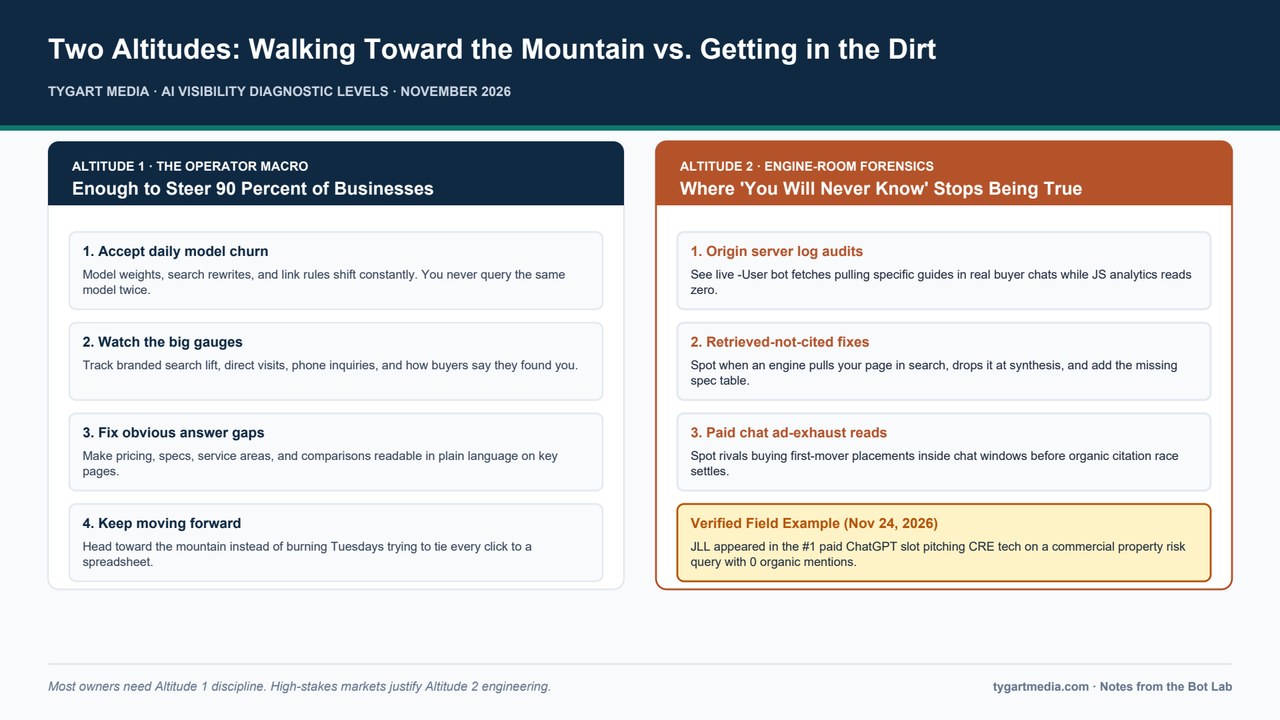
There are levels to this work. Most companies do not need to live in the weeds every morning. Watching your macro — branded searches, inbound calls, and whether your name comes up when a buyer asks the obvious question in your category — is plenty to steer the ship.
When a company does need to know where it sits in the marketplace, though, you can get really deep in the dirt. You do not have to guess. You can read raw origin server logs to see which AI agents are actually pulling your pages in live buyer conversations while your analytics screen reads zero, tracking the audience that never says thanks. You can test which pages an engine retrieves in the background and skips at the last second — and fix the missing table or spec sheet that cost you the nod.
You can even watch competitors telegraph their next move before the rest of the market notices. Just this week, while testing commercial property underwriting and catastrophe-risk prompts inside ChatGPT, we watched Jones Lang LaSalle (JLL) show up in the paid placement slot pitching data-driven commercial real estate technology on an insurance-risk query where they had zero organic mentions. You could see a first-mover play happening in plain sight just by looking at what was being sold inside the chat window.
Keep Walking Toward the Mountain
Most business owners never need to crawl that far into the engine room on their own. That is high-level diagnostic work — the kind of thing a company brings in a specialist like me to map out when they want to know whether they are leading a category, losing ground quietly, or leaving a first-mover lane wide open.
For everybody else, keep it simple. Stop mourning the old click chain. Pick the macro where your buyers actually live, make your answers easy for both people and machines to read, and keep walking toward the mountain.
Frequently Asked Questions
Why can't I track an AI citation like a normal Google click?
AI answers often give buyers enough confidence to shortlist a vendor without clicking a referral link, so they search your brand or visit your site directly days later with no AI referrer header attached.
What should most business owners measure instead of click-by-click AI attribution?
Watch the macro that matches how your customers actually buy: branded search volume, direct demo or phone inquiries, how prospects say they found you, and whether your company shows up when buyers ask obvious category questions.
Can you ever verify what AI systems are actually reading on your site?
Yes. At the diagnostic level, raw origin server logs record live -User agent fetches even when JavaScript analytics reports zero sessions, and multi-engine testing reveals retrieved-but-skipped content gaps and paid chat placements.
Get The Signal
What we actually ran, what it measured, and what it means for a restoration shop — every week, including the flops.
Leave a Reply