
By Will Tygart · Published November 28, 2026 · Notes from the Bot Lab
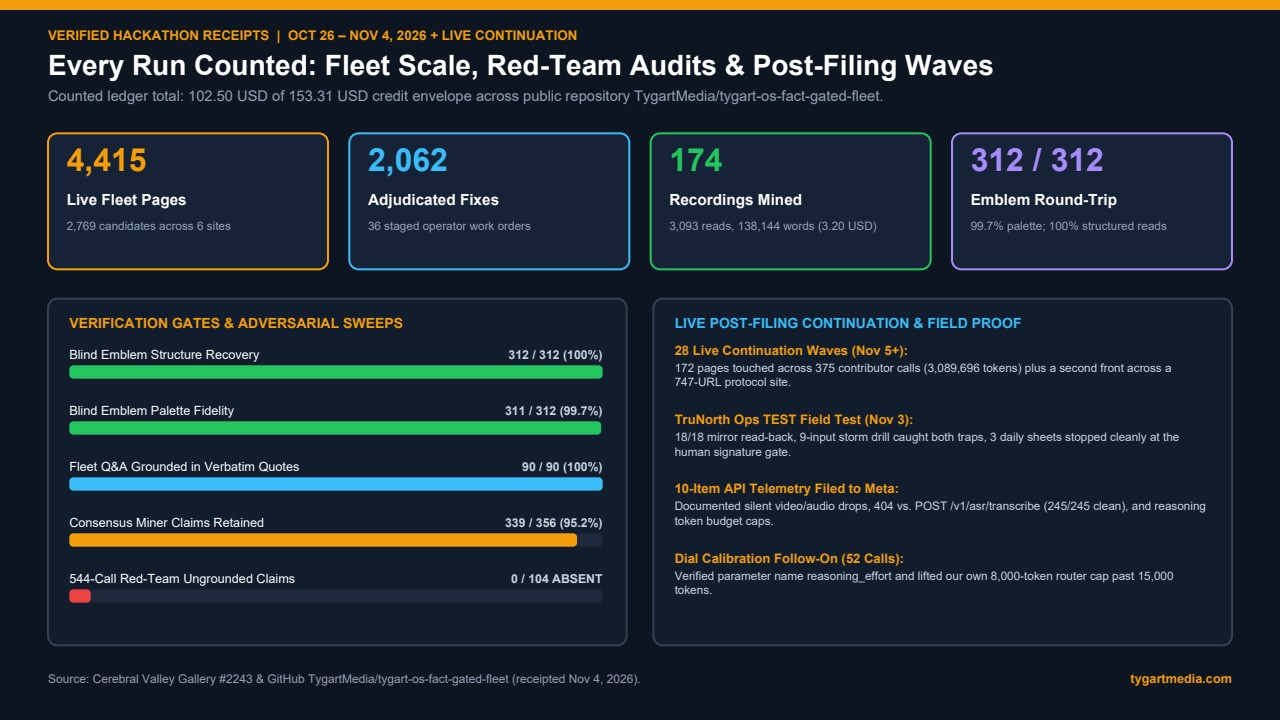
Direct Answer: Tygart Media did not win a prize at the Meta Global AI Developer Hackathon (filed November 4, 2026), yet our Fact-Gated Fleet shipped live across 4,415 pages on six production sites—delivering 2,769 candidates, 2,062 adjudicated fixes, 174 mined session recordings, 312 blind emblem round-trips, and a counted ledger of 102.50 USD inside a 153.31 USD credit envelope.
| Workstream | Measured Output | Counted Cost / Rate | Verification Receipt |
|---|---|---|---|
| Production Fleet Sweep (6 Sites) | 4,415 live pages, 2,769 monetization candidates, 2,062 adjudicated fixes, 36 staged WOs | Standard Trio ~12 cents/page vs. Contributor ~0.25 cents/page (49x spread) | Site 02 (647 fixes) + Site 03 (1,415 fixes) sweep logs |
| Session Recording Corpus | 174 recordings (100.3 h), 3,093 window reads, 138,144 words, 361 mined findings | 3.20 USD across 245 ASR calls; routing decision ~2.5 cents/recording | Verbatim-quote check + read-file-first rule at report 18 |
| Blind Emblem Round-Trip | 312 briefs rendered via muse-image-1.0 and read blind by Spark vision | 4.37 USD vision read (image generation unpriced in ledger) | 312/312 structure, 311/312 (99.7%) palette, cobwebbed rain gauge |
| 544-Call Red-Team Sweep | 405 usable calls auditing 104 sampled packet claims + 90 live fleet Q&A checks | 0.47 USD metered contributor sweep | 0/104 ABSENT claims; 90/90 Q&A verbatim grounded |
| TruNorth Ops TEST Sandbox | 18/18 mirror read-back, 9-input storm drill (both traps caught), 3 ROMs, 3 daily sheets | 16 drill calls in 65.5 s (~1 cent); screen import 8x slower than intake | 3,902.50 USD across 3 sheets stopped PENDING human signature |
| Live Continuation Waves | 28 waves on this site (172 pages, 375 calls, 3.09M tokens) + 747-URL second front | Free contributor credits (0 credit-card charges) | Live public wave logs inside GitHub repo |
Why Losing the Trophy Still Left Us With a Working System
I will be honest about the scoreboard first: we did not place in the Meta Global AI Developer Hackathon, and after putting ten days of heavy production runs into the entry, that stung. Most hackathon entries are weekend prototypes built around a slide deck. Ours was the opposite—we wired Meta’s Muse Spark 1.3 and Muse Wonder models directly into a live six-site publishing fleet of 4,415 pages because we wanted to know whether an AI operator could fix real pages without quietly making things up.
The prize did not land, so we did what operators do when a pitch deck loses: we opened the receipts. Every script, run ledger, failure log, and follow-on wave lives in the open on GitHub, and this post puts the full 4,415-page receipt on our own front door.
The Core Invention: Separation of Duties (The Trio)
Publishing at machine speed breaks facts quietly. Hand a language model a sprawling web page and ask it to clean up stale numbers or missing disclosures, and a single-pass editor writes fluent, confident, wrong fixes. Worse, no human can hand-check four thousand pages by eye.
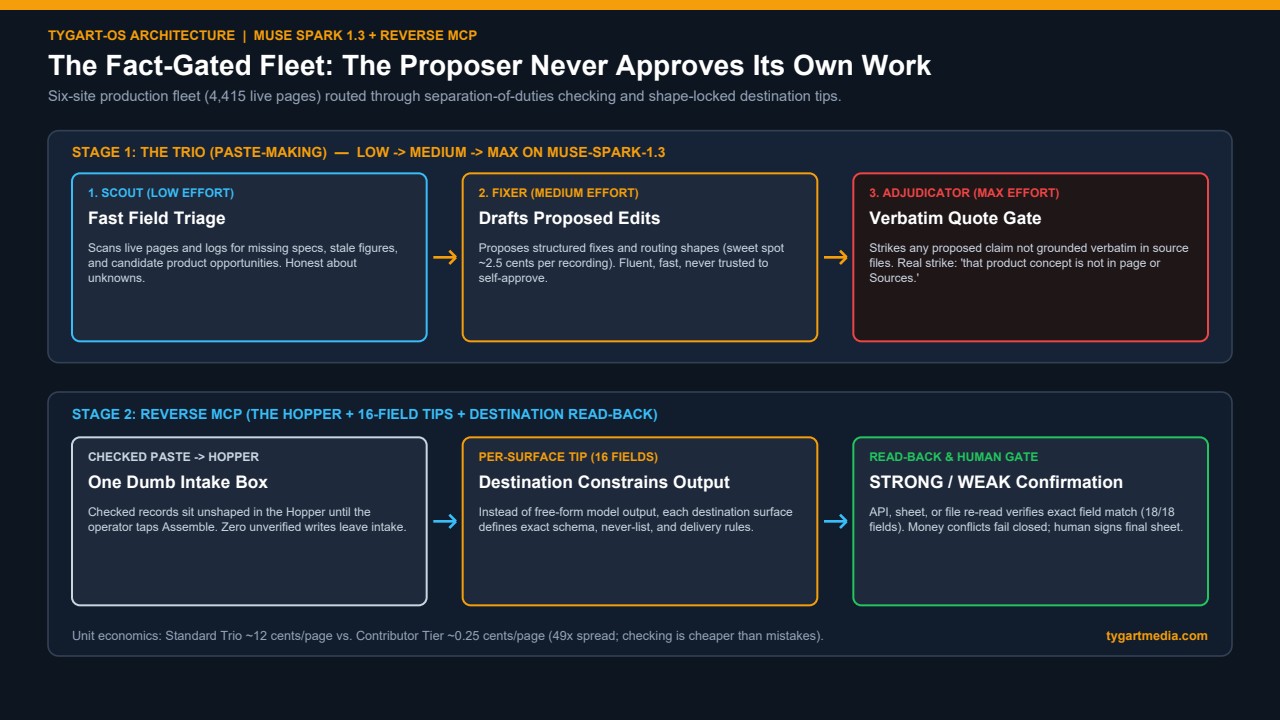
Our fix was structural separation across reasoning-effort tiers on muse-spark-1.3—the same principle behind our containment-room architecture for AI agents:
- Scout (low effort): Reads pages and logs cheaply to flag gaps, stale figures, and candidate download offers without drafting prose.
- Fixer (medium effort): Proposes concrete revisions and routing classifications. Medium effort hit our measured sweet spot (~2.5 cents per session recording), though it still hallucinates plausibly when left unchecked.
- Adjudicator (max effort): Acts as a pure fact gate. Every proposed field must carry a verbatim quote from the verified source material; an empty quote fails closed. During our live cyber-insurance sweep on Site 03, the Fixer invented the phrase “and any crime / funds-transfer extension”—and the Adjudicator struck it verbatim: “that product concept is not in page or Sources.”
We learned the ordering rule the hard way. When we sent a max-effort leg in cold without Scout and Fixer prep, it failed repeatedly—burning budget guessing context. We started calling the first two legs the Earth launch so the max-effort gate could make its Moon launch off clean, structured paste.
Reverse MCP: The Hopper and the 16-Field Tip
Standard Model Context Protocol lets a model reach out into tools whenever it wants. On real business operations, we inverted that contract in our adjudicated Router Design—the exact same philosophy behind our standardized input-tray robotics rule:
Everything inbound—field voice memos, PDFs, storm updates, log summaries—lands in one dumb intake box called the Hopper. While waiting inside the bag, verified material is called paste: grounded in verbatim quotes, with zero destination formatting yet. Paste leaves the Hopper only through a Tip—a 16-field destination profile named after cake-decorating nozzles, where the destination’s own accepted schema constrains what the model is allowed to emit.
Every emission is verified afterward by destination read-back (STRONG when an API, sheet, or screen re-read confirms exact fields; WEAK when inferred, such as outbound mail). Two sources disagreeing on money trigger a hard conflict exception rather than letting a model pick whichever number sounds nicer.
The System Audited Itself: 174 Recordings and 312 Blind Emblems
Mid-build, we turned the pipeline inward on 174 working-session screen recordings totaling 100.3 hours (3,093 window reads and 245 speech-recognition calls yielding 138,144 words for 3.20 USD). That audit exposed a critical workflow rule at report 18 on mic: when an assistant tried narrating session summaries from memory instead of reading the saved files, it drifted. Read the file first, then speak became a hard operating gate.
We also ran a 312-page visual round-trip test across our property-restoration hub (Site 06). A contributor brief-writer distilled each Trio concentrate into one visual-metaphor sentence; muse-image-1.0 rendered a flat cream/orange/black emblem with zero text; and Spark vision read all 312 emblems blind without seeing the briefs. Structure returned 312 of 312, palette returned 311 of 312 (99.7 percent), and an empty zero-char blog page came back as an empty stage rather than invented filler—while independent storm briefs spontaneously converged 27 times on a cobwebbed rain gauge motif that survived text-to-image-to-text intact.
Ten Bugs Filed to Meta—Plus What We Corrected on Ourselves
Because our application promised Meta honest telemetry on where the models break under production loads, we filed a structured 10-item report in FEEDBACK-TO-META.md. The sharpest pattern was accept-and-silent-drop: sending video or audio to chat endpoints returned HTTP 200 while the model quietly processed a single frame or silence—whereas audio worked 245 for 245 once we discovered POST /v1/asr/transcribe.
The discipline ran both ways. When we published our 52-call reasoning_effort follow-up test and coding ladder comparison, we logged two mistakes we had made in our October notes: we had used the wrong parameter name (reasoning instead of reasoning_effort), and the 8,000-token output ceiling we blamed on the API turned out to be our own router setting (verified past 15,000 tokens once lifted).
Capstone Field Test: TruNorth Ops TEST Sandbox
Architecture diagrams are cheap; software you do not own is unforgiving. On November 3, 2026, founder Jason Gilstrap handed us personal login credentials to a private TEST sandbox of TruNorth Ops—restoration field-operations and time-and-materials billing software with no public API. Running live in watched sessions:
- Mirror & Sheet Read-Back: Run 1 matched 18 of 18 job fields verbatim; Run 2 matched a computed daily sheet to the cent at 465.50 USD and caught an image-only upload surface rejecting PDFs and voice files with an explicit on-screen reason.
- Nine-Input Storm Drill: Sixteen contributor calls in 65.5 seconds (~1 cent total) processed one storm pulse and eight messy field inputs through adjudication. Both planted traps were caught: a contradictory dual-address caller produced zero phantom jobs, and an unmapped earthquake peril routed cleanly to Other with the mapping named in the job title.
- Wave 3 Human Boundary: Three consecutive days of Edmond job sheets totaled 3,902.50 USD across verified labor and equipment unit-days—and stopped PENDING at the manager-signature step. Checked automation prepares the packet; a named human signs the bill.
What Kept Running After November 4
Closing the portal did not stop the system. Between November 5 and November 7, 28 live continuation waves ran directly via Glint against this site—touching 172 pages across 375 contributor calls (3,089,696 tokens) at zero credit-card cost—before expanding onto a second 747-URL protocol site. Combined with our founding April 6 statement on articles as infrastructure, our Bot Tinder /agent-handshake/ intake standard, and our team Claude and MCP implementation work, the hackathon build became the backbone of how Tygart Media ships every day.
Frequently Asked Questions
What is the separation-of-duties Trio inside Tygart-OS?
The Trio splits editing across three Muse Spark 1.3 effort levels: Scout (low effort) flags suspect claims, Fixer (medium effort) drafts proposed revisions, and Adjudicator (max effort) strikes any proposed change that cannot be grounded verbatim in verified source documents.
How does Reverse MCP differ from standard Model Context Protocol tool calls?
Standard MCP lets an AI model reach out into tools freely. Reverse MCP flips the boundary so each destination surface defines a strict 16-field Tip schema that constrains what checked paste inside the Hopper is allowed to emit, confirmed afterward by STRONG or WEAK read-back.
Why did running Muse Spark at max effort alone fail before the Trio was ordered?
Sending a max-effort call cold against raw input caused it to spend reasoning budget guessing missing context or hitting token limits. Running Scout (low) and Fixer (medium) first prepares grounded source material so the max-effort Adjudicator can enforce strict yes-or-no checks.
Where can anyone inspect the public receipts from the November 4 hackathon filing?
The complete submission packet, evidence index, run ledger, router design, Meta API feedback log, and live continuation waves are public on Cerebral Valley Gallery #2243, GitHub (TygartMedia/tygart-os-fact-gated-fleet), and the 3-minute YouTube demo 8xg3_UqEAPk.
Leave a Reply