
From the Workbench · November 28, 2026 · By Will Tygart
Before connecting an AI assistant to WordPress, most developers fall back on bulk REST scraping — pulling dozens of pages of paginated post JSON just to answer a single question. In our 24-hour origin audit in Grok Knocked on Our WordPress Door 86 Times Using MCP, bulk scrapers transferred 84.45 MB over /wp-json/wp/v2/posts while xAI-Grok-Connectors ran 86 clean MCP sessions at a fraction of the bandwidth.
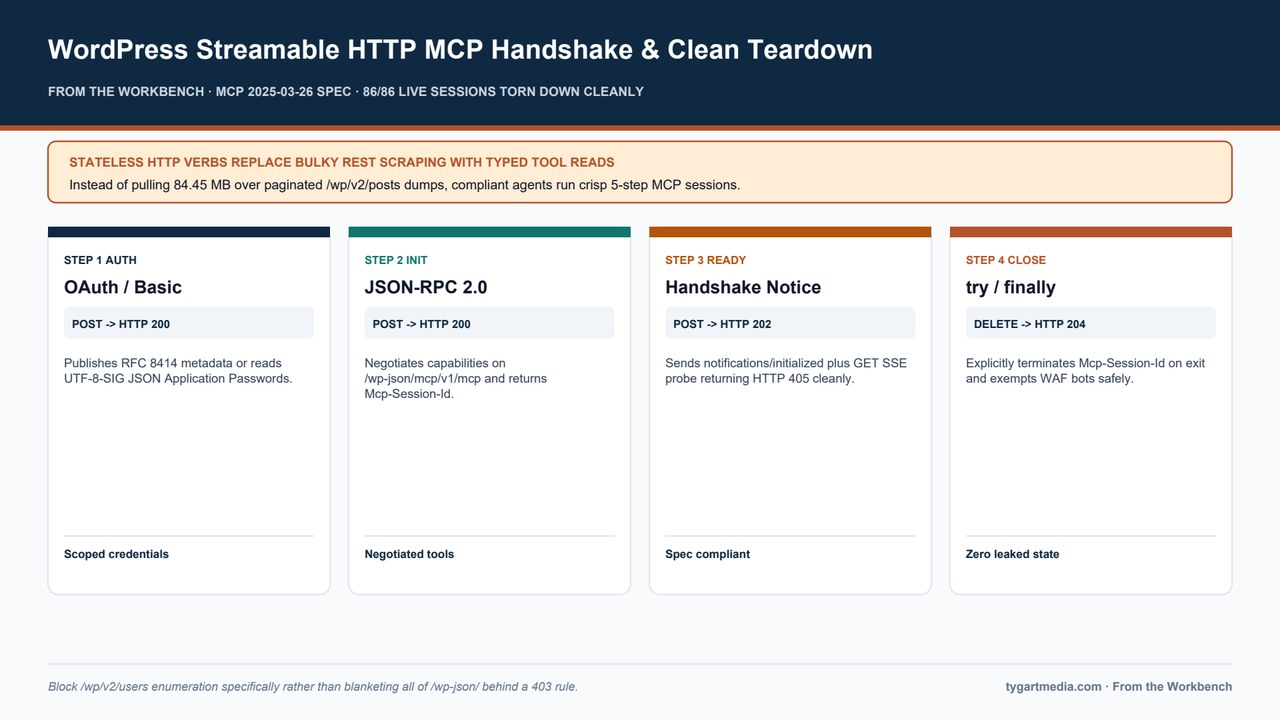
Under the Streamable HTTP MCP transport spec, WordPress does not need long-lived background daemons or open WebSockets. Every step — authentication, capability discovery, JSON-RPC tool calls, optional SSE checks, and explicit teardown — rides standard stateless or session-header HTTP verbs you can test in twenty lines of Python.
The Five-Verb WordPress MCP Lifecycle
Inspecting real connector logs shows why partial client wrappers fail. Clients that skip the notifications/initialized step or forget DELETE leave orphaned state, while naive WAF rules break OAuth metadata discovery before authentication even begins. Expect these exact HTTP codes:
| Session Stage | HTTP Method & Endpoint | Expected Status | Protocol Purpose |
|---|---|---|---|
| 1. Auth / Token Refresh | POST OAuth token URL or Basic Auth header | HTTP 200 OK | Issues scoped bearer token (or validates WordPress Application Password) |
| 2. Initialize Handshake | POST /wp-json/mcp/v1/mcp (initialize) | HTTP 200 OK | Returns server capabilities plus Mcp-Session-Id response header |
| 3. Client Ready Notice | POST /wp-json/mcp/v1/mcp (notifications/initialized) | HTTP 202 Accepted | Confirms capability agreement before issuing tools/list or tools/call |
| 4. Optional Stream Probe | GET /wp-json/mcp/v1/mcp (Accept: text/event-stream) | HTTP 405 Method Not Allowed | Stateless WordPress handlers decline optional SSE cleanly per spec |
| 5. Clean Session Teardown | DELETE /wp-json/mcp/v1/mcp (Mcp-Session-Id) | HTTP 204 No Content | Frees session state cleanly on exit inside try/finally blocks |
When publishing an externally discoverable connector for xAI Grok or Claude Desktop, pair your MCP endpoint with an RFC 8414 OAuth metadata document and publish a plain Agent Handshake specification so visiting bots read your supported endpoints rather than brute-forcing guesswork paths.
Client Configuration and OAuth Discovery Endpoints
Most modern agent hosts accept a compact Streamable HTTP block pointing directly at /wp-json/mcp/v1/mcp. Avoid older deprecated serverUrl or SSE-only paths unless routing through an explicit stdio bridge:
{
  "mcpServers": {
    "wordpress-production": {
      "url": "https://example.com/wp-json/mcp/v1/mcp",
      "headers": {
        "Accept": "application/json, text/event-stream",
        "User-Agent": "Mozilla/5.0 (compatible; Studio-MCP-Client/1.0)"
      }
    }
  }
}
Self-Testing Handshake Harness and Real-World Traps
Never assume an active WordPress MCP plugin works just because wp-admin says Active. Run an uncached end-to-end probe from your own terminal using standard MCP lifecycle calls and verify every common edge blocker listed below:
| WordPress MCP Blocker | What Breaks Live | Why It Tricks Builders | Clean Production Fix |
|---|---|---|---|
| Edge Firewall 403 / 1010 | Python-urllib or default Curl UAs rejected at edge proxy | Local curl works from allowlisted shell while remote agents get 403 | Send standard User-Agent and exempt signed /wp-json/mcp/v1/ calls |
| UTF-8 BOM in JSON Credential Files | Windows PowerShell prepends 0xEFBBBF BOM to JSON secrets | json.loads fails or base64 auth token includes corrupt leading bytes | Always read secret JSON files with encoding='utf-8-sig' |
| Blanket /wp-json/ Firewall Block | Security rule blocks entire REST prefix to stop user scans | Breaks oEmbed, Application Passwords, and all MCP discovery together | Block only /wp/v2/users enumeration and query author=N scans cleanly |
| Orphaned Sessions Without DELETE | Client scripts exit after tools/call without cleanup | Test harness works 10 times before hitting server session limits | Always wrap session calls in try/finally issuing HTTP DELETE |
import base64, json, pathlib, urllib.request

def load_wp_basic_header(secret_file: pathlib.Path) -> tuple[str, str]:
    data = json.loads(secret_file.read_text(encoding="utf-8-sig"))
    token = base64.b64encode(f"{data['username']}:{data['application_password']}".encode()).decode()
    return data["site"].rstrip("/") + "/wp-json/mcp/v1/mcp", f"Basic {token}"

def mcp_post(url: str, auth: str, payload: dict, session_id: str | None = None):
    hdrs = {
        "Content-Type": "application/json",
        "Accept": "application/json, text/event-stream",
        "Authorization": auth,
        "User-Agent": "Mozilla/5.0 Chrome/131.0.0.0 Safari/537.36",
    }
    if session_id:
        hdrs["Mcp-Session-Id"] = session_id
    req = urllib.request.Request(url, data=json.dumps(payload).encode("utf-8"), headers=hdrs, method="POST")
    with urllib.request.urlopen(req, timeout=20) as resp:
        raw = resp.read().decode("utf-8", errors="replace")
        return resp.status, resp.headers.get("Mcp-Session-Id", session_id), (json.loads(raw) if raw else {})

def smoke_test_mcp(secret_file: pathlib.Path) -> None:
    url, auth = load_wp_basic_header(secret_file)
    st, sid, _ = mcp_post(url, auth, {"jsonrpc": "2.0", "id": 1, "method": "initialize", "params": {}})
    assert st == 200 and sid
    try:
        st2, _, _ = mcp_post(url, auth, {"jsonrpc": "2.0", "method": "notifications/initialized"}, sid)
        assert st2 in (200, 202)
        st3, _, tools = mcp_post(url, auth, {"jsonrpc": "2.0", "id": 2, "method": "tools/list", "params": {}}, sid)
        assert st3 == 200 and "result" in tools
    finally:
        del_req = urllib.request.Request(url, headers={"Authorization": auth, "Mcp-Session-Id": sid}, method="DELETE")
        with urllib.request.urlopen(del_req, timeout=15) as r_del:
            assert r_del.status in (200, 204)
Remember WordPress REST authentication mechanics: Application Passwords work cleanly over HTTPS for operator workflows, while third-party multi-tenant connectors should use scoped OAuth 2.1 tokens with explicit expiry and rotation.
Treat Your API Door Like Your Storefront
As we explored in Skills vs. MCP vs. Connectors vs. Plugins, exposing clean, typed tools lets external AI systems verify facts and run workflows without downloading gigabytes of noisy HTML. Run the teardown probe regularly so your endpoint stays as clean on call ten thousand as on day one.
Frequently Asked Questions
Does WordPress MCP require an always-on Node or SSE daemon?
No. Under the Streamable HTTP 2025-03-26 transport specification, standard PHP handlers over /wp-json/mcp/v1/mcp return JSON-RPC responses via POST HTTP 200 and answer optional GET SSE checks with HTTP 405 Method Not Allowed.
Why do Python REST and MCP scripts fail with HTTP 403 behind edge firewalls?
Many edge security rules reject default Python-urllib User-Agent strings. Passing a standard desktop browser User-Agent or explicit service-account headers resolves transport rejections without lowering overall bot defenses.
Why send HTTP DELETE at the end of an MCP session?
Sending DELETE with the Mcp-Session-Id header signals explicit client teardown (returning HTTP 204 No Content), preventing abandoned session state from accumulating on the origin host.
Primary Documentation & References
- MCP 2025-03-26 Streamable HTTP Transports Spec
- MCP 2025-03-26 Lifecycle Specification
- RFC 8414 OAuth 2.0 Authorization Server Metadata
- WordPress REST API Authentication Docs
- xAI Official Developer Documentation
Leave a Reply