
Notes from the Bot Lab · November 28, 2026 · By Will Tygart
In our curing-window rule essay, I reminded operators not to keep poking wet concrete while waiting weeks for search indexes to settle. Wait until you put an actual millisecond stopwatch on what happens inside our server logs the moment a brand-new post goes live on tygartmedia.com.
On November 27, 2026, a scheduled morning dispatch went live at 04:16:39 UTC. Because nobody has ever bothered to print a real second-by-second server race from zero to the first live human chat citation on one URL, we traced every verified search crawler, wholesale AI search indexer, training bot, and live chat agent that touched that fresh URL over its first 24 hours.
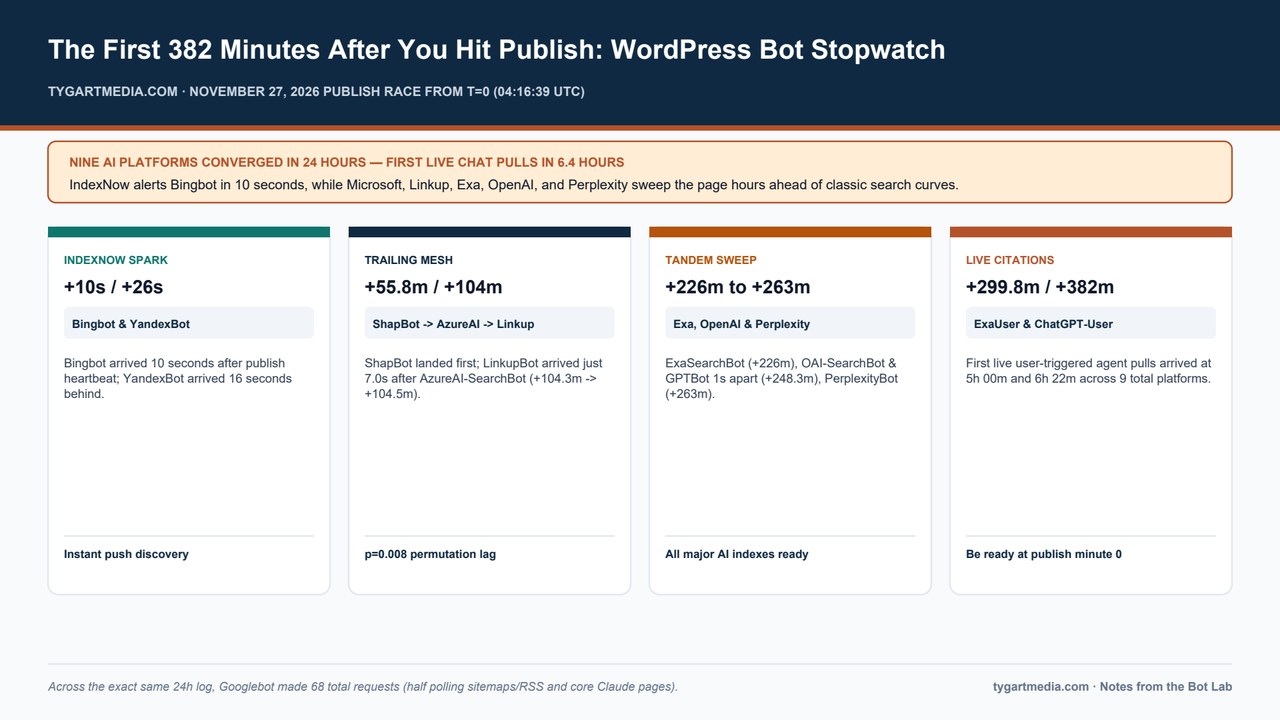
Within one day, nine completely different AI platforms logged 26 fetches against that single post — and the choreography between Microsoft, OpenAI, and third-party wholesale search indexes was startling.
The Full Stopwatch Ledger: From t=0 to First Live Buyer Pulls
Every timestamp below was measured directly on tygartmedia.com from the initial publish heartbeat (04:16:39 UTC) forward:
| Elapsed Time After Publish | Verified Bot Family | Ecosystem Role | What Happened on the Wire |
|---|---|---|---|
| +10 seconds (04:16:49Z) | Bingbot | IndexNow Search Pusher | Arrived almost instantaneously after IndexNow ping notified Microsoft. |
| +26 seconds (04:17:05Z) | YandexBot | IndexNow Participant | Shared IndexNow notification mesh pulled 16 seconds behind Bingbot. |
| +55.8 minutes | ShapBot | Wholesale AI Search | First standalone AI search startup to discover and fetch the new URL. |
| +104.3m & +104.5m (1h 44m) | AzureAI-SearchBot -> LinkupBot | Cloud Search & Grounding API | LinkupBot hit the exact slug just 7.0 seconds after Microsoft AzureAI arrived. |
| +226.0 minutes (3h 46m) | ExaSearchBot | Wholesale AI Indexer | Third-party neural search index pulled HTML for API distribution. |
| +248.3m & +248.4m (4h 08m) | OAI-SearchBot + GPTBot | OpenAI Search & Training | Both OpenAI indexers arrived roughly 1 second apart in tight tandem. |
| +263.0 minutes (4h 23m) | PerplexityBot | AI Answer Indexer | Completed Perplexity's primary crawl pass ahead of daytime queries. |
| +299.8m (5h 00m) & +382.1m (6h 22m) | ExaUser & ChatGPT-User | Live User Conversations | First real-time human/workflow citations pulled the page live — inside 6.4 hours. |
Look at two jaw-dropping synchronizations sitting in plain sight inside that ledger. First, under the IndexNow push protocol, Microsoft showed up in ten seconds flat. Our own earlier crawl-speed benchmark proved that IndexNow compresses discovery from days down to seconds — and watching Bingbot hit at +10s with YandexBot sixteen seconds behind confirms it.
Second, notice OpenAI’s OAI-SearchBot and GPTBot arriving one second apart just past hour four (+248.3m and +248.4m). And look right before them at +104.3m: LinkupBot walked onto that fresh page just 7.0 seconds after AzureAI-SearchBot touched it.
Coincidence or Feeder Pipeline? The 500-Trial Permutation Check
Whenever you spot one crawler landing 7 seconds behind another on one morning post, your first instinct should be skepticism: on a busy WordPress site, bots overlap by sheer chance. So we ran a strict 500-trial random permutation null test across our 30-day origin logs to see whether crawlers genuinely trailed one another more often than random daily timing allowed.
Against ShapBot (p = 0.926), KeenableBot (p = 0.563), ExaSearchBot (p = 0.317), and PerplexityBot (p = 1.000), LinkupBot showed purely random timing overlap. Against Microsoft and OpenAI, however, the signal lit up cleanly with zero reverse leads: AzureAI-SearchBot led LinkupBot within 5 minutes (observed 2 vs 0.1 expected, p = 0.008), Bingbot led LinkupBot within 30 minutes (observed 9 vs 3.1 expected, p = 0.004, with 24 pairs inside 2 hours), and GPTBot led LinkupBot within 30 minutes (observed 3 vs 0.4 expected, p = 0.008).
Where Was Googlebot While Nine AI Platforms Converged?
Meanwhile, look at what Googlebot was doing across that same 24-hour window on tygartmedia.com versus how established pillars win convergence:
| Audience & Speed Layer | 24h Measured Behavior on tygartmedia.com | Speed to Live Distribution | What Operators Should Ship at Publish |
|---|---|---|---|
| IndexNow + AI Mesh | Bingbot (+10s) -> 9 distinct AI engines converged in 24h | First live citations in 5.0h – 6.4h | Fire IndexNow + keep XML sitemaps and Markdown alternates ready at t=0. |
| Googlebot 24h Focus | 68 total requests (34 polling sitemaps/RSS; 28 top Claude pages) | Conservative ranking & verification curve | Respect 7-14d search curing windows while AI cites same-day specs. |
| 9-Platform Convergence Leaders | 5 slugs hit by 9 AI platforms (up to 73 hits on flagship pricing) | Continuous background + live-agent demand | Keep high-convergence tables & Markdown twins synced before hitting publish. |
In that entire 24-hour window, Googlebot made just 68 requests on tygartmedia.com — half of them polling sitemaps and RSS feeds, and almost all editorial reads focused tightly on our highest-traffic Claude rate-limit and comparison guides. Google operates on a deliberate, conservative discovery clock.
Publish Ready From Minute Zero
As we documented in our Direct box autopsy and Markdown twins white paper, AI agents do not patiently wait around for you to clean up a rough draft next week. Within six hours of hitting publish — when IndexNow fires cleanly and your metadata, table facts, and Markdown twin are in place at t = 0 — live buyer assistants are already pulling the finished copy.
Frequently Asked Questions
How fast do AI crawlers find a new WordPress post after publish?
In our timed test on tygartmedia.com, IndexNow brought Bingbot in 10 seconds, ShapBot in 55.8 minutes, AzureAI and LinkupBot at 104 minutes, OpenAI bots at 248 minutes, PerplexityBot at 263 minutes, and live user citations inside 382 minutes.
Why did LinkupBot follow AzureAI-SearchBot 7 seconds later?
A 500-trial 30-day permutation check on tygartmedia.com confirmed statistically significant trailing behind AzureAI-SearchBot within 5 minutes (p=0.008) and Bingbot within 30 minutes (p=0.004) with zero reverse leads.
Why does Googlebot move slower than live AI citation agents on new pages?
Across the same 24-hour slice, Googlebot focused half of its 68 requests on sitemaps/RSS and established high-demand pillars while Bing/IndexNow and wholesale AI indexers pushed fresh URLs into live citations the same morning.
Leave a Reply