
Notes from the Bot Lab · November 28, 2026 · By Will Tygart
Every classic rule in web design starts from the same comfortable picture: a human being sits down at a laptop, opens Chrome or Safari, types a question, clicks a result, waits for your fonts and header logo to paint, scrolls past a hero banner, and skims down to the table.
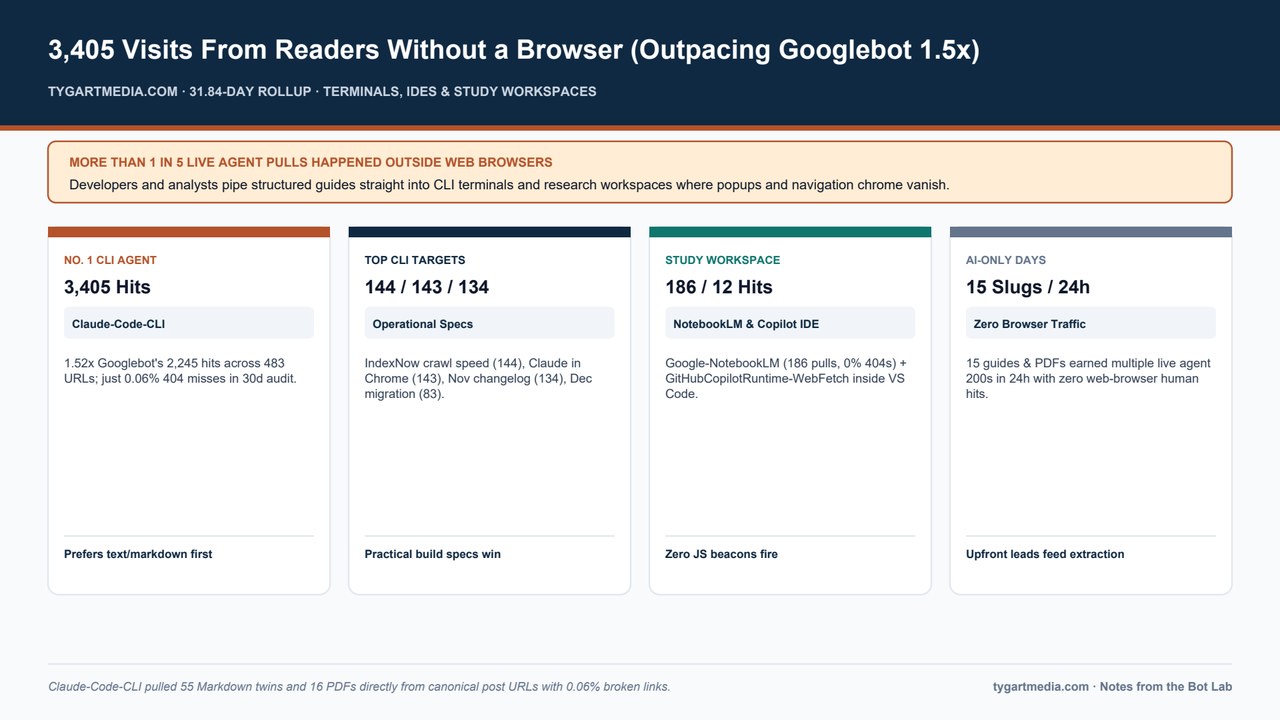
Now open our 31.84-day origin server logs on tygartmedia.com (1,859,626 in-window lines from October 28 through November 28, 2026). Over that single month, a command-line coding terminal called Claude-Code-CLI pulled 3,405 requests across 483 of our guides — roughly 1.52x more total requests than Googlebot’s 2,245 hits across the entire same period.
Think about what that actually means on the ground. Nobody was looking at our header menu. Nobody saw our sidebar newsletter box, our font pairing, or our hero illustrations. An engineer had a black terminal window or a notebook workspace open, asked their assistant to wire up a real integration, and the software reached out across the open web to read our specifications live while the engineer stayed in their editor.
When we wrote Articles as Infrastructure back in spring and The Buyer Is a Bot Now this fall, that shift was partly thesis. Here is the receipt stamped directly into November’s server ledger.
Who Is Visiting Without a Browser on tygartmedia.com
Across our 31.84-day log window on tygartmedia.com, live human-triggered AI agents logged 17,422 total requests across retail chat assistants, coding terminals, research APIs, and study workspaces. Wait until you separate the chat windows from the developer and research workspaces:
| Browserless Workspace Agent | 31.8d Hits on tygartmedia.com | Unique Slugs & 404 Discipline | Accept Preference & Human Workflow |
|---|---|---|---|
| Claude-Code-CLI (Anthropic CLI) | 3,405 (1.52x Googlebot) | 483 slugs; just 0.06% 404 misses (2 total) | Sends Accept: text/markdown, text/html; engineers reading docs inside terminal. |
| Google-NotebookLM | 186 | 10 focused guides (0% 404s) | Human uploads URLs/PDFs for synthesis, audio briefings, and study workspaces. |
| GitHubCopilotRuntime-WebFetch | 12 | 4 guides (0% 404s) | In-IDE VS Code Copilot agent verifying migration & enterprise framework docs. |
| GoogleAgent-URLContext | 2 | 1 deep technical post (0% 404s) | Gemini API URL-Context runtime tool reading live structured reference pages. |
| Googlebot (Baseline Comparison) | 2,245 | 176 unique slugs | Periodic search indexing sweeps across core guides & XML sitemaps. |
Put Claude Code, Google NotebookLM, and GitHub Copilot together with live workflow APIs: more than 1 in 5 (20.7%) of our non-search live agent traffic came from developer terminals and workspace ingestion tools rather than general consumer chat boxes.
Look closely at Claude-Code-CLI’s HTTP hygiene in our 30-day rollup: out of 3,345 checked requests on tygartmedia.com, it hit just two 404 dead links (0.06%) while recording 2,310 clean HTTP 200 document pulls — including 55 direct Markdown (.md) fetches and 16 House PDF downloads. Unlike sloppy scrapers guessing URLs in the dark, a coding terminal fetches exact canonical links directly from a real engineer’s prompt or workflow.
What Engineers Actually Asked Their Terminals to Read on Our Site
You can tell the difference between background training crawls and real working engineers simply by looking at which slugs rise to the top inside terminal logs. General bots hammer evergreen pricing pages over and over; terminal tools pull implementation details and breaking deprecation deadlines:
On tygartmedia.com, the top terminal targets over 31.8 days were our IndexNow crawl-speed experiment (144 terminal pulls), our Claude in Chrome operational guide (143 pulls), our November 2026 changelog (134 pulls), and our December 14 standalone migration briefing (83 pulls).
That list tells an immediate story. Nobody inside a terminal asks an agent to read generic motivational fluff. They paste a reference guide into their coding loop because they need exact flag names, IndexNow endpoints, deprecation dates, or browser-extension permissions to finish shipping real work that afternoon.
Even wilder: in a single 24-hour slice on tygartmedia.com, 15 distinct articles and takeaway PDFs received multiple live human-triggered AI agent reads while recording zero real human web-browser visits that entire day. Our IndexNow benchmark led that day with 5 live agent reads and zero desktop pageviews; our December 14 migration briefing took 4 live agent reads with zero browser traffic. Your most engaged technical audience on a Tuesday might never load a CSS file.
Why Popups and Marketing Chrome Break Terminal Readers
Think about how a normal blog renders for an operator in Chrome versus how a developer terminal under RFC 8288 Web Linking reads that same URL:
| Page Element | Human Browser Experience | Terminal / Workspace Reader Reality | How We Keep Both Happy |
|---|---|---|---|
| Cookie Banners & Modals | Dismissed visually with one mouse click. | Consumes context tokens at top of scraped DOM before first heading. | Keep clean HTML body structure or expose direct Markdown (.md) twins. |
| Direct Answer Lead | Establishes thesis in top 5 seconds. | Immediate extraction target right below the H1 heading. | Put a crisp 45-55 word synthesis lead right at the top. |
| Code Snippets & Migration Dates | Scanned selectively when troubleshooting. | Verified verbatim as operational constraints by coding agents. | Print exact versions, dates, and steps cleanly inside semantic HTML/tables. |
Look at Accept: text/markdown, text/html, */* in Claude-Code-CLI’s header string. Terminal agents explicitly tell web servers they prefer clean Markdown first because every kilobyte of navigation menus, JavaScript trackers, and footer clutter crowds out the facts sitting inside the article body.
Publish for the Room Where the Terminal Lives
Google Analytics will look you straight in the eye and tell you those 3,405 terminal fetches never happened. No JavaScript beacon fired, no cookie landed, and no ad pixel blinked. Yet an engineer trusted your guide enough to pipe your work straight into production setup work.
When you structure every serious technical guide with an upfront factual summary, real specification tables, and a clean Markdown twin, you stop losing the readers who never open a browser window in the first place.
Frequently Asked Questions
How many times did Claude-Code-CLI visit tygartmedia.com compared to Googlebot?
Across 31.84 days on tygartmedia.com (Oct 28-Nov 28, 2026), Claude-Code-CLI logged 3,405 visits across 483 unique URLs — 1.52x more than Googlebot's 2,245 requests across 176 URLs.
Why don't coding terminals or NotebookLM show up in Google Analytics?
Tools like Claude-Code-CLI, GitHubCopilotRuntime-WebFetch, and NotebookLM fetch raw HTTP text or Markdown over server-side clients without executing page JavaScript, leaving zero analytics footprints.
What makes an article easy for coding terminals and AI workspaces to use?
Explicit Accept text/markdown twin support, clean semantic headings, exact version/date stamps, structured comparison tables, and placing a concise synthesis lead at the very top of the page.
Leave a Reply