Tag: Bing AI Performance

  • Half the Citations Sit on Three Pages

    Half the Citations Sit on Three Pages

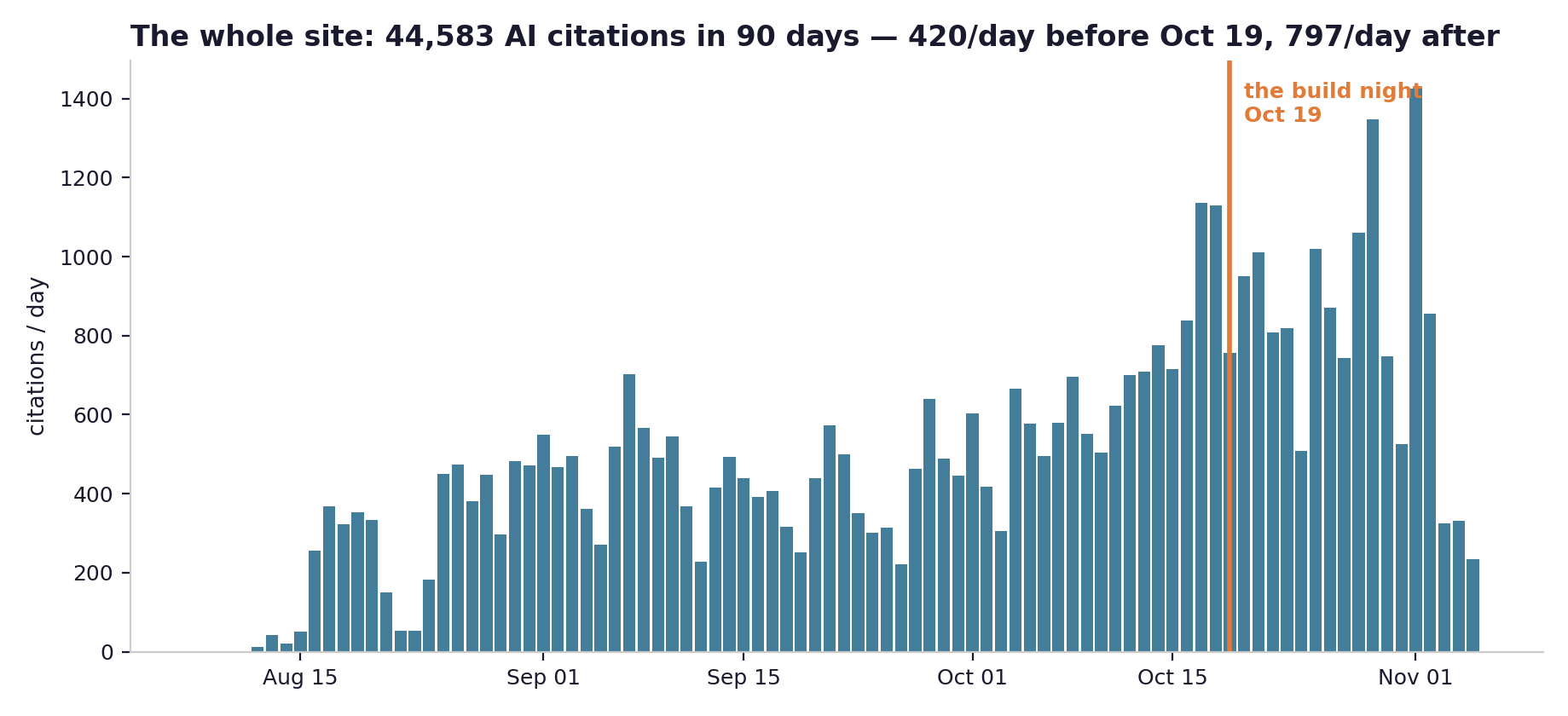
    Eight receipts so far in this series: 44,583 citations at BC ESG, 109,844 at Healthcare Facility Hub, 813,426 on this site, 50,607 at Risk Coverage Hub, 57,798 at Continuity Hub, 111 at Restoration Intel, 295 earned by Claude’s own pasted error messages, and a weekly rhythm that keeps office hours. The ninth receipt is a first: the first AI Performance measurement we have ever pulled for theuniversalcommerceprotocol.com — the site we built to teach the Universal Commerce Protocol, the standard AI shopping agents use to buy things. Ninety days, August 8 to November 5, 2026. What the machines cite there is not what we would have guessed — and one thing they cite most was teaching a model the protocol itself had already replaced. Both below.

    Watch the 60-second version: Why do three pages hold half of this site’s AI citations? — the same receipts in 59 seconds, chapters matched to the sections below.

    Three questions hold half the site

    The page view of the export lists 117 cited pages holding 9,628 citations between them. Half of that total sits on three pages. Our agent authentication and identity verification guide leads the site at 1,668 citations (17.3%). The agent payment failures and recovery guide is ten citations behind it at 1,658 (17.2%). The UCP compliance and risk checklist holds third at 1,444 (15.0%). Together: 4,770 citations, 49.5% of everything the site earned. The top ten pages hold 7,748 — 80.5%. The other 107 pages share the remaining fifth.
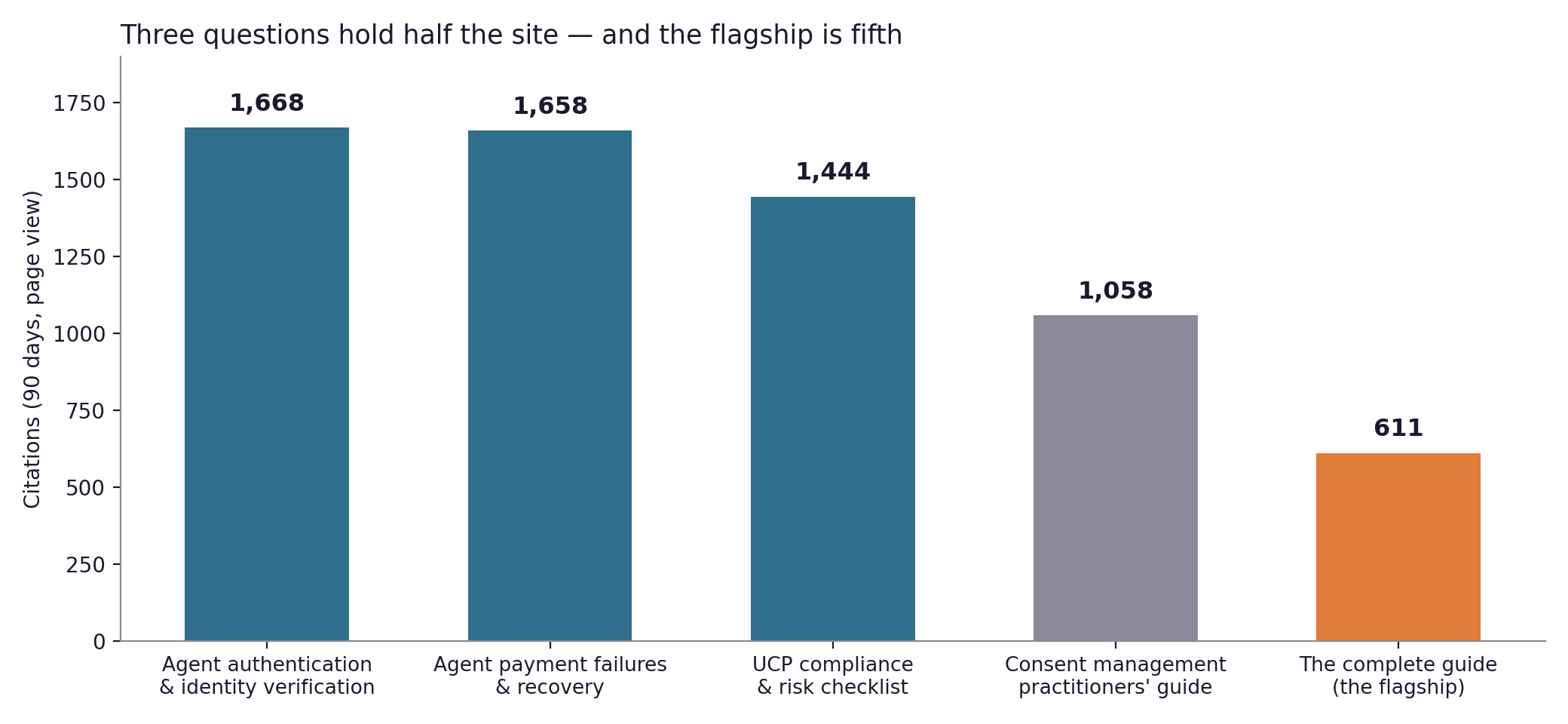
    The five most-cited pages on theuniversalcommerceprotocol.com over ninety days: agent authentication and identity verification 1,668; agent payment failures and recovery 1,658; the UCP compliance and risk checklist 1,444; the consent management guide 1,058; and the complete guide — the flagship — fifth at 611.
    Three pages, half the site. Source: Bing Webmaster Tools AI Performance, page view.

    Read the three pillars as questions and they are the three questions every merchant actually asks about agent commerce: how do I know this agent is who it claims to be, what happens when its payment fails, and what do the rules require of me? Identity, failure, compliance. Not how the protocol works in the abstract — what breaks, who’s responsible, and what’s allowed. On the query side, the single biggest question in the window says the same thing in the searcher’s own words: “agentic commerce frameworks payment exceptions handling” — 1,334 citations, at a 44.11% share of that query’s citation pool. The machines are not citing our explainers. They are citing our answers to things going wrong.

    The front door is fifth

    The page we built as the site’s front door — the complete guide to the Universal Commerce Protocol — holds 611 citations, 6.3% of the page view, good for fifth place. Each of the three pillars out-cites it roughly two and a half times over. The consent-management guide sits between them and it at 1,058.

    We do not read that as the guide failing. A complete guide is what a person reads when they arrive already curious. A citation is what a machine reaches for when it needs one fact to finish an answer — and the facts it needs are specific: an authentication model, a failure procedure, a checklist item. The front door is for arriving. The pillars are for answering. This site was named for the protocol and built around the guide; the citations went to the troubleshooting shelf anyway.

    Three views, three totals — and the widest gap in the fleet

    Every receipt in this series carries the same disclosure, and this one carries it largest. The export’s three views do not agree with each other. The daily view sums to 12,105 citations over the ninety days. The page view sums to 9,628. The query view sums to 8,755 across 121 queries. Three views of the same window, three different totals — and the widest gap, daily against page, is 2,477 citations, 20.5%.
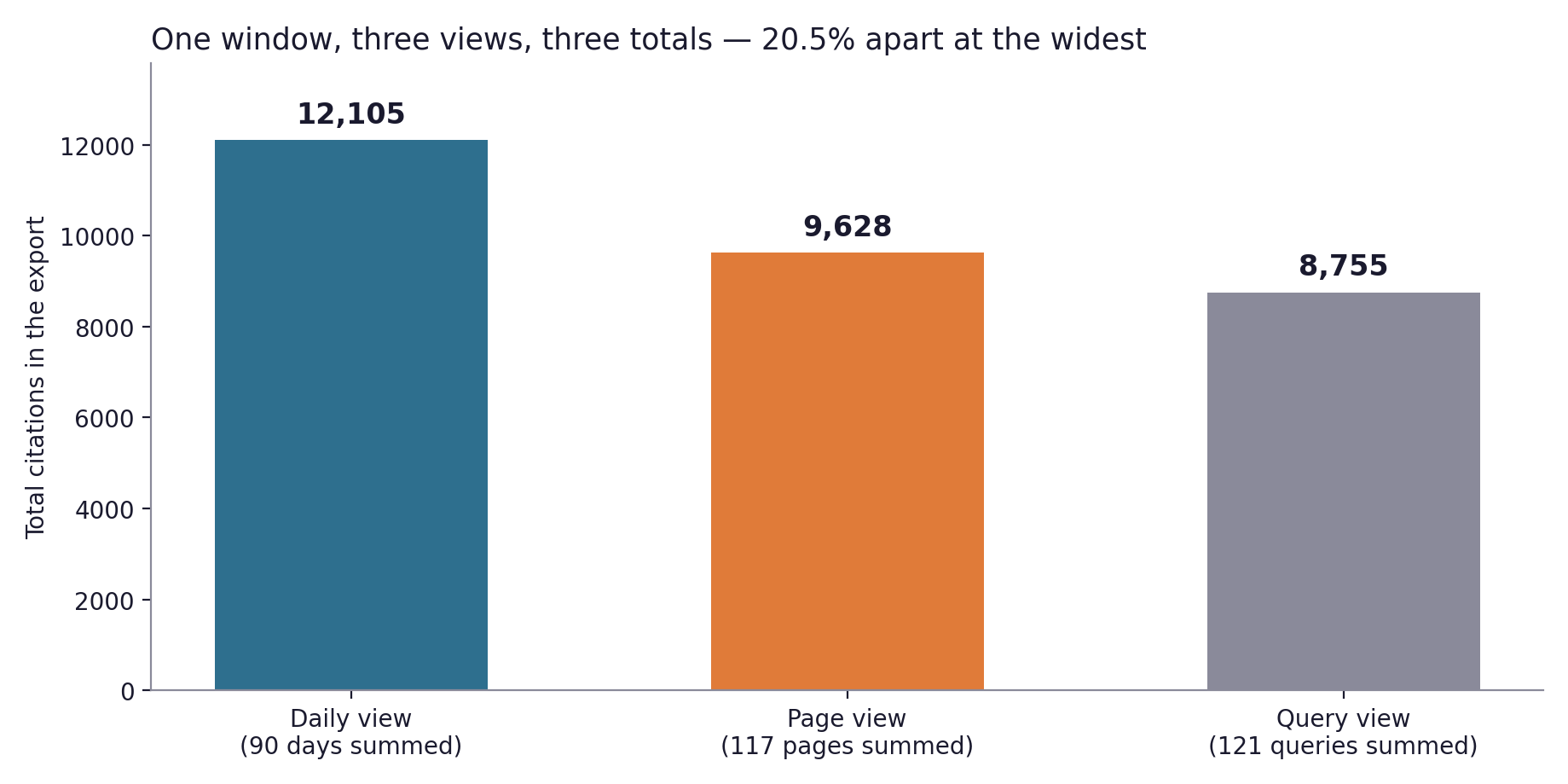
    The three views of the same ninety-day window for theuniversalcommerceprotocol.com give three totals: the daily view sums to 12,105 citations, the page view to 9,628, and the query view to 8,755 — a 20.5 percent gap between the widest two.
    Same window, same pull, three totals. Source: Bing Webmaster Tools AI Performance.

    For scale: the same disagreement on our other sites ran 2.6% (this site, No. 3), 5.7% (Risk Coverage Hub, No. 4), 4.8% (Continuity, No. 5) and about 0.9% (Restoration Intel, No. 6). UCP’s 20.5% is four times the next widest. We do not know why this site’s views diverge so much further than the others’ — the export does not say, and we will not invent a mechanism. What we can do is refuse to blend them: every page share in this piece is a share of the page view’s 9,628; every daily figure is from the daily view’s 12,105; the query numbers are the query view’s own. If you only remember one number from this receipt, remember that the report disagrees with itself by a fifth, and plan your confidence accordingly.

    The shape: a sag, then a climb back past the start

    The daily view does not run flat. The first forty-five days average 144 a day; the second forty-five average 125 — a decline, if you stop reading there. Keep reading and the line turns: the first fourteen days average 139 a day, the last fourteen average 169. The smoothed line tells it cleanest — the fourteen-day average sinks to a floor of 75 a day in mid-October, then climbs for three straight weeks to the window’s peak day, Thursday, October 29, at 269 citations, with 255 the day after. A U, not a slide: strong open, a sag through September into mid-October, and a climb back that ends higher than it started.
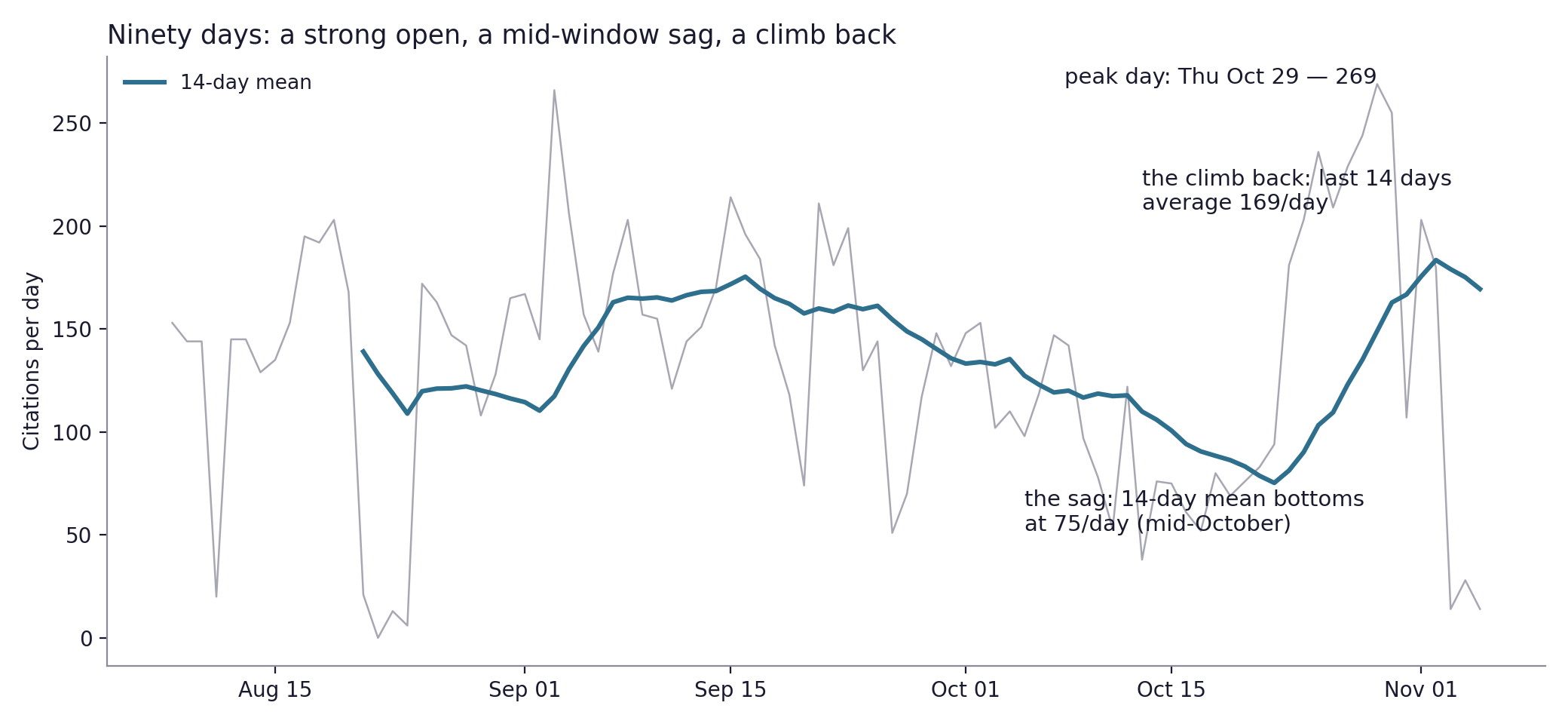
    Ninety days of daily AI citations for theuniversalcommerceprotocol.com: a spiky daily line with a fourteen-day average that sinks to 75 a day in mid-October, then climbs to the window's peak day — Thursday, October 29, at 269 citations — before the count cuts off at the window's edge on November 3 to 5.
    The U in ninety days. The last three days are a window edge, not a trend — see below. Source: Bing Webmaster Tools AI Performance, daily view.

    Two cautions belong on this chart, and we put them on the chart. The daily line is spiky at a level the other sites’ lines are not — it touches zero on Saturday, August 22, with zero cited pages, and several other days land under 25 while their neighbors run ten times higher. And the final three days of the window (14, 28, 14) drop off a cliff that is almost certainly the export’s edge, not the site’s collapse — the fourteen-day average was still climbing when the data ran out. On a small site’s report, single days are close to noise; the averages are the claim.

    The second act: the authentication shelf taught a replaced model

    Here is what we did about all this — because the first measurement arrived in the middle of a full refresh of this site, and the two collided in an uncomfortable place. Between October 27 and 31, Google rewrote its UCP documentation: the UCP-Agent request header — the identifier a page of ours taught merchants to trust — was demoted to routing and analytics only, spoofable by anyone, never authentication. The settled model is cryptographic: RFC 9421 request signatures (ES256) verified against the keys in the protocol profile, with mTLS at the transport layer. Spec version 2026-08-25; Canada live for shoppers since November 4.

    Our AI agent verification guide — a cited page on the authentication shelf — taught the old model in so many words: the agent’s identifier “travels in the UCP-Agent request header alongside a request-signature.” That sentence is the superseded model, stated as instructions. On November 8, in Wave 4 of the refresh, that page was republished teaching the RFC 9421 model instead, along with the endpoint shelf (the discovery-endpoint guides corrected to the same authentication model) and the flagship — the complete guide itself, republished the same day with its capability model corrected to spec version 2026-08-25 and the live US and Canada checkout status added. Fourteen pages in the wave. The measurement said the authentication shelf is what the machines cite; the documentation said the shelf was teaching last month’s answer; the refresh fixed the teaching.

    One part of that story we will not tidy up: the number-one page itself has not been fixed yet. The authentication leader at 1,668 citations still carries its pre-correction text — it was not one of Wave 4’s fourteen pages, and its own audit has not run. Its shelf got corrected around it. It is named, queued, and owed — and this receipt records it as open rather than pretending the leader and the lesson are the same page. They are one shelf apart.

    What we can’t claim

    • No baseline. This is the site’s first AI Performance pull, ever. Every shape in this piece — the U, the sag, the climb — is one window with nothing before it. A second pull may redraw all of it.
    • The views disagree by a fifth, and we don’t know why. Daily 12,105, page 9,628, query 8,755. We report each figure from its own view and never blend them, but a report that argues with itself this loudly caps how hard any single number can be leaned on.
    • No cause for the sag or the climb. Not Google’s October documentation rewrite — tempting as that timing is, with the peak landing October 29 — not crawl cycles, not the refresh (the refresh published November 8, after the window closed). The line moved; the export is silent about who moved it.
    • Single days are nearly noise here. A zero day (August 22), neighbors ten times apart, a cliff at the data’s edge — on a site this size the daily grain is too coarse to carry conclusions. We claim the averages and the shares, not the spikes.
    • The refresh’s effect is unmeasured. Wave 4 published November 8, outside this window entirely. Whether corrected pages hold or grow their citations is a question for the next pull — claiming it now would be grading our own homework before the test.
    • One engine, one window. Microsoft Copilot and partner citations as Bing reports them, ninety days, one small technical site. Another engine’s report could tell a different story about the same pages.

    What we do now

    1. Audit the leader. Post 4105 — the most-cited page on the site — gets its own audit-and-refresh pass, first in the next tranche, alongside the unaudited high-traffic shelf. The shelf around it is corrected; it is the remaining open item from this receipt, and it closes next.
    2. Pull the second measurement. Same window method, same three-view disclosure. The first re-measure after a refresh is the one that says whether teaching the current model changes what the machines cite.
    3. Keep the shares straight. Page shares from the page view, daily shape from the daily view, query figures from the query view — and the 20.5% disagreement printed wherever the totals are quoted. The receipts rule holds: the recount wins, and so does the disclosure.

    9,628 page citations, and half of them sit on three troubleshooting pages — while the shelf those pages stand on was teaching last month’s authentication model until the morning of November 8. The machines told us what they read. Then they told us, indirectly, that some of it was out of date. Both were receipts.

    Download the field-report PDF — the same receipts in a printable report.

    Update history
    November 8, 2026 — Published.

    November 8, 2026 — The video version went live on YouTube the same morning. Article published earlier the same day.

    November 8, 2026 — The fix this piece promised shipped the same day: the protocol’s #1 page (Agent Authentication & Identity Verification in Agentic Commerce, post 4105) was refreshed in UCP Wave 5 and now teaches the settled RFC 9421 model; the unverifiable vendor passages named in its audit are out. Wave 5 refreshed nine pages in total; the two remaining pillars followed in Wave 6 — so the correction it promised is done.

    Method note: All figures are from the Bing Webmaster Tools AI Performance exports for theuniversalcommerceprotocol.com — daily, page and query views — window August 8–November 5, 2026 (90 days), pulled November 8, 2026; this is the site’s first-ever pull. The three views sum to 12,105 (daily), 9,628 (page) and 8,755 (query); the 20.5% gap is the daily-minus-page difference as a share of the daily sum. “Pillars” are single exact pages — the most-cited page in each of the site’s three leading subjects — not keyword groupings. Page shares are shares of the page-view sum; daily means are means of the daily view; a query’s “share” is the export’s own printed figure. The authentication correction is documented in the UCP refresh programme’s Wave 4 record (addendum AUTH-2026-11, November 8, 2026): Google’s rewritten UCP FAQ (changed October 27–31, 2026) makes RFC 9421 ES256 signatures plus mTLS the authentication model, with the UCP-Agent header demoted to routing and analytics. Citation counts are Microsoft Copilot and partner citations as Bing reports them. The field-report PDF is at https://tygartmedia.com/wp-content/uploads/2026/11/half-the-citations-ucp-field-report.pdf. One site, one engine’s report, one first window — and a fifth of it disagrees with itself.
  • The Weekend Trough: The Work Week and the Weekend Never Touch

    The Weekend Trough: The Work Week and the Weekend Never Touch

    Seven receipts so far in this series: 44,583 citations at BC ESG, 109,844 at Healthcare Facility Hub, 813,426 on this site, 50,607 at Risk Coverage Hub, 57,798 at Continuity Hub, 111 at Restoration Intel, and — in No. 7 — 295 citations earned by Claude’s own pasted error messages. The eighth receipt comes back to this site’s big number, the 813,426, and lays it out the one way we had not laid it out yet: by weekday.

    Receipt No. 3 read the window as a plateau — the two halves nearly identical, about 9,000 citations a day. Averages hide rhythm. Lay the same ninety days on a calendar and the site has a heartbeat: a high plateau Monday through Thursday, a sag on Friday, a deep trough across the weekend — and a rebound every single Monday. It also has a confession to make about our own first description of that rhythm, which got its lowest day wrong. Both below.

    Watch the 60-second version: Why do this site’s AI citations keep office hours? — the same receipts in 49 seconds, chapters matched to the sections below.

    The pattern: a work-week with a weekend trough

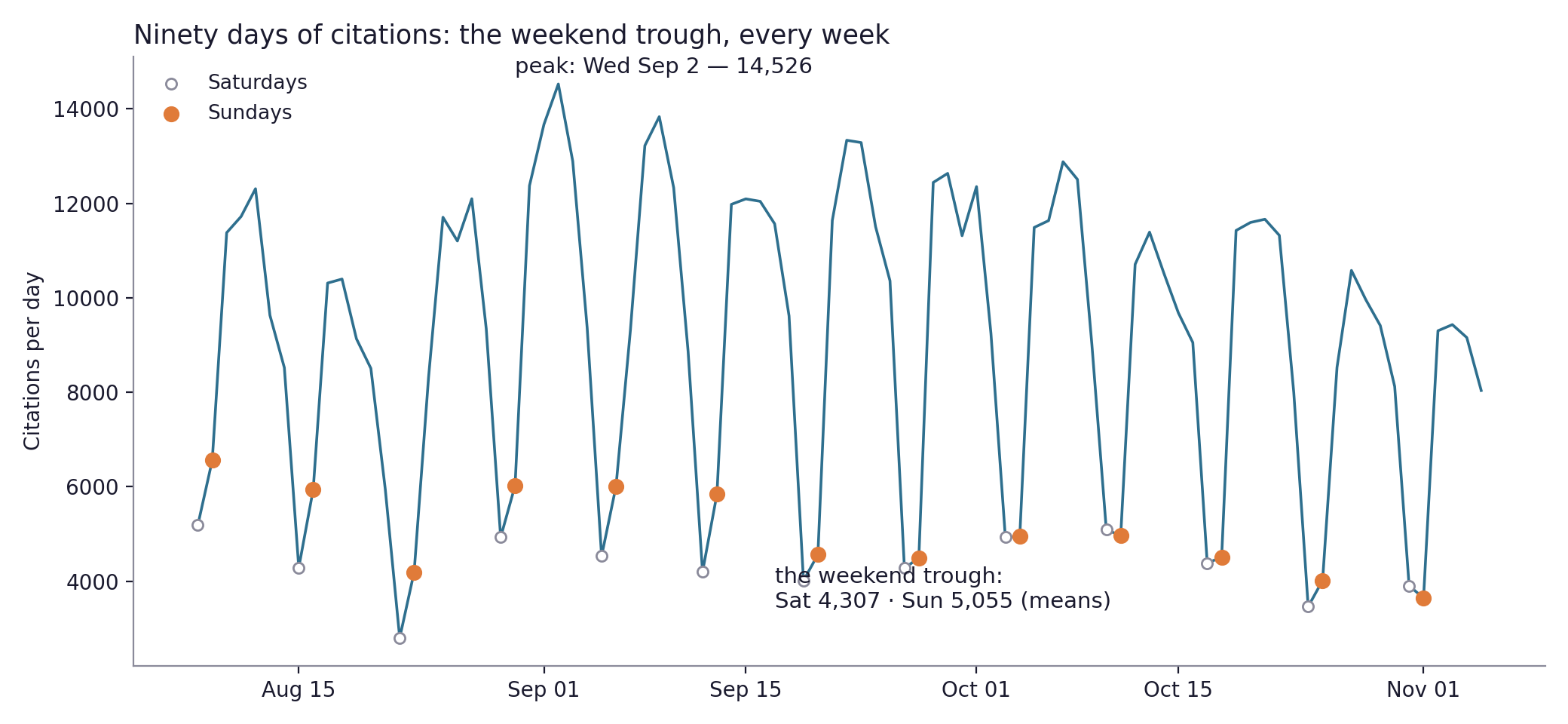
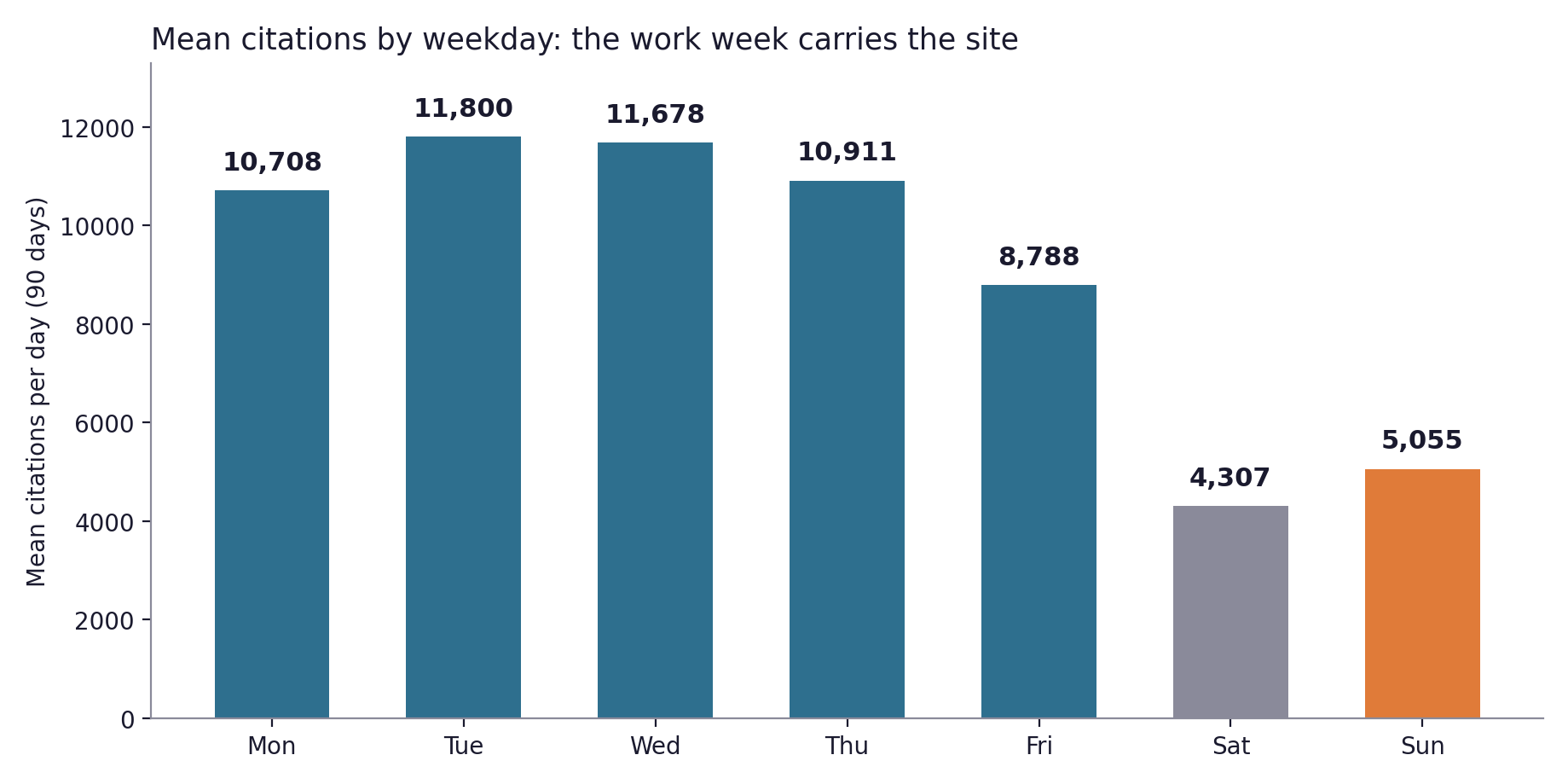
    The ninety days run Saturday, August 8 to Thursday, November 5, 2026. Grouped by weekday, the means are not close. Tuesday averages 11,800 citations, Wednesday 11,678, Thursday 10,911, Monday 10,708, Friday 8,788. Then the floor drops out: Sunday averages 5,055 and Saturday 4,307. Saturday and Sunday together — two-sevenths of the calendar — hold just 15.0% of the window’s citations. Monday through Thursday each hold 17–19% on their own.

    Tygart Media's daily AI citations over ninety days, August 8 to November 5, 2026: a high weekday plateau and a deep trough every weekend, with Sundays marked in orange and Saturdays as open grey circles. The peak day is Wednesday, September 2, at 14,526 citations.
    Ninety days, thirteen weekends, thirteen troughs. Source: Bing Webmaster Tools AI Performance, daily view.

    The cleanest single fact in the table: the weakest Monday of the window — 8,314 citations, on August 24 — still beats every Saturday and every Sunday in it. The strongest Sunday managed 6,559. There is no overlap at all between the work week and the weekend. Whatever the machines are doing, they do it on a work-week rhythm, and this site’s citation line keeps office hours.

    The numbers: the rebound is real, the cliff is Saturday’s

    Here is where we correct ourselves, in the open, the way No. 7 corrected its count. Our morning sweep described this pattern as a Sunday cliff — “every Sunday craters, every Monday roughly doubles it, ten clean doublings in a row.” The pairs it quoted all check out. The shape does not.

    Sunday is not the bottom. In eleven of the thirteen weekends, Sunday is higher than the Saturday before it — Sunday is already the climb back. Across the twelve complete Monday-to-Sunday weeks in the window, Saturday is the week’s lowest day ten times; Sunday is the lowest only twice — October 11 (4,966, under its Saturday’s 5,093) and November 1 (3,646, the window’s lowest Sunday). The cliff, if we are naming one, is Friday-to-Saturday. Sunday is where the recovery starts, and Monday completes it.

    Weekday Days Mean Median Low High Share of window
    Monday 13 10,708 11,378 8,314 12,442 17.1%
    Tuesday 13 11,800 11,705 9,432 13,669 18.9%
    Wednesday 13 11,678 11,663 9,132 14,526 18.7%
    Thursday 13 10,911 11,506 8,037 12,891 17.4%
    Friday 12 8,788 9,034 5,945 10,359 13.0%
    Saturday 13 4,307 4,287 2,800 5,188 6.9%
    Sunday 13 5,055 4,946 3,646 6,559 8.1%
    Mean AI citations by weekday for Tygart Media over ninety days: Tuesday 11,800, Wednesday 11,678, Thursday 10,911, Monday 10,708, Friday 8,788, Sunday 5,055, and Saturday lowest at 4,307.
    The work week carries the site. Source: Bing Webmaster Tools AI Performance, daily view.

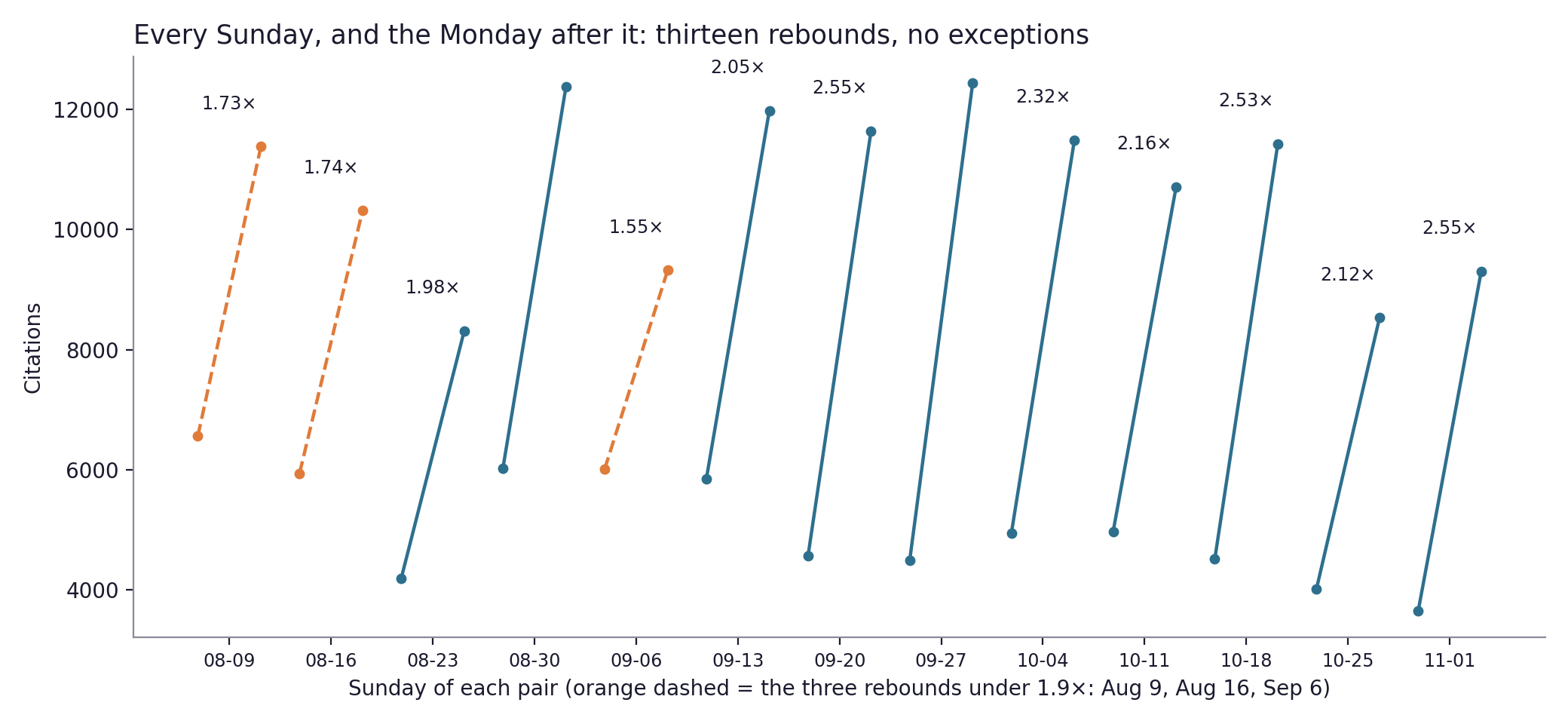
    The Monday rebound, though, is exactly as strong as advertised — it just isn’t ten straight doublings. All thirteen Sundays are followed by a Monday rebound; none fails. The average Monday runs 2.12× the average Sunday (2.30× on medians). Per week, ten of the thirteen rebounds reach 1.9× or better, and nine reach a full 2×. But the three that don’t are not scattered politely at the end — two of them open the window (August 9: 1.74×; August 16: 1.74×) and one sits mid-window (September 6: 1.55×). The longest clean run of near-doublings is seven straight, September 13 through October 25, plus one more on November 1. Our sweep quoted six example pairs, and every one of them was a qualifying week. That is how a true pattern gets a slightly false headline.

    Each of the thirteen Sundays in the window paired with the Monday after it: every pair rebounds, from 1.55 times on September 6 up to 2.77 times on September 27; the three rebounds under 1.9 times — August 9, August 16 and September 6 — are dashed in orange.
    Thirteen rebounds, none missing. Three of them aren’t doublings, and the chart doesn’t hide them. Source: Bing Webmaster Tools AI Performance, daily view.

    One more quiet fact under the rhythm: the load is concentrating. The daily report counts how many distinct pages were cited each day. On the window’s first day that was 173 pages; on its last, 135 — and the means agree with the endpoints: the first fourteen days averaged 184.7 cited pages a day, the last fourteen averaged 134.1, a 27% narrowing while the volume held. Fewer pages, carrying the same 9,000-a-day load. Breadth rests on weekends too — Saturdays average 132 cited pages against Tuesdays’ 181.

    The exceptions, named

    • August 9 — the mildest Sunday. The first Sunday in the window is its highest Sunday, 6,559, and its Monday rebound is the joint-weakest at 1.74×. The pattern starts at its gentlest and sharpens later.
    • September 6 — the weakest rebound. Sunday 6,009 to Monday 9,319 is 1.55× — the one weekend where neither the dip nor the rebound did much. It breaks any “ten straight doublings” story on its own.
    • October 11 and November 1 — the true Sunday bottoms. The only two Sundays that are their week’s minimum and below their Saturdays. November 1 is the window’s lowest Sunday (3,646) — and its Monday rebounds the hardest of the late window, 2.55× to 9,302.
    • Saturday, August 22 — the quietest day of the window. 2,800 citations across 90 cited pages. The deepest point of the deepest trough belongs to a Saturday, like most of them.
    • Monday never tops its own week. In zero of the twelve complete weeks is Monday the highest day — a Tuesday or Wednesday beats it every time. The window’s peak is a Wednesday: September 2, 14,526 citations across 232 cited pages, also the widest breadth day. Monday is the rebound, not the peak.
    • September 27 — the strongest rebound. Sunday 4,490 to Monday 12,442: 2.77×, the sharpest single step in the window.

    What we can’t claim

    • No cause. None. Not readers working weekdays, not crawl scheduling, not the engine batching its reporting by day. The data shows a rhythm; it is silent about the drummer.
    • The pattern may live in the measuring, not the world. Receipt No. 6 made this point about a fossil record, and it applies here with interest: a weekly shape in a report can be a weekly shape in reality, or a weekly shape in how the report gets built. From inside the report, we cannot separate those.
    • Our publishing cadence is untested against this. We have not lined our own posting calendar up against these ninety days, so we claim nothing either way — not innocence, not guilt. Correlation with a publishing rhythm, if one were found, would still not be a mechanism.
    • One engine, one window. These are Microsoft Copilot and partner citations as Bing reports them, ninety days on one site. Another engine’s report might keep different hours.
    • Our first headline was wrong in the open, and stays corrected. “Sunday cliff, ten straight doublings” was our sweep’s summary. The recount — printed above, with the table — is: a weekend trough whose bottom is usually Saturday, a Sunday that usually rises, and a Monday rebound that happens thirteen times out of thirteen at 2.12× on average. The title keeps the cliff; the article keeps the correction. The receipts rule is the recount wins.

    What we do now

    1. Nothing to fix. There is no Sunday problem to solve, because there is no Sunday problem — there is a rhythm. We do not publish to a citation clock, and we will not start.
    2. Read the week, not the day. From here on, a weekend dip in this report is not a collapse and a Monday spike is not a triumph. Any future read of this site’s citations gets compared weekday-to-weekday, or not at all.
    3. Re-measure on the next sweep. Same window method, same weekday arithmetic, same correction rule if the rhythm moves. If the trough ever fills in — or moves to a different day — that will be a receipt too.

    813,426 citations, and they keep office hours: 85% of them land Monday through Friday, the weakest Monday beats the strongest Sunday, and the line has rested every weekend for thirteen straight weeks. The plateau had a pulse. The receipts are the receipts.

    Download the field-report PDF — the same receipts in a printable report.

    Update history
    November 8, 2026 — Published.

    November 8, 2026 — The video version went live on YouTube the same morning. Article published earlier the same day.

    Method note: All figures are from the Bing Webmaster Tools AI Performance export for tygartmedia.com, daily view, window August 8–November 5, 2026 (90 days), pulled November 8, 2026. The daily view sums to 813,426 citations; the page view from the same pull sums to 792,317 (2.6% apart, as reported in Receipt No. 3) — each figure above is from the daily view unless it says otherwise. Weekdays are computed from the calendar dates (August 8, 2026 was a Saturday). A “week” is Monday through Sunday; week-minimum claims cover the twelve complete weeks inside the window. The Monday-to-Sunday ratio of 2.12× is the ratio of the two weekday means across all thirteen Mondays and thirteen Sundays. “Cited pages” is the daily report’s own column: distinct pages cited that day. Citation counts are Microsoft Copilot and partner citations as Bing reports them. The field-report PDF is at https://tygartmedia.com/wp-content/uploads/2026/11/the-weekend-trough-tygart-media-field-report.pdf. One site, one engine’s report, one window — with a weekly pulse.

  • The Machines Ask Claude’s Own Error Messages

    The Machines Ask Claude’s Own Error Messages

    Six receipts so far in this series: 44,583 citations at BC ESG, 109,844 at Healthcare Facility Hub, 813,426 on this site, 50,607 at Risk Coverage Hub, 57,798 at Continuity Hub, and 111 — every one of them inside seventeen days — at Restoration Intel. The seventh receipt is not a site at all. It is this site’s own question list, and it is the strangest shelf in it: buried in the 1,698 questions the machines consulted us on, some of the “questions” are not questions. They are Claude’s own error messages, pasted whole.

    Here is the shape of it. Somebody is working in Claude and hits a wall — a chat that will not take another image, a workspace that will not start, a request that is too large. They copy the message off the screen, paste it into an AI, and the AI goes looking for help. It finds our pages, and it cites them. Thirteen pasted messages, 295 citations. Around them sits a small franchise of misspellings worth 576 more, and a set of perfect scores so rare they round to zero. This is the smallest receipt in the series, and the funniest. Weird beats big.

    Watch the 60-second version: Why do machines ask about Claude’s own error messages? — the same receipts in 52 seconds, chapters matched to the sections below.

    The errors: pasted, not typed

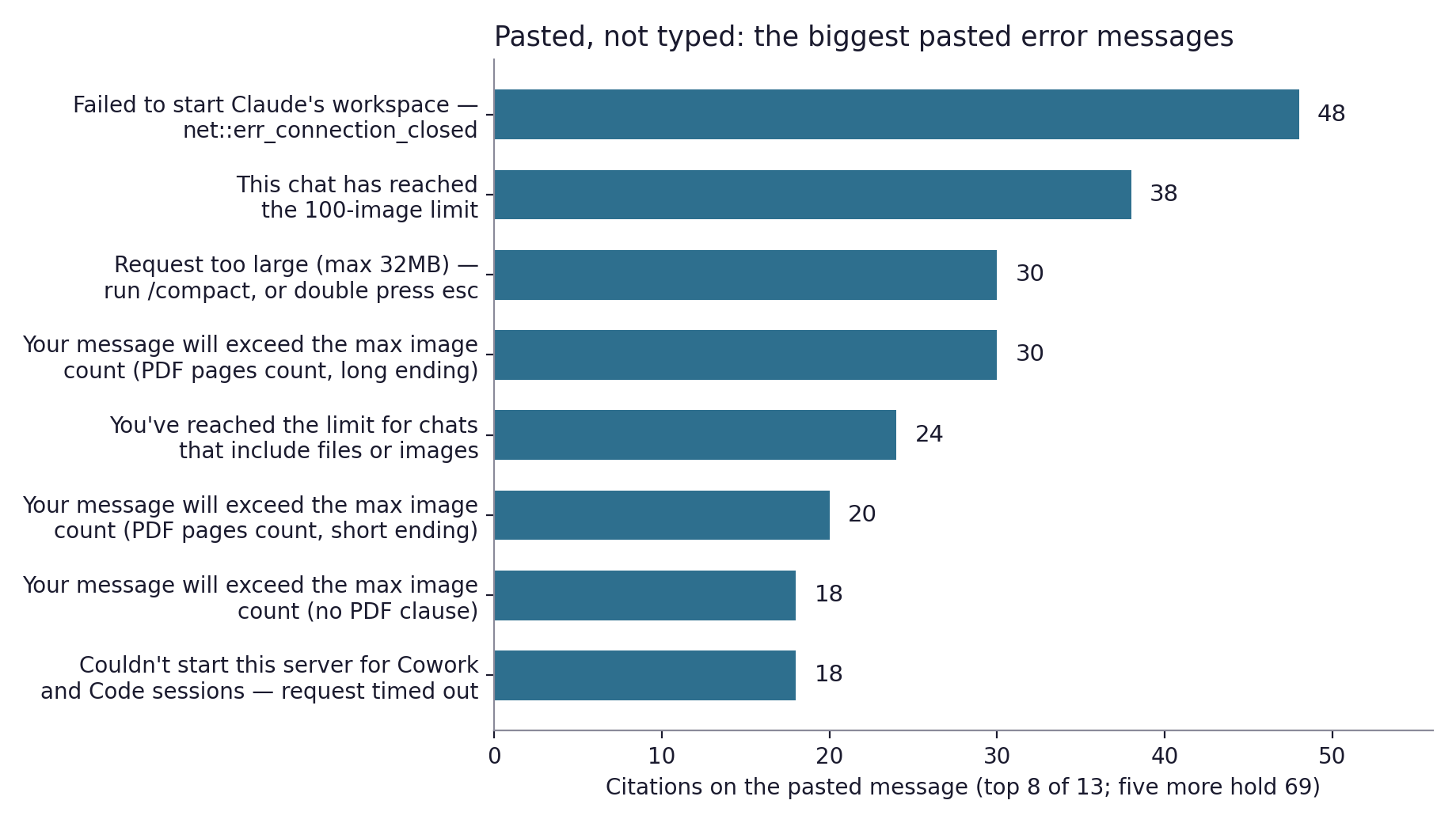
    The query view for this site holds 1,698 grounding queries for August 8 to November 5, 2026. Thirteen of them are verbatim copies of messages Claude’s interface shows its users — error dialogs and limit notices, word for word, punctuation and all. Counted together, they earned 295 citations.

    Our counting rule, printed so anyone can recount us: a query counts only if its whole text is a pasted interface message, in the system’s own voice. A person typing “claude cowork not working” (50 citations) is describing a problem in their own words — that does not count. Neither does the one pasted banner that is a promotion rather than an error, “your limits are temporarily boosted” (38). Errors and limit blocks only. The thirteen:

    • “failed to start claude’s workspace request error: net::err_connection_closed restarting claude or your computer sometimes resolves this. if it persists, you can reinstall the workspace.” — 48 citations; our share 14.72%.
    • “this chat has reached the 100-image limit (including pdf pages). start a new chat to add more.” — 38; our share 19.29%.
    • “request too large (max 32mb). accumulated images and attachments in the conversation pushed the request over the limit. run /compact, or double press esc to go back and remove attachments.” — 30; our share 27.78%.
    • “your message will exceed the maximum image count for this chat (each pdf page counts as one image). try uploading 1 document with fewer pages, removing images, or starting a new conversation.” — 30; our share 29.70%.
    • “you’ve reached the limit for chats that include files or images. start a new text-only chat or upgrade to continue now.” — 24; our share 50.00% — half of every answer to that pasted message cited us.
    • “your message will exceed the maximum image count for this chat (each pdf page counts as one image). try removing images or starting a new conversation.” — 20; our share 21.74%.
    • “your message will exceed the maximum image count for this chat. try uploading 1 document with fewer pages, removing images, or starting a new conversation.” — 18; our share 27.27%.
    • “couldn’t start this server for cowork and code sessions (they run their own copy of it), so they can’t use its tools: request timed out” — 18; our share 34.62%.
    • “your organization’s model list hasn’t loaded yet. claude reloads it automatically once the connection or sign-in recovers; if it still won’t load, contact your it administrator.” — 15; our share 22.73%.
    • “failed to start claude’s workspace” — 15; our share 6.61%.
    • “claude’s workspace service isn’t running” — 15; our share 20.00%.
    • “api error: claude’s response exceeded the 128000 output token maximum. to configure this behavior, set the claude_code_max_output_tokens environment variable.” — 12; our share 22.22%.
    • “failed to start claude’s workspace not enough disk space to set up the workspace. free up space and try again. restarting claude or your computer sometimes resolves this. if it persists, you can reinstall the workspace.” — 12; our share 26.09%.
    The eight biggest pasted Claude error messages in Tygart Media's grounding-query report: the failed workspace start at 48 citations, the 100-image limit at 38, the too-large request and the maximum-image-count message at 30 each, and four more between 18 and 24.
    Pasted, not typed — the top eight of thirteen. Source: Bing Webmaster Tools AI Performance, query view.

    Two patterns inside the thirteen. The message “your message will exceed the maximum image count for this chat” appears three times with three different endings — the same wall, screenshotted at three slightly different moments, worth 68 citations between them. And “failed to start claude’s workspace” opens three of the thirteen, worth 75. People do not paraphrase an error message. They hand the machine the exact words the last machine showed them, and the machine comes to us.

    The typos: a small franchise

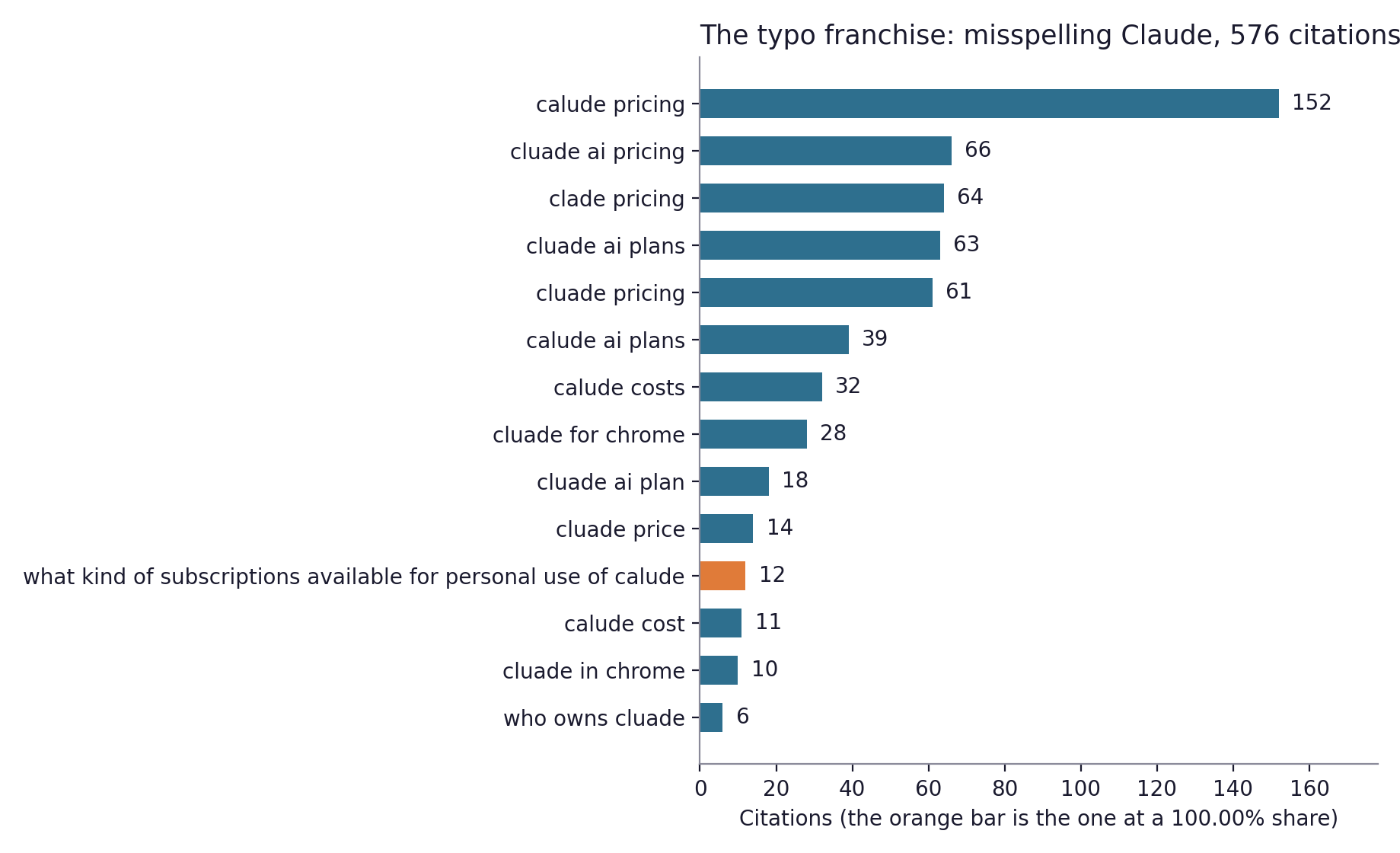
    Fourteen queries in the report misspell the product’s name — calude, cluade, clade — and between them they earned 576 citations, nearly double the entire error shelf:

    • “calude pricing” — 152 citations
    • “cluade ai pricing” — 66 (our share 69.47%)
    • “clade pricing” — 64
    • “cluade ai plans” — 63 (50.00%)
    • “cluade pricing” — 61
    • “calude ai plans” — 39 (68.42%)
    • “calude costs” — 32
    • “cluade for chrome” — 28
    • “cluade ai plan” — 18
    • “cluade price” — 14
    • “what kind of subscriptions available for personal use of calude” — 12, at a 100.00% share
    • “calude cost” — 11
    • “cluade in chrome” — 10
    • “who owns cluade” — 6
    All fourteen misspelled-Claude queries and their citations: calude pricing at 152, cluade ai pricing at 66, clade pricing at 64, down to who owns cluade at 6; the subscriptions question about 'calude' highlighted at a 100 percent share.
    Fourteen misspellings, 576 citations. Source: Bing Webmaster Tools AI Performance, query view.

    Somebody, six citations’ worth, asked who owns Cluade. We do not. But the best row in the table is the personal-use one: asked in exactly those misspelled words, every single time, the machines cited us. A perfect score — which turns out to be the rarest thing in the whole report.

    The perfect scores: five in 1,698

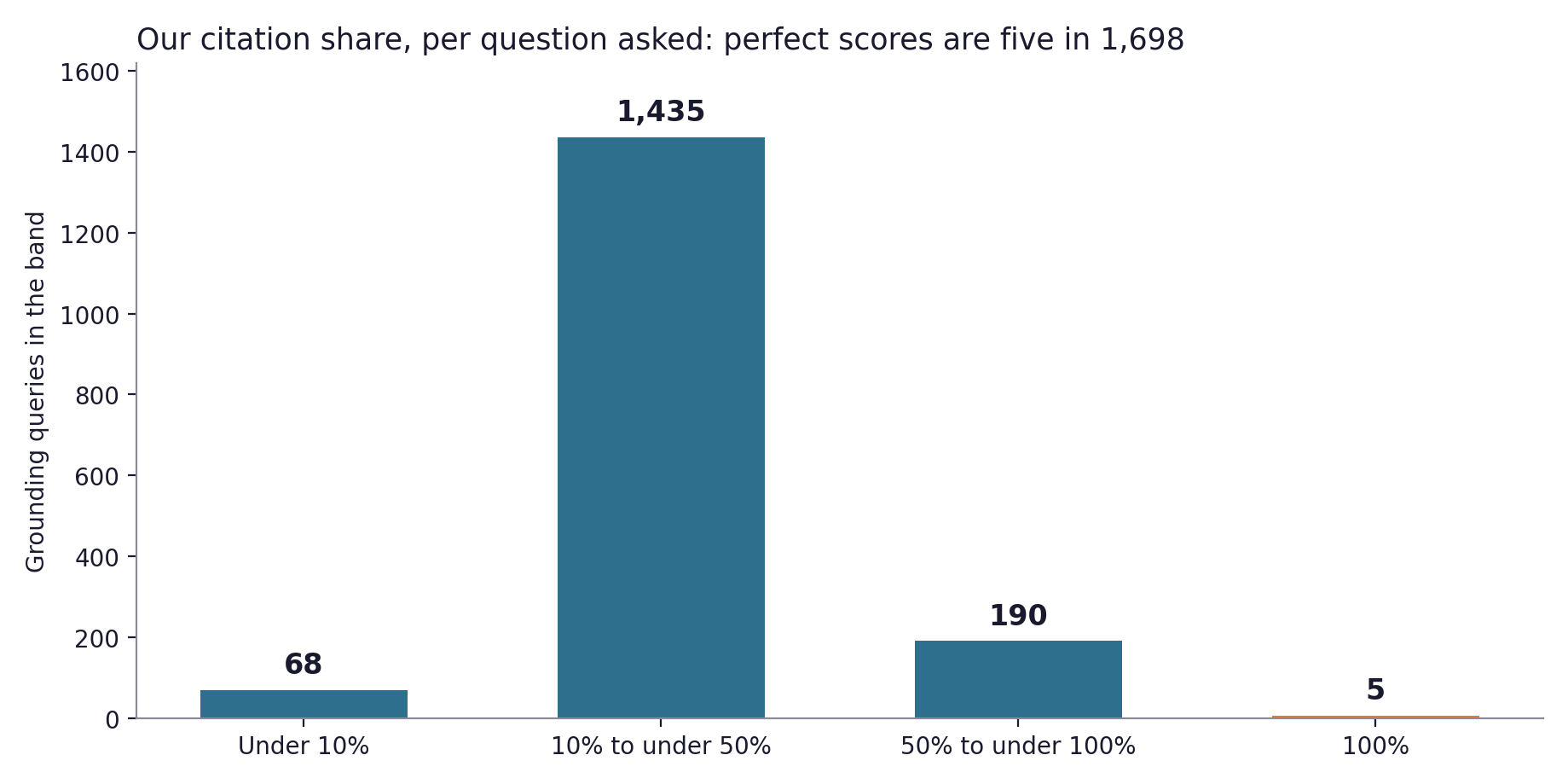
    Bing reports a citation share for every query — the fraction of answers that cited us. Spread across all 1,698 questions, the shape is ordinary: 68 questions sit under a 10% share, 1,435 sit between 10% and 50%, 190 sit between 50% and 100%. And at exactly 100.00% — every answer, every time — there are five:

    • “claude standard plan” — 345 citations
    • “how much for claude ai” — 33
    • “claude entreprise prix” — 30 (French: the enterprise price)
    • “what kind of subscriptions available for personal use of calude” — 12 (the typo, again)
    • “anthropic create api key” — 4
    Distribution of Tygart Media's citation share across all 1,698 grounding queries: 68 under 10 percent, 1,435 between 10 and 50 percent, 190 between 50 and 100 percent, and 5 at exactly 100 percent.
    Perfection is five questions wide. Source: Bing Webmaster Tools AI Performance, query view.

    Two side dishes from the same shelf. The longest query in the report, at 236 characters, is a multiple-choice exam question — it opens “what can copilot do if you join a meeting late?” and then pastes its own four answer options; somewhere a quiz is being answered with our pages as the source (10 citations, 26.32%). And the report cites our homework: the article describing this site’s citation experiment holds 20 citations of its own. The thesis about the report, cited in the report.

    What we can’t claim

    • We don’t know why our pages answer the errors. Nothing in the report says which page answered which pasted message, or why the machines reached for us. The pattern is visible; a mechanism would be storytelling.
    • The query view is a sample, not a census. Its citations sum to 371,847 against the daily view’s 813,426 — Bing showed us a window onto the questions, not all of them. Every number here is “of the queries Bing showed us.”
    • The text is what people pasted — errors included. We quote these queries as data, exactly as they sit in the report, misspellings and truncated sentences and all. Correcting them would be editing the evidence.
    • Our own first count was wrong, so we fixed it in the open. Our sweep’s first tally read 12 messages and 245 citations. When we pinned the counting rule down in writing — the rule printed in the first section above — the count moved to 13 and 295. The rule is printed precisely so the recount is checkable.
    • One engine, one window, one site. These are Microsoft Copilot and partner citations as Bing reports them, for ninety days. Another engine’s report would show a different shelf.

    What we do now

    1. We don’t write for typos. There will be no “calude pricing” page. The franchise is a fact about how people type, not a strategy; the pages earn the misspelled questions by answering the spelled ones.
    2. Keep the help pages accurate. The machines route broken sessions to us — a person mid-error, request too large, workspace dead. The least the page they land on can do is be right.
    3. Re-measure on the next sweep. The error shelf and the typo franchise get counted again with the rest of the fleet, same windows, same instrument, same counting rule.

    295 citations for error messages nobody typed. 576 for a name spelled wrong. Five perfect scores in 1,698 tries. The receipts are the receipts — including the funny ones.

    Download the field-report PDF — the same receipts in a printable report.

    Update history
    November 8, 2026 — Published.

    November 8, 2026 — The video version went live on YouTube the same morning. Article published earlier the same day.

    Method note: All figures are from Bing Webmaster Tools AI Performance exports for tygartmedia.com, window August 8–November 5, 2026 (90 days), pulled November 8, 2026. The daily view sums to 813,426 citations, the page view to 792,317 (2.6% apart), and the query view — a sample of 1,698 grounding queries — to 371,847; each figure above names its view. Citation counts are Microsoft Copilot and partner citations as Bing reports them; citation shares are Bing’s per-query figures. Query text is quoted verbatim from the report, including the errors in it. The error-message count uses the rule printed in the article: whole pasted interface messages only — 13 queries, 295 citations. The field-report PDF is at https://tygartmedia.com/wp-content/uploads/2026/11/the-machines-ask-claudes-errors-tygart-media-field-report.pdf. This is one site, one engine’s report, one window — and its strangest shelf.

  • The 17-Day Wonder: One Burst, Then Silence

    The 17-Day Wonder: One Burst, Then Silence

    Five receipts so far in this series, five living sites: 44,583 citations at BC ESG, 109,844 at Healthcare Facility Hub, 813,426 on this site, 50,607 at Risk Coverage Hub, 57,798 at Continuity Hub. The sixth site we counted is a ghost. Restoration Intel — our restoration-industry library — earned 111 AI citations in the older window we measured, and every one of them landed inside seventeen days. In the fresh ninety-day window, the same report says zero. Not a decline. A disappearance.

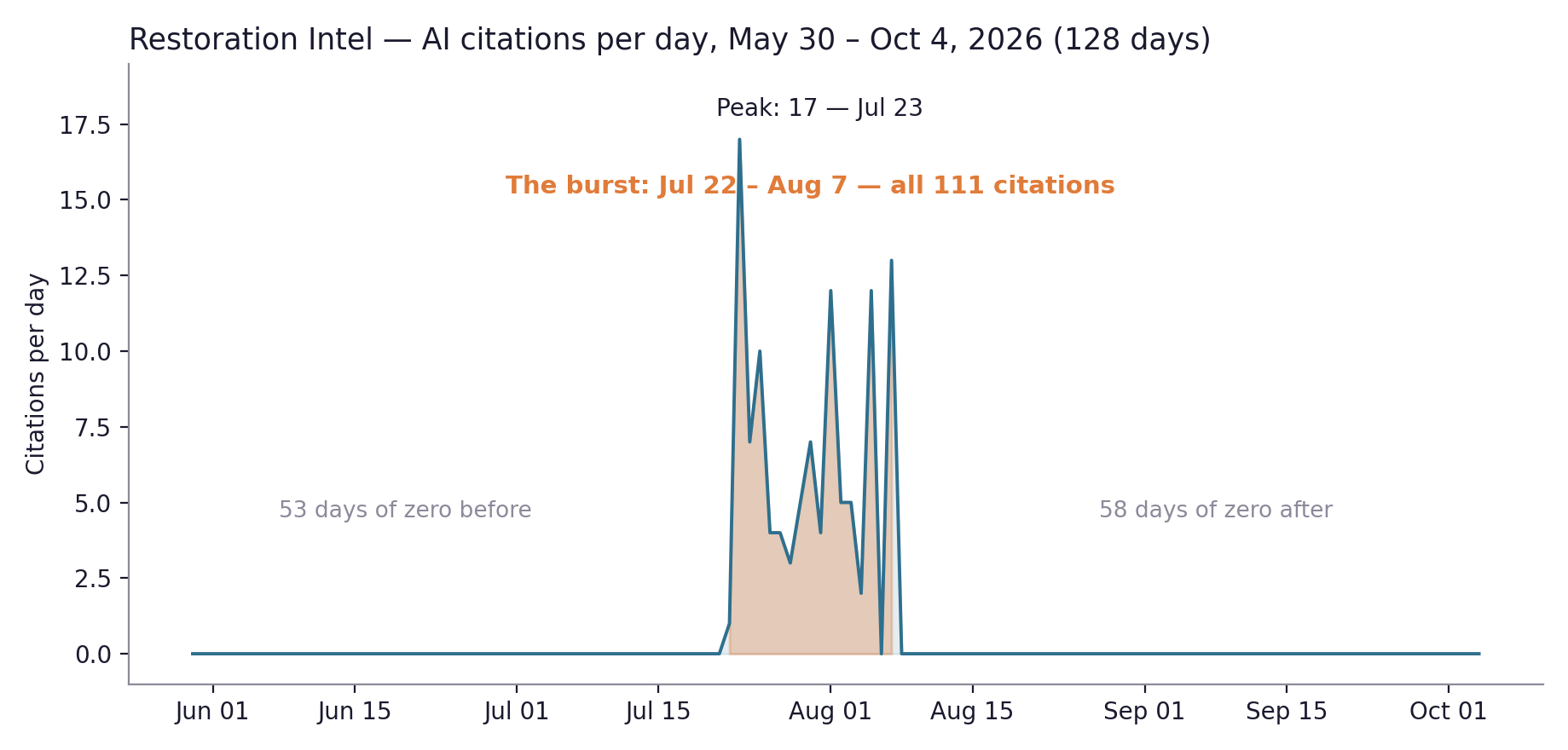
    Here is the whole story, because the whole story is short: fifty-three days of nothing, a burst from July 22 to August 7, then silence — fifty-eight more days of it in that export, and ninety straight days of zero in the new one. One guide holds nearly two-thirds of the burst. Five questions account for all of it that the query view can see. This is the smallest receipt in the series by orders of magnitude, and the strangest.

    Watch the 60-second version: Why did this site’s AI citations live for exactly 17 days? — the same receipts in 44 seconds, chapters matched to the sections below.

    The burst: seventeen days

    The older window is May 30 to October 4, 2026 — 128 days, exported from Bing Webmaster Tools’ AI Performance report on October 6. The daily series sums to 111; the page table sums to 110. Bing’s views differ, and at this size they nearly agree: 0.9% apart, where the other sites in this series ran 2.6% to 5.7%. Every figure below names its view.

    112 of the 128 days read zero. The sixteen days that don’t sit inside one stretch, July 22 to August 7: 1, 17, 7, 10, 4, 4, 3, 5, 7, 4, 12, 5, 5, 2, 12, 0, 13. One day inside the burst — August 6 — reads zero too, a held breath in the middle. The peak is the second day: 17 citations on July 23. Then, after August 7, nothing. Not a taper — the line simply stops, and it has not restarted in any window we’ve pulled since.

    Restoration Intel daily AI citations over 128 days: a flat zero line, a 17-day burst in late July and early August holding all 111 citations with a peak of 17 on July 23, then zero again.
    One burst in 128 days. Source: Bing Webmaster Tools AI Performance, daily view (exported October 6, 2026).

    The guide: 70 of 110

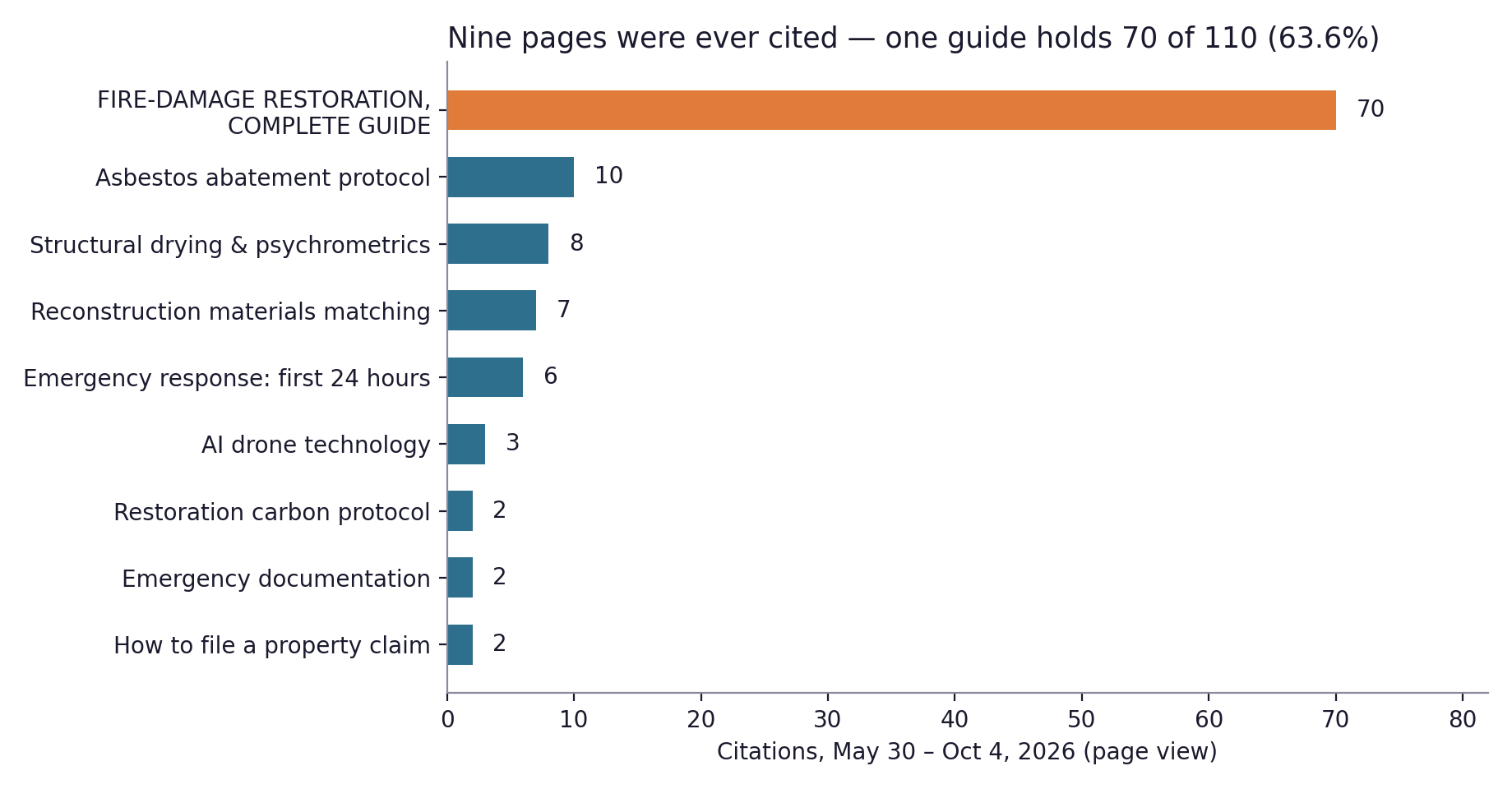
    Nine pages were cited in the burst, ever. One of them took nearly two-thirds of the page-sum:

    • Fire-damage restoration, complete professional guide — 70
    • Asbestos abatement protocol — 10
    • Structural drying systems & psychrometrics — 8
    • Reconstruction materials matching — 7
    • Emergency response: the first 24 hours — 6
    • AI drone technology in restoration — 3
    • Restoration carbon protocol — 2
    • Emergency documentation — 2
    • How to file a property insurance claim — 2

    Receipt No. 3’s leader held 30.8% of a huge site and we called it a star. This is 63.6% of a tiny one. The fire guide wasn’t a page among pages during those seventeen days; for whatever the machines were doing that fortnight, it was close to the whole site. The supporting cast is the library doing its job — drying science, abatement protocol, materials matching — real professional references, cited in single digits, then gone.

    Restoration Intel's nine cited pages: the fire-damage restoration guide at 70 citations, the other eight between 2 and 10.
    Nine pages, one guide. Source: Bing Webmaster Tools AI Performance, page view.

    The questions: five, ever

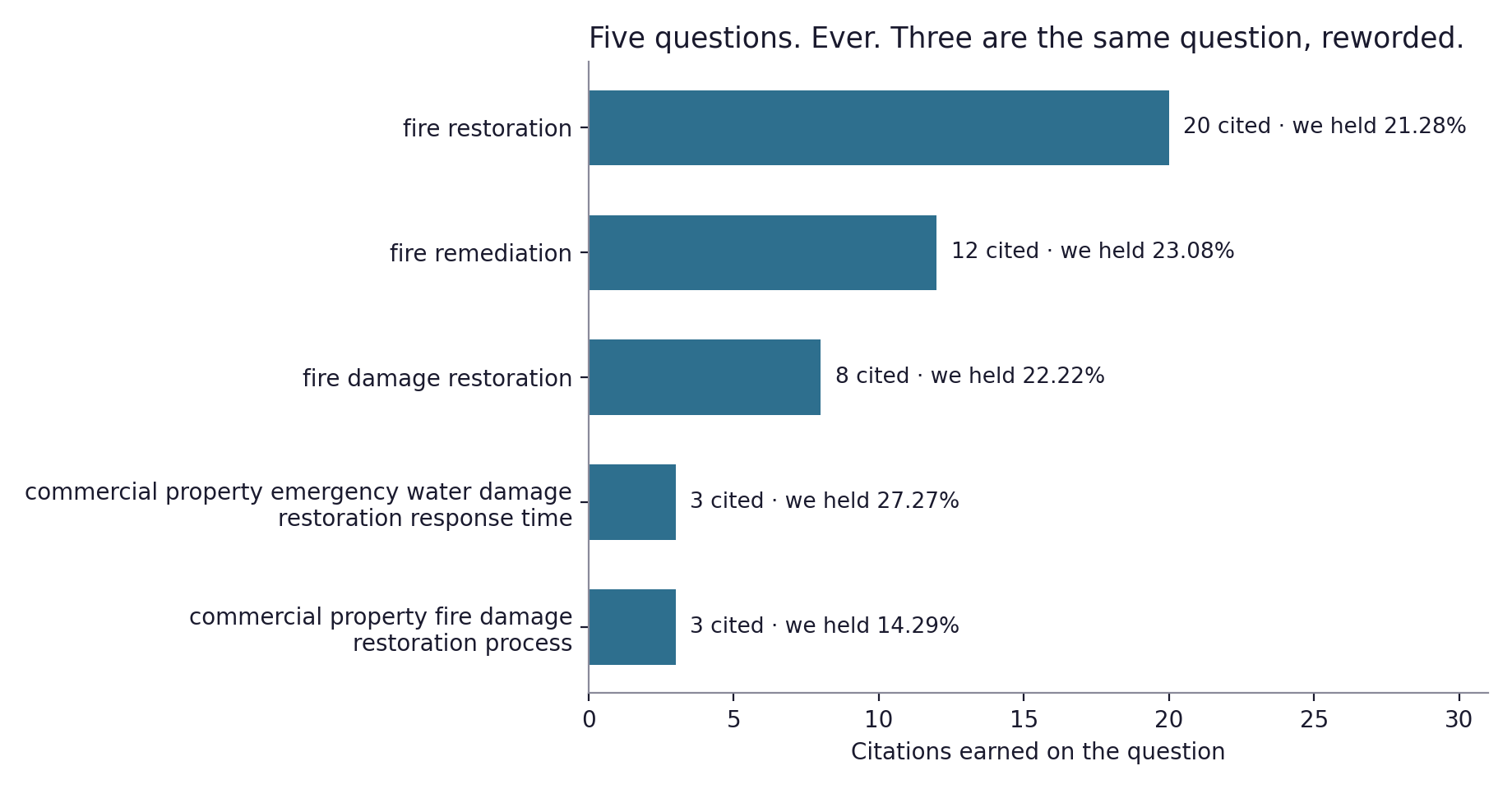
    The query view for the older window holds exactly five questions. Not five hundred — five. Three of them are the same question with the words rearranged:

    • “fire restoration” — 20 citations; our share 21.28%.
    • “fire remediation” — 12; our share 23.08%.
    • “fire damage restoration” — 8; our share 22.22%.
    • “commercial property emergency water damage restoration response time” — 3; our share 27.27%.
    • “commercial property fire damage restoration process” — 3; our share 14.29%.
    The only five questions that ever cited Restoration Intel, with the site's share of each: fire restoration 20 citations at 21.28 percent, fire remediation 12 at 23.08, fire damage restoration 8 at 22.22, and two long commercial-property questions at 3 each.
    Five questions, and our share of each. Source: Bing Webmaster Tools AI Performance, query view.

    Those five rows are the entire visible demand. The query view sums to 46 citations against the daily view’s 111 — the views don’t reconcile at this scale, and we won’t pretend they do. What’s solid is the shape: for seventeen days, when the machines answered questions about fire restoration, they reached for this library about a fifth to a quarter of the time — and reached for its fire guide most of all. Then they stopped reaching.

    The silence: ninety days of zero

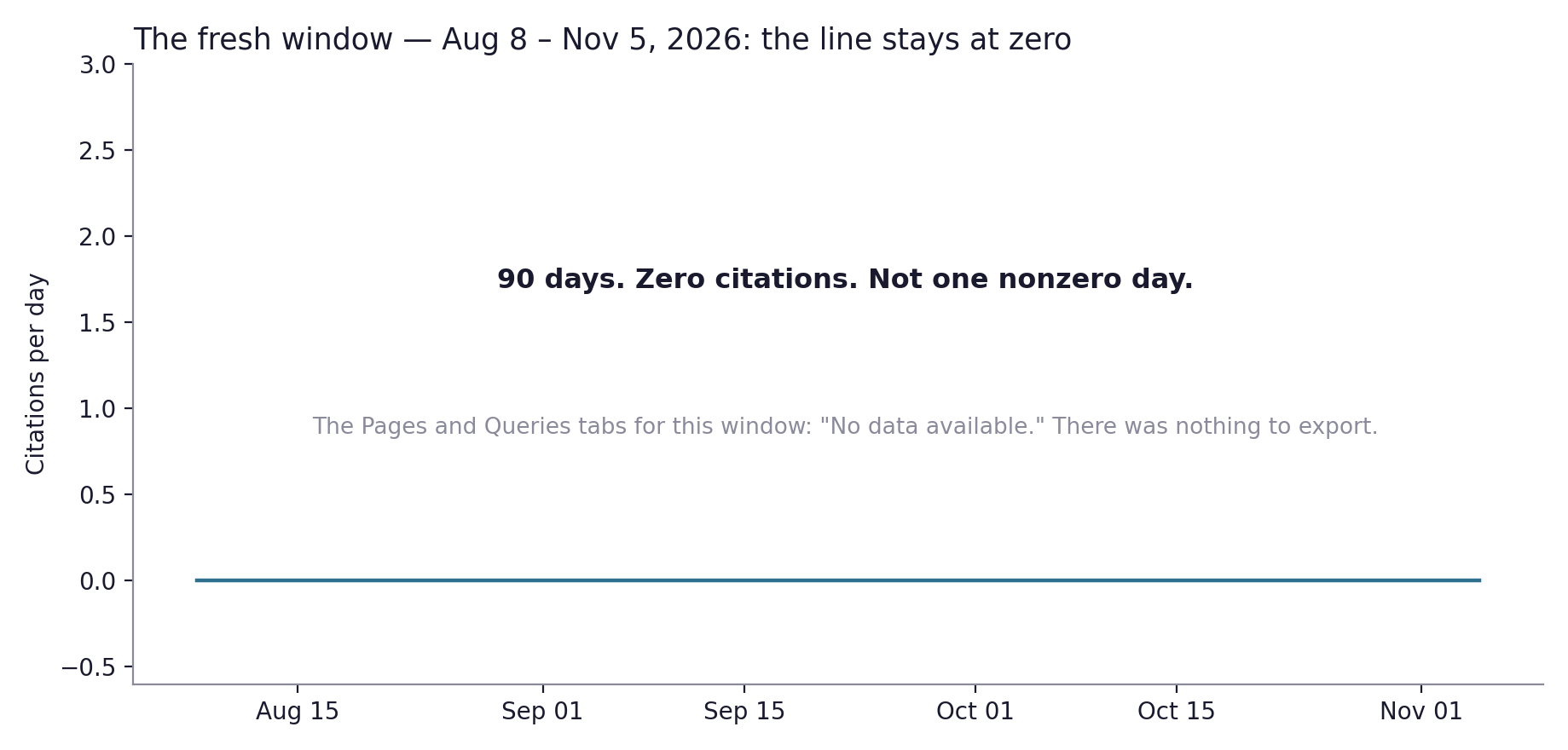
    The fresh window is the series-standard one — August 8 to November 5, 2026, ninety days, pulled November 8. The daily series sums to 0. There is not one nonzero day in it. The report’s Pages tab and Grounding Queries tab for this window showed “No data available” — the downloads were disabled, because there was nothing to download.

    Restoration Intel daily AI citations in the fresh 90-day window, August 8 to November 5, 2026: a flat line at zero for all ninety days.
    The fresh window. The emptiness is the data. Source: Bing Webmaster Tools AI Performance, daily view (pulled November 8, 2026).

    Put the two windows side by side and the site has now been silent for 148 consecutive measured days — the last fifty-eight of the old export and all ninety of the new one. Every other site in this series grew, plateaued, or tripled. This one is the only line in the fleet that goes to zero and stays there.

    What we can’t claim

    • We don’t know why it started. Nothing in these files says what switched on around July 22. The burst also predates the export that recorded it — the data was pulled October 6, looking back — so we’re reading a fossil, not watching a feed.
    • We don’t know why it stopped. A ranking change, a crawl change, a reporting change, the end of some trial on the engine’s side — the report records counts, not causes. Picking one would be storytelling.
    • The report’s own coverage may be part of the story. When Bing’s AI Performance report began covering this site, and how completely, is inside the mystery, not outside it. A burst in the data can be a burst in the world or a burst in the measuring. We can’t separate those from here.
    • No cause is claimed — including ours. Anything we published or changed around those dates is not established as a cause, in either direction. Correlation with the burst would still not be a mechanism.
    • 111 is small. One engine, one report, one site. At this size a handful of answers moving is the whole chart. We publish it because it’s ours and it’s strange — not because it’s big.

    What we do now

    1. Keep publishing the library. Restoration Intel exists to be a working reference for restoration professionals — the guides are useful whether or not a machine quotes them this quarter. The library is not a citation farm and we won’t run it like one.
    2. Re-measure on the next sweep. The ghost gets counted again with the rest of the fleet, same windows, same instrument. If it ever flickers, we’ll see it in the series.
    3. Don’t chase it. No rewrite of the fire guide to summon a burst we don’t understand, no surgery on a site whose only proven fact is that something happened once, for seventeen days, in the summer.

    111 citations. Seventeen days. Then zero, for ninety straight days and counting. The ghost — published like everything else in this series, because the receipts are the receipts.

    Download the field-report PDF — the same receipts in a printable report.

    Update history
    November 8, 2026 — Published.

    November 8, 2026 — The video version went live on YouTube the same morning. Article published earlier the same day.

    Method note: All figures are from Bing Webmaster Tools AI Performance exports for restorationintel.com. Older window: May 30–October 4, 2026 (128 days), pulled October 6, 2026 — the daily view sums to 111, the page view to 110 (0.9% apart), and the query view to 46; Bing notes totals may differ across views, and each figure above names its view. Fresh window: August 8–November 5, 2026 (90 days), pulled November 8, 2026 — the daily view sums to 0, and the Pages and Grounding Queries tabs showed “No data available,” so no page or query export exists for that window. Citation counts are Microsoft Copilot and partner citations as Bing reports them; citation shares are Bing’s per-query figures. Page names are shortened from the pages’ own titles. The field-report PDF is at https://tygartmedia.com/wp-content/uploads/2026/11/the-17-day-wonder-tygart-media-field-report.pdf. This is one site, one engine’s report, two windows — one of them empty.

  • The Anchor and the Pillars: One Guide, a Fifth of a Site

    The Anchor and the Pillars: One Guide, a Fifth of a Site

    Three shapes so far in this series: a star (Receipt No. 3 — one page, 30.8% of its site), a bench (Receipt No. 4 — no page above 7.7%), and now the shape between them. Continuity Hub — our business-continuity reference — earned 57,798 AI citations in ninety days, and one guide holds 10,579 of them: 19.2% of the page-sum.

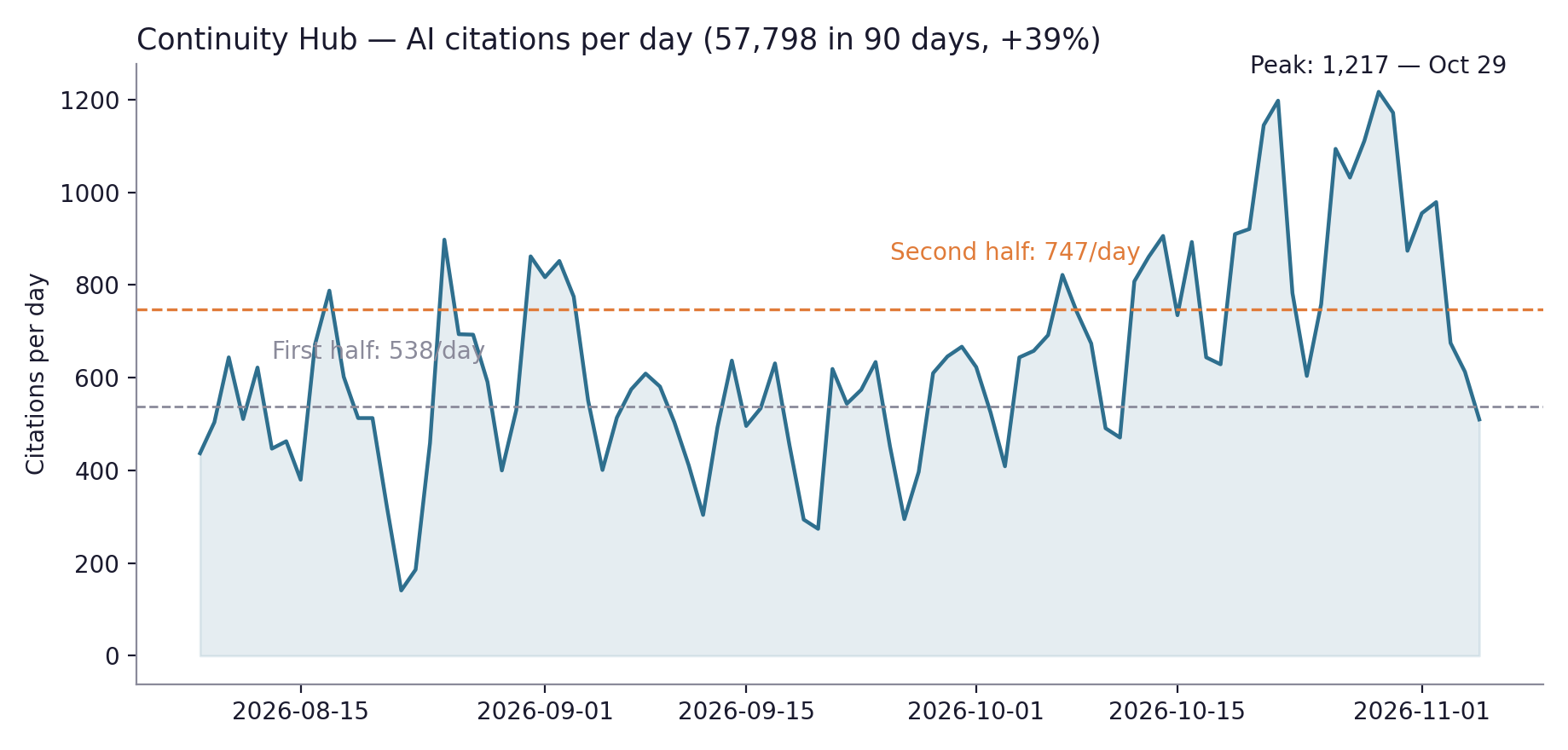
    The guide is a complete professional treatment of supply-chain resilience. The site grew +39% by halves — 538 citations a day to 747 — with the last fourteen days averaging 884 and a peak of 1,217 on October 29. An anchor, real support, steady growth. The hybrid.

    Watch the 60-second version: Why does one guide hold a fifth of this site’s AI citations? — the same receipts in 47 seconds, chapters matched to the sections below.

    The count

    The window is August 8 to November 5, 2026, from Bing Webmaster Tools’ AI Performance report — the same instrument as the rest of this series. The daily series sums to 57,798; the page table sums to 55,029. Bing’s views differ (here by 4.8%), Bing prints a note saying so, and every figure below names its view.

    55 pages, 547 questions. The halves: 538 a day, then 747. First fourteen days: 530 a day. Last fourteen: 884. Not the flagship’s plateau, not Risk Coverage Hub’s triple — a working site’s steady climb, with its biggest day, October 29, landing in the most recent third of the window.

    Continuity Hub daily AI citations over 90 days: 538 a day in the first half, 747 in the second, peak 1,217 on October 29.
    Steady growth: 57,798 citations in 90 days, +39% by halves. Source: Bing Webmaster Tools AI Performance, daily view.

    The anchor — and the support under it

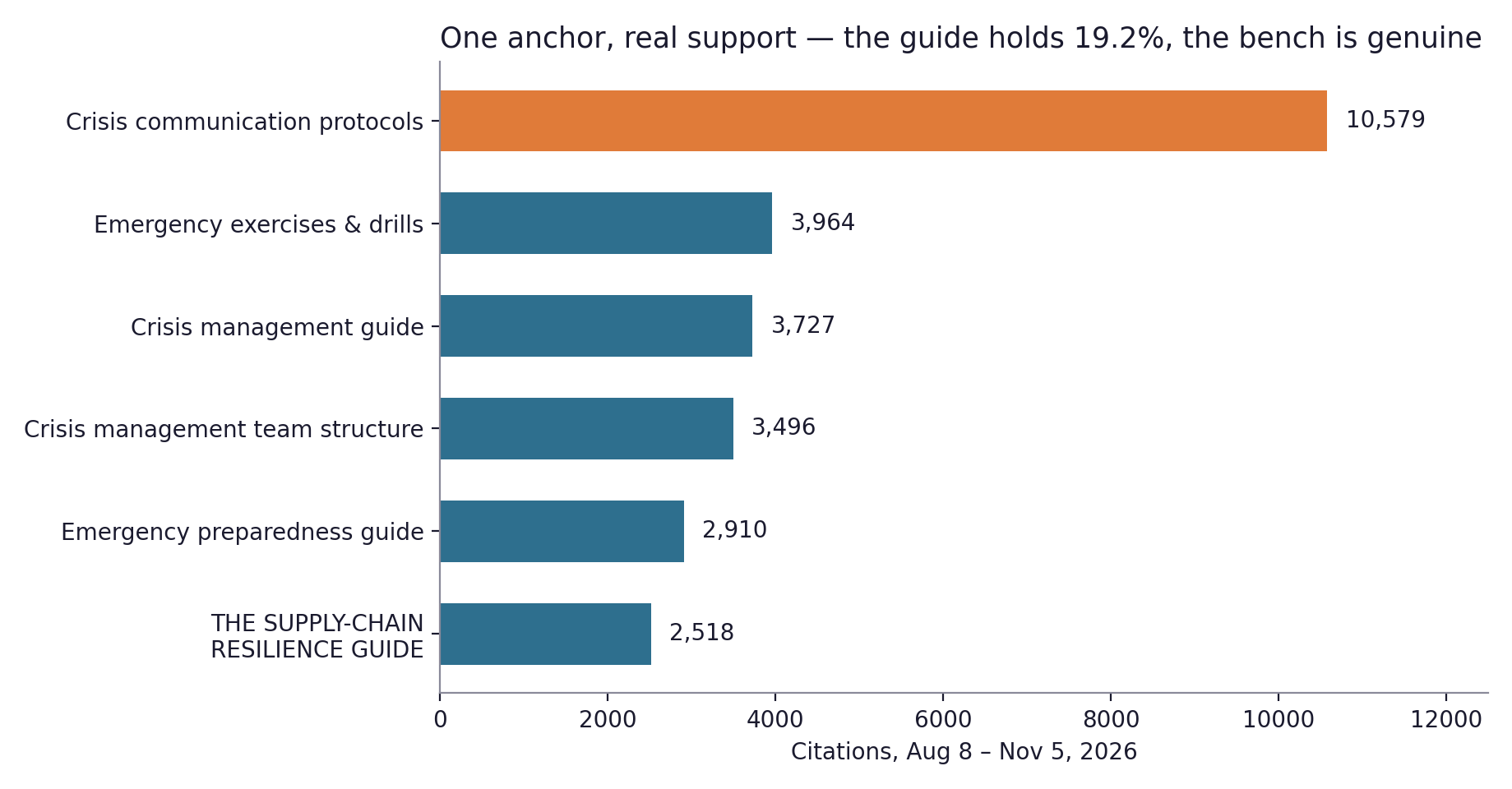
    The supply-chain resilience guide’s 10,579 is a genuine lead — 2.7 times the runner-up. But read down the table and the anchor isn’t carrying the building alone:

    • Supply-chain resilience, complete guide — 10,579
    • Crisis communication protocols — 3,964
    • Emergency exercises & drills — 3,727
    • Crisis management, complete guide — 3,496
    • Crisis management team structure — 2,910
    • Emergency preparedness, complete guide — 2,518

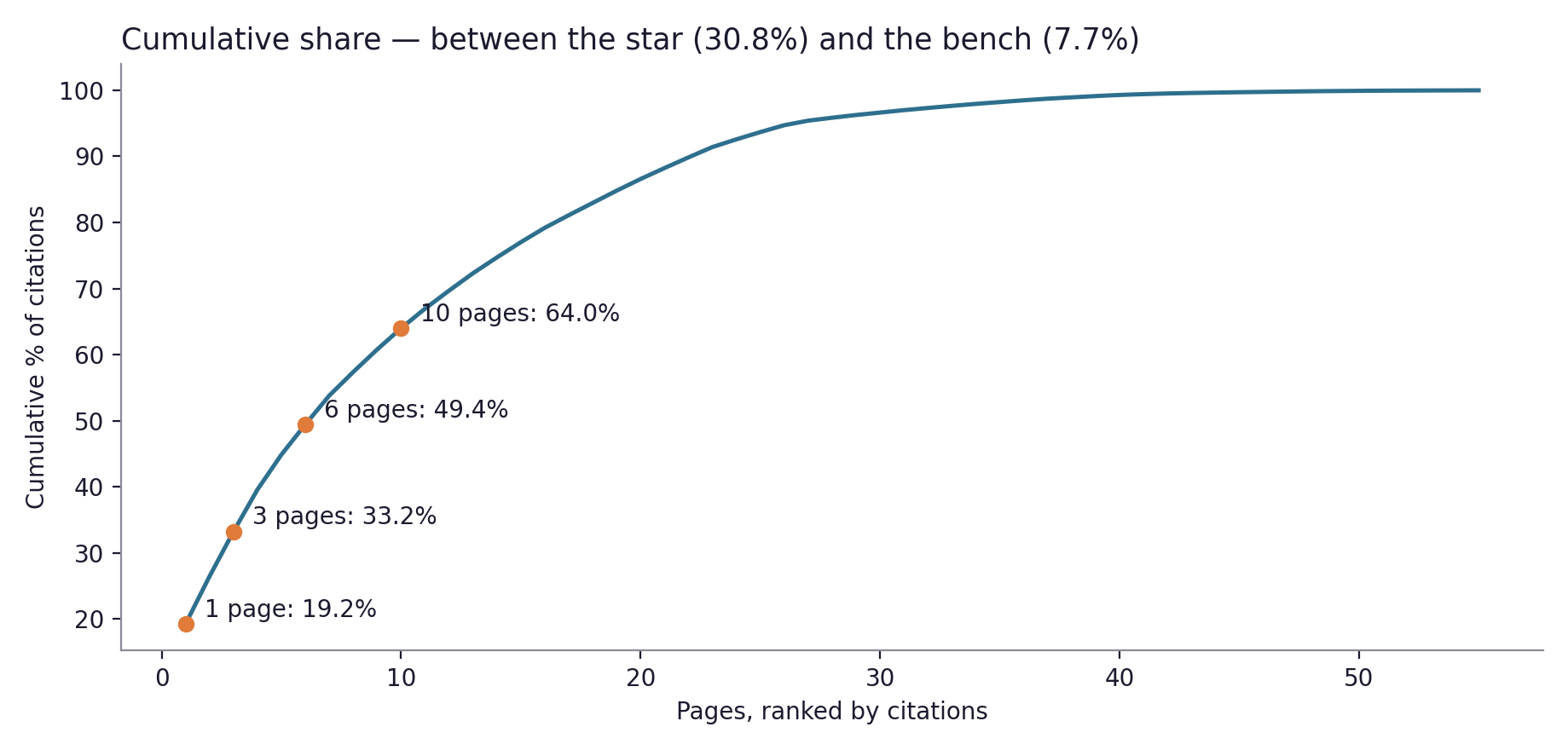
    Three pages hold 33.2% of the page-sum; six hold 49.4%; ten hold 64.0%. And the families are balanced: five crisis pages hold 23.4% (12,869), five supply-chain pages hold 24.7% (13,614). Two pillars of near-equal weight, one of them fronted by an anchor. If the anchor page stumbled tomorrow, this site would lose a fifth of its count, not a third — and the crisis pillar wouldn’t notice. That’s the risk arithmetic of the hybrid shape, and on these numbers it’s the most comfortable of the three.

    Continuity Hub's top pages: the supply-chain resilience guide at 10,579, with five more guides between 2,518 and 3,964 — an anchor with genuine support.
    One anchor, real support. Source: Bing Webmaster Tools AI Performance, page view.
    Cumulative share curve for Continuity Hub: one page 19.2 percent, three pages 33.2, six pages 49.4, ten pages 64.0 — between the star site and the bench site.
    Cumulative share of the page-sum — the middle curve of the series. Source: Bing Webmaster Tools AI Performance, page view.

    The questions: one phrase owned, one contested

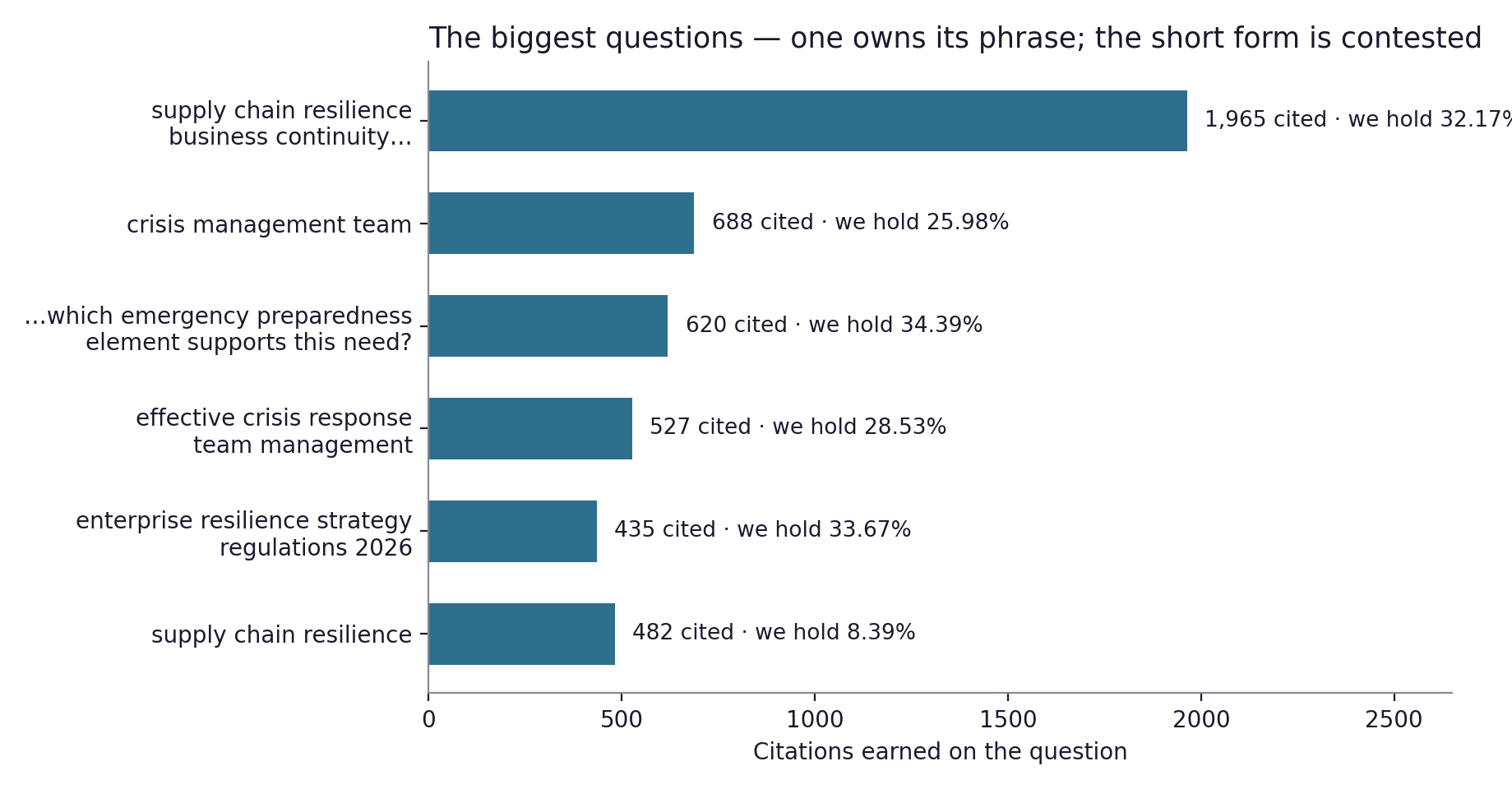
    The guide’s own question is the site’s biggest, and the hold is strong:

    • “supply chain resilience business continuity vulnerabilities management” — 1,965 citations; our share 32.17%.
    • “crisis management team” — 688; our share 25.98%.
    • And a question in full sentence form, the way someone asks a person: “during a disaster, a facility needs to quickly reach staff, volunteers, and emergency management partners. which emergency preparedness element supports this need?” — 620 citations; our share 34.39%.
    • “enterprise resilience strategy regulations 2026” — 435; our share 33.67%.
    Continuity Hub's biggest questions and the site's share of each: strong holds on the long phrasings, but just 8.39 percent on the short phrase supply chain resilience.
    The biggest questions, and our share of each. Source: Bing Webmaster Tools AI Performance, query view.

    Now the honest complication, and it’s a good one: the short form — plain “supply chain resilience” — earns 482 citations across the web’s answers, and our share of it is only 8.39%. The guide owns its long, precise phrasing and is a minor holder of the short, famous one. That’s not a failure; it’s a map. The long forms are where professional intent lives, and 32–34% holds there are worth more than a sliver of the generic phrase. But anyone who tells you this page “owns supply chain resilience” hasn’t read the query table. We have. It owns a specific, valuable cut of it.

    What we can’t claim

    • No build story. Unlike Receipt No. 1’s stepped sites, nothing here dates the +39% to a single act. The guide predates the window’s story; the claim is the shape and the growth, not a cause.
    • The views differ. Daily-sum 57,798 vs page-sum 55,029 — 4.8% apart, disclosed, each figure naming its view.
    • One engine’s window. Copilot and partner citations as Bing reports them; ninety days is a snapshot, not a deed.
    • Citations are not visits. Established in Receipt No. 1: this count measures being quoted into answers, not being read.

    What we do now

    1. Protect the anchor’s freshness. A fifth of the site rides on one guide; it gets the flagship leader’s discipline — the heartbeat watch from Receipt No. 3, at hybrid scale.
    2. Build toward the short phrase carefully. The 8.39% is an invitation, not an emergency: adjacent, specific pages in the supply-chain family — the Receipt No. 1 method — rather than a rewrite of the page that’s already winning its own question.
    3. Keep both pillars fed. Crisis and supply chain are near-equal earners; starving one to feed the other would unbalance the sturdiest shape in the fleet.
    4. Publish the receipts — including the share we don’t hold. The map is the value; a prettier story would be worth less.

    57,798 citations. One guide at 19.2%, two pillars, +39%. The hybrid — and, on the risk arithmetic, maybe the shape to aim for.

    Update history
    November 8, 2026 — Published. The 60-second video version went live on YouTube the same morning (linked at the top of this page); its chapters match the sections below, and each chapter links back to its section.

    Method note: All figures are from Bing Webmaster Tools AI Performance exports for continuityhub.org, pulled November 8, 2026. Citation counts are Microsoft Copilot and partner citations as Bing reports them. Window: August 8–November 5, 2026 (90 days). The daily view sums to 57,798; the page view sums to 55,029 — Bing notes totals may differ across views, and each figure above names its view. Citation shares are Bing’s per-query figures. Guide names are shortened from the pages’ own titles. The “crisis family” and “supply-chain family” counts cover pages whose addresses contain those terms. The R4R Continuity article staged for a grant submission is a different piece and plays no part in these numbers. This is one site, one engine’s report, one 90-day window.

  • The Climb With No Star: A Site That Tripled With No Page in Charge

    The Climb With No Star: A Site That Tripled With No Page in Charge

    Receipts No. 3 was about a site with a star: one page holding a third of everything. This one is about the opposite build. Risk Coverage Hub — our insurance-risk reference site — earned 50,607 AI citations in ninety days, and it has no star at all. Its biggest page holds 7.7%.

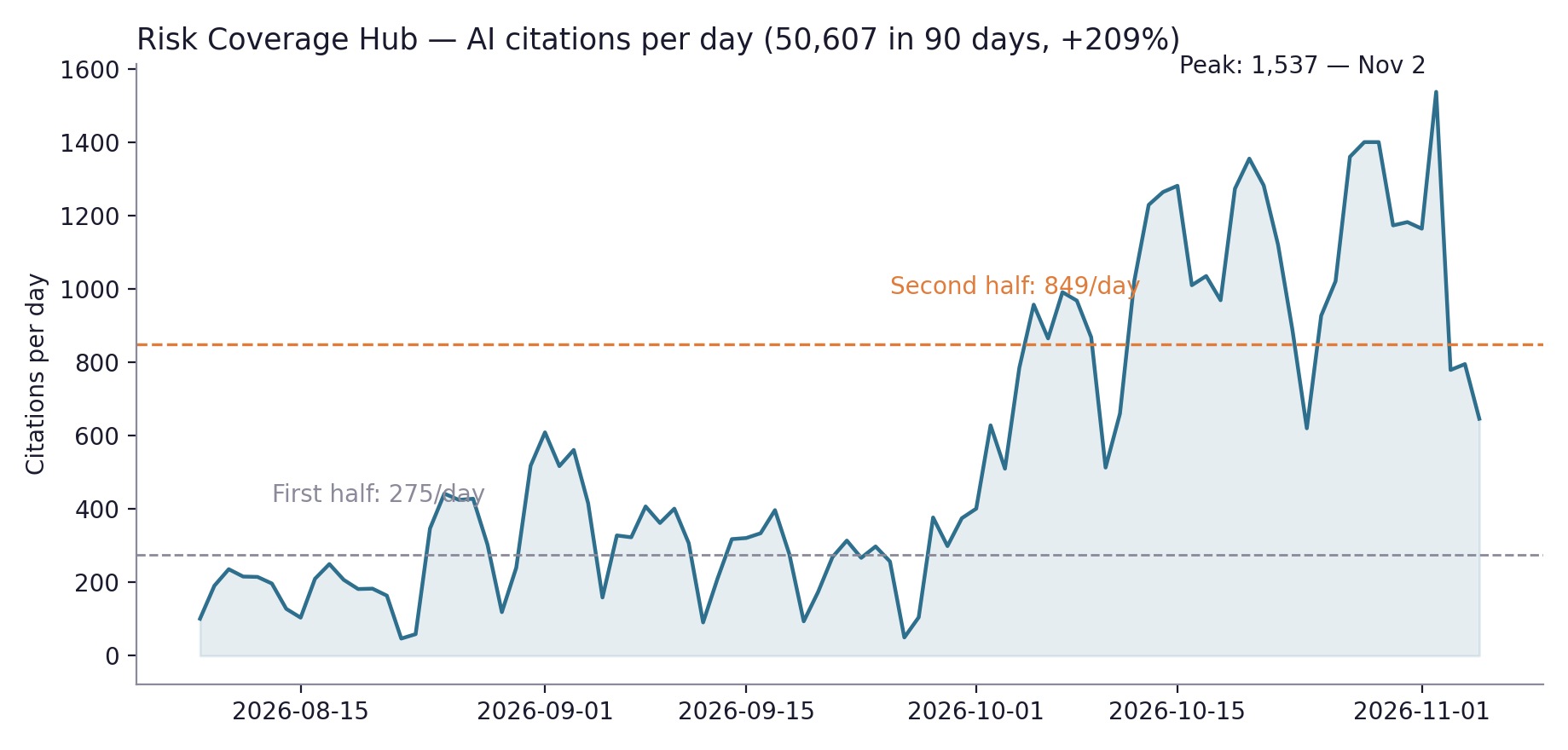
    What it has instead is growth, and spread. The site’s daily citation rate went from 275 a day to 849 a day between the halves of the window — +209%, the fastest climb in our fleet. First fourteen days: 185 a day. Last fourteen: 1,064 a day. Peak day: November 2, with 1,537.

    Watch the 60-second version: How did a site triple its AI citations with no page in charge? — the same receipts in 50 seconds, chapters matched to the sections below.

    The climb

    The window is August 8 to November 5, 2026, from Bing Webmaster Tools’ AI Performance report — the same instrument as the rest of this series. The daily series sums to 50,607; the page table sums to 47,747. Bing’s views differ (here by 5.7%), Bing prints a note saying so, and we name the view behind every number, as always.

    Read the climb honestly: it isn’t a step. Receipt No. 1 had a step — a build date you could point at. This is a slope. The rate rises across the whole window, halves 275 to 849, and we are not going to invent a single cause for a slope. What we can do is read what the slope is made of — which pages, which questions — because that’s the part an operator can actually use.

    Risk Coverage Hub daily AI citations over 90 days: rising from 275 a day in the first half to 849 a day in the second, peak 1,537 on November 2.
    The climb: 50,607 citations in 90 days, +209% by halves. Source: Bing Webmaster Tools AI Performance, daily view.

    The bench: six guides, no star

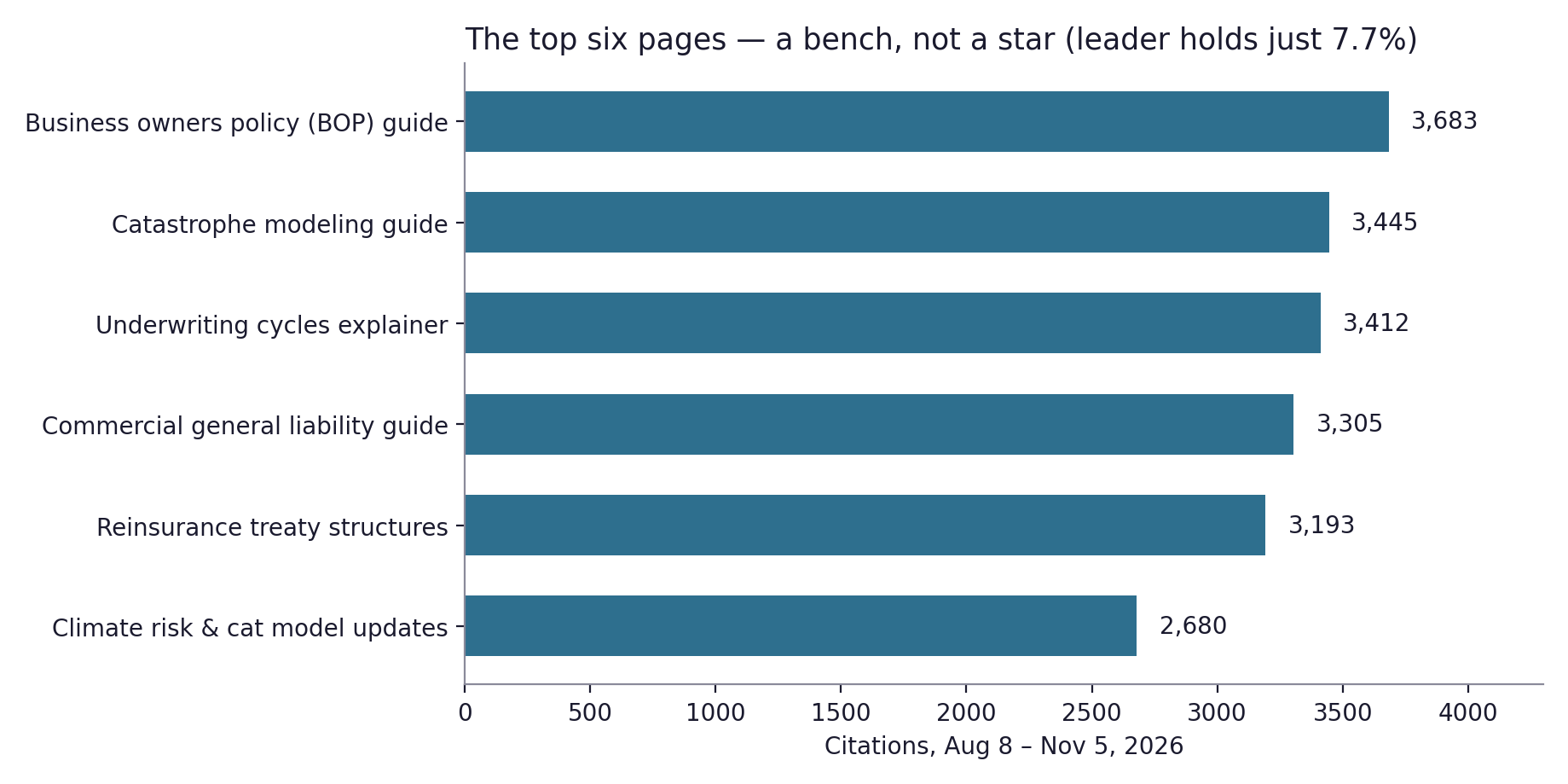
    The top of the page table is bunched like a peloton:

    • Business owners policy (BOP) coverage guide — 3,683
    • Catastrophe modeling, complete guide — 3,445
    • Underwriting cycles: hard and soft markets — 3,412
    • Commercial general liability guide — 3,305
    • Reinsurance treaty structures — 3,193
    • Climate risk pricing & catastrophe model updates — 2,680

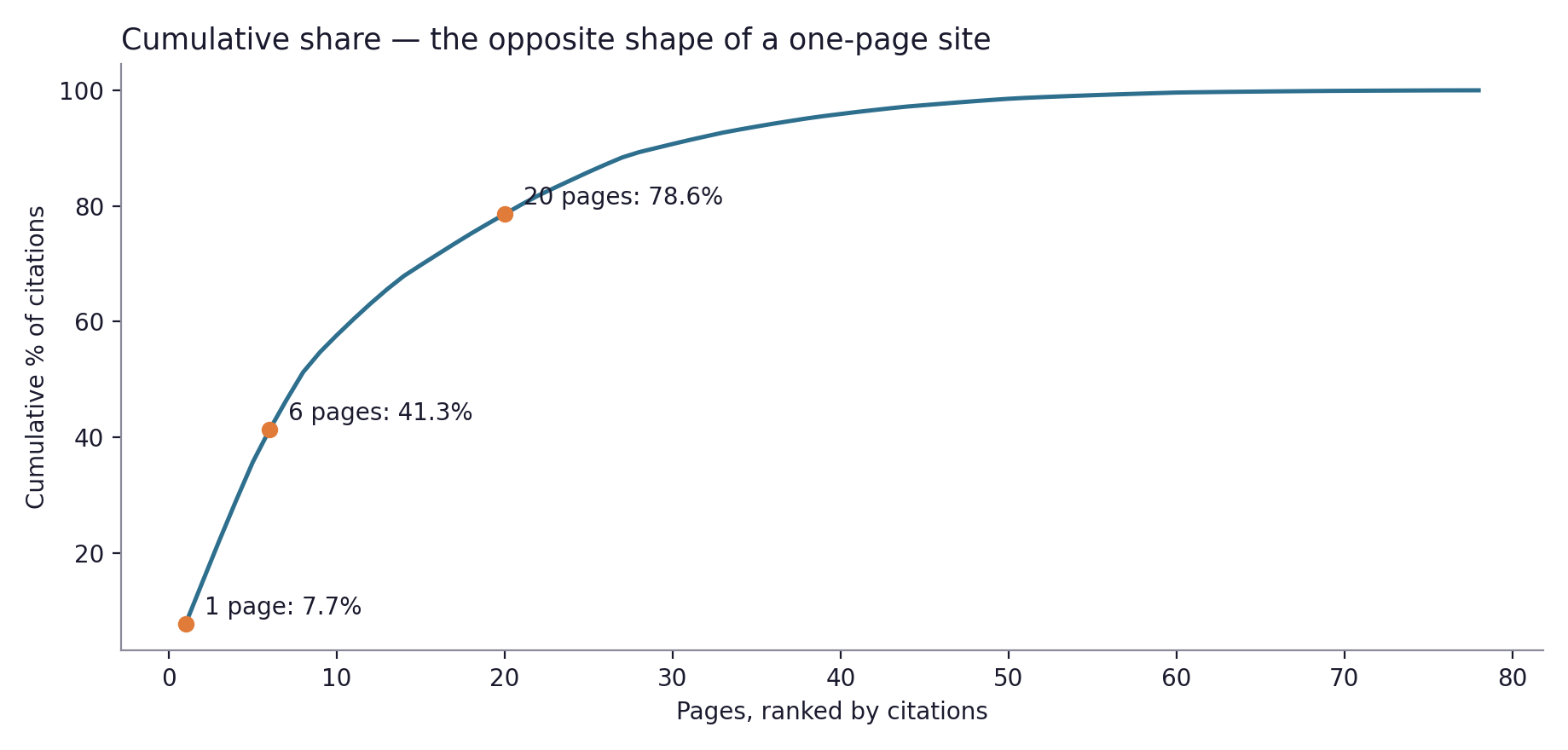
    Six professional guides within a thousand citations of each other. Together they hold 41.3% of the page-sum; the leader alone holds 7.7%. Twenty pages get you to roughly three-quarters of the site — on our flagship, five pages are a majority. This is the diversified portfolio to Receipt No. 3’s concentrated bet, and it carries the mirror-image virtue: no single page’s bad week can wound this site. The bench is the moat.

    Risk Coverage Hub's top six pages, bunched between 2,680 and 3,683 citations; the leader holds just 7.7 percent of the page-sum.
    The bench: six guides, no star. Source: Bing Webmaster Tools AI Performance, page view.
    Cumulative share curve for Risk Coverage Hub: one page is 7.7 percent, six pages 41.3 percent — the opposite shape of a one-page site.
    Cumulative share of the page-sum, pages ranked by citations — contrast Receipt No. 3’s curve, where one page is 30.8%. Source: Bing Webmaster Tools AI Performance, page view.

    The questions: long, specific, professional

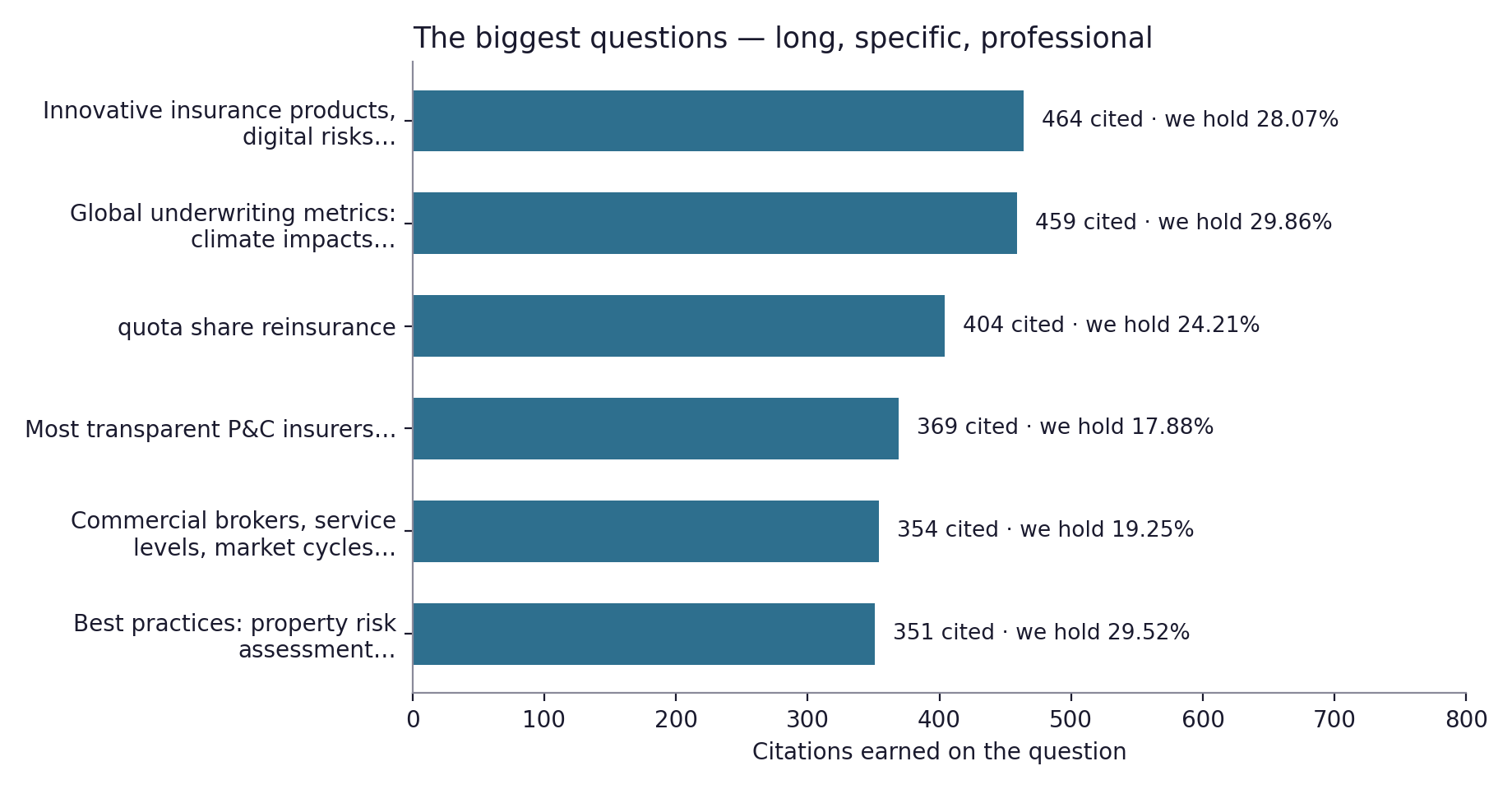
    The query table explains the shape. There is no “what is X” blockbuster here. The biggest questions are working questions, asked the way insurance professionals actually phrase work:

    • “innovative insurance products digital risks cryptocurrency fraud deepfake liability…” — 464 citations; our share 28.07%.
    • “global insurance risk underwriting metrics: evaluating climate disaster impacts on property premiums” — 459; our share 29.86%.
    • “quota share reinsurance” — 404; our share 24.21%. The one short question in the list, and a term of art.
    • “best practices property risk assessment commercial insurance” — 351; our share 29.52%.
    Risk Coverage Hub's biggest questions: long, specific professional queries, with the site holding between a fifth and a third of each.
    The biggest questions, and our share of each. No blockbuster — a working vocabulary. Source: Bing Webmaster Tools AI Performance, query view.

    414 questions, 78 pages — and the shares sit in a band, mostly a fifth to a third. Nobody owns these questions outright, including us. The site earns by being a solid, specific answer across a whole professional vocabulary, not by holding one phrase hostage. That is a slower asset to build and a harder one to knock down.

    What we can’t claim

    • No single cause for the slope. Unlike the stepped sites in this series, nothing here dates the rise to one build. The honest sentence is: the site tripled while publishing steady, specific, professional guides — and correlation across a portfolio is not a mechanism.
    • The views differ more here. Daily-sum 50,607 vs page-sum 47,747 — 5.7% apart, disclosed, each figure naming its view.
    • One engine’s window. Copilot and partner citations as Bing reports them; ninety days is a snapshot, not a deed.
    • Citations are not visits. Established in Receipt No. 1: this count measures being quoted into answers, not being read.

    What we do now

    1. Feed the bench, not a star. The next guides get chosen from the question map where a working question is landing on an adjacent page — the Receipt No. 1 method, applied to a bench instead of a doorway.
    2. Watch for bunching changes. If one page starts separating from the peloton, that’s a signal — good or bad — worth a diagnosis, the way we diagnosed the flagship’s leader in October.
    3. Keep the shares honest. A fifth to a third on the big questions means the work is depth and currency, not defense of a crown we don’t hold.
    4. Publish the receipts — including the part where the growth has no single hero. A slope you can’t attribute is still a slope you can measure.

    50,607 citations. 275 to 849 a day. No star — a bench, a vocabulary, and a climb. That’s the count and the shape.

    Update history
    November 8, 2026 — Published. The 60-second video version went live on YouTube the same morning (linked at the top of this page); its chapters match the sections below, and each chapter links back to its section.

    Method note: All figures are from Bing Webmaster Tools AI Performance exports for riskcoveragehub.com, pulled November 8, 2026. Citation counts are Microsoft Copilot and partner citations as Bing reports them. Window: August 8–November 5, 2026 (90 days). The daily view sums to 50,607; the page view sums to 47,747 — Bing notes totals may differ across views, and each figure above names its view. Citation shares are Bing’s per-query figures. Guide names are shortened from the pages’ own titles. The Risk Coverage Hub underwriting explainer published today (post 1495 on that site) is not a driver of these numbers — it postdates the window. This is one site, one engine’s report, one 90-day window.

  • One Page Holds a Third of This Site’s AI Citations

    One Page Holds a Third of This Site’s AI Citations

    This site — tygartmedia.com, the one you’re reading — earned 813,426 AI citations in ninety days. That’s the whole portfolio: 578 cited pages, 1,698 different questions that assistants asked and answered with our work. One page holds 244,307 of them.

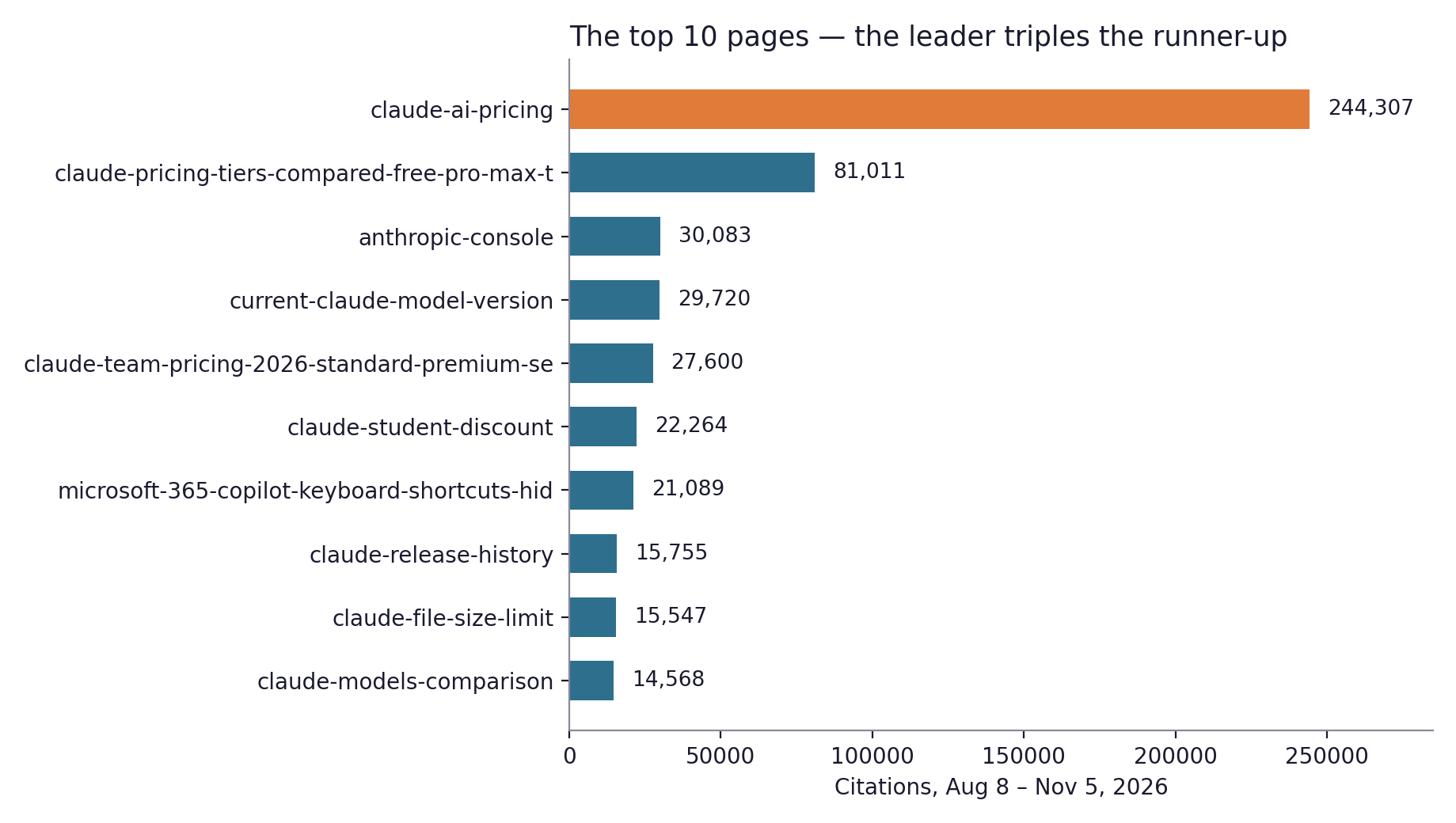
    The page is our Claude pricing page: a plain, kept-current answer to what Claude costs. It holds 30.8% of everything this site earned. The runner-up — our pricing-tiers comparison — holds 81,011. The leader triples it.

    This is Receipts No. 3, and it’s the uncomfortable one. The first two pieces in this series were about growth — a hospital site stepping up, two doors built in a night. This one is about shape: what it means when a third of your citation count lives at one address.

    Watch the 60-second version: Why does one page hold 244,307 of this site’s AI citations? — the same receipts in 49 seconds, chapters matched to the sections below.

    The count

    The window is August 8 to November 5, 2026, from Bing Webmaster Tools’ AI Performance report — the same instrument as the rest of this series. The daily series sums to 813,426; the page-level table sums to 792,317. Bing’s own views disagree by 2.6%, and Bing prints a note saying totals may differ across views. We use each view for what it measures and say which is which, every time.

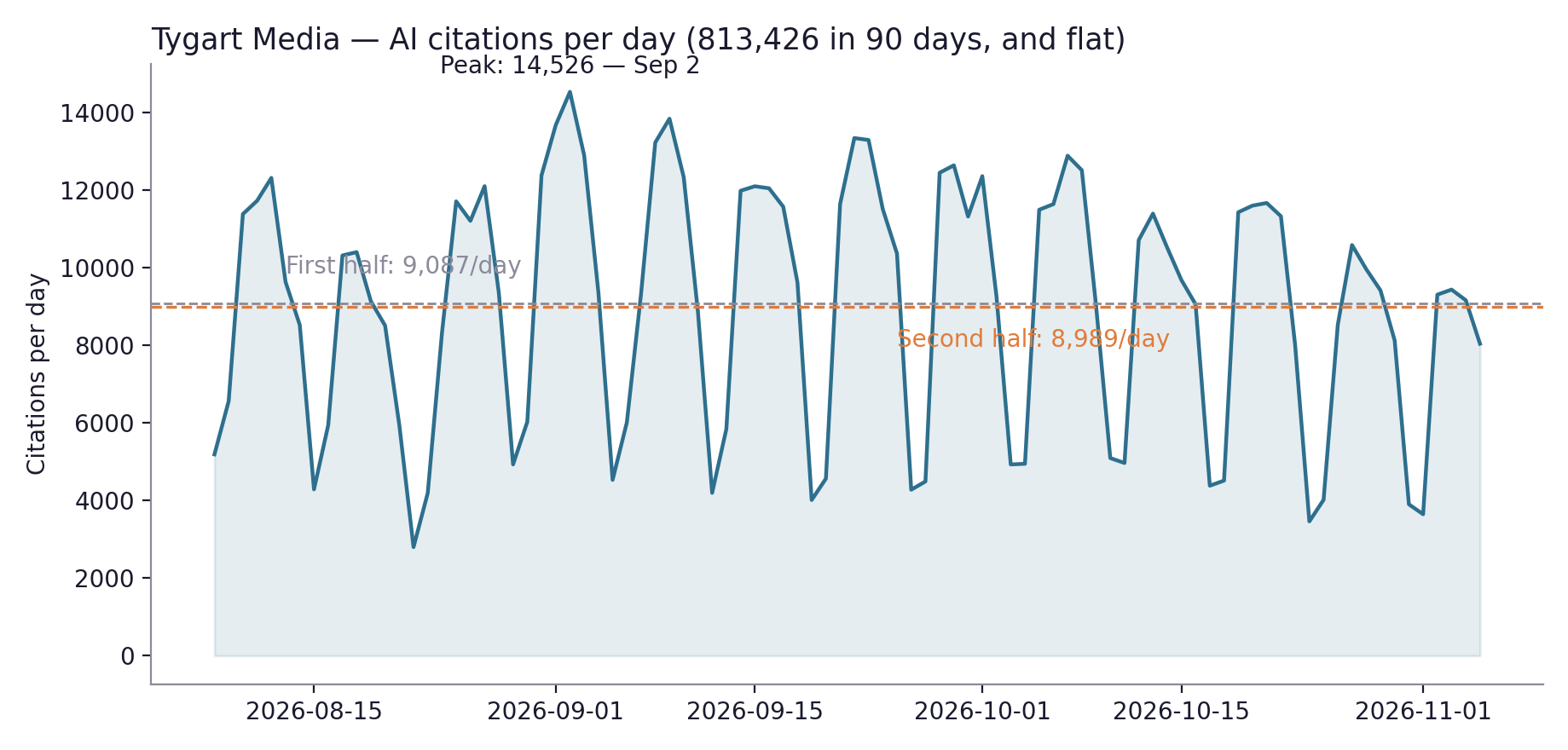
    The site’s halves are flat: 9,087 citations a day in the first half of the window, 8,989 a day in the second. Peak day: September 2, with 14,526. Nothing about the total is a growth story. The total is a plateau — and a plateau is exactly where shape matters, because the composition is the whole story.

    Daily AI citations for tygartmedia.com over 90 days: flat halves at about nine thousand a day, peak 14,526 on September 2.
    The plateau: 813,426 citations in 90 days, halves flat. Source: Bing Webmaster Tools AI Performance, daily view.

    The shape of the portfolio

    Read the page table by rank and the portfolio stops looking like a portfolio:

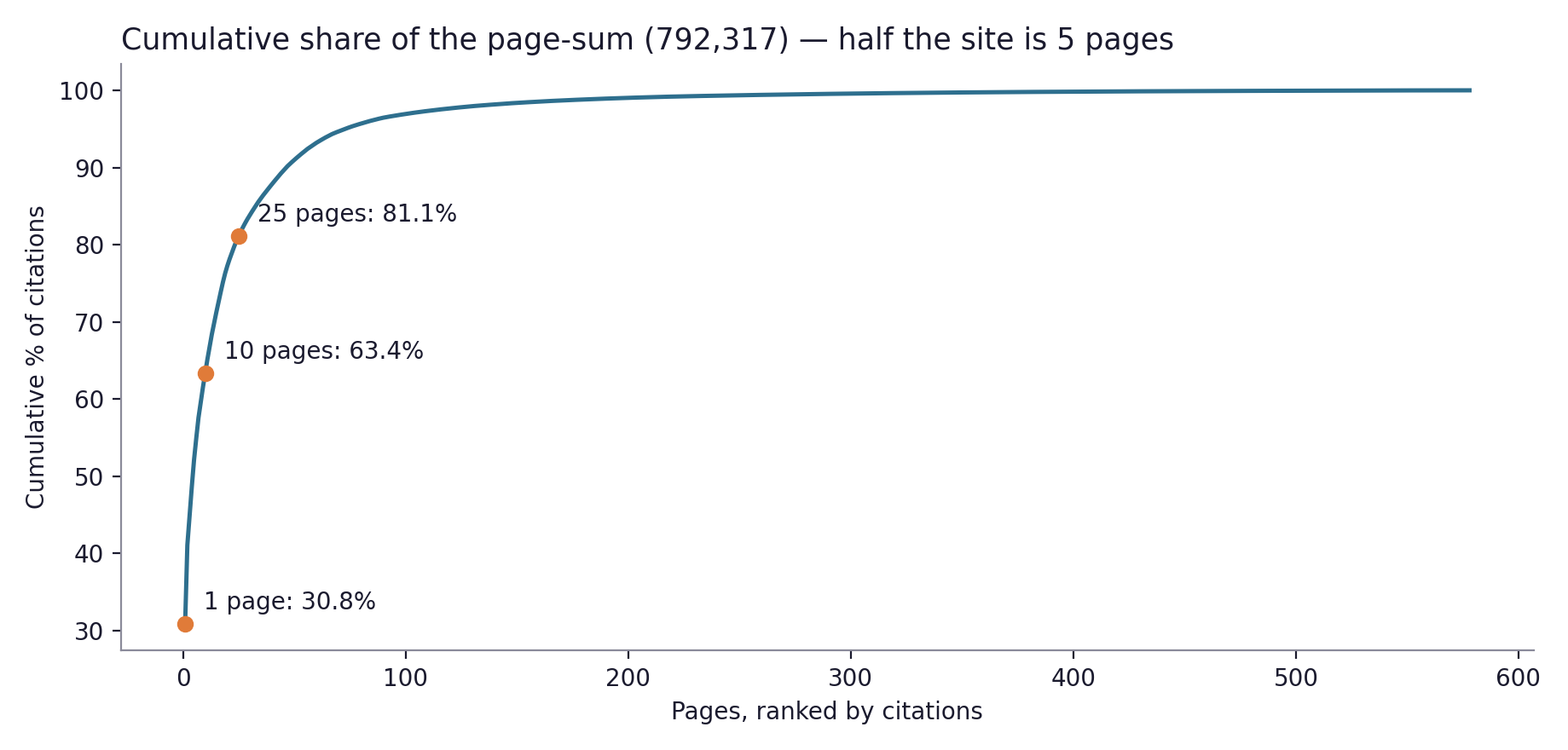
    • 1 page holds 30.8% of the page-sum.
    • 3 pages hold 44.9%. 5 pages hold 52.1% — a majority of the site is five addresses.
    • 10 pages hold 63.4%. 25 pages hold 81.1%.
    • The remaining 553 pages share what’s left — about 19% between them.
    Top ten cited pages on tygartmedia.com: the Claude pricing page at 244,307, triple the runner-up at 81,011.
    The top 10 pages. The leader isn’t ahead — it’s in a different weight class. Source: Bing Webmaster Tools AI Performance, page view.
    Cumulative share curve: one page is 30.8 percent of the page-sum, ten pages are 63.4 percent, twenty-five are 81.1 percent.
    Cumulative share of the page-sum, pages ranked by citations. Source: Bing Webmaster Tools AI Performance, page view.

    And the concentration has a subject. Thirty-six of the 578 pages are pricing pages — their addresses carry “pricing” or “cost” — and together they hold 396,978 citations: 50.1% of everything. Half this site’s citation count is one question family, asked over and over in slightly different words: what does Claude cost, what does the Team plan cost, is there a student discount, what does Enterprise run. We didn’t set out to become a pricing reference. The assistants decided that’s what this site is for — and the page table is what that decision looks like from the inside.

    The questions are bigger than the page

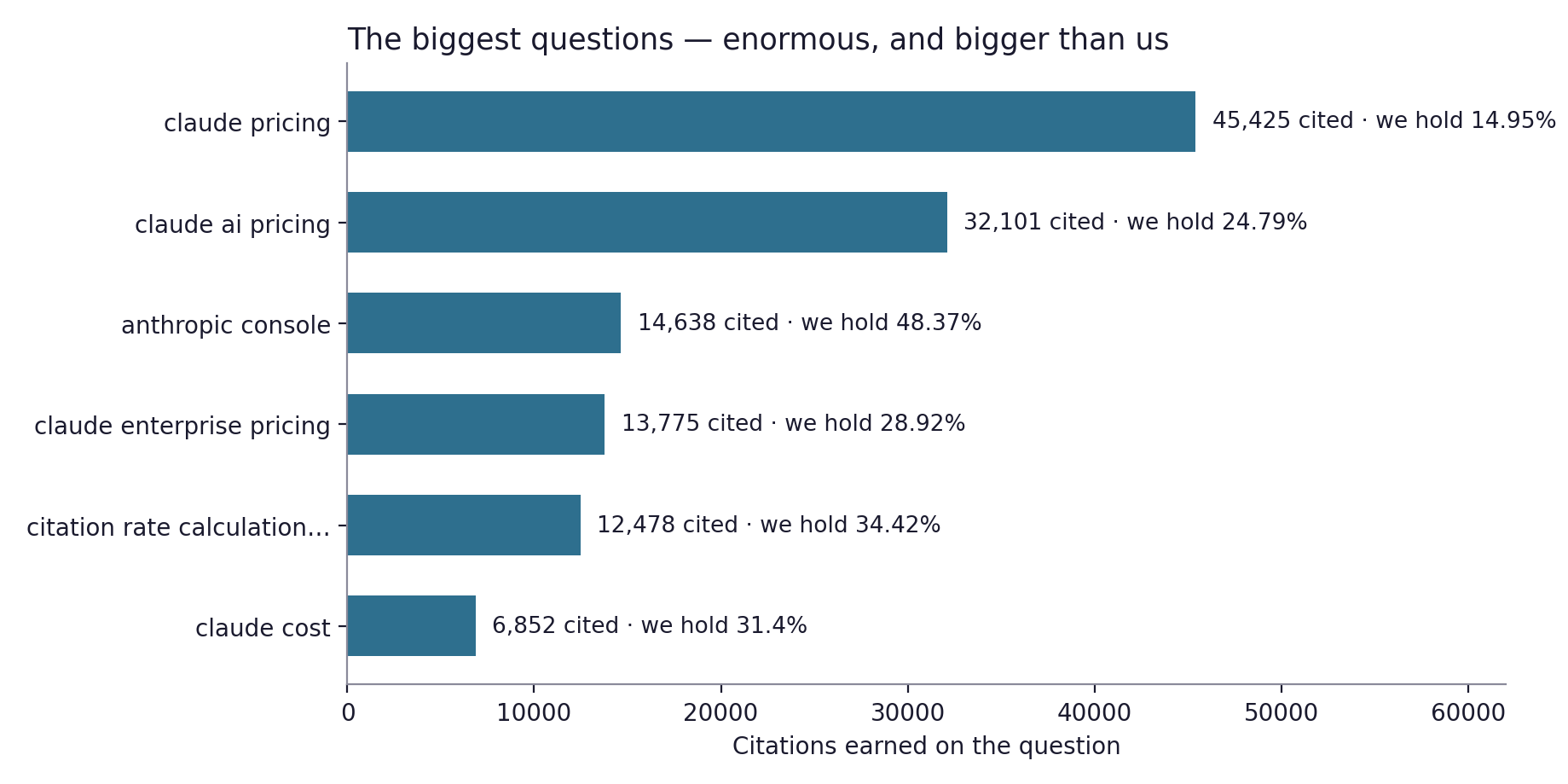
    Here’s the part that keeps the story honest. The pricing page is enormous — and on the biggest question it serves, we are a minority holder:

    • “claude pricing” — 45,425 citations earned across the web’s answers; our share is 14.95%.
    • “claude ai pricing” — 32,101 citations; our share 24.79%.
    • “anthropic console” — 14,638; our share 48.37%, the strongest hold on a big question.
    • “claude enterprise pricing” — 13,775; our share 28.92%.
    • And at number five, a tell: “citation rate calculation AI-generated responses” — 12,478 citations at a 34.42% share. That’s our own trade, reading about the instrument itself.
    The biggest questions asked of the site, with Tygart Media's citation share on each: the biggest question is one where the site holds under fifteen percent.
    The biggest questions, and our share of each. The page is huge; the questions are bigger. Source: Bing Webmaster Tools AI Performance, query view.

    A page can hold a third of a site and a seventh of its biggest question at the same time. Both numbers are true, and the second one is the opportunity measured precisely: the demand under the leader is roughly seven times the leader.

    What concentration means

    Two things, and they’re the same fact read from opposite ends.

    It’s a moat. A page that answers a money question plainly, stays current, and gets cited 244,307 times becomes the reference the assistants reach for — and every citation is a small vote that makes the next one likelier. Nobody at this desk did anything exotic to earn it. The page does one job, in the asker’s words, and it’s kept honest. That’s the whole trick, and Receipt No. 1 showed what happens when you build that shape on purpose.

    It’s a single point of failure. If that page stumbles — a pricing change at Anthropic that makes it stale overnight, a careless rewrite, a bad week — a third of this site’s citation count reprices with it. We don’t have to imagine the exposure; we watch it. In October we ran a full formal diagnosis on this one page — its pattern had broken in ways we needed explained before we touched anything. You don’t commission a diagnosis for a page that doesn’t matter. You commission one for the page that carries the building.

    The hedge is the bench. The tiers comparison at 81,011 is a genuine understudy — same question family, different cut. Team pricing, the student discount page, the console page: the family is deep, and the family is the insurance. Concentration at the page level, diversification at the family level. That’s the actual structure, and it happened before we were wise enough to plan it.

    What we can’t claim

    • One engine’s window. These are Copilot and partner citations as Bing reports them. It’s the cleanest instrument we have; it is not the whole sky.
    • The views differ. Daily-sum 813,426 vs page-sum 792,317 — 2.6% apart, disclosed above, used consistently.
    • Citations are not visits. Receipt No. 1 established it on another of our sites: 57 citations per human visit. This count measures being quoted, not being read.
    • Ninety days is a snapshot, not a deed. Questions mutate — the BC ESG piece watched pharma’s biggest phrasing change between pulls. Shares move. This is the shape on November 8, 2026.

    What we do now

    1. Watch the leader’s daily line like a heartbeat — not the site’s total, which can hide a dying leader inside a healthy plateau for weeks.
    2. Keep the bench current. The understudy pages get the same freshness discipline as the star; the day the leader stumbles is the wrong day to start.
    3. Build adjacent doors the measured way — when the question map shows demand landing sideways (Receipt No. 1’s method), build the page the question is asking for.
    4. Publish the receipts — including the shape we’d rather not have. A third of the building on one page is a fact we’re better off saying out loud, because saying it is what keeps us watching it.

    813,426 citations. 244,307 of them at one address. That’s the count, that’s the shape, and that’s what we’re doing about it.

    Update history
    November 8, 2026 — Published. The 60-second video version went live on YouTube the same morning (linked at the top of this page); its chapters match the sections below, and each chapter links back to its section.

    Method note: All figures are from Bing Webmaster Tools AI Performance exports for tygartmedia.com, pulled November 8, 2026. Citation counts are Microsoft Copilot and partner citations as Bing reports them. Window: August 8–November 5, 2026 (90 days). The daily view sums to 813,426; the page view sums to 792,317 — Bing notes totals may differ across views, and each figure above names its view. Citation shares are Bing’s per-query figures. The “pricing family” count is pages whose addresses contain “pricing” or “cost.” The October diagnosis referenced was an internal workup of the pricing page’s citation pattern. This is one site, one engine’s report, one 90-day window.

  • The Page the Machines Cite Most Is the One the Humans Actually Read

    The Page the Machines Cite Most Is the One the Humans Actually Read

    Receipts, No. 2 — Healthcare Facility Hub. First in this series: We Watched the Questions AI Was Asking Our Site.

    In October we believed one of our sites was declining. We said so in writing, with a chart. The chart was honest; the window was the problem — it ended October 4, and Healthcare Facility Hub spent the rest of October doing the opposite of declining.

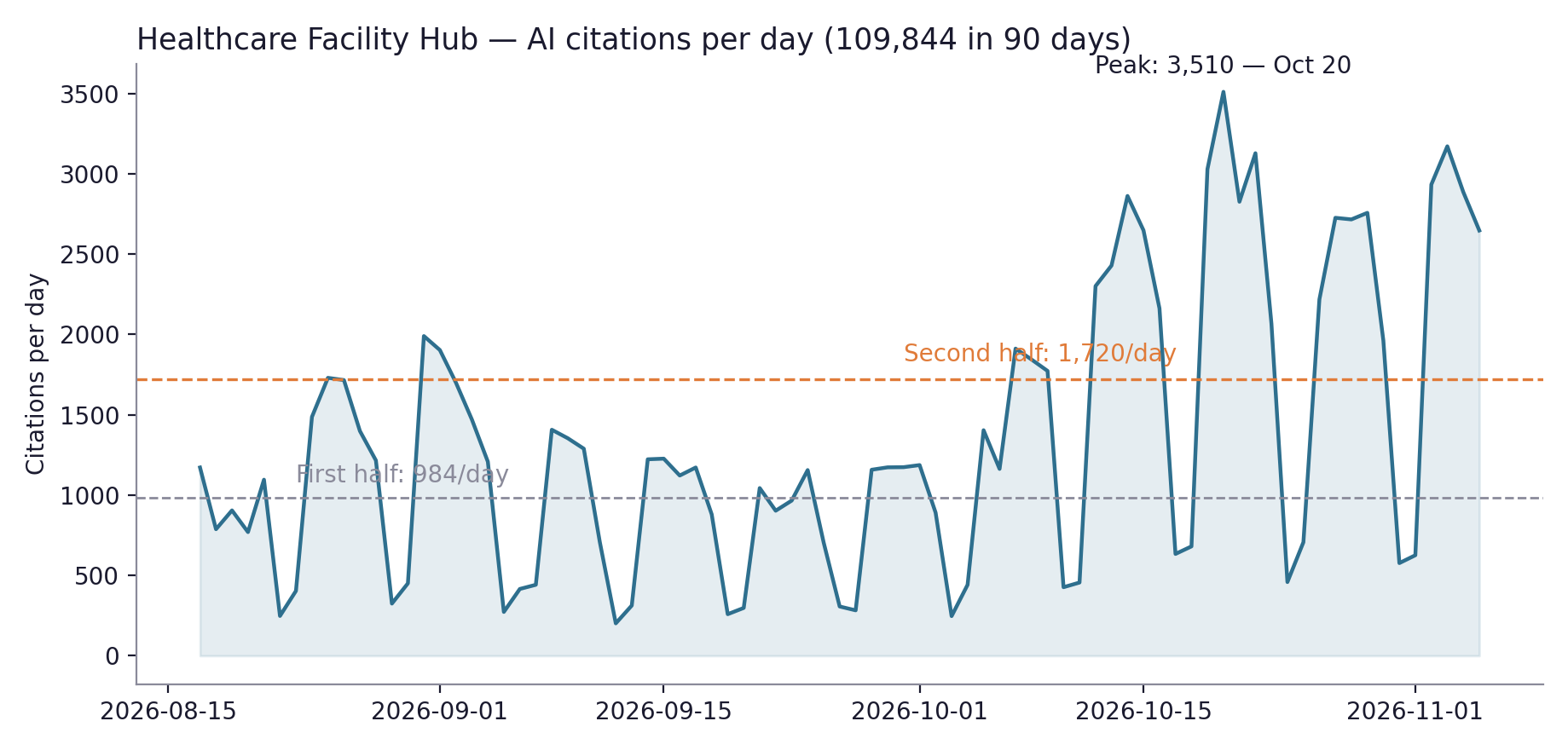
    This morning we pulled the full ninety days. Between August 7 and November 6, AI answers cited Healthcare Facility Hub 109,844 times. The first half of the window averaged 984 citations a day; the second half averaged 1,720 — up 75%. The last fourteen days ran at 2,032 a day, and the peak, October 20, hit 3,510. It is the fastest-growing property we run.

    So we went looking for its biggest page, expecting to find the usual pattern from the rest of the fleet: a page the machines read and the humans barely visit. We found the opposite. This is the story of that page — including the part where we shipped its companion file split in two and the citations divided themselves between a summary and the real thing.

    Watch the 60-second version: Why does one hospital page get cited 11,181 times by AI? — the same receipts, in 52 seconds, with chapters matched to the sections below.

    The page

    The page is a guide: What Is ICRA in Healthcare? (ASHE 2.0) — infection control risk assessment for construction and maintenance work in occupied hospitals. It holds 11,181 citations, the most-cited page on the site, about a tenth of everything. Around it sits a small family: a sibling ICRA guide at 2,053, a Class IV–V requirements page at 173, a matrix explainer at 121, a class finder at 23.

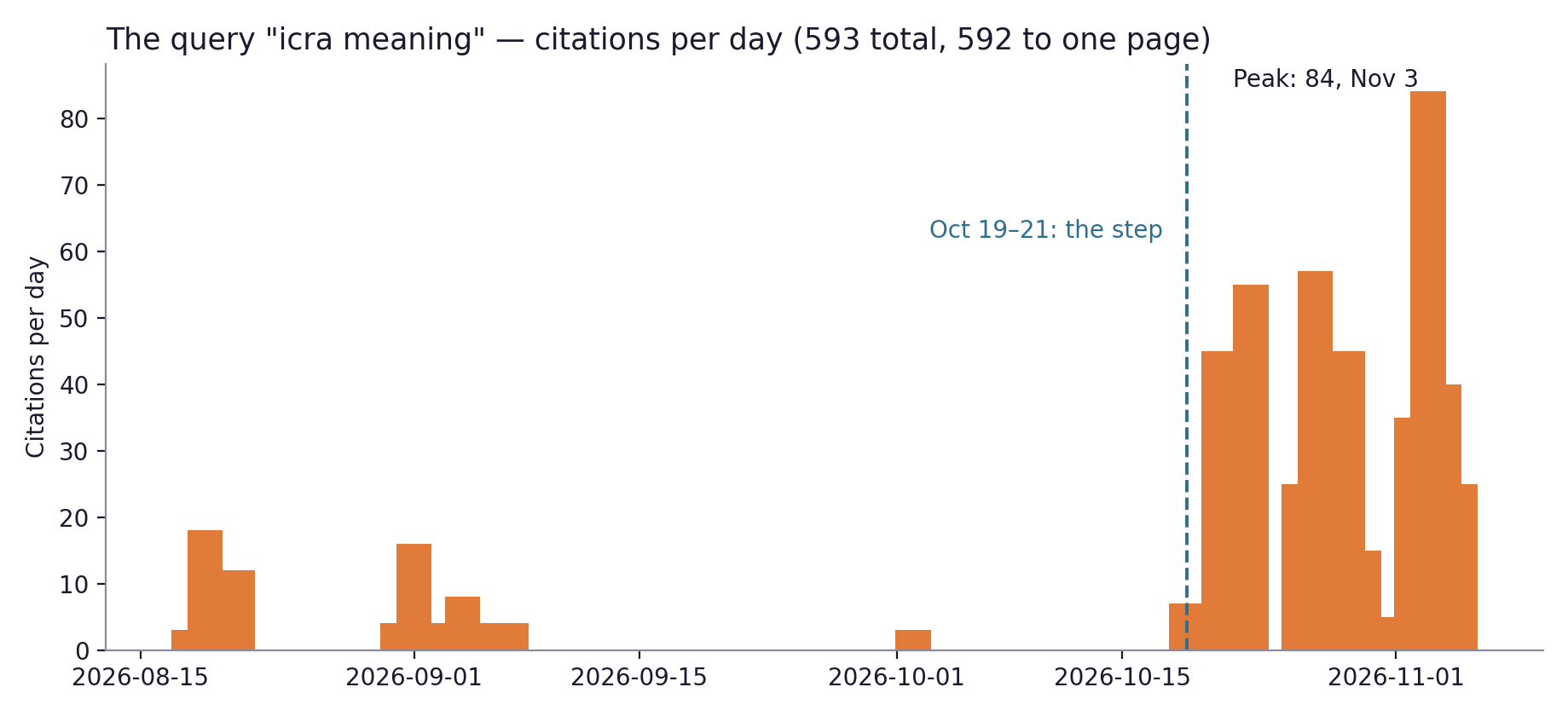
    The query that feeds it hardest is plain: “icra meaning.” Five hundred ninety-three citations, and 592 of them land on this one page. Its daily rhythm tells the build story. Through mid-October it ran flat, a handful a day. Then, on the October build dates, it stepped: 45 on October 21, 55 on the 23rd, 57 on the 27th, peaking at 84 on November 3.

    Then we checked the humans

    On the beauty-industry site in our first report, the pattern was stark: hundreds of citations, a handful of human sessions, visits that lasted about ten seconds. Machines verifying, nobody reading.

    The ICRA page breaks that pattern completely. Microsoft Clarity, last thirty days: 231 human sessions (seventeen bot sessions excluded), 162 people, an average of 4.4 active minutes inside a 7.8-minute visit, 1.72 pages per session, scroll depth 36%, zero rage clicks, almost no friction. Three quarters of them arrive from Bing search. And the browser split gives the audience away: 73.6% Microsoft Edge, 88% desktop. That’s facilities and infection-prevention staff on managed hospital workstations, in the middle of a workday, using a page to do a job.

    The site as a whole is built the same way: 2,412 human sessions in thirty days against 1,091 bot sessions excluded — the most human audience in our fleet. The machines cite this site the fastest-growing amount, and the humans actually read it. Both. At the same time. On the same pages.

    The machinery question, again

    Our first report noted that the beauty site had no llms.txt file and full FAQ schema on its winning guides. Healthcare Facility Hub is the mirror image: it has an llms.txt, and its most-cited page carries no FAQ schema at all — video markup, breadcrumbs, speakable, that’s it. Opposite machinery, same explosion. Whatever is being selected here, it isn’t a schema flavor.

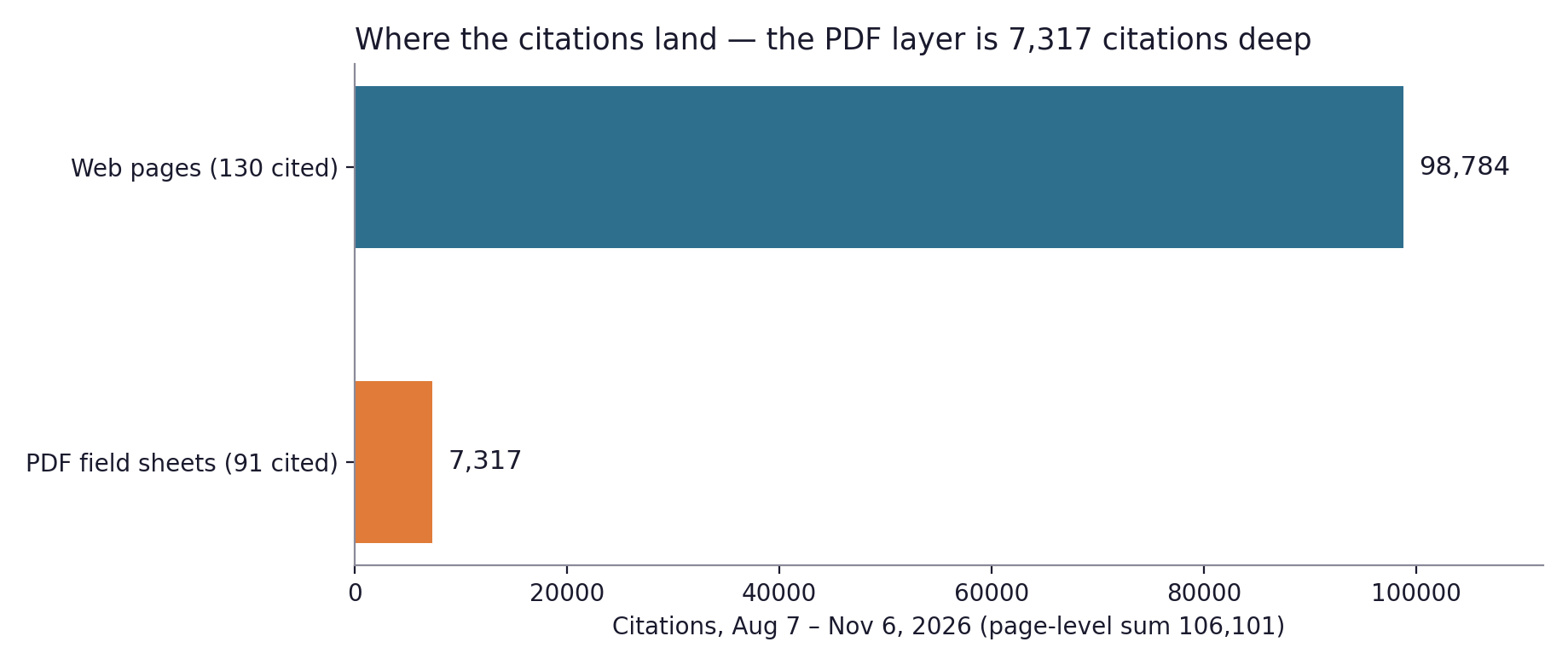
    What the two winners share is more ordinary: one real question answered completely on one page, and a downloadable artifact attached to it — a field sheet a person (or an agent) can take away. On this site that second layer is not small: 91 cited PDF field sheets hold 7,317 citations — compliance checklists for the Joint Commission, evacuation, fire drills, medical gas. Books for bots, and for the people who print them.

    What we got wrong

    Here is the part we would rather skip, which is exactly why it’s in the report.

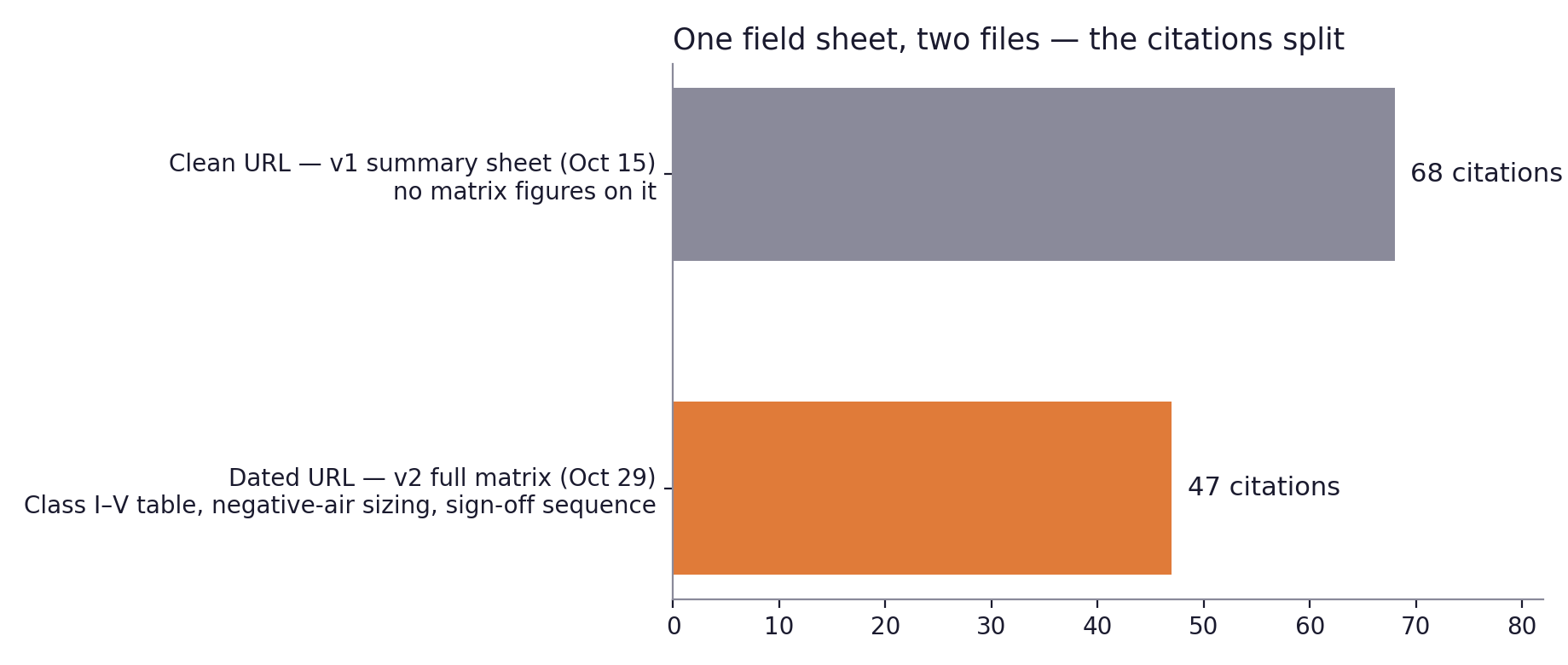
    The ICRA guide links its field sheet twice — and the two links go to two different files. The first version, published October 15, sits at the clean, obvious filename. It is a summary sheet: the direct answer, the framing, no numbers — the actual Class I–V barrier matrix is not on it. It holds 68 citations.

    On October 29 we published the real sheet — the full matrix, barrier requirements by class, negative-air sizing, the decommissioning sign-off sequence, stamped on its face as the current version. But it went up under a new, dated filename instead of replacing the old file. It holds 47 citations. An email-gate on the same page points at the clean filename too, so the older, thinner sheet has a third door in.

    A page and its download are supposed to be one asset, saying one thing. Ours said two, and the citation record split along the seam — with the lead going to the version that has less in it. Anybody who followed the most-cited link got the summary. Anybody who followed the page’s own button got the matrix. We built both halves of that on purpose, two weeks apart, and never noticed the seam until we pulled the page-level export this morning.

    The fix is two file renames, and nothing else. The October 15 file moves to an archive name — its bytes preserved, its history intact. The October 29 sheet takes the clean filename. The page doesn’t change; no link anywhere changes. Every door — the page, the email gate, the citation record — then opens onto the full matrix.

    As this publishes, the fix is staged and waiting on a server door, not on a decision: the file host has refused our automated connections this morning, so the two renames run the moment that door reopens, or by hand in the hosting panel. When it lands, this article gets a dated line below saying so — the same update-lineage rule we apply to the pages themselves. If you’re reading this without that line, the fix is still in flight and we’d rather tell you that than round it off.

    What we’d tell another operator

    Check your cited PDFs for version splits. If a page was ever refreshed by uploading a new file instead of replacing the old one, you may have two assets dividing one citation record — and the split favors whichever file got the cleaner name, not whichever is better. This took one page-level export to find.

    Read the session data before you call a page machine-only. The fleet’s loudest page turned out to have its most human audience. The machines and the people are not reading different sites; on the good pages, they’re reading the same one.

    A trend is a window, not a verdict. We wrote “declining” in October because our window ended October 4. The site was already turning. The correction cost us nothing but a sentence — because the first claim was in writing, with its dates on it.


    Method. Bing Webmaster Tools, AI Performance, pulled November 8, 2026, window August 7–November 6, 2026. Daily totals sum to 109,844; the page-level sum runs slightly lower (106,101) — Bing notes totals can differ between views. Query figures from the filtered pull for “icra meaning” (593 total; 592 to the ICRA guide, 1 to a sibling). Microsoft Clarity figures are the last 30 days, bot sessions excluded as reported; the citation and session windows differ, so comparisons between them are directional. Field-sheet contents verified by reading both files this morning.

    The full dataset — every chart above, the site table, and the field-sheet comparison — is in the companion field report: Built for the Question: Healthcare Facility Hub (PDF).

    Working on a site where AI answers are sending mixed signals? Book a call with Will Tygart.

    Update history

    November 8, 2026 — Published. Field-sheet consolidation staged; completion line to be added here when the renames verify live.
    November 8, 2026 — The 60-second video version published on YouTube (linked at the top of this page); its chapters match the sections below, and each chapter links back to its section.

  • We Watched the Questions AI Was Asking Our Site. Then We Built the Answers.

    We Watched the Questions AI Was Asking Our Site. Then We Built the Answers.

    In early October, a spreadsheet landed on my desk that I can’t stop thinking about.

    It was an export from Bing Webmaster Tools — the AI Performance report for BC ESG, one of the sites we run. Filtered to a single question people were asking AI assistants: “pharmaceutical companies esg executive compensation.” Five days, October 1–5: 51 citations. Our pages, being read into AI answers about how drug companies tie executive pay to sustainability targets.

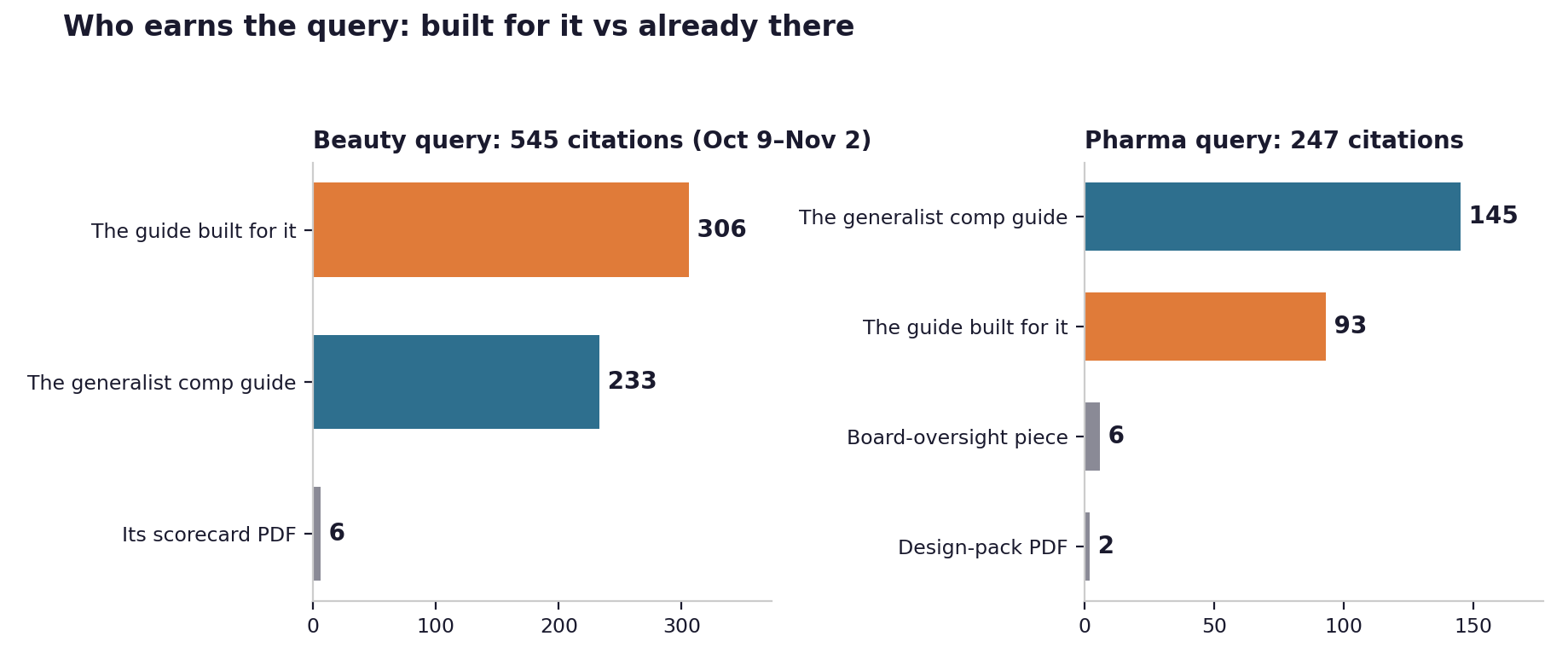
    Here’s the thing. We had never built a page for that question. The citations were landing on a generalist compensation guide — a good page, but a sideways answer to a specific question. The demand was real, measured, and unanswered on purpose by nobody. It was just there.

    We did try to find out what sparked it. There was movement around a company — I’m not naming it, because we never could source it, and guessing in public is how you become the thing we don’t want to be. So we made a rule out of it: build on the demand you can measure, never on the attribution you can’t. The demand we could measure. So we went and measured all of it.

    Watch the 60-second version: How did two missing pages step AI citations from 11 a day to 30? — the same receipts in 56 seconds, chapters matched to the sections below.

    The map: count everything before you build anything

    On October 19 we pulled the full report — every query, every page, counted by value instead of skimmed. The clusters that mattered:

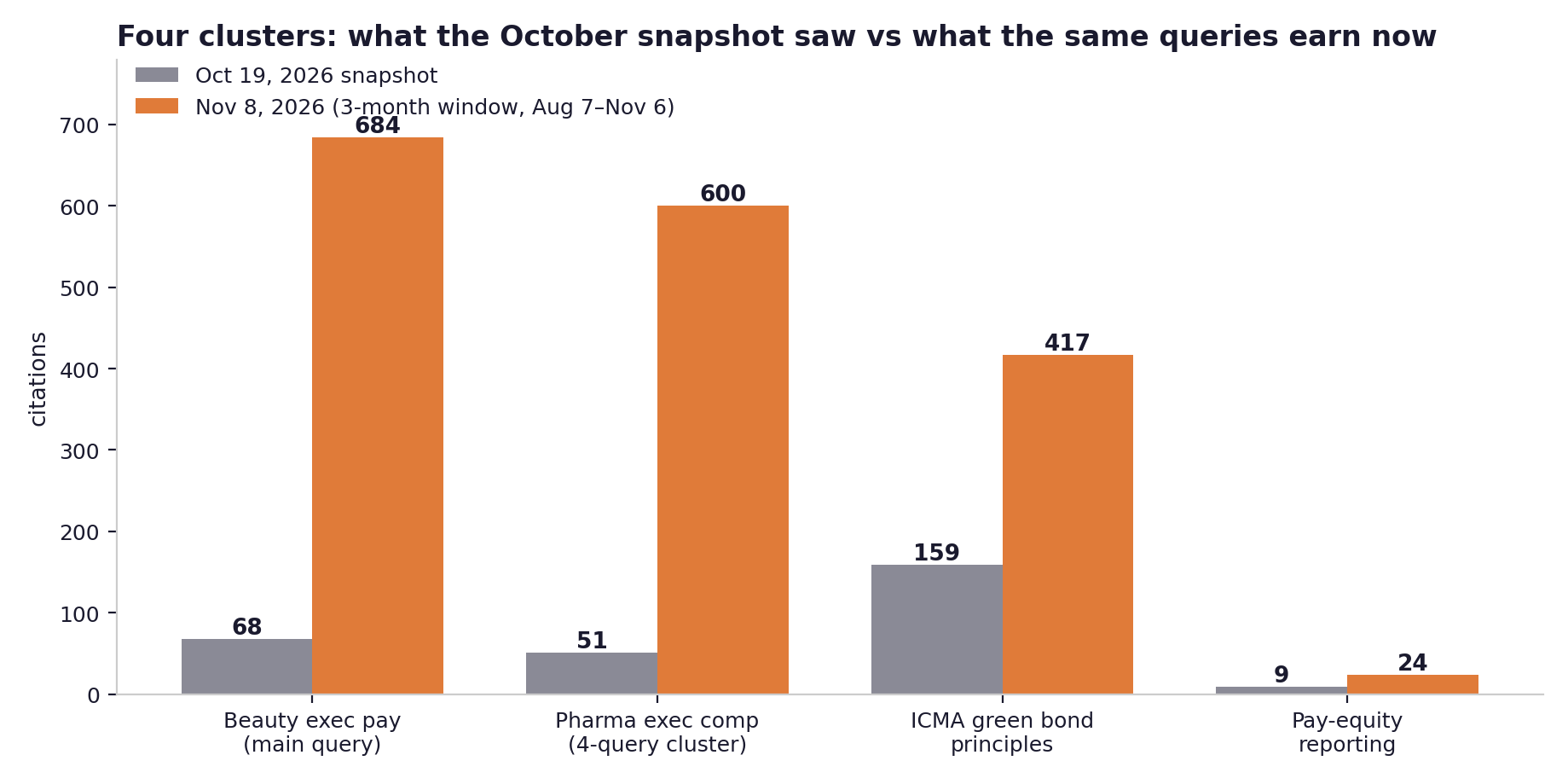
    • Beauty companies, executive pay, sustainability targets — 68 citations on the main phrasing, more scattered across variants. Again: no dedicated page. The generalist guide was absorbing all of it.
    • Pharmaceutical executive comp — 51 citations across four related phrasings.
    • ICMA green bond principles — 159 citations at a 45.43% citation share. The site’s #1 query — and this one already had real pages behind it.
    • Pay-equity reporting — small. 9 citations. Noted, not built.

    Two of the four clusters were demand with no door built for it. That’s the whole insight, and it’s not complicated: AI assistants were asking our site specific questions, and we were answering adjacent ones.

    The build: one night, two pages

    That same night — October 19 — we published two guides:

    The rules we built them by:

    1. One real question per page, in the asker’s own words. The page’s address is the question, word for word — because that’s the string the assistants are already carrying.
    2. Answer first. No throat-clearing, no “in today’s rapidly evolving landscape.” The answer is at the top; the depth is below it for whoever wants it.
    3. Every page carries its download. Each guide has a companion PDF — a scorecard pack, a design pack. A page and its PDF are one asset. If the content changes, both change, same run. You’ll see why in a minute.

    Then we waited. Three weeks later — this morning — we pulled the reports again and counted.

    What happened: the step

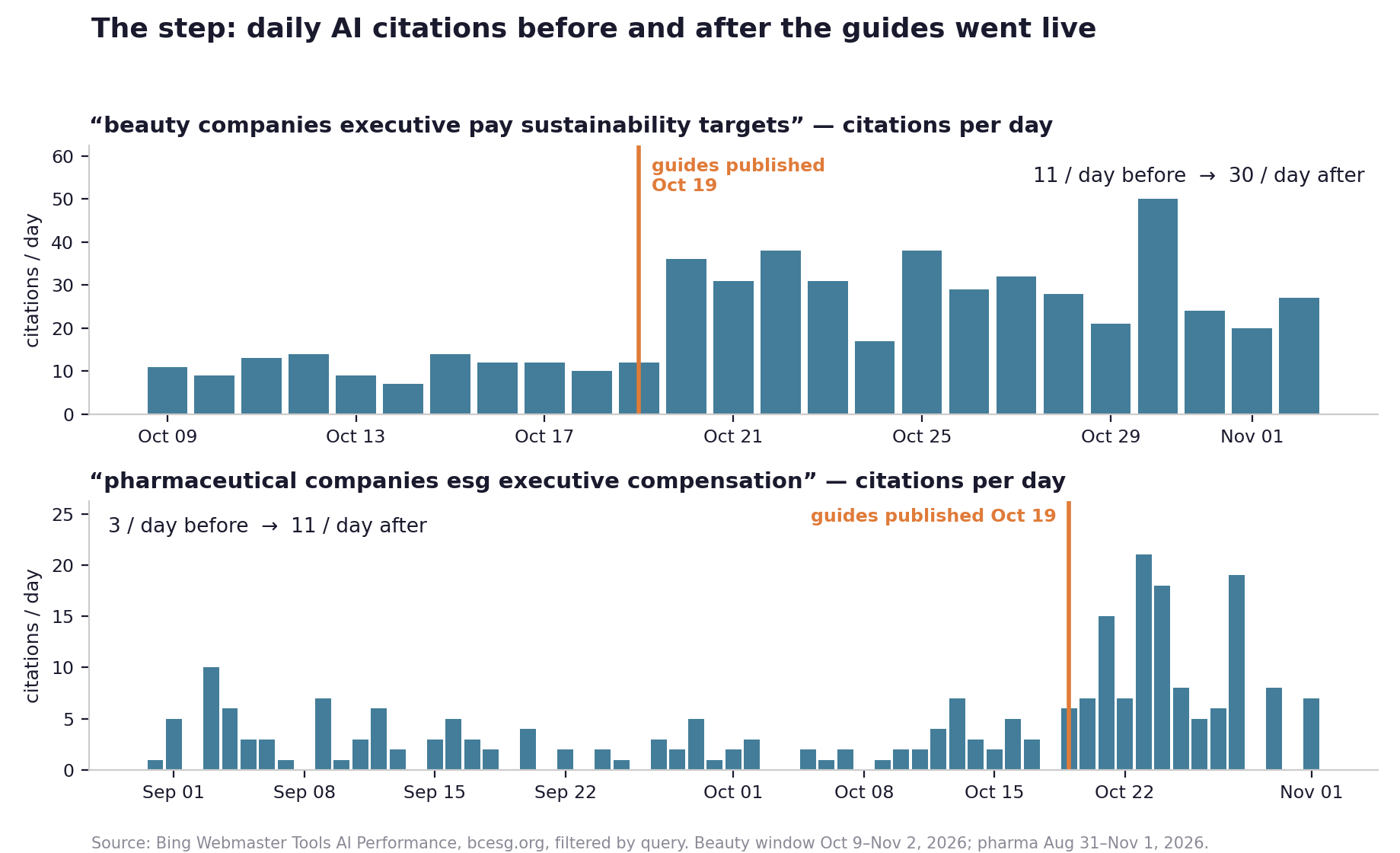
    Two bar charts of daily AI citations. Beauty query: 11 per day before October 19, 30 per day after. Pharma query: 3 per day before, 11 per day after.
    The step: daily citations before and after the guides went live. Source: Bing Webmaster Tools AI Performance, filtered by query.

    Read the daily series, not the totals, and the story tells itself. The beauty query was running at 11 citations a day. The day after the guides went live it stepped to 30 a day — peak day, 50 — and it has stayed at the new level. The pharma query went from 3 a day to 11 a day, same step, same date. Nothing else changed on those pages’ behalf that week. The step is dated, and the date is the build.

    Paired bars comparing October 19 snapshot to now. Beauty main query 68 to 684. Pharma cluster 51 to 600. ICMA green bond principles 159 to 417. Pay-equity reporting 9 to 24.
    Four clusters, October snapshot vs now. The snapshot counts come from that day’s site-wide report; the current counts are the November 8 report’s three-month window — windows differ by design, and the daily step above is the causation read.

    Against the October snapshot, the beauty query is at 684 citations and now holds a 57.33% citation share — when an assistant answers that question, it cites our site more than half the time, and the page it cites most is the one we built for it. The pharma cluster totals 600 across its phrasings.

    Now the two honest complications, because a report that only shows the wins isn’t a report.

    The tide rose too. ICMA green bond principles grew from 159 to 417 with no new build from us — the pages already there just kept earning. The whole site went from 420 citations a day to 797 a day across the same line. So no, I won’t claim every new citation is ours by construction. The claim I’ll defend is narrower: on the two queries we built for, the daily rate stepped on the build date and held, and the built pages took the lead or second place in earning them. The tide explains growth. It doesn’t explain a step.

    Small stayed small. Pay-equity reporting — the cluster we noted and didn’t build — went from 9 to 24. Fine, and roughly what you’d expect: no door, no step.

    Daily citations for all of bcesg.org across 90 days, 44,583 total, rising from 420 per day before October 19 to 797 per day after.
    The whole site: 44,583 AI citations in 90 days.

    Who earns the query

    Citations by page within each query. Beauty: built guide 306, generalist guide 233, scorecard PDF 6. Pharma: generalist guide 145, built guide 93, board-oversight piece 6, design-pack PDF 2.
    Built for it vs already there — who earns each query.

    This is the chart I keep coming back to. On beauty, the guide we built leads — 306 citations to the generalist’s 233 — and the generalist didn’t lose anything in absolute terms. The pie grew; the new page took the bigger slice of a bigger pie. That’s the answer to the cannibalization worry, at least this once: building the specific page grew the specific query.

    On pharma, the built guide is second — 93 to the generalist’s 145. A strong second, on a query whose daily rate tripled, but second. One difference between the two builds: the beauty page’s address is the query word-for-word. The pharma page’s address drops one word of it. Is that the reason? Two data points is a hypothesis, not a law — I’m labeling it as one, and it’s the first thing we’ll test on the next build.

    And look at the bottom of both panels: the PDFs get cited. Six for the beauty scorecard, two for the pharma design pack in these filtered windows — and across the whole site, four PDFs hold 45 citations, one pharma scorecard alone at 23. The downloads aren’t lead magnets bolted onto the content. In an AI answer, they are content. That’s why the page and its PDF ship as one asset here, and why this article has a companion report instead of a screenshot gallery.

    The companion report: Built for the Question — a Tygart Media field report (PDF). The same findings in the form built to travel: all four charts, the tables, the method note. Take it, share it, keep the method note attached.

    The other half of the instruments: what the humans did

    Everything above comes from Bing’s report — the machines’ side of the glass. We also run Microsoft Clarity on the site, so we went and looked at the humans’ side: recordings and friction data for the two guide pages, last 30 days.

    The honest headline: there is almost nobody there. The beauty guide — 725 citations in the new report — has had 7 human sessions in 30 days. The pharma guide — 301 citations — has had 2. Sitewide it’s the same shape: 786 human sessions against 44,583 citations. The citation economy runs at roughly 57 citations per human visit, and on the built pages it’s over a hundred to one. The audience for this content is not visiting. It’s being quoted.

    And the handful of humans who do land on the beauty guide arrive from a telling set of doors — among the seven sessions, referrers include claude.ai and gemini.google.com. Not the channel the citations live in (that’s Copilot, which sends almost no one), but the same species of door: a person reads an AI answer, then clicks through to check the source. They stay 10 seconds, scroll 5% of the page, click nothing, and leave. No rage clicks, no dead clicks, no errors — zero friction of any measured kind on either page. They’re not reading. They’re verifying — and the page’s job, for them, is to be checkable at a glance: answer first, sources visible.

    Meanwhile the bots Clarity filtered out tell their own story: on the pharma page, 6 of its 8 total arrivals were bots; the beauty page, 4 of 11. Sitewide, 2,526 bot sessions excluded against 786 human ones kept. Even the “traffic” is mostly machines.

    This is what the PDF citations meant, seen from the other side. If the content’s real consumers are assistants pulling pages and files into answers, then the page is a source document that occasionally gets audited by a human — and it should be built like one. Which brings us to the machinery people argue about.

    About llms.txt, JSON, and the rest of the folklore

    There’s a standing argument in our trade about what a site must hand the machines: a special llms.txt file, elaborate JSON schema, structured feeds — with one camp saying none of this can work without them and another saying it’s all decoration. We’re in the odd position of not having to argue. We can look.

    This site has no llms.txt. None. The address returns our 404 page. It has never existed on bcesg.org — and the site earned 44,583 citations in 90 days without it. Whatever llms.txt is for, “getting cited at all” is not it.

    The pages do carry JSON-LD — a FAQ block, article markup, breadcrumbs. And we don’t credit it for the step, because the evidence we trust most on that question — including a controlled test on 1,885 pages that added JSON-LD and got no citation lift — says schema buys eligibility and accuracy, not selection. Our dates agree: the schema was there before October 19 too. What changed on October 19 was the content — a page built to be one question’s answer, carrying a file built to travel.

    That’s the whole machinery conclusion, and it’s almost embarrassingly plain: the assistants cite what answers the question, in a form they can carry. A clean page whose address is the question. A PDF that is the answer, portable. The rest is garnish — some of it harmless, some of it a whole industry’s worth of billable garnish.

    What we can’t claim

    • Bing’s own tables don’t perfectly agree with Bing’s own charts. On one filtered view, the chart total was 247 and the pages beneath it summed to 246 — Bing prints a note saying totals may differ when filters are applied, and they do. We report the chart totals and say so.
    • The windows differ. Each export covers the range Bing gives it; every chart here carries its window on its face. Comparing across windows without saying so is how case studies become fiction.
    • Leaderboards move. The single biggest pharma phrasing in the new report — “pharmaceutical companies ESG metrics executive compensation,” 248 citations — isn’t the phrasing we built for in October. It was second then. Questions mutate. The map is a snapshot, not a deed.
    • This is one site, one engine’s report, one month. Copilot citations are what Bing measures. It’s the cleanest window we have, and we say what it is.

    What we do now

    This is the operating loop, and it’s the same one we’d run on any site, including a client’s:

    1. Pull the AI citation report and count it by value. Not impressions-vanity — which questions, which pages, what shares.
    2. Find the clusters where demand lands on pages that weren’t built for it. That gap is the work list. It’s usually short.
    3. Build one page per question, in the asker’s words, answer first, with its download attached as part of the same asset.
    4. Wait, then re-pull and read the daily step — not the cumulative total, which flatters everything.
    5. Publish the receipts, including the parts that complicate the story.

    BC ESG’s whole portfolio, for the record: 44,583 AI citations in 90 days, across 75 cited pages and 428 distinct questions. We didn’t buy that. We counted, we built two doors where the traffic already was, and we wrote down what happened.

    If you’re running a site and wondering what the assistants think it’s for — the report that answers that question already exists. It’s sitting in your Webmaster account, unopened. Open it, count it, and build what it’s asking for.

    That’s what we did. This is what we saw.


    Method note: All figures are from Bing Webmaster Tools AI Performance exports for bcesg.org, pulled October 8 (query-filtered), October 19, and November 8, 2026. Citation counts are Microsoft Copilot and partner citations as Bing reports them. Behavior figures are from Microsoft Clarity (project for bcesg.org), last 30 days as of November 8, 2026, with Clarity’s bot sessions excluded as reported. Page structure and file checks (llms.txt, JSON-LD, PDF links) were verified directly against the live pages on November 8, 2026. Windows: site-wide overview Aug 7–Nov 6, 2026; filtered views as labeled on each chart. Where Bing’s chart totals and table sums differ under filters, chart totals are used and the difference is disclosed above. The two guides discussed were published on bcesg.org on October 19, 2026.

    Update history
    November 8, 2026 — Published. The 60-second video version is live on YouTube (linked at the top of this page); its chapters match the sections below, and each chapter links back to its section.