Receipts No. 3 was about a site with a star: one page holding a third of everything. This one is about the opposite build. Risk Coverage Hub — our insurance-risk reference site — earned 50,607 AI citations in ninety days, and it has no star at all. Its biggest page holds 7.7%.
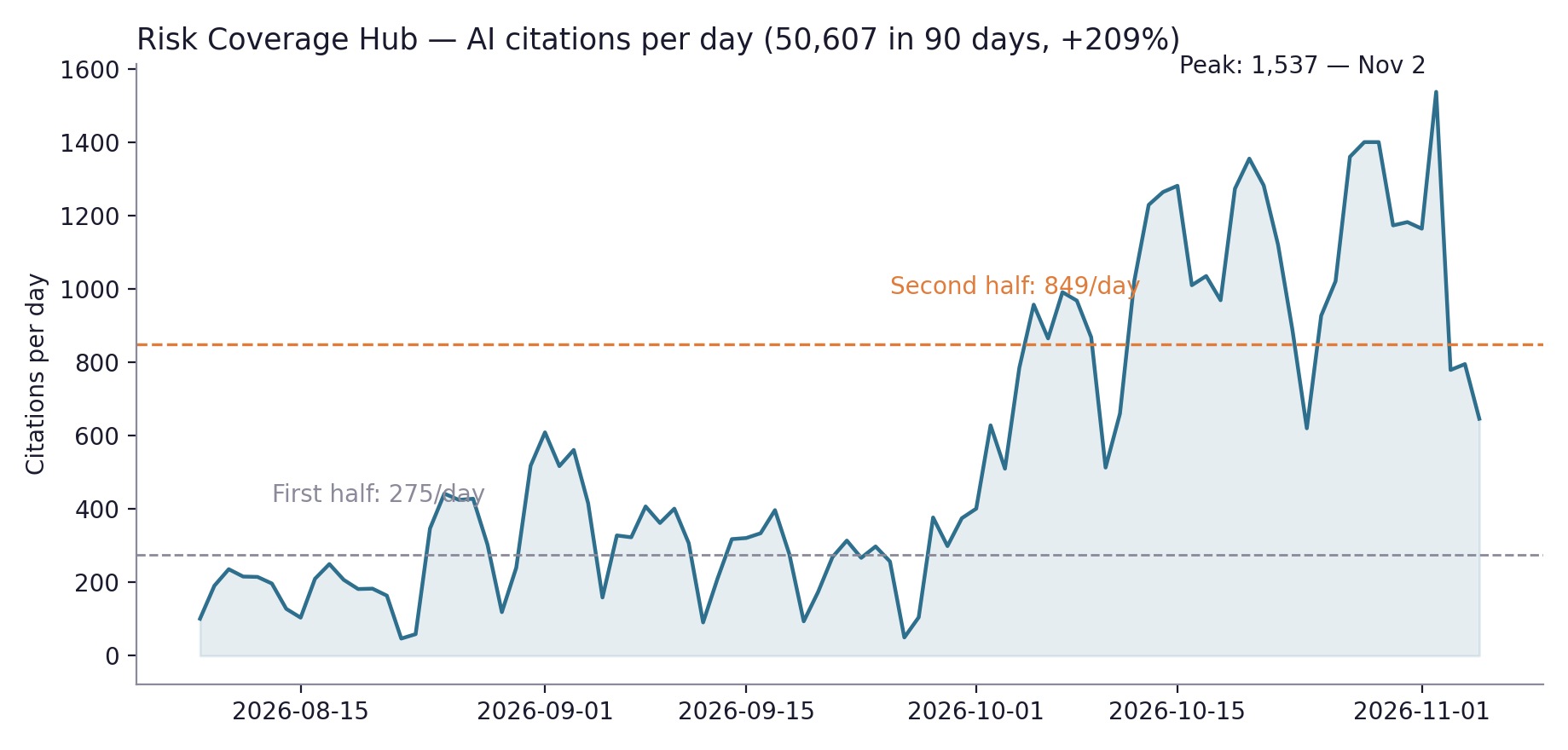
What it has instead is growth, and spread. The site’s daily citation rate went from 275 a day to 849 a day between the halves of the window — +209%, the fastest climb in our fleet. First fourteen days: 185 a day. Last fourteen: 1,064 a day. Peak day: November 2, with 1,537.
Watch the 60-second version: How did a site triple its AI citations with no page in charge? — the same receipts in 50 seconds, chapters matched to the sections below.
The climb
The window is August 8 to November 5, 2026, from Bing Webmaster Tools’ AI Performance report — the same instrument as the rest of this series. The daily series sums to 50,607; the page table sums to 47,747. Bing’s views differ (here by 5.7%), Bing prints a note saying so, and we name the view behind every number, as always.
Read the climb honestly: it isn’t a step. Receipt No. 1 had a step — a build date you could point at. This is a slope. The rate rises across the whole window, halves 275 to 849, and we are not going to invent a single cause for a slope. What we can do is read what the slope is made of — which pages, which questions — because that’s the part an operator can actually use.
The bench: six guides, no star
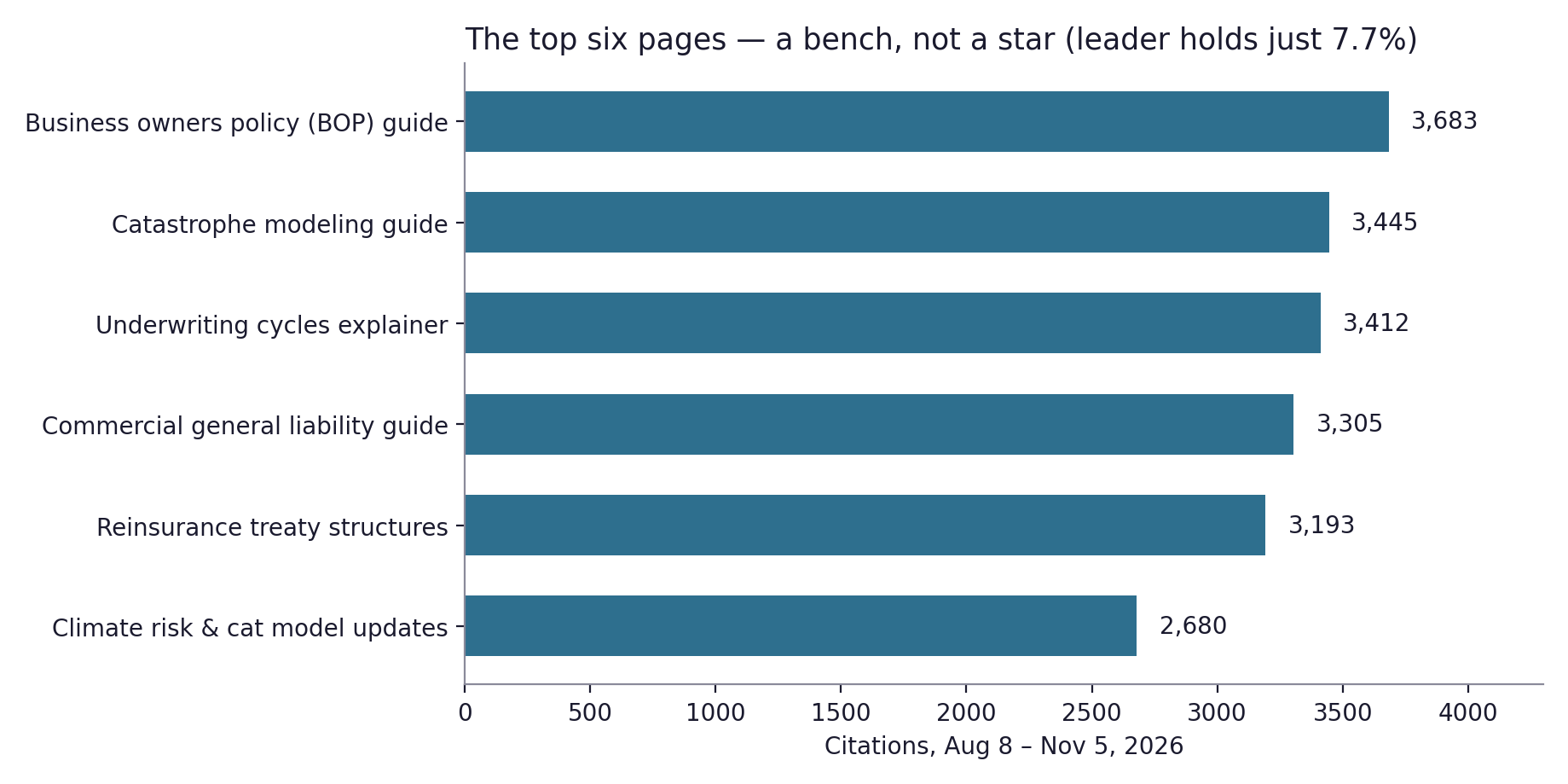
The top of the page table is bunched like a peloton:
- Business owners policy (BOP) coverage guide — 3,683
- Catastrophe modeling, complete guide — 3,445
- Underwriting cycles: hard and soft markets — 3,412
- Commercial general liability guide — 3,305
- Reinsurance treaty structures — 3,193
- Climate risk pricing & catastrophe model updates — 2,680
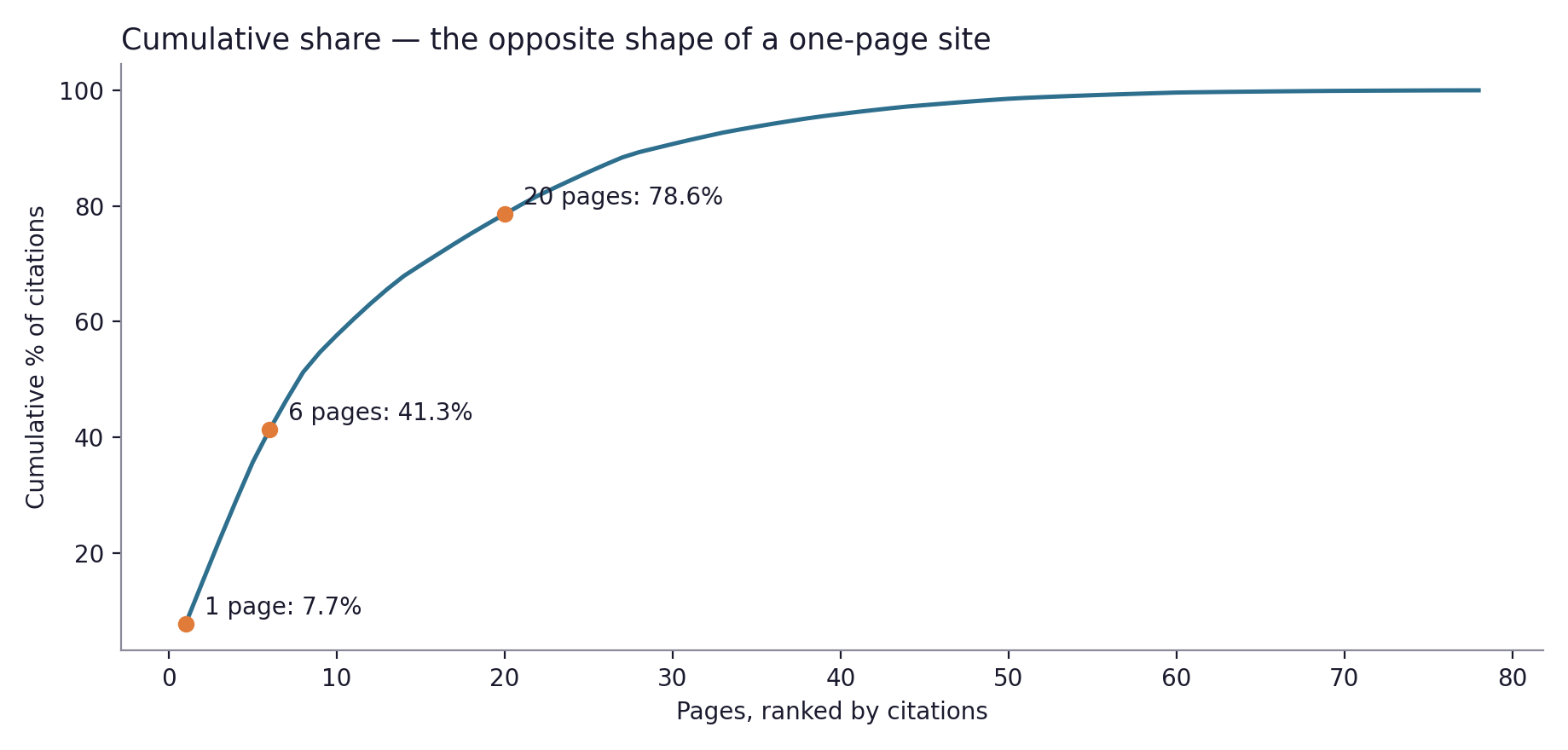
Six professional guides within a thousand citations of each other. Together they hold 41.3% of the page-sum; the leader alone holds 7.7%. Twenty pages get you to roughly three-quarters of the site — on our flagship, five pages are a majority. This is the diversified portfolio to Receipt No. 3’s concentrated bet, and it carries the mirror-image virtue: no single page’s bad week can wound this site. The bench is the moat.
The questions: long, specific, professional
The query table explains the shape. There is no “what is X” blockbuster here. The biggest questions are working questions, asked the way insurance professionals actually phrase work:
- “innovative insurance products digital risks cryptocurrency fraud deepfake liability…” — 464 citations; our share 28.07%.
- “global insurance risk underwriting metrics: evaluating climate disaster impacts on property premiums” — 459; our share 29.86%.
- “quota share reinsurance” — 404; our share 24.21%. The one short question in the list, and a term of art.
- “best practices property risk assessment commercial insurance” — 351; our share 29.52%.
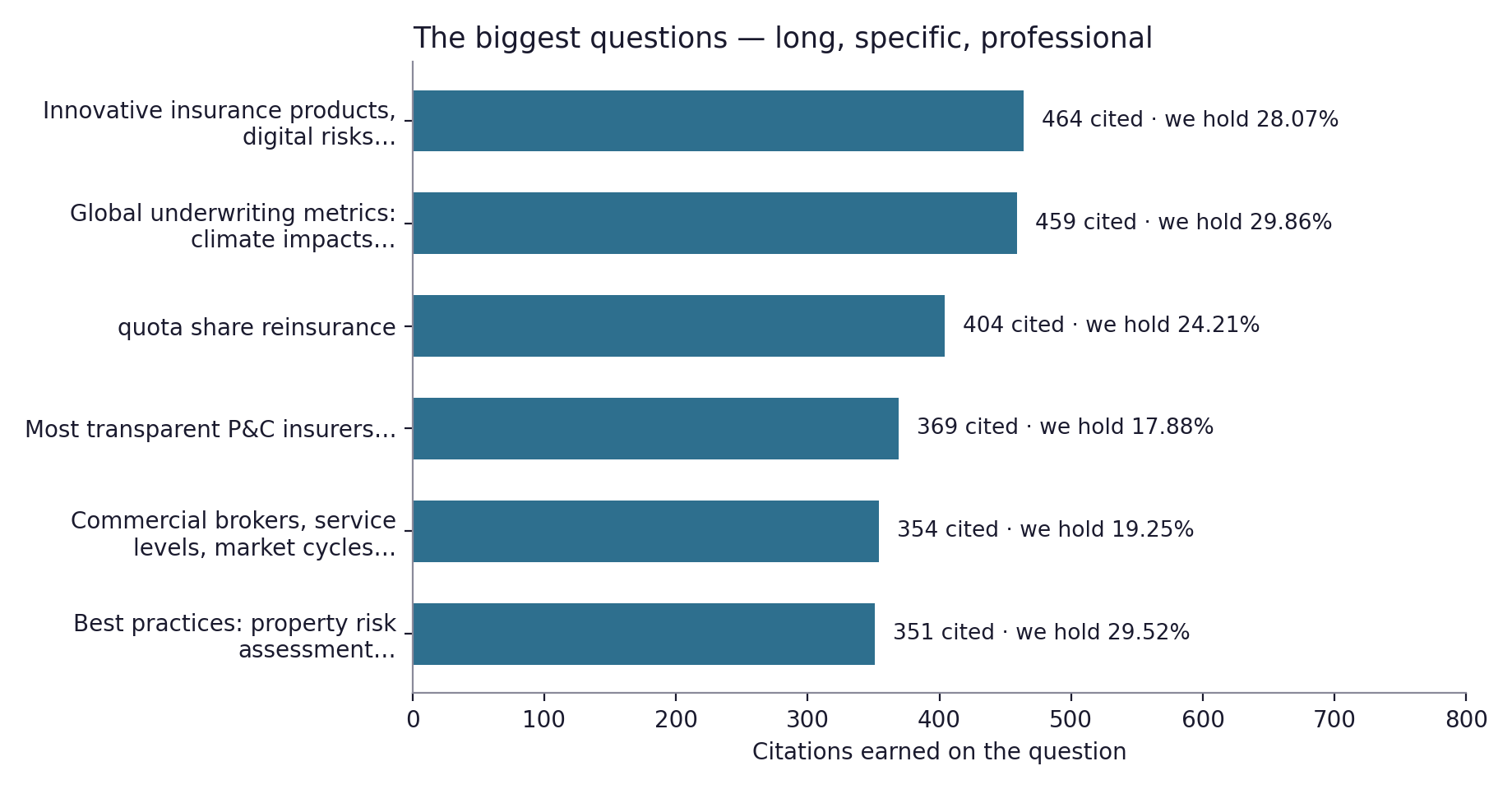
414 questions, 78 pages — and the shares sit in a band, mostly a fifth to a third. Nobody owns these questions outright, including us. The site earns by being a solid, specific answer across a whole professional vocabulary, not by holding one phrase hostage. That is a slower asset to build and a harder one to knock down.
What we can’t claim
- No single cause for the slope. Unlike the stepped sites in this series, nothing here dates the rise to one build. The honest sentence is: the site tripled while publishing steady, specific, professional guides — and correlation across a portfolio is not a mechanism.
- The views differ more here. Daily-sum 50,607 vs page-sum 47,747 — 5.7% apart, disclosed, each figure naming its view.
- One engine’s window. Copilot and partner citations as Bing reports them; ninety days is a snapshot, not a deed.
- Citations are not visits. Established in Receipt No. 1: this count measures being quoted into answers, not being read.
What we do now
- Feed the bench, not a star. The next guides get chosen from the question map where a working question is landing on an adjacent page — the Receipt No. 1 method, applied to a bench instead of a doorway.
- Watch for bunching changes. If one page starts separating from the peloton, that’s a signal — good or bad — worth a diagnosis, the way we diagnosed the flagship’s leader in October.
- Keep the shares honest. A fifth to a third on the big questions means the work is depth and currency, not defense of a crown we don’t hold.
- Publish the receipts — including the part where the growth has no single hero. A slope you can’t attribute is still a slope you can measure.
50,607 citations. 275 to 849 a day. No star — a bench, a vocabulary, and a climb. That’s the count and the shape.
Update history
November 8, 2026 — Published. The 60-second video version went live on YouTube the same morning (linked at the top of this page); its chapters match the sections below, and each chapter links back to its section.
Method note: All figures are from Bing Webmaster Tools AI Performance exports for riskcoveragehub.com, pulled November 8, 2026. Citation counts are Microsoft Copilot and partner citations as Bing reports them. Window: August 8–November 5, 2026 (90 days). The daily view sums to 50,607; the page view sums to 47,747 — Bing notes totals may differ across views, and each figure above names its view. Citation shares are Bing’s per-query figures. Guide names are shortened from the pages’ own titles. The Risk Coverage Hub underwriting explainer published today (post 1495 on that site) is not a driver of these numbers — it postdates the window. This is one site, one engine’s report, one 90-day window.
Get The Signal
What we actually ran, what it measured, and what it means for a restoration shop — every week, including the flops.
Leave a Reply