Three shapes so far in this series: a star (Receipt No. 3 — one page, 30.8% of its site), a bench (Receipt No. 4 — no page above 7.7%), and now the shape between them. Continuity Hub — our business-continuity reference — earned 57,798 AI citations in ninety days, and one guide holds 10,579 of them: 19.2% of the page-sum.
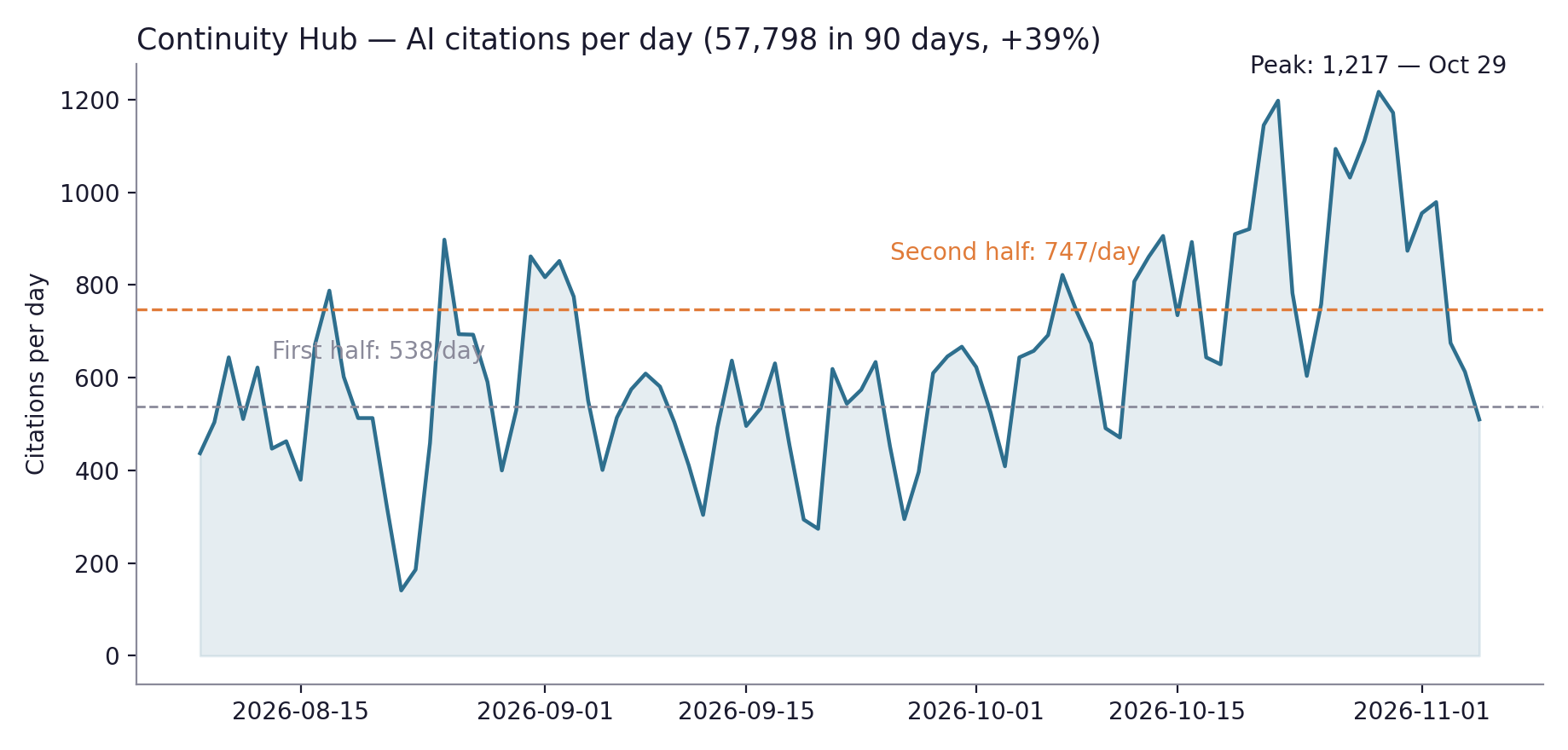
The guide is a complete professional treatment of supply-chain resilience. The site grew +39% by halves — 538 citations a day to 747 — with the last fourteen days averaging 884 and a peak of 1,217 on October 29. An anchor, real support, steady growth. The hybrid.
Watch the 60-second version: Why does one guide hold a fifth of this site’s AI citations? — the same receipts in 47 seconds, chapters matched to the sections below.
The count
The window is August 8 to November 5, 2026, from Bing Webmaster Tools’ AI Performance report — the same instrument as the rest of this series. The daily series sums to 57,798; the page table sums to 55,029. Bing’s views differ (here by 4.8%), Bing prints a note saying so, and every figure below names its view.
55 pages, 547 questions. The halves: 538 a day, then 747. First fourteen days: 530 a day. Last fourteen: 884. Not the flagship’s plateau, not Risk Coverage Hub’s triple — a working site’s steady climb, with its biggest day, October 29, landing in the most recent third of the window.
The anchor — and the support under it
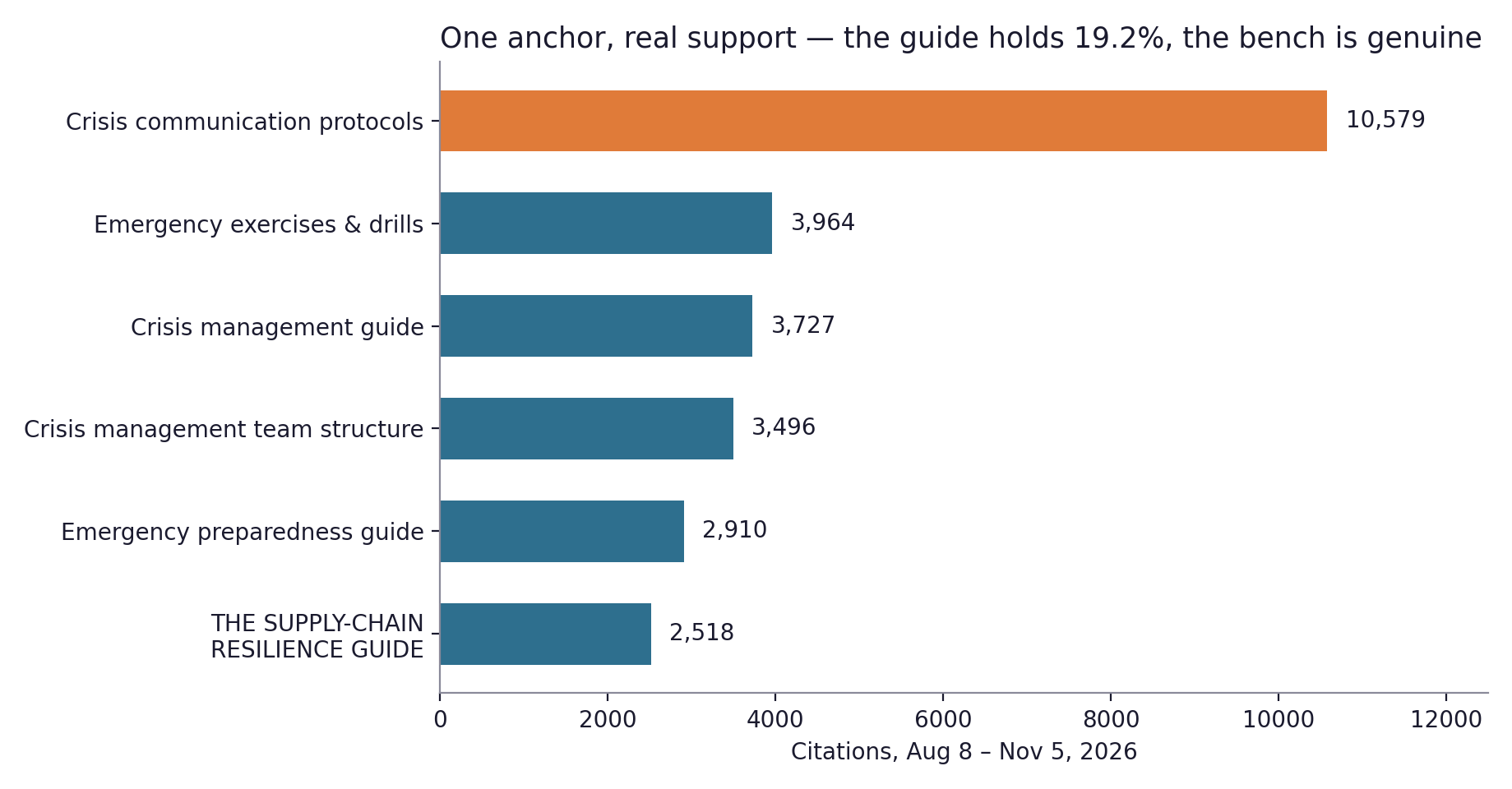
The supply-chain resilience guide’s 10,579 is a genuine lead — 2.7 times the runner-up. But read down the table and the anchor isn’t carrying the building alone:
- Supply-chain resilience, complete guide — 10,579
- Crisis communication protocols — 3,964
- Emergency exercises & drills — 3,727
- Crisis management, complete guide — 3,496
- Crisis management team structure — 2,910
- Emergency preparedness, complete guide — 2,518
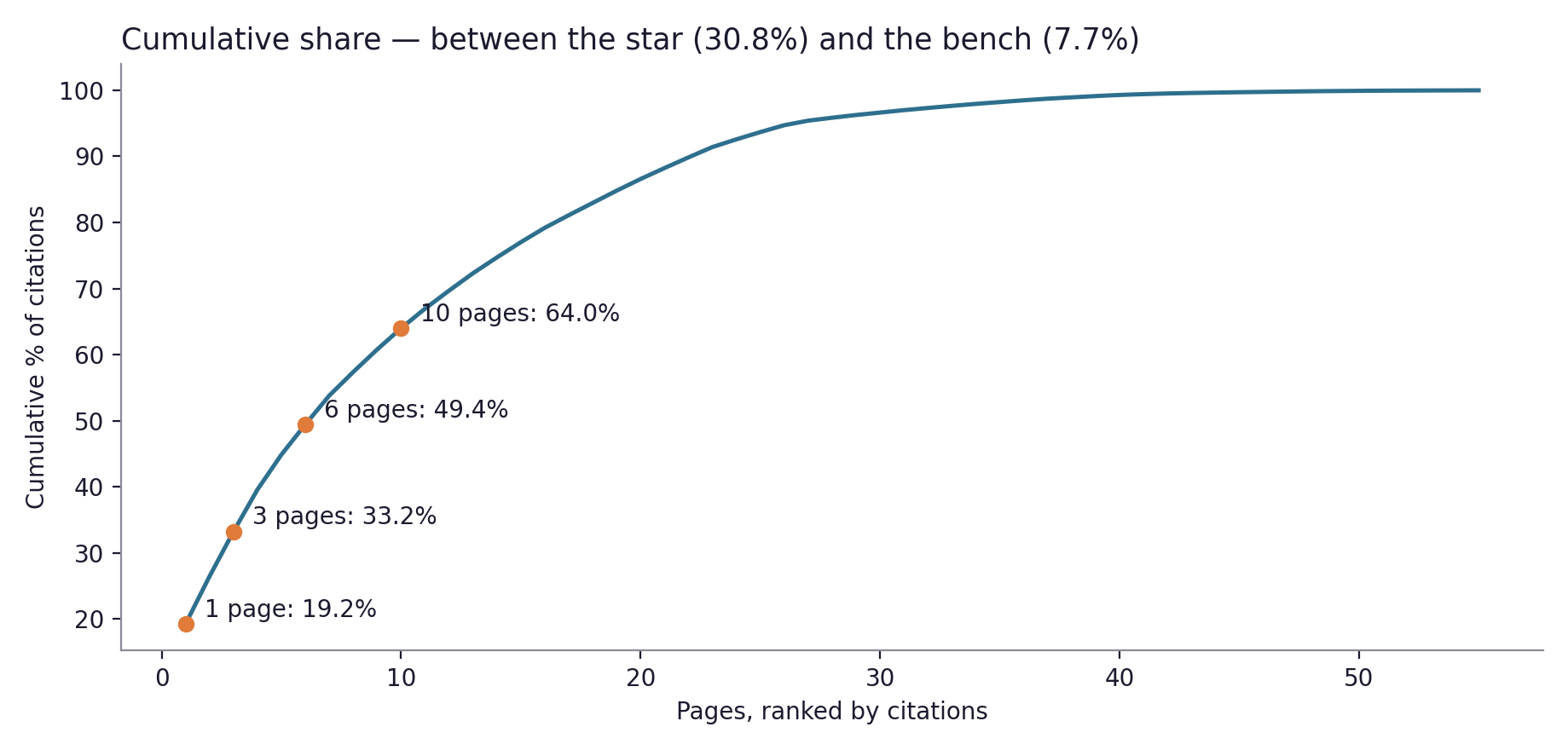
Three pages hold 33.2% of the page-sum; six hold 49.4%; ten hold 64.0%. And the families are balanced: five crisis pages hold 23.4% (12,869), five supply-chain pages hold 24.7% (13,614). Two pillars of near-equal weight, one of them fronted by an anchor. If the anchor page stumbled tomorrow, this site would lose a fifth of its count, not a third — and the crisis pillar wouldn’t notice. That’s the risk arithmetic of the hybrid shape, and on these numbers it’s the most comfortable of the three.
The questions: one phrase owned, one contested
The guide’s own question is the site’s biggest, and the hold is strong:
- “supply chain resilience business continuity vulnerabilities management” — 1,965 citations; our share 32.17%.
- “crisis management team” — 688; our share 25.98%.
- And a question in full sentence form, the way someone asks a person: “during a disaster, a facility needs to quickly reach staff, volunteers, and emergency management partners. which emergency preparedness element supports this need?” — 620 citations; our share 34.39%.
- “enterprise resilience strategy regulations 2026” — 435; our share 33.67%.
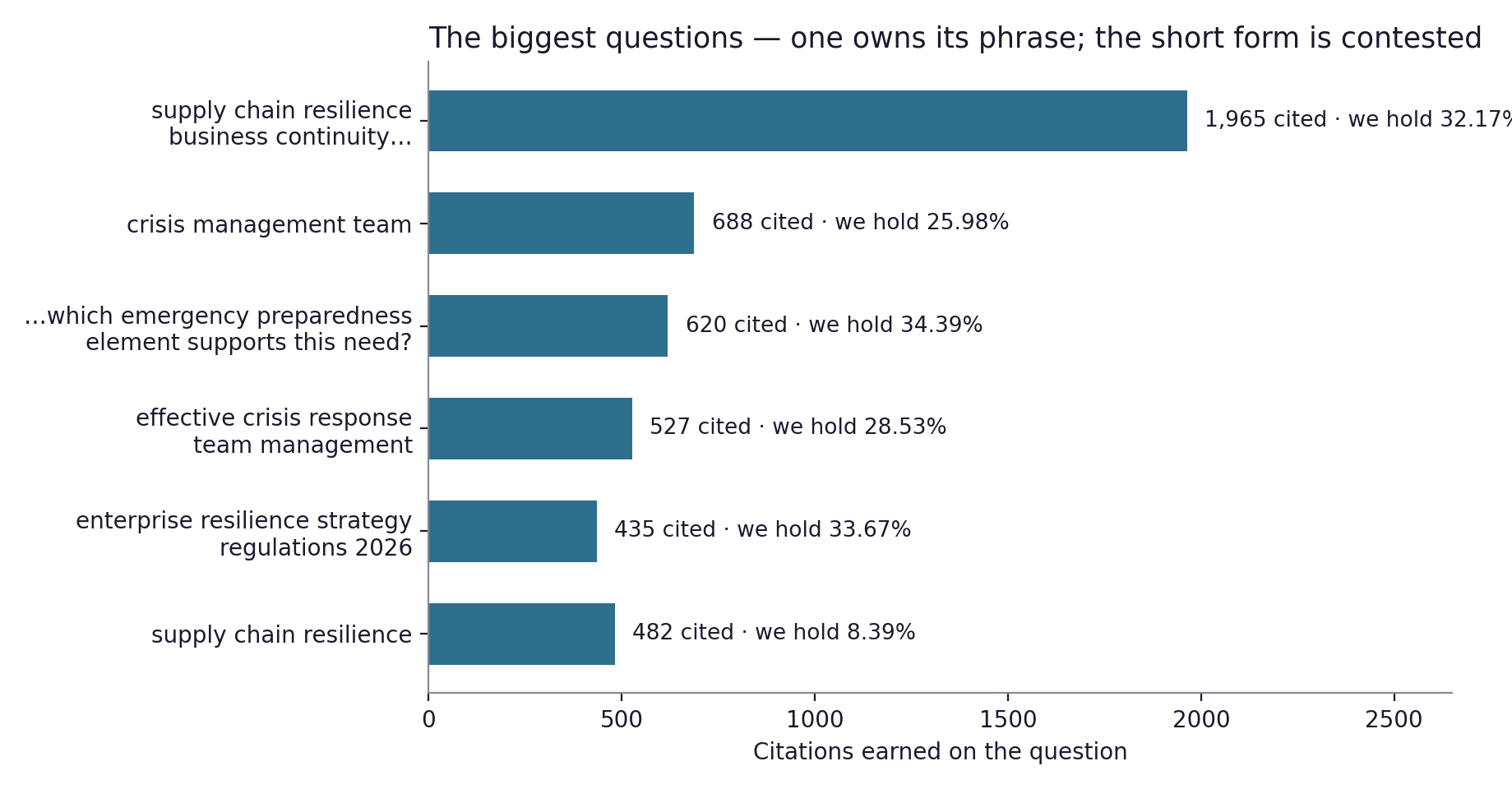
Now the honest complication, and it’s a good one: the short form — plain “supply chain resilience” — earns 482 citations across the web’s answers, and our share of it is only 8.39%. The guide owns its long, precise phrasing and is a minor holder of the short, famous one. That’s not a failure; it’s a map. The long forms are where professional intent lives, and 32–34% holds there are worth more than a sliver of the generic phrase. But anyone who tells you this page “owns supply chain resilience” hasn’t read the query table. We have. It owns a specific, valuable cut of it.
What we can’t claim
- No build story. Unlike Receipt No. 1’s stepped sites, nothing here dates the +39% to a single act. The guide predates the window’s story; the claim is the shape and the growth, not a cause.
- The views differ. Daily-sum 57,798 vs page-sum 55,029 — 4.8% apart, disclosed, each figure naming its view.
- One engine’s window. Copilot and partner citations as Bing reports them; ninety days is a snapshot, not a deed.
- Citations are not visits. Established in Receipt No. 1: this count measures being quoted into answers, not being read.
What we do now
- Protect the anchor’s freshness. A fifth of the site rides on one guide; it gets the flagship leader’s discipline — the heartbeat watch from Receipt No. 3, at hybrid scale.
- Build toward the short phrase carefully. The 8.39% is an invitation, not an emergency: adjacent, specific pages in the supply-chain family — the Receipt No. 1 method — rather than a rewrite of the page that’s already winning its own question.
- Keep both pillars fed. Crisis and supply chain are near-equal earners; starving one to feed the other would unbalance the sturdiest shape in the fleet.
- Publish the receipts — including the share we don’t hold. The map is the value; a prettier story would be worth less.
57,798 citations. One guide at 19.2%, two pillars, +39%. The hybrid — and, on the risk arithmetic, maybe the shape to aim for.
Update history
November 8, 2026 — Published. The 60-second video version went live on YouTube the same morning (linked at the top of this page); its chapters match the sections below, and each chapter links back to its section.
Method note: All figures are from Bing Webmaster Tools AI Performance exports for continuityhub.org, pulled November 8, 2026. Citation counts are Microsoft Copilot and partner citations as Bing reports them. Window: August 8–November 5, 2026 (90 days). The daily view sums to 57,798; the page view sums to 55,029 — Bing notes totals may differ across views, and each figure above names its view. Citation shares are Bing’s per-query figures. Guide names are shortened from the pages’ own titles. The “crisis family” and “supply-chain family” counts cover pages whose addresses contain those terms. The R4R Continuity article staged for a grant submission is a different piece and plays no part in these numbers. This is one site, one engine’s report, one 90-day window.
Get The Signal
What we actually ran, what it measured, and what it means for a restoration shop — every week, including the flops.
Leave a Reply