Receipts, No. 2 — Healthcare Facility Hub. First in this series: We Watched the Questions AI Was Asking Our Site.
In October we believed one of our sites was declining. We said so in writing, with a chart. The chart was honest; the window was the problem — it ended October 4, and Healthcare Facility Hub spent the rest of October doing the opposite of declining.
This morning we pulled the full ninety days. Between August 7 and November 6, AI answers cited Healthcare Facility Hub 109,844 times. The first half of the window averaged 984 citations a day; the second half averaged 1,720 — up 75%. The last fourteen days ran at 2,032 a day, and the peak, October 20, hit 3,510. It is the fastest-growing property we run.
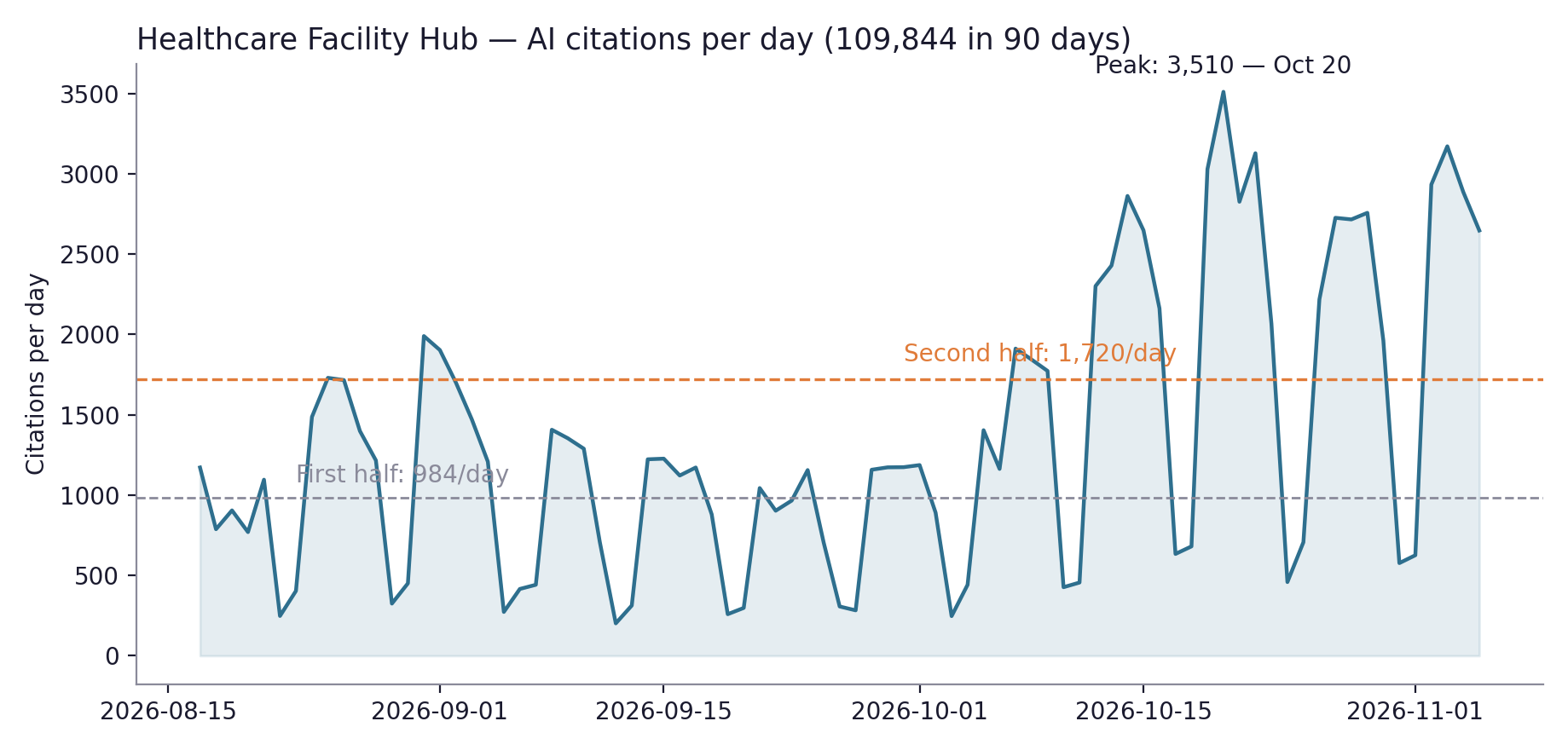
So we went looking for its biggest page, expecting to find the usual pattern from the rest of the fleet: a page the machines read and the humans barely visit. We found the opposite. This is the story of that page — including the part where we shipped its companion file split in two and the citations divided themselves between a summary and the real thing.
Watch the 60-second version: Why does one hospital page get cited 11,181 times by AI? — the same receipts, in 52 seconds, with chapters matched to the sections below.
The page
The page is a guide: What Is ICRA in Healthcare? (ASHE 2.0) — infection control risk assessment for construction and maintenance work in occupied hospitals. It holds 11,181 citations, the most-cited page on the site, about a tenth of everything. Around it sits a small family: a sibling ICRA guide at 2,053, a Class IV–V requirements page at 173, a matrix explainer at 121, a class finder at 23.
Get The Signal
What we actually ran, what it measured, and what it means for a restoration shop — every week, including the flops.
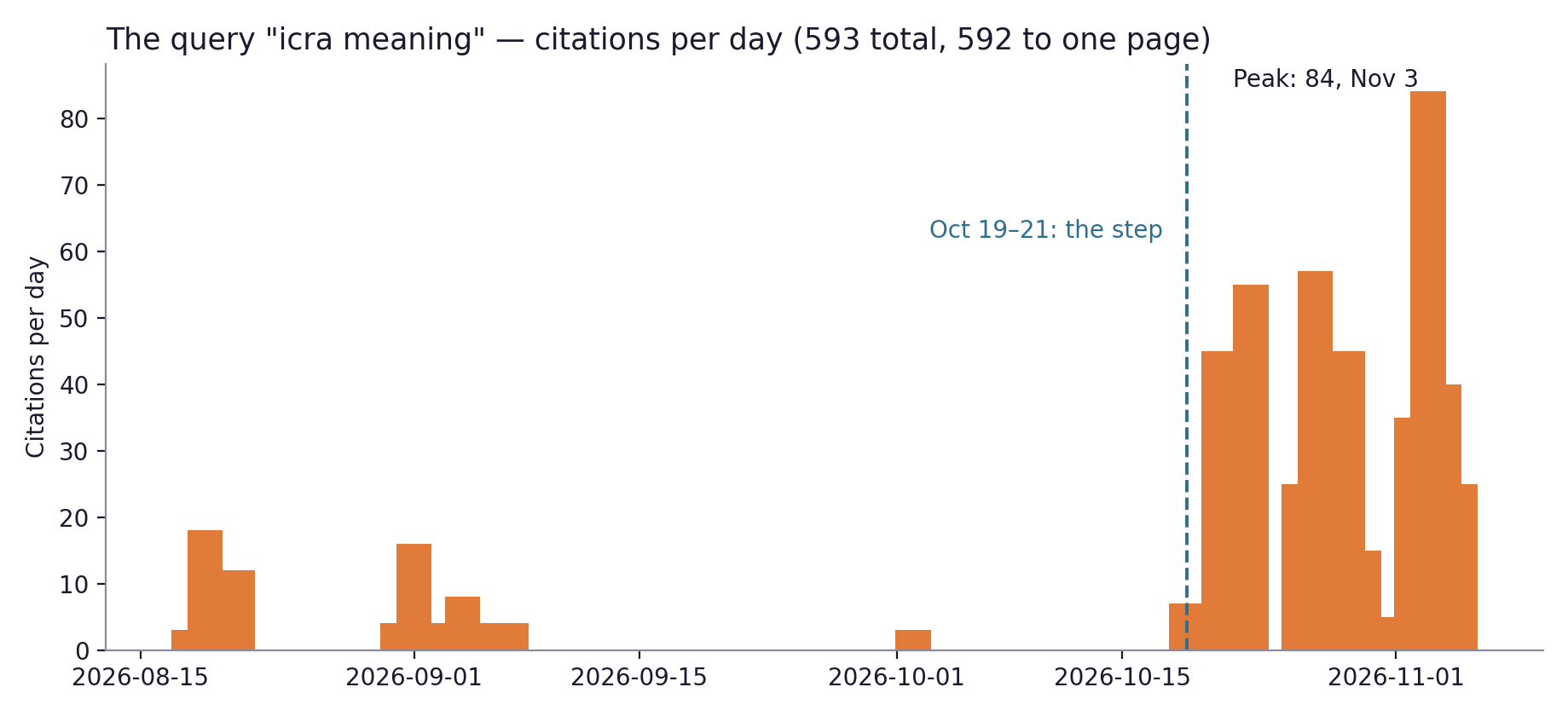
The query that feeds it hardest is plain: “icra meaning.” Five hundred ninety-three citations, and 592 of them land on this one page. Its daily rhythm tells the build story. Through mid-October it ran flat, a handful a day. Then, on the October build dates, it stepped: 45 on October 21, 55 on the 23rd, 57 on the 27th, peaking at 84 on November 3.
Then we checked the humans
On the beauty-industry site in our first report, the pattern was stark: hundreds of citations, a handful of human sessions, visits that lasted about ten seconds. Machines verifying, nobody reading.
The ICRA page breaks that pattern completely. Microsoft Clarity, last thirty days: 231 human sessions (seventeen bot sessions excluded), 162 people, an average of 4.4 active minutes inside a 7.8-minute visit, 1.72 pages per session, scroll depth 36%, zero rage clicks, almost no friction. Three quarters of them arrive from Bing search. And the browser split gives the audience away: 73.6% Microsoft Edge, 88% desktop. That’s facilities and infection-prevention staff on managed hospital workstations, in the middle of a workday, using a page to do a job.
The site as a whole is built the same way: 2,412 human sessions in thirty days against 1,091 bot sessions excluded — the most human audience in our fleet. The machines cite this site the fastest-growing amount, and the humans actually read it. Both. At the same time. On the same pages.
The machinery question, again
Our first report noted that the beauty site had no llms.txt file and full FAQ schema on its winning guides. Healthcare Facility Hub is the mirror image: it has an llms.txt, and its most-cited page carries no FAQ schema at all — video markup, breadcrumbs, speakable, that’s it. Opposite machinery, same explosion. Whatever is being selected here, it isn’t a schema flavor.
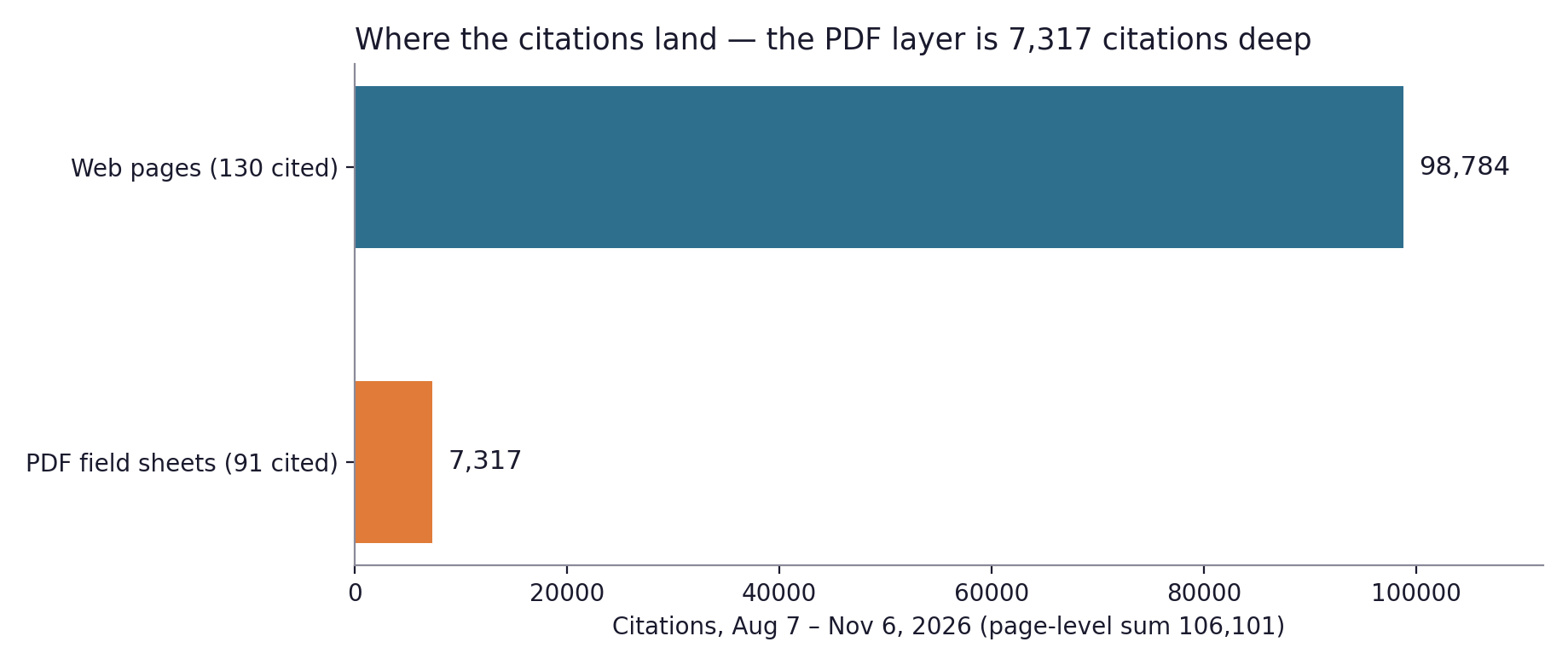
What the two winners share is more ordinary: one real question answered completely on one page, and a downloadable artifact attached to it — a field sheet a person (or an agent) can take away. On this site that second layer is not small: 91 cited PDF field sheets hold 7,317 citations — compliance checklists for the Joint Commission, evacuation, fire drills, medical gas. Books for bots, and for the people who print them.
What we got wrong
Here is the part we would rather skip, which is exactly why it’s in the report.
The ICRA guide links its field sheet twice — and the two links go to two different files. The first version, published October 15, sits at the clean, obvious filename. It is a summary sheet: the direct answer, the framing, no numbers — the actual Class I–V barrier matrix is not on it. It holds 68 citations.
On October 29 we published the real sheet — the full matrix, barrier requirements by class, negative-air sizing, the decommissioning sign-off sequence, stamped on its face as the current version. But it went up under a new, dated filename instead of replacing the old file. It holds 47 citations. An email-gate on the same page points at the clean filename too, so the older, thinner sheet has a third door in.
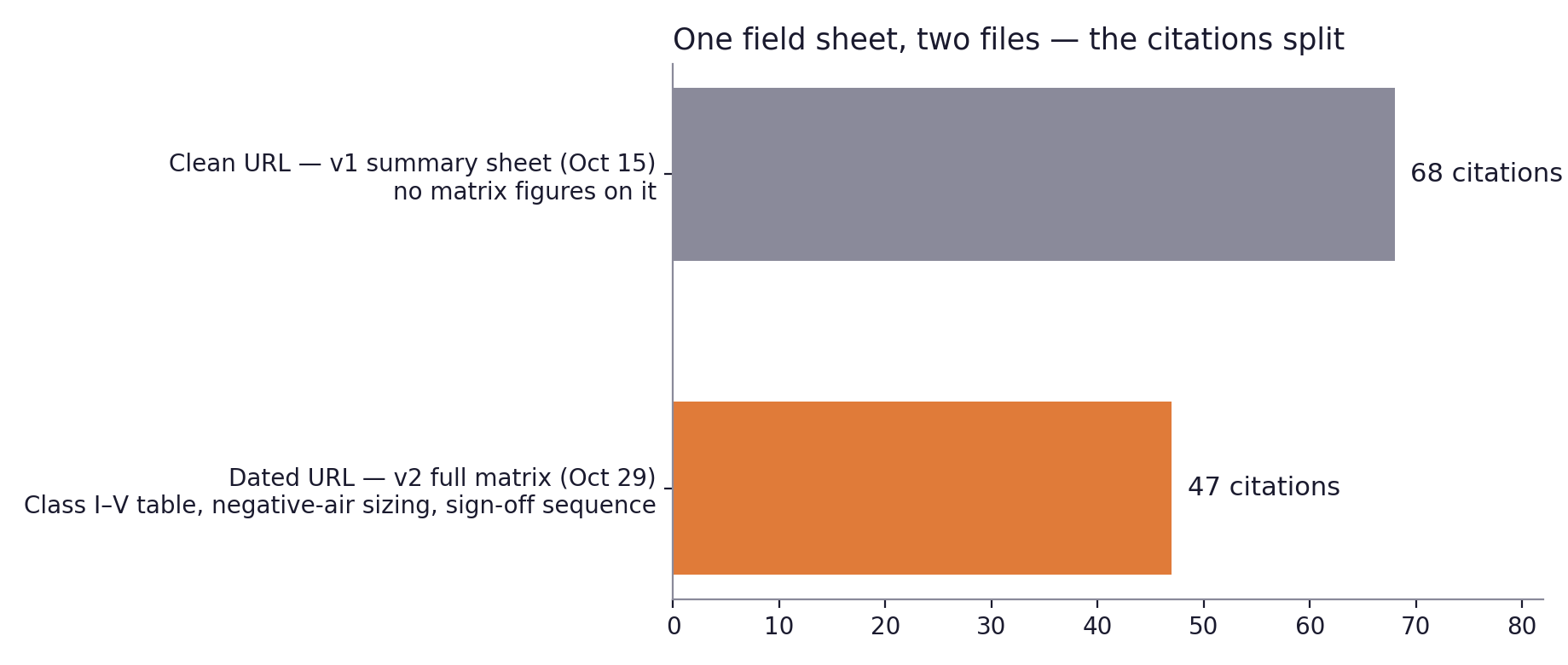
A page and its download are supposed to be one asset, saying one thing. Ours said two, and the citation record split along the seam — with the lead going to the version that has less in it. Anybody who followed the most-cited link got the summary. Anybody who followed the page’s own button got the matrix. We built both halves of that on purpose, two weeks apart, and never noticed the seam until we pulled the page-level export this morning.
The fix is two file renames, and nothing else. The October 15 file moves to an archive name — its bytes preserved, its history intact. The October 29 sheet takes the clean filename. The page doesn’t change; no link anywhere changes. Every door — the page, the email gate, the citation record — then opens onto the full matrix.
As this publishes, the fix is staged and waiting on a server door, not on a decision: the file host has refused our automated connections this morning, so the two renames run the moment that door reopens, or by hand in the hosting panel. When it lands, this article gets a dated line below saying so — the same update-lineage rule we apply to the pages themselves. If you’re reading this without that line, the fix is still in flight and we’d rather tell you that than round it off.
What we’d tell another operator
Check your cited PDFs for version splits. If a page was ever refreshed by uploading a new file instead of replacing the old one, you may have two assets dividing one citation record — and the split favors whichever file got the cleaner name, not whichever is better. This took one page-level export to find.
Read the session data before you call a page machine-only. The fleet’s loudest page turned out to have its most human audience. The machines and the people are not reading different sites; on the good pages, they’re reading the same one.
A trend is a window, not a verdict. We wrote “declining” in October because our window ended October 4. The site was already turning. The correction cost us nothing but a sentence — because the first claim was in writing, with its dates on it.
Method. Bing Webmaster Tools, AI Performance, pulled November 8, 2026, window August 7–November 6, 2026. Daily totals sum to 109,844; the page-level sum runs slightly lower (106,101) — Bing notes totals can differ between views. Query figures from the filtered pull for “icra meaning” (593 total; 592 to the ICRA guide, 1 to a sibling). Microsoft Clarity figures are the last 30 days, bot sessions excluded as reported; the citation and session windows differ, so comparisons between them are directional. Field-sheet contents verified by reading both files this morning.
The full dataset — every chart above, the site table, and the field-sheet comparison — is in the companion field report: Built for the Question: Healthcare Facility Hub (PDF).
Working on a site where AI answers are sending mixed signals? Book a call with Will Tygart.
Update history
November 8, 2026 — Published. Field-sheet consolidation staged; completion line to be added here when the renames verify live.
November 8, 2026 — The 60-second video version published on YouTube (linked at the top of this page); its chapters match the sections below, and each chapter links back to its section.
Get The Signal
What we actually ran, what it measured, and what it means for a restoration shop — every week, including the flops.
Leave a Reply