This is part of Tygart Media’s AI Search Intelligence series — a 10-article investigation into how content gets discovered, cited, and valued in the age of AI-powered search.
Most content strategies start with a keyword. You open a tool, find a search volume number, and build an editorial calendar around what people type into Google. That process worked for two decades. It does not work for AI crawlers.
When we set out to publish 40 articles targeting Microsoft Copilot citations, we did not start with keywords. We started with a question that has no equivalent in traditional SEO: What will an AI system need to cite when a knowledge worker asks it a question during their workday?
The answer to that question led us to build what we now call the AI Citability Framework — a five-criteria evaluation system for selecting topics that AI engines will actually reference in their responses. Within 48 hours of publishing our first batch of articles, we had 3 confirmed Copilot citation referrals from copilot.microsoft.com appearing in our server logs (Tygart Media server log analysis, June 2026).
This article explains exactly how we chose those 40 topics, why we organized them into 5 specific categories, and how you can apply the same framework to your own content strategy.
Why Traditional Topic Selection Fails for AI Search

Traditional keyword research answers one question: “What are people searching for?” AI-era topic selection must answer a fundamentally different question: “What will AI systems need authoritative sources for when they construct answers?”
Get The Signal
What we actually ran, what it measured, and what it means for a restoration shop — every week, including the flops.
The distinction matters because AI systems do not simply match queries to pages. They synthesize answers from multiple sources, and they cite the sources they find most authoritative, most structured, and most directly responsive to the user’s underlying intent. A page that ranks #1 for a keyword might never get cited by an AI assistant if it buries its answer in marketing fluff or lacks the structural signals AI systems use to extract citable claims.
We documented this dynamic extensively in our analysis of how AI engines cite content — the mechanics of citation are fundamentally different from the mechanics of ranking. Understanding that difference is what makes the AI Citability Framework necessary.
The Enterprise B2B Advantage in AI Citations
Enterprise B2B content gets cited by AI systems at dramatically higher rates than consumer content. This is not a hypothesis — it is a pattern we observed repeatedly across our server log data (Tygart Media server log analysis, June 2026) and one that shaped every topic selection decision we made.
Three structural factors explain this advantage:
- Workflow integration. Microsoft Copilot, the AI assistant embedded in the Microsoft 365 suite used by over 400 million people, is predominantly accessed during business hours. When a CIO asks Copilot about governance frameworks or a BI analyst asks about DAX generation accuracy, Copilot needs enterprise-grade sources to cite. Consumer lifestyle content simply does not enter these workflows.
- Authority signals. Enterprise content tends to carry stronger E-E-A-T (Experience, Expertise, Authoritativeness, Trustworthiness) signals. Technical documentation, frameworks, checklists, and implementation guides signal expertise in ways that generic blog posts do not.
- Answer scarcity. For many enterprise topics — particularly around emerging tools like Microsoft Copilot — authoritative, well-structured content simply does not exist yet. AI systems must cite something, and being the first authoritative source in a scarce topic area creates a durable citation advantage.
We explored the broader dynamics of what enterprise content wins in our analysis of Bing-Copilot user enterprise workflows, and the data is clear: if you want AI citations, enterprise B2B content is where the opportunity lives.
The AI Citability Framework: 5 Criteria for Topic Selection
Before writing a single article, we evaluated every potential topic against five criteria. A topic had to score well on at least four of the five to make our editorial calendar. Here is the framework.
Criterion 1: Query Frequency in Enterprise Workflows
Definition: How often do knowledge workers ask AI assistants about this topic during their actual workday?
This is not the same as search volume. A topic might have low Google search volume but high query frequency inside enterprise AI workflows because workers are asking Copilot directly — those queries never appear in traditional keyword tools.
We estimated enterprise query frequency by analyzing:
- Microsoft 365 product update announcements and the specific features they highlighted
- Enterprise IT community discussions on platforms like Reddit r/sysadmin, Spiceworks, and Microsoft Tech Community
- LinkedIn conversations among CIOs, IT directors, and enterprise technology decision-makers
- Support ticket patterns from Microsoft’s own documentation and community forums
For example, “Microsoft 365 Copilot governance framework” had minimal traditional search volume in June 2026. But every enterprise deploying Copilot needs a governance framework, and IT leaders are asking their AI assistants for guidance on exactly this topic. That gap between traditional search volume and actual enterprise query frequency is where the AI citation opportunity lives.
Criterion 2: Answer Scarcity
Definition: For this topic, does authoritative, well-structured content already exist — or is the AI system working with thin, outdated, or poorly organized sources?
Answer scarcity is the single most powerful predictor of AI citation success. When an AI system needs to cite a source for a topic and only finds one or two authoritative options, your content does not compete — it gets cited by default.
We assessed answer scarcity by:
- Querying Copilot directly and evaluating the quality and recency of its cited sources
- Searching Bing for the topic and analyzing whether top results were comprehensive or shallow
- Checking whether existing content used structured data markup that AI systems could easily parse
- Evaluating whether any existing source provided a complete, implementable answer versus a partial overview
The results were striking. For topics like “Copilot DLP policies CISO configuration,” the existing content landscape was almost entirely Microsoft’s own documentation — technically accurate but not structured for AI extraction, not contextualized for decision-makers, and not organized as implementable frameworks. That is a textbook answer scarcity gap.
This dynamic is precisely what we documented in why competitor content gets cited by AI and yours doesn’t — it is rarely about quality alone. It is about being the structured, authoritative answer in a space where that answer does not yet exist.
Criterion 3: Bing Index Coverage
Definition: Can this content get indexed by Bing quickly and comprehensively, given that Microsoft Copilot pulls its citation sources from Bing’s index?
This criterion is specific to the Copilot citation pathway, but the principle applies broadly: every AI system has a source index, and your content must be present in that index before it can be cited.
For Microsoft Copilot specifically, the pipeline is: Bing indexes your content → Copilot accesses Bing’s index to construct answers → Copilot cites your content in its response → the user clicks through to your site. If Bing does not index your content, Copilot cannot cite it. Full stop.
We evaluated Bing index coverage by:
- Checking our existing Bing Webmaster Tools data for crawl frequency and index coverage rates
- Analyzing which content types Bing was indexing fastest on our site
- Reviewing Bing’s stated preferences for content structure, page speed, and technical SEO
- Ensuring our XML sitemap was submitted and processing correctly in Bing Webmaster Tools
We covered the full mechanics of this pipeline in our deep dive on the 98,800 AI citations and Microsoft Copilot sourcing data, including how Bing’s index directly determines Copilot’s citation pool.
Criterion 4: Structured Data Compatibility
Definition: Does this topic map cleanly to schema.org types and structured data formats that AI systems use to extract and cite specific claims?
Not all content is equally extractable by AI systems. A narrative essay about AI trends is harder for an AI system to cite than a structured framework with named components, numbered steps, and clearly defined terms. The more your content maps to established structured data types, the easier it is for AI systems to identify, extract, and cite specific claims.
Topics we evaluated well on structured data compatibility included:
- Frameworks and checklists → HowTo schema, ItemList schema
- Comparison guides → Product schema, comparison tables
- Implementation guides → HowTo schema with step-by-step structure
- FAQ-rich topics → FAQPage schema
- Category-defining content → Article schema with clear definitions
Every one of our 40 articles was built with multiple schema.org markup types embedded, following the PSAO (Platform-Specific AI Optimization) framework we developed specifically for multi-platform AI visibility. Structured data is not optional in AI-era content — it is infrastructure.
Criterion 5: Citation Chain Potential
Definition: Will this content become a reference point that other AI-cited content links back to, creating a self-reinforcing citation network?
This is the most strategic criterion and the one most content teams overlook entirely. In the AI citation economy, individual articles do not exist in isolation. They exist within citation chains — networks of content where AI systems cite Source A, which references Source B, which links to Source C, creating a web of mutual reinforcement.
Content with high citation chain potential is:
- Foundational — it defines a category, framework, or approach that other content must reference
- Interconnected — it links to and from related content within a topical cluster
- Evergreen-adjacent — it covers a topic that will remain relevant as the technology matures
- Definitive — it aims to be the single most comprehensive source on its specific subtopic
We explored how this citation economy works in our analysis of why being cited is worth more than being clicked. The core insight: a single AI citation can generate referral traffic for months, whereas a single click is a one-time event. Content with citation chain potential compounds its value over time.
Mapping the Bing → Copilot → Bing Ads Flywheel Before Writing
Before we wrote a single article, we mapped the complete flywheel that would determine our content’s commercial value. Understanding this flywheel is what separates strategic AI content from hopeful publishing.
The flywheel works in four stages:
- Bing Indexation: Content gets indexed by Bing’s crawler, entering the index that Copilot draws from. Fast indexation depends on technical SEO, sitemap submission, and content structure.
- Copilot Citation: When enterprise users ask Copilot questions matching our content topics, Copilot cites our articles as sources. This generates referral traffic from copilot.microsoft.com.
- Engagement Signals: That referral traffic creates engagement signals — time on page, pages per session, return visits — that feed back into Bing’s ranking algorithms, reinforcing our content’s authority.
- Bing Ads Amplification: The increased Bing visibility and proven engagement metrics create opportunities within the Bing Ads ecosystem, allowing us to amplify high-performing content to enterprise audiences already searching for related topics.
We documented the timing patterns of this flywheel in our analysis showing Copilot users arrive during the day while Google users arrive at night — the same website, two completely different audience patterns. Mapping this flywheel before writing ensured every topic we selected could participate in all four stages.
The data confirmed our thesis: our site was being read by AI more than by humans, which meant optimizing for AI citation was not an experiment — it was adapting to our actual traffic reality.
Why We Chose These 5 Categories
We organized our 40 articles into 5 categories, each selected for specific strategic reasons within the AI Citability Framework. Here is our reasoning for each.
Category 1: Governance (8 articles)
Why governance: Every enterprise deploying Microsoft Copilot must address data governance, security policies, and compliance frameworks. These are questions CISOs, CIOs, and IT directors ask their AI assistants daily. The answer scarcity was extreme — most existing content was either Microsoft’s own documentation (accurate but not implementable) or consultant marketing pages (shallow and self-serving).
Example articles:
- Microsoft 365 Copilot Governance Framework for Enterprise 2026
- Copilot DLP Policies: CISO Configuration Guide
- Copilot Data Exposure Pre-Deployment Security Checklist
Citability score: Governance content scored highest across all five framework criteria. Enterprise query frequency is high (every deployment requires governance decisions), answer scarcity is extreme, Bing indexes authoritative governance content quickly, the content maps perfectly to HowTo and ItemList schemas, and governance frameworks become foundational references that other content must cite.
Category 2: Business Intelligence (8 articles)
Why BI: The intersection of Microsoft Copilot and Power BI represents one of the highest-value enterprise use cases. BI analysts and data teams are already using Copilot to generate DAX queries, build reports, and analyze datasets. Their questions are specific, technical, and poorly served by existing content.
Example articles:
- Microsoft Copilot Power BI Setup and Licensing Guide 2026
- Copilot DAX Generation Accuracy Guide 2026
Citability score: BI content scored exceptionally well on query frequency (daily use by analysts) and structured data compatibility (technical guides map perfectly to HowTo schema). Answer scarcity was significant — most existing Copilot-BI content was surface-level overviews rather than implementation guides.
Category 3: Adoption (8 articles)
Why adoption: Enterprise Copilot adoption is the primary challenge facing IT leaders in 2026. Change management, user training, ROI measurement, and rollout planning are daily concerns for technology decision-makers. These are exactly the questions they ask AI assistants when planning deployments.
Example articles:
- Microsoft Copilot Adoption Framework: 90-Day Enterprise Playbook 2026
- Change Management for Microsoft Copilot Rollout
Citability score: Adoption content scored highest on citation chain potential. A governance article cites the adoption framework. A BI implementation guide references the change management playbook. Adoption content became the connective tissue linking our entire 40-article cluster.
Category 4: Productivity (8 articles)
Why productivity: Individual productivity workflows — using Copilot in Teams meetings, Outlook email management, Word document creation — represent the highest-volume query category. Every Microsoft 365 user has productivity questions, and they increasingly ask Copilot itself for help using Copilot.
Example articles:
- Microsoft 365 Copilot Productivity Guide: Daily Workflows 2026
- Copilot for Microsoft Teams: Meetings, Summaries, and Action Items 2026
Citability score: Productivity content scored highest on query frequency but lower on answer scarcity (Microsoft’s own content is more comprehensive here). We differentiated by providing decision frameworks and workflow templates rather than feature documentation.
Category 5: Alternatives (8 articles)
Why alternatives: Decision-makers evaluating Copilot inevitably compare it to ChatGPT Enterprise, Google Gemini, and other AI assistants. Comparison queries are among the most citation-rich in AI search because the AI system must present balanced, multi-source analysis.
Example articles:
- Microsoft Copilot vs. ChatGPT Enterprise: Daily Work Comparison 2026
- AI Assistant Decision Framework for Organizations 2026
Citability score: Alternatives content scored highest on Bing index coverage (comparison content ranks well in Bing) and structured data compatibility (comparison tables and decision matrices map perfectly to Product schema and structured comparison formats). We analyzed the different audience dynamics in our piece on writing for Google vs. Copilot vs. ChatGPT as different audiences.
The Full Optimization Stack: SEO + AEO + GEO on Every Article
Topic selection was only the first layer. Every one of the 40 articles received the full optimization stack — a triple-layer approach combining traditional SEO, Answer Engine Optimization (AEO), and Generative Engine Optimization (GEO).
Here is what that stack looked like in practice:
SEO Layer
- Keyword-optimized titles, meta descriptions, and H2/H3 structure
- Internal linking across all 40 articles and the broader site architecture
- Technical SEO fundamentals: page speed, mobile responsiveness, Core Web Vitals compliance
- XML sitemap inclusion and Bing Webmaster Tools submission
AEO Layer
- Featured snippet formatting: definition boxes, numbered lists, concise answer paragraphs
- FAQ sections with schema markup on every article
- Direct-answer paragraphs positioned within the first 200 words
- Question-based H2 and H3 headers matching enterprise query patterns
GEO Layer
- Entity-rich content naming specific platforms, tools, frameworks, and organizations
- Structured data markup: Article, FAQPage, HowTo, BreadcrumbList, and Product schemas as applicable
- Claim-level sourcing so AI systems can attribute specific data points
- Cross-platform optimization following our PSAO approach to writing one article that serves all six AI platforms
The debate over whether to prioritize SEO, GEO, or AEO is, in our view, a false choice. We addressed this directly in our piece on why the SEO vs. GEO vs. AEO debate is over — the answer is all three, applied as layers rather than alternatives. The AI Citability Framework simply adds a strategic topic-selection layer on top of this optimization stack.
Verified Results: 3 Confirmed Copilot Citations in 48 Hours
Within 48 hours of publishing our first batch of optimized articles, our server logs showed 3 confirmed citation referrals originating from copilot.microsoft.com (Tygart Media server log analysis, June 2026).
To be precise about what “confirmed citation referral” means: these were HTTP requests to our articles where the referring URL was copilot.microsoft.com — meaning a user asked Copilot a question, Copilot cited our content in its response, and the user clicked through to read the full article. This is a direct, server-verified signal that our content was selected by Copilot’s citation algorithm.
Three citations in 48 hours from a standing start may sound modest, but consider the context:
- The articles were brand-new with zero backlinks and zero domain-specific authority for Copilot governance content
- They were competing against Microsoft’s own documentation and established enterprise IT publications
- The 48-hour window demonstrates that Bing indexed and Copilot accessed the content within two days of publishing
- Each citation represents a high-intent enterprise user — the exact audience we targeted
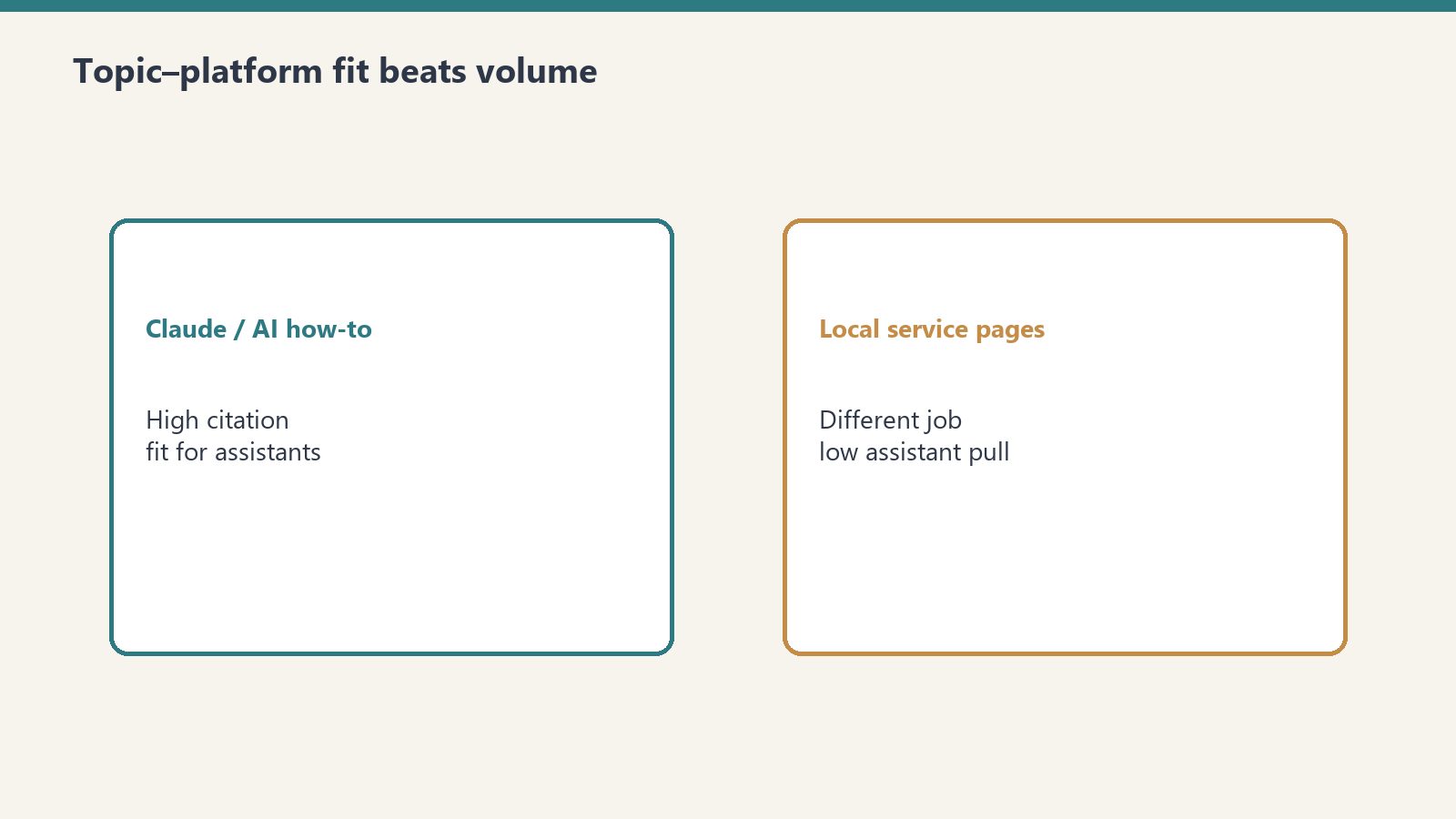
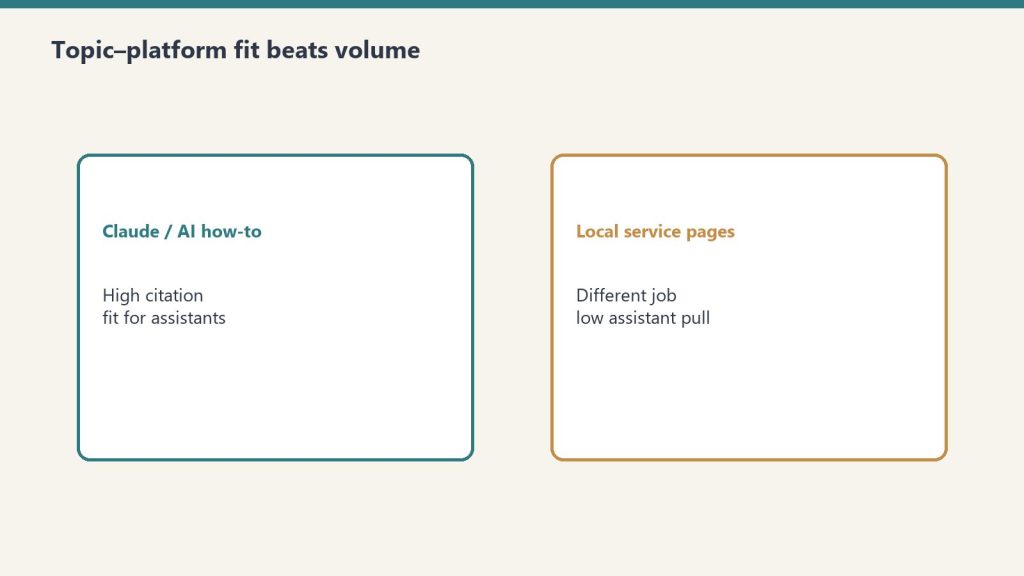
We documented the broader pattern of AI citation data in our analysis showing Claude articles generated 16,500 reads while Copilot citations for roofing content were zero — the topic-selection criteria matter enormously. Enterprise Copilot content gets cited. Generic content does not.
How to Apply the AI Citability Framework to Your Content Strategy
The framework is not proprietary magic. It is a systematic evaluation process that any content team can adopt. Here is a practical implementation guide.
Step 1: Identify Your Enterprise Query Universe
List every question that your target audience might ask an AI assistant during their workday. Not what they Google — what they ask Copilot, ChatGPT, or Claude while working. These are often more specific, more action-oriented, and more technically detailed than traditional search queries.
Step 2: Audit Answer Scarcity for Each Topic
For every topic on your list, query Microsoft Copilot, ChatGPT, and Google’s AI Overviews directly. Evaluate the quality of the cited sources. If the AI system cites outdated, shallow, or poorly structured content, you have an answer scarcity opportunity.
Step 3: Verify Bing Index Viability
Check Bing Webmaster Tools to confirm your site is being crawled regularly. Review your Bing index coverage rate. If Bing is not indexing your content within 48 hours of publishing, fix your technical SEO before investing in new content.
Step 4: Plan Your Structured Data Architecture
Before writing, decide which schema.org types each article will use. Plan the structured data markup as part of the content brief, not as an afterthought. Every article should have at minimum Article schema, FAQPage schema, and BreadcrumbList schema.
Step 5: Design Citation Chains
Map how your articles will reference each other. Identify which articles will be foundational (cited by many) and which will be supportive (citing the foundations). Plan internal links that create a citation web, not just a list of related posts.
Step 6: Score and Prioritize
Rate every potential topic on each of the five criteria (1-5 scale). Topics scoring 20+ out of 25 are your highest-priority targets. Topics scoring below 15 should be deprioritized or reconsidered.
The Strategic Lesson: Topic Selection Is Now a Competitive Moat
In traditional SEO, topic selection was important but recoverable. You could publish mediocre content, see it underperform, and pivot to better topics without significant cost. In the AI citation economy, topic selection is a strategic moat.
Here is why: when your content becomes an AI citation source for a topic, it creates a compounding advantage. The AI system cites your content, users engage with it, engagement signals reinforce its authority, and the AI system cites it again — more frequently, in more contexts. The first authoritative source for a topic can establish a citation position that is extraordinarily difficult for competitors to displace.
Conversely, publishing content on topics that AI systems will never cite is an increasingly expensive waste. You are competing for a shrinking pool of direct search clicks while ignoring the growing pool of AI-mediated discovery.
The 40 articles we published are not just content. They are positions in the AI citation landscape — selected, structured, and optimized to be the sources that AI systems reference when enterprise workers ask questions about Microsoft Copilot. The AI Citability Framework is how we chose those positions. And the confirmed Copilot citations within 48 hours suggest we chose well.
Frequently Asked Questions
What is the AI Citability Framework?
The AI Citability Framework is a five-criteria evaluation system for selecting content topics that AI systems are most likely to cite. The five criteria are: query frequency in enterprise workflows, answer scarcity, Bing index coverage, structured data compatibility, and citation chain potential. Topics must score well on at least four of five criteria to be prioritized.
Why does enterprise B2B content get cited more by AI systems than consumer content?
Enterprise B2B content gets cited more because AI assistants like Microsoft Copilot are predominantly used during work hours for professional queries. Enterprise content also tends to be more structured, more authoritative, and covers topics where definitive answers are scarce — all factors that increase AI citation probability.
How long does it take for new content to get cited by Microsoft Copilot?
Based on Tygart Media’s 40-article experiment, confirmed Copilot citation referrals from copilot.microsoft.com appeared within 48 hours of publishing, provided the content was indexed by Bing and optimized for AI citability (Tygart Media server log analysis, June 2026). The key prerequisite is fast Bing indexation — if Bing has not indexed your content, Copilot cannot cite it.
What types of content topics should you prioritize for AI citation?
Prioritize topics with high query frequency in enterprise workflows, low existing authoritative coverage (answer scarcity), strong Bing indexation potential, natural compatibility with structured data markup like schema.org types, and the ability to become reference points that other AI-cited content links back to. Governance frameworks, implementation guides, and comparison analyses tend to score highest across these criteria.
How does the Bing to Copilot to Bing Ads flywheel work?
Content indexed by Bing becomes available to Microsoft Copilot for citation. When Copilot cites that content, it drives referral traffic back to the source. That traffic and engagement signal feeds back into Bing’s ranking algorithms, reinforcing the content’s authority. The increased visibility then creates opportunities within the Bing Ads ecosystem for amplification — forming a self-reinforcing flywheel where each stage strengthens the next.
This is Article 8 in Tygart Media’s AI Search Intelligence series. The series documents our ongoing investigation into how content gets discovered, cited, and valued in the age of AI-powered search — backed by real server log data, not speculation.
Get The Signal
What we actually ran, what it measured, and what it means for a restoration shop — every week, including the flops.
Leave a Reply