Tag: Water Damage Restoration

  • Plumber Referrals: How Restoration Companies Win Leads

    Plumber Referrals: How Restoration Companies Win Leads

    How does a restoration company build a real referral relationship with plumbers? By understanding how plumbers actually run their business — flat-rate pricing, speed-to-lead discipline, service-call economics, and the commercial account book they protect fiercely — and by becoming an asset to that business rather than a transaction on top of it. The restoration companies that dominate plumber referrals are the ones that respond faster than the plumber’s own office, document the job in a way that makes the plumber look good to the homeowner, never compete on plumbing scope, and offer the plumber something the competing restorers don’t — typically fast arrival, clean handoff paperwork, a consistent named point of contact, and straight-up reciprocity in the form of plumbing referrals back from the restoration company’s own job flow.


    There is no referral source more valuable to a restoration company than a good plumber. The math is obvious. Plumbers are first on scene at the majority of residential water losses. They are the person the homeowner is already talking to at the exact moment the restoration decision gets made. A plumber who trusts you is worth ten lead-form submissions and the cost of a Local Services Ads subscription combined.

    And yet most restoration companies handle plumber relationships poorly. They walk into plumbing shops with business cards and pizza and a gift card program. They call it “relationship building.” It is not. It is a low-quality sales motion aimed at a business the restorer does not actually understand.

    This article is the antidote. It is how plumbing companies actually make money, how they think, what they protect, and where a restoration company with discipline plugs in to become the plumber’s trusted partner rather than the tenth restoration card on a cluttered desk. The same framework applies to the rest of the trade ecosystem we will cover — HVAC, facilities vendors, carpet cleaners, pest control, property managers, general contractors — but plumbing is the place to start because the volume is there and the operational overlap is tightest.

    How Plumbing Companies Make Money

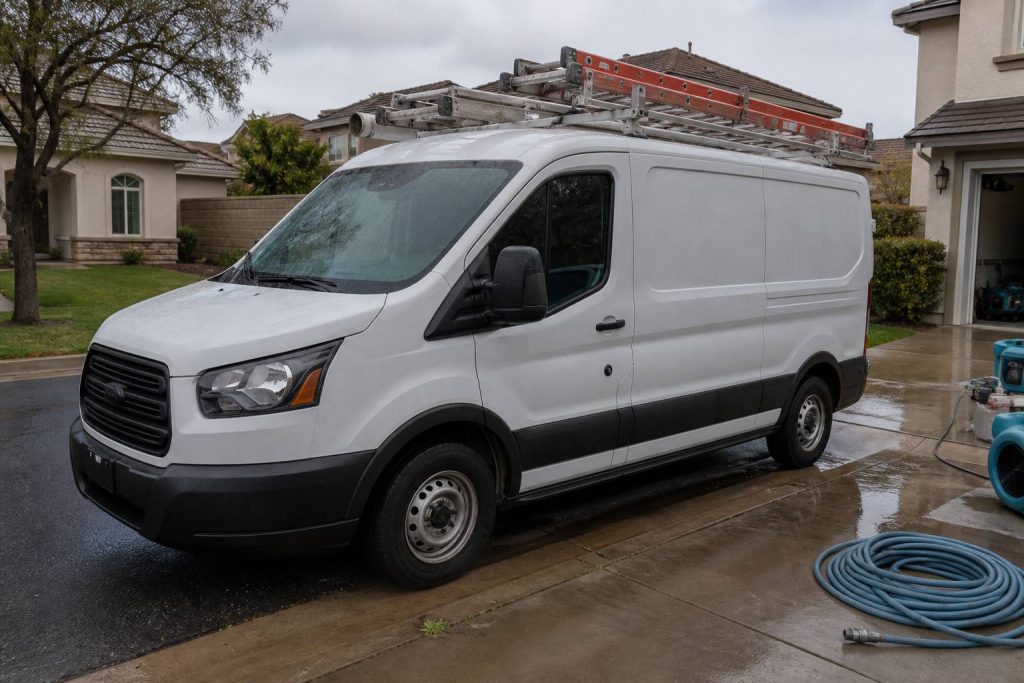
    White restoration work van with ladder rack parked at a suburban jobsite curb
    The plumber is already on the curb when the water loss starts.

    Before you sell into a plumber, understand where their profit actually comes from. A modern residential plumbing operation runs on a clear pricing and margin stack.

    Flat-rate pricing has become the industry standard for established plumbing companies. A modern shop prices most residential jobs — drain clearing, toilet installs, water heater swaps, fixture replacements, standard repairs — as fixed fees out of a price book rather than hourly. The benefits are obvious: the homeowner gets a predictable number, the tech closes faster at the kitchen table, and the margin is protected against jobs that drag on.

    Hourly billing still exists, mostly for diagnostics, commercial time-and-materials work, and jobs where the scope is genuinely uncertain (slab leaks, multi-fixture failures, old-pipe situations where every valve is a surprise). Most residential plumber hourly rates fall between $80 and $130 per hour, with some premium markets higher. Service-call fees — the trip-and-diagnostic charge a plumber collects just for arriving — typically run $50 to $250 depending on market and time of day.

    Gross margin targets are structural. A well-run plumbing company runs 60 to 62 percent gross margin on service and repair work, with net margins in the 10 to 20 percent range. Underperformers are at 2 to 8 percent net. The difference is almost entirely operational discipline — flat-rate pricing discipline, dispatch efficiency, call-booking rate, labor as a percentage of revenue.

    Labor is the dominant cost, typically 40 to 60 percent of operating expenses. Every minute a tech is not in front of a paying customer is a minute of unrecovered fixed cost. This matters to a restoration company because it tells you exactly what the plumber values most: technician time.

    The job mix separates the healthy from the struggling. Service and repair — single-tech, high-ticket, fast-turn — runs the 50 to 60-plus percent gross margin that carries the company. New construction and larger remodels run 20 to 30 percent and are often loss-leaders on labor utilization. The plumbing companies that are growing fast and buying competitors are running service-and-repair-heavy books with strong flat-rate pricing and disciplined dispatch.

    This is the business you are calling on. When you walk in, you are walking into an operation where every non-revenue minute is a tax on the P&L.

    How Plumbing Companies Acquire Customers

    Understanding the lead flow tells you where you sit in their world.

    Google Business Profile is the single most important acquisition channel for most residential plumbing companies — identical to the restoration playbook. A well-run GBP, paired with aggressive review velocity, produces the majority of a residential plumber’s organic lead flow at effectively zero marginal cost.

    Google Local Services Ads sit at the top of the paid stack. LSA leads for plumbers typically run $25 to $85 per lead at 40 to 65 percent conversion, for an effective $38 to $213 per booked job. Like restoration, LSA ranking is driven by review signals and response time. A plumber with a weak review foundation cannot win LSA.

    Shared marketplace leads — the Angi and HomeAdvisor category — run $15 to $50 per lead at 8 to 12 percent conversion, producing $125 to $625 effective cost per job. Most plumbing operators treat these as a fill-the-gap channel rather than a core source.

    Past-customer reactivation is the compounding layer. SMS reactivation of past customers costs less than a dollar per broadcast and typically produces 8 to 15 percent booking rates. Every plumber who has been in business five years is sitting on an underutilized database.

    Referral programs fund a meaningful slice of the book at $25 to $50 per acquired customer in incentives.

    Here is the industry’s consensus #1 tactical lever: speed to lead. Responding to a lead in under 60 seconds converts at roughly four times the rate of slower responses. This is why a plumber obsesses over dispatch tools like ServiceTitan, Housecall Pro, and FieldPulse, and why 24/7 answering services and AI receptionists have proliferated in the category. Every second matters.

    The implication for a restoration company courting that plumber: you are being evaluated against the same standard. If you cannot respond to a plumber’s referral in under 60 seconds, you are losing to the restoration shop that can. This is not a nice-to-have. It is the single largest predictor of whether a plumber will keep sending you leads after the first one.

    The Plumber’s Commercial Book

    Residential service drives most of the volume in a typical plumbing operation, but the commercial book is what makes the business valuable at exit. Property management companies, facilities vendors, retail operators, HOAs, and industrial property owners operate on vendor contracts and scheduled maintenance programs. They produce lower per-ticket margin than residential service calls but dramatically higher revenue predictability and customer lifetime value.

    The property manager who finds a reliable, documented, certificate-of-insurance-compliant plumbing vendor rarely switches. That retention is what turns a $2M plumbing company into a $10M plumbing company over a decade. It is also the piece most small plumbing operators protect most aggressively — because losing a commercial account is a severed artery, not a lost ticket.

    For a restoration company, this matters in two ways. First, a plumber who trusts you will open their commercial book to you when those properties have water losses — because the plumber’s reputation is now attached to yours, and they are not going to introduce you to their best customer unless you can execute perfectly. Second, your own commercial book is the most valuable thing you can offer a plumber in return. The restoration companies that build deep plumber partnerships typically have their own commercial relationships that refer plumbing work downstream — and a disciplined restorer puts those referrals through their plumber partners intentionally, tracks the flow, and makes sure the value is visible.

    Reciprocity in the commercial channel is the highest-leverage thing a restoration company can offer a plumber. Nothing else you do comes close.

    How a Plumber Thinks About a Water Loss

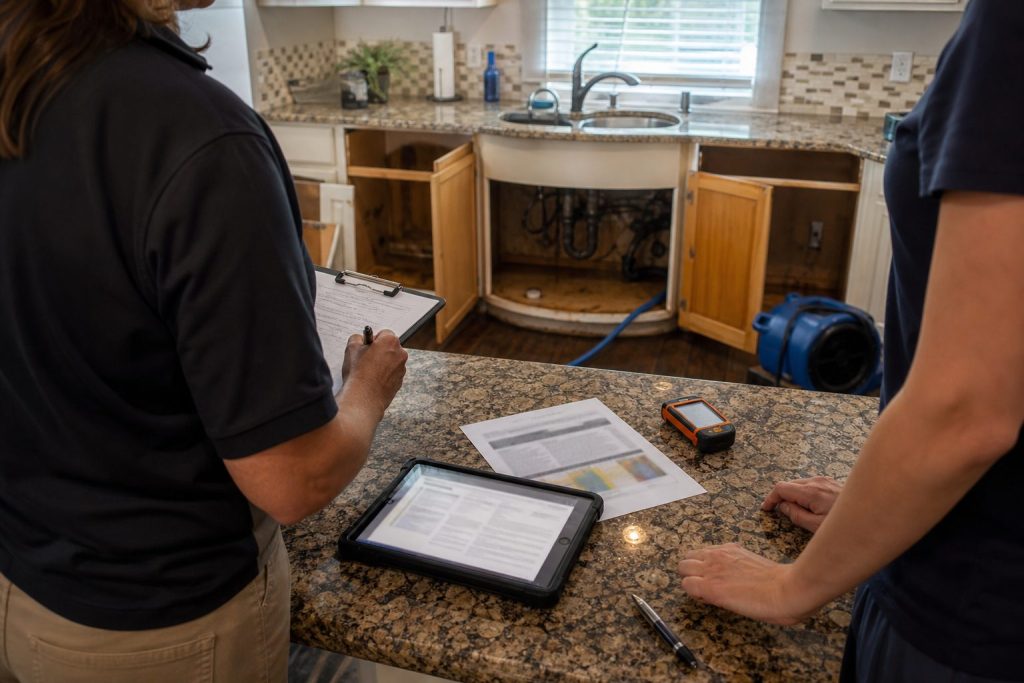
    Clipboard and tablet on a kitchen counter during an insurance adjuster walkthrough after water loss
    How a plumber thinks about a water loss — speed, liability, handoff.

    Now zoom into the moment that matters: the plumber is on site. Pipe has burst. Homeowner is standing in two inches of water. The plumber’s job, strictly, is to shut off the supply, diagnose the failure, repair or replace, and get out. Mitigation and drying are outside their scope and outside their certification.

    In that moment the plumber has three options.

    Option one: ignore it. Let the homeowner figure out the water damage themselves. Give them a generic “you’ll want to call a restoration company” and leave. This is what most plumbers actually do, because it is zero risk and zero effort.

    Option two: recommend whoever the homeowner has already tried to call, even if that restoration company is unfamiliar. Low risk, low value, no upside.

    Option three: make a trusted referral. Pull out their phone, call the restoration company they know personally, hand the phone to the homeowner. The restoration crew arrives before the plumber has finished their paperwork. The homeowner feels taken care of. The plumber looks like a full-service problem-solver rather than someone who created a problem and left.

    Option three is the one that matters. It is also the one that requires the restoration company to have earned the trust to be the plumber’s one call.

    Earning that call is what this article is about.

    Why Most Restoration-Plumber Relationships Fail

    The trade press is full of plumbers complaining about restoration companies. The complaints cluster into a predictable set.

    Promised referral fees never arrive. A restoration company makes a big show of the referral program, then the plumber sends a lead, and the check is either late, wrong, or missing entirely. Once burnt, the plumber stops sending leads and never tells the restorer why. The restorer blames their own marketing. The real cause is a broken promise the plumber made mental note of and walked away from.

    Slow response after the referral. The plumber hands off the homeowner, expects a truck on site within the hour, and the restoration crew shows up the next morning. The plumber looks bad. The plumber does not send a second lead.

    Overlap creep. The restoration company starts doing water heater replacements, pipe repairs, or other scope the plumber considers theirs. The plumber, correctly, stops referring to the company that is competing with them.

    Transactional over relational. The restorer drops by every month with business cards and a bag of swag, asks “any jobs this month?”, and never demonstrates any interest in the plumbing business itself. Plumbers read this the way everyone reads it — as a vendor trying to extract leads without offering anything in return.

    One-directional flow. The plumber sends water losses. The restoration company sends nothing back. A year in, the plumber calculates the relationship and realizes the restorer has taken dozens of high-ticket insurance jobs and returned effectively nothing. The relationship is dropped for a competitor who understands reciprocity.

    No co-branding of the homeowner experience. The restoration company shows up, does the work, and the homeowner ends up viewing the plumber as “the guy who recommended this crew” — a connector, not a savior. A sophisticated restorer makes a point of telling the homeowner, in the presence of the plumber, that the plumber caught the problem early and protected the home from far worse damage. That small discipline produces the story the plumber tells for the next six months.

    Inconsistency. The restoration company is great on the first three jobs, slips on the fourth, misses a callback on the fifth, and the plumber’s trust decays without the restorer ever knowing.

    Every one of these is fixable. Every one of these is the reason most restoration-plumber relationships never compound.

    What the Best Restoration Companies Actually Do

    A restoration operator with intention can build plumber partnerships that are durable, compounding, and unreachable by competitors. The playbook is specific.

    Respond faster than the plumber’s own dispatch. When a plumber calls to refer a loss, the target is truck rolling within 15 minutes and on site within 45. The plumber’s tech, still on site, calls their own office and the office quotes a 90-minute window for the next plumbing job — and the restoration crew has already arrived. That single data point, experienced twice, will make the restorer the plumber’s default for the next decade.

    Arrive in a way that makes the plumber look good to the homeowner. The lead restoration tech introduces themselves, acknowledges the plumber by name, explicitly credits the plumber for catching the problem early, and explains what happens next. This takes sixty seconds and produces outsized returns in the plumber’s willingness to call again.

    Never encroach on plumbing scope. The restoration company’s role is water mitigation, drying, demo, and rebuild scope outside the plumbing trade. Anything inside the plumbing trade — fixture replacements, pipe work, water heater installs, drain clearing — is not your business. Routinely declining to take that work when homeowners ask, and actively referring it back to the plumber partner, is a trust-building act that plumbers notice and remember.

    Co-brand the documentation. The mitigation paperwork the homeowner receives should reference the plumber who made the initial diagnosis and repair. The plumber’s contribution becomes part of the record. Insurance adjusters see the plumber’s name. Homeowners see the plumber’s name. The plumber becomes more valuable in the eyes of the people they rely on, and knows the restoration company is the reason.

    Send plumbing leads back. This is the most underused discipline in the restoration-plumber relationship. Every restoration company is sitting on customer flow — past customers, current mitigation jobs, commercial property managers — that periodically needs plumbing work. Route that flow to partner plumbers intentionally. Track it. Tell the plumber quarterly how many leads you sent them, how many converted, how much revenue they produced. If the answer is a six-figure number — and for any mid-sized restoration company it usually is — you have built the kind of partnership plumbers do not leave. Reciprocity in the commercial channel is the single highest-leverage lever a restoration company has.

    Name the point of contact. Every plumber partner should have one named person at the restoration company who owns the relationship, answers the phone at 2 a.m., and personally visits the plumbing shop quarterly. Rotating account managers and generic inboxes are death. A plumber referring a six-figure insurance job wants to know the person they are handing the phone to, and that person’s name and cell should be in the plumber’s contacts.

    Handle the insurance complexity so the plumber does not have to. Most plumbers do not want to deal with adjusters, xactimate, drying logs, or moisture mapping. The restoration company that takes on 100 percent of that burden, keeps the plumber informed at the milestones that matter, and asks the plumber zero insurance-adjacent questions, becomes invaluable.

    Feed the plumber’s content engine. A plumber who wants to grow is publishing photos, doing GBP posts, writing neighborhood testimonials. A restoration company that supplies the plumber with branded before/after photos from the job, permission to use them, and the homeowner testimonial the plumber can share is providing content the plumber cannot easily get elsewhere. This is a small gesture that compounds into meaningful organic reach for the plumber. They remember.

    Pay the referral fee on time, every time, without being asked. The check is in the plumber’s hand within 30 days of job completion and insurance payment, and the payment is accompanied by a short note about the job. If cash-flow discipline is a problem (see cash discipline in restoration), fix it before you promise referral fees at all. Unpaid referrals are the fastest way to destroy plumber trust.

    Never make the plumber feel transactional. The quarterly shop visit is about the plumber’s business, not your leads. Ask how their LSA is performing. Ask about their recent hires. Ask what is working and what is not. Be interested. Most plumbers rarely get a conversation with an industry peer who actually understands their operation. Becoming that person is worth more than any referral incentive.

    The Reciprocity Ledger

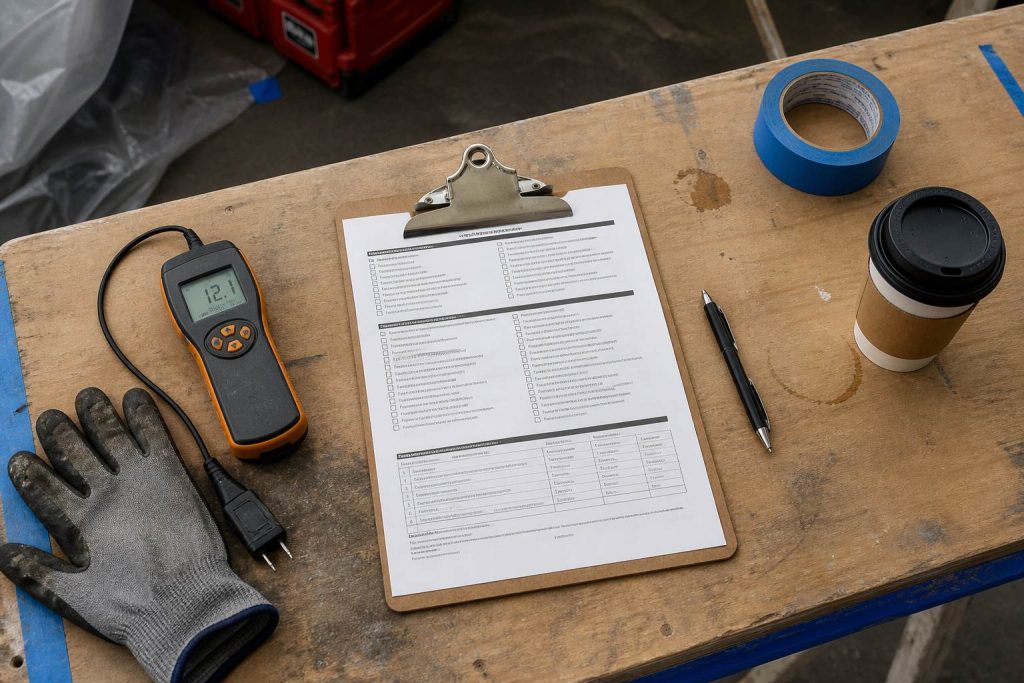
    Restoration SOP clipboard with checklist, moisture meter, and gloves on a jobsite table
    Reciprocity ledger — track every handoff both ways.

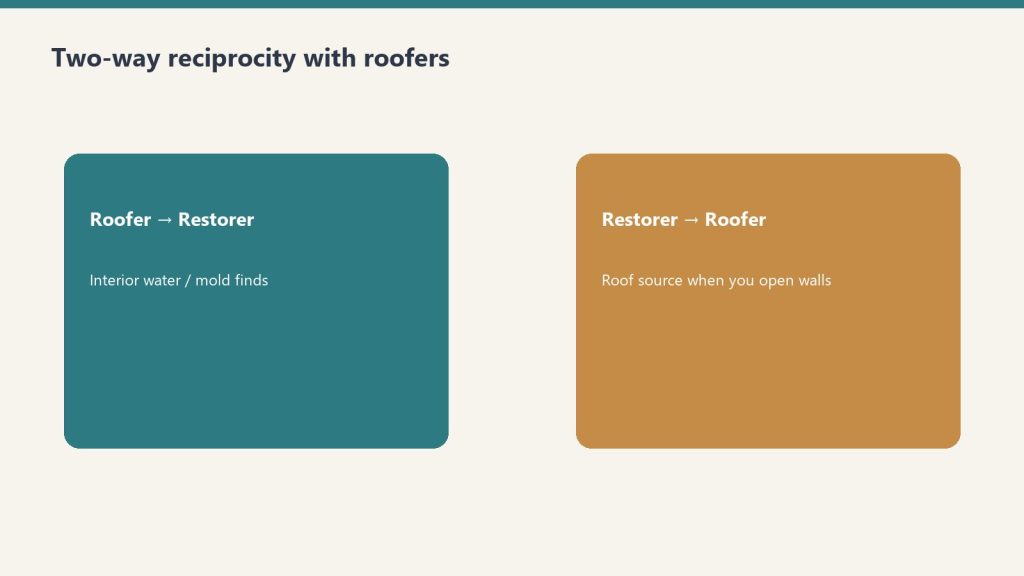
    The single most underused concept in restoration-plumber relationships is the reciprocity ledger. A shared, transparent record of leads flowing in both directions.

    One side: leads from plumber to restorer. Loss name, date, approximate job size, outcome.

    Other side: leads from restorer to plumber. Homeowner name, date, type of work, outcome.

    Run it quarterly. Share it with the plumber. Quantify the dollar value of the flow in each direction. Have a real conversation about whether the balance is fair and what to adjust.

    Most plumbers have never had a restoration partner bring this level of discipline to the relationship. It is the single clearest signal that the restorer thinks of the plumber as a business partner rather than a lead source. It is also the mechanism that surfaces problems before they cause defection. If the ledger shows six months of flow from plumber to restorer and nothing back, it is visible and fixable. Without the ledger, it is invisible and terminal.

    The Ninety-Day Plumber Program

    A restoration company with no systematic plumber program can build a strong one in 90 days.

    Week 1-2: Identify the 20 plumbing companies in the service area most likely to produce water damage referrals. Criteria: residential service and repair focus, 4.7+ star GBP, 100+ reviews, visible community presence, technician count of 5+. Rank them. Decide the top 5 to pursue first.

    Week 3-4: Research each of the 5 deeply. What does their website say about their services? What are their reviews telling you about how they talk to customers? Who is the owner or operations lead? What commercial properties have they done work on? This is the preparation that separates a professional approach from a cold-call one.

    Week 5-6: Make contact. Not a cold sales visit. An introductory conversation with the owner or ops lead, initiated with a specific, concrete offer: a standing commitment to respond to any referral within 15 minutes, a named point of contact, and a tracked referral program with transparent payouts. Treat the meeting as two small-business operators comparing notes, not a sales call.

    Week 7-8: Agree on the operating protocol. Who calls whom, what number, what happens in the handoff, how the paperwork flows. Put it in writing — not a contract, a shared one-pager. Confirm the referral fee amount, cadence, and mechanics.

    Week 9-12: Execute. Every referral gets a white-glove response. Every plumber interaction reinforces the partnership. Every job ends with co-branded documentation and the plumber visibly credited. Referral fees are paid before the 30-day mark, always.

    Day 90: Meet with each partner plumber. Review the ledger. Adjust as needed. Expand to the next tier of plumber partners.

    A restoration company that runs this program with discipline for a year has built an acquisition moat competitors cannot cross without spending five times the marketing budget to achieve a fraction of the flow.

    Where This Pairs With the Rest of the Stack

    The plumber partnership program sits alongside the observational B2B plan — plumbers are one of the highest-yield categories in that plan, but deserve their own dedicated playbook because of the volume and operational overlap. It sits alongside the owner-as-rainmaker practice — senior-level relationships with plumbing company owners are what ultimately unlock the commercial book. It feeds the review engine because plumber-referred homeowners are typically the most satisfied and most willing to review. And it runs on the measurement discipline — the reciprocity ledger is measurement in its purest form.

    Where to Start

    Pick one plumber this week. Not five. One. The best-reviewed, most operationally sharp residential plumbing company in your service area. Study them. Meet them. Propose a real partnership with a real operating protocol. Execute flawlessly on the first three jobs they send you. Use those three jobs as the reference when you expand to the next four plumbers.

    The compounding math is the same as every other asset Tygart Media has written about. One great plumber partnership, operated well for five years, produces more durable lead flow than ten inconsistent ones. The discipline is in going deep rather than wide, paying on time, never encroaching, and making reciprocity visible.

    The next article in this series covers HVAC — same structural playbook, different operational realities, a different set of entry points for a restoration company that has the discipline to learn the trade before selling into it.


    Frequently Asked Questions

    What is the single most important thing a restoration company can do to build plumber referrals? Respond faster than the plumber’s own dispatch. When a plumber calls to refer a water loss, a restoration crew on site within 45 minutes — while the plumber is still there — resets the entire relationship. It proves the restorer is worth the plumber attaching their reputation to. Speed to lead is the #1 lever in plumbing acquisition, and it is the single most important lever in earning plumber trust.

    How much should a restoration company pay a plumber per referred lead? Market norms range from $350 for a standard water or sewer damage job to $500 to $1,000 for insurance-covered jobs. The amount matters less than paying on time, paying every time, and never requiring the plumber to chase the money. A smaller consistent fee paid reliably beats a larger fee that arrives late or not at all.

    Can a restoration company do plumbing work itself to capture more of the job? Strongly discouraged if the goal is durable plumber referral flow. The moment a restoration company starts replacing water heaters, doing pipe work, or competing with plumbing scope, every plumber partner reads the signal correctly and pulls back. The restoration companies with the strongest plumber referral networks are explicit and disciplined about staying out of plumbing scope.

    What kills a restoration-plumber relationship faster than anything else? Two things tied for first. Slow or missed referral fee payments. And slow response time on a referred job. Both are experienced by the plumber as a breach of trust. Both cause silent defection to a competitor, often without the restorer ever being told why the flow stopped.

    How does the reciprocity ledger work in practice? A simple shared document showing leads flowing from plumber to restorer and restorer to plumber, with dates, rough job size, and outcome. Reviewed quarterly with the plumber. Quantified in revenue terms. It makes the balance of the relationship visible and is the mechanism that catches imbalance before it becomes a relationship-ending problem. Most restoration companies do not run one. The ones that do rarely lose plumber partners to competitors.

    Should a restoration company try to partner with every plumber in their service area? No. Depth beats breadth. Five deeply trusted plumber partners producing durable referral flow is dramatically more valuable than twenty transactional relationships. The ninety-day plumber program in this article is built around concentrated investment in a small number of high-quality partners rather than blanket coverage.

    How does this playbook change for commercial plumbing relationships versus residential? The core mechanics are the same — speed, reciprocity, never encroaching on plumbing scope, named point of contact. But the stakes are higher. Commercial plumbing relationships gate access to property management portfolios where a single water loss can generate six-figure mitigation revenue. The referral-fee mechanics often shift from per-job bounties to structured revenue sharing or preferred-vendor arrangements. The relationship discipline required is identical; the commercial ceiling is much higher.


    Tygart Media on restoration — an analyst-operator body of work on the systems that separate compounding restoration companies from busy ones. No client names. No brand placements. Just the operating standard.

  • Restoration Lead Generation: The Complete 2026 Guide

    Restoration Lead Generation: The Complete 2026 Guide

    Every restoration owner in America is looking for the same thing: more qualified water, fire, and mold leads at a cost that lets them stay profitable. The market is flooded with promises — buy these exclusive leads, run these ads, sign up for this network — and most of them don’t survive contact with reality.

    This is the complete operator’s guide to restoration lead generation: the honest economics of every channel, what cost per acquired job looks like in real markets, and the framework for building a lead engine that compounds instead of one that has to be re-fed every Monday morning.

    The five categories of restoration leads

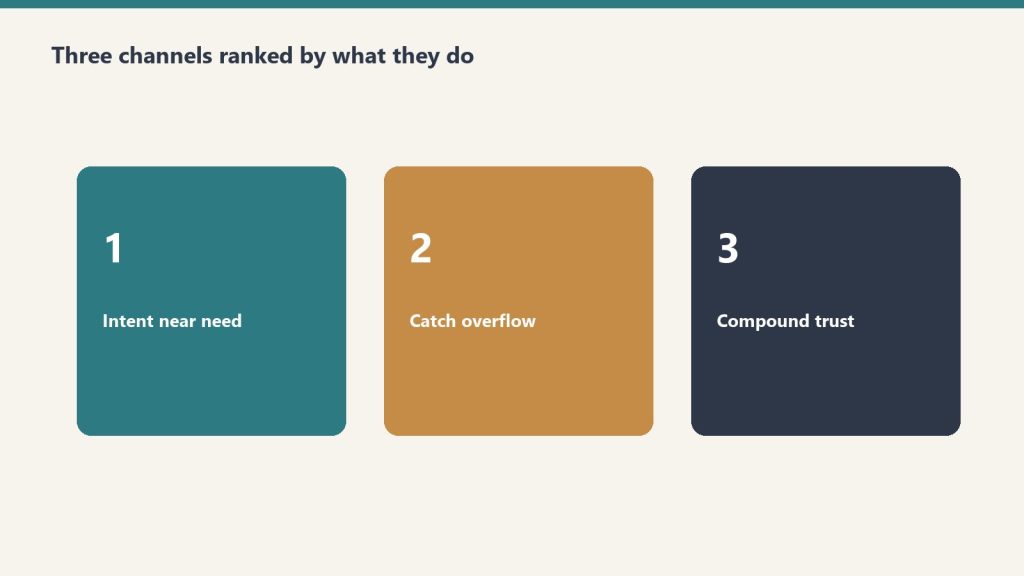
    Three ranked panels: intent near need, catch overflow, compound trust
    Five categories of restoration leads.

    Every restoration lead, no matter how it’s marketed, falls into one of five categories. Understanding which category a lead source belongs to is the first step to evaluating whether it deserves your money.

    The five categories are direct organic (someone Googles you and calls), paid search and LSAs (you pay Google for a click or a lead), third-party lead aggregators (Networx, HomeAdvisor, Thumbtack, restoration-specific platforms), preferred vendor programs and TPAs (insurance carriers and third-party administrators send you work), and referrals (plumbers, agents, adjusters, past customers). Each has a different economic profile, conversion rate, and durability.

    Organic and direct leads: the gold standard

    A direct call from someone who Googled your name or got referred by a neighbor is the most valuable lead in restoration. There’s no middleman cost, the trust signal is high, and the conversion rate from call to job typically runs 50-70%. The catch: building enough brand and SEO presence to generate this volume reliably takes years. Restoration companies that are 5+ years old in their market with strong reviews and SEO often see 30-50% of their leads come direct.

    Local Service Ads (LSAs)

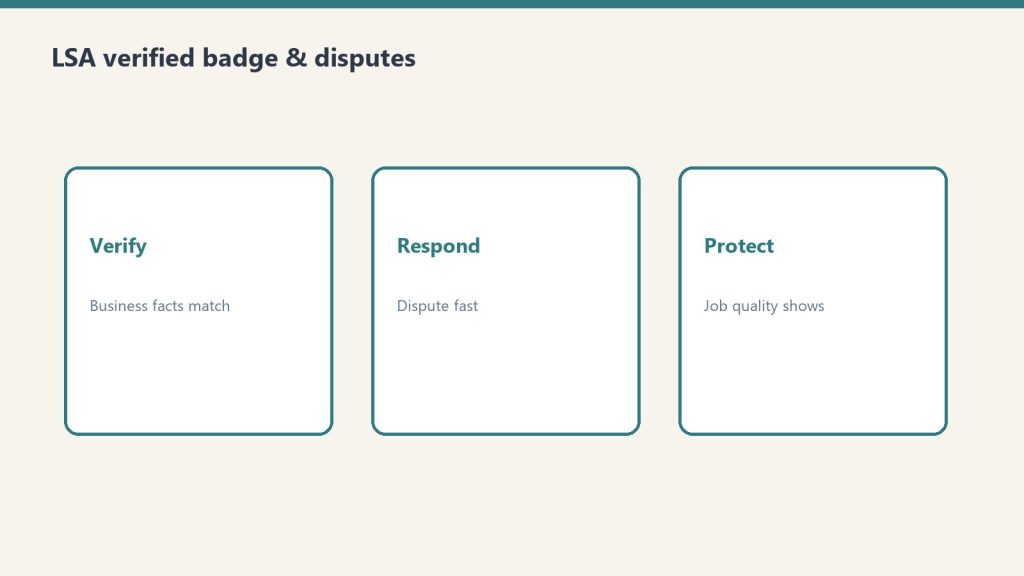
    Three cards: verify business facts, respond to disputes fast, protect with job quality
    Local Service Ads — overflow and intent.

    LSAs are Google’s pay-per-lead product that sits above the map pack on emergency searches. For restoration, this is typically the highest-ROI paid channel available. Cost per lead in most US markets ranges $35-$85, with conversion rates from lead to job running 40-60%. Acquiring a $5,000 water mitigation job for a $150-200 marketing cost is normal here. Setup requires Google Guarantee verification, ongoing review generation, and active dispute management for unqualified leads.

    Google Ads (paid search)

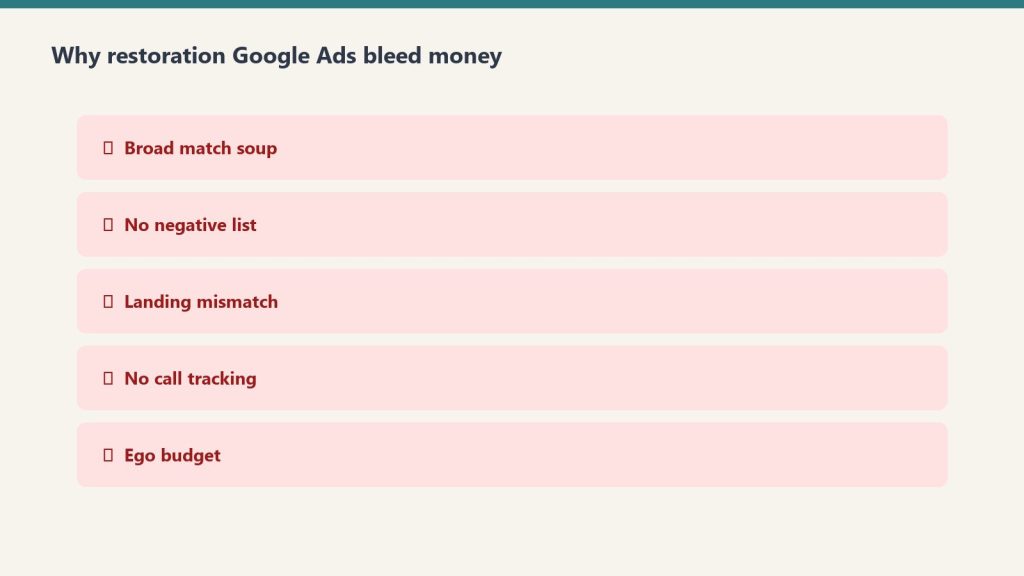
    Red checklist of five reasons restoration Google Ads waste budget
    Google Ads bleed money without structure.

    Standard PPC on terms like “water damage restoration [city],” “mold remediation near me,” and “fire damage cleanup” still works, but only with disciplined campaign management. Cost per click in competitive metros runs $20-$80 for top emergency terms. Without aggressive negative keywords, location targeting, and call-only or call-extension setups, Google will happily incinerate the budget on irrelevant traffic.

    Lead aggregators and lead-buying platforms

    HomeAdvisor, Networx, Angi, Thumbtack, and restoration-specific platforms (33 Mile Radius, Lead PPC, Restoration Marketing Pros lead programs, etc.) sell leads on a per-lead or per-month basis. The economics here vary wildly. Shared leads (sold to 3-5 contractors) typically run $35-$90 with conversion rates of 5-15%, making real cost per acquired job $300-$1,500. Exclusive leads (sold only to you) run $150-$500 with higher conversion rates. Most restoration operators who buy leads either love them or hate them — the dividing line is usually how disciplined the company is about speed-to-call (under 2 minutes is the bar) and qualification scripting.

    TPA and carrier preferred vendor programs

    Contractor Connection, Code Blue Restoration, Sedgwick CCMSI, Crawford & Company, Allstate, State Farm Premier Service, USAA, and the dozens of regional TPAs all run vendor networks that send work to qualified contractors. The economics are different — you’re not paying per lead, you’re paying in margin compression (typically 10-20% off retail Xactimate pricing), program audit overhead, and required SLAs (24-hour response, daily updates, photo documentation, etc.). A well-run TPA program can fill 30-60% of a residential mitigation truck’s calendar; a poorly managed one will burn margin and goodwill simultaneously.

    Plumber and trade referral programs

    The classic restoration lead source. Plumbers see water damage first — when they pull a P-trap and find a slow leak that’s been running for months, the homeowner needs a restorer. A formal plumber referral program (with co-branded marketing, fast-response promises, lead tracking, and quarterly thank-yous — gift cards, dinners, branded swag) routinely produces 100-300 leads per year per major plumbing partner. Three to five strong plumber partners can fill a substantial portion of a small operator’s calendar.

    Insurance agent and adjuster referrals

    Local independent insurance agents who write homeowners policies are referral gold. They want a contractor they can trust to handle their insureds’ losses well so policies don’t churn. Independent adjusters working catastrophe and daily claims also refer. Building these relationships takes time — agent breakfast meetings, monthly tips emails, claim co-presentation, and consistent customer satisfaction reports back to the agent.

    What “exclusive restoration leads” actually means

    “Exclusive” is the most abused word in the lead generation industry. Some platforms genuinely sell each lead to only one contractor; many “exclusive” programs are actually just shared leads with extra steps. Before paying for any exclusive lead program, get the answers in writing: how is exclusivity defined geographically (ZIP, city, county)? How is it defined temporally (exclusive for one hour, one day, forever)? What happens if the customer also fills out a form on a competing platform? How are disputes handled?

    The lead generation economics framework

    To compare any two lead sources fairly, you need four numbers per channel: cost per lead, lead-to-job conversion rate, average job revenue, and gross margin on jobs from that source. The math: cost per lead divided by conversion rate equals cost per acquired job. Cost per acquired job divided by average job revenue equals customer acquisition cost as percent of revenue. A healthy restoration program runs CAC in the 5-15% of revenue range for residential and 2-8% for commercial.

    The 30-day lead generation diagnostic

    If your phone isn’t ringing enough, here’s the 30-day diagnostic. Pull every lead from the last 90 days. Tag each by source. Calculate cost per acquired job by source. Identify the bottom two sources by ROI and cut them. Take that budget and split it: 50% goes to doubling down on your best performing channel, 50% goes to testing one new channel. Run for 90 days. Repeat the diagnostic. This is how high-performing restoration companies build channel discipline over time.

    Related on Tygart Media: Starlink on a water job · S500 in the van · local SEO for restoration.

    Frequently Asked Questions

    What is the best source of restoration leads?

    For emergency residential work, Local Service Ads typically deliver the best ROI in most US markets. For commercial work, structured business development to property managers and facilities directors outperforms any paid lead source. For sustained organic volume, Google Business Profile optimization and review velocity drive direct calls that compound over time.

    How much do restoration leads cost?

    Costs vary widely by source: Local Service Ads run $35-$85 per lead in most markets; Google Ads CPCs for emergency restoration terms range $20-$80; shared leads from aggregators cost $35-$90; exclusive leads from third-party platforms run $150-$500; preferred vendor programs charge no per-lead cost but compress margin 10-20%.

    Are restoration lead-buying platforms worth it?

    It depends on the platform and your operational discipline. Companies that answer leads in under two minutes, run a tight qualification script, and track ROI by source can profitably buy leads. Companies that let leads sit for hours or skip qualification will lose money on almost any lead-buying platform.

    How do I get more commercial restoration leads?

    Commercial leads come from relationships, not digital channels. The proven plays are direct outreach to property managers and facility directors, attending IFMA and BOMA chapter events, joining commercial insurance broker referral networks, and building case studies that prove you can handle large losses. Digital marketing supports these activities but rarely originates commercial leads on its own.

    What is a good lead-to-job conversion rate for restoration?

    Healthy benchmarks: residential emergency leads from LSAs and Google Ads should convert at 40-60%; shared leads from aggregators 5-15%; exclusive leads 30-50%; referral leads 60-80%; commercial RFP leads 15-30%. Companies under these benchmarks usually have a speed-to-call problem or a script problem, not a lead quality problem.

    How fast do I need to respond to restoration leads?

    Under two minutes is the modern bar for emergency restoration leads. Conversion rates drop sharply after five minutes and collapse after thirty. The best operators have a 24/7 trained answering service or in-house call center, not a voicemail and a callback system.

  • Restoration Pricing & Profit Margins: Operator’s Guide

    Restoration Pricing & Profit Margins: Operator’s Guide

    Restoration pricing is the most misunderstood part of running a restoration company. Owners argue about Xactimate rates, complain about insurance carriers, and chase competitor pricing — while quietly losing money on jobs they think are profitable. The problem isn’t usually the rates. It’s that most restoration companies don’t actually know what their work costs them.

    This guide walks through how restoration pricing actually works in 2026: Xactimate fundamentals, when to use time and material versus fixed bids, where margin leaks happen, what healthy profit margins look like, and the financial math that separates the operators who scale from the ones who stay stuck.

    The two pricing systems restoration uses

    Gloved hands using a pin-type moisture meter on wet drywall during inspection
    The two pricing systems restoration actually uses.

    Almost all restoration work is priced one of two ways. Xactimate pricing dominates insurance work — line items at published unit rates, with regional pricing that updates quarterly, plus overhead and profit added on top. Time and material (T&M) is used for non-insurance work, certain commercial losses, and emergency mitigation where scope is unknown — billed by labor hour and materials at marked-up cost.

    Most restoration companies use both depending on the job. Residential insurance mitigation and reconstruction is almost always Xactimate. Commercial losses with sophisticated buyers often allow T&M or hybrid pricing. Out-of-pocket residential work (mold remediation that isn’t covered, biohazard cleanup, certain reconstruction) is typically T&M or fixed-bid.

    How Xactimate pricing actually works

    Xactimate is a software platform owned by Verisk that contains a database of construction line items priced by region. Each line item has a labor component, a material component, and an equipment component. Pricing updates quarterly and is based on regional cost surveys. The pricing the carrier sees and the pricing you see should be identical — Xactimate is “single price database” for both sides.

    The actual price of a job is the sum of all line items, plus overhead and profit (O&P), typically 10% and 10% (for 21% combined when multiplied), added on top when the job involves three or more trades or specific complexity criteria carriers recognize. Whether O&P is approved is one of the most contested issues in restoration pricing — many carriers and TPAs push back hard, and operators need to know the documentation to defend it.

    Time and material pricing

    T&M pricing bills labor at an hourly rate and materials at a marked-up cost. Healthy restoration T&M rates in 2026 run $75-$110/hour for technicians, $95-$140/hour for lead technicians, and $135-$195/hour for project managers, depending on market and certification level. Material markup typically runs 25-50% over cost. Equipment rental (dehumidifiers, air movers, HEPA filtration) is billed by day at established rates.

    The advantage of T&M is no price disputes — you bill what it actually took. The disadvantage is the customer needs to trust your hours, and you need rigorous time tracking. Without disciplined timekeeping, T&M jobs become arguments about “what could it have possibly taken that long for?”

    The two big places margin gets lost

    Four ascending service-line bars for mitigation, rebuild, contents, specialty
    Where margin gets lost — without sticky dollar stickers.

    Restoration companies don’t lose margin on the rates — they lose it in two specific places. First, missed scope. The job estimate doesn’t capture all the affected materials. The carrier pays the original estimate. The actual work takes longer and uses more material than estimated. Loss.

    Second, weak supplements. When additional damage is discovered (almost always the case in restoration), supplements need to be written, documented, and submitted. Companies with weak estimating and slow supplement processes leave 5-15% of revenue on the table on every insurance job. Companies with disciplined supplement processes capture every dollar of legitimate scope.

    Healthy profit margin benchmarks

    Industry-healthy gross margins by service line: water mitigation 45-60%, reconstruction 25-40%, mold remediation 50-65%, fire and smoke restoration 35-50%, contents cleaning and pack-out 40-55%, commercial large loss highly variable but generally 20-35%. Net margin (after overhead) for a healthy restoration company runs 8-15% of revenue. Companies under 5% net are usually one bad month away from cash crisis. Companies above 18% are either very small, very specialized, or under-investing in growth.

    The job costing discipline most restorers skip

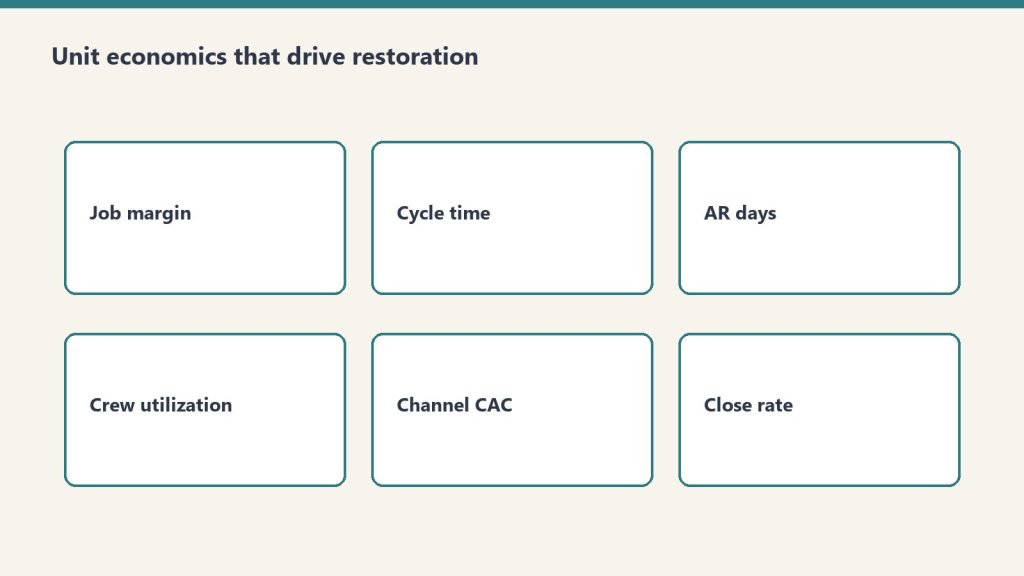
    Six cards covering job margin, cycle time, AR days, utilization, CAC, close rate
    Job costing discipline most restorers skip.

    You cannot manage profit margins you can’t measure. Real job costing means tracking, per job: estimated revenue, actual revenue (including supplements), labor hours and dollars actually spent, material costs actually incurred, equipment days and rental cost, subcontractor cost, and overhead allocation. The output is a per-job gross margin number. Pulling this report monthly and identifying jobs that lost money — and why — is how operators improve pricing over time.

    Most restoration companies skip this because the data is messy and the spreadsheets are painful. The companies that automate it (with restoration-specific software like Restoration Manager, Xactimate, Encircle, or DASH) have a structural advantage that compounds.

    How to handle the “your competitor charges less” objection

    This objection appears constantly. The honest answer: most price differences in restoration are scope differences, not rate differences. Xactimate rates are the same across all contractors in a region — your competitor isn’t using a cheaper Xactimate. They’re either writing less scope, missing items that you’d catch, or planning to supplement aggressively later. Walk the customer through the scope comparison line by line. Often the price gap closes or reverses.

    Pricing strategy by service line

    Water mitigation is almost always Xactimate. The leverage is in writing complete drying chamber configurations, accurate equipment days, and complete demolition scope. Reconstruction is Xactimate with discipline around overhead and profit, change orders, and supplements. Mold remediation can be Xactimate when insurance covers it, T&M or fixed bid when it doesn’t — pricing requires careful scope documentation due to liability. Fire and smoke is Xactimate, with significant supplement opportunity around contents, deodorization, and structural cleaning. Biohazard and trauma cleanup is typically T&M or fixed bid with hazard premiums.

    Related on Tygart Media: Starlink on a water job · S500 in the van · local SEO for restoration.

    Frequently Asked Questions

    How much does water damage restoration cost?

    The national average for residential water damage restoration in 2026 ranges from $1,500 for a small Category 1 (clean water) loss to $40,000+ for a large Category 3 (sewage) loss requiring extensive demolition and reconstruction. Most insurance-covered water mitigation jobs fall in the $3,000-$8,000 range. Pricing is calculated using Xactimate line items based on affected square footage, equipment days, demolition scope, and reconstruction needs.

    What profit margin should a restoration company make?

    Healthy gross margin benchmarks: water mitigation 45-60%, reconstruction 25-40%, mold remediation 50-65%, fire restoration 35-50%, commercial large loss 20-35%. Net margin (after overhead) for a profitable restoration company typically runs 8-15% of revenue. Companies below 5% net margin are at financial risk; companies above 18% are usually small, specialized, or under-investing in growth.

    What is overhead and profit in restoration?

    Overhead and profit (O&P) is typically a 10% + 10% addition on top of the line-item subtotal in Xactimate, applied when a job involves three or more trades or meets carrier complexity criteria. The 10% overhead covers indirect costs like supervision, office, and equipment depreciation; the 10% profit is the contractor’s profit margin. Whether O&P is approved is frequently disputed by carriers and TPAs, and proper documentation is required to defend it.

    Should restoration jobs be priced T&M or Xactimate?

    Insurance work is almost always Xactimate because that’s what carriers will adjust to. Out-of-pocket residential work, certain commercial losses, and unscoped emergency mitigation are often better priced as time and material. The dividing line is typically whether a third-party payer (insurance carrier or TPA) is involved.

    What is the labor rate for restoration technicians?

    Healthy 2026 T&M billing rates: technicians $75-$110/hour, lead technicians $95-$140/hour, project managers $135-$195/hour. These vary by region and certification level. Insurance work uses Xactimate’s regional labor rates rather than billed hourly rates, with the labor component embedded in each line item.

    How do restoration companies make more money on jobs?

    The two highest-leverage activities are complete initial scoping (capturing every affected material in the original estimate) and disciplined supplementing (writing and submitting supplements promptly when additional damage is discovered). Companies with rigorous estimating and supplement processes capture 5-15% more revenue per insurance job than companies that don’t.

  • Xactimate Strategy for Restoration Contractors: 2026 Guide

    Xactimate Strategy for Restoration Contractors: 2026 Guide

    Xactimate is the operating system of insurance restoration in North America. Every major insurance carrier, almost every TPA, and the majority of preferred vendor programs require it. If you can’t write a defensible Xactimate estimate, you can’t run a serious insurance restoration business.

    This guide is the operator-level Xactimate strategy for 2026: how the pricing actually works, the sketch discipline that produces approvable estimates, the supplement workflow that captures the 5-15% of revenue most companies leave on the table, and how to defend your scope when carriers push back.

    What Xactimate actually is

    Gloved hands using a pin-type moisture meter on wet drywall during inspection
    What Xactimate actually is in the claim workflow.

    Xactimate is a software platform owned by Verisk that combines a regional pricing database, a sketch-based scope builder, and an estimating workflow. The pricing database contains line items priced by metropolitan statistical area, updated quarterly based on labor and material cost surveys. Carriers, adjusters, contractors, and TPAs all use the same database, which means there’s no negotiation over rates — only over scope and applicability of line items.

    The product comes in three editions: Xactimate online (X1), the modern web-based version most contractors use today; Xactimate desktop (X28), the legacy desktop client still used in some workflows; and Xactimate mobile, for on-site sketching and photo capture. Most active restoration contractors today work primarily in X1 with mobile capture in the field.

    The Xactimate pricing logic

    Each Xactimate line item has three components: a labor component (the labor cost to perform the task), a material component (the material cost), and an equipment component (rental or use cost). Every line item is priced for a specific region using current local labor rates, material costs from supplier surveys, and equipment rental data. Because the carrier sees the same prices the contractor sees, the rates themselves aren’t disputed — disputes are about scope.

    On top of the line item subtotal, contractors add overhead and profit (typically 10% + 10%) when the job qualifies — historically defined as work involving three or more trades or meeting other complexity criteria. O&P is one of the most contested elements in restoration estimating. Carriers and TPAs frequently push back on it, especially on smaller jobs. Documenting the trade count, complexity, and supervisory burden is how restorers defend it.

    Sketch discipline: the foundation of approvable estimates

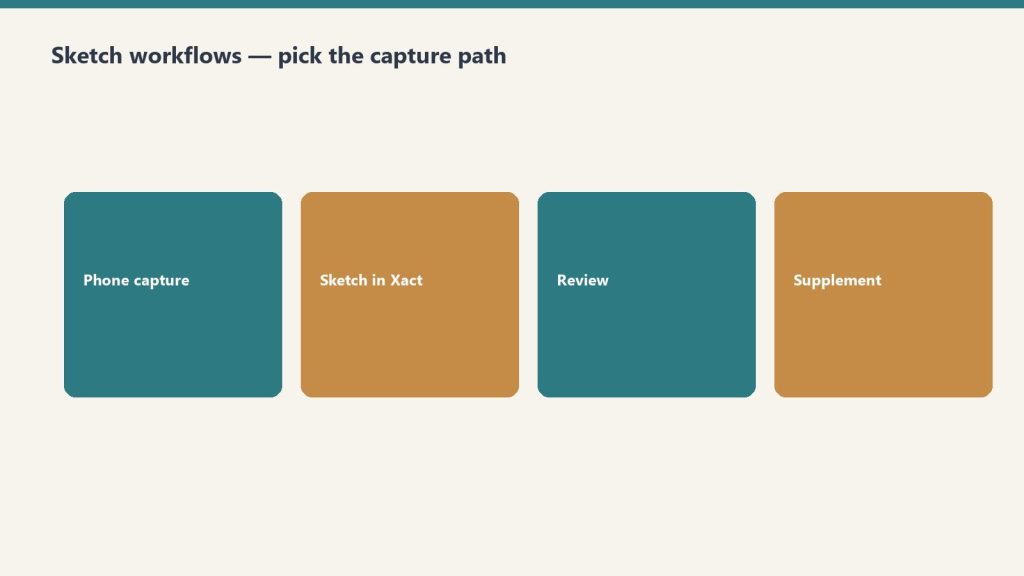
    Four steps: phone capture, sketch in Xactimate, review, supplement
    Sketch discipline — the foundation of approvable estimates.

    The single biggest predictor of estimate approval is sketch quality. A clean sketch with accurate room dimensions, properly labeled rooms, correct ceiling heights, openings (doors, windows, cased openings) drawn to scale, and labeled affected materials is approved with minimal questions. A messy sketch — wrong dimensions, missing rooms, unlabeled openings, no notes — generates rejection cycles and supplements.

    The sketch discipline that produces clean estimates: measure every room (laser measurer, then verify), draw to scale at the loss site (don’t sketch from memory back at the office), label every room with its purpose (kitchen, bathroom, master bedroom — not just “Room 1”), draw all openings with width and height, label affected materials room by room (drywall, flooring type, baseboards, ceiling), and capture matching photo documentation tied to each room.

    The estimating workflow that produces complete scope

    Most missed scope in restoration comes from a rushed initial estimate. The disciplined workflow: walk the entire affected area first (don’t start writing scope until you’ve seen everything), photograph every affected room from every corner, identify and document all hidden damage (pull baseboards, lift carpet corners, check behind cabinets, scope the floor structure), document moisture readings on a moisture map, write the scope room by room with photos referenced, then review the estimate against the photo set before submitting.

    This takes longer on the front end. It saves significant time and revenue on the back end because the supplement burden is dramatically lower.

    Supplements: the 5-15% revenue most companies leave on the table

    Clipboard and tablet on a kitchen counter during an insurance adjuster walkthrough after water loss
    Supplements — revenue most companies leave on the table.

    Supplements are revisions to the original estimate when additional damage is discovered, scope changes, or items were missed. In legitimate restoration work, supplements are normal — almost every job will have at least one. Companies with weak supplement processes leave 5-15% of revenue on the table on every insurance job. Companies with disciplined supplement workflows capture every dollar of legitimate scope.

    The supplement workflow that works: document the additional damage with photos and notes immediately upon discovery, write the supplement in Xactimate within 48 hours, submit through the proper channel (carrier portal, adjuster email, TPA system), follow up on approval status weekly, and track every supplement to closure. Supplement revenue should appear on the job costing report alongside original revenue so you can measure the discipline.

    Defending scope against pushback

    Adjusters and TPAs push back on scope routinely — sometimes legitimately, sometimes reflexively. The defense is documentation. For each contested line item: photo evidence of the affected material, moisture readings or other measurable damage indicators, IICRC standard reference (S500 for water, S520 for mold, S700 for fire, S800 for HVAC), and clear notes about why the scope is necessary. A line item with photos and a standard reference is hard to dismiss. A line item with no documentation is dismissed routinely.

    The Xactimate certifications that matter

    Xactimate offers user certification at three levels: Level 1 (basic functionality), Level 2 (advanced sketch and estimating), and Level 3 (advanced supplements, complex scope, dispute resolution). Level 1 should be a minimum requirement for any estimator at a restoration company. Level 2 is appropriate for senior estimators and project managers. Level 3 is the standard for owners, lead estimators, and anyone who handles disputed scope.

    Common Xactimate mistakes that cost real money

    The most common margin-killing mistakes: using regional default rates instead of pulling current quarterly pricing, missing equipment days on water mitigation jobs, failing to add proper drying chamber configuration, forgetting matching where required by IICRC standard, missing demolition scope on Cat 3 losses, not adding cleaning of unaffected areas where smoke or odor migrated, missing contents pack-out and cleaning, and submitting estimates without overhead and profit when they qualify.

    Related on Tygart Media: Starlink on a water job · S500 in the van · local SEO for restoration.

    Frequently Asked Questions

    How does Xactimate pricing work?

    Xactimate pricing is built from a regional database of line items, each containing labor, material, and equipment cost components. Pricing updates quarterly based on local cost surveys. Both contractors and carriers use the same pricing database, so disputes are about scope (which line items apply) rather than rates (what each line item costs).

    How much does Xactimate cost?

    Xactimate online (X1) subscription costs vary based on tier and seat count, with most restoration contractors paying $200-$500/month per seat. Xactimate mobile is typically included or available as an add-on. Pricing changed significantly with the move to X1 — contractors should request a current quote directly from Verisk.

    What is overhead and profit in Xactimate?

    Overhead and profit (O&P) is typically a 10% + 10% addition applied on top of the line-item subtotal when a job involves three or more trades or meets other complexity criteria. The 10% overhead covers indirect costs like supervision and office burden; the 10% profit is the contractor’s profit on the work. O&P is frequently disputed by carriers and requires documentation to defend.

    How do you write a Xactimate supplement?

    The disciplined supplement workflow: document additional damage with photos and notes upon discovery, write the supplement in Xactimate within 48 hours, submit through the proper channel (carrier portal, adjuster email, TPA system), follow up on approval status weekly, and track every supplement to closure. Companies with disciplined supplement processes capture 5-15% more revenue per insurance job.

    Do I need Xactimate certification to be a restoration contractor?

    You don’t need certification to use Xactimate, but most TPAs and many carriers require certified users on the account, and certification is increasingly the norm for any serious estimating role. Level 1 is a baseline; Level 2 or 3 is appropriate for owners, lead estimators, and dispute handlers.

    How do I dispute a Xactimate estimate?

    Disputes are won with documentation: photo evidence of the affected material, moisture readings or measurable damage indicators, IICRC standard references (S500, S520, S700, S800), and clear notes explaining why the scope is necessary. The most common adjustment requests succeed when supported by IICRC standards and visual evidence; unsupported requests are dismissed routinely.

  • IICRC Certification: 2026 Restoration Training Guide

    IICRC Certification: 2026 Restoration Training Guide

    Certification matters more in restoration than in most trades. Insurance carriers, TPAs, commercial buyers, and many state regulators look for IICRC credentials as the baseline trust signal. A restoration company with no certifications can do residential cash work; a company with a credentialed team can win commercial accounts, qualify for preferred vendor programs, and defend scope against challenge.

    This is the complete guide to IICRC certifications and restoration training in 2026: which certifications actually matter for which roles, the realistic path for a new technician, what each course costs and covers, and how to build an in-house training program that turns new hires into productive technicians in 90 days instead of nine months.

    How to get IICRC certified: the exact steps

    IICRC certification is the industry’s credential for individual technicians and firms — earned by completing an approved course and passing a standardized exam. There are no formal prerequisites for entry-level courses: you register, take the course, and sit the exam.

    1. Pick your certification. WRT (Water Damage Restoration Technician) first if you touch water losses — it’s the baseline everything else stacks on.
    2. Take an IICRC-approved course. Most run three days. Two exceptions: ASD (Applied Structural Drying) and AMRT (Applied Microbial Remediation Technician) must be taken in person — the IICRC hasn’t approved them for online delivery because of the hands-on elements. Everything else is available in person or live-stream.
    3. Register for the exam and pass it. The exam is multiple-choice and closed book; question count and time limit vary by course. The passing score is 75%. The IICRC exam fee is $80 ($150 for AMRT and inspection exams), paid before you sit. If you take a live-stream course, you complete the exam online through the IICRC exam portal within 45 days of the class ending; in-person students take it on the last day of class. Fail it and you get two more attempts (each costs another exam fee) — fail three times total and you have to retake the course before testing again.
    4. Get your credentials. After you pass, the IICRC takes 4–6 weeks to process and issue the certification, then mails your certificate, wallet card, and patch (allow another 7–10 business days for delivery).
    5. Stay current. Certification stays valid as long as you maintain it: an annual renewal fee to the IICRC plus 14 Continuing Education Credits (CECs) every four years for technicians. (Inspectors and master-designation holders need 14 CECs every two years.) Renewal fees run roughly $46–$70/year depending on how many certifications you hold — AMRT is $72/year, a master designation adds $12/year, and certified firms pay $199/year. The IICRC sets these fees and adjusts them, so confirm current numbers at iicrc.org before you budget.

    What the IICRC actually is

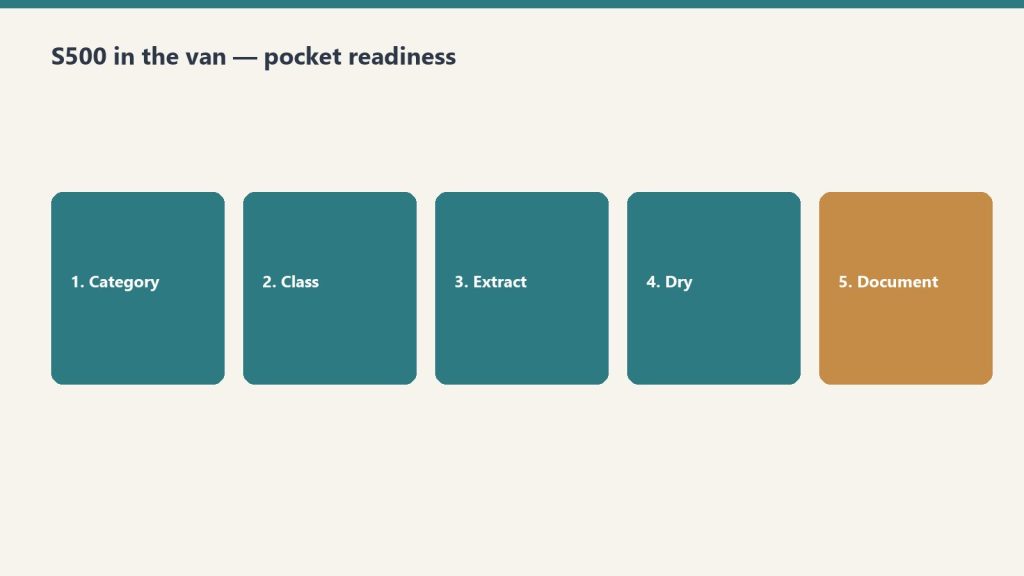
    Five-step van pocket flow: category, class, extract, dry, document
    What the IICRC actually is.

    The Institute of Inspection, Cleaning and Restoration Certification (IICRC) is the standards-setting and certification body for the cleaning, inspection, and restoration industry. Founded in 1972, it publishes the technical standards that govern the industry — most notably S500 (water damage), S520 (mold), S540 (trauma and crime scene), S700 (fire and smoke), and S800 (HVAC) — and certifies individuals and firms in specific competencies.

    IICRC certifies individual technicians through course completion and exam, and certifies firms through documentation of insurance, technician credentials, and adherence to standards. Firm certification is what most insurance carriers and commercial buyers actually look for on vendor applications.

    The IICRC certifications that matter for restoration

    The certifications that should be on every restoration company’s checklist:

    WRT (Water Damage Restoration Technician) — the foundational water mitigation certification. Three-day course covering water categories, drying science, equipment use, and the S500 standard. This is the absolute minimum for any technician handling water losses. Most companies require WRT within 60-90 days of hire.

    ASD (Applied Structural Drying) — the advanced drying certification. Builds on WRT with deeper coverage of psychrometry, drying chamber configuration, equipment sizing, and complex drying scenarios. Standard for lead technicians and project managers.

    AMRT (Applied Microbial Remediation Technician) — the mold remediation certification. Covers S520 standard, containment design, PPE, work practices, and post-remediation verification. Required for any contractor performing mold remediation work; often required by state regulators in mold-licensed states.

    FSRT (Fire and Smoke Restoration Technician) — fire and smoke damage certification. Covers smoke types, deodorization, contents cleaning, and structural restoration after fire losses. Important for any contractor handling fire work.

    OCT (Odor Control Technician) — focused certification on odor identification and removal techniques. Useful for technicians and project managers handling fire, sewage, biohazard, and HVAC remediation.

    HST (Health and Safety Technician) — covers OSHA compliance, PPE selection, hazard assessment, and crew safety practices. Recommended for project managers and crew leaders.

    UFT (Upholstery and Fabric Cleaning Technician) and CCT (Carpet Cleaning Technician) — for contents cleaning and carpet cleaning operations. Standard for contents departments.

    CCMT (Commercial Carpet Maintenance Technician) — relevant for commercial restoration operations with maintenance contract work.

    TCST (Trauma and Crime Scene Cleanup Technician) — for biohazard and trauma cleanup divisions. Required by some state regulators.

    WRT-Master, ASD-Master, AMRT-Master designations — the highest individual certifications, requiring multiple credentials, hours of field experience, and additional examination.

    The path from new hire to credentialed technician

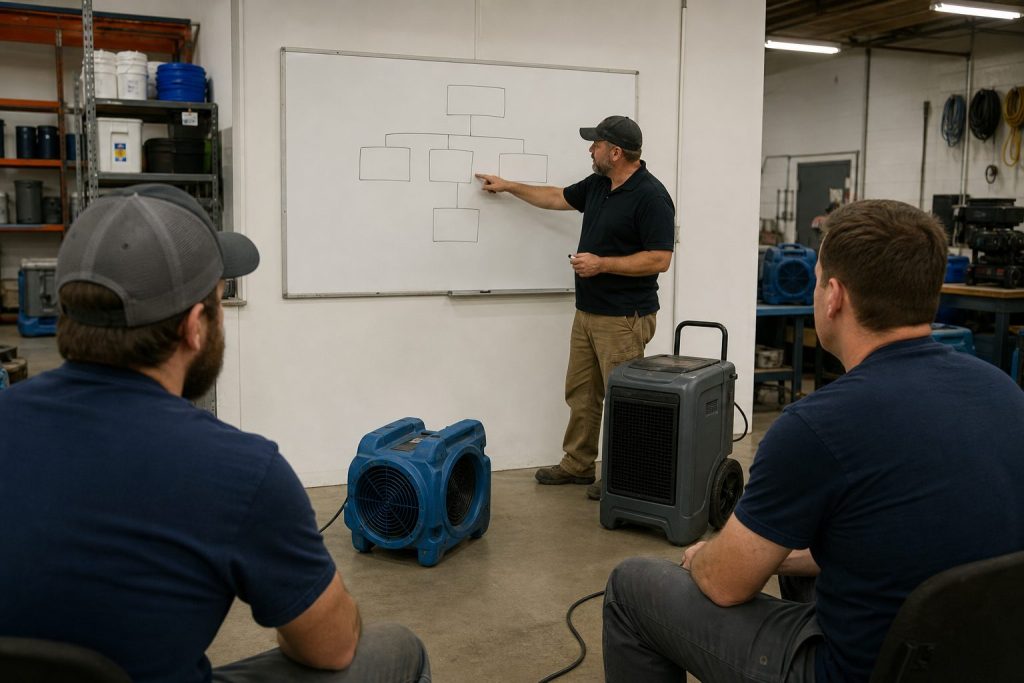
    Restoration technicians training in a shop bay with equipment demo and whiteboard
    Path from new hire to credentialed technician.

    A realistic 12-month path for a new restoration technician: Days 1-30 — shadow experienced technicians, complete OSHA 10 and basic safety orientation, learn equipment handling. Days 31-90 — complete IICRC WRT certification (three-day course plus exam), begin running mitigation jobs as second tech under supervision. Days 91-180 — complete ASD or FSRT depending on focus area, begin running smaller jobs as lead. Days 181-365 — complete AMRT (if mold work), additional specialty certifications based on role, eligibility for lead technician promotion.

    Companies that compress this timeline (six-month path to fully certified lead tech) usually do it by combining IICRC courses with rigorous in-house training, structured ride-alongs, and weekly skill assessments.

    In-house training programs: building beyond IICRC

    Restoration SOP clipboard with checklist, moisture meter, and gloves on a jobsite table
    In-house training beyond IICRC.

    IICRC certification is the baseline. The companies that consistently outperform have in-house training programs that fill the gaps. The components of a real in-house program:

    Onboarding curriculum — week one orientation covering company processes, equipment handling, safety, and customer interaction expectations. Weekly skills training — 30-60 minute sessions on specific topics: drying chamber setup, content pack-out procedures, moisture mapping, customer communication scripts. Quarterly cross-training — rotating technicians across service lines so the team has bench depth. Annual recertification — refresher training on IICRC standards updates, new equipment, and procedural changes. Mentor pairing — every new technician paired with an experienced lead for the first 90 days.

    Training cost: what to budget

    Realistic 2026 cost per new restoration technician: WRT certification $700-$1,000 (course + exam + travel), ASD $700-$1,000, AMRT $800-$1,200, FSRT $700-$1,000, plus 40-80 hours of paid in-house training time. Total first-year investment per technician: $3,000-$8,000 depending on path. Companies often recoup this within a few months through improved productivity and reduced supervision burden.

    Training providers worth knowing

    Restoration training providers fall into three categories. IICRC-approved training schools deliver the certification courses themselves — Restoration Sciences Academy, IICRC-approved regional providers, and online options through providers like KEY Restoration. Industry consultants and coaches deliver advanced training in estimating, sales, operations, and leadership — Violand Management, GrowthWerks, Performance Restoration, and several others. Manufacturer training from equipment vendors like Phoenix Restoration Equipment, Drieaz, and chemical suppliers covers product-specific operations.

    Related on Tygart Media: Starlink on a water job · S500 in the van · local SEO for restoration.

    Frequently Asked Questions

    What is IICRC certification?

    IICRC (Institute of Inspection, Cleaning and Restoration Certification) is the industry standards-setting and certification body. It publishes the technical standards (S500 for water, S520 for mold, S700 for fire) and certifies both individual technicians and restoration firms in specific competencies. Insurance carriers, TPAs, and commercial buyers commonly require IICRC credentials.

    How much does IICRC certification cost?

    Individual IICRC certification courses typically run $700-$1,200 each, including course materials, the exam, and exam administration. Travel and lodging (when courses are in-person) add to the total. Online and hybrid options are increasingly available at lower cost. Annual maintenance fees apply to keep credentials active.

    What IICRC certifications do restoration technicians need?

    The baseline for any water mitigation technician is WRT (Water Damage Restoration Technician). Lead technicians typically add ASD (Applied Structural Drying). Companies handling mold work require AMRT (Applied Microbial Remediation Technician). Fire restoration adds FSRT (Fire and Smoke Restoration Technician). Specialty roles add OCT, HST, TCST, and others as needed.

    How long does IICRC certification take?

    Most individual IICRC courses are three days of in-class instruction followed by a written exam. Some courses are available in compressed two-day or hybrid formats. From start to certified takes one to four weeks depending on exam scheduling. The full certification path (multiple credentials) for a senior technician usually spans 6-18 months.

    What is the difference between IICRC certification for individuals and firms?

    Individual IICRC certification is earned by a single technician completing a course and exam. Firm certification is earned by a company that documents insurance coverage, employs a minimum number of certified technicians, agrees to abide by the IICRC code of ethics, and participates in customer complaint resolution. Firm certification is what most carriers and commercial buyers look for on vendor applications.

    Where can I take IICRC courses?

    IICRC courses are delivered by approved training schools across the US and internationally. Major providers include Restoration Sciences Academy and various regional IICRC-approved schools. Many manufacturers and equipment vendors also offer IICRC-approved training. The IICRC website maintains an updated list of approved providers.

    What is the passing score for the IICRC exam?

    75%. IICRC exams are multiple-choice and closed book. If you don’t pass, you can retake the exam up to two more times (each attempt costs another exam fee) — after three failed attempts you must retake the course before testing again.

    How do I keep my IICRC certification active?

    Pay the annual IICRC renewal fee and earn 14 Continuing Education Credits (CECs) every four years (technicians) or every two years (inspectors and master-designation holders). CECs come from IICRC-approved courses, industry events, or earning an additional certification. If your certification lapsed less than 24 months ago, contact IICRC renewals to reinstate it; beyond 24 months goes through a separate reinstatement process.

    How can I verify someone’s IICRC certification?

    Ask for their certification number and check it against the IICRC’s public “Locate a Certified Professional” directory. For firms, ask for proof of current Certified Firm status — that’s the credential carriers and commercial buyers actually check on vendor applications.

  • Restoration Insurance Programs: TPA & Vendor Network Guide

    Restoration Insurance Programs: TPA & Vendor Network Guide

    The insurance ecosystem in restoration is its own universe with its own language: TPAs, carriers, preferred vendor programs, MSAs, scorecards, audits, performance guarantees, network certifications. Most restoration owners have a vague sense of what these programs are and a stronger opinion about whether to join them, often without knowing the actual economics.

    This is the complete operator’s guide to restoration insurance programs in 2026: what TPAs actually do, how carrier preferred vendor programs work, what MSAs require, the real margin economics, and the framework for deciding which programs deserve your application.

    The four players in the insurance restoration ecosystem

    Clipboard and tablet on a kitchen counter during an insurance adjuster walkthrough after water loss
    Four players in the insurance restoration ecosystem.

    Every insurance restoration job involves up to four parties. Understanding which is which is the first step to navigating the system.

    The carrier is the insurance company that issued the policy and pays the claim — State Farm, Allstate, USAA, Liberty Mutual, Travelers, Nationwide, Farmers, Progressive, Chubb, and dozens of regionals. Carriers either have in-house claims handling or contract claims management out to TPAs.

    The TPA (third-party administrator) is a company that manages claims on behalf of carriers — Sedgwick, Crawford & Company, Contractor Connection, Code Blue Restoration Services, CCMSI, ESIS, and others. TPAs handle adjuster assignments, vendor management, scope review, payment processing, and customer communication on behalf of the carrier.

    The vendor network is a managed roster of restoration contractors that the carrier or TPA assigns work to. Some networks are operated by TPAs (Contractor Connection is the largest); some are operated directly by carriers (Allstate Premier Service, USAA STARS).

    The independent adjuster is a contracted adjuster (not a carrier employee) hired to assess specific claims, often for catastrophe events or to supplement carrier capacity. Independents work for IA firms like Eberl, Pilot Catastrophe, and Crawford.

    What a TPA program actually requires

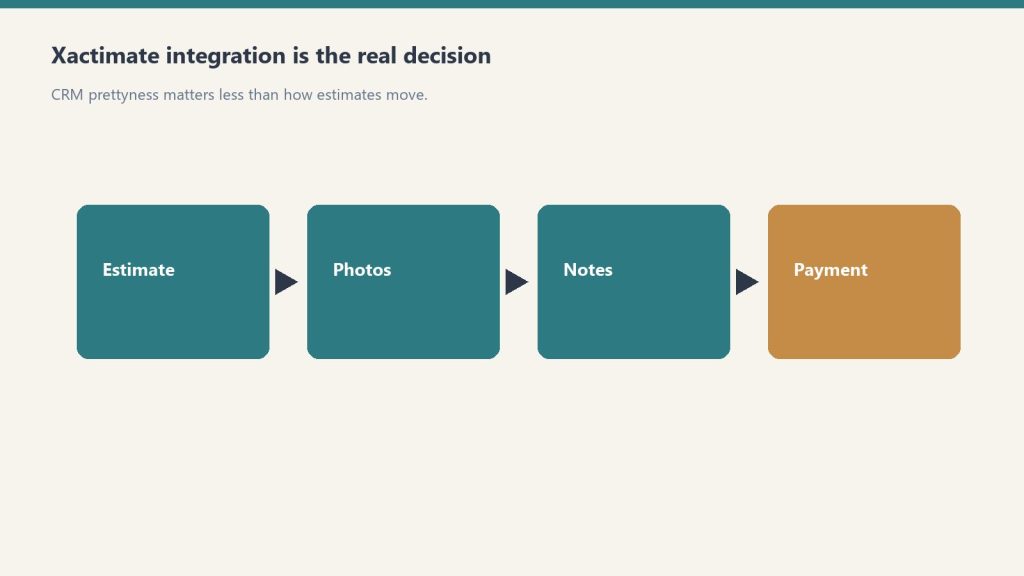
    Flow from estimate to photos to notes to payment emphasizing integration
    What a TPA program actually requires.

    Joining a major TPA vendor network typically requires: a multi-year track record in restoration (most require 3+ years), specific IICRC certifications (firm-level plus individual technicians for relevant service lines), insurance coverage at higher limits than standard (often $2M+ general liability, $1M+ pollution liability, $1M+ professional liability), background checks and drug testing for technicians, vehicle and uniform standards, technology compatibility (use of TPA-approved estimating and reporting platforms), 24/7 dispatch capability with documented response time SLAs, monthly reporting and KPI tracking, and a signed master service agreement that defines pricing, scope, performance standards, and termination conditions.

    The application process typically takes 60-180 days, includes facility audits, reference checks, and may require a probationary period of supervised job assignments before full network status.

    The pricing economics of TPA work

    The honest economics: TPA work pays less than direct retail work. Most TPA agreements include some form of pricing concession — typically 10-20% off published Xactimate pricing, restrictions on overhead and profit, capped supplements, or fee schedules that cap certain line items. The trade-off is volume and predictability: a vendor in good standing on a major TPA network may receive 30-100+ assignments per month depending on territory.

    The math that matters: net margin per TPA job, after pricing concessions, after the operational overhead of TPA-required reporting and SLAs, and after slower payment terms (45-90 days is common). Companies that profitably run TPA programs typically have lean overhead, disciplined estimating, and the operational scale to absorb the lower per-job margin with higher volume. Companies with high overhead burden often lose money on TPA jobs they think are profitable.

    Major TPAs and vendor programs to know

    Contractor Connection (subsidiary of Crawford & Company) is the largest restoration vendor network, managing claims for many major carriers including Allstate, Liberty Mutual, and others. Network membership is tightly managed with strict performance standards and capacity targets.

    Code Blue Restoration Services is a major restoration-specific TPA serving multiple carriers, with significant residential mitigation volume.

    Sedgwick is one of the largest TPAs overall, serving commercial and residential property claims for many major carriers. Sedgwick’s vendor network is more decentralized than Contractor Connection’s.

    Crawford & Company operates both adjusting services and Contractor Connection, with significant CAT (catastrophe) capacity.

    Allstate’s Premier Service Program is a direct-from-carrier preferred vendor program for water mitigation and reconstruction.

    USAA STARS is USAA’s preferred vendor program serving its policyholder base.

    State Farm Premier Service is State Farm’s similar program (formerly Service First).

    Numerous regional and specialized TPAs exist — Sedgwick CCMSI, Cunningham Lindsey (now Sedgwick), various large loss specialty firms, and carrier-specific direct programs.

    Master Service Agreements (MSAs)

    Restoration SOP clipboard with checklist, moisture meter, and gloves on a jobsite table
    Master Service Agreements — the real contract.

    An MSA is the contract that governs the relationship between the contractor and the TPA or carrier. Key MSA terms to scrutinize: pricing schedule (Xactimate concession amount, capped line items, fee schedules); territory definition (geographic scope, exclusivity provisions, right of first refusal); performance metrics (response time SLAs, completion timelines, scorecard targets); payment terms (net days, retention, hold-back provisions); insurance and indemnification requirements; termination provisions (notice periods, performance-based termination, transition obligations); customer ownership (whether you can market to customers post-job, whether the carrier owns the customer relationship); audit rights (TPA rights to review your job files, scope, photos, and pricing).

    MSAs are negotiable in some areas (especially territory and performance metrics) and rarely negotiable in others (pricing concessions, audit rights). Operators should have an attorney with restoration industry experience review any MSA before signing.

    The decision framework: which programs to join

    Whether to join a TPA program depends on four factors. Operational capacity: do you have the SLA capability, technology stack, and management bandwidth to meet program requirements? Market lead flow: is your direct lead generation strong enough that you can be selective, or do you need TPA volume to fill the calendar? Cost structure: is your overhead lean enough to make money at the program’s pricing concessions? Strategic mix: what percentage of revenue comes from TPA programs vs. direct? Most healthy operators target 30-50% TPA revenue mix — enough volume to leverage operations, not so much that the company is captive to a single TPA’s decisions.

    How to win at TPA performance scorecards

    Once on a TPA network, performance metrics determine assignment volume. The metrics that matter on most scorecards: response time (minutes from assignment to first contact, hours to first on-site), customer satisfaction scores (post-job surveys), cycle time (days from assignment to job completion), scope variance (how often supplements are needed and whether they’re approved), complaint rate (formal customer complaints per 100 jobs), quality scores (file documentation, photo quality, scope accuracy on TPA audits). Top-quartile performers on these metrics receive disproportionate assignment volume; bottom-quartile performers get reduced assignments and eventual termination.

    Related on Tygart Media: Starlink on a water job · S500 in the van · local SEO for restoration.

    Frequently Asked Questions

    What is a TPA in restoration?

    A TPA (third-party administrator) is a company that manages claims on behalf of insurance carriers. In restoration, TPAs handle adjuster assignment, vendor selection, scope review, payment processing, and customer communication. Major restoration TPAs include Sedgwick, Crawford & Company, Contractor Connection, Code Blue, and CCMSI.

    How do you get on a carrier preferred vendor program?

    The application process typically requires: 3+ years in business, specific IICRC firm and individual certifications, higher insurance limits than standard, background-checked technicians, 24/7 dispatch capability, monthly KPI reporting, and signing a master service agreement that defines pricing concessions and performance standards. Applications take 60-180 days and often include facility audits and reference checks.

    Are TPA programs profitable for restoration companies?

    It depends on cost structure. TPA work typically pays 10-20% less than direct retail work due to pricing concessions, capped overhead and profit, and other restrictions. Companies with lean overhead and high operational discipline can run profitable TPA programs at high volume. Companies with high overhead burden often lose money on TPA jobs while believing they’re profitable.

    What is an MSA in restoration?

    An MSA (Master Service Agreement) is the contract between a restoration contractor and a TPA, carrier, or commercial customer that governs the relationship — pricing schedules, territory, performance metrics, payment terms, insurance requirements, audit rights, and termination provisions. MSAs should be reviewed by an attorney with restoration industry experience before signing.

    What percentage of revenue should come from TPA work?

    Most healthy restoration operators target 30-50% of revenue from TPA and preferred vendor programs. Below that range, the company isn’t leveraging program volume; above that range, the company is operationally captive to a few TPAs and vulnerable to program changes, pricing reductions, or termination.

    How do restoration vendor scorecards work?

    TPA performance scorecards typically measure response time (minutes to first contact, hours to on-site), customer satisfaction scores, cycle time (days from assignment to completion), scope variance and supplement approval rates, complaint rates, and quality scores from TPA file audits. Top-quartile performers receive disproportionate assignment volume; bottom-quartile performers face reduced assignments and eventual network termination.

  • Water Damage Restoration Marketing: Proven Channel Guide

    Water Damage Restoration Marketing: Proven Channel Guide

    Water damage restoration is unlike almost any other home service. The buying decision happens in minutes, not weeks. The customer is panicked, often dealing with an active leak or flood, and they will hire whoever shows up first with credibility. Marketing for water damage restoration is therefore less about persuasion and more about presence — being visible at the exact moment a homeowner or property manager opens their phone and types “water damage near me.”

    This guide covers the full channel stack that profitable water damage restoration companies use to capture that demand and build a referral engine that keeps producing between emergencies. For the broader strategic context, see our complete restoration marketing guide, which sits above this article in the hub-and-spoke architecture.

    Why Water Damage Marketing Is Different

    Flooded residential living room with standing water on hardwood after a water loss
    Why water damage marketing is different.

    Three structural realities shape every marketing decision in this category. First, intent is overwhelmingly bottom-funnel. Almost no one searches “water damage restoration company” out of curiosity. They search because they have a problem. That collapses the funnel and rewards channels that intercept high-intent searches.

    Second, the competitive set is dominated by Google. Google Search, Google Maps, Local Service Ads, and Google Business Profile collectively account for the majority of net-new water damage leads in most metros. If a restoration company is not visible across all four, it is competing for table scraps.

    Third, insurance and TPA dynamics shape lead economics. A water damage job paid through a carrier preferred vendor program has a different margin profile than a cash retail job sourced from Google. Marketing has to be tuned to the mix the operator actually wants.

    The Five Channels That Drive Most Water Damage Leads

    Comparison of Claude how-to fit versus local service page fit for assistants
    The five channels that drive most water damage leads.

    1. Google Local Service Ads (LSAs)

    LSAs sit at the top of the search results page above traditional paid ads and the map pack. For water damage queries, LSAs produce leads at a cost per acquisition that is typically lower than Google Ads in most markets, though margins vary by metro. The Google Guaranteed badge is a meaningful conversion lever for cold homeowners. Setup requires background checks, license verification, and insurance documentation — friction that becomes a moat once cleared.

    2. Google Ads (Search)

    Traditional pay-per-click on emergency keywords (“water damage restoration,” “flooded basement,” “burst pipe cleanup”) remains the workhorse channel for most restoration companies. Campaign structure matters enormously here. Single-keyword ad groups, hyperlocal geo-targeting, call-only ads after hours, and aggressive negative keyword lists separate profitable accounts from money pits.

    3. Google Business Profile and the Map Pack

    Map pack visibility is essentially free traffic, but it is also the most competitive surface in local search. Ranking in the three-pack for “water damage restoration [city]” requires consistent NAP citations, a steady stream of authentic reviews with keyword-rich responses, regular GBP posts, geo-tagged photo uploads, and proximity to the searcher.

    4. Organic SEO and Content

    Organic search is a longer-term play but produces the cheapest leads at scale. Service pages targeting “[service] in [city]” combinations, neighborhood landing pages for high-value zip codes, and educational content answering insurance and restoration process questions all stack into a moat that competitors struggle to replicate.

    5. Insurance Adjuster and Plumber Referrals

    Marketing is not only digital. The most profitable restoration companies invest heavily in offline relationships with adjusters, plumbers, property managers, and real estate agents. A single plumber referral relationship can produce more revenue than a full year of paid search.

    Budget Allocation: Where to Put the First Marketing Dollar

    For a restoration company spending under $5,000 per month on marketing, the priority order is usually: GBP optimization first (it is free), then LSAs (lowest CAC for verified businesses), then a tightly scoped Google Ads campaign on emergency keywords, then organic content investment. Social media and display should generally come last in the water damage category because intent is too immediate for those channels to convert efficiently.

    For companies spending $10,000-$50,000 per month, the channel mix expands to include programmatic display for retargeting, YouTube for brand awareness in target zip codes, and a content marketing operation that produces 4-8 SEO-targeted pieces per month.

    Tracking and Attribution

    Four-stage funnel: citation, click, engage, convert
    Tracking and attribution.

    Water damage marketing fails when leads cannot be tracked back to source. Every campaign should use call tracking numbers (CallRail, CallTrackingMetrics, or WhatConverts), every form should fire a conversion event, and every job should be tagged in the CRM with its origin channel. Without this, marketing decisions are guesses.

    Related on Tygart Media: content marketing strategy · Google Ads guide · SEO for restoration companies.

    Frequently Asked Questions

    How much should a water damage restoration company spend on marketing?

    Most healthy restoration companies invest between 5% and 12% of revenue on marketing, with a higher share during the first three years while organic and referral channels are still being built. Companies relying primarily on paid acquisition often run closer to the higher end of that range.

    Are Google Local Service Ads worth it for water damage?

    For most water damage restoration companies in mid-sized and major metros, yes. LSAs typically produce a lower cost per lead than traditional Google Ads and the Google Guaranteed badge improves close rates on cold inbound calls. The qualifying process is the main barrier.

    What marketing channels work best for commercial water damage?

    Commercial water damage leans more on relationships, MSAs with property management firms, LinkedIn outreach, and association involvement than on paid search. Paid search still matters but a larger share of commercial pipeline comes from offline business development.

    How long does SEO take for a restoration company?

    Local SEO results — map pack visibility, branded search, and a handful of city service pages — typically begin to compound in 90-180 days. Building a competitive organic presence on the most valuable water damage keywords in a major metro often takes 12-24 months of consistent content and link building.

    Should a restoration company hire an agency or build marketing in-house?

    Companies under roughly $3M in revenue usually get more value from a specialized restoration marketing agency than from an in-house hire, because the talent pool of operators who understand both restoration and digital marketing is thin. Above $5M, an internal marketing leader paired with specialist agencies is often the best mix.

  • Residential Restoration Lead Generation: Proven Channels

    Residential Restoration Lead Generation: Proven Channels

    Residential restoration lead generation runs on a different operating system than commercial. The buying decision is fast, the buyer is emotional, the decision criteria are weighted heavily toward speed and trust, and the lead source mix is dominated by Google in nearly every metro. Companies that get residential right build predictable, high-volume pipelines; companies that try to use commercial tactics on residential prospects consistently underperform.

    This article is part of our restoration lead generation master guide, which sits above this piece in the cluster architecture.

    The Residential Restoration Buyer

    Seven cards naming common AI chatbot failure modes
    The residential restoration buyer.

    The typical residential restoration buyer is a homeowner facing an active loss — a burst pipe, a roof leak after a storm, smoke after a kitchen fire, mold discovered during a remodel. They are usually researching for the first time, anxious, and operating under time pressure. They will call 1-3 companies, often the first ones to appear, and pick the company that responds fastest with the most credibility.

    The lead-gen implication is that visibility at the moment of search and credibility on first contact matter more than almost anything else.

    The Six Channels That Drive Residential Restoration Leads

    Comparison of Claude how-to fit versus local service page fit for assistants
    The six channels that drive residential restoration leads.

    1. Google Search (Organic + Paid)

    Google Search dominates residential restoration lead generation in most metros. Organic rankings on “[service] [city]” queries, Google Ads on emergency intent terms, and a strong Google Business Profile collectively account for the majority of inbound residential lead volume for most well-marketed companies.

    2. Google Local Service Ads

    LSAs sit above traditional paid search and produce leads on a per-lead basis with the Google Guaranteed badge. For verified restoration companies, LSAs are typically the lowest cost per qualified lead channel in residential.

    3. Lead-Buying Platforms

    HomeAdvisor, Angi, Networx, and restoration-specific lead vendors fill capacity gaps but require operational discipline. They work best as a supplemental channel rather than a primary one.

    4. Plumber and Adjuster Referrals

    Offline referrals from plumbers, adjusters, real estate agents, and past customers produce the highest-margin and highest-converting residential leads in most operations. The investment cycle is long but the ROI is durable.

    5. Social Media (Paid)

    Paid Facebook and Instagram ads targeting homeowners by zip code with educational creative around water damage prevention and storm preparation produce both top-of-funnel awareness and direct lead form fills in most markets.

    6. Direct Mail and Local Print

    Often dismissed but still effective in some markets, particularly post-storm targeting in affected zip codes and ongoing presence in neighborhood publications and HOA newsletters.

    Channel Sequencing for a New Restoration Company

    For a residential restoration company starting from zero, the channel build order that consistently works: complete GBP optimization first (free, foundational), apply for and complete LSA verification next (lowest cost per lead once approved), launch tightly scoped Google Ads on emergency keywords, build out service and city pages for organic SEO, layer in paid social as budget allows, then test lead vendors with small pilots.

    Budget Allocation by Revenue Stage

    Companies under $500K in revenue should concentrate marketing budget heavily into LSAs and one tightly run Google Ads campaign. Diversification too early dilutes effort. Companies between $500K and $2M can add organic content investment and lead vendors. Companies above $2M can run the full channel mix simultaneously.

    Speed-to-Lead and Conversion Operations

    Three panels showing one problem, three options, one recommendation
    Speed-to-lead and conversion operations.

    The lead generation channel mix only matters if the operations behind it convert leads. Residential restoration close rates are heavily influenced by speed of first contact, after-hours coverage, dispatch quality, and the in-home estimate experience. Companies that buy leads but cannot answer the phone within 60 seconds during business hours should fix operations before scaling lead spend.

    Related on Tygart Media: water damage marketing · lead nurture · residential sales scripts.

    Frequently Asked Questions

    What is the highest-ROI lead source for residential restoration?

    For verified restoration companies, Google Local Service Ads typically produce the lowest cost per qualified lead. Plumber and adjuster referrals produce the highest-margin leads but take longer to build. Most healthy residential operations run both alongside organic search and paid search.

    How much should a residential restoration company spend on marketing?

    Most healthy residential restoration companies invest 6-12% of revenue on marketing, with newer companies often spending toward the higher end of that range while organic and referral channels are still maturing.

    Are direct mail and local print still effective for restoration?

    Direct mail and hyperlocal print can produce results in specific scenarios — post-storm zip code targeting, neighborhood publications in affluent areas, HOA newsletters in target communities. Broad-based direct mail without targeting precision usually underperforms digital channels.

    Should I focus on water damage, fire damage, or mold for residential lead generation?

    Most residential restoration revenue comes from water damage in nearly every market, with fire and mold producing supplemental volume. Lead generation budget should generally be weighted toward water damage in proportion to its share of total revenue, with smaller dedicated budgets for fire and mold to maintain pipeline.

    How do I know when to add a new lead-gen channel?

    Add a new channel when existing channels have hit their cost-per-lead efficiency ceiling — meaning increased spending on the channel produces diminishing returns. Adding channels too early dilutes attention; adding too late caps growth. Quarterly channel performance reviews usually surface the right timing.

  • Residential Restoration Sales Scripts That Close Jobs

    Residential Restoration Sales Scripts That Close Jobs

    Residential restoration sales is won or lost in the first 60 seconds of the inbound call and the first 15 minutes of the in-home estimate. Companies that script these moments tightly close at meaningfully higher rates than companies that wing it. This article walks through the call flow, in-home conversation, and closing language that consistently performs in residential restoration sales operations.

    This is part of our restoration sales playbook, which covers the full sales motion.

    The Inbound Phone Call

    Side-by-side comparing a pitch dump with value-first contact habits
    The inbound phone call.

    The inbound call is the highest-leverage 3-5 minutes in residential restoration. The script needs to accomplish four things quickly: establish empathy and credibility, qualify the situation, create urgency and book the appointment, and prevent the prospect from continuing to call competitors.

    The opening should never be “Hi, can I help you?” — it should be a confident, warm greeting that immediately signals competence: “[Company], this is [Name], how can I help you with your water damage today?”

    The qualification questions are simple but specific: What is the source of the water? When did it start? How much area is affected? Is the water still active? Is anyone home? What city are you in? These questions both qualify the lead and demonstrate competence to the homeowner.

    The booking close: “We can have a project manager on-site in [time]. Can I confirm the address?” — and then the critical ask: “Just so I can let our PM know, are you also calling other companies, or did you decide to go with us?” This last question, asked warmly and without pressure, reduces shopping behavior dramatically.

    The In-Home Arrival

    The first 60 seconds on-site set the tone for the entire conversation. The sequence that works: introduce yourself, ask permission to enter, ask the homeowner to walk you through what happened in their own words (don’t immediately start inspecting), then transition into a guided inspection together. Skipping the homeowner’s narrative is a common mistake — they need to feel heard before they will trust the recommendation.

    The Inspection Walk-Through

    Gloved hands using a pin-type moisture meter on wet drywall during inspection
    The inspection walk-through.

    Educational narration during the inspection separates restoration sales pros from amateurs. Rather than silently using a moisture meter, the rep should narrate what the readings mean, what category of water it appears to be, what equipment will be needed, and what the timeline looks like. This builds confidence and pre-frames the price.

    Presenting the Scope and Price

    The scope presentation should happen at the kitchen table, not standing up. The rep should walk through the scope line by line, explain why each item is necessary, address insurance process clearly, and then present the total — without flinching and without immediately offering a discount. The number is the number.

    Common price language that works: “Based on what we found, the scope to dry your home down properly comes to [amount]. Most of this will be covered by your insurance policy, and we’ll work directly with your adjuster on the supplements. The out-of-pocket exposure for you depends on your deductible. Does that match what you were expecting?”

    Handling the “Let Me Think About It”

    The most common objection in residential restoration is the soft delay: “Let me think about it” or “I need to talk to my spouse.” The script that works addresses the underlying concern without applying pressure: “Of course. The one thing I’d mention is that the longer we wait to start drying, the more secondary damage typically occurs. We can have equipment in place today and you can still cancel within 24 hours if you change your mind. What works better for you?”

    The Authorization Close

    Three panels showing one problem, three options, one recommendation
    The authorization close.

    The work authorization signature is the actual close. The handoff language: “Let me get this paperwork started — it just authorizes us to begin the mitigation and lets us bill your insurance directly.” Smooth, confident, and assumes the close. Hesitant closing language (“So… do you want to do this?”) signals uncertainty and triggers second-guessing.

    Related on Tygart Media: residential lead gen · sales playbook · CRM pipeline.

    Frequently Asked Questions

    Should restoration salespeople use a written script verbatim?

    The framework should be scripted; the delivery should be conversational. Reading a script word-for-word feels robotic and erodes trust. Memorizing the structure and language patterns and delivering them naturally is the goal.

    How do I train new restoration salespeople on these scripts?

    Role-play is the fastest training method. Pair new reps with senior staff for ride-alongs, then run weekly role-play sessions where new reps practice handling the toughest objections. Recording actual customer calls (with consent) and reviewing them as a team also accelerates learning.

    What is a reasonable close rate on residential restoration estimates?

    Well-trained residential restoration salespeople running emergency mitigation typically close 60-80% of first-on-scene appointments. Reconstruction-only estimates close at much lower rates, often 25-40%, because of the longer decision cycle.

    Should I quote prices over the phone?

    Generally no for restoration. Phone pricing without seeing the damage triggers price shopping and locks the rep into a number that may not match the actual scope. The phone goal is to book the on-site appointment, not to quote.

    How do I handle a homeowner who is getting multiple bids?

    Address the underlying concern (they want to make sure they’re not being overcharged) by walking through your scope line-by-line, explaining what each item does, and offering to review competitor scopes side-by-side. Confidence in your scope and price usually wins more often than discounting.

  • IICRC S500 2026 Revision: Guide for Restoration Contractors

    IICRC S500 2026 Revision: Guide for Restoration Contractors

    The 2026 revision of ANSI/IICRC S500 — the Standard for Professional Water Damage Restoration — is the most consequential update the standard has seen in nearly a decade. For restoration contractors, the practical impact lands in three places: documentation, scope-of-work language, and the science behind how losses are categorized and classed.

    This guide focuses on what changes for the working restoration company, not the academic background. If you are billing insurance, defending scope in litigation, or training technicians to a current standard, here is what the 2026 update actually requires of you.

    Why Standards Revisions Matter to Restoration Contractors

    Restoration SOP clipboard with checklist, moisture meter, and gloves on a jobsite table
    Why standards revisions matter to restoration contractors.

    S500 is the reference document insurance carriers, TPAs, and litigation experts cite when evaluating whether a restoration job met the standard of care. When the standard moves, your documentation, your contracts, and your technician training all need to move with it. Continuing to operate against the prior version creates avoidable exposure on every loss you handle.

    The 2026 revision was driven by a combination of new science around microbial contamination, accumulated industry experience with category 3 losses, and the documentation burden that has emerged from rising restoration litigation. Each driver shows up in the changes.

    Documentation Is Now the Center of the Standard

    Gloved hands using a pin-type moisture meter on wet drywall during inspection
    Documentation is now the center of the standard.

    The single largest practical change is that documentation expectations have been promoted from supporting language to a central requirement. The 2026 revision tightens the description of what must be recorded at each phase of a water mitigation project.

    For a restoration contractor, this means a moisture map, atmospheric readings, and material moisture content readings are no longer optional supporting evidence. They are the evidence that the work met the standard. Operators who have been documenting on the technician’s phone with no centralized capture process need to formalize that workflow before their next loss.

    Practical implication: if your shop is still relying on handwritten logs or on technicians remembering to upload photos at the end of the day, the 2026 revision has effectively closed that gap. A documented chain from FNOL through final reading, with timestamps and consistent measurement methodology, is now the standard.

    Category and Class Definitions Have Been Sharpened

    Category and Class definitions in the prior S500 had room for interpretation that frequently surfaced in scope disputes. The 2026 revision narrows that room. Specifically, the language around when a Category 2 loss escalates to Category 3, and the criteria for Class 4 losses involving low-permeance materials, has been written more tightly.

    For contractors, the practical consequence is that the determination is now harder to wave away if challenged. A clearly documented Category 3 determination — with the specific contamination indicator that drove the call — protects the scope. A loosely documented determination is now easier to challenge in a coverage dispute.

    Scope-of-Work Language Has to Match the Standard

    If your work authorization, scope sheet, and final invoice use category and class language inconsistent with how the 2026 revision defines those terms, expect more pushback from carriers and TPAs. Many restoration shops are revising their template documents — work authorizations, scope sheets, certificates of completion — to align with the updated terminology.

    This is a low-cost, high-value update to make once. A document review by your shop manager or a qualified consultant ahead of your next loss will save hours of dispute resolution downstream.

    Microbial Considerations and the Mold Boundary

    Mold remediation containment zipper door with plastic sheeting and negative-air hose in a hallway
    Microbial considerations and the mold boundary.

    S500 has historically pointed to ANSI/IICRC S520 for mold remediation guidance, but the 2026 revision sharpens the boundary between the two standards. Specifically, the 2026 update clarifies the conditions under which a water mitigation project becomes a microbial remediation project, with corresponding implications for containment, PPE, and documentation.

    The takeaway for contractors is that the gray area between “drying” and “remediation” has narrowed. A job that crosses the threshold needs to be re-scoped under S520, not extended under S500. Operators who run both work types should review their internal escalation triggers against the new language.

    Drying Goals and Verification

    The 2026 revision retains the drying-goal framework but tightens the verification language. Specifically, the standard now expects that the drying goal be documented at the project outset, that the verification methodology be specified, and that the final reading be tied back to the goal that was set.

    For a working contractor, this means the moisture map and the dry-standard reference need to live in the same document trail, not in separate files that no one reconciles. Loss reviewers will increasingly look for that reconciliation as a marker of standard-of-care compliance.

    Training Implications

    Every WRT and ASD technician on your team is being trained to the prior version of the standard until your training materials are updated. IICRC course content typically lags a standard revision by several months, which means there will be a window in which technicians hold a credential issued under the prior standard but are working to a job that needs to meet the new one.

    Mature shops are addressing this with a short internal training cycle: a one-page summary of the changes, a documentation template update, and a refresher on category and class language. The cost is low. The cost of skipping it is a documentation gap that surfaces during the next disputed claim.

    What to Do This Quarter

    If you are a restoration contractor reading this and have not yet acted on the 2026 revision, the prioritized list is short: review your work authorization and scope-sheet templates, formalize your documentation workflow if it is not already centralized, run a 30-minute internal training for production staff on category and class language, and review your S500-to-S520 escalation triggers. None of these are large projects. All of them reduce exposure on the next loss.

    Related on Tygart Media: Starlink on a water job · S500 in the van · local SEO for restoration.

    Frequently Asked Questions

    When did the IICRC S500 2026 revision take effect?

    The 2026 ANSI/IICRC S500 revision is the current published version of the standard. Restoration contractors are expected to operate against the most current published version of the standard as their reference for standard of care.

    Does the 2026 S500 revision change how I bill water mitigation jobs?

    The standard does not directly govern billing, but it governs the documentation and scope language that supports billing. Expect carriers and TPAs to align their review criteria with the updated terminology, which means scope sheets and final invoices need to use the current language.

    What is the most important documentation change in the 2026 revision?

    The promotion of documentation from supporting language to a central requirement. Moisture maps, atmospheric readings, and material moisture content readings must now form a continuous, timestamped record of the project from FNOL through completion.

    Do I need to retrain my technicians on the 2026 S500 revision?

    A formal IICRC retake is not required for technicians already holding WRT or ASD credentials. However, a short internal training on documentation workflow, updated category/class language, and the S500-to-S520 boundary is a recommended practice for any shop operating to current standard of care.

    Where does the S500 2026 revision draw the line between drying and microbial remediation?

    The 2026 revision sharpens the boundary by clarifying the conditions — including time elapsed, contamination indicators, and material affected — that move a project from S500 water mitigation into S520 microbial remediation. Shops that handle both types of work should review their internal escalation triggers against the updated language.

    For more industry standards coverage and operator-focused analysis, see Industry Signals on Tygart Media.